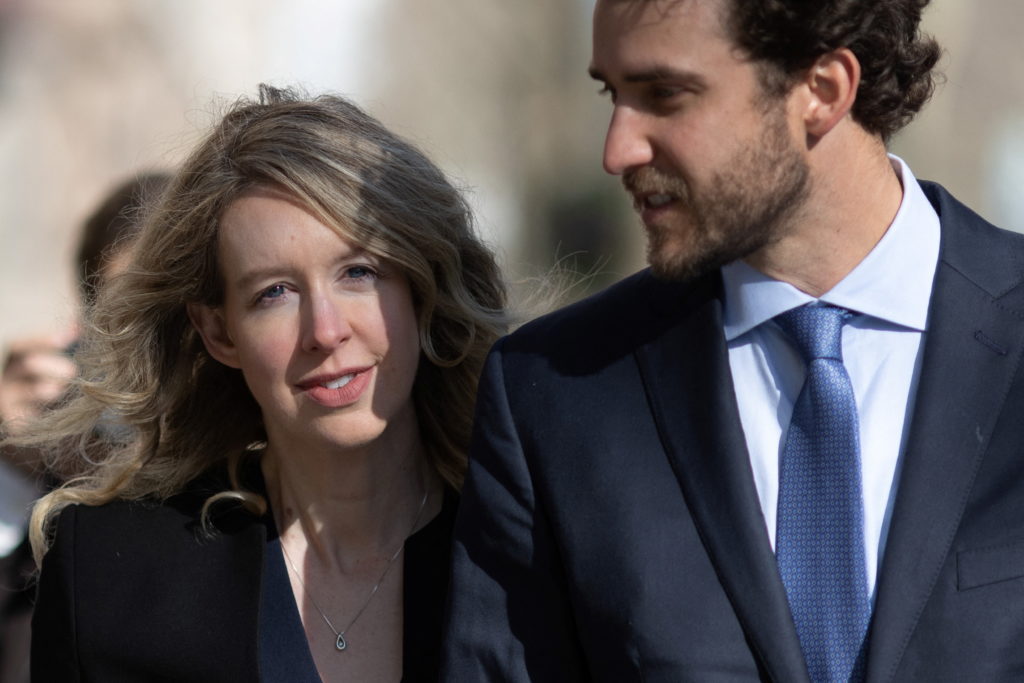
Meghan McCain, former Sen. John McCain’s (R-Ariz.) daughter, predicts that convicted Theranos founder Elizabeth Holmes will get a pardon from President Trump. “One of my hottest, hot takes is that Elizabeth Holmes will eventually get a Trump pardon,” McCain wrote on the social platform X. She shared her thoughts in another post, asking comedian and…
Meghan McCain, former Sen. John McCain’s (R-Ariz.) daughter, predicts that convicted Theranos founder Elizabeth Holmes will get a pardon from President Trump. “One of my hottest, hot takes is that Elizabeth Holmes will eventually get a Trump pardon,” McCain wrote on the social platform X. She shared her thoughts in another post, asking comedian and…
Billy Evans and Elizabeth Holmes in "You Can See Everything."
A24
A24's new documentary "You Can See Everything" follows Elizabeth Holmes and her partner Billy Evans.
The movie features an early scene of full-frontal nudity while Evans is showering.
Director Lance Oppenheim said the scene was Evans' idea and "he didn't care about being seen naked."
In "You Can See Everything," one person apparently took the movie's title to a physical extreme.
A24's twisty new documentary is ostensibly focused on Theranos founder Elizabeth Holmes, one of Silicon Valley's most infamous felons — yet it's her longtime partner, William "Billy" Evans, who frequently steals the show.
Evans' comfort in front of the camera is evident when the couple invites co-directors Nathan Fielder and Lance Oppenheim to capture intimate moments in their home life, just a few weeks before Holmes is scheduled to begin an 11-year prison sentence.
In fact, according to Oppenheim, Evans proactively suggested one of the movie's buzziest and most revealing moments: a full-frontal shot of Evans in the shower.
"We were in the car ride on the way back from the gym, and I said to Billy, 'We will give you some time to shower,'" the filmmaker said in a recent interview with GQ. "And Billy responded, 'Want to film me showering?' I offered to film him in a way that could avoid seeing his genitals, but Billy said he didn't care about being seen naked."
Oppenheim speculated that Evans was inspired to give the audience "full access," though he admitted that he was personally baffled by the choice.
"There's a camera in the bathroom, there's a camera that was on Nathan, there's a camera outside the bathroom, and there's an interaction that we see after Billy leaves where he sort of looks at the camera and smiles," Oppenheim said. "So I don't know what that means, but I feel like there's enough stuff in there that gives me the impression that maybe he was excited that people could see everything and that there was full access, I guess. But it really beats me, honestly."
Billy Evans in "You Can See Everything."
A24
Oppenheim said that, to his knowledge, neither Holmes nor Evans has seen the movie. Evans has not commented publicly on his portrayal, and he did not respond to a request for comment from Business Insider.
"We haven't talked with Billy in a bit now," Oppenheim told GQ. "You sort of see it in the film. Billy can be intense, and there were a lot of conversations he had about the future of the film and the release of the film that made us uncomfortable. So contact broke down for a bit."
Holmes reports to prison about halfway through "You Can See Everything," though Fielder and Oppenheim continue to film Evans as he adjusts to life as a single dad and aspiring entrepreneur; at one point, Evans tells Fielder that he's planning to build another company off the back of Theranos and "do it all again."
In 2025, The New York Times and NPR reported that Evans had raised millions for a new blood-testing startup called Haemanthus.
Evans also boasts that he's in charge of running Holmes' social media while she's incarcerated, telling Fielder that he has power of attorney. "I can literally do whatever," he says.
Dozens gathered for the Elizabeth Holmes and Nathan Fielder lookalike contest.
Getty Images
Dozens gathered in New York for a Nathan Fielder and Elizabeth Holmes look-alike contest.
A small crowd cheered on the sea of black blazers, blonde buns, and tiny headphones.
One of the event's winners said she got around 100 Instagram messages urging her to compete.
Washington Square Park on Sunday afternoon looked like a cross between a vigil, a corporate mixer, and a low-budget film set.
It was, in reality, an Elizabeth Holmes and Nathan Fielder lookalike contest, as fandom about the documentary "You Can See Everything" spilled onto the streets. A small crowd cheered on the gaggle of blazer-donning blondes and graying fans wearing tiny headphones. Holmes wannabes milled around, their heavily lined eyes wide and fingers forming the "okay" hand gesture associated with the Theranos founder.
Spotted in Washington Square Park https://t.co/fmyNswZWm1
Age was no object: One of the Holmeses appeared to be under 10 in a video on X, though she'd already mastered thefounders' characteristic stare.
Maddy West, a New York-based comedian and Fielder fan, organized the event with a friend. The organizers had about a week to set up the event, from the registration to securing the guest judge, Kor Skeete, who starred in an episode of Fielder's series "The Rehearsal." West said more than 200 people responded to a registration form on the event's Partiful invitation.
The prize ultimately went to Joe Sivick and Nicole Travolta, the post on X said. Travolta, an actress and comedian, said she's been doing impressions of Holmes since 2022, and already owned the costume and wig. She said she got around 100 Instagram messages from fans urging her to participate in the contest and mainly went because she thought it would be funny.
"In the world that we're living in, everything is so heavy, and I think if you are choosing to go to something like this, you're doing it to be silly and fun," she said.
Travolta thinks her spoken impression is probably what secured her the win, since everyone looked eerily similar to Holmes. Her eyes were somewhat bloodshot on Monday morning, after keeping them wide open in the sun for hours.
The winners of the Elizabeth Holmes and Nathan Fielder look-alike contest celebrate in Washington Square Park. https://t.co/IzhuTp8Z22
WATCH: Nathan Fielder and Elizabeth Holmes Lookalike Contest Takes Over Washington Square Park
Fans in turtlenecks and blonde wigs packed Washington Square Park in NYC on Sunday for a Nathan Fielder and Elizabeth Holmes lookalike contest decided right in front of the crowd. Winners Joe Sivick and Nicole Travolta and organizers Maddy West and Katherine Gehring talk about the day.
Video: Ken Lopez | Licensing @FreedomNTV Desk@freedomnews.tv
Neither Sivick nor Travolta wanted the $50 cash prize, West said, opting instead to just keep a purse made by a local business.
Both West and Travolta said Sivick's impression was so convincing, they momentarily thought he was Fielder himself.
"When he showed up to the event, I saw him from a distance, and he was wearing sunglasses. At first glance, I was like, 'Oh my gosh, did Nathan Fielder actually show?" West said.
JUST IN: New Yorkers gather in Washington Square Park for an Elizabeth Holmes lookalike contest. https://t.co/ZeUIM8OvxO
Sunday's contestants aren't the only ones investing in the documentary duo's wardrobe. TikTokers have posted about dressing up as Holmes and Fielder — or Holmes and her "drop of blood," in at least one case — for Halloween.
Fielder's documentary has made waves in the tech and film worlds since it debuted earlier this month. The A24 movie tracks the time the comedian spent with Holmes weeks before she reported to prison for defrauding investors, among other charges. Business Insider's Callie Ahlgrim described it as "part character study, part psychological thriller, part surrealist thought experiment."
"I came out of the movie feeling like I had gone through some sort of vortex, black hole, mind-bending experience," Travolta said, having seen it a week before the contest.
"You Can See Everything" grossed $15 million in its opening weekend after opening in 855 theaters, doubling producers' expectations.
The movie is part of a string of recent releases about wealthy, hubristic tech founders — there's Mark Zuckerberg in "The Social Reckoning," Elon Musk in "Musk," Sam Altman in "Artificial," and Sam Bankman-Fried in "The Altruists." The on-screen Silicon Valley backlash has coincided with real-life discontent about the AI buildout, which is becoming a more potent issue for tech leaders and politicians alike.
This story has been updated with comments from event organizer Maddy West and winner Nicole Travolta.
Bloomberg/Getty; Jeremy Strong/Sony Pictures; Finn Gomez/Getty; Tyler Le/BI
Writing villains is supposed to be hard. No grand, world-dominating plan ever really makes sense in a story. Soon after "The Dark Knight" came out, David Goyer, its writer, told me the Joker had been a real relief. "Blessedly, because of who the Joker is, we just said, 'fuck the plan. We don't have to do it. He's the Joker. He's the anti-plan,'" Goyer said. "Trying to take over the world is such an impossible, stupid idea — as if anyone could do it with a single act, you know?"
Yet now very real people seem to try just that, on the regular. Except if you believe Hollywood, they're not insane clowns. They're billionaire tech bros. It's starting to seem like every movie and TV bad guy is a douchebag who got rich making stuff that works on your phone. Mark Zuckerberg in "The Social Reckoning," Elon Musk in "Musk," Elizabeth Holmes in "You Can See Everything," Sam Altman in the upcoming "Artificial," Sam Bankman-Fried in "The Altruists." In these stories, at varying levels of fictionality, the evil villains' megalomaniacal plans mostly make sense. Some of them even got away with it. America is eagerly consuming stories about them. "You Can See Everything" grossed $15 million on opening in just 855 theaters, twice what its producers expected.
The more interesting question is why these founders are our demons, all of a sudden. Chalk it up to the reality of the "techlash," the society-wide revulsion to Big Tech's ubiquity and power. But if you really want to understand the extent to which everyone thinks Silicon Valley is so uncanny these days, you should be watching a CBS legal procedural called "Cupertino." It's a sharp look at tech and its discontents — but more than that, it clarifies how widely the techlash is spreading.
"Cupertino" comes from the TV-making couple Michelle and Robert King, best known for the "The Good Wife" and "The Good Fight." In their new show, a slick lawyer played by Mike Colter gets iced out of the tech company he cofounded at the same time as a more junior attorney also gets ousted. The two join their wrongful-termination lawsuits against the company, eke out a big settlement, and start a firm to represent "little guys" against Silicon Valley giants. In one plotline, a drone maker tries to blame a mid-level coder for one of its bots falling out of formation during a show and killing a man — it turns out the company had changed batteries to accommodate a prospective military contract. In another, a mysterious whistleblower client asks for help to force an Anthropic-like company to put guardrails around its most powerful AI. Then the whistleblower claims to in fact be the AI.
It's all in good fun. The actors are beautiful. They banter well. Colter wears the hell out of a suit. Busy Philipps plays a Mackenzie Scott-like benefactor of the new law firm — if Scott used her incredible wealth to become a hardcore partier.
A CBS show like "Cupertino" picks bad guys that millions of people can easily recognize as deserving of comeuppance. It picked the overlords of Silicon Valley.
But thematically, there's depth. That Colter is the only Black person for miles does not go unremarked. His new partner Olivia Siffre (pronounced "cypher"), played by Rachel Keller, is a devout, cross-wearing conservative from the Midwest, an alumna of Liberty University. Their closest allies don't come from the ranks of coders, marketing, or venture capital but are instead service workers, tradespeople, and the waitstaff from a nearby TGI Fridays. (Alas, a fiction — there are no TGI Fridayses in the Valley.)
So see that class rage for what it is. The fantasy here is that the middle-American proletariat gets to stick it to bespoke-suited, arrogant C-level types and unkempt, geniuser-than-thou sex pests. Because for the last few years, those people have had all the power. "They always have a friendly audience, an accommodating interviewer who won't ask them anything controversial. And then they get into territory where the price is much higher," Robert King said in a recent interview. "They reveal who they really are: robotic, inhuman nerds who never got laid in high school and are now kind of crazy with power, self-importance, and a sense of entitlement."
The point is, the "little guys" fighting this good fight seem like they're supposed to be proxies for the viewer. "Cupertino" is a CBS procedural, the genre of shows like "NCIS" and its offspring — things that no one watches, except for 10 million people every week. That's a lot. CBS typically has the largest primetime viewership of any network, and the oldest — like, people in their 70s. It's all well and good for young coastal sophisticates to post about Elizabeth Holmes' inability to grasp the Who's-on-First routine, but "Cupertino" is aimed at America's parents and grandparents. And apparently they are excited to see the people who make their phones portrayed as the wealthy engines of every inconvenience — sources of half a billion dollars to Republicans only, builders of data centers, creators of chatbots that drive kids to death by suicide, purveyors of screens that watch you back. "Cupertino" debuted to rapturous reviews and more than 3 million viewers, beating "Grey's Anatomy" in its time slot.
A show like "Cupertino" is meant to have a low barrier to entry; it picks bad guys that millions of people can easily recognize as deserving of comeuppance. It picked the overlords of Silicon Valley.
Not so long ago it would've seemed preposterous to give a scrawny, socially awkward, brainy little guy the job of Big Bad. They're the assistant, or the butt of a particular kind of joke, like the spectrum-y heroes of the wildly popular "Big Bang Theory" — Klingon-speaking, physics-doing, Green Lantern oath-knowing clods. Still, I can think of examples of "bad guy, subtype: tech nerd" going back to the early days of science fiction. Mad scientists like Dr. Frankenstein or Dr. Jekyll, or various HP Lovecraft antiheroes, probably count. So too might the arrogant cyberneticist in Robert Heinlein's "Waldo."
A rough analog in the mid 20th century might be the rogue industrialist. After all, James Bond villains have often been tech-bro adjacent. Karl Stromberg in "The Spy Who Loved Me" wants to build independent ocean settlements; he's basically a seasteader. Hugo Drax in "Moonraker" is a eugenics-obsessed CEO who wants to build space stations, which sounds familiar. Max Zorin, played by Christopher Walken in "A View to a Kill," is an "industrialist" and the product of Nazi genetic experiments. But his megalomaniacal plan is to use a California natural disaster to gain a monopoly on silicon computer chips. That's just Jensen Huang on any given Tuesday.
The weirdest new phenomenon here is how personal it all is. Evil technology oligopolies have been representatives of oppressive capitalism in Hollywood for decades — but they were faceless. The anonymity was part of the terror. Think of the company that orders Bruce Dern to destroy the last forest in his spaceship biodome in "Silent Running," the Umbrella Corporation in "Resident Evil," or Cyberdyne Systems, creator of Skynet in the Terminator movies.
More recently, film and television have started identifying not just faceless corporations but specific tech-coded people as their worst-of-the-worst. And not just any people, but people geofenced into Silicon Valley: "Glass Onion," "Don't Look Up," "Ex Machina," "Devs," "Super Pumped" (fictionalized Uber), "WeCrashed" (fictionalized WeWork), "The Playlist" (fictionalized Spotify), and "The Dropout" (fictionalized Theranos), "Mythic Quest" — the list goes on.
Actually, Cyberdyne's a good example of one important way these depictions have changed; in 1984's "The Terminator," Cyberdyne is a Los Angeles-area heavy-industry firm. In 2015, "Terminator Genisys" moved Cyberdyne to a gleaming tech campus explicitly modeled on the headquarters of Oracle. It's an inside joke, though not the ha-ha kind. The movie's producers included Megan and David Ellison, children of Oracle CEO Larry Ellison. David now owns the merged studios of Warner Bros. and Paramount, and he just got a billion-dollar investment from Elon Musk. The new company, Skydance, includes in its holdings … CBS.
Christopher Walken's Bond villain has a megalomaniacal plan is to use a California natural disaster to gain a monopoly on silicon computer chips. That's just Jensen Huang on any given Tuesday.
"A sequence of Hollywood contemporary science-fiction movies identifies Silicon Valley capitalists as a new type of villain," write Northumbria University film studies scholars Joe Street and Russ Hunter in a 2024 paper. These new movies critique tech, they say, using an approach "in the grand tradition of cinematic science fiction touchstones such as the Cold War alien invasion films that allegorized fears of Communism in 1950s America."
In other words, movies about time-travelling killer robots and dead-eyed billionaires aren't so different, after all. Horror is about shared anxieties. Old-school mad scientists posed a threat because they dared to do experiments that contravened the laws of nature; they were evil for love of the game. The Silicon Valley bad guys are worse, because they do it for profit. "When presented with an innovation," Street and Hunter write, "the prime movers in these corporations think not of moral or ethical concerns and crucially not of the material impact of what they are doing — but only of the innovation's potential for financial gain."
Is Hollywood's techlash actually on the rise? The schlemiels of "Silicon Valley" premiered in 2014. I have tech-bro-villain articles in my files going back to 2022 at least. And the business world has always been fodder for stories filtered through the anxieties of the time—what was Ebenezer Scrooge if not a capitalist oppressor?
Mapping the full arc of technology-associated villains would be, in the words of Ted Underwood, "hard to code." Underwood's an English and information science professor at the University of Illinois at Urbana-Champaign, researching ways to identify literary trends across time, in big canons. "In addition to tracing the history of villains, you'd have to think how often these social types appear as heroes," he says. For every Max Zorin there's a Tony Stark. Ethan Hunt's nobody without tech aces Luther and Benji. "Star Trek" doesn't trek without Scotty, or Chief O'Brien. Every movie heist is basically a hack. And let me just say unto you: "MacGyver." "One hypothesis would be that what we're feeling right now with evil tech bro villains is just that the counterbalancing examples have dropped out," Underwood says.
Clearly, though, tech billionaires and their hangers on have actively tried to make themselves into main characters. Some of them seem to think they're the only real consciousnesses in a simulation, a virtual world populated with non-player characters like you and me. At minimum they evince a belief that they possess a greater depth of perception and knowledge. As the architect and tech historian Fred Scharmen once wrote, "for this particular kind of person, wealthy and powerful or not, intelligence comes paired with a certain kind of malignance. The Evil Nerd is sharp, and also mean, their big brains are oriented towards anger and destructiveness."The Thiels, Altmans, Musks, and Karps of the world turn what had been nerdy weakness into nerdy strength. They go on friendly podcasts and show up in pictures taken with presidents. We don't have to imagine them delivering what the screenwriter John Rogers, creator of the anticapitalist TV show "Leverage," calls the Evil Speech of Evil. They monologue at tech conferences! These guys embody their ideologies; l'enterprise, c'est moi.
And what happens if that kind of behavior gets depicted, week in and week out, on a popular legal procedural TV show? Even if that show airs on a network owned by one of those "evil nerds"? Hard to say. Maybe it'll be enough to turn some people into the Joker.
“Clayface” was No. 1 at the box office, but “You Can See Everything,” a documentary about the disgraced Theranos founder, surged in its second weekend.
"You Can See Everything," the documentary co-directed by Lance Oppenheim and Nathan Fielder, is a breakthrough success. It follows Elizabeth Holmes, the convicted founder of Theranos, just weeks before she goes to prison. The intimate access and the questions it raises are the talk of this fall movie season. Jeffrey Brown sat down with Alissa Wilkinson for our arts and culture series, CANVAS.
The new Elizabeth Holmes documentary is reviving interest in the Theranos scandal.
Hulu, Spotify, and Apple all saw audience growth for titles related to the Silicon Valley saga.
The "You Can See Everything" doc, released on October 16, has quickly become a smash hit.
The new smash-hit documentary about disgraced biotech founder Elizabeth Holmes is fueling a fresh wave of fascination with the saga surrounding one of Silicon Valley's biggest scandals.
Nathan Fielder and Lance Oppenheim's film, "You Can See Everything," follows Holmes, the ex-CEO of blood-testing startup Theranos, in the weeks before she began her 11-year prison sentence for defrauding investors.
Ahead of the October 16 release of the nearly three-hour documentary, viewers flocked to Hulu's 2022 miniseries, "The Dropout," in which actor Amanda Seyfried starred as Holmes.
Streaming hours for the Hulu original show skyrocketed 186% in September over August and then surged 92% the week of "You Can See Everything's" release compared to the week prior, a spokesperson for Disney, which owns Hulu, said.
The eight-episode series, also available on Disney+, has been streamed for over 2 million hours since September, the spokesperson said.
The renewed spotlight on the rise and fall of Holmes' Theranos is also driving listeners back to ABC News' "The Dropout" — the true crime podcast on which Hulu's drama was based.
Plays of "The Dropout" podcast across Spotify and Apple climbed nearly 400% the week the "You Can See Everything" teaser trailer was released, from September 7 to September 13, according to data from ABC News provided by the Disney spokesperson.
Listenership was up more than 900% over the new film's release weekend and has continued to soar, the spokesperson said, adding that Tuesday saw the highest number of plays in a single day since "You Can See Everything" was announced.
A Spotify spokesperson told Business Insider that Wednesday marked the "The Dropout" podcast's biggest streaming day on the platform since the documentary's release, with a 305% uptick in US listeners compared to the average listening volume over the prior 30 days.
The audiobook of "Bad Blood: Secrets and Lies in a Silicon Valley Startup," by journalist John Carreyrou, has also drawn a wave of new listeners. Carreyrou's reporting for The Wall Street Journal exposed Theranos' flawed blood testing devices.
According to the Spotify spokesperson, Carreyrou's audiobook saw its biggest spike Thursday, with a 560% jump in US listeners.
The book sat at No. 6 on Amazon's best seller list for business and money as of Friday.
In January 2022, following a nearly four-month trial, Holmes was convicted of four federal counts of conspiracy and wire fraud in connection with a scheme to dupe investors in Theranos out of hundreds of millions of dollars.
Holmes reported to a minimum-security women's prison camp in Texas on May 30, 2023, after being handed an 11-year-and-three-month sentence.
The onetime Silicon Valley darling repeatedly claimed Theranos — once valued at $9 billion — had developed a revolutionary blood analyzer capable of running hundreds of tests with only a few drops of blood from a finger.
Nathan Fielder and Lance Oppenheim directed "You Can See Everything," a documentary that centers on Theranos founder Elizabeth Holmes in the 34 days before reporting to federal prison.
JC Olivera/Getty Images
The Elizabeth Holmes documentary "You Can See Everything" earned $15.6 million in its debut weekend.
That makes it the second-highest-grossing traditional docufilm opening weekend of all time.
Business Insider compiled the 25 biggest documentary opening weekends using Box Office Mojo data.
Something unusual is happening right now: a documentary is drawing crowds to theaters at a level rarely seen for the genre.
The Elizabeth Holmes documentary "You Can See Everything," directed by Nathan Fielder and Lance Oppenheim, grossed $15.6 million in the US and Canada during its opening weekend in October.
That makes itthe second-biggest theatrical docufilm debut ever, behind director Michael Moore's "Fahrenheit 9/11," which saw a nearly $24 million opening in 2004. "You Can See Everything"was filmed in the month before Holmes reported to prison in May 2023 after she was convicted of defrauding investors in connection with her now-defunct blood-testing company, Theranos.
Theatrical documentary premieres have become rarer since the streaming era began, as the genre has found a major audience on streaming services such as Netflix and Hulu. Besides the new Holmes docufilm, only two others on the list were from this decade: "Melania" debuted to $7.1 million in January 2026, and "After Death," a documentary about near-death experiences,opened to $5 million in 2023.
Still, theatrical docufilms were once a cultural force, especially in the 2000s and 2010s, when a wave of nature-, political-, and celebrity-focused ones premiered in theaters to much fanfare.
Here are the 25 highest-grossing traditional documentary film openings at the box office, using data from Box Office Mojo. Several hit concert docufilms, like "Taylor Swift: The Eras Tour" and "Justin Bieber: Never Say Never," earned more but were omitted from this list to focus on traditional nonfiction documentaries.
25. Whitney (2018)
Director Kevin MacDonald and Executive Producer Pat Houston attend the "Whitney" premiere on June 27, 2018, in New York City.
Theo Wargo/Getty Images
Opening weekend domestic gross: $1,265,572
Directed by Kevin Macdonald, "Whitney" chronicles the life and career of singer Whitney Houston.
The documentary uses archival footage and interviews with people close to Houston to explore her rise to fame, personal struggles, and her death in 2012.
24. Imagine: John Lennon (1988)
Richard Gere and photographer Herb Ritts attend the "Imagine: John Lennon" premiere on October 6, 1988 in New York City.
Ron Galella, Ltd./Ron Galella Collection via Getty Images
Opening weekend domestic gross: $1,412,213
The documentary, directed by Andrew Solt, looks back on John Lennon’s life and career through archival footage, home movies, interviews, and recordings.
It covers Lennon's time with the Beatles, his solo work, and his relationship with Yoko Ono.
23. That's Dancing! (1985)
Actress Lindsay Wagner and American director and producer Jack Haley Jr. attend the premiere of 'That's Dancing!' on January 18, 1985, in New York City.
Vinnie Zuffante/Getty Images
Opening weekend domestic gross: $1,506,802
Directed by Jack Haley Jr., "That's Dancing!" chronicles how dance evolved in Hollywood films through clips from musicals.
It features performances by Fred Astaire, Gene Kelly, Judy Garland, and more.
22. Rize (2005)
Christina Aguilera and David LaChapelle attend the premiere of "Rize" on June 21, 2005, in Hollywood.
Jeff Kravitz/FilmMagic
Opening weekend domestic gross: $1,574,787
David LaChapelle directed the documentary that focuses on the different dance styles across Los Angeles, including krumping and clowning.
It follows dancers who use dance as an outlet in South Central LA.
21. Babies (2010)
NEW YORK - APRIL 27: Hoda Kotb and Bobbie Thomas attend the premiere of "Babies" at the Tribeca Grand Screening Room on April 27, 2010 in New York City. (Photo by Jerritt Clark/WireImage)
Jerritt Clark/WireImage
Opening weekend domestic gross: $2,160,460
Directed by Thomas Balmès, the documentary follows four infants from birth through their first year in Namibia, Mongolia, Japan, and the US.
20. Penguins (2019)
Jeff Wilson, Ed Helms, Dr. Jane Goodall, Alastair Fothergill, and Roy Conli attend DisneyNature's "Penguins" premiere on April 14, 2019, in New York City.
Roy Rochlin/Getty Images for Disney Studios
Opening weekend domestic gross: $2,282,593
Directed by Alastair Fothergill and Jeff Wilson, the Disneynature documentary, narrated by Ed Helms, follows a penguin as he searches for a partner and starts a family in Antarctica.
19. The Real Cancun (2003)
Rick De Oliveira during "The Real Cancun" Premiere at The Egyptian Theater in Hollywood, California, United States. (Photo by Jon Kopaloff/FilmMagic)
Jon Kopaloff/FilmMagic
Opening weekend domestic gross: $2,300,000
"The Real Cancun" follows 16 American college students on spring break in Mexico.
The documentary captures the students as they party, hook up, argue, and more during a 10-day stay in Cancún's Hotel Zone.
18. Death of a Nation (2018)
Death of a Nation was written and directed by Dinesh D'Souza and Bruce Schooley.
Greg Doherty/Getty Images
Opening weekend domestic gross: $2,356,522
Conservative commentator Dinesh D'Souza co-directed "Death of a Nation" with Bruce Schooley.
The documentary uses reenactments and interviews to argue that Donald Trump is comparable to Abraham Lincoln and that the Democratic Party has historical ties to racism and fascism.
17. Meet the Mormons (2014)
The cast of "Meet the Mormons" attend the documentary's premiere on October 7, 2014, in Sandy, Utah.
Photo by The Church of Jesus Christ of Latter-day Saints
Opening weekend domestic gross: $2,509,808
Produced by The Church of Jesus Christ of Latter-day Saints, the documentary follows six church members around the world, including the US, Costa Rica, and Nepal, to depict their daily lives and beliefs.
16. Expelled: No Intelligence Allowed (2008)
WASHINGTON - OCTOBER 19: Actor Ben Stein speaks during the Family Research Council's 2007 Washington briefing October 19, 2007 in Washington, DC. The legislative action arm of the Family Research Council held the yearly event at which 2008 U.S. presidential hopefuls spoke, including Rep. Tom Tancredo (R-CO), former Massachusetts Gov. Mitt Romney and others. (Photo by Brendan Smialowski/Getty Images)
Brendan Smialowski/Getty Images
Opening weekend domestic gross: $2,970,848
Directed by Nathan Frankowski, "Expelled: No Intelligence Allowed" challenges the teaching of evolution and includes interviews with scientists, writers, and religious figures.
15. Fahrenheit 11/9 (2018)
Michael Moore, Director/Writer/Producer, seen at Michael Moore's 'Fahrenheit 11/9' Los Angeles Premiere at the Samuel Goldwyn Theater, Beverly Hills, CA, USA - 19 September 2018 (Photo by Eric Charbonneau/Getty Images for Briarcliff Entertainment)
Eric Charbonneau/Getty Images for Briarcliff Entertainment
Opening weekend domestic gross: $3,008,563
Director Michael Moore's "Fahrenheit 11/9," a follow-up to his 2004 documentary "Fahrenheit 9/11," examines the political climate surrounding Donald Trump's election and presidency.
The documentary ranges from the Flint water crisis to the Parkland school shooting and criticism of Democratic leaders.
14. Religulous (2008)
TORONTO, ON - SEPTEMBER 07: (L-R) Director Larry Charles and Bill Maher speak at the "Religulous" press conference during the 2008 Toronto International Film Festival held at the Sutton Place Hotel on September 7, 2008 in Toronto, Canada. (Photo by Malcolm Taylor/Getty Images)
Malcolm Taylor/Getty Images
Opening weekend domestic gross: $3,409,643
Comedian Bill Maher travels the world questioning believers, clergy members, and religious institutions in "Religulous," directed by Larry Charles.
The documentary takes a comedic and confrontational look at Christianity, Judaism, Islam, and other religions.
13. Terror in the Aisles (1984)
People standing on the street in front of the Criterion Center Movie Theatre marquee in Times Square in New York City, New York in 1984. (Photo by Thomas McGovern/Getty Images)
Thomas McGovern/Getty Images
Opening weekend domestic gross: $4,009,866
Directed by Andrew J. Kuehn, "Terror in the Aisles" dives into the history of horror cinema.
Actors Donald Pleasence and Nancy Allen introduce clips from films including "Psycho," "The Exorcist," "Halloween," and "The Shining," while discussing why audiences enjoy being scared.
12. Monkey Kingdom (2015)
LOS ANGELES, CA - APRIL 12: (L-R) President of the Environmental Media Association (EMA) Debbie Levin, Conservation scientist and writer M. Sanjayan, and director Mark Linfield attend the world premiere Of Disney's "Monkey Kingdom" at Pacific Theatres at The Grove on April 12, 2015 in Los Angeles, California. (Photo by Charley Gallay/Getty Images for Disney)
Charley Gallay/Getty Images for Disney
Opening weekend domestic gross: $4,577,861
"Monkey Kingdom" follows Maya, a toque macaque, as she raises her son within the Sri Lankan jungle.
Mark Linfield and Alastair Fothergill directed the Disneynature documentary, narrated by Tina Fey.
11. Tupac: Resurrection (2003)
LOS ANGELES - NOVEMBER 4: Producers David Gale (L) and Van Toffler (R) arrive at the premiere of "Tupac: Resurrection" at the Cinerama Dome on November 4, 2003 in Los Angeles, California. (Photo by Kevin Winter/Getty Images)
Kevin Winter/Getty Images
Opening weekend domestic gross: $4,632,847
Director Lauren Lazin's documentary examines the life of Tupac Shakur through archive footage, home videos, interviews, and Shakur's own voice recordings.
The documentary lets Shakur's recordings guide the audience through his childhood, music career, activism, legal troubles, and his death in 1996.
10. Bears (2014)
NEW YORK, NY - APRIL 15: (L-R) Producer Alastair Fothergill, Dr. Jane Goodall and producer Keith Scholey attend Dr. Jane Goodall, Alastair Fothergill, and Keith Scholey, Disneynature's "Bears" at Apple Store Soho on April 15, 2014 in New York City. (Photo by Monica Schipper/FilmMagic)
Monica Schipper/FilmMagic
Opening weekend domestic gross: $4,776,267
"Bears" follows a brown bear mother as she emerges from hibernation in Alaska with her two cubs.
Directed by Alastair Fothergill and Keith Scholey and narrated by John C. Reilly, the Disneynature documentary tracks the family's search for food and protection as they face wolves, rival bears, and the wilderness.
9. Born in China (2017)
NEW YORK, NY - APRIL 08: Producer Roy Conli, Primatologist Jane Goodall and Director Lu Chuan attends the Disneynature With The Cinema Society Host The Premiere Of "Born In China" at Landmark Sunshine Cinema on April 8, 2017 in New York City. (Photo by Nicholas Hunt/Getty Images)
Nicholas Hunt/Getty Images
Opening weekend domestic gross: $4,790,367
Director Lu Chuan takes viewers across China's mountains and forests in "Born in China," a Disneynature documentary narrated by John Krasinski.
It follows a giant panda mother and cub, a golden snub-nosed monkey family, and a snow leopard raising her young in the highlands.
8. After Death (2023)
"After Death" was released through the American media and technology company, Angel.
Angel
Opening weekend domestic gross: $5,051,950
"After Death" interviews people who say they had near-death experiences and returned to life.
The documentary, co-directed by Stephen Gray and Chris Radtke, also includes interviews with doctors, scientists, and others about consciousness, death, and the possibility of an afterlife.
7. African Cats (2011)
LONDON, ENGLAND - APRIL 25: A general view of the Q and A session after the "African Cats" UK film Premiere in Aid of Tusk at the BFI Southbank on April 25, 2012 in London, England. (Photo by Jon Furniss/WireImage)
Jon Furniss/WireImage
Opening weekend domestic gross: $6,003,200
Set in Kenya, the Disneynature documentary, directed by Alastair Fothergill and Keith Scholey, focuses on a family of lions and a cheetah raising her cubs.
It was nominated for documentary awards by the Environmental Media Awards and the Phoenix Film Critics Society.
6. Oceans (2010)
HOLLYWOOD - APRIL 17: (L-R) Disney Studios CEO Robert Iger, Consul General of Monaco Maguy Maccario-Doyle, President of The Walt Disney Studios Alan Bergman, musician Kevin Jonas, Chairman of The Walt Disney Studios Rich Ross, and musicians Joe Jonas and Nick Jonas arrive at the premiere of Walt Disney Pictures' 'Oceans' at the El Capitan Theatre on April 17, 2010 in Hollywood, California. (Photo by Mark Sullivan/Getty Images)
Mark Sullivan/Getty Images
Opening weekend domestic gross: $6,058,958
"Oceans," directed by Jacques Perrin and Jacques Cluzaud, is a portrait of marine life around the world.
The documentary is largely filmed underwater, showcasing whales, sharks, schools of fish, and more.
5. Melania (2026)
President Donald Trump and First Lady Melania Trump attend the world premiere of "Melania" at the Kennedy Center in Washington, DC, on January 29, 2026.
Alex WROBLEWSKI / AFP via Getty Images
Opening weekend domestic gross: $7,161,605
Directed by Brett Ratner, "Melania" follows first lady Melania Trump during the 20 days before Donald Trump’s second presidential inauguration in January 2025.
The film offers behind-the-scenes footage of her preparations to return to the White House, including meetings, travel, and intimate moments among family members.
4. Earth (2009)
HOLLYWOOD, CA - APRIL 18: Disney's Mark Zoradi, DisneyNature Jean-Francois Camilleri, Disney's Dick Cook, Disney's Robert Iger, Director Alastair Fothergill and Director Mark Linfield at the World Premiere of DisneyNature's "EARTH" on April 18, 2009 at the El Capitan Theatre in Hollywood, California. (Photo by Eric Charbonneau/Le Studio/Wireimage)
Eric Charbonneau/Le Studio/Wireimage
Opening weekend domestic gross: $8,825,760
Disneynature directors Alastair Fothergill and Mark Linfield directed "Earth," which follows polar bears, elephants, and humpback whales across the different seasons.
The documentary was the first release from Disneynature in the US and was among the highest-grossing nature documentaries at the time.
3. Chimpanzee (2012)
LAKE BUENA VISTA, FL - APRIL 13: (L-R) Alan Bergman, President The Walt Disney Studios, Mark Linfield, Director and Producer, Alastair Fothergill, Director and Producer, Dr. Jane Goodall, founder of the 'Jane Goodall Institute', Bob Iger, President and CEO The Walt Disney Company and Don Hahn, Executive Producer attend the World Premiere Of Disneynature's Chimpanzee on April 13, 2012 at Disney World in Lake Buena Vista, Florida. (Photo by Gerardo Mora/Getty Images for Disney)
Gerardo Mora/Getty Images for Disney
Opening weekend domestic gross: $10,673,748
"Chimpanzee" centers on a young chimp living in the forests of Ivory Coast who is orphaned after a rival troop attacks his group.
The Disneynature documentary was directed by Alastair Fothergill and Mark Linfield, with Tim Allen as the narrator.
2. You Can See Everything (2026)
NEW YORK, NEW YORK - SEPTEMBER 30: Nathan Fielder and Lance Oppenheim speak onstage at the "You Can See Everything" premiere during the 64th New York Film Festival at Alice Tully Hall, Lincoln Center on September 30, 2026 in New York City. (Photo by Cindy Ord/Getty Images for FLC)
Cindy Ord/Getty Images for FLC
Opening weekend domestic gross: $15,601,418
Directed by Nathan Fielder and Lance Oppenheim, the documentary offers a revealing portrait of Elizabeth Holmes, who was convicted of fraud and conspiracy connected to her fallen company, Theranos.
Holmes allowed the directors into her life during the 34 days before she reported to federal prison to serve an 11-year sentence. It's receiving wide critical acclaim and sparking online debate about its portrayal of Holmes.
1. Fahrenheit 9/11 (2004)
Michael Moore during "Fahrenheit 9/11" Press Conference - July 6, 2004 at Essex House Hotel in New York City, New York, United States. (Photo by J. Countess/WireImage)
J. Countess/WireImage
Opening weekend domestic gross: $23,920,637
Director Michael Moore's "Fahrenheit 9/11" takes a close look at President George W. Bush, the September 11 attacks, the war in Iraq, and the connections between American political and business leaders.
The documentary won the Palme d'Or at the Cannes Film Festival and became the highest-grossing traditional documentary in US box-office history.
In today’s Backstory, the new Holmes film takes issue with our profile, Nikole Hannah-Jones unpacks her viral essay and a professor shares why he thinks we apply “conservative” and “liberal” labels inconsistently.
In this personal essay at The New Yorker, Anna Holmes writes about growing up in Davis, California, a college town near Sacramento; the financial challenges her mixed-race family faced; and what it means to come from a family without the generational wealth that can make homeownership, and the financial security that comes with it, possible.
It’s hard to hear people who own property grumble about how little money they have. One friend who regularly moans about money has a four-bedroom home on the West Coast and a vacation house in New England. I’m unmoved by the financial lamentations of another friend, who owns a town house in New York with an apartment for a nanny or an in-law. Stuff like this makes me want to scream. Demonstratesomemodicumofself-awareness!Read the fucking room! When a friend told me that her parents were going to help her buy a second home, I made a pointed remark that it must be nice to have access to that sort of capital. She conceded the point, graciously, and we moved on.

 Login