A group of Democratic senators is expressing distrust that the Trump administration will treat renewable energy fairly under a bipartisan permitting reform bill — and they are calling on the administration to restore climate funding it terminated for blue states. Their letter to Democrats and Republicans who negotiated the bill represents a fracture in the…
A group of Democratic senators is expressing distrust that the Trump administration will treat renewable energy fairly under a bipartisan permitting reform bill — and they are calling on the administration to restore climate funding it terminated for blue states. Their letter to Democrats and Republicans who negotiated the bill represents a fracture in the…
Democratic lawmakers urged the Venezuelan government to hold elections following opposition leader María Corina Machado’s recent return to the country after nearly a year in exile. Sen. Jeanne Shaheen (D-N.H.), the top Democrat on the Senate Foreign Relations Committee, called Machado’s return to Venezuela “welcome news” in a statement shared to social platform X Monday.…
Sen. Bernie Moreno (R-Ohio) and Michigan Senate candidate Abdul El-Sayed (D) tussled Monday and Tuesday over a campaign advertisement the sitting senator made with the Democrat’s GOP challenger, Rep. Mike Rogers. Moreno, who was elected in 2024, appeared in a video alongside Rogers posted to the social platform X Monday, pushing for Michiganders to support…
Senate Democrats, led by Sens. Ron Wyden (D-Ore.) and Bernie Sanders (I-Vt.), are pressing 10 major insurance companies about their decisions to work with the Trump administration to terminate coverage for thousands of ObamaCare enrollees due to alleged fraud. The letters, sent Monday to the CEOs of the 10 biggest Affordable Care Act (ACA) insurers…
Democrats have an 8-point lead over Republicans in the final week before the midterm elections, according to a new survey released Tuesday. The Marist Poll, conducted alongside NPR and PBS News, found voters favor Democrats over Republicans by 52-44 precent. Independents also prefer Democrats over the GOP, with 52 percent saying so. Another 39 percent…
Retiring Sen. Tina Smith (D-Minn.) says that President Trump is “laying the groundwork” for MAGA allies to “steal” the Senate election after Trump said the federal government would be keeping an eye on the state. “He’s blatantly laying the groundwork to steal an election if his chosen candidate doesn’t win… Minnesota will not take kindly…
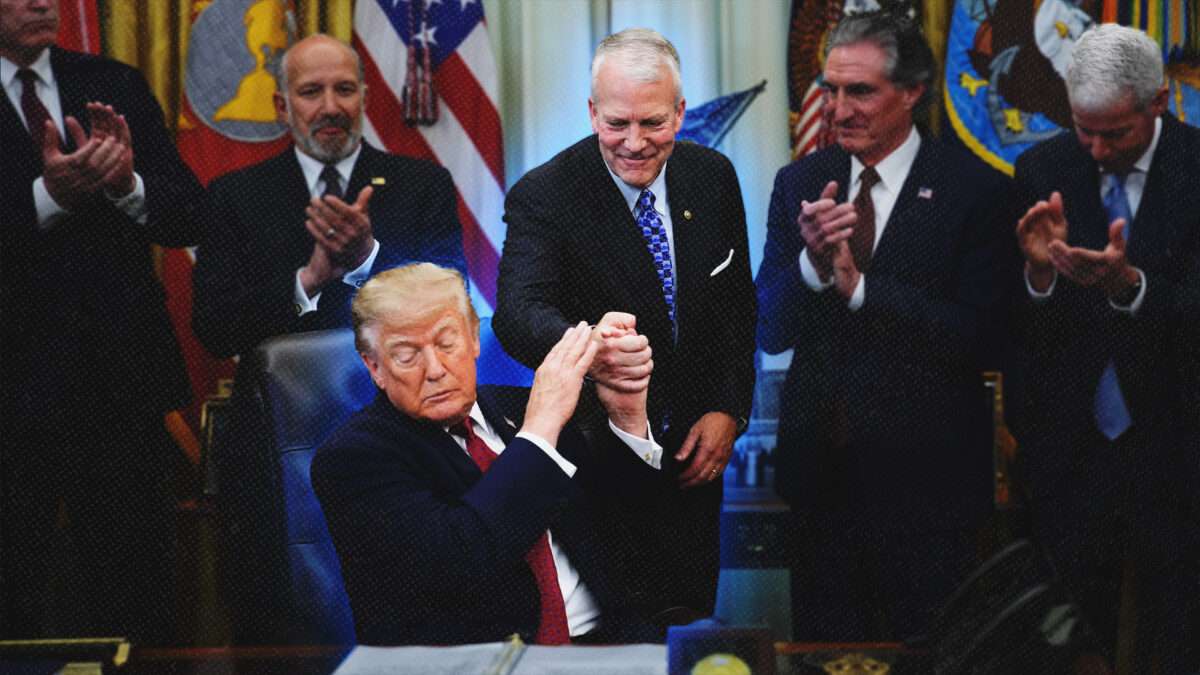
Senators are bracing for a potential floor fight over accepting the results of the Alaska Senate race between incumbent Sen. Dan Sullivan (R) and former Rep. Mary Peltola (D) — and perhaps other battleground contests — if President Trump urges allies to dispute what he might view as unfair or “rigged” results. Democratic senators generally…
President Donald Trump has long been associated with lust. The 2016 election prominently featured "the Access Hollywood tape" in which he can be heard boasting about grabbing women "by the pussy." But recently, his affections have turned to men.
"I examined his ass," Trump said of Sen. Jon Husted (R–Ohio) at an October 17 rally. "I examined his ass. And then I looked at his shoulders; I looked at his feet; I looked at his hand; I looked at his jawline." He liked what he saw.
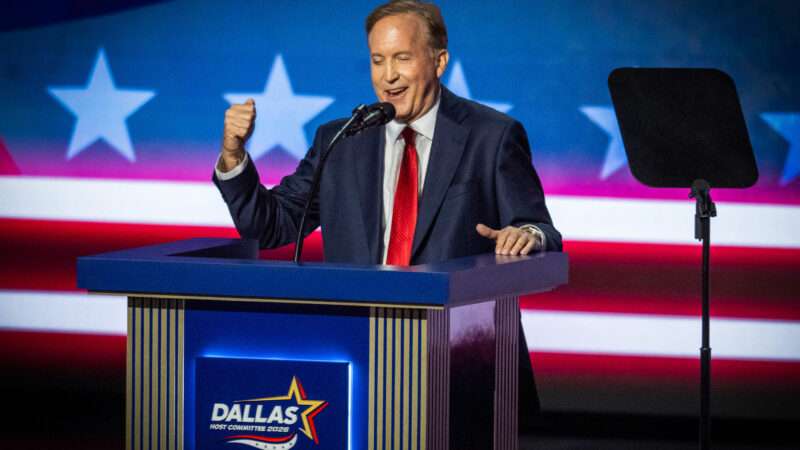
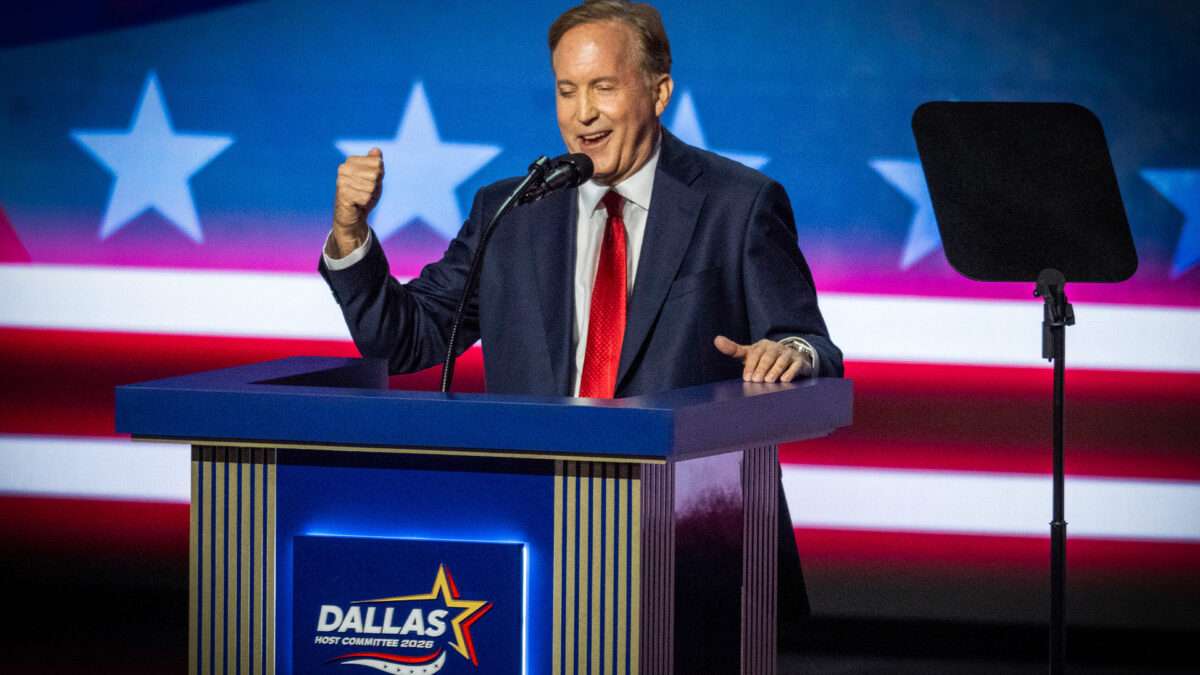
There is one candidate, however, whose ass appears to be safe from the president's admiration. "He may not dress right. He may not talk exactly perfectly, and he may not be the best-looking guy I've ever seen," Trump told the crowd on the first night of the GOP midterm convention in Dallas, Texas. Even still, "he deserves to be your next senator."
Such was the pitch for Ken Paxton, the Texas attorney general asking voters to promote him to the U.S. Senate. It has been a tough sell, much more so than is typical for a Republican fighting to represent Texas on the national stage. His opponent, state Rep. James Talarico of Austin, has often led in the polls in a place where a Democratic Senate victory would usually be relegated to liberal fever dreams. As A.G., Paxton has been dogged by an impeachment and by longstanding accusations, including from within his party, that his ethics compass is all but demagnetized.
There is another potential obstacle in his way, something Trump hinted at repeatedly in his Trumpian way over the course of that two-day convention. The main characters in the MAGA movement often have a kind of crass charisma—not necessarily a literal beauty, but certainly a talent for performance and presentation. This is a theme in populist movements for a reason: It's the people versus the elite, the outsiders versus the establishment, us versus them. So too can it serve as a helpful distraction when policies' practical results fail to match the promises made, as well as when allegations of corruption surface.
Paxton has the baggage with fewer obvious tools to combat it. And yet if one word best describes him, it may be survivor.
One Scandal After Another
Paxton had been Texas' top law enforcement officer for about six months when he became a defendant.
In July 2015, a grand jury indicted him on three felonies. The charges—two counts of first-degree securities fraud and one count of third-degree failure to register as an investment adviser—concerned work he had done while in the Texas House of Representatives. As state representative for part of Collin County, he convinced investors to put hundreds of thousands of dollars into Servergy, a tech startup, while allegedly failing to disclose that he was paid to attract those very investments.
A state attorney general showing up for a mug shot reverses the typical arrangement. Still, there were signs that this was on the way. In 2014, while Paxton was a state senator, the Texas State Securities Board disciplined him and fined him $1,000 for not completing the required registration to solicit investors. But while the criminal investigation delving into the full scope of alleged misconduct had been announced to the public, it was put on hold until after the election so as not to potentially sway the outcome.
It did not sway the next one either. Paxton was reelected in 2018. But that run-in with the law turned out to be just the beginning.
In 2020, the scandal that would come to define his career began to take shape. Several senior officials from Paxton's office went to the FBI to report him for what they said was an inappropriate and illegal relationship with his friend Nate Paul, an Austin real estate developer who was already under federal investigation.
Paxton, the officials said, had leveraged his office to help Paul in various legal disputes, such as foreclosure proceedings. They also alleged that the attorney general had deployed a special prosecutor to go after Paul's enemies. Paxton denied the accusations. He was reelected in 2022.
"These were upstanding people that Ken Paxton himself had hired because of their conservative bona fides. And yet they all left stating, 'I don't want to have anything to do with this guy,'" says one Republican official who worked alongside Paxton in the Texas government. "It's basically the story of Ken Paxton in my mind. If he doesn't cross the line and literally break the law, he constantly skirts it. And therein lies the problem.
"Now, that's not me saying that he doesn't break the law," the official continues. "I'm just saying that is kind of his MO."
The following year, the Republican-led Texas House of Representatives impeached Paxton for conduct related to the same scandal. The information aired during his trial, particularly as it related to his love life, arguably made the biggest impression on the public consciousness. Paul, it seemed, had set up a fake Uber account under the name "Dave P." It had a mysterious habit of summoning cars to pick up a passenger a block from Paxton's house so it could travel to the apartment of Laura Olson, Paxton's girlfriend.
This was complicated, because Paxton also has a wife, Angela Paxton, herself a member of the Texas state Senate. That body would go on to acquit Paxton of impeachment in September 2023. Angela announced two years later that she was filing for divorce "on biblical grounds."
As for that 2015 criminal indictment, the attorney general was set to go to trial in April 2024, after a series of protracted delays, when he cut a deal at the 11th hour. He would pay restitution and do community service, and in exchange, the prosecutors ultimately dismissed the charges. Had he been convicted, he faced decades in prison, and, per his own guidance, he would likely have been precluded from running for public office in Texas again as a felon.
Paxton declared his candidacy for the U.S. Senate the next year.
A Blunt Instrument
Paxton's knack for survival has long baffled onlookers. "The guy's ability to take shots and just keep moving on and stay in elected office is unlike anything I've ever seen in my career in 25 years of running campaigns," Ash Wright—previously a senior adviser to George P. Bush, who invoked the incumbent's mug shot in a 2022 bid to be attorney general—told the Associated Press in July.
How he does that is a matter of some mystery, given he does not possess the showmanship the president favors. One answer might provide a window into how the Republican Party has evolved in recent years. What Paxton may lack in stage presence, he makes up for in a willingness to use his office as a performative blunt instrument.
The attorney general's lengthy tenure has been consumed almost entirely by two categories: high-profile scandals and high-profile lawsuits. During the 2026 Senate primary, as he made his case that he should replace Republican John Cornyn, Paxton advertised his conservative credentials with a statistic: He had "sued [President Joe] Biden over 100 times."
His lawsuits covered quite a bit of ground. There was his attempt in 2020 to overturn the election results, which the U.S. Supreme Court rejected. But he did not always fare poorly. Within days of Biden taking office in 2021, Paxton sued to stop the then-president's 100-day pause on certain deportations, which a federal court granted. He also secured enormous settlements against Meta and Google—$1.4 billion and $1.375 billion, respectively—for alleged privacy violations, although neither company admitted wrongdoing.
Paxton has not lost steam. In 2025, he filed a lawsuit against former Rep. Beto O'Rourke, a Democrat, and his advocacy organization, Powered by People, over donations that supported Democratic lawmakers who left the state to block new Republican-drawn congressional maps. "Our Texan founding fathers—like our American founding fathers—took prior restraints on political speech out of the tool kit," a Texas appeals court later wrote, "when they enshrined the right to free speech in our Constitution." The year prior, Paxton filed suit against Annunciation House, a Catholic charity that shelters migrants in El Paso; one judge called his office's conduct in that case "outrageous and intolerable." Yet Paxton has succeeded in drawing out both cases with lengthy litigation. Even when he may lose the final battle, he often hamstrings his opponents for long periods, a different kind of victory.
Has that helped make Paxton nearly bulletproof? Maybe. But it is also a snapshot of the power of branding in this political moment and how he has leveraged it offstage. "How hard is it for anybody, any Republican, to go into the A.G.'s office and sue the president of the opposing party?" says the Republican former official. "It's just typical stuff, you know. It's nothing of this great political fighter that they think he is."
When it comes to the other category—those high-profile scandals—Paxton has repeatedly denied wrongdoing, casting his legal tribulations as politically motivated witch hunts. He is, he always insists, the victim, not the perpetrator. It may be another sign of how the political landscape has changed, particularly in the GOP, in that transgressions can become capital when marketed savvily.
In the May runoff with Cornyn, who has represented Texas in the Senate since 2002, Paxton won by 28 points.
Can the Survivor Survive?
Party conventions usually exist to formally nominate a president and vice president. Those trappings were still there in the GOP's midterm convention, though no one was being nominated. There were state delegations, their role entirely symbolic. There were balloons and sequins and Lee Greenwood, who introduced the president both nights by singing "God Bless the USA." Trump, of course, loves a good production.
You couldn't help but get the feeling sometimes that the event was largely mounted for Paxton. It took place in Dallas, after all, and his race was a constant part of the discussion.
"He is a weird-looking dude," Trump said. That time, he was referring to Talarico, whom he called "Talafreako." That comment didn't come with an endorsement. "I mean, I don't like talking about looks, but there's something missing there."
Talarico's general presentation has been a subject of fascination on the right throughout the race: his appearance, whether he likes football, accusations he's a vegan (he isn't). An ad run by Paxton deems Talarico "too low-T for Texas"—not macho enough.
How this mudslinging resonates may vary. "Policy is all that matters," Kyle Biedermann, a Republican who served with Talarico in the Texas House of Representatives, told me on the sidelines during the second night of the convention. "I don't care if he's a vegan. I don't care what he does. But his policies are horrible, terrible for our state." Those policies, he said, "are so socialist, so far, far left" that anything else is beside the point.
The night prior, when the president offered $5,000 to every American adult if Republicans won the midterms, a victory in Texas may have been at the top of Trump's mind. On closing night, during the president's second speech, Paxton was featured heavily again. Trump described how he had rehearsed for the moment with his circle. "I'll tell you what I was thinking about saying. I said, 'I don't like the way Ken dresses,'" he recounted to the audience. "And then I said, 'I don't really like the way Ken talks.' And then I said something that they really hated….I said, 'I don't really like the way he looks.'"
In the VIP section, Paxton smiled awkwardly. He is, after all, a survivor.
Texas might finally turn blue, and the man poised to do it is a mask-wearing, trans rights–supporting, Gnostic Gospel–quoting liberal from Austin. In an already tough year for Republicans, voter dissatisfaction at the state's data center boom is giving the Democrat an edge.
A few weeks out from the 2026 midterm elections, the polls have been giving state Rep. James Talarico (D–Austin) a small, steady edge over Republican Attorney General Ken Paxton in the race to fill the Senate seat currently occupied by Republican Sen. John Cornyn.
Texas has not elected a Democrat to statewide office since 1994. The chattering class's constantly misfiring prediction that the latest liberal challenger will beat the favored Republican has made "Texas turning blue" a mockable meme—the political equivalent of Charlie Brown winding up to kick the football.
But this year may be different. The national environment is very bad for Republicans. President Donald Trump's unpopular tariffs and unpopular war have made him, well, unpopular and given GOP candidates little to run on. Texas Republicans are also saddled with Paxton, who won a hotly contested primary despite having little natural charisma and a lot of scandals (both personal and political) to explain away.
Republicans' political headwinds have made Talarico, a 37-year-old legislator with a history that puts him solidly to the left of the median Texas voter, a surprisingly competitive candidate. Some of Talarico's edge can no doubt be chalked up to the candidate's own political skill and fundraising advantage. But he is also benefiting from a late-breaking development that few saw coming: the Lone Star's data center revolt.
For as long as Republicans have run Texas, they've been able to claim credit for the state's decades-long economic growth streak. But the grassroots groundswell of opposition to Texas' data center boom has helped to neutralize that traditional GOP advantage. In solidly red rural areas, large majorities are telling pollsters that they are opposed to the hundreds of data centers proposed in their backyard.
When Republicans thus talk about their economic stewardship today, it conjures up not positive feelings of persistent prosperity but dissatisfaction at all the ways the party has allowed an unpopular data center to be built next door. In a tight race, that might just be enough to give Talarico the last little push he needs to finally turn Texas blue.
Lab-Grown Liberals vs. the GOP Growth Machine
All the Texas Senate races of the past couple of decades have taken place within a growth machine. From 1998 through 2024, the Lone Star state posted the fourth-highest GDP growth rate, a period that roughly matches the GOP's unbroken record of statewide election wins. Not a day goes by, it seems, without a major corporation announcing a Texas megaproject or a billionaire relocating to booming Austin.
The state's frenetic growth rate has given the Texas GOP a good story to tell voters about why they should continue Republican rule: Under their low-tax, low-regulation regime, Texas has prospered. The jobs and businesses flooding into the state tend to be coming from states ruled by the Democrats trying to unseat them.
Those Texas Democrats whose bids for statewide office have managed to electrify liberals, meanwhile, have been ill-suited to convince voters that they'll keep the "Texas Miracle" going. There's an old joke that "Republicans fall in line, Democrats fall in love." In Texas, this hopeless romanticism has led to repeated heartbreak. In 2014, Wendy Davis inspired a national media buzz with her pro-abortion messaging while running for governor against Greg Abbott. Beto O'Rourke's style-over-substance challenge to Ted Cruz in 2018 produced a similar mania. Both lost.
You might expect Talarico to meet a similar fate. The fresh-faced lawmaker seems almost grown in a lab to leave liberals giddy while making swing voters stick with the GOP. A former teacher, he first won elected office in 2018, when he flipped an open Texas House seat in the Austin suburbs from red to blue. At 29 years old, he was then the youngest member of the Texas Legislature.
Analyses of lawmakers' voting record put Talarico squarely in the ideological middle of his fellow Democrats, and well to the left of the state's political center. His national star began to rise among Democrats when he used religious arguments to challenge Texas Republicans' culture-war battles over education.
In 2021, Texas Republicans proposed a bill requiring K-12 athletes to play on girls' or boys' sports teams according to the sex listed on their birth certificates. Two years later, they introduced a measure that would require the Ten Commandments to be displayed in public school classrooms. Talarico, a Presbyterian seminarian, cited his liberal brand of Protestantism to oppose both bills. "Trans children are God's children, made in God's own image. There's nothing wrong with them. Nothing at all. They are perfect. They are beautiful, and they are sacred," he said in a floor speech opposing the sports bill. In a debate on the Ten Commandments bill, he declared the legislation "deeply un-Christian," citing Christ's instructions in the Gospel of Matthew to pray privately. (The sports bill eventually passed. The 2023 Ten Commandments bill failed, but a near-identical bill would pass in 2025.)
Conservative Christians would quibble with Talarico's progressive readings of the Bible. For national Democrats and liberal-leaning magazine writers, however, his penchant for reframing the Annunciation as a pro-abortion parable and his citations of the noncanonical Gospel of Thomas to support trans rights all served as proof that this "deeply religious" Democrat could effectively speak to Christian swing voters in their own terms.
Talarico has also taken many secular positions that might be hard sells in Texas. In May 2020, a couple of months into the COVID-19 pandemic and weeks before George Floyd was killed by Minneapolis police, Talarico declared that racism was the real virus. At a 2022 animal welfare fundraiser, a mask-wearing Talarico said he was running a vegan campaign. The same year, he said in a public hearing, again wearing a mask, that "fossil fuels are destroying the planet."
In a state where oil, gas, and beef are champion industries, swing voters to not swoon ordinarily for race-critical, carbon-neutral veganism. Talarico himself seems to have conceded that point. He's dispelled rumors of his veganism by eating barbecue on camera and waved away his past wokisms as "cringey" and "miss[ing] the mark." Even so, Talarico's campaign platform remains stridently progressive. He wants to tax billionaires and raise the minimum wage. If it were up to him, he'd open up Medicare to everyone, regardless of age, and would codify abortion protections into law. He's pro–marijuana legalization and fanatically anti–school choice.
So why are polls showing Talarico maintaining a consistent two- to six-point edge over Paxton?
In one sense, his continued leftward lean is an electoral boon. In a race with a clear enthusiasm gap, some 91 percent of Democrats say they'll be supporting Talarico in the general election. Only 79 percent of Republicans say the same about their candidate. Talarico has also been blessed with a national environment that's shaping up to be a bloodbath for Republicans, who have to answer for the rising prices driven by Trump's tariffs and the Iran war.
But there is one final factor putting Talarico over the edge: a statewide data center revolt that's souring Texas voters on their state's growth machine and neutralizing the pro-growth message that has carried the GOP through so many other tough election cycles.
It's the Data Centers, Stupid
In November 2025, on the heels of Google's decision to invest $40 billion in data center development in the state, Gov. Greg Abbott proudly declared, "Texas is the epicenter of AI development, where companies can pair innovation with expanding energy." Just a few months later, the governor was vowing to impose new regulations on data centers to "protect" Texans from the consequences of their rampant development.
The U.S. has experienced a rapid revolt against data centers this year, and in few places has that backlash been more sudden or more pronounced than in Texas. According to a 2025 poll by the University of Texas at Austin, nearly 60 percent of Texans were either supportive or neutral about a data center being built in their neighborhood. In August 2026, 57 percent said they would oppose a local data center project.
This backlash against data centers couldn't have come at a worse time for Texas Republicans, or, consequently, at a better time for Talarico. The policies the Texas GOP have long touted as the key to the state's economic success—loose land use and environmental regulations, no state income tax, and the cheap commercial energy prices created by its deregulated energy sector—are the same policies attracting data centers. When the most visible recent consequence of those pro-growth policies is a data center boom most Texans hate, the state's Republicans are having to run away from what were once their prime selling points.
The sudden negative turn in public opinion on data centers has "proven a catalyst for people raising questions about governance and the economy in the state," says James Henson, director of the Texas Politics Project at the University of Texas at Austin. Making matters worse, says Henson, is the geography of the data center backlash. Opposition to these projects is concentrated in rural areas that have long been Republican strongholds and in suburban areas where the party needs to stay competitive to win statewide elections.
As Abbott's pivot demonstrates, Texas Republicans feel acutely vulnerable on this issue and are scrambling to adopt policies that ensure these developments do not lead to higher electricity prices for residential consumers. Paxton himself has called for a raft of new regulations on these facilities' water and power use and for ending a sales tax exemption on data centers, as well as some more off-the-wall conservative-coded policies, such as holding data centers criminally liable for facilitating AI chatbots that "endanger" children.
Talarico's data center proposal isn't all that different. He too would require data centers to pay for the full costs of their power and would end the sales tax exemption they can currently claim on equipment purchases. He'd also give local communities veto power over data center projects. That makes him more moderate on data centers than fellow Democrat Gina Hinojosa, who is running for governor against Abbott. She's called for a moratorium on data center construction until the state Legislature can convene to discuss "protections" for Texans.
Talarico's moderation could be partly explained by the fact that data centers are more popular, relatively speaking, in heavily Democratic urban areas. He also represents a slice of Austin, which has become a booming tech town. Why risk upsetting one's base when long-ruling Republicans already have to own the data center boom they were so recently bragging about?
'Talafreako'
The 2026 midterm environment seems almost tailor-made to neutralize Republicans' long-time advantages in Texas. Nationally, they have to own higher prices. Locally, they have to own an unpopular data center boom. Waning voter concerns about illegal immigration have caused their favored red-meat issue to turn a dull brown.
The Texas GOP's only weapon left is personal attacks on the man they call "Talafreako"—some weirdo liberal who calls trans kids "perfect" and thinks racism is the real virus. Talarico's persistent lead in the polls and on the prediction markets (which, in late October, put the chances of him winning at nearly 70 percent) suggest that these attacks are not working.
One could sense Republicans' desperation when right-wing influencers spun up a rumor that Talarico was absent from the campaign trail in early October because he was in a mental health facility in Ohio. (The hospital publicly denied ever treating Talarico. The candidate himself said he'd been recovering from the flu and said he'd never even visited Ohio.)
When Republicans call Talarico a freak, they mean to cast him as abnormal and off-putting: a "freak of nature." But freak has multiple usages. The word can also mean an unpredicted or unusual event: a "freak occurrence." Talarico succeeding in ending Republicans' three-decade run of statewide victories in Texas would fit the latter definition.
Rather than run from the Talafreako barb, Talarico's campaign has emblazoned merch with the intended insult. They at least seem to appreciate the irony of it all.
If Talarico is a freak, that will make his likely victory all the more freaky.
Republican candidates in marquee Senate races have welcomed Thune's help as he's traveled around the country in the weeks before the midterm elections, scrambling to save his majority.
More than 60 former diplomats and top foreign affairs experts are backing Democrat Troy Jackson as he vies for a Maine Senate seat next week against Sen. Susan Collins (R-Maine). Sixty-two officials — including former U.S. Ambassador to the United Nations Susan Rice, former Deputy Secretary of State Wendy Sherman, former Undersecretary of State for…
A Platner superfan’s reluctance to support the Democrat now running against Senator Susan Collins reflects the party’s challenges navigating left-wing passions.
President Trump said Sunday his trade war with Canada will be over “soon,” as the dispute poses ongoing political problems for Republicans in the midterms. During a rally in Port Huron, Mich., Trump reiterated his view that Canada “has been ripping off” the U.S. “for years.” The president used that justification in imposing 50 percent…
Democrats are targeting G.O.P. strongholds that could set them up for new majorities. But if they don’t win those races now, it could be a long time before they have another chance.
Protesters outside of an event for Senator Roger Marshall in Topeka, Kan. Soaring fuel costs and economic struggles have made some Republican senators like Mr. Marshall vulnerable on their home turf.
Alaska's U.S. Senate race features four candidates. Two are named Dan Sullivan: the Republican incumbent, and a political neophyte.
Republicans say the presence of two Dan Sullivans on the ballot is an illegal act of election interference. The federal government is now suing to keep Alaska from certifying the election results, but only if their guy loses.
"One of the biggest election scandals in history has been the Democrats' installation of a fake Dan Sullivan (not the US Senator) to deceive voters in Alaska," White House advisor Stephen Miller wrote on X. President Donald Trump called it "a disgrace."
"Democrats pulled a dirty trick by enlisting a decoy, Daniel J. Sullivan, to run against Republican Alaska Sen. Dan S. Sullivan," TheWall Street Journaleditorialized. "Please spare us the lectures about election interference."
Last week, the Department of Justice (DOJ) sued the state of Alaska and its election authorities.
"Should Alaska certify any electoral results tainted by the inclusion on the ballot of Daniel J. Sullivan," the filing warns, "the State and its officers will fail in its obligation to protect the integrity of its election. The United States accordingly brings this lawsuit to protect the integrity of the 2026 Senate election in Alaska."
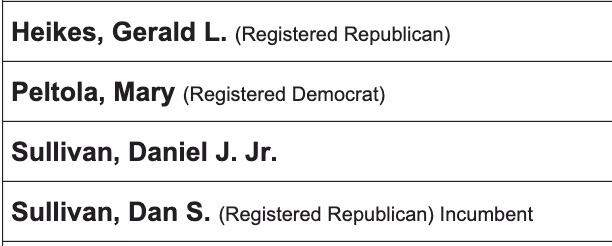
Alaska uses a ranked choice ballot, in which voters are given four candidates and rank each one in order of preference. Along with the Sullivans, the candidates are Mary Peltola, a Democrat who is polling narrowly ahead, and Gerald Heikes.
The Justice Department lawsuit says Republican voters would be too confused by the presence of two Dan Sullivans to properly fill out their ballot: "Some supporters of Senator Sullivan likely will inadvertently vote for Daniel J. Sullivan. Other supporters of Senator Sullivan likely will be confused as to how to rank the three Republican candidates as to defeat Peltola."
Given this, "there is a substantial likelihood that a certification of the election will reflect an electoral process that lacked integrity," the lawsuit proclaims. "To guard against this danger, it is vital that [Alaska] not certify any election result" in which "(1) Senator Sullivan does not win the election; and (2) had all votes cast for Daniel J. Sullivan been cast instead for Senator Sullivan and Alaska's rank-choice process played out accordingly, Senator Sullivan would have won the election."
In other words, the state of Alaska should only certify the election if Sullivan wins; if Peltola wins, but it's close, then that could suggest it "lacked integrity," and the state must instead conduct "an investigation to determine whether votes cast for Daniel J. Sullivan were meant to be cast for Senator Sullivan."
The lawsuit has a number of problems. First and foremost, it's completely inappropriate to treat an election as fair only if your candidate wins, even if it is what Trump believes.
It's also too late to bring an action of this kind: The state elections division decided in June to bar Daniel J. Sullivan from the ballot, but a state superior court reversed and the Alaska Supreme Court upheld the reversal before the end of that month.
And yet the feds waited until less than two weeks before Election Day—when ballots have been printed and tens of thousands of Alaskans have already voted—to bring this suit.
If the Justice Department was truly concerned about voter confusion, it should have brought a lawsuit months ago. But even then, it's not clear what it could have done: "DOJ has no power to decide which candidates can appear on the ballot," writes UCLA School of Law professor Richard L. Hasen.
Besides, it's not illegal to mislead or even outright lie to voters. "If 'voter confusion' were a legitimate reason to overturn election results, that would imperil a great many election winners, as voter ignorance—and exploitation thereof by candidates—is a widespread and longstanding problem," writes George Mason University law professor Ilya Somin.
It does seem more likely than not that Daniel J. Sullivan is indeed running just to pull votes from the senator with the same name.
But as I pointed out earlier this month, the ranked-choice ballot itself can take care of this problem: Republican voters who wish to reelect Sullivan can simply rank both Dan Sullivans first and second; if and when Daniel J. Sullivan fails to capture more than 50 percent of all votes, he will be eliminated, and his votes will transfer to all their second choices.
The ballot itself makes it clear which Sullivan is which: The sitting senator is labeled as both Registered Republican and incumbent.
Alaska Division of Elections
Despite Miller's claim that letting two Dan Sullivans on the ballot "reveals pure contempt for voters," it's the objecting Republicans who appear to lack faith in their voters.
"People are totally confused," Trump told reporters. "A lot of people don't know what 'incumbent' means."
When CNN's Dana Bash asked Attorney General Todd Blanche what crime is being alleged, he replied that "it depends." He elaborated: "There could be a crime, but the real wrong here is that Alaskans are going to be confused and will not have their vote heard."
This isn't even Alaska's most complicated election in recent memory. In 2010, after Sen. Lisa Murkowski lost the Republican primary to Joe Miller, she announced that she would still run as a write-in candidate—requiring voters to not just know about her ahead of time but to add her name by hand.
Improbably, Murkowski prevailed, defeating Miller by more than 10,000 votes.
If Trump, Blanche, Miller, and others are truly concerned that the ballot will be too confusing for Alaska Republicans, they could expend some energy showing them how to use the ranked choice ballot.
In fact, Sullivan has done just that, posting a video on X explaining how to rank all candidates except Peltola.
What they can't do is force a state to reject the results if their guy loses.
"Alaskans don't need any help voting for their preferred candidates, and the State of Alaska has already handled this by clearly distinguishing the candidates on this year's ballot," Murkowski wrote on X. "The Department of Justice should never have filed this lawsuit."
"I believe that this lawsuit is abusive in its intentions and borders on frivolous in its arguments, and that it is destined for defeat in the courts should it reach the merits," Cato Institute senior fellow Walter Olson noted in a statement. "This lawsuit is an assault on the constitutional design by which states, not the federal government, run elections. The issue in question is one for the Alaska Supreme Court to decide under Alaska law, and the Alaska court did just that."
Sen. Mitch McConnell (R-Ky.) is warning that President Trump’s efforts to end the war between Russia and Ukraine by “coddling” Russian President Vladimir Putin and limiting assistance to Kyiv is “certain to fail.” McConnell, who had been largely quiet on the issue of the war after Ukraine lost full access to the satellite-based Starshield network,…
The left says its populist message can attract moderates and conservatives in addition to liberals. That theory will be put to the test in a series of competitive races on Election Day.
The president contended that Dr. Abdul El-Sayed, a Muslim, would “invite hordes of jihadis to our shores” as he sought to bolster the G.O.P. candidate in a tight Senate race.
President Trump’s comments, coming in a key midterm battleground nine days before the elections, underscored the dark themes and personal vilification he and his allies have embraced as part of their closing pitch.

 Login