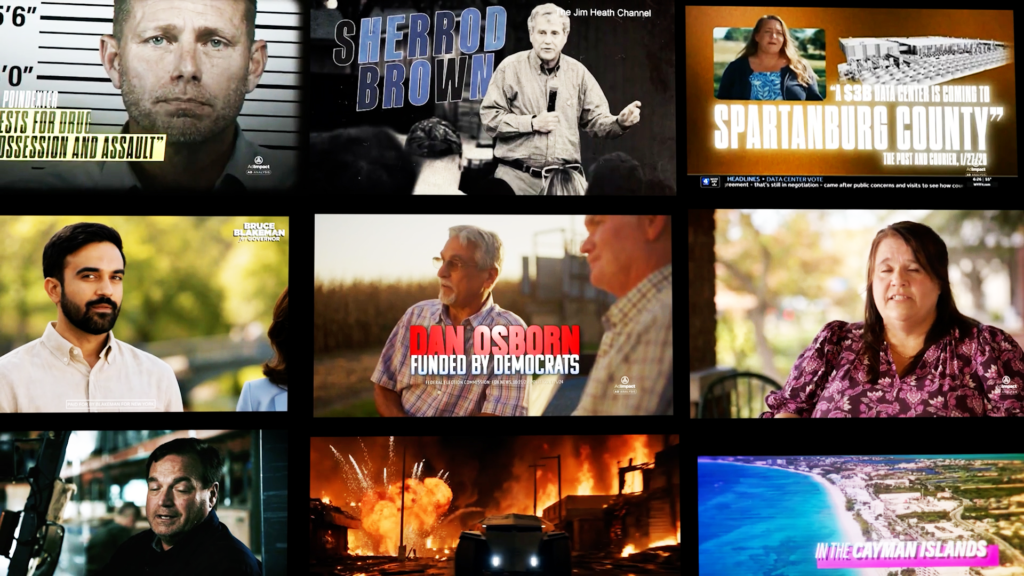
Campaigns and their allies are making their closing arguments, and they've spent more than the annual budgets of a handful of states doing it. Much of that money is aimed at voters' wallets, but the attacks are also getting more personal and more artificial. Lisa Desjardins explains.
Meta's Mark Zuckerberg and Adam Mosseri are betting on long-form.
Kevin Mazur/MG26/Getty Images for The Met Museum/Vogue
Instagram is opening its arms to long-form video again.
Adam Mosseri, Instagram's top exec, said longer videos will help the app stay "relevant."
Instagram is testing tools for creators making episodic content. But will it pay for them?
Instagram's top executive, Adam Mosseri, has a plan to keep the platform "culturally relevant" — by making it more like YouTube.
Meta-owned Instagram unveiled an overhaul of long-form video features on Monday, including a test of horizontal videos called "Features." Taken together, the changes make the app feel a lot more like YouTube.
"We want to be the most culturally relevant platform," Mosseri said in an interview with content creators and founders of Press Publish, Colin Rosenblum and Samir Chaudry. "To do that, we just need to show up where people are."
The context: YouTube has become a major hit on TV screens, and there's a growing appetite for Instagram-native shows with recurring episodes.
"Subway Takes," hosted by Kareem Rahma, is a prime example of Instagram's strengths and limits. The show started in 2023 as a short-form interview series and, as it grew, expanded with longer-form cuts on YouTube and the streaming platform Tubi. Instagram, however, is where Rahma's show still has its largest audience of 2.4 million followers.
Instagram doesn't want people to go to YouTube or Tubi to see longer versions of shows like "Subway Takes." That's leaving ad revenue and user engagement on the table. Its new tools are designed to entice creators and viewers to stay on its platform.
Here are Instagram's latest video tools and how creators can use them:
"Features" keep viewers within the Instagram ecosystem. Instead of leaving Instagram to watch the extended version of an interview or episode, it'll be relatively seamless to stay on Instagram and watch that longer-form content. Instagram's "Features" can be as long as 90 minutes, although the new format is, for now, only available to a limited number of creators in the US and Brazil.
Instagram is feeding more content to its TV apps. Instagram is also pushing its "Instagram for TV" app further. The app will feature various video content on TV services like Samsung, Amazon Fire TV, Google TV, and now Apple TV. People can now watch a feed of content their friends are also liking or resharing on TV.
Instagram-native shows can label their episodes more clearly with "Series." Within the main Instagram feed, Instagram is testing a way for shows on the app to seamlessly connect episodic content. Eligible creators can add videos to a Series, and a label appears over the content indicating that there are additional episodes. People can then watch those episodes in order from the start. This test is expanding to more countries through the end of the year.
Clips can directly drive engagement back to the original video. Instead of clipping content and praying that the audience will go the extra mile of clicking on an account and finding the original, longer-form video, Instagram is letting creators link up to 8 clips to one long video.
Instagram is expanding its offerings for long-form video content.
Meta
This isn't Instagram's first time dabbling in long-form content.
In 2018, it launched IGTV, a long-form video format and stand-alone app. In 2020, Instagram rolled out a program that let creators earn money from those videos on IGTV. Four years after launching, the company sunset the IGTV app and shifted its video efforts to Reels.
There are a few key elements missing from Instagram's big leap (back) into long-form video.
You can't watch the video while continuing to scroll through Instagram, or multitask by opening other apps while keeping the Instagram content in a picture-in-picture pop-up. There also aren't automated transcripts and subtitles yet. A spokesperson for Meta told Business Insider that there are plans for these features.
Will creators get a slice of the ad revenue pie?
For creators, one key question and pain point looms: Will Meta share the honeypot?
Mosseri told Rosenblum and Chaudry that Instagram is thinking about ways to test pre-roll and mid-roll ads that could lead to a revenue split. However, he said previous attempts by Instagram to build a creator monetization system comparable to YouTube's Partner Program didn't prove beneficial for the platform.
"We spend more money than we make back by a long shot," Mosseri said of Instagram's previous efforts at broad revenue-sharing programs.
Mosseri said that in its previous iterations of content monetization, creators typically didn't produce more content than they already did for free, and the content they did create tended to be lower quality.
Still, Instagram will need to "figure it out" as it tries to crack longer-form content, Mosseri said.
"I don't think of platform payments or performance-based incentives or bonuses as a revenue driver," Mosseri added. "I'd be psyched to scale them up for any of these formats — as long as we're breaking even."
Democrats are increasingly optimistic about the midterms. But they are being outspent by Republicans. And they are trying to compete in states that favored President Trump by large margins.
The fallout from Vivek Ramaswamy’s brutal spot targeting his Democratic rival in the Ohio governor’s race showed that even in the Trump era, a political attack can be seen as going too far.
E.l.f. Beauty hosted an influencer activation at Coachella.
VALERIE MACON / AFP via Getty Images
Influencer marketing can be messy and unpredictable.
We asked top creator marketers about the main challenges they face when running campaigns.
Marketers said choosing talent, approving content, and forecasting reach create the most headaches.
Influencer marketing has ballooned into a $12 billion industry in the US. And yet, running campaigns can still feel unpredictable.
Business Insider asked more than a dozen executives at top brands like Poppi, E.l.f. Beauty, and the National Football League what challenges they face when working with creators. Three common pain points emerged.
First, it's tough to find relevant talent amid a growing pool of content creators. It can also be tricky to agree on content copy when balancing a brand's messaging goals with the creator's own voice. Lastly, campaign performance can be erratic as social-media algorithms become more personalized and harder to crack.
Buying influencer ads, unlike TV spots or display ads, requires a human touch. It's tough to automate (despite some attempts to do so). Forty-five percent of brands said they relied on manual processes like spreadsheets, emails, and DMs to run creator campaigns, according to a June survey of 209 executives conducted by Northwestern University and LTK.
"We're dealing with people, and making content is their time and their business, and it's hard," said Lindsay Burstein, senior director of integrated social and communications at Keurig Dr Pepper. "We're always looking for ways to do it faster and in a way that feels more real-time so that we're keeping up with the pace and the culture of the internet. But also knowing that these are people. They have lives. They have other commitments."
Read on for more details on the common pain points that emerged from our conversations with marketing executives at 14 brands. These execs were recently featured in Business Insider's 2026 list of innovative influencer marketers.
1. It's hard to find the right creators for your brand when there are so many
"The landscape of the influencer, creator, and affiliate model is changing every single day, and new people are coming in and identifying as an influencer," said Patrick O'Keefe, chief integrated marketing officer at E.l.f. Beauty. "I would love a model or a plan or a program that would capture all the new people coming into this space in real time."
"We've just seen this space get so much more saturated than it ever has before," said Kiara Kempski, vice president of global consumer marketing at The Knot Worldwide. "The game of scale is totally changing."
2. Breaking through the noise
"The feed is so loud right now," said Anna Doré, Rothy's vice president of brand and communications. "In this AI-driven algorithm world where we're all being served the same content on the feed, we, more than ever, are going to be looking to great tastemakers."
"There is a ton of content that's just content for content's sake that's out there," said Ian Trombetta, the National Football League's senior vice president of global social, creator, and content marketing. "The creative bar is going up in order for us to drive that organic reach and engagement."
Ninety to 95% of the content that we see in our own feeds is not from accounts we follow, Keurig Dr Pepper's Lindsay Burstein said. "Followership matters a little, but not nearly as much as I think it once did because the algorithms just don't favor it the way that we used to."
3. Agreeing on content that works for both a brand and a creator's audience
Some brands "are a little bit too prescriptive and don't allow the creators to do what it is that they really are good at, which is understanding their audience and how to create great content and formats that work for their audience," the NFL'sTrombetta said.
"Overbriefed" projects are "not the business that we want to be in," said Sophia Sesto, Poppi's vice president of culture. "We want to take these opportunities and work with the talent to make something special" and "lean into their personalities and let them carry the brand forward with us."
"For a long time, the industry treated creators as ad placements," said Samim Sadrzadeh, director of creator content and partnerships at Disney. "We think that significantly undersells the value they actually bring."
"We start from a pretty simple place, which is creators know their audiences better than we ever will," said Stacy Martinet, Adobe's chief content and creative officer. "The most effective approach has been to treat creators as creative partners, first and foremost."
The vice president backed an advertisement featuring Democrat Amy Acton’s mother, who has been estranged from Dr. Acton since her stepfather was charged with child rape.
The spending has hurt the Silicon Valley giant’s cash flow, which turned negative. Meta said it would issue a new class of stock to help it raise more money.
Alex Tait on a proposed amendment to the representation of the people bill, and Dr Joseph Mullen on Russian interference in the Brexit referendum
Andy Burnham’s comments about Russian interference in Brexit (Report, 11 October) and the warning by the MI5 chief, Ken McCallum, against exaggerating its impact (Report, 13 October) risk overlooking another serious threat to electoral integrity: disinformation from our own political parties and campaigners.
Foreign interference deserves scrutiny, but misleading factual claims in electoral advertising are unregulated, unlike in commercial advertising. We have four sets of rules to ensure an advert for a packet of sausages is accurate, but none for the most important advertising of all – ads that influence how we vote.
Israeli digital advertising agency Discover-Tech used a sprawling network of online ads to track internet users and help hack their devices, according to reports from Citizen Lab and Confiant.
 Login