
❌

Reading view

Republican voters are getting worried about high costs as inflation stings and the midterms approach

A hand in a plaid shirt holding a fuel nozzle refueling a car at a gas station pump. Bright day with a visible station backdrop.
Rising costs are weighing on Republican voters.

Lajst/Getty Images

  • Republicans are feeling the strain of rising costs, with more saying it's a drag on their finances.
  • Those voters are feeling generally bad about the economy as key midterm elections loom.
  • Voters not approving of the party in power is common; what's unclear is how it'll play out.

Republicans are feeling the high-cost crunch.

The latest consumer sentiment reading out of the University of Michigan finds that, across the board, Americans are still feeling bad. While self-identified Republicans still feel better than their Democratic and Independent counterparts, they're increasingly feeling the pinch of rising prices.

From January to October 2026, the share of Republicans citing high prices as a drag on their finances rose the most out of all political factions. It's a sign that, even as their party holds Congress and the White House, Republican voters might still be feeling the heat — especially as inflation continues to rise.
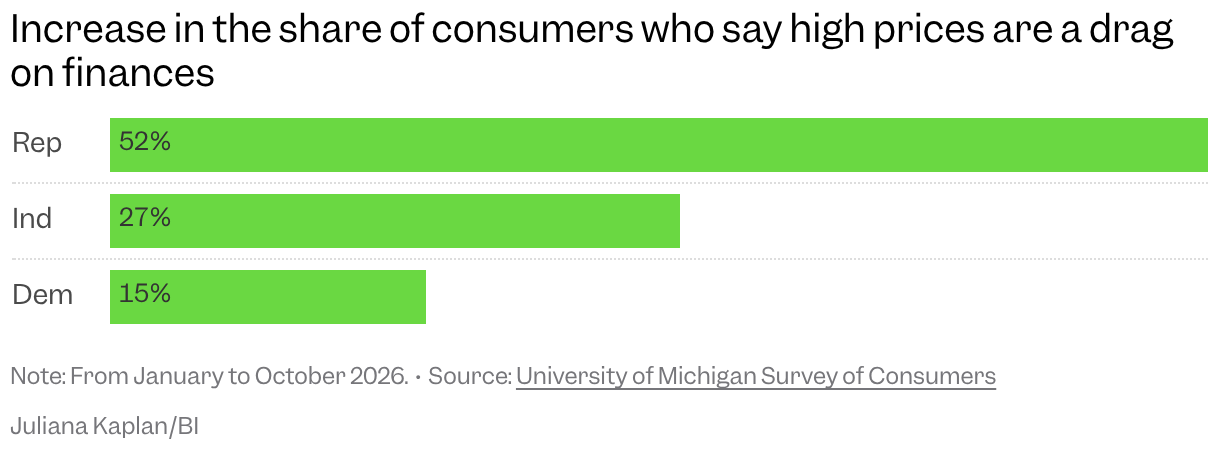
Bar Chart

And, more broadly, Republicans seem to be souring on economic conditions. A Pew Research survey of 5,062 American adults from September 28 to October 4 found that Republicans, and those who lean Republican, were becoming less likely to say that economic conditions in the country are good.
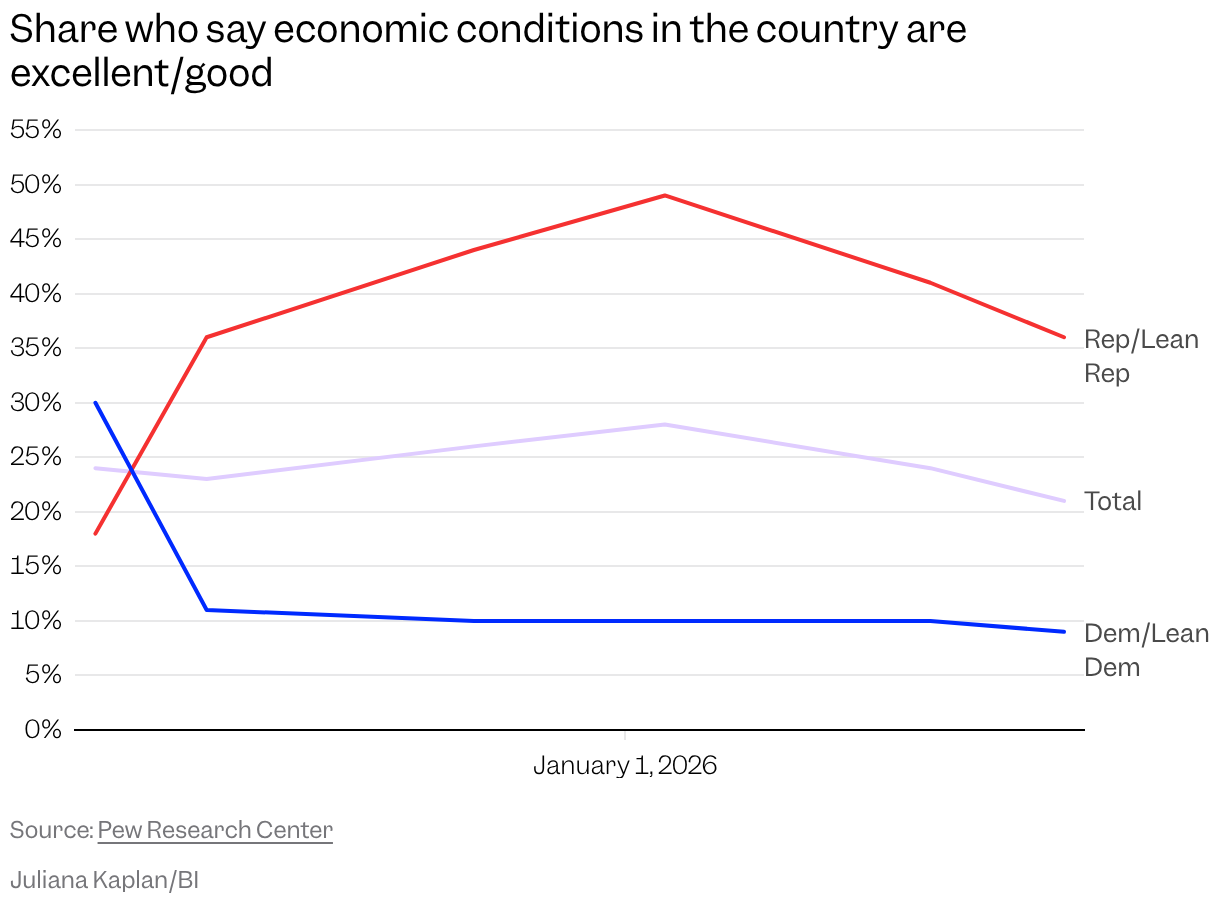
Line chart

Historically, consumer sentiment and surveys asking voters about economic conditions tend to have strong partisan correlations. Democrats are more likely to say that the economy is doing well and they're optimistic about the future when a Democrat is president; Republicans do the same when the GOP holds the White House.

The shift in Republican sentiment illustrates just how bad Americans at large are feeling about the economy. A similar downshift happened among Democrats amid the inflationary spike during President Joe Biden's term.

"President Trump has implemented an aggressive, pro-growth economic agenda that has blunted Biden's historic 40-year high inflation crisis, driven economic growth, increased wages and created private-sector jobs in areas that had been hollowed out and shipped overseas," White House spokesman Matthew Middleton said in a statement. "The President has always been clear about temporary disruptions as a result of the Iran conflict, but this administration will continue to deliver economic wins for the American people over the next two years."

While 18% of Republicans surveyed by Pew in January 2026 said that President Donald Trump's economic policies have made economic conditions worse, that share grew to 35% in October 2026. Similarly, an increasing share — 14% in January versus 25% in October — said that they expect economic conditions to be worse a year from now.

Similarly, polling from SSRS's Economic Attitudes Tracker found that Republicans are now more likely to describe the economy as bad than good — and the share of Independents who think the economy is good has plummeted to 12%, compared to a high of 25% in August 2025.

The cost concerns come as Iran War volatility — and the resulting fallout on energy prices — kept inflation high. In September, the consumer price index accelerated more than anticipated, with skyrocketing energy prices driving the increase. That means that, for the sixth month in a row, inflation has outpaced wage increases. Meanwhile, the labor market is floundering, with the country adding a paltry 29,000 payrolls in September — a far cry from the 90,000 roles economists predicted.

Midterm Election Day is a week away, and partisan sentiment around prices is shaping up to be especially important at the ballot box. Affordability messaging has become a touchpoint in swing state elections, with lawmakers on both sides of the aisle clamoring to show how their policies have and will bring down everyday costs.

But the declining sentiment among even the Republican base could be a warning sign for conservatives: An Ipsos/Washington Post/ABC News poll found that, in April, 34% of respondents said they trusted Republicans to do a better job of handling the economy, compared to 33% saying the same of Democrats. As of October 13, that had flipped. Just 28% of respondents said they'd trust Republicans to handle the economy better, while 37% said they'd trust the Democrats.

Read the original article on Business Insider

  •  

Trump approval ticks up to 32 percent: Survey 

President Trump’s approval rating inched up by 1 point from a record low last week, according to a new poll. The Reuters/Ipsos survey, released Monday, found 32 percent of U.S. adults support the president’s job performance, while 66 percent disagreed. This is a slight uptick from the pollster’s previous findings, which showed Trump with a…

  •  

Toys are facing their biggest price spike in years. Mom-and-pop toy stores tell us how they're getting by.

Terra Toys, a toy store in Austin.

Sylvia Edwards

  • Toy prices have gone up 8.3% since February due to tariffs, geopolitics, and supply chain issues.
  • Local mom-and-pop toy stores across the US spoke to the rise and its impact on their businesses.
  • Legacy toymakers also grapple with the impacts, looking toward tariff refunds.

Toy prices are rising fast across the country— and local toy stores are struggling to play along.

At Clever Monsters, a toy store in NYC, co-owner Daniel Orlov said he has to recalculate prices order by order, at times cutting into his own profits to keep them at a reasonable level for his customers. Sometimes, he knows before putting some toys on the shelves that he won't make anything off them.

The struggle results from higher shipping fees, tariffs, and customs charges and reflects a broader inflationary moment in the economy.

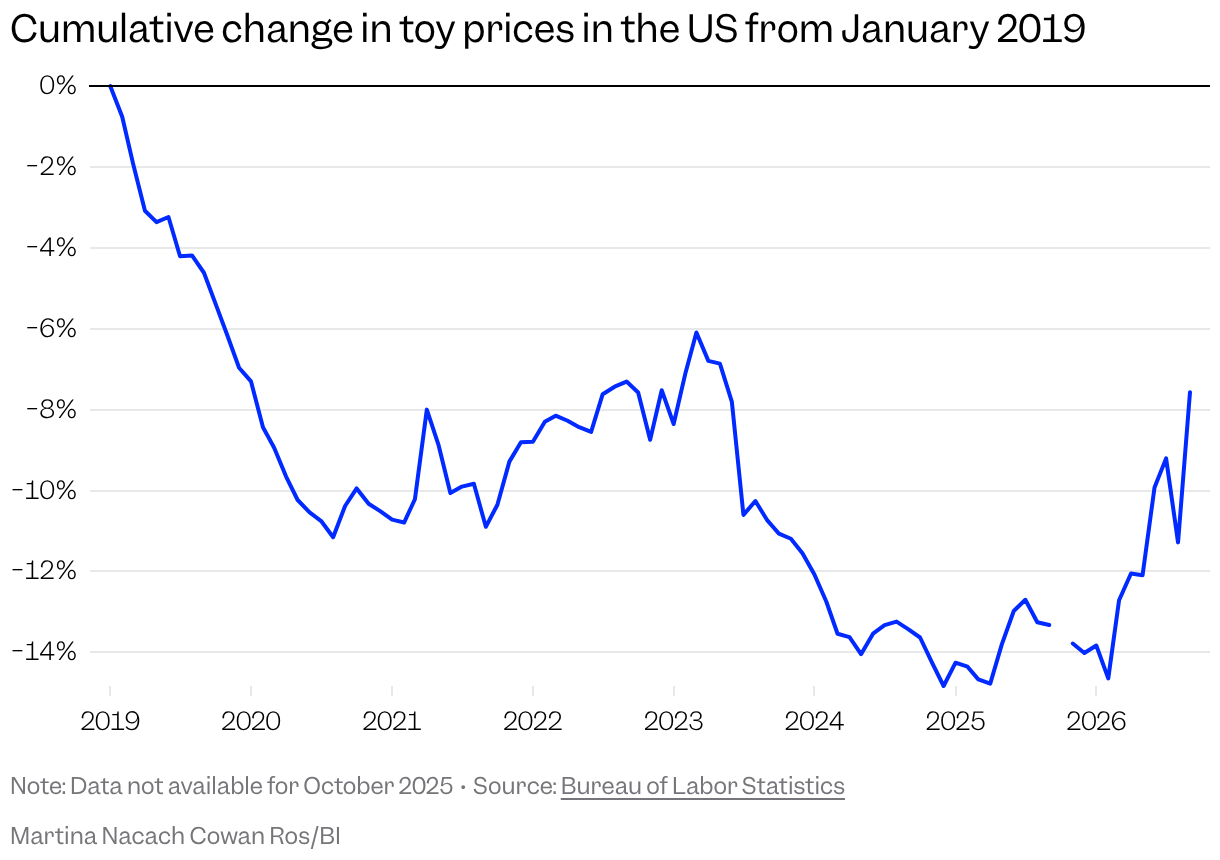
Toys have historically gotten less expensive over time, but have seen a spike in prices this year, rising 8.3% in the US between February and September. Year-over-year, toy prices were up 6.6% in September, the highest annualized growth rate since 1988.

This graph shows toy prices in the US from January 2019 to September 2026.

Orlov said smaller toy stores like his could be particularly affected by these sharp price spikes. "It especially hurts for small businesses like us because we don't really have a pocket; we had to open up credit lines and take loans — bigger companies have a little pocket of collateral that they can use for a bit."

Tariffs, fuel prices, and supply chain woes

Big geopolitical swings are one factor putting pressure on toy sellers. President Donald Trump's on-again, off-again tariffs have added extra costs, and smaller retailers don't have the financial flexibility to wait for refunds like those from the Supreme Court's invalidation of the "Liberation Day" levies. Meanwhile, the ongoing war in Iran has driven up fuel prices and shipping costs for all manner of goods.

Small toy stores, confronting those problems, are facing smaller profit margins.

Helen Dean, owner and operator of Toy Safari in California for 34 years, said her usual 7 to 8% profit margin has fallen to around 5% in the past year. She cut into her own salary and skipped on hiring the two or three college students she brings on during vacation season to cut costs.

"It was summer by the time I started to see that I was going to have to pay more for the items, and that it was going to come out of my bottom line," Dean said. "For a long time, mass market has gotten favorable pricing from major toy companies, and this problem has only been exacerbated by the tariffs and fuel prices and supply chain issues; everywhere we lose."

It's not just specialty mom-and-pop stores; toymaking giants are also dealing with the tariff back-and-forth and broader inflationary issues. An AlphaSense analysis of company filings and earnings transcripts over the last six months found that legacy toymakers such as Hasbro and Mattel have alluded to cost inflation caused by "tariffs, oil-linked resin and freight, packaging, labor," while also discussing the impact of tariff refunds. However, those large toymakers haven't disclosed any major increases in toy prices over that period.

Hasbro's Q2 earnings report highlighted an $8 million adjusted operating loss in consumer products — its physical toy sector — due to "incremental tariff expense, entertainment-related mix shifts, and normal seasonality." Yet its Q3 earnings report highlighted $55 million in relief from tariff refunds; $48 million of this was attributed to the core toy sector.

The Q3 report also noted that tariffs could "increase our product costs and other costs of doing business, result in higher prices of our products, impact consumer spending," and hurt business revenue.

Mattel's gross margin is still under pressure due to tariffs and inflation. The toy company has also received about $90 million in tariff refunds, said Paul Ruh, Mattel's former chief financial officer, at a conference in September.

Scalpers, TikTok and squishy NeeDohs

High operating costs are not the only thing changing the toy market. First, more adults are participating in "Kidulting," said Jay Berino, store manager at the Lowry Town Center Timbuk Toys in Denver, meaning toys are being bought by older demographics who buy into nostalgia.

"As much as we're a toy store and people hear toy store and think of kids, we sell to a lot to full-blown adults, and that drives a huge chunk of our business," he said. At the same time, viral toys such as NeeDohs, which are sensory fidget and stress-relief toys, have helped bring more people into stores.

Sylvia Edwards, co-owner and CEO of Terra Toys in Austin, said that scalpers try to buy up stock from toy shops to resell it at higher prices — fueling the perception of product scarcity and price gouging.

"We're in a crisis where there's way more demand than there is product available, and so when that happens, people will naturally get greedy and increase the price," Edwards said. To manage the issue, stores like Terra Toys limit bulk purchases.

Daniel Orlov, co-owner of Clever Monsters in New York City.
Daniel Orlov, co-owner of Clever Monsters toy store in Brooklyn, New York City.

Daniel Orlov

Orlov from Clever Monsters in NYC said they have also placed a limit on scalpers. "I'm only limiting it because this is the kids' store, and the kids are really excited to get that stuff," he said.

The virality of products such as NeeDohs on TikTok and other platforms helps these stores boost demand at a time when the high cost of living means buyers are not looking to spend much on other classic toys. Parents and kids are willing to spend on hyped products — but for much else, they keep their wallets shut.

"Honestly, the trends have been really saving us in that it drives not just sales, but just foot traffic through the store," Orlov said. "The only thing we can do is just stay on the trends, on what people want, make sure customers are happy, build up relationships with our customers, and sort of have a little monopoly on our area on parents who think toys — 'Oh, we gotta come to Clever Monsters. That's just where you go.'"

Read the original article on Business Insider
  •  

Can’t Afford a Home. Can’t Afford a Baby. Can’t Afford Life. This Is 30.

They’re trying to build middle-class lives in New York. But many 30-year-olds in the city feel worse off than their parents. Is it average adult angst? Or something more enduring?

© Todd Heisler/The New York Times

People in their early 30s make up the largest age cohort in the United States. They’re feeling priced out of adulthood.
  •  

Italy’s Young Protesters Return to the Streets

Fed up with the political establishment and rising cost of living, demonstrators hoped to make their message heard after violence overshadowed protests last weekend.

© Yara Nardi/Reuters

Young people protested the rising cost of living in Milan on Saturday, a week after similar demonstrations in cities across northern Italy ended in violent clashes and looting.
  •  

Here’s What Democrats Plan to Do With Their Power if They Win Back Congress

Democrats have campaigned on lowering living costs and holding the Trump administration accountable. This is a look at their to-do list if they win the majority.

© Nick Hagen for The New York Times

Should they win in November, top House Democrats are planning a shock-and-awe legislative sprint to demonstrate within hours of taking power that they are passing bills to deliver on their promises.
  •  

Affordable Housing Act: Is Brussels over-promising and under-delivering?

The European Commission calls it the Affordable Housing Act and says it can “truly bring a change in people’s lives”. But how much will it actually do to make housing more affordable, asks Catherine Feore? 

The tension at the heart of the proposal is that Brussels is making ambitious claims about tackling the housing crisis while simultaneously making clear that it is not imposing new housing policies on governments or cities.

Commission President Ursula von der Leyen says the measure fulfils a promise to tackle housing affordability, describing it as “one step in this direction” and declaring: “Today, we are delivering for all Europeans.” Housing Commissioner Dan Jørgensen went further, saying the Act gives governments and cities tools to “make more affordable homes available”.

Yet the proposed legislation itself is considerably more cautious.
The Commission acknowledges that insufficient housing supply is the structural cause of the affordability crisis. Short-term rentals, second homes and other non-primary uses are not the root problem, although they can exacerbate shortages and push up prices in already constrained markets.

Housing stress test

The Act principally delivers a common legal framework for authorities that choose to intervene.

Central to this is a new EU test for housing stress. An area would normally qualify where an average home costs at least eight years of disposable per-capita income, that ratio has increased over the previous decade, and pressures are unlikely to ease over the next three years. At a ratio of ten or more, the historical deterioration test is dropped. Population dynamics, housing supply and demand must also be assessed.

Authorities could then restrict short-term rentals outside a host’s primary residence or tackle second homes, prolonged vacancy and certain other non-primary uses. But there is no obligation. They must also demonstrate that the activity has significantly harmed housing affordability or availability for at least three years, and any restriction must be targeted, necessary and proportionate. This seems to set a high bar of evidence for most local authorities.

Currently, local authorities must notify the Commission of short-term rental restrictions under the Services Directive. That notification requirement will no longer be required. Cities can use the new framework without seeking prior Commission approval, although measures must be published and remain open to legal challenge. Officials argue this will remove a burdensome procedure and make intervention easier.

But the Commission is equally explicit about what it is not doing. The Act does not regulate rents, harmonise housing policy, give Brussels new housing competences, dictate taxation, inheritance or planning, or require, recommend or encourage authorities to impose restrictions. Housing policy choices “remain national, regional and local”.

Executive Vice-President Teresa Ribera says that when markets fail to provide affordable homes, “public authorities have a responsibility to act”. But the Act does not compel that action; it provides a stronger legal framework if authorities choose to act independently.

Its impact could be real in tourist hotspots where non-primary housing use is demonstrably worsening shortages. But it cannot itself build a home or lower a rent. The question is whether a clearer legal toolbox matches the expectations created by the Commission’s promise to tackle Europe’s housing crisis. When asked to quantify how much of a difference the new provisions could make, the Commission couldn’t give precise figures, saying that it would depend on the measures adopted.

PHOTO CREDIT: Teresa Ribera, Executive Vice-President of the European Commission for a Clean, Just and Competitive Transition, and Dan Jørgensen, European Commissioner for Energy and Housing, give a press conference on the affordable housing Photographer: Jennifer Jacquemart © European Union

  •  

The Seniors Against Senior Housing

America’s elders need more places to live, but even in liberal enclaves that recognize the problem, developers are facing fierce foes: America’s elders. Make it make sense! Charley Locke reports from her hometown of Oakland, California, where boomers are organizing against two proposals that would add 618 market-rate residential units to the city’s senior housing stock:

Many in the crowd had been marching against governmental and corporate overreach for half a century: against the Vietnam draft and the invasion of Iraq; against Wall Street; against police brutality. They’re part of a generational force that’s antiestablishment and suspicious of power. But in this fight, it wasn’t so clear who the establishment was or who had the power. Were these righteous middle-class activists fending off greedy developers who would charge high rents, or were they wealthy seniors prioritizing neighborhood character over ameliorating the housing crisis? Were they once again David, or had they become Goliath?

  •  
❌