❌

Reading view

The pros and cons of offering voluntary buyouts to employees

A man walks past a sign on the Microsoft campus in Redmond, Washington
Microsoft offered buyouts to more than a quarter of its employees on Monday.

David Ryder/Reuters

  • Microsoft recently offered voluntary exit packages to some employees. It's the company's second buyout offer this year.
  • Some Google workers have said they want buyouts offered before layoffs, and to more employees.
  • Buyouts might soften job cuts, though broad offers could also send top talent out the door.

Voluntary buyouts are gaining momentum in Big Tech.

On Monday, Microsoft offered the exit packages to some of its employees for the second time this year, its latest attempt to slim its workforce without layoffs. In April, the company launched its first broad voluntary retirement program, offering packages to thousands of longtime US employees.

Separately, workers at Google pressed the search giant this past summer to make voluntary buyouts a standard first step whenever it plans job cuts — and to extend them to all members of affected teams, regardless of tenure.

Outside tech, Skydance, the company formed by the merger of Paramount and Warner Bros. Discovery, told employees Monday that it would require five days a week in the office. Employees unwilling to comply might be eligible for a buyout.

The developments are raising broader questions in tech, where many once-scrappy startups are now sprawling corporations — and where repeated rounds of layoffs have eliminated scores of jobs in recent years.

Now that many tech companies have workforces that include employees with decades of service, are buyouts — long part of the workforce-reduction playbook at legacy companies from Boeing to General Motors — a fairer, less painful way to reduce head count than layoffs? And should they remain reserved for veteran employees, as they traditionally have been, or be offered more widely?

"Buyouts are becoming increasingly compelling for older Silicon Valley companies," said Laszlo Bock, a former Google head of human resources who now advises CEOs. "They have more eligible people, and it's a softer message for morale."

A 'more humane' approach

Nearly 100 Google employees rallied in July outside the company's Mountain View headquarters, arguing that the company's past use of selective exit offers should be made a broader, more consistent policy. As part of the event, the union presented a petition signed by more than 4,500 Googlers calling for improved layoff protections.

Voluntary buyouts "provide agency to workers," Emma Jackson, a Google employee of more than 20 years and a leader of the Alphabet Workers Union, previously told Business Insider. Alphabet is Google's parent company.

Jackson said workers nearing retirement might have accepted buyouts in earlier rounds of layoffs at Google, reducing the number of cuts needed. She called the approach "more humane."

Google didn't respond to a request for comment from Business Insider. Alphabet said in July that its workforce had grown by nearly 12,000 employees over the prior year, reaching about 199,000 at the end of June.

With Microsoft's latest voluntary buyouts, the company said around 60,000 employees — or more than a quarter of its workforce — will be eligible and that the terms will be similar to its standard severance. They will have until early December to decide whether to take the offer and exit at the end of the year, and there are no plans for another buyout at this time, a spokesperson said.

Microsoft made its voluntary retirement program available to employees whose age and years of service added up to at least 70, meaning some could qualify well before a conventional retirement age.

At 47, retirement wasn't on Marisela Cerda's radar. Yet Cerda, a principal customer experience manager at Microsoft who joined the company after college in 2001, was among those who received an exit offer this past spring.

Although she ultimately decided to stay, Cerda previously told Business Insider that she stuck around as long as she has because of the opportunity to keep learning about emerging technologies and the relationships she has built with colleagues. The offer prompted Cerda to think more urgently about the next phase of her career.

"You move toward what you want more of, versus moving away from things you don't want," she previously said.

Why the calculus may be changing

As Silicon Valley companies grow older alongside their workforces, buyouts may grow more attractive, said Josh Bersin, an HR analyst and consultant. Forcing veteran employees to leave through layoffs "creates a lot of bad blood," he said.

Peter Rahbar, a New York employment attorney and cohost of the "Across the Bar" podcast, said buyouts might not reduce staff as quickly as layoffs, but they don't carry the same "huge" morale costs for those who remain — or for potential future hires.

"How you treat people on the way out is certainly something people look at on the way in," he said.

There are downsides for employers, however. Offering buyouts can make labor reductions less predictable, said Jay Zagorsky, a professor at Boston University's Questrom School of Business. If too few employees accept, a company may still need to make cuts to reach its target.

"With a layoff, there's certainty," he said.

Extending buyout offers to everyone, including those who've logged only a few work anniversaries, also carries drawbacks.

"People whom you would prefer to stay might leave," and they could go to a competitor, said Bock, the former Google executive.

The risk is especially concerning for companies with what he calls "spiky talent," where a small number of employees create disproportionate value.

For workers who receive a buyout offer, Rahbar, the employment attorney, said they should understand how accepting it would affect their retirement benefits, stock awards, deferred compensation, and healthcare coverage. Depending on a company's plans, employees who retire may continue vesting in certain benefits or retain those they have already earned, he said.

Buyout packages also tend to be more generous than the severance offers, Rahbar added, and there's an emotional difference between choosing to leave and being told to go.

"People are feeling good about leaving on their own terms," he said. "With a layoff, they're clearly not."

Have a tip? Contact Sarah Needleman via email at sneedleman@businessinsider.com or Signal at saraheneedleman.13. Contact Tim Paradis via email at tparadis@businessinsider.com or Signal at tparadis.70. Use a personal email address, a nonwork WiFi network, and a nonwork device; here's our guide to sharing information securely.

An earlier version of this story appeared on July 27, 2026.
Read the original article on Business Insider
  •  

Nvidia's sales and marketing leadership is seeing a changing of the guard — and new faces are gaining influence

Jensen Huang in Stockholm, seen from a profile with a blurry background.
Nvidia CEO Jensen Huang.

Bloomberg/Getty Images

  • Nvidia's sales and marketing leadership is changing as its sales pitch evolves.
  • Veterans are retiring, opening the door to internal succession and outside hires.
  • Nvidia CEO Jensen Huang's daughter Madison is also gaining influence.

Nvidia's sales and marketing organizations are seeing a changing of the guard as the AI boom reshapes demands on leadership.

Veterans at Nvidia are retiring, opening the door for longtime employees. And CEO Jensen Huang is tapping talent from outside the company — and outside the chip industry — to meet new challenges.

Nvidia's sales pitch has evolved. It has already convinced companies to choose its chips. To keep growing, it has to convince more businesses to adopt AI. These customers care less about hardware specifications than how Nvidia's AI can be put to work.

Leadership changes are most visible in sales and marketing, said former vice president of corporate marketing Greg Estes, while other areas of the company, such as finance, legal, operations, and software and hardware engineering, have remained relatively stable.

In marketing, Nvidia tapped Google Cloud executive Alison Wagonfeld to become its first chief marketing officer earlier this year, while Microsoft veteran Nick Parker became its new sales chief in August. Neither comes from the chip industry, though both bring years of experience helping businesses adopt software and cloud services.

Nick Parker presenting onstage, wearing a pink collar shirt.
Nick Parker, Nvidia's EVP of worldwide field operations.

Bloomberg/Getty Images

At the same time, Huang's daughter Madison has gained influence beyond her formal marketing role, two former employees said.

Huang regularly reshapes Nvidia as the business evolves, said Scott Baker, a sales VP who retired in July after 26 years.

"It's truly a battleship spinning on a dime, and everyone gets aligned," he said.

Nvidia did not respond to requests for comment from Business Insider.

A 'deep bench' of younger Nvidia talent

Retirees this year include former sales EVP Jay Puri, VP of enterprise marketing Laura Fay, SVP of enterprise business Shanker Trivedi, and sales VP Kevin Connors.

Fay said Huang doesn't want to lose longtime executives, many of whom he personally recruited. But as they move on, the next generation is getting a chance.

Before leaving in April after 17 years, Trivedi made mentorship part of his mission. He was ready to pass the baton after years of grueling travel and seven-day workweeks.

"Time stops for nobody," the 69-year-old said.

Trivedi said Nvidia has a "deep bench" of younger sales and marketing talent who know its culture, market, and partners inside out, including Raj Mirpuri in AI cloud infrastructure, Kimberly Powell in healthcare, and Kari Briski in AI software.

When he retired, the company divided Trivedi's responsibilities among multiple leaders. As Nvidia's revenue soared during the AI boom, his job had ultimately become too big for one person.

"Better to flatten the structure and gain velocity," he said.

Another Huang is gaining influence

One insider bringing an unconventional background to Nvidia's marketing ranks is Jensen Huang's daughter, Madison Huang.

Madison formerly worked at French luxury conglomerate LVMH in hospitality marketing before joining Nvidia as an MBA intern in 2020. She has quickly ascended to senior director of product marketing for physical AI.

One former employee said Madison's experience working on luxury brands brought a fresh perspective to a marketing team traditionally staffed by semiconductor veterans.

Madison Huang arrives for a dinner event in Taipei in May 2026.
Madison Huang, senior director of product marketing for physical AI at Nvidia.

Bloomberg/Getty Images

Job titles can be fluid at Nvidia, and a second former employee said Madison's remit extends beyond physical AI marketing. They said she exerts authority across multiple parts of the company and directs teams at all levels on strategy and business decisions.

Madison is also among a small circle of executives known to travel with her father. And their close relationship gives her the ability to anticipate his needs during high-level meetings and appearances, the first former employee said.

"She 'speaks Jensen' very well," the former employee said, "so he doesn't have to explain himself to her."

Have a tip? Contact this reporter via email at gweiss@businessinsider.com or Signal at @geoffweiss.25. Use a personal email address, a nonwork WiFi network, and a nonwork device; here's our guide to sharing information securely.

Read the original article on Business Insider
  •  

Micro1 is making a $1 billion bet on AI's latest data craze

A San Francisco Muni bus emblazoned with Micro1 advertising drives on Mission Street.

Stephen Council/BI

  • Micro1 pledged to spend $1 billion on licensing companies' data for AI developers.
  • The startup snags Slack messages, Canva files, Google Docs, and as much other data as it can get.
  • By selling company data, CEOs have a new revenue stream that popped up this year.

As AI labs go on the hunt for real-world data, Micro1 is throwing everything at getting it for them.

The startup is one in a new class of fast-moving data brokers, gobbling up companies' internal data and packaging it for the likes of OpenAI, Anthropic, and other model developers. The executives who sell their companies' data to Micro1 find themselves suddenly participating in a new sector of the economy, where terabytes of mundane workplace interactions can be worth hundreds of thousands of dollars.

Ilya Brotzky, the CEO and cofounder of the recruiting startup VanHack, told Business Insider he was shocked when he filled out a Micro1 survey about his company's data and received a "substantial" offer.

"I didn't believe it, to be honest," he said. "I felt like it was a little too good to be true."

Micro1 says it pays $100,000 to $2 million for a single midsize company's data. It recently announced plans to spend $1 billion on the project over the next year. Brotzky and the other executives Business Insider spoke to for this story wouldn't share the exact amounts their companies received.

For Micro1, the new focus on workplace data matches a broader evolution in the industry, as Business Insider has written about in The AI Data Grab, a series about how tech giants are increasingly turning to workers, users, and the physical world to get data to train AI.

First, AI companies gobbled up text from the internet and corpora of old books. Then they realized that humans grading AI responses could improve their models. And now, companies are using complex simulations, built on real-world data, to improve the tenacity and skill of their AI.

Micro1 CEO Ali Ansari.

Micro1

Gartner estimated that spending on AI data is likely to surge from less than $1 billion last year to almost $6.5 billion in 2027. Micro1's chief revenue officer, William Almeida, told Business Insider in September that his company has been explaining to prospective customers why their data is suddenly so valuable for those simulations.

"Every time I talk to companies, I tell them, 'Hey, I see this as a booming business,'" Almeida said.

Slack DMs, Google Docs, Canva files: Micro1 wants all it can get

Micro1 has three ways of working with AI model developers.

First, it can take a company's raw data, transform it to protect privacy, and license it to a lab. In addition, Micro1 provides an in-progress AI agent to companies and gets feedback on how it works. The third route is the simulation: Micro1 takes a company's data up to a certain timestamp, freezes it, and then provides that "environment" to a model developer trying to teach its AI how to work from existing context.

Micro1 pays more for larger, more complex datasets, as well as for data that represents a unique type of work or knowledge. It usually wants to license a company's entire data corpus, so that an AI model can replicate what it would be like to be a human employee.

"The connection, the diversity, the traceability of all of these data points, they matter a lot when you think about model training," Almeida said.

Brotzky also received an offer from AI data startup Mercor to buy his company's data, though he opted for Micro1. Once Brotzky dug into Micro1's privacy process, he said he felt comfortable sharing all the data they requested. That included VanHack's Google suite, Confluence data, Slack messages, and customer relationship management software.

Grant Gooley, the CEO of the marketing agency MyPortal Marketing, also views his deal with Micro1 as an innovation. He has sold internal design files from Figma and Canva, as well as checklists from Monday.com.

"When we were building these processes years ago, I didn't think that we would be using it to support AI learning," Gooley said. "But doing that, it's very fulfilling."

CEOs pitch the deals to their workers

Micro1 and its rivals are full steam ahead. Still, there are open questions. Former and current employees aren't likely to get any compensation from — or a voice in — their work becoming AI fodder. Ifeoma Ajunwa, a law professor at Emory University, previously told Business Insider that data sales are an "ethically gray area."

When pitching to potential customers, Almeida tells them this business is in the early days.

"If you wait too much, you won't get the premium that the first companies are getting," he said.

VanHack's team got a confidence boost from the Micro1 deal, Brotzky said, because of the additional revenue stream it represents

Gooley said he's kept MyPortal Marketing's employees in the loop about the deal with Micro1 and hasn't heard any complaints.

"I told my team that this is something that you're going to tell your grandchildren about one day, because we are literally supporting the future growth of marketing agencies," Gooley said.

Have a tip? Contact this reporter via email at scouncil@businessinsider.com, or over text, Signal, Telegram, or WhatsApp at 415-757-8198. Use a personal email address, a non-work WiFi network, and a non-work device; here's our guide to sharing information securely.

Read the original article on Business Insider
  •  

Want to land a legal job at Google or Nvidia? These law firms could be your ticket.

Google logo on a glass office building behind orange flowers and greenery in bright daylight.
Google has a thing for Big Law lawyers.

Tayfun Coskun/Anadolu Agency via Getty Images

  • Big Law has plenty of competition for its best lawyers.
  • Some of the most ambitious lawyers want to work for clients in their legal departments.
  • New Pirical data shows which law firms have the most alumni working in Big Tech.

Big Law has a hard time keeping its lawyers.

It's not just rival firms dangling basketball-player salaries, extra vacation, and branded merch to lure away top talent.

Big Tech is competing for those lawyers, too.

New data shared with Business Insider reveals which firms send the most lawyers to the biggest names in tech.

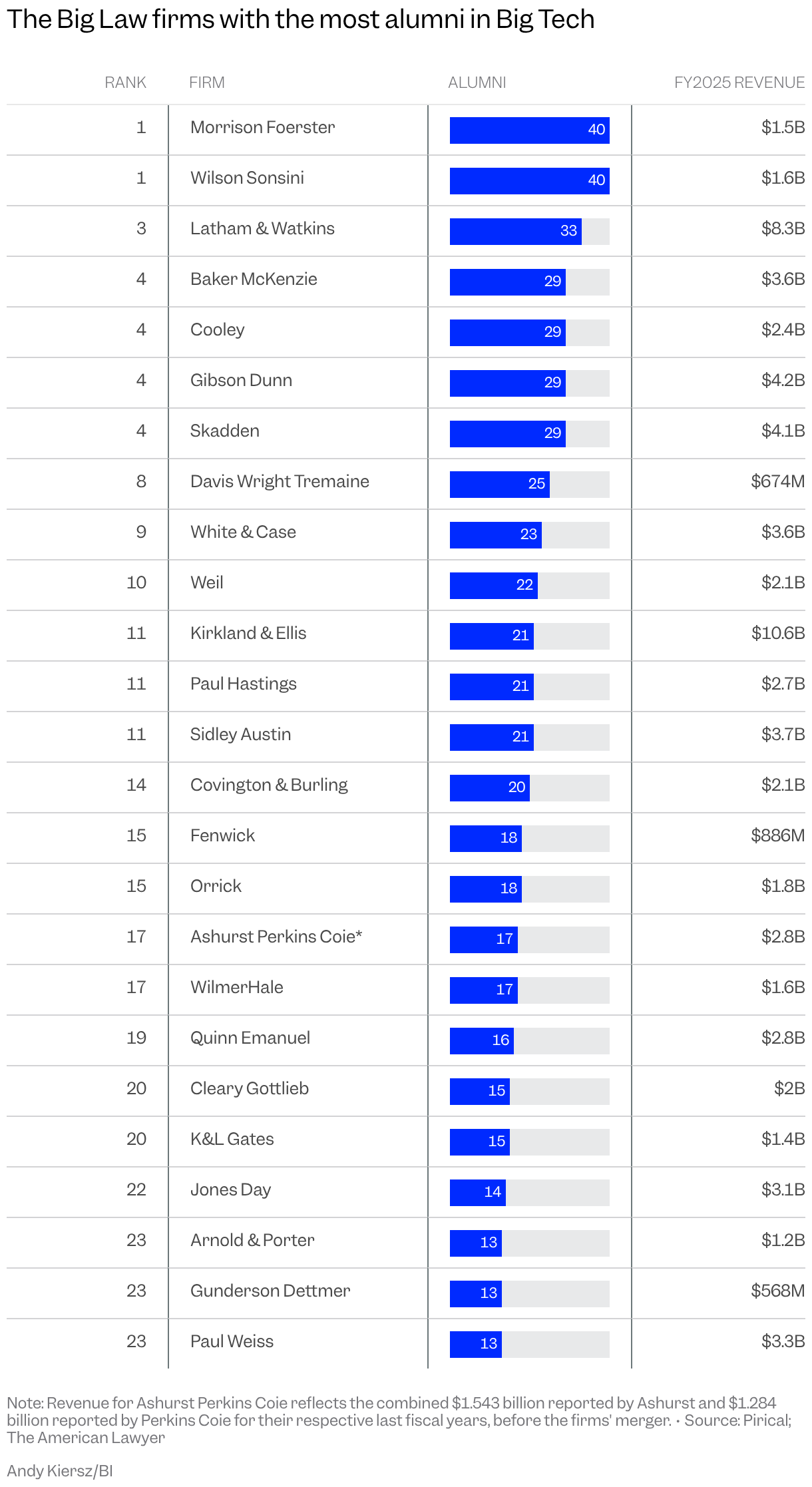
Pirical, a legal people-analytics company, tracked lawyers who previously worked at the 200 largest law firms by revenue in the United States and now hold legal roles at seven tech companies: Google, Meta, Microsoft, Nvidia, OpenAI, Anthropic, and SpaceX. Pirical filtered out summer associates and interns.

Morrison Foerster and Wilson Sonsini tied for the top spot, each with 40 alumni working in legal roles across the seven companies. Both firms regularly represent tech startups and the investors backing them.

Latham & Watkins followed with 33 former lawyers. Kirkland & Ellis, the industry's revenue leader, ranked 11th with 21 former lawyers working at those companies, tied with Paul Hastings and Sidley Austin.

Table

Pirical's analysis may have missed lawyers whose job titles fell outside its search criteria, said Craig Savitzky, its insights and content editor. He said newer companies, particularly Anthropic, are also likely undercounted because their legal teams are growing faster than public profiles are updated.

Big Law-Big Tech pipeline

For attorneys hoping to land a coveted job at a tech giant, a stint at a white-shoe law firm can be a stepping stone. They can trade billable-hour quotas for a seat closer to the business, attractive pay, and just one client to keep happy instead of dozens.

That combination makes these roles "some of the most highly desirable and sought-after positions" for law firm associates, said Casey Sullivan, a recruiter with CMW Legal Search.

There's another draw, Sullivan said. The companies at the forefront of artificial intelligence are wrestling with some of the thorniest legal questions of the day, from intellectual property to regulation.

"That's where the most interesting work is for lawyers," he said.

Not all law firms are equally effective launch pads. Pirical's Savitzky noted that the firms near the top of the list have deep ties to the tech industry, if not the deepest pockets.

Cooley brought in $2.4 billion in revenue last fiscal year, placing it 29th on The American Lawyer's ranking of top law firms by revenue. But it tied fourth on Pirical's list, with 29 alumni working at the seven tech companies, including nine at Nvidia, a longtime client.

Davis Wright Tremaine, which has represented Microsoft in antitrust and employment lawsuits, has 13 alumni working in the software giant's legal department. Fenwick, which advised Wiz and Fitbit on their sales to Google, has 13 lawyers at the search giant.

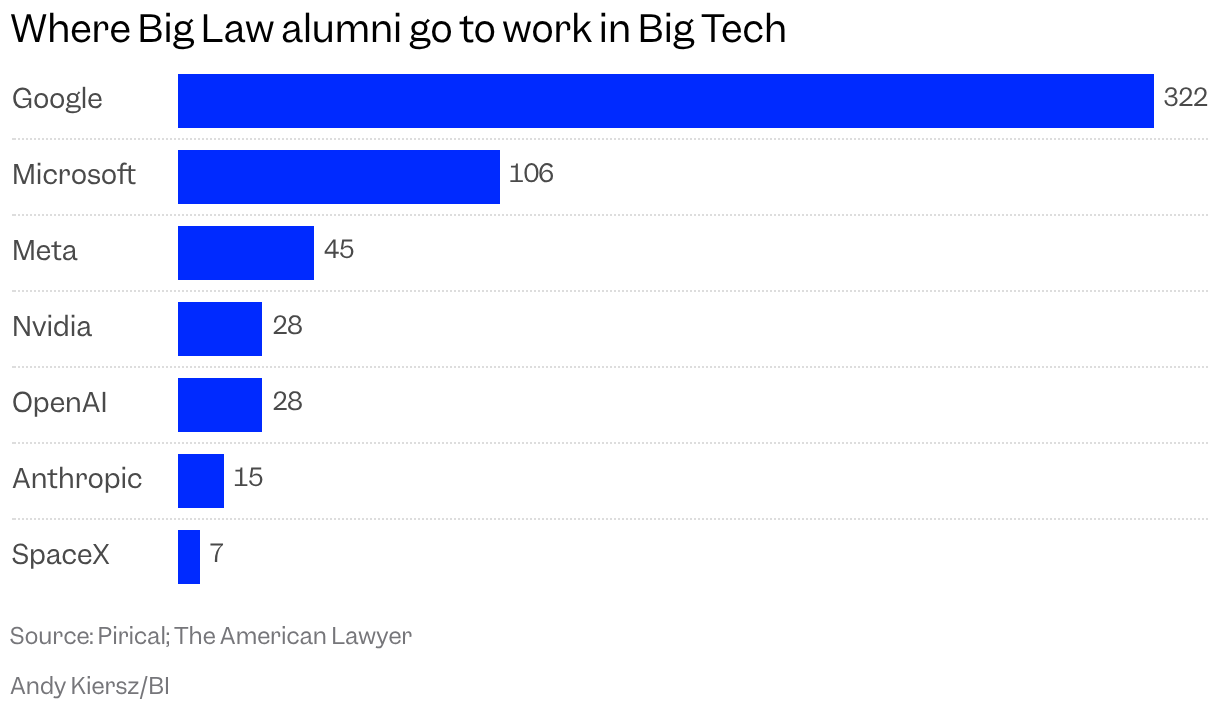
Business Insider also sliced the data another way, looking at which of the seven tech giants employ the most alumni from the top 25 firms on Pirical's list.

Bar Chart

Big Law is effectively a feeder school for Google's legal team. The company employs 322 alumni of the top 25 law firms on Pirical's list, more than any other tech company studied.

That doesn't necessarily mean Google is the most desirable location for lawyers leaving Big Law. Savitzky said the numbers likely reflect the sheer size of Google's legal department and the decades it has had to recruit from top firms.

Read the original article on Business Insider
  •  

Here's how Canva's new image generation tool compares to models by OpenAI, Google, and Meta

A red gemstone pendant is shown handheld beside the same pendant displayed in a glass case.
Canva has launched Canva Craft, a new image generation tool.

Business Insider

  • Canva launched Canva Craft, a tool similar to AI image models by Google, Meta, and OpenAI.
  • Surprisingly, Canva fell short on a design task but did well at generating more realistic images.
  • Here is how Canva's new image generation tool stacks up against ChatGPT, Gemini, and Muse.

Canva wants a shot at winning the AI image generation race.

The design platform launched Canva Craft on Thursday, its first image-generation model, similar to those from Google, Meta, and OpenAI.

Users can access Craft through Canva’s Dream Lab, including with free accounts, though it is subject to AI usage limits. You’ll need to sign in to a Canva account to get started.

In the release announcement, Canva said the tool plans a design’s layout, proportions, and text before generating an image, an approach that aims to help it produce legible lettering and accurate details.

The company also said that the model was trained on human-designed Canva templates, including posters, menus, and presentations, rather than photographs.

To test how Canva performs, Business Insider created three image generation prompts with escalating difficulty levels — from designing a simple greeting card to creating a photorealistic image from scratch.

Here is how Canva's brand-new image generation tool stacked up against three of the most powerful models.

Canva did not respond to a request for comment.

Starting off with an illustration

Three colorful personalized birthday card designs feature illustrated pink-haired characters and visible messages for Jessica turning 28.
Canva's response to a greeting card prompt (left), compared to ChatGPT (middle) and Gemini (right).

Business Insider

We started off simple with a prompt for a birthday card.

Create a cartoon "Happy Birthday" greeting card for a friend named Jessica who has pink hair, brown eyes, likes to wear paisley, and is turning 28 years old in November.

Surprisingly, Canva, the design platform, fell short in its design of the birthday card, from the awkward font to the outsize head of the cartoon character. It didn't even bother to include any paisley.

By comparison, ChatGPT and Muse understood the assignment.

ChatGPT guessed that the recipient's favorite color might be pink, while Muse thoughtfully wove in cozy fall elements for the November birthday girl.

A chat interface displays a colorful illustrated birthday card for Jessica with balloons, pumpkins, fall leaves, and the number 28.
Muse wove in cozy fall elements for the November birthday girl.

Screenshot/Business Insider

Meanwhile, Gemini took the request literally and produced an image of an actual card. Extra points!

Winner: Muse

Editing an image

Web editing interface shows a red garnet pendant displayed in a glass vitrine on a blue cushion.
The request and original image (left). Canva's results (right).

Screenshot/Business Insider

For the second task, I tested the AI models' ability to identify an element and place it in a brand-new setting.

Edit this image of me holding a necklace pendant. Take the red garnet pendant off my hand and make it look as if it is displayed in a vitrine in a jewelry showroom.

Canva did a great job of identifying the pendant and creating an atmospheric setting, but, like Gemini, it depicted the jewelry in a way that defied physics and common sense. It would be unrealistic for a pendant to float in the air or sit propped on a metal pole.

Three display case views show a red garnet rosette pendant on necklace stands and a pedestal.
ChatGPT (left), Muse (middle), and Gemini (right).

Business Insider

ChatGPT and Muse once again outperformed other models in understanding how things typically look in reality. Muse, however, made some alterations to the pendant, which I didn't ask for.

Winner: ChatGPT

Creating a photorealistic image from scratch

Orange tabby cat with bat-like wings sits on a stone castle ledge under a full moon.
Canva's depiction of a cat perched atop a gothic castle.

Made with Canva/Business Insider

With Halloween approaching, I asked for a realistic depiction of my favorite animal.

Generate a photorealistic image of a long-haired orange tabby cat in a Halloween costume with bat wings, perched on the edge of a gothic medieval castle under the full moon and a starless night sky.

Though the cat's fur looks a little too strandy and high-contrast in Canva's creation, no components are missing or malformed, and the image composition pretty much matches the quality of Muse and Gemini.

The clear winner for me in this round, however, would be ChatGPT.

Orange long-haired cat wearing bat wings poses on gothic stone ledges under full moons in a dark fantasy triptych.
Gemini (left), ChatGPT (middle), and Muse (right).

Business Insider

Not only is the cat's posture majestic, but the soft glow on his left side is extremely realistic, and the white balance is well done. There are also clouds softly cradling the moon, which could be a response to my request for a starless sky.

Winner: ChatGPT

Overall, it's evident that Canva still has a lot of room to grow compared to other models, especially if graphic design is its focus. For now, I'll stick to moving components around by hand.

Read the original article on Business Insider
  •  

Mark Zuckerberg keeps coming out on top

Mark Zuckerberg
Meta CEO Mark Zuckerberg.

picture alliance/Getty; Tyler Le/BI

Meta's AI gamble is suddenly looking like a win for Mark Zuckerberg.

That was far from a given. Even the Meta CEO was doubting himself. His company had poured hundreds of billions of dollars into AI investments with largely unproven results.

"Are you sure this is going to work?" he asked his 29-year-old AI chief, Alexandr Wang, at the end of last year, he recalled on a recent episode of the "Cheeky Pint" podcast.

Those risky AI bets — which one analyst compared to throwing spaghetti at the wall — as well as the massive layoffs and reorganization that came with them, are now starting to pay off. Meta beat its AI rivals to the punch with its new AI assistant, Muse, and it finally released a frontier AI model. Although Muse is bleeding cash amid high compute costs, analysts are excited by its moneymaking potential.

Zuckerberg is riding high, too. Sipping a Guinness alongside Wang during a recent podcast interview, the pair extolled Meta's AI prowess.

"You never know when you launch something how it's going to be received," the CEO said. "There's always the case where you get a home run, which in this case it was, right? And it's just like extremely well received right off the bat."

And Meta seems to believe in Zuckerberg's leadership more than ever. His latest coup: Convincing the company to issue a new class of shares after he threatened to list his Palo Alto compound and leave California as voters weigh a billionaire tax.

The big question is how long the good vibes will last. Meta is still spending gobs of money on AI without a concrete financial payoff. Some remain skeptical.

"The bill is huge," David Wagner, a portfolio manager at Aptus Capital Advisors, told Business Insider.

"He's won the narrative. He hasn't proven the return yet."

Meta's social reckoning era

Zuckerberg is no stranger to public discourse. He's undertaken multiple personas: the nerdy wunderkind in hoodies, the jacked wife guy, the unapologetically masculine Trump ally.

At the beginning of this year, it looked as if he was headed for a new reckoning, and it wasn't just because of the aptly named sequel to "The Social Network."

Zuckerberg was on trial, taking the stand in a landmark lawsuit that alleged Meta's platforms harmed the mental health of young people. (Meta was found negligent and is appealing.) It was one of three major lawsuits this year that put the company on the defensive against claims that its technology posed safety risks to children.

Mark Zuckerberg at LA courthouse
In February, Mark Zuckerberg appeared at a Los Angeles courthouse to defend the company in a landmark social media addiction trial.

Jon Putman/Anadolu via Getty Images

And there were the more typical Zuckerberg cringe moments, too, like his front-row appearance at a Prada fashion show that raised eyebrows across the internet.

On the inside, employee morale was waning. Though the billionaire CEO had called 2026 "the year of AI," Meta had little momentum, and unpopular decisions — including a program to track employee keystrokes — amplified the discontent.

Also, Meta had one of its largest rounds of layoffs, ever. Meta began trimming staff in March, followed by a huge round in May, when it laid off about 10% of its workforce.

Separately, Meta reshuffled another 7,000 workers as part of an AI-focused reorganization of its tech and product teams. Many engineers were relegated to individual contributor status. Meta later asked some of the employees it had demoted to return to their managerial roles.

The AI push didn't seem to be paying off: In the second quarter of this year, 98% of revenue came from its traditional advertising business — not AI.

Morale was "maybe not the worst it's ever been in 20 years here, but it's probably up there," Meta's chief technology officer, Andrew "Boz" Bosworth, said during an internal call in June.

The groundwork for Meta's comeback

Amid the chaos, Zuckerberg laid the groundwork for a comeback. Wang and Meta's elite AI researchers moved their desks to sit near Zuckerberg.

Starting last year, Zuckerberg and Wang also went on a talent-hiring spree, dangling pay packages worth hundreds of millions of dollars to poach top researchers.

Zuckerberg empowered key lieutenants, including former GitHub CEO Nat Friedman, to go ham on any vision they had, including on his pet project, an AI assistant. It all fit into Zuckerberg's longtime playbook of embracing small teams and overseeing reorgs until something works — move fast and break things, as he has infamously put it.

It worked.

Muse, the long-awaited Meta AI agent, became a breakout hit. A week after it launched, it shot to the top of the app store, and has since achieved more than 10 million downloads in North America. The team was stunned to have beaten OpenAI to market, a person familiar with the matter said. OpenAI's rival product, Dots, launched three weeks later.

Jolly, Meta's mascot for its Muse agent, waves.
Jolly is the mascot for Meta's Muse AI agent, which launched successfully last month.

Bloomberg/Getty Images

Meta also threw unprecedented compute and talent at building a series of frontier AI models, called Muse Wonder, that could keep up with those from giants like OpenAI and Anthropic.

On Meta's third-quarter earnings call, Zuckerberg was optimistic that Meta's AI and hardware investments could soon become cash cows, as people shop through Muse and buy more virtual-reality glasses powered by the company's growing AI chops.

Meta, meanwhile, views Zuckerberg as more critical than ever to its long-term fortunes.

Key board members abruptly excused themselves from a dinner with Zuckerberg in September after he told them he was going to sell his Palo Alto estate in response to California's proposed billionaire tax, Meta disclosed in a filing on Wednesday.

Four days later, a special committee returned with a deal that would give Zuckerberg $20 billion in "immediate liquidity" to cover the tax — if it passes — without reducing his controlling stake in Meta. Meta also made plans to ensure that billions in fresh AI fundraising wouldn't dilute Zuckerberg's control.

"Meta's track record of significant value creation for its shareholders is in large part due to his strong leadership, unique and creative vision, and exceptional management abilities," the company said in a press release.

The personal win comes as some of his other problems have blown over. Meta settled a major lawsuit brought by attorneys general across states, Washington, DC, and US territories. As part of the settlement, the company committed to make changes to its apps, such as daily time limits and pausing notifications overnight. The agreement was part of an August settlement, a move that allowed Meta to call out its competitors such as YouTube and TikTok.

"All platforms should empower parents and support teens by putting the same measures in place, because we know that when teens are restricted on one app, they simply move to another," the company said in a blog post at the time.

Big questions still loom. The day after Meta reported strong earnings and Muse adoption, its stock fell 7% as investors absorbed the scale of the company's hundreds of billions of dollars in future spending commitments.

And the legal troubles keep on coming. This week, a New Mexico jury also ordered Meta to pay a staggering $25 billion over the Cambridge Analytica scandal, a case that Meta plans to appeal.

Whether Zuckerberg's strategy is sustainable or not, the vibe shift has been notable — and may have proven naysayers wrong, at least until the next period of chaos erupts.

"Meta is cool again," Jesse Cohen, an analyst at Investing.com, said in a note. "That's the Muse effect."

Read the original article on Business Insider
  •  

The states with the fewest and most data centers, ranked

Aerial view of a large industrial facility with rooftop equipment, exterior construction, roads, parking lots, and surrounding greenery.
An Amazon Web Services data center under construction in Sterling, Virginia. Virginia has the highest number of data centers of any state.

Anna Moneymaker/Getty Images

  • The AI boom is accelerating data center development across the US.
  • Even states with few data centers are attracting major hyperscale projects.
  • Here's how all 50 US states rank by their number of operational data centers.

The data center business is booming in the US, and some states are feeling it more than others.

Data centers, which house the computing machines that power digital services, have been around for decades. However, the amount of computing power required to fuel the AI boom has accelerated their development and brought the industry into the mainstream.

This ranking was compiled by analyzing data from Data Center Map, an industry source that maps data center locations around the world. It shows a snapshot of its US database as of October 2026. Business Insider limited this ranking to fully operational data centers.

Data Center Map compiles its data from multiple sources and mainly tracks cloud and colocation service providers. Each data center it tracks has to have an initial capacity of at least 10 cabinets. While some states have hyperscale AI data centers, others have relatively small operations.

Firstly, data center operators and service providers add their own listings to market themselves. Data Center Map also monitors external databases and manually identifies any missing operators. It also handles requests from users who identify missing or outdated listings.

There is no federal requirement for data centers to register in a central database, so the figures should not be interpreted as a complete census of every data center in the country. Data Center Map also says it has a "more limited coverage on enterprise and government data centers."

Last year, Business Insider created its own US data centers map, which included estimated power usage, as part of an investigation into the industry.

Here are the states with the most operational data centers, ranked from least to most.

50. Vermont
Aerial view of a small town with a white church steeple, forested hills, and mountains under a cloudy sky.
Stowe, Vermont.

Jim Espey/Getty Images

Number of operational data centers: 3

Vermont's three operational data centers are located in Stowe, South Burlington, and Williston. The state has a limited electrical grid, according to the Vermont Natural Resources Council.

49. Alaska
Aerial view of downtown Anchorage with residential neighborhoods, high-rise buildings, green parkland, and Cook Inlet waterfront.
Anchorage, Alaska.

Jacob Boomsma/Getty Images

Number of operational data centers: 4

Half of Alaska's operational data centers are located in Anchorage. The University of Alaska Fairbanks said that the high cost of electricity and network connections are some of the challenges for data center buildout in the state.

48. South Dakota
Waterfalls cascade over rocky ledges beside a stone-and-wood structure under a partly cloudy sky.
Sioux Falls, South Dakota.

Lindsay Guido/Getty Images/iStockphoto

Number of operational data centers: 5

Most of South Dakota's data centers are in Sioux Falls. Lawmakers in South Dakota rejected proposals for industry tax incentives in 2026 while enacting new restrictions on electricity and water use, according to the South Dakota Searchlight.

46. Maine (tie)
Green steel truss bridge spans a calm river beside rocky banks, vegetation, and red brick industrial buildings.
Brunswick, Maine.

Photo Italia LLC/Getty Images/iStockphoto

Number of operational data centers: 6

Maine has data centers in Portland, Brunswick, and Bangor.

Maine's Gov. Janet Mills signed an order in April to establish a data center advisory council to advise on large-scale data center development.

46. Delaware (tie)
Wilmington, Delaware.

Bo Shen/Getty Images

Number of operational data centers: 6

Half of the data centers in Delaware are located in Wilmington.

Delaware Gov. Matt Meyer signed legislation in August requiring data centers to generate their own energy and cover infrastructure costs, WHYY reported.

44. West Virginia (tie)
Steel arch bridge spans a river beside a downtown skyline at dusk with reflections on the water.
Charleston, West Virginia.

Sean Pavone/Getty Images/iStockphoto

Number of operational data centers: 7

West Virginia's data centers are located in South Charleston, Bridgeport, Charleston, Star City, Petersburg, Nitro, and Berkeley Springs.

Having previously lacked the regulatory framework to approve or deny large-scale projects, Gov. Patrick Morrisey announced a data center development plan in August.

44. Rhode Island (tie)
Aerial view of downtown Providence skyline beside the Providence River under a partly cloudy blue sky.
Providence, Rhode Island.

Wirestock/Getty Images

Number of operational data centers: 7

All of Rhode Island's data centers are located in Providence.

The Providence Journal reported in April that one of the reasons Rhode Island has not been as attractive to data center developers is high energy costs.

42. Montana (tie)
Elevated view of a city skyline with tree-filled neighborhoods and low hills under a cloudy sky.
Billings, Montana.

George Dodd/Getty Images

Number of operational data centers: 8

The majority of Montana's data centers are located in Billings.

Big Sky Digital Infrastructure is developing a 5,100-acre campus 30 miles north of Billings.

42. Hawaii (tie)
Honolulu waterfront skyline at dusk with Aloha Tower lit beside harbor water and office buildings.
Honolulu, Hawaii.

otman lazrak/Getty Images

Number of operational data centers: 8

Over half of Hawaii's data centers are in Honolulu.

The Honolulu Civil Beat reported that there are currently no hyperscale data centers in Hawaii.

41. Arkansas
Urban park with a winding boardwalk over water, green trees, and a modern skyline beneath cloudy sunlight.
Little Rock, Arkansas.

Brandon Olafsson/Getty Images

Number of operational data centers: 9

The city with the most data centers in Arkansas is Little Rock.

Google announced its first data center in the state, to be located in West Memphis, in 2025, while Avaio is developing a large-scale one near Little Rock.

39. New Hampshire (tie)
Aerial view of a riverfront city with brick mill buildings, downtown towers, highways, and autumn trees.
Manchester, New Hampshire.

ChrisBoswell/Getty Images/iStockphoto

Number of operational data centers: 10

Manchester has three data centers, while the rest are spread across seven different cities.

A proposed data center in Nottingham was withdrawn earlier this year following local opposition, the New Hampshire Bulletin reported.

39. Idaho (tie)
Downtown Boise skyline and the Idaho State Capitol are lit by sunset beneath dramatic storm clouds.
Boise, Idaho.

knowlesgallery/Getty Images

Number of operational data centers: 10

Four of Idaho's 10 data centers are located in Boise, followed by three in Coeur d'Alene.

Meta plans to operate a $1.2 billion data center in Kuna, which it broke ground on in 2022.

38. Louisiana
Workers in safety vests walk through a muddy construction site with cranes, barriers, and steel framing in the background.
Construction underway at River Bend, Hut 8's AI data center campus in Saint Francisville, Louisiana.

Kathleen Flynn/Getty Images

Number of operational data centers: 12

The majority of Louisiana's data centers are located in New Orleans and Baton Rouge.

Meta is building its largest-ever data center in Richland Parish, which will house the multi-gigawatt AI cluster Hyperion.

37. North Dakota
Parked cars line a downtown street with historic storefronts, a skyway, and a modern high-rise under blue sky.
Fargo, North Dakota.

gnagel/Getty Images

Number of operational data centers: 13

Four of North Dakota's data centers are located in Fargo, followed by three in Ellendale.

There are some large-scale data center projects in the state, such as Applied Digital's 280-megawatt campus near Harwood.

36. Kansas
Terraced concrete spillway and pedestrian bridge overlook a pond in a landscaped park under a clear blue sky.
Lenexa, Kansas.

Wirestock/Getty Images/iStockphoto

Number of operational data centers: 15

Nearly half of Kansas' operational data centers are located in Lenexa, which has seven of the state's 15 facilities.

Kansas is experiencing a surge in plans for large-scale data center development, including one by Dubai-based developer Damac Properties in Edgerton, Kansas, The Wall Street Journal reported.

35. Mississippi
Industrial facility grounds with utility poles, work trucks, and a Southaven water tower behind a large white building.
Work continues on a data center being built by SpaceXAI in Southaven, Mississippi.

Brandon Dill / AFP via Getty Images

Number of operational data centers: 16

Six of Mississippi's operational data centers are located in Canton.

Amazon announced in April this year that it increased its total planned investment in its Mississippi data centers, including in Canton, to $25 billion.

33. New Mexico (tie)
Desert roadside gate and fence stand before a dry hillside and rugged mountains under a clear blue sky.
Los Lunas, New Mexico.

Lily Kimei/Getty Images

Number of operational data centers: 20

Over half of New Mexico's data centers are located in Los Lunas.

Meta opened a data center in Los Lunas in 2019, which it has since expanded.

33. Connecticut (tie)
Elevated view of an urban plaza with leafless trees, surrounding buildings, and an American flag under a cloudy sky.
Stamford, Connecticut.

stockphoto52/Getty Images/iStockphoto

Number of operational data centers: 20

Connecticut's 20 operational data centers are spread across multiple cities, with the highest concentration in Stamford.

The Connecticut Mirror reported that lawmakers said the state's high electricity costs make it unattractive to data center developers.

32. Wyoming
Black cattle graze among sagebrush on a grassy hillside beneath a cloudy sky.
Cows graze in the area where the Prometheus Hyperscale Data Center will be built east of Evanston, Wyoming.

Natalie Behring/Getty Images

Number of operational data centers: 22

All but two of Wyoming's data centers are located in Cheyenne, with the other two in Casper and Afton.

In 2012, Microsoft built its first data center in Cheyenne and has expanded its footprint there multiple times since.

31. Alabama
Dusk Over The Downtown Urban City Center of Huntsville Alabama

ChrisBoswell/Getty Images/iStockphoto

Number of operational data centers: 23

Huntsville has the most operational data centers in Alabama.

Meta broke ground on its Huntsville campus in 2018.

30. South Carolina
Crowd gathers before a bunting-decorated stage labeled “MONCKS CORNER,S.C.” under a cloudy sky.
Moncks Corner, South Carolina.

Bloomberg/Getty Images

Number of operational data centers: 26

Moncks Corner has the most operational data centers in South Carolina, accounting for 11 of the state's 26 facilities.

Google has three facilities in South Carolina, where it first made its footprint in 2007.

29. Maryland
Aerial view of downtown Baltimore skyline with urban buildings, roads, greenery, and water under a partly cloudy sky.
Baltimore, Maryland.

Majestic_Aerials/Getty Images

Number of operational data centers: 27

Baltimore has the most operational data centers in Maryland, followed by Frederick.

Amazon is developing a new data center campus in Frederick, Maryland.

28. Kentucky
Aerial view of downtown Louisville skyscrapers and hotels, including the Galt House Hotel, under a clear blue sky.
Louisville, Kentucky.

Nicholas Klein/Getty Images

Number of operational data centers: 32

Louisville has the most operational data centers in Kentucky, with 13 of the state's 32 facilities.

Mason County, Kentucky, recently signed a development agreement for a Meta hyperscale data center, as reported by LEX 18.

27. Utah
Fenced industrial buildings sit beyond a dirt road and scrubland under a cloudy mountain skyline.
Meta data center campus complex in Eagle Mountain.

Charles-McClintock Wilson/NurPhoto via Getty Images

Number of operational data centers: 35

Salt Lake City has the most operational data centers in Utah, followed by Bluffdale, Eagle Mountain, and West Jordan.

Meta operates a campus in Eagle Mountain, and the National Security Agency operates one located near Bluffdale.

25. Oklahoma (tie)
Aerial view of a large construction site with earthmoving equipment, parked cars, trailers, and cleared land.
Construction of a 500-acre data center in Owasso, Oklahoma.

Jim West/UCG/Universal Images Group via Getty Images

Number of operational data centers: 36

Most of Oklahoma's data centers are located in Tulsa, followed by Oklahoma City and Pryor.

Google operates a facility in Pryor and is developing additional locations in the state.

25. Nebraska (tie)
Google logo appears on a white industrial building beside utility structures, poles, grass and a cloudy sky.
Google data center in Papillion, Nebraska.

Misty Prochaska for The Washington Post via Getty Images

Number of operational data centers: 36

Omaha has the most operational data centers in Nebraska, with 11, followed by Papillion and Springfield, each with 8.

Google has campuses in Lincoln, Omaha, and Papillion.

24. Wisconsin
Aerial view of a large industrial campus under construction with retention ponds, roads, and a sunset horizon.
Microsoft's data center project in Mount Pleasant, Wisconsin, on November 13, 2025.

Joe Timmerman/Wisconsin Watch via Getty Images

Number of operational data centers: 41

Wisconsin's 41 data centers are spread across several cities, with Milwaukee and Madison hosting the most.

Microsoft finished building an AI data center in Mount Pleasant in June.

23. Massachusetts
Aerial view of a neighborhood with houses, tree-lined streets, and a large black industrial building.
The Markley Group data center in Lowell.

Danielle Parhizkaran/The Boston Globe via Getty Images

Number of operational data centers: 46

Marlborough has the most operational data centers in Massachusetts, with six, followed by Boston with five, and Cambridge and Waltham with four each.

CBS News reported that the biggest, the Markley data center, is in Lowell.

21. Missouri (tie)
Downtown Kansas City skyline rises beyond green parkland and roads in warm evening light.
Kansas City, Missouri.

Garrett Smith/Getty Images

Number of operational data centers: 47

Missouri's 47 operational data centers are spread across eight cities, with Kansas City accounting for most of them.

Axios reported in September that most of Missouri's planned data center expansion is concentrated in the Kansas City metropolitan area, citing research by Cleanview.

21. Minnesota (tie)
Spoonbridge and Cherry sculpture spans a pond in a green park with the Basilica of Saint Mary in the background.
Minneapolis, Minnesota.

GummyBone/Getty Images

Number of operational data centers: 47

Minnesota's 47 data centers are spread across 21 cities, with Minneapolis accounting for 15, followed by Eden Prairie, St. Paul, Shakopee, and Minnetonka.

Google announced earlier this year that it plans to build a data center in Pine Island.

20. Nevada
Aerial view of a large construction site with a partially built structure in a dry hilly desert landscape.
The Tahoe Reno Industrial Center. Several companies are building facilities in an area about 15 miles east of downtown Reno in this development project named the Tahoe Reno Industrial Center including data storage facilities from Switch. Apple is also building a data storage facility nearby in the Reno Technology Park (Photo by David Butow/Corbis via Getty Images)

David Butow/Corbis via Getty Images

Number of operational data centers: 51

More than half of Nevada's data centers are located in Las Vegas.

Switch has plans to expand its Citadel Campus at the Tahoe Reno Industrial Center, which the company says will have gigawatts of power capacity upon completion.

19. Indiana
NEW CARLISLE, INDIANA - OCTOBER 2: In this handout provided by Amazon, a technician works at an Amazon Web Services AI data center in New Carlisle, Indiana on October 2, 2025.
A technician works at an Amazon Web Services AI data center in New Carlisle, Indiana.

Noah Berger/Getty Images via Amazon Web Services

Number of operational data centers: 51

Indiana's 51 operational data centers are spread across 11 cities, with Indianapolis leading and New Carlisle following.

18. Tennessee
Industrial construction site behind a chain-link fence with heavy equipment, trucks, tall towers, and drifting smoke.
Construction at an xAI data center in Memphis on April 25, 2025.

Brandon Dill for The Washington Post via Getty Images

Number of operational data centers: 53

Nashville has the largest concentration of Tennessee's 53 operational data centers.

Elon Musk's xAI describes its Colossus facility in Memphis as the world's largest AI supercomputer.

16. Michigan (tie)
Aerial view of a large industrial construction site with cranes, white-roofed buildings, and surrounding farmland.
Construction of a data center developed by Related Digital for Oracle and OpenAI in Saline, Michigan.

: Jim West/UCG/Universal Images Group via Getty Images

Number of operational data centers: 58

Michigan's 58 data centers are spread across 27 cities, with Southfield accounting for the most.

Part of the Stargate Project, Related Digital kicked off construction of a $16 billion data center called "The Barn" in Saline Township in June.

16. Colorado (tie)
Heavy earthmoving machines work on a dirt mound behind a chain-link fence at a construction site.
QTS constructs a data center in Aurora in 2025.

RJ Sangosti/MediaNews Group/The Denver Post via Getty Images

Number of operational data centers: 58

There are 14 data centers in operation in Denver, followed by 11 in Englewood, 7 in Centennial, and 7 in Colorado Springs.

QTS is expanding its 65-acre data center campus in Aurora, Colorado, Colorado Public Radio reported in July.

15. Iowa
Blue and gray edged facility building at 9100 behind a black security fence under clear sky.
The "Edged Des Moines" data center nears completion in Altoona, Iowa.

Leon Neal/Getty Images

Number of operational data centers: 69

Altoona and West Des Moines are among Iowa's leading data center locations, alongside Council Bluffs and Des Moines.

Google has had a campus in Council Bluffs since 2007, recently invested in its expansion, and has also kicked off a new one in Cedar Rapids.

14. North Carolina
Modern gray building with vertical concrete panels, flags, parked cars, landscaped rocks, trees, and lawn under cloudy sky.
Meta's data center in Forest City, taken in 2010 when it was formerly a Facebook data center.

Rainier Ehrhardt/Getty Images

Number of operational data centers: 76

Charlotte has 24 data centers, the most in North Carolina, followed by Raleigh, Maiden, and Lenoir.

Apple operates a data center in Maiden, according to The Charlotte Observer. Google and Meta also operate data centers in the state.

12. Pennsylvania (tie)
Two large cooling towers release steam behind an industrial facility construction site under a partly cloudy sky.
An Amazon Web Services construction project in Berwick.

Paul Weaver/SOPA Images/LightRocket via Getty Images

Number of operational data centers: 78

Pittsburgh and Philadelphia have the largest concentrations of operational data centers in Pennsylvania.

In 2025, Amazon announced plans to invest at least $20 billion in the state to expand its data center operations.

12. New Jersey (tie)
Large windowless concrete building sits behind a black fence along a quiet street under a clear blue sky.
The Equinix NY5 data center in Secaucus, New Jersey.

Kena Betancur/Getty Images

Number of operational data centers: 78

Secaucus and Piscataway are two of New Jersey's main data center hubs, alongside Jersey City.

Equinix operates a 129,436-square-foot data center in Secaucus, known as NY5.

11. Florida
Aerial view of a modern glass and concrete facility with orange accents beside a multi-lane highway.
The HostDime data center in Eatonville, Florida, is north of Orlando.

Paul Hennessy/SOPA Images/LightRocket via Getty Images

Number of operational data centers: 113

Florida's 113 operational data centers are spread across 27 locations, with Miami accounting for the most at 33, followed by Tampa with 20, Jacksonville with 13, and Orlando with nine.

Data center provider HostDime has been based in the state since 2003 and is building a 100,000-square-foot facility in Eatonville.

10. Arizona
A data center under construction under a blue sky.
A QTS data center under construction in Phoenix in 2024.

Bloomberg/Getty Images

Number of operational data centers: 114

Phoenix contains 34 of Arizona's data centers, followed by Goodyear with 24, and Chandler with 17.

ABC 15 reported that companies such as Meta, Apple, and Microsoft all have campuses in Arizona.

9. Georgia
Aerial view of a large industrial complex under construction surrounded by parking lots, roads, forest, and power infrastructure.
A QTS data center complex in Fayetteville, Georgia, in 2024.

Bloomberg/Getty Images

Number of operational data centers: 123

Atlanta has the largest concentration of operational data centers in Georgia, with 43 facilities, followed by Lithia Springs with 25 and Social Circle with 10.

Google built its first data center in Georgia in 2007, and QTS is has one in Fayetteville.

8. Washington
Large industrial warehouse complex with flat roofs surrounded by trees and roads under a cloudy sky.
The Sabey Data Centers' Seattle Data Center campus in Tukwila, Washington.

Bloomberg/Getty Images

Number of operational data centers: 132

Quincy has the largest concentration of operational data centers in Washington, with 33 facilities, followed by Seattle with 31, Tukwila with 16, and East Wenatchee with 11.

Washington's Department of Ecology says Quincy and Wenatchee are popular spots because they have cheaper, reliable energy.

7. Oregon
Modern white industrial building with large dark windows, concrete walkway, rocks, and sparse landscaping under a clear blue sky.
The Facebook Inc. Prineville Data Center stands in Prineville, Oregon, U.S., on Monday, April 28, 2014. The Facebook Prineville Data Center features leading energy-efficient technology, including features such as rainwater reclamation, a solar energy installation for providing electricity to the office areas and reuse of heat created by the servers to heat office space. Photographer: Meg Roussos/Bloomberg via Getty Images

Bloomberg/Getty Images

Number of operational data centers: 141

Hillsboro has the most operational data centers in Oregon, followed by Boardman, and then Umatilla and Prineville.

Oregon is home to Meta and Google's first-ever data centers: Meta built its in Prineville, and Google's The Dalles.

6. Illinois
Modern glass office building stands behind a wide road with parked cars and trees under a clear sky.
A CyrusOne data center in Aurora, Illinois.

Bloomberg/Getty Images

Number of operational data centers: 143

Chicago has the largest concentration of operational data centers in Illinois, with 49 facilities, followed by Elk Grove Village, which has 24. Lombard, Aurora, and DeKalb each have seven.

Companies such as Digital Realty Trust, Microsoft, Meta, and CyrusOne operate in Illinois.

5. New York
Gray industrial facility behind black security fencing, with autumn vegetation and trees under an overcast sky.
The JPMorgan Chase data center in Orangeburg, New York.

Kena Betancur/Getty Images

Number of operational data centers: 149

New York City is home to a large share of the state's operational data centers, with additional concentrations in Buffalo and Albany.

In July, New York was the first state to enact an executive order that imposed a statewide yearlong moratorium on hyperscale AI data centers.

4. Ohio
Aerial view of a large industrial construction site with rooftop equipment, rows of white units, cars, and surrounding fields.
The 5C Data Centers CMH01 on October 18, 2026 in Springfield, Ohio.

Michael M. Santiago/Getty Images

Number of operational data centers: 189

Columbus has the largest concentration of operational data centers in Ohio, with Johnstown, Hilliard, and Cleveland also home to significant numbers of facilities.

Intel announced plans in 2022 for a major semiconductor manufacturing facility in New Albany, a suburb in central Ohio known as the "Silicon Heartland," which is already home to data centers operated by Amazon, Google, and Meta, as Business Insider previously reported.

3. California
Aerial view of city blocks with modern buildings, streets, cars, and a waterfront pier beside the bay.
The Digital Realty SFO12 Data Center, center in the Rincon Hill neighborhood of San Francisco.

Stephen Lam/San Francisco Chronicle via Getty Images

Number of operational data centers: 285

Santa Clara has the largest concentration of operational data centers in California, with 75 facilities, followed by Los Angeles with 51 and San Jose with 26.

Major operators in Santa Clara include Digital Realty, Equinix, CoreSite, and Vantage Data Centers.

2. Texas
Aerial view of a large industrial building under construction amid red dirt earthworks, cranes, equipment, and surrounding forest.
The Stargate Oracle AI data center under construction on August 26, 2026 in Abilene, Texas.

Brandon Bell/Getty Images

Number of operational data centers: 358

Of Texas's 358 operational data centers, 58 are located in Dallas, 42 in Houston, and 39 in San Antonio.

Earlier this year, Business Insider, citing research from Jones Lang LaSalle, reported that Texas is on track to become the largest data center market in the world by 2030.

Texas is home to some of the world's largest planned data center projects, such as Fermi America's Project Matador.

1. Virginia
Aerial view of large industrial data center buildings beside a river and surrounding suburban neighborhoods.
An Amazon Web Services data center in Aldie, Virginia.

Bloomberg/Getty Images

Number of operational data centers: 452

Northern Virginia is not only the largest data center market in the US but also in the world. Major operators in the state include Equinix, Digital Realty, Microsoft, Vantage Data Centers, and Amazon.

Ashburn has the largest concentration of operational data centers in Virginia, with 102 facilities, followed by Sterling with 84 and Manassas with 60.

Read the original article on Business Insider

  •  
❌