Anthropic is touting its ability to use different AI chips in its initial public offering filing.
Analysts say a multichip strategy could weaken Nvidia's pricing power.
Switching chips is hard and expensive, putting it out of reach for smaller players.
Anthropic is hedging its bets by using multiple chips to handle its AI work — a strategy that could eventually erode Nvidia's dominance.
The AI lab says it manages compute "as a single, fungible pool from multiple strategic partners" — with software that can direct its work to different chips depending on where they're most productive, according to Anthropic's S-1 filing, which came out Monday as the company prepares to go public.
Anthropic says it uses hardware from four chip families: Amazon Trainium, Google TPUs, Nvidia GPUs, and AMD GPUs.
That flexibility, which Anthropic said "took years and significant investment to build," could make major AI companies less dependent on Nvidia over time and give them more negotiating leverage, analysts said.
"The real exposure could be Nvidia's pricing power," said Patrick Moorhead, founder and CEO of Moor Insights & Strategy, "because a customer that can shift work across four platforms negotiates very differently than one that can't."
Ashish Nadkarni, an analyst at IDC, added that a multichip approach also makes Anthropic less vulnerable to fluctuations in Nvidia's chip supply.
Breaking Nvidia's grip isn't easy
Although Anthropic's chip mix isn't new, the company is now pitching it as a core advantage to investors, Moorhead said.
The threat has its limits. Switching between chips is still difficult — especially when it comes to training AI models as opposed to running them, Moorhead said — and only the biggest AI companies have the resources to do it.
Anthropic also continues to spend billions on Nvidia compute, Moorhead said.
Gil Luria, head of technology research at D.A. Davidson, said that while other major companies like OpenAI likely take a multichip approach, it may not be worth the effort and investment for smaller players.
Brad Gastwirth, global head of research and market intelligence at Circular Technology, said Anthropic's strategy doesn't represent a major near-term threat. Having more chip options doesn't erase Nvidia's advantages in performance, networking, and software, he said.
There's a broader risk for Nvidia if AI compute becomes more of a commodity.
Citadel CEO Ken Griffin has warned that if supply overtakes demand, it could drive down rental prices.
"GPUs, like airlines, have a very low marginal cost to run," he told Bloomberg last week. "The moment you have overcapacity, pricing goes into freefall."
Nvidia did not immediately respond to a request for comment from Business Insider.
Have a tip? Contact this reporter via email at gweiss@businessinsider.com or Signal at @geoffweiss.25. Use a personal email address, a non-work WiFi network, and a non-work device; here's our guide to sharing information securely.
Cyprus may still be an unlikely place to build a biotechnology company, but Dr Marianna Prokopi-Demetriades, co-founder and director of Theramir, is increasingly convinced that this is precisely what gives the island something to prove.
At Theramir, that means developing precision-oncology technologies, building the manufacturing and regulatory foundations needed to move experimental therapies closer to patients, and trying to show that globally relevant biotech can emerge from a small ecosystem.
The work is slow by design. Cancer therapies cannot be rushed through validation, safety testing, manufacturing or regulation, and even strong laboratory results can take years to reach the clinic.
For Prokopi-Demetriades, that reality sits alongside a much bigger ambition. She wants Theramir to help prove that Cyprus can do more than support innovation from elsewhere. It can create it, retain the intellectual property and take it international.
From a small island to global biotech
That ambition received fresh recognition this year when Prokopi-Demetriades was named the 2026 Study UK Alumni Awards global winner for Business and Innovation, selected among 1,800 candidates from 120 countries.
For years, she said, Cyprus “was not a place people immediately associated with biotechnology”, even though its technology and innovation ecosystem has grown enormously over the past decade.
Being recognised internationally therefore felt “both like a very personal milestone and a huge surprise”, but Prokopi-Demetriades also sees it as an opportunity to put Theramir and Cyprus more firmly on the global biotech map.
She is careful, however, not to confuse recognition with progress itself. “Of course, awards do not suddenly bring deals or open doors,” she said, noting that in biotech, progress still depends on years of scientific R&D, validation, manufacturing and regulatory work.
What recognition can do is bring visibility to a field that often feels like “a long and lonely path”.
Her hope is that the award brings more confidence and excitement around biotechnology in Cyprus, inspires the next generation of scientists and helps strong science find “a real path to scale and, ultimately, reach patients”.
What Theramir is trying to do differently
The science behind Theramir starts from a simple but difficult reality. Cancer does not behave in the same way from one patient to another.
Each tumour has its own molecular profile and can evolve under treatment, Prokopi-Demetriades explained, particularly in metastatic and treatment-resistant disease, where cancer can activate several pathways in order to survive.
Theramir’s EVmiR® platform is designed around that complexity.
“We use extracellular vesicles (the body’s natural cellular messengers) to deliver microRNAs, small molecules that can regulate multiple cancer-driving pathways simultaneously,” she said.
The distinction lies in how those molecules act. “Rather than blocking one target, the aim is to interfere with networks controlling tumour growth, resistance and metastatic spread,” she explained.
The company’s lead programme targets triple-negative breast cancer, with expansion into bladder and pancreatic cancer. Because EVmiR® is a platform technology, different microRNAs can be selected for different tumour biology, creating what Prokopi-Demetriades described as “a potentially adaptable precision-oncology approach”.
Could a blood test help tell us what comes next?
Theramir is also developing companion biomarker tools alongside its therapeutics, bringing diagnosis and treatment closer together.
The aim, Prokopi-Demetriades said, is “to connect treatment with the biomarkers that can tell us who is most likely to benefit and how the disease is responding”.
Today, Theramir evaluates LCP-1 expression through tissue biopsy, while liquid biopsy allows the team to study circulating microRNAs and tumour-associated extracellular vesicles in blood.
The value comes from combining those sources of information. “Together, these markers could support patient selection and provide a more dynamic picture of treatment response, with future potential for real-time monitoring and earlier detection of progression, resistance or recurrence,” she explained.
When the laboratory is only the beginning
A new challenge begins when promising science has to leave the laboratory.
“A promising laboratory result is only the beginning,” Prokopi-Demetriades said, because before a therapy can reach patients, the science must be reproduced consistently, safety and efficacy confirmed preclinically and the product transferred into GMP manufacturing with strict quality control and batch-to-batch consistency.
“This is why biotech development takes years rather than months,” she said.
Medochemie’s involvement is therefore significant. As she explained, “Medochemie’s involvement is important because it brings pharmaceutical manufacturing, quality and regulatory expertise directly into this next phase.”
For Theramir, the next major milestone is to translate EVmiR® into a clinical-grade product, establish a robust GMP manufacturing process and generate the data required to support first-in-human clinical development.
The expensive patience of biotech
That timetable also changes the way a biotech company has to think about investment.
Unlike a software startup, which can launch, test and change direction in months, biotech may spend years generating evidence before conventional revenues appear.
“Biotech investors are backing scientific progress long before conventional revenues appear, so milestones look very different: reproducible data, preclinical validation, GMP manufacturing, regulatory progress and eventually clinical development,” Prokopi-Demetriades said.
Public funding, she explained, helps de-risk the early science, while private investors “mainly place trust in the founders, the vision and the potential to create something with real patient impact”.
Strategic partners such as Medochemie then add sector expertise alongside capital.
There is, however, a limit to what money can accelerate. “Money can accelerate execution, but it cannot shortcut biology, safety or regulation” is how Prokopi-Demetriades put it, adding that this patience is part of “building biotech for the greater good”.
What could Cyprus become?
The question for Cyprus is whether individual companies such as Theramir can eventually become part of something broader.
Prokopi-Demetriades said the country has “come a long way since Theramir started”, when it was only the second company approved as an innovative company locally.
Her ambitions for the sector are focused. “Competing directly with mature biotech hubs is still unrealistic, but we can build our own niche,” she said.
Instead, she sees a real opportunity in next-generation biomanufacturing, developing specialised GMP capabilities that can take innovation from the laboratory towards the clinic.
Equally important is “creating and retaining Cyprus-made intellectual property”, then scaling it internationally through strategic partnerships and licensing.
That, she believes, would allow Cyprus “not simply to host innovation, but to originate and export it”.
When the science becomes personal
Behind the science, however, there is also a more personal contradiction.
Prokopi-Demetriades has spoken openly about losing people she loves to cancer while spending years working on therapies for the disease.
“There is a painful contradiction in spending years working on cancer therapies while, at the same time, losing people you love to the disease,” she said.
That experience creates an instinct to move faster.
“It makes you want to move faster, but it also reminds you why you cannot take shortcuts,” she said, adding that patients deserve “evidence and safety, not just promising science”.
Through the slower periods, she remains focused on why Theramir began. “The long timelines can be frustrating, but I know why we started,” she explained.
Reaching the first patient with a Theramir therapy would therefore mean far more than another development milestone.
It would be, she said, “a major scientific milestone and, for me, an intensely personal one”.
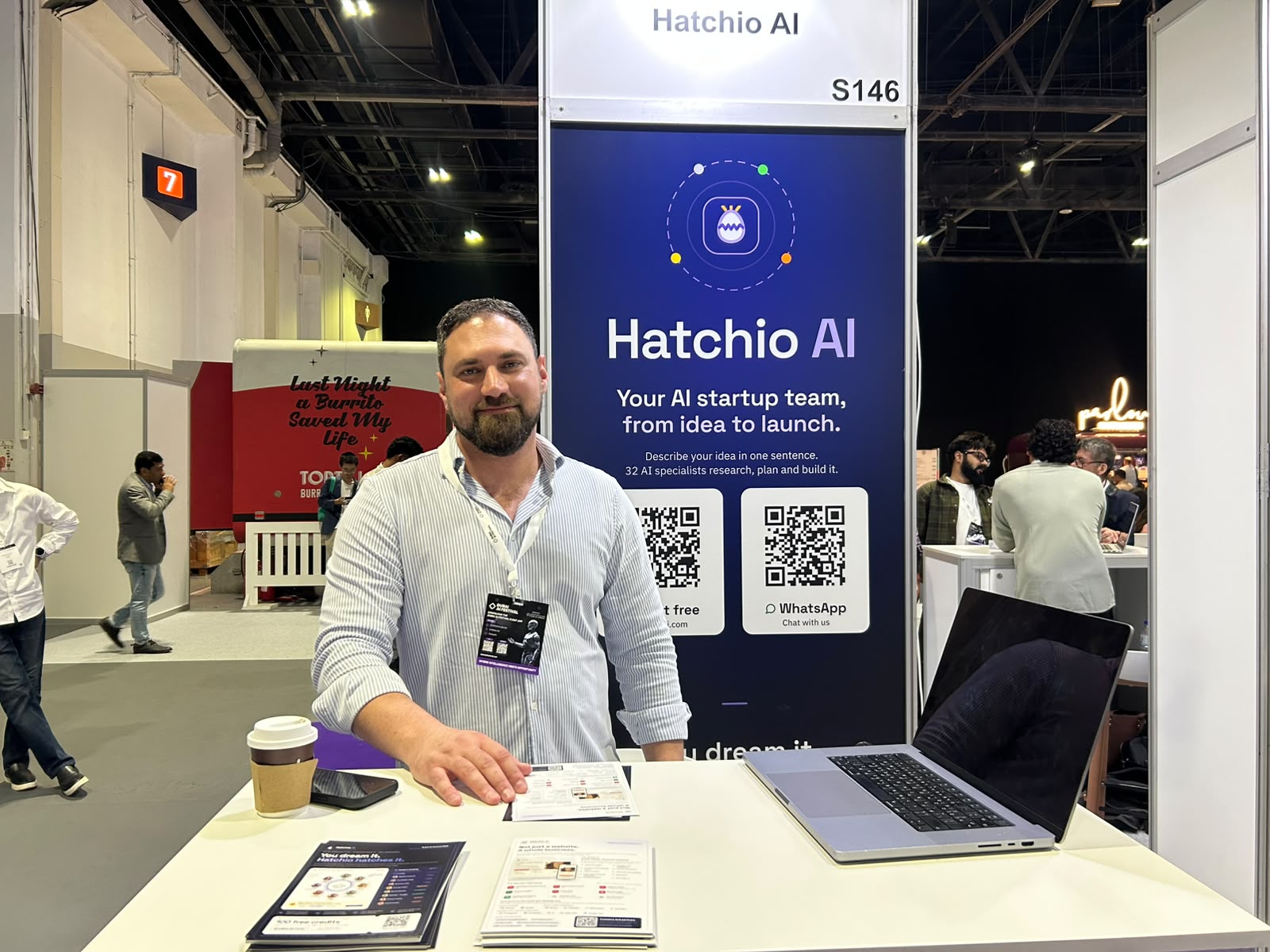
DUBAI: A Saudi-based startup is deploying 32 artificial intelligence agents across nine departments to help entrepreneurs turn business ideas into fully fledged startup projects, covering everything from financial planning and market research to website development and marketing. Hatchio AI is designed for non-technical founders, established businesses and startup incubators, bringing multiple business functions together on a single platform. The startup aims to reduce the time and resources re
Just two months after launching i spy, Cypriot founder and CEO Nicole Georgiou is already seeing signs that the way people discover fashion online may be changing faster than the tools they use to shop it.
The London-based fashion-tech platform is built around a familiar problem. An outfit catches your eye on TikTok, Instagram or Pinterest, but finding the pieces behind it can mean screenshots, Google searches, several retailer tabs and saved posts scattered across different platforms.
Georgiou is trying to bring those steps together, allowing users to take inspiration from elsewhere, search for exact or similar items, save products into boards and return to them when they are ready to buy.
Early users show real purchase intent
For Georgiou, the clearest early sign that there is a genuine problem to solve has come from user behaviour, with early users showing that “people aren’t just coming to i spy for inspiration, they’re coming with real purchase intent”.
That interest has translated into activity. In the platform’s first two months, entirely through organic growth, “we’ve seen more than 20,000 searches and 800 user-created boards, alongside thousands of products being saved,” she said.
Those searches are also increasingly tied to genuine buying decisions, with users looking for “things they genuinely want to wear and potentially buy, wedding guest dresses, holiday outfits, bridal looks and pieces they’ve seen elsewhere”.
For Georgiou, however, repeat use matters more than the initial download. “What matters to me isn’t just that someone downloads i spy, but that they come back,” she said, adding that “A download tells you someone was curious. Coming back tells you you’ve created something they actually want to use.”
The same applies to how users save products. Georgiou said “a save means something different on i spy”, explaining that on a traditional inspiration platform it can simply mean “I like this”, while on i spy it can mean “I might actually buy this”.
That difference is reflected in the way users behave, she added, with people beginning to “search, compare, save and organise products they are genuinely considering”.
Fixing a fragmented shopping journey
Asked what problem i spy is actually solving for consumers, Georgiou pointed to the increasingly fragmented nature of online shopping, saying “The way we shop online has completely changed, but the infrastructure hasn’t caught up.”
A typical journey, she said, might involve seeing an outfit on TikTok, saving something on Instagram, finding inspiration on Pinterest, using Google to search for the product, opening multiple retailer tabs and taking screenshots on a phone.
The result is that “The inspiration, search, saving and purchasing parts of the journey are completely disconnected,” she said.
That is the gap i spy is trying to close. Georgiou put it simply when she said “i spy connects that journey”, allowing users to “take inspiration from anywhere, find the exact or similar products, save them, organise them and come back when you’re ready to buy”.
Building between inspiration and purchase
While visual search itself is not new, Georgiou sees i spy as occupying a different place from larger platforms.
She described Google Lens as “a strong image search tool” and Pinterest as “incredible for inspiration”, but said i spy is “specifically built around fashion and around what happens between seeing something you like and deciding to buy it”.
That space between discovery and purchase is central to the company’s proposition, with Georgiou describing it as “the consideration layer between inspiration and purchase”.
Taking on the bigger platforms
Asked what makes i spy defensible when Google, Pinterest and other large platforms could potentially build parts of it, Georgiou said there is “a structural reason why this space is still relatively unowned”.
In her view, large platforms face conflicting incentives. “Pinterest ultimately wants to keep you on Pinterest, while Google operates within its own ecosystem,” she said, while i spy is “deliberately cross-platform and consumer-first, if you discover something anywhere, you can bring it into i spy”.
Georgiou acknowledged that large platforms could technically build elements of the same experience, but said “creating a system that connects users across different platforms and retailers doesn’t naturally align with their existing business models”.
Focus is another part of the argument. “We’re also incredibly focused,” she said, contrasting i spy with platforms “building for hundreds of millions of people across many behaviours”.
By comparison, she said, “we’re building one thing for one specific behaviour: what happens between seeing something you want and deciding to buy it”.
That focus also feeds into the technology itself. Georgiou said “Our proprietary fashion technology and the behaviour we’re learning from searches, saves and interactions become increasingly valuable as the platform grows.”
Using AI to understand taste
When asked what AI can understand about a shopper that traditional search cannot, Georgiou said its value lies in reducing rather than expanding choice.
“I think AI is most useful when it reduces choice rather than simply giving you more of it,” she said.
The company is using technology to learn “someone’s real, underlying taste”, looking not just at what a person has searched for once, but at “the patterns across what they repeatedly search for, save, put into boards and eventually keep in their closet”.
Over time, Georgiou said, that allows i spy to understand “the person behind the search” and give users “better results, recommendations and discovery”.
She is also keen to distinguish that approach from the growing number of AI shopping agents. “We’re not trying to build another AI shopping agent that simply gives you a list of products,” she said, adding that “I want technology to understand someone’s taste while keeping the human and social side of fashion intact.”
Changing where shopping begins
Georgiou’s ambitions stretch beyond building another fashion app.
Asked what she means when she describes i spy as becoming “the default system for online shopping”, she linked that ambition to a change in where the shopping journey actually begins.
“When i spy becomes the default system for online shopping, it will be because we’ve changed where people think shopping starts,” she said.
That behaviour is already shifting, in her view, because “Shopping used to start with a search bar. Increasingly, it starts with a TikTok, an Instagram post, a creator, a Pinterest board or something you see in real life.”
For Georgiou, that is the space i spy wants to occupy, with the aim to “own the moment between seeing something you want and deciding to buy it”.
Fashion is where the company is starting because “it’s one of the most visual and fragmented categories”, although she believes “the underlying behaviour is much broader”.
Georgiou is also building the company from London as a Cypriot founder, saying the city has given her “access to fashion, technology talent, investors and brands”, while she still sees “a huge opportunity for Cyprus to support globally ambitious consumer technology companies”.
The company is now moving into fundraising after what she described as “strong interest from early investors”, with plans “to scale the technology, team and user growth”.
Ultimately, however, Georgiou’s measure of success is much simpler. She wants someone to see something they love and instinctively think “I’ll i spy that.”
Intel CEO Lip-Bu Tan, Hyperbolic founder Jasper Zhang, and Walden Catalyst partner Shankar Chandran.
Luke Dietz
Infrastructure startup Hyperbolic raised a $30 million round led by Intel CEO Lip-Bu Tan's VC firm.
The startup connects companies with neoclouds and makes their AI chips easier to use.
Hyperbolic also wants to let customers resell unused computing power.
Intel CEO Lip-Bu Tan is backing an infrastructure startup that has raised $30 million to help companies rent compute across hundreds of different AI cloud providers.
Hyperbolic, an AI chip marketplace and software startup, has raised $50 million to date.
Walden Catalyst, the venture capital firm founded by Tan and former Samsung president Young Sohn, led the Series A-1 funding round. Dell Technologies Capital, General Catalyst, Vista Equity Partners, and Cambium Capital also participated.
As companies scramble for computing power, one challenge is that AI cloud providers, or neoclouds, use a mix of different chips, networking, and software. Hyperbolic helps customers find compute resources from different providers and creates software that makes it easier to use them all, rather than dealing with each one separately.
"It's been a really fragmented market that makes the customer experience really painful," said 31-year-old founder and CEO Jasper Zhang.
Hyperbolic also wants to let customers resell compute that they're paying for but no longer need.
The four-year-old startup works closely with about 30 neoclouds, including WhiteFiber and Vector Core Compute. It says it has roughly $200 million worth of compute connected to its software annually.
Hyperbolic previously raised a $12 million Series A round in 2024, led by Variant and Polychain Capital, following a $7 million seed round earlier that year. The company expects to have 50 employees by the end of the year and will use its funding to expand software tools for managing AI chips across different neoclouds.
Zhang said the company is aiming for $150 million in annual recurring revenue by the end of the year and is already breaking even. More than 250,000 developers, including teams at Modal, Higgsfield, and Daytona, use Hyperbolic.
Before founding the company, Zhang worked as a quantitative researcher at Citadel Securities. As Wall Street explores ways to financialize AI chips, he said his startup's plans to let companies resell unused compute could help pave the way for a futures market.
Here's a look at the pitch deck Hyperbolic used to raise its $30 million Series A-1. Slides have been redacted so that the deck can be shared publicly.
GPTZero cofounder Edward Tian's last day at the GPTZero office before the team moved to the Superhuman offices.
Courtesy of Edward Tian
Edward Tian co-founded GPTZero in college, building it into a success before selling to Superhuman.
He said he thinks that creating 'artificial scarcity' for the product contributed to its success.
He said he'd major in the humanities, not computer science, if he went to college today.
This as-told-to essay is based on a conversation with Edward Tian, the 26-year-old cofounder of GPTZero, who's based in New York. His words have been edited for length and clarity.
I was never planning to go down the founder path straight out of college. I had a visual investigations fellowship lined up for after graduation and was ready to start a journalism career.
My cofounder Alex and I went to high school together. When ChatGPT came out, he was pursuing his Ph.D. in computer science at the University of Toronto, and I was in my senior year at Princeton. Over winter break, we built an AI detection tool and put it online. The success was almost overnight.
Three years later, we sold our company, GPTZero, to Superhuman, and have stayed on board to work with the team. Superhuman is a very pro-AI company, and I think it was an unexpected move for us as an AI detection company to join them.
We didn't build GPTZero to say there should be no AI on the internet. I think that's the biggest misunderstanding about why we started our company, but my feelings on AI have changed.
I had a different job lined up for after graduation
I studied computer science at Princeton and worked with a professor at the Princeton Natural Language Processing Lab on AI research. I also worked on a few other startup projects in school, but I was always hoping to work in journalism.
While in college, I became very involved in the open-source investigation community. I ended up working on open-source investigative projects with the BBC and Bellingcat, and had a visual investigations fellowship at The New York Times lined up after graduation, which I was excited about but ultimately didn't take.
After ChatGPT came out, I was inspired to investigate where and when AI was being used online. It took about a week over winter break to build the first version of our AI detection tool, and it was released in January 2023.
We created artificial scarcity to help grow the business
My cofounder Alex and I posted on social media to market the tool so people could try it, but we didn't view it as a business right away. However, it blew up online pretty quickly. After seeing the success, we wanted to double down on the opportunity and turn it into a legitimate site.
One piece of advice I have for founders is that using a waitlist is really helpful for generating hype and excitement. We put the first version of GPTZero on a waitlist because it had reached capacity. So I think that artificial scarcity was also very helpful in the success.
We had a lucky combination of very talented engineers and some traction and buzz, so we started reaching out to VCs. Many of our early VC partners went to my alma mater, and kind of all knew each other. Jack Altman is also an investor, and I remember we had a call where I was in my dorm room, and he was like, "Oh, I recognize that dorm room too."
For founders raising funding for the first time, my advice is not to optimize for the flashiest name or the biggest brand because you think it will attract future talent. Go for where there's familiarity and trust; trust is the most important thing when working with an investor.
We raised around $3.5 million in our first funding round. I stayed at Princeton to finish my senior year and graduate, and we kept growing the business. My cofounder Alex left his Ph.D. program to focus on the business.
It was bittersweet to sell the company
When Shishir, the new CEO of Superhuman, joined in 2025, we spoke with him about his broader platform vision for a suite of products. He thought we could be part of the authenticity suite he wanted to create.
It was bittersweet to think about giving up something that we started from scratch and put so much energy and care into. At the same time, it was a lot easier because the team stayed on. I'm now a director of product at Superhuman.
For company acquisitions, a lot of folks think the three most important things for a great fit are product match, people fit, and economic sense. We had similar people philosophies, and the deal made sense financially. Then, product-wise, we realized we're definitely not against AI use anywhere in education. We just want to make sure there's some authenticity and truth with that usage.
Over the next few years, we're going to take our shot at building a startup within a larger company. I've seen a lot of startup founders go to larger companies and start their moonshots from within.
The bigger mission we have is to take steps to ensure people are being respectful of the person who's on the receiving end of AI generations and productivity now. We want it to be that we're reaping the benefits of AI without making other people deal with more work.
I wouldn't major in computer science anymore
When we first started GPTZero, I think I was actually more pro-AI than I am now. I believe people should know when something is AI-generated, but I wasn't saying not to outsource anything at all.
In the past year, though, I've started to see an over-reliance on AI among people who finished university after ChatGPT was launched, especially with writing. If I went back to college right now, I wouldn't major in computer science. I'd probably major in journalism and get a minor in computer science. I'd get a humanities degree because those are the important skills now.
I've started to see a friction point at work when people can't write or edit, and everything they send reads like AI. Part of what I'm doing now at Superhuman is working on responsible AI usage policies and guidance.
People are allowed to use these tools however they see fit. At the same time, I feel a profound sadness for the internet at large.It's important to make sure we still have human-written content online.
Do you have a story to share about working on a tiny team? If so, please reach out to the reporter ataapplegate@businessinsider.com.
Simile, an AI startup, raised $300 million at a $2 billion valuation to build models that simulate consumer behavior.
Alistair Berg/Getty Images
Simile raised $300 million to build models that simulate consumer behavior.
CEO Joon Sung Park said users can define an audience and ask simulated consumers questions.
Park said CVS and companies in finance and entertainment are already working with Simile.
Companies could soon have a new way to find out your shopping habits — by asking your digital clone.
Joon Sung Park, Co-Founder & CEO of Simile, an AI startup, told show host Molly O'Shea on the Sourcery podcast released on Monday that the company is building simulations of people that businesses can quiz about everything from products to marketing campaigns.
Park said the company is "creating a foundation model of human behavior that basically can take as input a description of a person or a group of people and then simulate what these people might do in different contexts," Park said.
"So they get access to this web interface where they can basically come in and define two things," Park added of existing users. "They can say who they want to talk to and what questions they want to ask. And really they can ask anything, and right now they can ask any number of questions."
Park said Simile raised $300 million in total at a $2 billion valuation.
Simile’s pitch comes as retailers turn to AI to get shoppers to spend. Amazon and Walmart have rolled out AI shopping assistants that answer questions, compare products, and recommend items, while retailers use customer data to personalize what shoppers see. Executives at both companies have said their AI tools are helping boost online sales.
Park said CVS has worked with Simile to better understand consumers, including their responses to store layouts and messaging. The startup also works with financial institutions and entertainment companies, Park said.
Simile maintains simulated panels for different industries and collects additional data when customers want to understand a specific population. Park said Simile's partnerships with organizations, including Gallup, which have access to actual humans who have agreed to participate, provide it with data from more than 40 million people globally. He said the company also uses behavioral information, such as transaction and mobility data, to train its models.
“If we can create simulations of people and be able to ask any questions at any time," Park said, "That becomes a superpower for these companies."
Posters on a wall at Anthropic's developer conference in San Francisco.
Alistair Barr/Business Insider
Anthropic shows strong profit potential, with revenue growing way faster than expenses.
Anthropic's revenue per employee exceeds $6.6 million, outpacing estimates for Meta and Google.
Anthropic has a surprisingly diverse customer base and huge cash reserves.
For years, one of the biggest unanswered questions about the artificial intelligence boom has been surprisingly simple: Can the companies building the world's most powerful AI models actually make money?
After spending hours poring over Anthropic's IPO filing on Monday, we finally have an answer: Yes. And potentially lots of it.
A couple of Chinese AI labs went public earlier, revealing appalling financial results that sowed doubt about the industry's economics. Now Anthropic has provided a much more compelling demonstration of how this business can work at enormous scale.
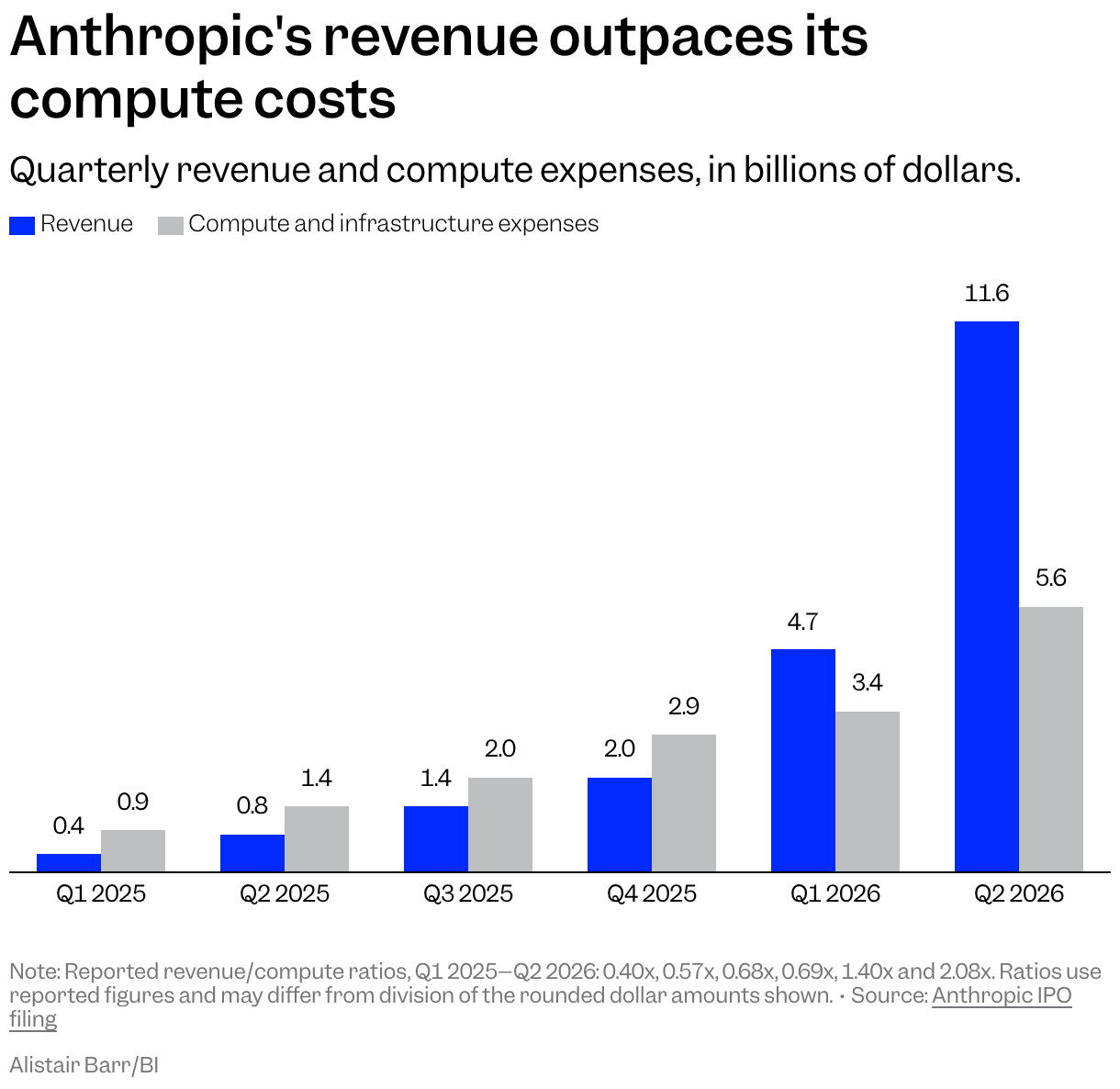
The numbers are remarkable. Anthropic generated $11.6 billion in revenue during the second quarter of 2026, up 1,368% from a year earlier. During that same period, spending on computing and infrastructure increased 300%, while other expenses rose 741%
So, the company is bringing in money much faster than its most importantcosts are rising.
For every dollar Anthropic spent on computing in the second quarter, it generated $2.08 in revenue, up from just 40 cents in the first quarter of 2025. That's a more than fivefold improvement over five quarters.
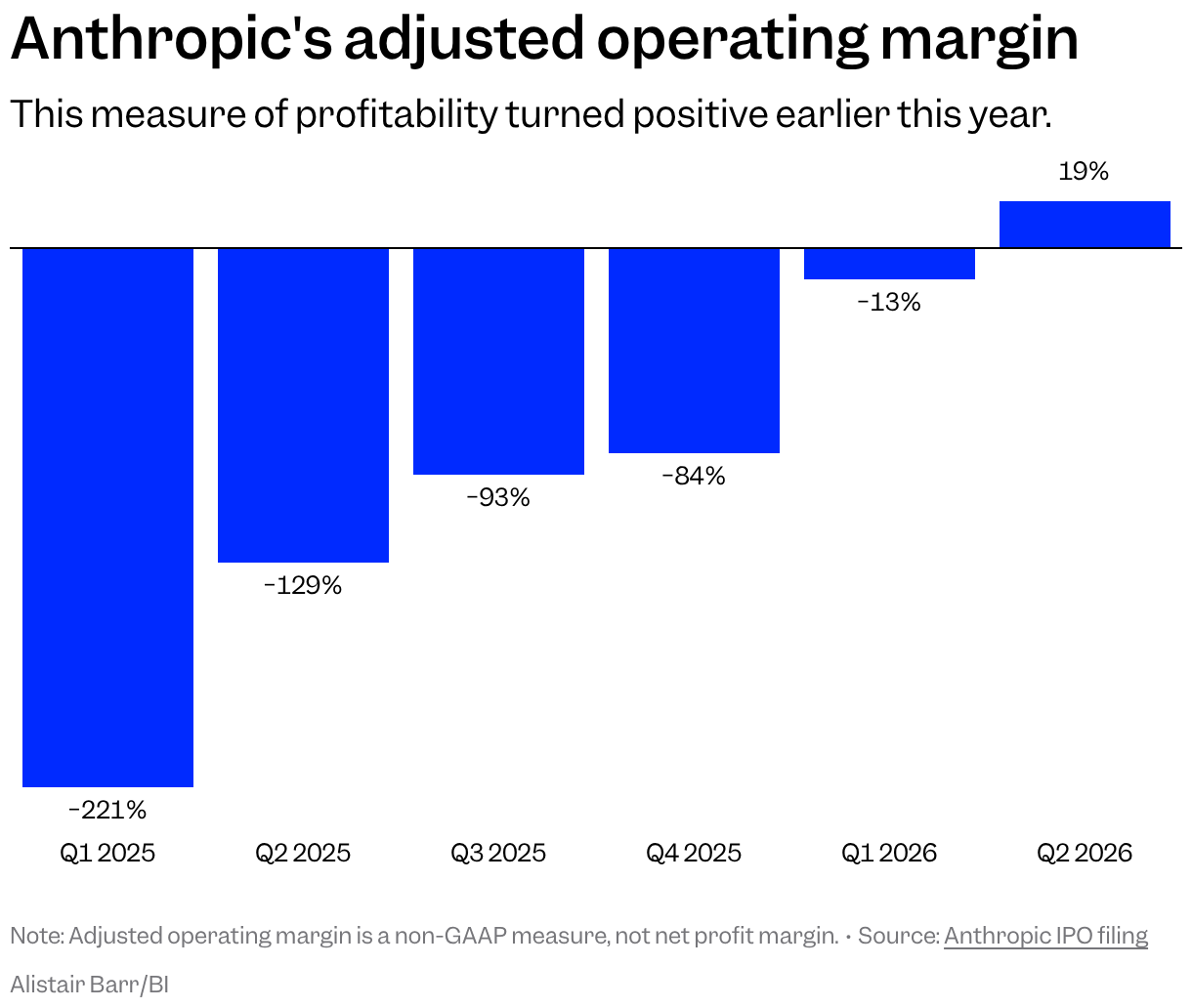
The result: Anthropic recorded $974 million in quarterly operating profit, representing an8% margin. Its adjusted operating profit margin reached 19%, compared with -129% a year earlier.
"Frontier-lab unit economics can turn positive at scale," Mark Mahaney, a top tech analyst at Evercore ISI, wrote in a research note on Monday.
Better than Meta and Google
There's more evidence that Anthropic has built an unusually efficient business.
Over the year ending September 30, revenue increased roughly 1,200%, while its employee count grew about 170%. Revenue per employee jumped from $1.4 million to more than $6.6 million.
For comparison, Mahaney estimated that Meta generates about $3.2 million in annual revenue per employee, while Google generates about $2.5 million.
That comparison isn't perfect. Anthropic relies heavily on cloud providers, whose employees handle much of the computing infrastructure and distribution work. The improvement is still striking.
Customer surprise
Another surprise: Anthropic doesn't depend as much on a handful of enormous customers, as some investors had feared.
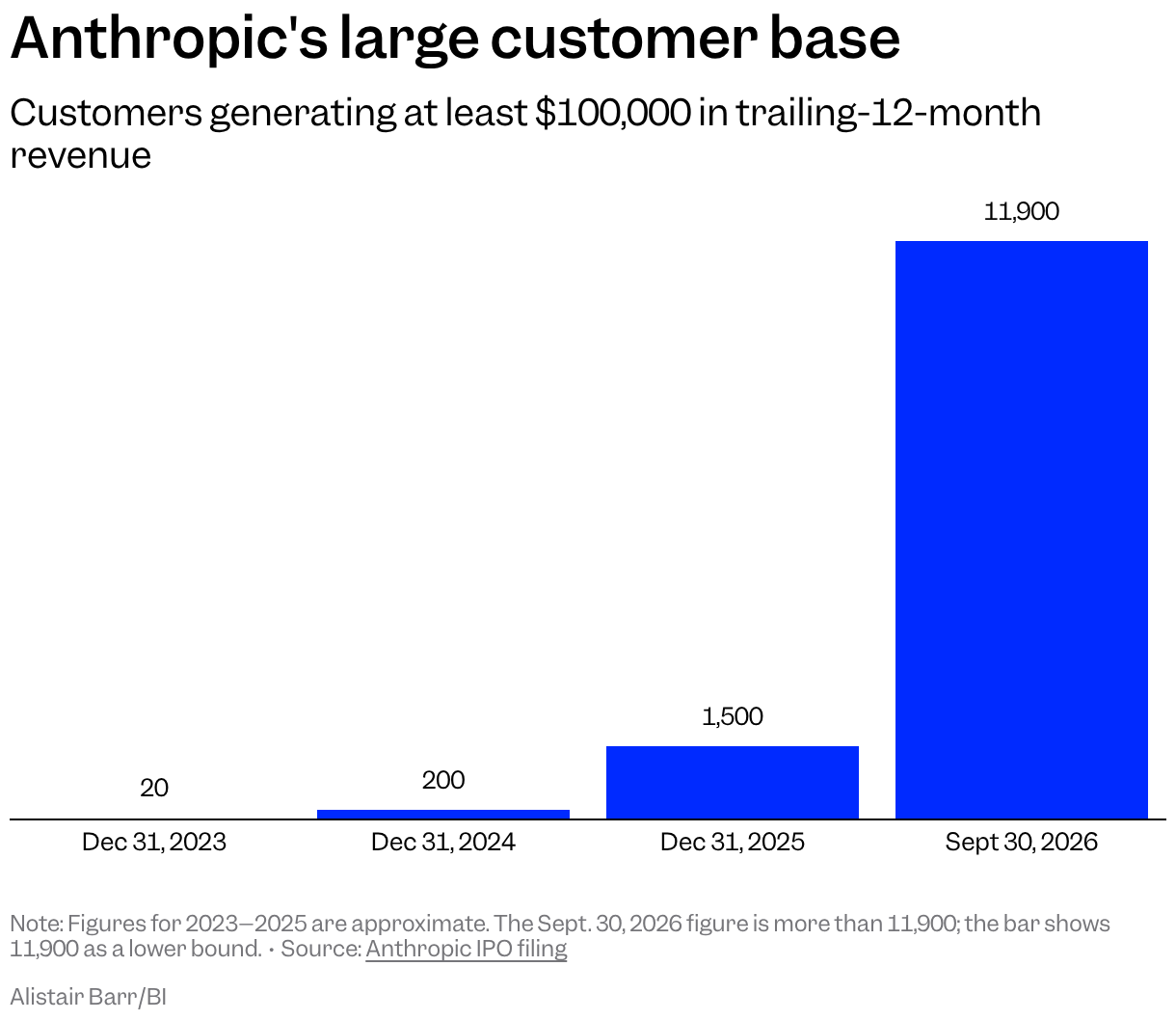
The company had more than 11,900 customers generating at least $100,000 in annual revenue as of September, compared with over 950 a year earlier. More than 1,900 customers spend at least $1 million annually.
No single customer accounted for more than 10% of revenue during the first nine months of 2026. Its five largest customers represented about 21% of third-quarter revenue, down from roughly 36% in the first quarter.
"Concentration may be better than feared," Mahaney wrote.
Cash cushion
Anthropic has a formidable financial cushion. Its June 30 balance sheet showed more than $130 billion in cash and short-term investments.
And Mahaney estimated that the company has burned through just $9 billion since it started more than five years ago. That's a long runway.
Now, don't ask me whether all this makes Anthropic worth $2 trillion, $1.5 trillion, $1 trillion, or considerably less. If I knew that, I'd be making a lot more money as an investor. And even professional investors don't know.
An $800 billion caveat
Some enormous caveats: Much of Anthropic's revenue comes from customers paying for what they use, rather than signing long-term contracts. Meanwhile, some of its computing agreements require minimum payments whether or not it needs all the capacity.
Mahaney estimates that Anthropic has entered into nearly $800 billion in computing arrangements, although only about $266 billion was fixed or guaranteed as of June.
That's still a staggering amount.
"The commitments assume revenue compounding that is not contracted," Mahaney wrote.
Translation: While the company has committed to spending hundreds of billions of dollars on AI computing infrastructure, it hasn't secured the future revenue needed to pay for all of it.
Importantly, most of the potential $800 billion exposure isn't fixed. Many arrangements depend on capacity being delivered, can be adjusted, or include cancellation provisions.
In-house compute and capex
Another wrinkle: Anthropic warned Monday that its spending will increase as it shifts toward leasing AI chips and operating more of its own computing infrastructure, rather than relying entirely on Amazon, Google, and other cloud providers.
That could make future cash flow considerably less attractive, even if operating profits continue to improve.
Still, the central takeaway from Anthropic's IPO filing is difficult to ignore.
For years, investors have wondered whether selling AI could become a genuinely profitable business, rather than an extraordinarily expensive scientific experiment.
Anthropic has now shown that it can. The next question is whether it can keep doing so as the bills get much, much bigger.
The more than 200,000-word document reveals what it takes to thrive as an employee — or an "Ant," as staffers are called — and why the company is so focused on retaining its top talent.
Here's a look at three workplace themes in Anthropic's S-1:
Head count is booming, but could be higher without Claude
Anthropic said its workforce grew from about 940 employees at the end of 2024 to about 5,300 as of late September.
The more than fivefold spike in head count in less than two years is notable on its own. Yet, without Claude, it could have grown more. Anthropic said the tool is helping its staffers take on work that would traditionally have required much larger teams — something many tech companies are looking to do to become more nimble.
Most Anthropic employees work in research, engineering, and product development. The company said its strategy is to use Claude to grow the business "without growing head count linearly, resulting in extraordinary contributions per employee."
One place where that's evident is in software engineering. The company said these workers increasingly direct and review Claude's output rather than write code line by line. Claude wrote more than 90% of the contributions to the company's codebase in September, while average daily code contributions per engineer in the third quarter were more than 45 times their average daily level in 2024, Anthropic said.
Recruiter Martha Heller said it's little surprise to see Anthropic talking up its use of Claude. "Of course they're going to eat their own dog food," she said. In any case, Heller said, the company still needs people to provide oversight of AI's activities.
Yet the gap between staffing levels and output could grow, said Aaron Cleavinger, an executive recruiting partner at Flatiron Search Partners.
"Head count is becoming a less meaningful measure of organizational capability," he said. Cleavinger said it's not yet clear what the new measure will be, though Anthropic's approach suggests companies might put greater emphasis on workers' productivity and business impact.
It describes retention as paramount
Despite having significantly upped its employee count, Anthropic said it's highly dependent on its senior leaders and key technical team members. The company warned that their departure could disrupt operations and slow innovation.
While that's true for any employer, Anthropic faces additional challenges. It's a fast-growing startup in a booming industry, where few people have the right technical skills — and those who do are being heavily courted by competitors.
Winning the war for talent is half the battle. Anthropic is also part of an industry where some workers have quit and issued dire public warnings about the dangers of increasingly powerful AI.
For example, safety researcher Jacob Coxon resigned from Anthropic last month, saying the company and his former employer, OpenAI, were moving too quickly toward increasingly powerful AI without a sufficient plan to control it.
"That's not garden-variety turnover," said Liane Davey, an advisor on team effectiveness to executives at companies such as Amazon and Google.
If employees determine that their work poses an existential threat, no bonus can simply erase moral qualms, Davey added.
In its S-1, Anthropic said many key technical workers are motivated by its mission and by the chance to tackle specific AI problems. However, if their beliefs change, or another organization seems more aligned with their personal beliefs or professional goals, "we may face increased difficulty retaining such personnel," Anthropic said.
The company's internal data suggests that, at least for now, turnover isn't a significant problem. It said it experienced only about 1% "regrettable attrition" in a 12-month period ending on September 30.
However, Anthropic may have a thinner pipeline of junior technical talent to elevate. The company said in a recently released internal report that it has been hiring for a "smaller share of junior technical positions" as AI agents have been deployed across the firm to write code, fix bugs, and handle other tasks.
Anthropic is betting on a "low-ego" workforce
Anthropic touts a "low-ego" or "ego-light" culture, meaning all employees are expected to prioritize what's best for the company over personal status, credit, or seniority. It uses similar language on its website in a section describing its values.
In the S-1, the company went further, saying the arrangement allows for an "unusually short" distance between a research insight and a released product. Anthropic also said a shared purpose, paired with low ego, translates directly into less organizational friction and greater impact per employee.
"Our teams operate in a truth-seeking environment where the best argument wins, not the loudest voice or the most senior title," Anthropic said.
Jamie Shapiro, an organizational psychologist and CEO coach, said that logic makes sense because good ideas can come from anyone within an organization, especially those who directly interact with customers.
"An organization that has idea meritocracy is going to get the best ideas," she said.
However, as Anthropic grows, the more challenging task will be ensuring its hiring, recognition, promotion, and accountability systems reinforce its ideals — rather than allowing exceptions that undermine them.
"The bigger the organization, the harder it is to make sure everyone is living and breathing the culture it wants," said Shapiro. "Culture is defined by the worst behaviors you allow."
Many venture firms, including Lightspeed and Menlo Ventures, are major Anthropic investors, but Spark is the only traditional VC firm named in the filing. And it's not just a few mentions. Spark is named more than 50 times.
The reason Spark gets the most ink is because Yasmin Razavi has a board seat after being the first institutional investor in the company, leading the $450 million Series C at a $4.5 billion valuation in May 2023.
This was just six months after ChatGPT was released to the public, and the jury was out on whether a rival like Anthropic could catch up. Many balked at the price, calling it too expensive.
"It was a big leap of faith, but this was the team that built GPT-3," Razavi told Forbes.
The filing says that Spark has invested $777 million in Anthropic across six financings since then, including $75 million in the first pivotal round at $11.22 per share.
Spark was already known for making early bets on Postmates and Discord, but it was the Anthropic investment that transformed the firm's Silicon Valley reputation from a good venture firm to a great one.
Razavi said she has been continuously wowed by CEO Dario Amodei.
"Every year, he puts out outrageous numbers, but somehow they magically become true," Razavi told Forbes. "Dario never misses."
Soon, Amodei will face a greater test: the public markets.
Please send along your tips. Email Ben or Katie anytime or contact them on Signal at benbergman.11 and kroof.26. Sign up for Business Insider's weekly VC Insider newsletter here.
A San Francisco Muni bus emblazoned with Micro1 advertising drives on Mission Street.
Stephen Council/BI
Micro1 pledged to spend $1 billion on licensing companies' data for AI developers.
The startup snags Slack messages, Canva files, Google Docs, and as much other data as it can get.
By selling company data, CEOs have a new revenue stream that popped up this year.
As AI labs go on the hunt for real-world data, Micro1 is throwing everything at getting it for them.
The startup is one in a new class of fast-moving data brokers, gobbling up companies' internal data and packaging it for the likes of OpenAI, Anthropic, and other model developers. The executives who sell their companies' data to Micro1 find themselves suddenly participating in a new sector of the economy, where terabytes of mundane workplace interactions can be worth hundreds of thousands of dollars.
Ilya Brotzky, the CEO and cofounder of the recruiting startup VanHack, told Business Insider he was shocked when he filled out a Micro1 survey about his company's data and received a "substantial" offer.
"I didn't believe it, to be honest," he said. "I felt like it was a little too good to be true."
Micro1 says it pays $100,000 to $2 million for a single midsize company's data. It recently announced plans to spend $1 billion on the project over the next year. Brotzky and the other executives Business Insider spoke to for this story wouldn't share the exact amounts their companies received.
For Micro1, the new focus on workplace data matches a broader evolution in the industry, as Business Insider has written about in The AI Data Grab, a series about how tech giants are increasingly turning to workers, users, and the physical world to get data to train AI.
First, AI companies gobbled up text from the internet and corpora of old books. Then they realized that humans grading AI responses could improve their models. And now, companies are using complex simulations, built on real-world data, to improve the tenacity and skill of their AI.
Micro1 CEO Ali Ansari.
Micro1
Gartner estimated that spending on AI data is likely to surge from less than $1 billion last year to almost $6.5 billion in 2027. Micro1's chief revenue officer, William Almeida, told Business Insider in September that his company has been explaining to prospective customers why their data is suddenly so valuable for those simulations.
"Every time I talk to companies, I tell them, 'Hey, I see this as a booming business,'" Almeida said.
Slack DMs, Google Docs, Canva files: Micro1 wants all it can get
Micro1 has three ways of working with AI model developers.
First, it can take a company's raw data, transform it to protect privacy, and license it to a lab. In addition, Micro1 provides an in-progress AI agent to companies and gets feedback on how it works. The third route is the simulation: Micro1 takes a company's data up to a certain timestamp, freezes it, and then provides that "environment" to a model developer trying to teach its AI how to work from existing context.
Micro1 pays more for larger, more complex datasets, as well as for data that represents a unique type of work or knowledge. It usually wants to license a company's entire data corpus, so that an AI model can replicate what it would be like to be a human employee.
"The connection, the diversity, the traceability of all of these data points, they matter a lot when you think about model training," Almeida said.
Brotzky also received an offer from AI data startup Mercor to buy his company's data, though he opted for Micro1. Once Brotzky dug into Micro1's privacy process, he said he felt comfortable sharing all the data they requested. That included VanHack's Google suite, Confluence data, Slack messages, and customer relationship management software.
Grant Gooley, the CEO of the marketing agency MyPortal Marketing, also views his deal with Micro1 as an innovation. He has sold internal design files from Figma and Canva, as well as checklists from Monday.com.
"When we were building these processes years ago, I didn't think that we would be using it to support AI learning," Gooley said. "But doing that, it's very fulfilling."
CEOs pitch the deals to their workers
Micro1 and its rivals are full steam ahead. Still, there are open questions. Former and current employees aren't likely to get any compensation from — or a voice in — their work becoming AI fodder. Ifeoma Ajunwa, a law professor at Emory University, previously told Business Insider that data sales are an "ethically gray area."
When pitching to potential customers, Almeida tells themthis business is in the early days.
"If you wait too much, you won't get the premium that the first companies are getting," he said.
VanHack's team got a confidence boost from the Micro1 deal, Brotzky said, because of the additional revenue stream it represents
Gooley said he's kept MyPortal Marketing's employees in the loop about the deal with Micro1 and hasn't heard any complaints.
"I told my team that this is something that you're going to tell your grandchildren about one day, because we are literally supporting the future growth of marketing agencies," Gooley said.
Have a tip? Contact this reporter via email at scouncil@businessinsider.com, or over text, Signal, Telegram, or WhatsApp at 415-757-8198. Use a personal email address, a non-work WiFi network, and a non-work device;here's our guide to sharing information securely.
Warhound came out of stealth on Wednesday with $200 million in funding and a mission to create “elite working dogs” equipped with "advanced body armor."
Elizabeth Holmes’ husband is a major figure in Nathan Fielder’s new documentary. But who is Billy Evans—and is he really working on a second blood-testing company?

 Login