❌

Reading view

Ninth Circuit Rules Trump Illegally Federalized National Guard in Los Angeles
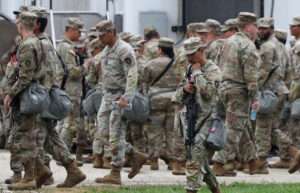
Members of the Texas National Guard assemble at the Army Reserve Training Center in Elwood, Illinois
Texas National Guard members in Illinois (Brian Cassella/TNS/Newscom)


On October 23, in the case of Newsom v. Trump, the US Court of Appeals for the Ninth Circuit ruled Donald Trump's June 2025 federalization of the National Guard in Los Angeles was likely illegal. This decision has little immediate effect, because the National Guard deployment ended months ago, after the Supreme Court ruled against Trump in a related Illinois case. But it has important implications for judicial review of executive invocation of emergency powers to use the military domestically. Among other things, it emphasizes that such actions are reviewable, and the president should get only limited deference. It also adopts a properly restrictive definition of "rebellion" (which is one of the conditions that might justify federalization of the National Guard).

Trump federalized the Guard in response to anti-ICE protests. The district court ruled his action was illegal and issued an injunction blocking it. But the Ninth Circuit lifted the preliminary injunction, in a decision I criticized at the time.

The relevant statute 10 U.S.C. Section 12406, can only be used to federalize state forces in one of the following situations:

1) the United States, or any of the Commonwealths or possessions, is invaded or is in danger of invasion by a foreign nation;

(2) there is a rebellion or danger of a rebellion against the authority of the Government of the United States; or

(3) the President is unable with the regular forces to execute the laws of the United States

Last year, the Ninth Circuit ruled (incorrectly, I think) that Trump's action might have been permissible under Subsection 3: a situation where "the President is unable with the regular forces to execute the laws of the United States." As the Ninth Circuit acknowledges in their most recent decision, this basis for Trump's actions was undermined by the Supreme Court's December ruling in the related case of Trump v. Illinois, which held that Subsection 3 can only be invoked when the president is authorized to use regular federal military forces to enforce the law, and those forces are inadequate. These circumstances do not apply to the anti-ICE protests in Los Angeles and Chicago.

No one claims that the situation in Los Angeles amounted to an "invasion" by a "foreign nation." Thus, in its most recent decision the Ninth Circuit considered whether Trump's actions were authorized by Subsection 2, which allows federalization of the guard when "there is a rebellion or danger of a rebellion against the authority of the Government of the United States."

The majority opinion by Judge Jennifer Sung holds that the determination that there is a "rebellion" is subject to judicial review and can be invalidated " if it "did not reflect a colorable assessment within a range of honest judgment." I think this is overly deferential. For reasons I outlined in an article published last year, there should be little or no deference when the executive invokes extraordinary emergency powers. Still, the Ninth Circuit standard is far from a blank check, and does allow invalidation of executive actions where the claim of rebellion is blatantly wrong - as it was here.

Following the district court, the Ninth Circuit defined  "rebellion" as "a violent, armed, organized, open and avowed uprising against the government as a whole." This differentiates "rebellion" from smaller-scale violence or other violations of law. I think that definition is largely correct. The court summarizes a wide range of historical evidence supporting it.

The Ninth Circuit also concluded that events in Los Angeles did not even come close to meeting that standard. There were some violations of law by protestors, and some small-scale violence. But no systematic effort to overthrow the government or anything close to it. If anything, both this issue and the definition of "rebellion" are easier calls than the court suggests.

Judge Sung, author of the majority opinion, is a liberal Biden appointee. But her opinion was joined by Judge Eric Miller, a conservative Trump appointee and onetime clerk for Supreme Court Justice Clarence Thomas. This suggests the issue here cuts across ideological and jurisprudential lines. Judge Mark Bennett, another Trump appointee, dissented, but mostly on procedural grounds.

Judge Bennett did also take issue with the majority's conclusion that if Trump's federalization of the National Guard exceeded his statutory authority, it also violated the Tenth Amendment, which reserves to the states or to "the people," those "powers not delegated to the United States by the Constitution." He argues that the power to call forth the National Guard is delegated to Congress by the Calling Forth Clause of the Constitution, which gives Congress power "[t]o provide for calling forth the Militia to execute the Laws of the Union, suppress Insurrections and repel Invasions." This is true enough. But in situations where Congress has not exercised that authority, states retain total control over their militia (of which the National Guard is the principal modern example), and that control is protected by the Tenth Amendment. Indeed, such control over state military forces is a central element of state sovereignty. Overriding it without proper constitutional authority qualifies as unconstitutional "commandeering" of state government forces. As the majority explains:

The federal government—whether the President or Congress—violates the Tenth Amendment by commandeering state personnel to enforce or administer federal law. Printz v. United States, 521 U.S. 898, 925 (1997) (Under the Tenth Amendment, "the Federal Government may not compel the States to implement, by legislation or executive action, federal regulatory programs."). If, for example, the President commandeered state police to help federal officers enforce federal immigration laws, that would violate the Tenth Amendment….

California National Guard members are state personnel, unless properly federalized… The President purported to convert the Guard into federal personnel by issuing federalization orders. If those federalization orders had been valid, then the President would have deployed federal officers in Los Angeles, and no commandeering of state personnel would have occurred. But because the President lacked authority to federalize the California National Guard, the federalization orders were invalid, and the deployed Guard members remained state personnel….

In other words, because the deployed members of the California National Guard were not properly federalized, they remained the legal equivalent (for Tenth Amendment purposes) of the state police. And because the challenged executive orders compelled those state officers to help federal officers enforce federal law, the orders violated the Tenth Amendment….

The Tenth Amendment protects States against overreach by the "Federal Government," whether "by legislation or executive action." Printz, 521 U.S. at 925, 935. The President cannot command state officials to enforce federal law even if a federal statute would authorize him, under some other circumstances, to call those officials into federal service. If the statute did not authorize the President to federalize the California Guard members here…, then the federalization orders were invalid, the Guard members remained state personnel, and Defendants violated the Tenth Amendment by commandeering those state personnel to administer federal immigration laws.

Exactly so. The majority and dissent  consider a number of procedural issues, which I will not try to address. The majority also parses a variety of relevant precedents in detail. I may have more to say about some of them in future writings.

For the moment, this decision has little immediate effect. But it sets an important precedent in favor of judicial review of executive invocation of emergency powers, and on the meaning of "rebellion."

The post Ninth Circuit Rules Trump Illegally Federalized National Guard in Los Angeles appeared first on Reason Magazine.


  •  

Trump Loses Yet Another Sanctuary City Case—This Time Against New York City

NA

Yesterday, in United States v. City of New York, yet another federal court ruled against the Trump administration in a sanctuary city case. "Sanctuary" jurisdictions are state and local governments that restrict their law enforcement agencies and other employees from assisting federal immigration enforcement and deportation efforts in various ways. In this case,  Judge Reyes of the US District Court for the Eastern District of New York upheld New York City laws restricting local law enforcement information-sharing and other assistance to federal immigration enforcers.

The court ruled that federal law does not preempt these policies, and that if if it did, there would be a violation of the anti-commandeering requirements of the Tenth Amendment:

Even were the Court to find that the United States has standing and the challenged provisions are preempted—both answered in the negative above—United States' claims would still fail because the anticommandeering doctrine of the Tenth Amendment to the Constitution of the United States precludes relief.

"The powers not delegated to the United States by the Constitution, nor prohibited by it to the States, are reserved to the States respectively, or to the people." U.S. Const. amend. X….

The United States argues it is "not seeking to compel participation in immigration enforcement … but rather to remove Defendants' express and implicit obstacles to the Executive's duty to carry out its immigration enforcement duties…." New York City replies "if accepted, [the United States' claims] would require the City to affirmatively assist the federal government in enforcing immigration laws in violation of the Tenth Amendment's anticommandeering doctrine…." New York City is correct, at least partially.

The United States seeks injunctive and declaratory relief to preempt the challenged provisions… If the challenged provisions were struck, while New York City would not be obligated to carry out federal immigration enforcement, they would be barred from prohibiting their agencies and employees from engaging in federal immigration enforcement by expending personnel, property, and other resources to (1) detain individuals and (2) implement inter-agency information-sharing, including disclosing personally identifiable information, all potentially in violation of state law. And of course, there is nothing within federal law that obligates states to participate in federal immigration enforcement or compels states to comply therewith.

The United States' preemption arguments amount to nothing more than a backdoor around the Tenth Amendment and rest on a false distinction between (a) compelling local governments' participation in federal immigration enforcement and (b) prohibiting local governments from dictating how their personnel and other resources may be utilized towards federal immigration enforcement….. "

The basic principle—that Congress cannot issue direct orders to state legislatures—applies" to commands for "affirmative action" and the imposition of "prohibitions." Murphy [v. NCAA], 584 U.S. at 455 (citation modified). If states cannot remain free to control their agencies and employees to resist federal immigration enforcement, which is within states' constitutional prerogatives, the Tenth Amendment anticommandeering doctrine means nothing.

This reasoning is correct. And it is notable that this ruling - like many others protecting sanctuary cities - relies heavily on the Supreme Court's 2018 anti-commandeering decision in Murphy v. NCAA, written by Justice Samuel Alito (probably the Court's most conservative justice), and joined by all the other conservatives then on the Court. In that case, the Court emphasized that the anti-commandeering doctrine bars Congress from dictating the actions of state and local legislatures, regardless of whether the dictation takes the form of an affirmative mandate, or a prohibition against legalizing or barring something under state law.

Judge Reyes also rejects the administration's argument under the "intergovernmental immunity" doctrine, which bars states and localities from directly regulating federal agencies or "discriminating" against them. Like the court in the recent case of United States v. New Jersey, he correctly emphasizes that there can be no discrimination when there is no other comparable activity that gets more favorable treatment under the sanctuary jurisdiction's policies:

"Differential treatment is critical to a discrimination-based intergovernmental immunity claim." New York, 814 F. Supp. 3d at 282….; "[A] comparator is necessary." New York, 810 F. Supp. 3d at 353. The United States discrimination claim fails for lack of a comparator.

The United States does not and cannot identify a similarly situated entity. State and local agencies and their officers do not enforce immigration law, nor do members of the public…  As the United States concedes, the Federal Government holds the "exclusive charge of enforcing immigration law…."  Not only are other federal law enforcement agencies with different charges differently situated, "[f]or a state law to unconstitutionally discriminate against the federal government, it must treat comparable classes of federal and non-federal employees differently, not different classes of federal employees." Illinois, 796 F. Supp. 3d at 534

I would add that, as I explained in a recent post, the entire antidiscrimination element of the intergovernmental immunity doctrine is dubious, and should probably be overturned by the Supreme Court:

[T]he whole doctrine of intergovernmental immunity strikes me as bogus, judge-made law. There is no provision in the Constitution requiring it. And the federal government is not some historically oppressed minority group protected by the antidiscrimination provisions Fourteenth Amendment. Where state and local governments are otherwise free to refuse to help the feds, that autonomy should not be forfeited merely because they choose to support potentially similar activities by state or local governments, or by the private sector. Obviously, a district court cannot refuse to obey Supreme Court precedent in this field. But I hope the Supreme Court might someday reevaluate that precedent.

This is just the most recent of a long line of defeats for Trump in sanctuary city cases, in both his first and second administration. Judge Reyes cites close to a dozen such cases over the last year alone.  I summarized this jurisprudence more fully in a post covering three other recent sanctuary cases, last month:

In cases where the administration has tried to directly coerce states and localities into cooperating, courts have rightly ruled this violates the Supreme Court's "anti-commandeering" precedents, a series of decisions reached primarily by conservative justices, which hold that the federal government may not force state and local governments to help enforce federal law or carry out under federal purposes. In cases where Trump has sought to withhold federal funds from sanctuary jurisdictions, courts have (also rightly) ruled that the executive cannot impose conditions on federal grants that were not authorized by Congress and (in some cases) that the Trump conditions are unconstitutionally coercive. For my analyses of Trump II court decisions on these issues, see here, here, and here.

My 2019 Texas Law Review article surveying and assessing litigation arising from Trump's first-term attacks on sanctuary jurisdictions. There and in other writings, I also explain why immigration sanctuaries (and conservative gun sanctuaries) are beneficial, and help protect our constitutional system. See also my February 2026 Dispatch article, "In Defense of Sanctuary Cities," which provides an overview of these issues, and defends sanctuary jurisdictions on both constitutional and policy grounds.

Yesterday's ruling may be appealed. But if so, it is unlikely to be overturned.

Trump has posted a few rare wins in sanctuary cases with unusual facts, such as in the Contracts Clause case I analyzed in the September post. But, such cases are highly exceptional. And, as explained in the September post, the Contracts Clause decision has various flaws, and would not greatly impede sanctuary jurisdictions even if it survives on appeal.

Overall, Trump has been losing these kinds of cases so much that he might even get tired of losing.

The post Trump Loses Yet Another Sanctuary City Case—This Time Against New York City appeared first on Reason Magazine.

  •  
❌