Ahead of the 2020 elections, Donald Trump told anyone who would listen that a Joe Biden victory would lead to “a depression the likes of which you’ve never seen.” The then-president’s claim was obviously foolish and quickly discredited by reality.
The Republican is nevertheless recycling the line, declaring at a campaign rally in Mississippi this week, “If the Democrats win, you will have a 1929-style economic depression. What they want to do is so bad for our country, you’re going to end up with a massive recession or depression.”
The incumbent president never got around to saying how this economic calamity would happen, which parts of the Democratic agenda are so dangerous or why he was so spectacularly wrong when he made the same prediction six years earlier.
But what struck me as especially notable was that even Trump doesn’t seem to believe his own fearmongering.
Just hours before his event in Mississippi, the president briefly spoke to reporters, one of whom asked how he’d “work with Democrats if they have control of the House or the Senate.” He replied:
We’ll figure a way. Look, I have strong veto. I hope that that won’t be the case, but if it is, that’s happened before with many presidents. And you have strong veto and you end up working out deals.
Oh.
So on the one hand, Trump wants Americans to believe that a Democratic majority on Capitol Hill would transform the nation into a hellscape in which transgender Muslim immigrants come to your home to turn your children into communists.
But on the other hand, Trump also wants Americans to believe that if there is a Democratic majority, he’ll veto bad ideas while working on possible bipartisan agreements — which is unlikely to sound all that scary to many voters.
The president made similar comments in early September, telling Fox News’ Laura Ingraham, “I’ll block all their bad stuff for two years. It won’t be the same, but I’ll be a blocker, what can I tell you?”
He then added that he’ll “probably be able to make deals” with the possible Democratic majority.
The Republican Party’s line is that the stakes in this election cycle are effectively existential — but Trump’s line is that it just won’t be that big a deal if Democrats prevail. That’s quite a message for the incumbent president to take to the electorate in the cycle’s closing days, but here we are.
Headed into Election Day, it’s not exactly a secret that House Republicans are likely to lose their majority. Democrats only need a net gain of a handful of seats, and all of the available evidence suggests that won’t be a problem.
House Speaker Mike Johnson, however, keeps taking issue with the evidence.
“Republicans are no longer responding to polls,” the GOP leader told Fox News over the weekend. He added, “I’m telling you these polls are off — all of them.”
On Monday night, the Louisiana congressman returned to the network and pushed effectively the same line. “I’m telling you the polling is inaccurate,” the House speaker said.
Maybe so. Maybe Johnson’s right — we can probably all think of instances when polls have been off to one degree or another — and it could be the political world is in for an enormous surprise next week.
But if that were to happen, Republicans themselves would be among those who are shocked.
As a matter of campaign strategy and tactics, I can appreciate why Johnson is pushing this line with so much enthusiasm. He is, after all, Congress’ top GOP lawmaker. If he were openly accepting the available data on public attitudes, the House speaker would effectively have to admit the odds of him holding onto his gavel are poor, which wouldn’t exactly motivate his party’s rank-and-file voters to cast a ballot.
But regardless of Johnson’s motivations, even his own party doesn’t genuinely believe his talking point. We know this for certain because Republicans keep moving campaign money around to protect vulnerable GOP incumbents — not based on pleas and anecdotal evidence, but because of their own polling data.
The same is true for Donald Trump’s campaign schedule. The president hasn’t invested his time in states such as Texas, South Carolina, Mississippi and Kansas — states he won by enormous margins two years ago — because he finds local conditions pleasant this time of year. The White House political operation is deploying Trump in response to polling data, even as Johnson insists that Republicans “are no longer responding to polls.”
Of course they are. There’s nothing else for them to use when making difficult electoral decisions.
During a brief Q&A with reporters on Tuesday afternoon, Donald Trump was asked whether he’ll “respect the results” of the midterm elections, “whatever happens.” Before we get to the president’s answer, it’s worth taking a moment to dwell on the question.
Not to put too fine a point on this, but we used to be a country in which questions like these weren’t even asked. It was a foregone conclusion for generations: The United States was a stable democracy and the world’s pre-eminent superpower. There was no real need to wonder: American candidates for powerful offices agreed to honor election results. The entire line of inquiry was unnecessary since the answers were assumed.
But as the radicalization of Republican politics intensifies, and GOP rejection of election results becomes more common, it’s no longer considered outlandish to ask Republican leaders whether they’ll accept voters’ judgment — just as it’s no longer surprising when they fail to say “Of course I’ll honor the will of the electorate.”
All of which brings us to Trump’s response on Tuesday afternoon.
Q: You'll respect the election results whatever happens?TRUMP: If they're honest elections(That's a no!)
“I will,” the president replied, indicating that he’d accept the election results, before quickly adding, “if they’re honest elections.”
And who gets to decide whether the elections are “honest”? According to Trump, he does.
To be sure, this isn’t altogether new. As The Washington Post reported, “In 2016, Trump said he would accept the election results ‘if I win.’ In 2020, he repeatedly declined to commit to accept the results, saying ‘We’re going to have to see what happens.’ In 2024, Trump said he would accept the results if the election was ‘fair and legal and good.’”
In other words, when it comes to conditional respect for democracy — the results are only legitimate if he likes and agrees with them — the Republican is at least consistent.
But this isn’t just a matter of Trump giving a Trumpian answer during a brief exchange with a reporter. On the contrary, there’s a more systematic effort underway, which appears designed to deliberately undermine confidence in the elections themselves. The Post separately reported:
President Donald Trump and his allies have spent the final weeks before the midterms showering his supporters with a relentless stream of doubt about the legitimacy of the election, priming them to question results if Republicans lose.
In court, the administration is telegraphing its readiness to challenge results based on alleged fraud. In podcasts and social media posts that are delivered nonstop to Trump’s core backers, right-wing influencers are telling supporters to expect cheating.
The newspaper’s analysis also found that the misinformation campaign is twice as intense as it was ahead of the 2024 elections.
It might be tempting to shrug this off, since Trump lies to so many people about so many things, and the president’s deceptions tend to have limited practical effects. But let’s not forget that the last time he tried to lay the groundwork for rejecting election results he didn’t like, and Republican candidates fared poorly, thousands of the president’s followers launched an insurrectionist attack on the U.S. Capitol.
Today’s installment of campaign-related news items from across the country.
* In case Republicans weren’t already worried about South Carolina’s U.S. Senate race, Annie Andrews, the Democratic nominee, has received endorsements from two former South Carolina governors — including one Republican.
Two former Governors of South Carolina – one from each party – have endorsed Democrat Annie Andrews who is running against Sen. Darline Graham R-SC
With a week remaining before Election Day, former Republican Gov. David Beasley and former Democratic Gov. Jim Hodges star in a video endorsement in which they throw their support behind the pediatrician taking on appointed incumbent Sen. Darline Graham.
Beasley, a former chair of the Republican Governors Association, said in the ad that “Annie understands that leadership isn’t about making people angrier. Well, it’s about making things better.”
* As MS NOW reported, election officials in Alaska filed a motion Monday night asking a federal judge to “immediately” dismiss the lawsuit brought by the Justice Department that seeks to block the results of the state’s U.S. Senate race should incumbent Republican Sen. Dan Sullivan lose, claiming it has “no legal basis.”
On a related note, while the DOJ case is predicated on the idea that voters will be confused by the appearance of two Dan Sullivans on the same ballot — despite the fact that the same ballot clearly identifies one of them as the “Republican incumbent” — it’s worth noting that there were also two Dan Sullivans on Alaska’s ballot in 2014, and the state’s electorate managed just fine.
* In Maine’s U.S. Senate race, the latest Marist poll found Democrat Troy Jackson with a narrow advantage over incumbent Republican Susan Collins, 49% to 47%.
* A relatively new super PAC called Building the Future, which represents the data center industry, initially launched an ad hoping to boost Graham in South Carolina, and now it’s spending more than $1.5 million in support of Republican Ty Masterson’s gubernatorial candidacy in Kansas.
* Donald Trump headlined a rally in Mississippi on Monday night, where the president said, “I’m here because Cindy is doing great,” referring to Republican Sen. Cindy Hyde-Smith. Of course, that didn’t make a lot of sense: If the incumbent were “doing great,” there’s no reason Trump would have traveled to Mississippi to help her campaign.
* In Pennsylvania’s four most competitive U.S. House races, the latest polling from The New York Times, The Philadelphia Inquirer and Siena University found Democrats with modest leads in three of the contests. The fourth race is Republican Rep. Scott Perry’s rematch against Janelle Stelson, a Democrat and former news broadcaster, and the poll found them tied at 48% each.
* And in one of Iowa’s most competitive congressional districts, the Congressional Leadership Fund, a super PAC aligned with the House Republican leadership, is airing an attack ad alleging that Democratic nominee Sarah Trone Garriott is “dangerous” when it comes to children. What the ad neglects to mention is that the critic who makes the claim previously pleaded guilty to charges related to child endangerment.
To a degree without modern precedent, White House Cabinet secretaries have spent recent months on the campaign trail, serving as pieces on an electoral chessboard to be moved around to the benefit of the Republican Party — despite ethics laws that are supposed to keep some distance between these powerful officials and partisan political activities.
Health and Human Services Secretary Robert F. Kennedy Jr. isn’t the only offender in the Trump administration, although he has arguably been the most ambitious, making all kinds of appearances with vulnerable GOP incumbents and even trying to orchestrate partisan strategies to give Republican lawmakers a boost.
To that end, Kennedy appeared at a partisan campaign event in Michigan on Monday, against a backdrop of several key contests up and down the ballot, most notably a highly competitive U.S. Senate race that may very well determine which party controls the chamber in the next Congress.
That Kennedy was critical of the Democratic nominee, Abdul El-Sayed, wasn’t too surprising, since this was one of the principal reasons the event was organized. What was notable, however, was how Kennedy targeted the Senate hopeful.
After briefly claiming to have some expertise about the Muslim Brotherhood — the conspiratorial secretary is an environmental lawyer by trade and has no meaningful background in studying transnational religious organizations — Kennedy shared his perspective on “Arab Muslims.”
RFK: "There's five hundred million Arabs in the world. And yet they don't produce science. They don't win the Nobel Prize. They don't win the Fields Prize. They don't win the Wolf Prize. They don't produce literature."
“There’s 500 million Arabs in the world,” he declared. “And yet they don’t produce science. They don’t win the Nobel Prize. They don’t win the Fields Prize. They don’t win the Wolf Prize. They don’t produce literature.”
In context, I think the point Kennedy was trying to make had something to do with criticizing the Muslim Brotherhood, which is itself a pointless observation, since El-Sayed has already denounced the organization and denied any ties to it. But instead of focusing on one group, the health secretary ended up trashing the accomplishments of a half-billion people.
For the record, whether the anti-science activist understands this or not, his criticisms were plainly inaccurate: Plenty of Arab Muslims have received those honors, and plenty of Arab Muslim authors have published works of literature. (In fact, Muslim authors such as Abdulrazak Gurnah and Naguib Mahfouz have won the Nobel Prize in literature.)
What’s more, as Kennedy ought to know, the United States is currently at war in the Middle East, and there are U.S. troops stationed in allied nations in the region. For a White House Cabinet secretary to declare that Arab Muslims are somehow inferior in the fields of science and literature isn’t wrong, it’s wrong on a geopolitical scale.
But there’s also the broader electoral context. As Donald Trump leans into Islamophobic rhetoric in the midterm cycle’s closing days, and the closing message of the president’s party relies heavily on overt and unapologetic bigotry, Kennedy traveled to the state with the largest percentage of Muslims to question the contributions of 500 million people.
Many Muslim voters also took an enormous risk two years ago, moving toward the Republican Party. Now, as many of those same voters feel used and betrayed by the party, if GOP officials are counting on them to remain a part of the Republican coalition, they’re likely to be disappointed.
When Barack Obama returned to the campaign trail in Michigan over the weekend, the former Democratic president took aim at his Republican successor on a variety of fronts, but he seemed especially interested in mocking Donald Trump’s misplaced priorities.
“I don’t know if you’ve noticed, but he seems very focused on home renovations. He should be on HGTV,” Obama said. “The guy’s building a ballroom that’s bigger than the White House. He’s paved over the Rose Garden, put a helicopter pad on the South Lawn.
“And there’s gold everywhere. What’s up with the gold? He’s got the White House looking like Saddam Hussein opened a Cheesecake Factory. Just gold everywhere.”
“He’s got the White House looking like Saddam Hussein opened up a Cheesecake Factory” — Obama
The comments drew hearty laughter, probably because Obama was right: Trump really is fixated more on remodeling, renovations and interior design than on his weighty responsibilities. That preference has gone poorly, because Trump’s presidency is failing and because the Republican’s gaudy taste has turned the Oval Office into a showcase for gold curios.
If the incumbent president were capable of thinking strategically, he would have taken this opportunity to push a constructive message that reflected the concerns of the American mainstream and proved Obama wrong. Trump instead spent Monday doing the opposite.
Before departing for Mississippi, for example, the Republican held a seven-minute Q&A with members of the White House press corps, and he spent more than half of it whining in response to Obama’s ridicule.
Soon after, the president headlined a rally in support of struggling GOP Sen. Cindy Hyde-Smith, where he spent another six minutes whining in response to the joke.
The pushback was itself foolish. To hear Trump tell it, Obama is “a stupid person” and “a lousy president” who “doesn’t like” companies like the Cheesecake Factory. The Republican also said he had spent “peanuts” on White House renovations, which seemed like an odd way to characterize roughly $1 billion in investments.
Just as notably, Trump wants Americans to know he’s worked tirelessly with the world’s “finest artisans” to overhaul the presidential mansion and make it “beautiful.” (He didn’t comment on Obama’s reference to Saddam Hussein, about whom Trump has said positive things in the recent past.)
So as Obama poked fun at his successor’s fixation on vanity projects and his failure to focus on what really matters, triggered Trump thought it would be good to fixate on his renovations in the most vainglorious way — and to prove Obama right.
CORPUS CHRISTI, Texas — Everything is bigger in Texas, and with a week to go until Election Day here, that holds true both for the amount of money being spent in the campaigns and for the political capital at stake for President Donald Trump.
The president made his third visit in the past month to the Lone Star State Tuesday with his endorsement power on the line. In the state’s primary, he helped oust incumbent Republican Sen. John Cornyn in favor of embattled state Attorney General Ken Paxton.
More than $1 billion in overall ad spending by both parties has already poured into Texas, and the critical race between Paxton and Democrat James Talarico, where well over half of that money has gone, is on track to become the most expensive Senate contest in U.S. history.
According to the latest polling average from MS NOW/FiftyPlusOne, Talarico has a slight edge over Paxton, 49.2% to 46.5%.
Trump’s trip back to Texas to stump for Paxton and other Republicans is another stop on his red state tour to turn out his base in the campaign’s closing days, with control of the House and Senate at stake.
On Tuesday he sought to energize those supporters, particularly young men, with two former college football stars beloved in the state, Johnny Manziel and Colt McCoy, along with two-time Super Bowl champion Danny Amendola, who joined him in Texas, according to a White House official. Axios was first to report the former football players joining Trump on the trail.
Trump made two stops, rallying first in the southern coast city of Corpus Christi followed by a visit to Lubbock in deeply conservative West Texas. Corpus Christi is located in Texas’ 34th Congressional District, which is one of a handful across the country that voted for Trump in the 2024 presidential election but elected a Democrat to the House.
At his first stop in Corpus Christi, Trump spent a considerable amount of time touting the acquisition of one million barrels of oil from Venezuela, calling it the “greatest oil victory in history.” He also doubled down on his proposal to make Venezuela the 51st state, saying that instead of voting for a president, “we’ll have an election for a governor” in Venezuela.
In a rare cameo, Secretary of State Marco Rubio took the stage briefly mid-speech as Trump repeated that he was going to “drop him off in Cuba.” The crowd chanted Rubio’s name as he was introduced by the president.
Paxton also spoke at the podium during pre-program and briefly joined Trump onstage during the president’s remarks.
A GOP strategist knowledgeable about Republicans’ thinking in the midterms who was given anonymity to talk freely about party strategy told MS NOW that the district is “one of the best offensive opportunities for us in the entire country in the House.” The competitiveness is evident in ad spending here: Republicans’ efforts to flip Democratic incumbent Vincent Gonzalez’ seat and Democrats’ attempts to defend it make it the most expensive House race in the state, according to data from ad tracking firm AdImpact.
As Trump travels from the southern coast to Lubbock, he’ll have company: Talarico is set to hold a community rally in town, just a few miles from where the president will be at about the same time.
“Lubbock is a chance for us to juice turnout in a red area,” the GOP strategist said, adding that bringing out “hardcore Trump supporters” from some of the reddest parts of red states to boost Republican votes in statewide elections has been a “theme” of many of Trump’s other rallies in the final stretch of the midterms.
“Texas is a state where the more people turn out, Dems don’t have the path to victory,” the strategist explained.
But as Trump urges his supporters to pretend he’s on the ballot in November, it remains to be seen whether his support will translate to a win for Paxton.
Paxton does have a clear financial advantage. It’s not from his own campaign fundraising, however, but instead from outside super PAC money that has poured in. Almost $560 million has been spent on advertisements in the Senate race, according to AdImpact, with Republicans’ spending making up nearly $400 million of that total.
One of Paxton’s biggest backers is SpaceX and Tesla CEO Elon Musk. Last month he dropped an eye-popping $158 million into a Senate GOP leadership-linked super PAC, to be directed to another group focused on boosting Paxton, making Musk the single biggest known GOP donor at the federal level this election cycle. That was after he gave $10 million to support Paxton in August.
But historically low voter turnout among active-duty military members and frustrations over the war with Iran may put a damper on Hegseth’s hopes for how the military will vote —- if its members vote at all.
Earlier this month, Hegseth ordered a one-day “stand down” to all commanders to give their troops a day to vote in the U.S. elections.
“Every warrior deserves an opportunity to cast his or her ballot and be confident that it will be counted. Keep our nation the land of the free and the home of the brave,” Hegseth said in a video on X. “Get registered and vote.”
Hegseth did not direct troops how to vote as he urged them to cast their ballots.
Military voters have largely been characterized as a constituency highly favorable to Republicans, but that isn’t necessarily the case, given how few service members actually cast ballots.
“Would he [Hegseth] do this if he thought that it was just about soldiers getting to vote and if he didn’t have some idea of which way they might go?” asked Jason Dempsey, an Army veteran and professor of International and Public Affairs at Columbia University who specializes in military demographics and civil-military relations. “He’s just not somebody who respects the normal processes and the independence of the military,” Dempsey said.
Support for Republicans might be lower than Hegseth hopes when low turnout combined with slim margins are taken into consideration.
“The key with the military is always, they come from the American public and so they bring the predispositions and proclivities towards politics that their fellow citizens do,” said Dempsey.
Dempsey says that demographics like race and gender are much more likely to influence a servicemember’s vote more than the fact that they are in the military, but he notes that senior officers have historically leaned toward voting Republican. Almost 20% of the military is Black, much higher than the American general population, and Dempsey notes that these servicemembers have been more likely to vote Democratic in the past.
This November’s elections come as service members are also raising a growing list of concerns about Hegseth’s and Trump’s leadership and directives, including the rise of Christian nationalism within the Pentagon, Trump’s use of the National Guard in cities across the U.S. and possibly illegal orders in military campaigns.
And as Trump and Hegseth continue to send troops to the Middle East on record-breaking deployments, the administration’s policies could become a motivating force for troops who might otherwise sit out the election.
“They want to follow leaders, and they want to do what they’re told, and they’re strong believers in defense and will go on deployments, but they just don’t believe that the leaders know what they’re doing,” said retired Navy Capt. Donald Inbody, author of “The Soldier Vote,” a history of how American service members gained the right to vote while serving away from home.
In March, the organization Blue Star Families reached out to about 200 military families and found that 81% reported elevated stress from the Middle East conflict, with 43% reporting “a great deal of stress,” driven by safety concerns, deployment changes and fear of escalation.
Hegseth’s stand-down day is another way to address a persistent challenge: getting troops to vote.
The nation’s 1.3 million active-duty military members have historically turned out to vote in lower numbers than civilians. Forty-three percent of active-duty service members cast a ballot in the 2024 general election, according to a report published by the Federal Voting Assistance Program. That’s compared with the 65% of all U.S. citizens who voted in 2024, according to the U.S. Census Bureau.
Plus, military service compounds a youth turnout problem.
Of about 1.32 million active-component members, 36.8% were under age 25, 60.3% were under 30, and 76.7% were under 35, according to Defense Health Agency data. Troops start from the baseline of young voters, a demographic with already low turnout.
The logistical challenges of casting an absentee ballot then push participation below what age alone would predict.
Experts say the timing of Hegseth’s stand-down directive leaves little time for service members to obtain, fill out and return their ballot in time for it to be counted.
Inbody said that service members needed to plan in advance to have their vote counted. Service members who didn’t request a ballot until the October stand-down face a tight round-trip by mail.
The Military and Overseas Voter Empowerment (MOVE) Act, which was signed into law by President Barack Obama in 2009, requires states to send requested ballots for military and overseas voters by Sept. 19 — which was 45 days before the Nov. 3 election, Inbody said.
“You basically have to plan really far in advance to not only receive the ballot, but then also mail it in time to get it back,” Inbody said.
“The absentee ballot will probably get to them within a week. Then they need to fill the ballot out and get it back, and assume that maybe it takes two weeks for it to get back. So there, you’ve eaten up three weeks of your 45 days.”
An emergence in working-class turnout delivered Lula a historic fourth presidential term, and that outcome signals a shift in climate policy and Latin American integration.
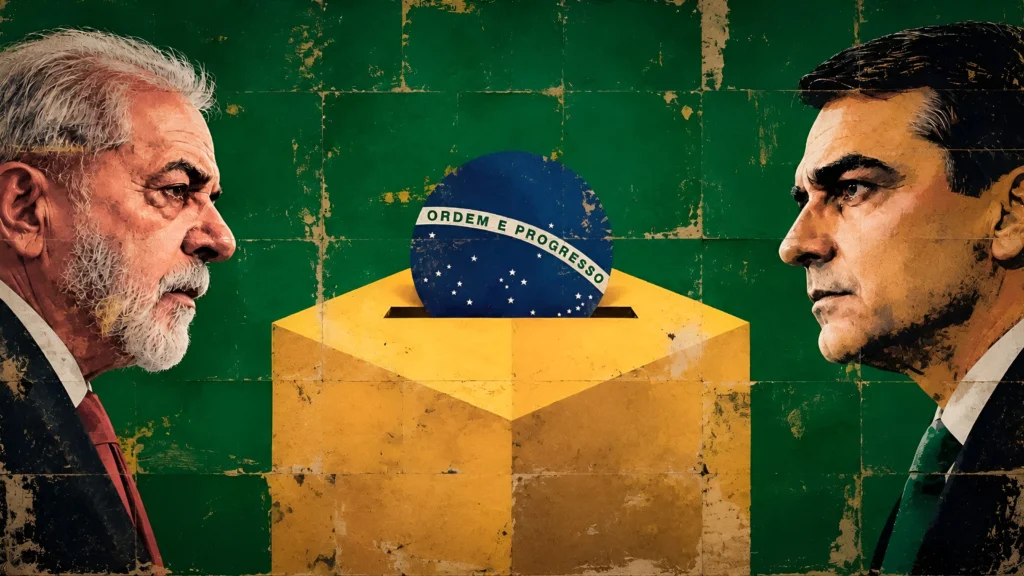
The 2026 Brazilian presidential election ended in a runoff, determining the leadership of Latin America’s largest nation for the next four years.
According to official data released by the Superior Electoral Court (TSE), incumbent President Luiz Inácio Lula da Silva of the Workers’ Party (PT) secured a fourth non-consecutive term after defeating Senator Flávio Bolsonaro of the Liberal Party.
The TSE’s final official count showed that Lula da Silva received 64,256,232 votes, representing 51.79 percent of the total valid votes. Flávio Bolsonaro garnered 59,826,041 votes, accounting for 48.21 percent of the valid ballots cast.
Voter turnout and participation figures underscored the civic engagement across the country, with total reporting reaching 100 percent of polling stations nationwide.
This electoral result marks a significant political milestone, occurring against a backdrop of intense political polarization in Brazil and the growing political influence of the far right across Latin America.
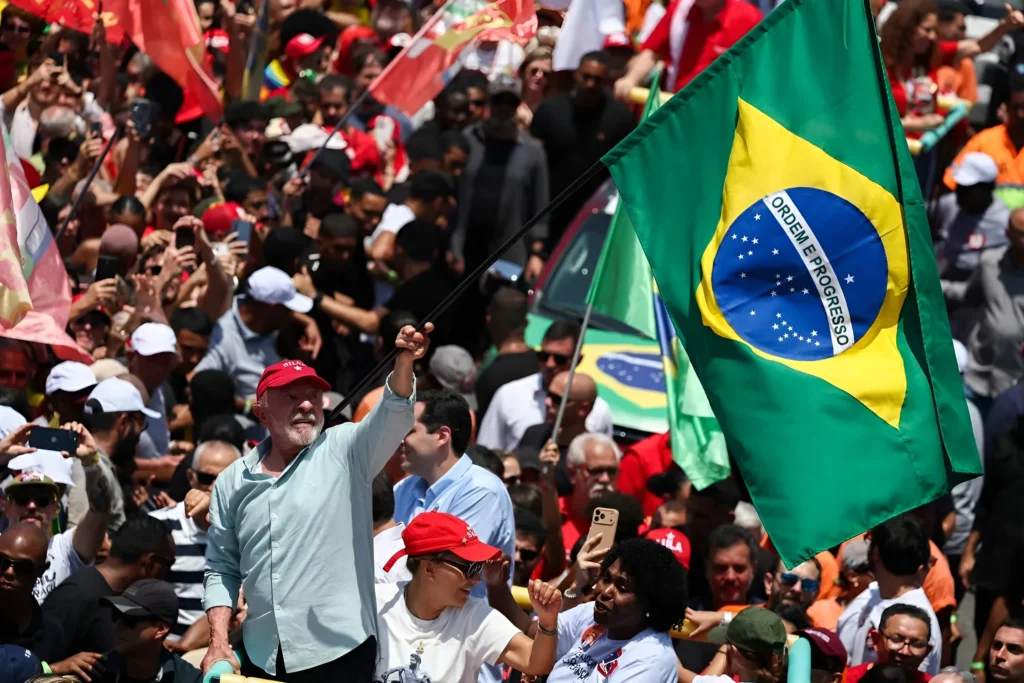
Lula’s victory sparked a wave of strong emotion in Brazil’s streets, eliciting a wide range of reactions, both positive and negative, to the outcome. In this in-depth article, we explore the discourse that has emerged following the confirmation of Lula da Silva’s win, which secures him a fourth term in office.
El triunfo electoral de Lula en Brasil redefine el tablero geopolítico y la correlación de fuerzas en América Latina.
The text reads, “Lula’s electoral victory in Brazil redefines the geopolitical landscape and the balance of power in Latin America. Do you think Lula’s win could shift the political equilibrium in the region?”
Domestic Mobilization and National Reactions to the Election Outcome
Brazil’s highest electoral authority, the Superior Electoral Court (TSE), announced the results of the presidential election runoff held this Sunday, October 25.
Following the official declaration, various reactions emerged within Brazil, reflecting the country’s political landscape.
Social organizations, trade union federations, and grassroots community networks gathered in major urban centers, including São Paulo, Rio de Janeiro, and Belo Horizonte, to await the election outcome.
Once the results were known, union leaders and civil society representatives emphasized that these elections, and Lula’s victory, demonstrate public support for the social welfare programs, minimum wage adjustments, expansion of public housing, and labor protections established during the current administration.
National media outlets highlighted the narrow electoral margin between the two candidates and its implications for the executive power exercise.
Market analysts noted that investor attention will focus on fiscal discipline targets, the management of public spending, and upcoming ministerial appointments for the new presidential term.
Is important to highlight that civic mobilization during the three-week interval between the first and second rounds played a decisive role in shaping voter participation.
Campaign committees focused on reducing voter abstention in metropolitan suburbs and organizing localized voter outreach efforts. Youth organizations and community groups conducted door-to-door awareness campaigns, while labor unions like the Unified Workers’ Central (Central Única dos Trabalhadores) coordinated transportation logistics to facilitate polling access for working-class voters in distant municipal sectors.
The national reaction also reflected broader debates regarding institutional stability and social cohesion. Differences emerged among religious organizations; even before the elections, the Catholic Church had issued statements noting that Flávio Bolsonaro’s proposals diverged from the Church’s social doctrine. Conversely, evangelical leaders have supported the claims of the defeated candidate by calling for the election results to be annulled.
BRAZIL ERUPTS AS LULA DEFEATS BOLSONARO
Brazil’s leftist President Luiz Inácio Lula da Silva staged a remarkable political comeback, defeating far-right candidate Flávio Bolsonaro to secure a historic fourth term, sparking mass celebrations nationwide.
Flávio Bolsonaro Response and Political Posture of Conservative Forces
In the immediate aftermath of the vote tabulation, Flávio Bolsonaro addressed his supporters and members of the press regarding the election results.
Bolsonaro and his campaign team requested that the TSE review procedures for voting hours at polling stations and the transmission of digital vote tallies in certain municipalities.
Candidate Flávio refused to acknowledge the election results that declared Lula the winner, stating: “It is impossible to recognize the outcome of these elections given the circumstances under which these events took place. We are going to request their annulment.”
Political analysts note that this post-election reaction aligns with common strategies used by conservative political groups in the region. Rather than immediately accepting the preliminary results, opposition leaders signaled their intention to maintain rigorous scrutiny over electoral authorities and administrative procedures.
Furthermore, Liberal Party representatives said that they will form an organized opposition bloc in the National Congress to oversee government actions, exercise legislative oversight, and challenge proposed changes to public policy throughout the legislative term.
🇧🇷 Lula's victory. A good day for socialists and not so good for capitalists.
80 years old and will be serving his last term as President. In 2022, after months in prison, he returned and won. He wins again after losing the 1st round in early October.
The Executive Victory Address and Focus on Institutional Integrity
President Luiz Inácio Lula da Silva delivered his victory address in São Paulo before supporters, party leaders, and domestic and international news agencies.
Lula’s speech outlined the strategic direction for his upcoming presidential term, focusing on national unity, poverty alleviation, re-industrialization, and democratic institutions’ preservation.
A central focus of the president’s address was digital communication, social media platform operations, and election administration. President Lula highlighted the impact of algorithmic distribution networks and automated messaging systems during political campaigns, asserting that digital platforms must adhere to national legal frameworks to prevent the spread of disinformation.
Lula said: “Brazil is no one’s backyard. We will change the way we run this country; we will make people participate more in the decision-making process.”
In his speech, President Lula emphasized the urgency of implementing updated regulatory guidelines for foreign technology companies operating within Brazil.
Lula stated that national sovereignty encompasses digital infrastructure, data protection, and the integrity of public communication channels.
The administration announced plans to work within the National Congress and regulatory bodies to draft legal frameworks addressing content moderation standards, corporate transparency, and digital network accountability during future democratic processes.
China takes note of the announcement by Brazil’s Superior Electoral Court of President Lula’s runoff victory @LulaOficial and extends congratulations. China stands ready to work with Brazil to advance the building of the China-Brazil community with a shared future. pic.twitter.com/1ClWUSx61b
International leaders and foreign governments issued statements following the announcement of the TSE election results. Despite the rejection of the results by Flávio Bolsonaro, leaders from Latin America, North America, and Europe weighed in on the outcome.
Mexican President Claudia Sheinbaum congratulated President Lula and the people of Brazil. Meanwhile, Uruguayan President Yamandú Orsi spoke with Lula by phone to congratulate him on the democratic process.
Even presidents with openly right-wing leanings, such as Noboa in Ecuador, Fujimori in Peru, and Kast in Chile, commented on the results and congratulated Brazil on Lula’s victory.
A common theme among these different heads of state was their emphasis on the importance of regional cooperation, economic integration through platforms like CELAC, and a shared vision regarding environmental sustainability.
In the United States, lawmakers such as Senator Bernie Sanders celebrated the election result, describing it as a reaffirmation of democratic governance and citizen participation in the hemisphere.
Meanwhile, Europe and Asia also reacted to the election result. French President Macron congratulated Lula on his fourth electoral victory and urged the deepening of the bilateral partnership between the two nations.
Spanish Prime Minister Sánchez described the win as a great victory via his social media channels, while Costa, the president of the European Council, spoke with Lula by phone to reaffirm the bloc’s ties with Brazil.
Additionally, a spokesperson for China’s Ministry of Foreign Affairs expressed Beijing’s full readiness to foster mutual development. Russian President Putin also sent his warmest congratulations via an official statement.
The Celebrations in Brazil for Lula's Victory are MASSIVE
There are THOUSANDS on the streets celebrating these Presidential Elections Results
Legislative Challenges and Regional Implications for Latin America
President Lula’s fourth term will be shaped by institutional dynamics and broader regional shifts. Domestically, the executive branch faces a conservative-majority National Congress, where conservative and center-right coalitions hold substantial parliamentary seats.
Pushing forward key agenda items, such as tax reform, social welfare expansion, fiscal adjustments, and climate conservation policies, will require building broad legislative alliances across party lines.
For their part, followers and supporters of Lula da Silva have announced that they will be monitoring the promises Lula made during his campaign, such as safeguarding the Family Allowance (Bolsa Família) program, strengthening food security, and increasing the real minimum wage.
Regionally, Lula’s victory consolidates left-of-center leadership in two of Latin America’s largest economies, Brazil and Mexico. This alignment provides institutional support for regional integration efforts, sustainable development initiatives in the Amazon basin, and coordinated strategies on international trade and environmental governance.
The election outcome signals sustained continuity for progressive policy frameworks while requiring pragmatic negotiation to navigate economic constraints and political polarization both domestically and internationally.
Sources: Brasil de Fato – Agência Brasil – Gov.br – O Globo – Folha de S.Paulo – O Estado de S.Paulo – El País – CNN Brasil – EFE – Instituto Tricontinental – La Base América Latina – Diario Red – TeleSUR – Al Jazeera
Attorney General Todd Blanche said on social media over the weekend that the Department of Justice does not seek “to stop the certification of Alaska’s election.”
The Department of Justice does not seek to stop any ballot from being cast or to stop the certification of Alaska's election. This litigation seeks to ensure that after Alaskans cast their ballots, they are preserved in a manner so that only Alaska's governing officials have the…
— Attorney General Todd Blanche (@AGToddBlanche) October 24, 2026
That statement is tough to square with the lawsuit the DOJ filed days earlier against Alaska’s election officials, as the department seeks to intervene there and in California amid GOP fears of losing congressional control in next week’s midterm elections.
The federal government’s Alaska complaint stems from its concern that Republican Sen. Dan S. Sullivan could lose a close race to Democratic challenger Mary Peltola due to the presence of a candidate on the ballot named Daniel J. Sullivan, who the DOJ said is running “with the intention of misleading supporters of Senator Sullivan into voting for him.”
But even if that claim about the other Sullivan’s intention is true, the legal question is: What can a federal court do for the federal government about it?
In the part of its complaint in which the DOJ makes its case for having legal standing to bring the suit, it said that its asserted legal injuries would be solved by a court order “declaring a certification of an election result prejudiced by Daniel J. Sullivan’s inclusion on the ballot unlawful and enjoining defendants [Alaska officials] from allowing such a certification to occur.”
Putting the merits of the DOJ’s argument aside — election law experts have deemed it incredibly weak — its complaint expresses an interest, contra Blanche’s post, in stopping the certification of Alaska’s election. To “enjoin” something is to stop it from happening. At least, according to the complaint, the DOJ wants to halt Alaska’s certification if the result is “prejudiced” by the other Sullivan’s inclusion on the ballot, At least, according to the complaint, the DOJ wants to halt Alaska’s certification if the result is “prejudiced” by the other Sullivan’s inclusion on the ballot — a claim that would be difficult to demonstrate in a timely manner, if ever.
Furthermore, in the complaint’s “prayer for relief,” which is the standard section where a plaintiff tells a court what it wants, the DOJ lists two specific things.
First, it asks the court to: “Declare that certification of any result that may be impacted by voter confusion, as defined above, would violate Defendants’ duties under the NVRA [National Voter Registration Act] to ‘protect the integrity of the electoral process.’”
Second, it asks the court: “Defendants from certifying any result that may be impacted by voter confusion, as defined above, pending an investigation to determine whether votes cast for Daniel J. Sullivan were meant to be cast for Senator Sullivan and any further procedures or relief this Court deems necessary and appropriate to determine what the result would have been absent Daniel J. Sullivan’s inclusion on the ballot.”
That second request for relief reads as if it is missing a word at the beginning. If so, then based on the rest of the complaint, the word “Enjoin” would seem to fit well. As in: Enjoin defendants from certifying … (I asked the DOJ press office whether a word is missing there, and if so, what that word is, but I did not immediately hear back.)
Whatever’s happening with that line, the government’s opponents are reading the complaint as seeking to block certification. Peltola’s campaign committee and the Democratic Senatorial Campaign Committee, which are attempting to join in the case to get it dismissed, said in a Sunday filing that the “DOJ seeks an unprecedented order precluding certification of the U.S. Senate election if the candidate the President favors loses narrowly.”
Calling the government’s claims “utterly without legal basis,” they said the Alaska district court “should not allow this lawsuit to hang like the Sword of Damocles over the ongoing election, lending false legitimacy to the President’s and the Attorney General’s ongoing efforts to spread false narratives about Alaska’s elections as voting continues and as results begin to be tabulated next week.”
One of the recurring themes this election cycle is a sense of betrayal: There are a growing number of constituencies that backed Republicans two years ago, only to feel abandoned by Donald Trump and his party.
Farmers, for example, voted for the president by lopsided margins in the 2024 race, and many have been let down by an administration that’s repeatedly made matters worse for the agricultural industry. Latino voters also shifted to Republicans in large numbers two years ago, confident that Trump would focus his deportation agenda on violent criminals. They now know better.
Similarly, many Muslim voters also took at enormous risk in 2024, moving toward a GOP nominee who championed a Muslim ban in his first term. Two years later, it’s a community that feels used and betrayed by a party that has seized on Islamophobia as the foundation for its closing message in the midterm elections.
But it’s also worth sparing a thought for those who believed Trump when he promised he was committed to “making America healthy again.” An overwhelming body of evidence leaves little doubt that he didn’t mean a word of it. The New York Times reported on the findings of a devastating investigation:
In total, since taking office again, Mr. Trump exempted 202 facilities in 39 states and Puerto Rico from clean-air regulations that were going into effect. Some were among the country’s worst industrial polluters, including chemical manufacturers, copper smelters and coal-burning power plants. About 3.3 million people live within three miles of at least one affected facility.
The exemptions represent the biggest presidential intervention in enforcement of the Clean Air Act in the half-century since President Richard M. Nixon signed the bedrock environmental law. And that is only one of the ways the Trump administration is dismantling a variety of federal environmental protections.
The Times documented in great detail the degree to which the Republican administration has systematically dismantled public safeguards to champion the wishes of polluters and chemical manufacturers, in ways without precedent in American history.
I’m mindful that much of the “MAHA” movement’s base is comprised of activists who are focused almost entirely on opposition to vaccines. But to the extent there are others who are genuinely interested in making America healthy again and who have sincere concerns about the spread of cancer-causing pollution, the Republican White House has gone to stunning lengths to express total indifference to those issues, instead elevating chemical industry lobbyists to leadership roles inside Trump’s Environmental Protection Agency.
“Donald Trump and [Health and Human Services Secretary Robert F. Kennedy Jr.] keep treating MAHA activists like disposable political pawns and now wonder why many resent it,” Protect Our Care President Brad Woodhouse recently said in a statement. “There’s not one MAHA promise Trump hasn’t been willing to break once the checks clear from his big chemical, food and tobacco donors. Food, air, water safety and kids’ health have all been compromised to feed profits for makers of addictive fruit flavored vapes, cancer-linked pesticides, and PFAS forever chemicals. And every time RFK Jr. proves himself a phony by making excuses for Trump’s latest MAHA double-cross, like making glyphosate great again.”
Time will tell how many of these constituencies move toward Democrats in the midterms or decide not to cast to ballots at all; but after the dust settles on the election cycle and the president and Republican leaders assess what went wrong, they might want to start by acknowledging the Americans who felt betrayed after counting on the GOP to deliver.
As October got underway, Donald Trump threw an online tantrum by way of his social media platform, lashing out at Sen. Tom Cotton because the Arkansas Republican hedged on a daylight saving time proposal supported by the White House. The president, however, didn’t just throw around some juvenile names.
Nearly two weeks later, as the president expressed fears about Texas’ U.S. Senate race, he threw another online tantrum, this time targeting Republican Sen. John Cornyn of Texas, whom Trump labeled a “WEAK and INEFFECTIVE” political hack who would deserve the blame if state Attorney General Ken Paxton loses.
On Friday, after Trump’s Justice Department filed an outlandish lawsuit targeting Alaska’s U.S. Senate race, Republican Sen. Lisa Murkowski of Alaska (who is not up for re-election this year) denounced the radical gambit, declaring in a statement, “Alaskans don’t need any help voting for their preferred candidates, and the State of Alaska has already handled this by clearly distinguishing the candidates on this year’s ballot. The Department of Justice should never have filed this lawsuit.”
Naturally, the president who demanded the lawsuit wasn’t pleased. In yet another lengthy online rant published Saturday night, Trump labeled Murkowski “the Republicans’ Worst Senator, by far,” before falsely saying that the senator “only got elected” because of the state’s system of ranked choice balloting, which he falsely described as “corrupt” and a “total Democrat [sic] scam.”
He added that Murkowski “probably wants” Democrats “to steal the Election,” before adding, “Lisa Murkowski is a DISGRACE to Alaska and our Country. You just don’t get any worse!”
Trump concluded that if incumbent Republican Sen. Dan Sullivan loses, “everything we’ve done for Alaska will come to an immediate hault.” (In context, I suspect he meant “halt.”)
For good measure, shortly before midnight, the president kept going, adding in a follow-up tirade, “They’ve been trying to get rid of Lisa Murkowski forever in Alaska, then she came up with the Ranked Choice Voting SCAM.” (Again, it’s not a scam; Murkowski isn’t the one who came up with it; and the system was not responsible for rescuing her career.)
That Trump holds the GOP senator in contempt is not exactly new, but the recent series of harangues directed at senators from his own party is a timely reminder that this guy, 11 years into his political career and nearly six years into his presidency, still has no idea how to deal with Congress.
Evidently, as the president sees it, if he can just harass his ostensible allies enough through online antics, then maybe they’ll succumb to his intimidation efforts and follow his demands.
Except, as he probably ought to know by now, his harassment efforts tend not to work. Cotton didn’t change his mind about daylight saving time; Cornyn hasn’t become a Paxton cheerleader; and Murkowski hasn’t backed off her criticisms of an indefensible lawsuit.
What we’re left with is a president who keeps picking pointless fights with intraparty allies, whose support he might yet need in the near future, in the run-up to critically important U.S. elections — which is every bit as foolish as it sounds.
As last week neared its end, struggling consumers confronted yet another discouraging development: Oil prices reached levels unseen since April. With so little time remaining in the midterm election cycle, and with affordability on the minds of so many Americans, common sense suggested this would be a topic Donald Trump would avoid at his latest campaign rallies.
And yet, the Republican president apparently couldn’t help himself.
Trump: "While oil prices are temporarily high … the United States oil and gas business is making hundreds of billions of dollars"
Saturday night in Georgia, Trump began by assuring his supporters that gas prices would “be falling dramatically” just as soon as he figured out a way to end the war he launched against Iran. If he had stopped here, it would not have been notable.
But then he kept going.
“The United States’ oil and gas business is making hundreds of billions of dollars,” the president said, conceding that he wasn’t sure whether to bring this up, and that members of his own team advised him, “Please don’t mention that, sir.”
He blew off the good advice.
Trump’s own team told him not to celebrate higher energy prices shortly before Election Day, since Americans generally don’t want to be told to be happy about their pain at the pump. He decided not to listen, evidently because he’s delighted to see Big Oil cash in, regardless of the impact on unhappy consumers.
The president first rolled out this talking point just two weeks after launching the war, using his social media platform to argue, “The United States is the largest Oil Producer in the World, by far, so when oil prices go up, we make a lot of money.”
That line proved wildly unpersuasive and was quickly dropped from the White House’s talking points, before making an unexpected comeback at an event in Arizona two weeks ago. “Our country is making more money than it’s ever made because of the fact that oil is so high,” Trump boasted, effectively telling American consumers to be glad they’re paying more at the pump.
As a substantive matter, the problem with Trump’s claim that “we’re making a fortune” is that the word “we” is doing a lot of work in that sentence. It’s true that the United States is producing a lot of oil, and it’s also true that higher prices help generate oil industry profits. But since the number of Americans who benefit from oil industry profits is very small, few will likely celebrate the ongoing hit to their wallets.
But as a political matter, it’s remarkable to see the Republican — who has gone out of his way to make the midterms a referendum on himself — execute such a bizarre strategy at the worst possible time.
“I can just see the fake headlines: ‘President Trump is talking about all the money they’re making while people are suffering at the pump,’” he said. The trouble is, there’s nothing fake about such headlines: Trump really did talk about all the money Big Oil was making while people were suffering at the pump, which he then promptly followed with, “I don’t give a damn.”
If Republicans are very lucky, voters won’t hear about this.
Sixteen days before Election Day, Abdul El-Sayed is sitting at the dinette of a bus that has his face plastered all over it.
I had just played him a clip on my iPad. It was of Tashawna Gill, a Detroit organizer he knows well and who was one of his earliest supporters, describing an alarming trend in what she and her canvassers were hearing from Black voters in the city’s retirement communities.
“They’re skipping that part of the ballot,” Gill said. “We do the senior home tour, and they’re not interested. They skipped that on the ballot. They have returned their absentees, and some of them have shared that they’ve returned their absentees without checking the box for anything for the Senate race.”
In the tight space on the bus, the clip finishes, and El-Sayed says: “I hope more folks will fill out that part of the ballot. This one’s for all the marbles.”
El-Sayed watches a video on his campaign busMS NOW
How did it feel, I asked? Hearing that his story, his message isn’t landing with people in a community he has long served, people he needs if he wants to become Michigan’s next senator?
El-Sayed has a reputation of being pretty sure of himself. Unflappable, quick on his feet, someone who leans into the “don’t let ’em see you sweat” brand of politics.
For a second, that drops.
”Obviously, it’s heartbreaking. I’ve spent most of my career serving exactly those communities,” he says. “But I also get that campaigns are complicated.”
He blames the tens of millions of dollars in PAC money for the tepidness within the Black community toward his attempt to hold Michigan’s open Senate seat for Democrats, and for “destroying trust” he built with the Black community in his time as a public health official in Detroit.
“Rebuilding it takes a long time, so I’ve got work to do to rebuild trust, but I’ve been serving those communities for a long time,” he said. “I’m confident in the work I have done and confident in the work that I will do. And I hope I get the opportunity to do it.”
He notes that he’s not sure, either, just how widespread the sentiment Gill related is among his would-be constituents.
And just like that, the self-assuredness is back.
It’s clear, though, that he’s hurt that the work he has done in Detroit is being misconstrued or discounted, or that folks just don’t know about it. And he’s running out of time to spread the word.
Empty yards
Greenview Avenue in the North Rosedale Park neighborhood of DetroitMS NOW
The clip that I had El-Sayed respond to was from a walk I took with Gill on a quiet street back in Detroit.
She wanted me to see the lawns on Greenview Avenue in North Rosedale Park. It’s a neighborhood of brick houses on Detroit’s northwest side that she calls one of the most educated, highest-turnout precincts in the city. And she would know — her office is one block over.
Gill is a well-known organizer who chairs the Michigan Democratic Party’s Grassroots caucus, founded the African American Leadership Institute, helped get Gretchen Whitmer elected governor and was an early endorser of El-Sayed’s Senate campaign when most of the party establishment — including Whitmer — was behind U.S. Rep. Haley Stevens. Every day, Gill’s office sends out about 70 canvassers across Wayne County.
Tashawna Gill, chair of the Michigan Democratic Party’s Grassroots caucusMS NOW
She knows of what she speaks, especially when it comes to Black voters.
“If you look down here, do you see any yard signs? Look left and right,” she says. I do, and it’s … empty. “It doesn’t even look like it’s an election going on anywhere,” she said.
Typically, Gill said, the streets are pretty lined with them. That they aren’t now, so close to the election, “is scary to me.”
Yard signs are not votes, but they are a sign of enthusiasm and of a campaign that is working hard to get those signs stuck in lawns.
Detroit is 75% Black, according to census data, the largest majority-Black big city in the country. And the Democratic playbook for winning statewide has not changed in a lifetime: run up the score in Wayne and Genesee counties, then hang on everywhere else.
When Detroit doesn’t turn out, Democrats lose. Two years ago, when Elissa Slotkin narrowly held Michigan’s other Senate seat, she won 86% of the Black vote compared with Republican Mike Rogers’ 12%. Recent polling shows El-Sayed hovering below 80% of the Black vote.
The concerns aren’t new. Back in the primary in August, El-Sayed eked out a 1-point win against Stevens. He won the college towns and progressive strongholds. He lost Detroit by 28 points.
El-Sayed seems well aware that the tepidness exists. The campaign says it and party entities have spent nearly $14.3 million in paid media specifically for the Detroit and Flint markets.
They’ve invited the equivalent of the Black political Avengers to endorse and campaign with him in the state, including former Vice President Kamala Harris, Georgia Sen. Raphael Warnock and Rep. Ayanna Pressley of Massachusetts. Former President Barack Obama is stumping with El-Sayed in Detroit this weekend.
The campaign says it has been to 45 Black churches and had more than 125 meetings and roundtables with Black elected officials, faith leaders and community organizations.
It’s not something that’s been lost on his opponent either; they see an opening. The Rogers campaign opened a storefront office on Livernois Avenue in Detroit while we were there, and a group calling itself Democrats for Mike Rogers has been campaigning for him. A recent ad features Black voters saying they felt El-Sayed cared more about Palestine than Detroit.
“If you’re from Detroit, you know no Republican will be going through Detroit like they’re going through Detroit. They are in places a Republican would never be,” Gill said. “So I’m scared that a slice of that, just a little bit, will go to them.”
A Rogers campaign spokesperson touted their outreach, saying they are the first Republican to open a Detroit office, have visited a dozen Black churches and visited Flint and Pontiac “multiple times.” And multiple Democrats in Michigan have told me that Rogers is showing up in places in Detroit that haven’t seen a statewide GOP candidate in years.
Nearly every person I talked to on the ground in Detroit pointed to three reasons why El-Sayed is underperforming with Black voters.
Community conflict
The first one is uncomfortable to talk about: historic tensions between Black and Arab Michiganders. Dearborn sits right on the edge of Detroit, and today Arab Americans are estimated to make up the majority of that city’s 105,000 residents. Older Black voters know the long, violent history between the two communities. In 1980 an Iraqi immigrant store owner shot a Black customer he suspected of stealing soda. In 2023 a clerk at a gas station locked customers inside with an armed man after a card used to purchase less than $4 was declined. One of them was killed. A crash this fall reignited the fight.
Gill puts it in plain terms: “African Americans, especially seniors, feel like they were treated disrespectful, targeted, kicked out of the stores in Dearborn. So our seniors and our parents, when they see Abdul, they blame him for all of that.”
He wasn’t there, I point out. She knows that but says that trauma is unfairly being taken out on his candidacy.
Former Obama administration official Portia Roberson is CEO of Focus: HOPE, a civil rights organization in Detroit founded in 1968. She put those tensions this way:
Portia Roberson, CEO of Focus: HOPEMS NOW
“It has seemingly been that Arab people have been able to move to Detroit in this area and find ways to be successful, whether that is owning gas stations, whether that is owning party stores, and that Blacks who have been here have been locked out of those places,” she said.
I asked El-Sayed about the tension.
“I’ll be honest with you, I understand. I’ve worked in the city of Detroit. You walk into one of these party stores, you walk into a gas station and you’ve got somebody that looks like me behind bulletproof glass, and you look at the way that they’re treating customers. The number of times that people have been denied a bathroom or their kid gets sold a loosie cigarette out of the back or they’re catcalling a woman in the community. That’s deeply inappropriate. It’s wrong and I’ve never been one of those guys,” he said, “even if I look like one of those guys.”
While he was health director in Wayne County, he said, he led a conversation with “those guys” about why that behavior was inappropriate, adding, “You can’t just take money out and not invest in the local community. You can’t just deny local contractors opportunities to service your business and think that’s OK.”
A fateful stance
That second reason? The Uncommitted movement in 2024. In February of that year, more than 101,000 Michigan Democrats, about 13%, voted “uncommitted” in the presidential primary to protest President Joe Biden’s support of Israel’s war in Gaza. El-Sayed publicly announced that he was one of them. Nine months later, Harris lost the state as Black voters watched a party they had carried for decades fail to show up for the first Black woman at the top of the presidential ticket.
When it comes to the Black community, El-Sayed leans hard on his track record. Detroit Mayor Mike Duggan’s mandate to him when he hired him back in 2015 to run a health department that had been gutted: “rebuild it.” In his first year, the department restarted lead screenings for children and helped pay for them in Detroit schools. The department also partnered with a nonprofit to offer free eye exams and glasses to thousands of students. After his failed run for governor in 2018, El-Sayed became director of Wayne County’s Department of Health, Human and Veterans Services.
His stance on Uncommitted is overshadowing all of that.
Roberson has voted consistently her entire adult life, and that movement still stings.
“As a Black woman, I’ve never had the luxury of voting on one issue. I’ve never had that luxury. I’ve never been able to walk into a polling booth and say, this is my one issue and if it doesn’t correlate with my one issue, I’m willing to throw the rest of it away,” she said. “We knew all of the things that have now happened to us, and you still decided to be uncommitted because of your issue.”
El-Sayed endorsed Harris the day after she became the nominee; Uncommitted largely was about the primary for him. And Harris came to Detroit just last month to endorse and campaign with El-Sayed. She has gotten over his criticism of the Biden-Harris policies.
“But a lot of folks haven’t,” Roberson said, laying out the very kind of single-issue objections she had just disavowed. “And I have friends who are very politically astute, and they have said, ‘I will never forgive that.’ It got so big so quickly that they couldn’t pull it back when it was time to coalesce around Kamala Harris, and now we are here.”
At the doors Gill’s team knocks on, the version that seniors are sharing is harsher than what actually happened and full of wrong information, she said.
They tell her teams, “‘He didn’t vote for Kamala. He didn’t help her get in.’ That’s the No. 1 thing,” she said. So the message from his campaign to set the record straight “needs to be louder.”
Democrats’ dilemma
The third reason is largely ideology, and in some ways reflects the maneuvering between progressives and mainstream Democrats within the larger party. Older Black voters in Detroit are more likely to be politically moderate. El-Sayed is running on Medicare for All, and Rogers has spent the fall telling anyone who will listen that Detroit is about to elect a socialist. For the record, El-Sayed says he is a capitalist.
The campaign’s answer to older Black voters has largely been to head to the Black church, the Old Faithful of politics. His team says he has been to 45 Black churches during this election season.
Last Sunday he visited two churches in Flint. His message was, yes, political and full of references to a shared God between his Muslim and their Christian faith. But one of his biggest applause lines was his promise to be back as Sen. El-Sayed.
Abdul El-Sayed speaks to a crowd in Flint, Michigan on Oct. 18, 2026MS NOW
“This is not my first time in communities like these,” he said from the front of the stage. “I’ve been showing up to do this work for the better part of a decade, and I hope that I can show up for you in the United States Senate. If you give me that honor, I promise you this will not be the last time you see me, and the next time I come, God willing, I’m bringing resources and I’m taking your pain and your purpose with me to the halls of power.”
The bridge he’s trying to build is a difficult one. A 2024 poll from AARP found that among Black Michaganders, only 29% called themselves “liberal.”
El-Sayed’s bet is that a different Black voter can come and make up the difference. “There’s a generational divide, and even if there are some seniors who might say, ‘You know what, we’re going to leave this blank because we’ve seen all the ads,’ there are a lot of young Black voters who are like, ‘This is the first time I’ve ever voted,’” he said.
The candidate isn’t blind to the tensions. On the contrary, he seems very aware of them and how hard they may be to overcome. But he’s also running out of time.
I asked Roberson if she thinks he has done enough in the short period he has been the nominee to get the Black vote where it really needs to be.
“That’s tough. Probably not,” she said. “I think there’s more he could have done. And listen, I’m giving grace to the fact that he had a contentious primary. But I do think there were more voters out there, and there are still more voters out there that he could be talking to.”
Her larger point is that it’s less about effort and more about translation. That in a lot of his ads, his platform sound great to the voters who follow politics closely, and who maybe aren’t affected by those three points of tension.
She’s also pretty hopeful. That when Detroit’s most reliable voters wake up on Election Day, they will do what they’ve always done.
”We know what we’re going to get if he doesn’t win,” she said. “So what are we so afraid of that we’re going to get if he does win?”
Nobody on Greenview Avenue has answered that yet. The lawns are still empty.
“Detroit just needs to be waking up. It needs to be waking up because it is asleep,” Gill said. “That is my fear, that Detroit has not woken up.”
El-Sayed says he’ll keep coming back either way.
“At the end of the day, whether folks vote for me or they don’t vote for me, I intend to serve in the same way that I showed up to serve back in 2015 when I came to Detroit to rebuild the health department.”
MS NOW producer Alexander Trowbridge contributed to this report.
The Superior Electoral Court enforces free public transport mandates and monitors vote access nationwide.
The Brazilian presidential campaign has entered its final stage ahead of the runoff vote scheduled for October 25, 2026. Incumbent President Luiz Inácio Lula da Silva faces Senator Flávio Bolsonaro, a candidate for the Liberal Party (PL), after a competitive first-round election on October 4, 2026.
The general election results established a narrow margin between the top two candidates. In the first round of voting, Senator Flávio Bolsonaro finished first, securing 47.03 percent of valid votes, or 56,103,033 ballots. Incumbent President Lula da Silva finished second, receiving 45.16 percent, or 53,870,724 ballots.
Turnout remained consistent with historical participation figures, reaching approximately 79 percent of registered voters. Lula maintained a structural lead throughout the Northeast region, winning majorities in key states such as Bahia, Pernambuco, and Ceará.
Economic indicators and social policy debates formed the primary foundation for candidate speeches throughout the first round. In campaign speeches, President Lula highlighted the accomplishments of his current administration, citing expanding employment rates, social assistance programs, and inflation control measures implemented since 2023.
Flávio Bolsonaro focused his campaign speeches on public security concerns, national debt levels, and economic challenges, presenting his platform as a continuation of conservative governance under his father, former President Jair Bolsonaro, who remains legally barred from holding office.
Street Mobilization and Electoral Propaganda Networks
Campaign operations shifted toward intensive physical rallies and structured broadcast messaging during the runoff period. The Workers’ Party (PT) and its broader political coalition centered their ground mobilization around major urban centers and traditional working-class strongholds.
Popular social movements, including the Landless Workers Movement (MST) and the Homeless Workers Movement (MTST), along with trade union confederations such as the Unified Workers’ Central (CUT), coordinated door-to-door canvassing operations and public rallies in major metropolitan areas including São Paulo, Rio de Janeiro, and Salvador.
Flávio Bolsonaro’s ground strategy relied heavily on state-level executive endorsements and conservative municipal networks. Key allies, including re-elected conservative governors from São Paulo, Minas Gerais, and Rio de Janeiro, organized regional logistics to boost conservative voter turnout.
Flávio Bolsonaro’s campaign speeches during street rallies emphasized hardline public security measures, moral issues, and support for the agribusiness sector, utilizing alliances with conservative caucus members in Congress to secure local political support.
Broadcast media exposure operated under the free electoral advertising time framework regulated by the Superior Electoral Court. The regulations ensured equal daily broadcast time across television and radio networks for both finalists during the runoff window.
Parallel to traditional broadcast propaganda, digital media networks expanded rapidly. Both campaign organizations directed significant funding toward micro-targeted online advertising and social media distribution channels to capture voters outside traditional media formats.
Digital outreach strategies diverged between the two operational teams. Lula’s digital apparatus utilized organized volunteer networks, endorsements from cultural figures, and policy fact sheets distributed through verified messaging channels.
The Flávio Bolsonaro campaign relied on decentralized messaging channels, emphasizing direct-to-voter video distribution, security rhetoric, and critiques of government institutions.
WHO'S THE REAL THIEF? LULA CHALLENGES BOLSONARO TO SHOW RECORDS
Ahead of Brazil’s presidential election, Brazilian President Lula da Silva publicly challenged rival Flávio Bolsonaro to open his bank accounts, release his phone records, and let the Brazilian people decide who… pic.twitter.com/U6Ge0yOV6A
The Superior Electoral Court (TSE) established strict administrative parameters to govern political content across major social networks, focusing heavily on Meta’s platforms, Facebook, Instagram, and WhatsApp.
Electoral judicial resolutions prohibited paid digital political advertising in the final 48 hours leading up to the October 25 vote, restricted automated messaging software, and required tech platforms to execute judicial content removal mandates within expedited timeframes.
Monitoring reports submitted to electoral authorities by digital rights watchdogs and research institutes identified recurring patterns in content dissemination across Meta’s channels.
Independent audits logged instances of dark ads, unverified allegations targeting electoral integrity, and micro-targeted digital campaigns deployed in private messaging groups.
Meta adjusted its content moderation operations in Brazil to comply with TSE directives, expanding its ad library transparency protocols and updating content review procedures.
The company reported the removal of non-compliant posts and the deactivation of unauthorized bulk-messaging networks. Despite these technical platform adjustments, electoral oversight bodies noted that closed messaging networks remained a primary vector for unverified political narratives due to end-to-end encryption limitations.
Broad Coalitions, Strategic Endorsements, and Voter Demographics
The transition from the October 4 first round to the October 25 runoff required both campaigns to expand beyond their primary ideological bases.
President Lula da Silva maintained a broad front coalition uniting left-wing parties with center-right political figures. Vice President Geraldo Alckmin returned as Lula’s running mate, reinforcing ties with business sectors and moderate electors, while key cabinet figures and allied governors led outreach campaign efforts aimed at consolidating anti-far-right voter segments.
Senator Flávio Bolsonaro expanded his campaign footprint by consolidating conservative regional power structures and legislative blocks. Selecting PL lawmaker Alfredo Gaspar as his vice-presidential running mate, a former prosecutor and public security secretary from Alagoas, Flávio Bolsonaro sought to bolster his law-and-order platform while solidifying backing among conservative lawmakers in Congress.
Flávio’s runoff effort secured endorsement commitments from conservative state governors, agribusiness associations, and international right-wing figures, reinforcing his position across traditional conservative strongholds.
Incumbent President Lula retained consistent lead margins among female voters, lower-income households earning up to two minimum wages, residents in the Northeast region, and older age demographics.
Conversely, Flávio Bolsonaro maintained stronger support metrics among male voters, higher-income earners, Evangelical Christian voters, and electors situated in the agribusiness-heavy South, Southeast, and Center-West regions.
Both campaign organizations directed their final operational focus toward undecided voters and middle-income suburban districts in the key battleground states of Minas Gerais, Rio de Janeiro, and São Paulo.
Debate Performances, Fact-Checking, and Media Coverage
The televised presidential debates between incumbent President Lula da Silva and Senator Flávio Bolsonaro emerged as decisive turning points during the three-week runoff window. Major media coalitions organized direct face-to-face encounters, allowing the candidates to present competing vision frameworks for Brazil’s governance.
During the live broadcast exchanges, President Lula focused his arguments on economic stability, job creation, and social progress achieved during his term, emphasizing the expansion of public investments, inflation control, and environmental protection initiatives.
Lula confronted Flávio Bolsonaro on fiscal proposals, judicial integrity, and the anti-democratic precedents associated with the far-right movement.
In response, Flávio Bolsonaro framed his candidacy around conservative public security policies, government austerity, and tax reforms. Flávio heavily criticized the economic administration’s public debt metrics and targeted the federal judiciary, presenting his campaign as a necessary alternative to political continuity.
Mainstream media coverage focused heavily on candidate posture, tone, and strategic attempts to appeal to the estimated 10 percent of undecided voters heading into the final days of the race.
Brazil’s top electoral court has said it will fine Meta $200,000 a day until it can prove that president Luiz Inácio Lula da Silva and his far-right challenger Flávio Bolsonaro get equal treatment on its platforms.
Election Day Execution, Institutional Resilience, and Regional Impact
Supervised directly by the Superior Electoral Court (TSE), voting logistics across all 26 states and the Federal District rely on fully digitized electronic voting machines (urnas eletrônicas) to ensure rapid processing and secure transmission of total ballots.
To facilitate maximum democratic access, federal judicial rulings mandated free public transportation (passe livre) across capital cities, while electoral inspectors monitored security forces to prevent voter transportation disruptions or targeted law enforcement checkpoints.
Following the October 4 first round, where Flávio Bolsonaro led with 47.03 percent (56,104,503 votes) against Lula’s 45.16 percent (53,879,538 votes), both organizations focused their final operational pushes on key battleground states like Minas Gerais, Rio de Janeiro, and São Paulo.
The outcome of the October 25 vote carries far-reaching geopolitical implications across Latin America and the broader global stage. A victory for President Lula would ensure the continuation of active multilateral diplomacy, regional integration through BRICS and CELAC, and strong federal commitments to Amazonian environmental conservation.
Conversely, a victory for Flávio Bolsonaro would mark a significant resurgence for the continental far-right, shifting Brazil’s diplomatic alignment toward conservative international blocs and introducing sweeping changes to domestic fiscal and environmental policy frameworks.
Sources: Brasil de Fato – Agência Brasil – Gov.br – O Globo – Folha de S.Paulo – O Estado de S.Paulo – El País – CNN Brasil – EFE – Instituto Tricontinental – La Base América Latina – Diario Re
Today’s installment of campaign-related news items from across the country.
* In Mississippi’s unexpectedly interesting U.S. Senate race, former Vice President Kamala Harris headlined a rally in support of local prosecutor Scott Colom, the Democratic nominee.
The rally came on the heels of Donald Trump’s political operation confirming that the president will hold a rally on Monday in hopes of boosting Republican Sen. Cindy Hyde-Smith, who’s struggling to a surprising degree in a race the GOP long assumed would be easy.
The news coincides with an Axios report that said Senate Republicans are so concerned about the Mississippi race that it’s “weighing a cash infusion” for the contest.
* In Maine’s closely watched U.S. Senate race, the latest Fox News poll found Democrat Troy Jackson and incumbent Republican Sen. Susan Collins tied, with each garnering 49% support.
* In Kansas’ closely watched U.S. Senate race, incumbent Republican Sen. Roger Marshall has finally sold his house in Florida. The sale was finalized the same day early voting began in Kansas.
* In Texas’ closely watched U.S. Senate race, The New York Times reported that a covert Russian influence operation is targeting Democratic state Rep. James Talarico’s candidacy as part of an apparent effort to boost Republican state Attorney General Ken Paxton.
* Speaking of Texas, Republican Gov. Greg Abbott recently boasted about endorsements he received from several Democratic sheriffs, but The New Republic reported that some of them deny having endorsed the GOP incumbent.
* While voter turnout is expected to be strong in New Hampshire this year, there is a new hurdle for voters to keep in mind: The Supreme Court granted New Hampshire’s emergency request to block the use of student IDs for voting in the midterms.
* Over the first two weeks of October, Republican megadonor Elon Musk invested an additional $76 million to boost GOP candidates. Five months after the billionaire publicly vowed to curtail his campaign spending, Musk has now donated more than $442 million to advance the Republican cause in the 2026 cycle.
* Speaking of Republican megadonors, billionaire Jeff Yass has now invested nearly $110 million to boost GOP candidates in the midterms. Yass is also the top donor to Vivek Ramaswamy, the Republican’s gubernatorial nominee in Ohio.
* And speaking of Ramaswamy, to appreciate the scope of the controversy surrounding his scandalous attack ad, it’s worth noting that 10 sitting Democratic female governors issued a joint statement on Thursday, condemning the candidate’s vile commercial as “an insult to survivors everywhere.”
After months of arguments, a state judge in Alaska ruled in late June that retired teacher Dan J. Sullivan could run against incumbent Republican Sen. Dan S. Sullivan, overturning the ruling from the Alaska Division of Elections. A few months later, after the first round of balloting, state election officials finalized the top four candidates for Alaska’s unique system, and both Dan Sullivans advanced to the general election.
That Donald Trump and his political team are worried about the race is obvious, but what the president’s team is doing about it is another matter entirely.
Late Thursday, Trump’s Justice Department filed a preemptive lawsuit that intends to block certification of the Senate race — but only if the Republican incumbent loses while the rival with the similar name remains on the ballot.
As The Associated Press reported, the litigation kicks off “what many have feared could become a lengthy battle between the U.S. government and states over certifying an election where the president’s party is struggling.”
What’s more, it’s entirely possible that former Democratic Rep. Mary Peltola will win this race and the efforts by Trump’s DOJ will determine whether she’s seated — and which party ultimately holds a majority in the Senate.
The lawsuit is a dramatic escalation, but it didn’t come out of nowhere. At a White House event in early September, the president publicly urged Attorney General Todd Blanche to pursue a case in Alaska specifically focused on the competing candidates with nearly identical names.
Last week, Trump went further, claiming that federal authorities were “looking into” the matter and pushing assorted conspiracy theories for which there was no evidence. As recently as Wednesday of this week, the president used his social media platform to publish a statement that read, in part, “Dan S. Sullivan is leading by a lot, but this is CHEATING in an Election, and the Judge that allowed this to happen should be ashamed of himself. We are looking at powerful legal options to remove the fraudulent Daniel J. Sullivan Jr. from the Ballot, and holding the Democrats accountable for their Election Interference, in the pursuit of Justice and Fairness.”
The statement included obvious falsehoods — most recent polling in Alaska shows the Republican incumbent trailing, not “leading by a lot” — and there is nothing to suggest Democratic officials have engaged in “election interference,” other than championing their party’s nominee.
Nevertheless, there have long been concerns that the Trump administration might try to derail election results it doesn’t like, and the DOJ’s new lawsuit regarding Alaska suggests those concerns are well grounded.
This is a developing story. Check back for updates.
Any story about a family dispute is bound to be complex, but the politics surrounding Vivek Ramaswamy’s abhorrent attack ad are relatively straightforward. Amy Acton, the Democratic gubernatorial nominee in Ohio, was allegedly raped by her stepfather when she was a child.
Her Republican opponent, Ramaswamy, is trying to weaponize this in despicable fashion, pushing a campaign commercial that features Acton’s estranged mother, who sided with the stepfather even after his arrest and stayed with him until his death.
But in recent days, it’s become clear that this ad has taken on far greater significance than one commercial in one gubernatorial election. As The New York Times’ Michelle Goldberg summarized in her latest column:
It’s quite a feat, in this numb and debased era, to create a political advertisement so shocking and indecent that people from across the political spectrum feel the need to denounce it. The Ohio gubernatorial candidate Vivek Ramaswamy, who has long fashioned himself as a kind of Donald Trump 2.0 — younger and brainier but just as brash — has managed it.
By releasing what may be the most disgusting ad in American political history, he’s done more than just reveal his own low character. He’s opened a kind of proxy debate on the right about whether a post-Trump conservatism should try to reclaim some base-line morality or continue along its current smashmouth course.
Donald Trump has changed his party and his nation’s politics in a great many ways, but among the most important shifts is the degree to which the president has championed the politics of cruelty and dishonor. There are messages — from attack ads to speeches to social message postings — that Republican officials used to avoid, even when they agreed with the underlying point, in part to avoid backlash and in part to maintain their public reputations and credibility.
In recent years, however, those scruples have been cast aside. GOP officials and candidates no longer hedge on depraved messaging: After having seen Americans twice elevate a malicious television personality to the nation’s highest office, they now routinely echo his amorality and cynicism, seeing it as a way to satisfy the party’s far-right base, to advance their own ambitions or both.
Most decent people can and will agree that Ramaswamy’s attack ad is indefensible, but the ad has also taken on totemic value.
“What the ad represents … is an opening salvo in the post-midterms fight for the Republican Party’s future,” Politico’s Jonathan Martin explained. “It’s a battle that will accelerate next year but may not culminate until the 2030s. Put simply, what sort of party does the GOP want to be — and what will the market bear?”
Trailing in polls and short on options, Ramaswamy made his choice, and the stain on his character is likely to be permanent. What the Ohioan might not have anticipated, however, is just how much his disgusting tactic has divided his own party.
Several prominent Republicans in the state, including outgoing Gov. Mike DeWine, have publicly condemned the ad, and others outside of Ohio have taken similar steps. Former GOP presidential contender Nikki Haley, for example, said via social media that Ramaswamy is “a bad guy.” A day later, Rep. Ashley Hinson, the party’s Senate hopeful in Iowa, called the commercial “absolutely terrible.”
On the other side, there’s the White House, where the politics of cruelty and dishonor still thrive, and where there are Republican leaders who still believe repugnant messaging will dominate for the foreseeable future.
JD Vance, for example, declared this week that he’s “a little bit disgusted,” not by Ramaswamy’s gutter politics, but by members of his own party who are “whining” about civility.
The vice president’s reaction itself drew swift rebukes — The Bulwark published a piece that described Vance as a “sociopath” — but that didn’t stop Trump from picking up where his vice president left off.
On Wednesday, the president told reporters he didn’t “know anything about it,” before shifting gears and talking about how important he considers it to see a mother “hate her daughter that much.”
In other words, Trump took care to keep dividing Republicans — with less than two weeks remaining, during the early voting period — in one of the nation’s most important gubernatorial races, by leaning into support for one of the most repulsive campaign ads in recent memory.
The series continues as we report on developments following April’s historic election and on the steps taken since then by the Tisza government. This week, we cover the following topics:
Orbán’s former right-hand man in custody.
What did we learn from Tisza’s first budget?
Ursula von der Leyen to give a speech on the anniversary of the revolution.
Poll of the week: more than four million people back Tisza.
Orbán’s ex-right-hand man in custody
The last time a central bank governor was taken into custody in Hungary was in 1944, during the German occupation, as Válasz Online pointed out. This 82-year hiatus ended on Wednesday (21 October), when György Matolcsy was taken into police custody.
But Matolcsy is not simply a former central bank governor; he is one of the architects of Orbán’s economic policy, a key figure in the former prime minister’s system, and together with his family he has in recent years become one of the symbols of Fidesz’s taste for luxury.
Who is György Matolcsy?
“I have a very strong emotional relationship with Matolcsy. I owe him a great deal, I have learned a great many things from him. Matolcsy is an economist of historic stature,” prime minister Péter Magyar quoted ex-prime minister Viktor Orbán’s words from an interview last November, after the former central bank governor had been taken into custody.
Matolcsy was a member of the Hungarian Socialist Workers’ Party (MSZMP), and after the regime change he became prime minister József Antall’s chief adviser. In 1999 he joined Orbán’s advisory board, and from 2000 to 2002 he served as economy minister in the first Orbán cabinet.
Even after the 2002 election defeat he remained loyal to Orbán, and in 2010 he became minister for national economy, meaning he was put in charge of both the finance and economy portfolios at the head of a merged super-ministry. It was at this time that Orbán called him his right-hand man.
Matolcsy was the architect of Orbán’s “unorthodox economic policy”; he oversaw the nationalisation of private pension funds, the sending home of the IMF from Hungary, and the introduction of high sectoral surtaxes.
The great bank heist
He was appointed central bank governor in 2013, and by 2016 the foundations scandal had already broken. It emerged that 266bn forints’ worth (€840m) of public assets had been shifted into the foundations of the Hungarian National Bank (MNB). These foundations bought buildings and works of art, and also granted substantial benefits to their own leaders.
Later, the foundations’ money was entrusted to an asset management company, which obtained further funds and thus came to control assets of around 500bn forints, of which some 400bn forints (€1bn) – was public money.
This asset manager built up an international corporate network, behind which stood the central bank governor’s son, Ádám Matolcsy, and his circle. The asset manager bought into risky foreign companies, spending a significant part of its resources. The Matolcsy family visibly became very rich, and Ádám also amassed a notorious Porsche collection.
György Matolcsy’s mandate expired in 2025, and after his departure the State Audit Office also concluded that abuses may have taken place at the central bank. For a long time, however, no police investigation was launched.
The current case
The current charges relate to a case that unfolded in the final days of Matolcsy’s activity as central bank governor. Matolcsy wanted to ensure that his family would control the roughly 500bn forints (€1.25bn) of central bank assets even after he no longer held office.
This article continues, but the full version is available only to EUobserver.com subscribers. Visit account.euobserver.com/membership
President Donald Trump traveled to Iowa on Thursday, looking to energize his base as he touts a financial-support plan to reassure farmers, a key constituency that has been hit hard by rising prices.
It’s another campaign trip to a reliably red state that has become surprisingly competitive. Trump won Iowa three times — carrying it by 13 points in 2024 — but this year several Republicans are in tight races.
Returning to Iowa for the first time in nearly 10 months, Trump campaigned, in part, for Rep. Ashley Hinson, the GOP Senate hopeful who is running to fill retiring Republican Sen. Joni Ernst’s seat. Hinson and her Democratic rival, state Rep. Josh Turek, are almost neck and neck in polling averages from MS NOW/FiftyPlusOne.
“There are a number of Senate seats in play that we did not expect to be in play,” said Whit Ayres, a veteran Republican pollster. “[Trump’s] record and his approach are likely to appeal much more to members of his base than they are to independent or swing voters.”
In Sioux City, Trump sought to appease Americans hurting from high fuel prices by announcing that his administration is using the Defense Production Act to release $150 million to increase U.S. refining capacity to produce more diesel and gas.
Trump spent the first few minutes of the rally railing against familiar political targets he has repeatedly invoked to rile up supporters at recent campaign stops, including Michigan Democratic Senate candidate Abdul El-Sayed and Rep. Ilhan Omar, D-Minn. Speaking to Iowans, Trump claimed without providing evidence that Omar used a different name to get elected and sworn into Congress, a claim the congresswoman’s spokesperson has publicly denied.
As the president attacked Omar and argued she should resign, his supporters chanted, “Lock her up.”
The president also spoke at length about a controversial attack ad by Ohio GOP gubernatorial candidate Vivek Ramaswamy targeting his rival, Democrat Amy Acton. The ad features Acton’s estranged mother saying her daughter lied about being sexually assaulted by her stepfather. Trump told supporters that he asked Ramaswamy to keep running the ad and to “look upstairs and say thank you, God, very much.”
And Trump, who frequently talks about running again in 2028 — despite the Constitution’s two-term limit — again bragged he would beat any opponent if he ran, but acknowledged that, after studying the law, he has learned that there was “not a lot of wiggle room” to allow him to seek another term.
“I think I have the right to run again because they cheated,” Trump said, repeating repeating his false claim that the 2020 presidential election was stolen from him.
Thursday’s rally at Sioux Gateway Airport is the first of at least two planned visits to Iowa by the president in the final stretch of the midterms. The president’s campaign blitz in typically Republican strongholds reflects shifts in the political landscape in a midterm that initially favored the GOP.
“The problem right now is that people perceive that the economy is not better, and inflation has not only not come down, but it’s higher,” Ayres said.
A GOP strategist familiar with Republicans’ thinking in the midterms, granted anonymity to speak freely about internal strategies, told MS NOW the president’s visits to some of the reddest districts in states like Iowa in the final days of the campaign are part of a deliberate strategy to maximize turnout by loyal Trump voters in key races.
“Specifically, the 4th District, where we’re deploying him, is the heart of the base, the heart of Republican support,” the strategist said. “If we can churn out our base voters in that area, Democrats’ path to winning the state just shrinks dramatically.”
Seeking to address the financial hardships hitting major agricultural states like Iowa, the Trump administration has announced an $8 billion relief package for farmers and construction plans for a $15 billion steel plant in the state. The president himself has also touted new foreign trade deals to export American farm products and other efforts to boost farmers and ranchers.
But some farmers MS NOW spoke to say Trump’s trade deals have made little impact on their businesses as their operating costs have increased from rising diesel and fertilizer prices. And the president’s announcement that he would lower tariffs on ground beef from Argentina earlier this year came as a blow to the state’s cattle industry, with both Hinson and Turek calling the policy a bad idea.
Craig Moss, a fifth-generation cattle and hog farmer from Hull, about 50 miles north of Sioux City, told MS NOW the volatile cattle market had been “rough” in the past year, in part because of the president’s lifting of tariffs on Argentine ground beef.
“Trump makes a trade deal with Argentina, and then when he’s questioned about it by reporters, he says, ‘You don’t know anything about what’s going on over there,’” Moss said. “Well, sir, you don’t know anything about the cattle market.”
Moss said the current diesel price “kind of stinks,” adding that the ongoing Iran war was to blame. Still, Moss, who voted for Trump in the past, said he agreed with the president on most issues and did not regret voting for him before.
Julius Schaaf, a corn-and-soybean farmer of more than 40 years based in Fremont County, voted against Trump in past elections and said the current volatility in the farming industry was because of Trump’s trade policies. Schaaf criticized the administration as a “rude and difficult” trading partner.
“A lot of the people that supported him were farmers that have a lot of equity in their property, and they can weather a storm for a while,” Schaaf said. “But you talk to the young guys that are just getting started and trying to buy inputs and inputs have gone through the roof — they’re the ones that are really struggling.”
Vice President JD Vance addressed some of those concerns last month at a rally in the state, telling supporters that the Trump administration’s trade and tax policies have directly benefited farmers and blue-collar workers. He has also sought to show understanding of economic realities, acknowledging the high cost of gas and telling voters “we’re working on it.” Trump, for his part, has at times downplayed those concerns, calling the focus on affordability a “hoax” and insisting that prices would plummet once the Iran war ends.
Many Iowans across the political spectrum whom MS NOW spoke with agreed that their No. 1 concern was the cost of living. And while Trump’s performance got mixed reviews, they still had not decided how they would vote in the Senate and House races.
Tiffany, an Iowa voter who backed Trump in 2024, plans to vote in the midterm races but said she is currently undecided. Her top issue: the cost of living, she said, because “prices keep going up.”
“If you can’t afford to put gas in your car, how can you go to work to make money to put a roof over your head to put food on your table?” said Tiffany, who asked to go by her first name only. “You can only stretch your penny and your dollars so far until you can’t stretch it anymore.”

 Login