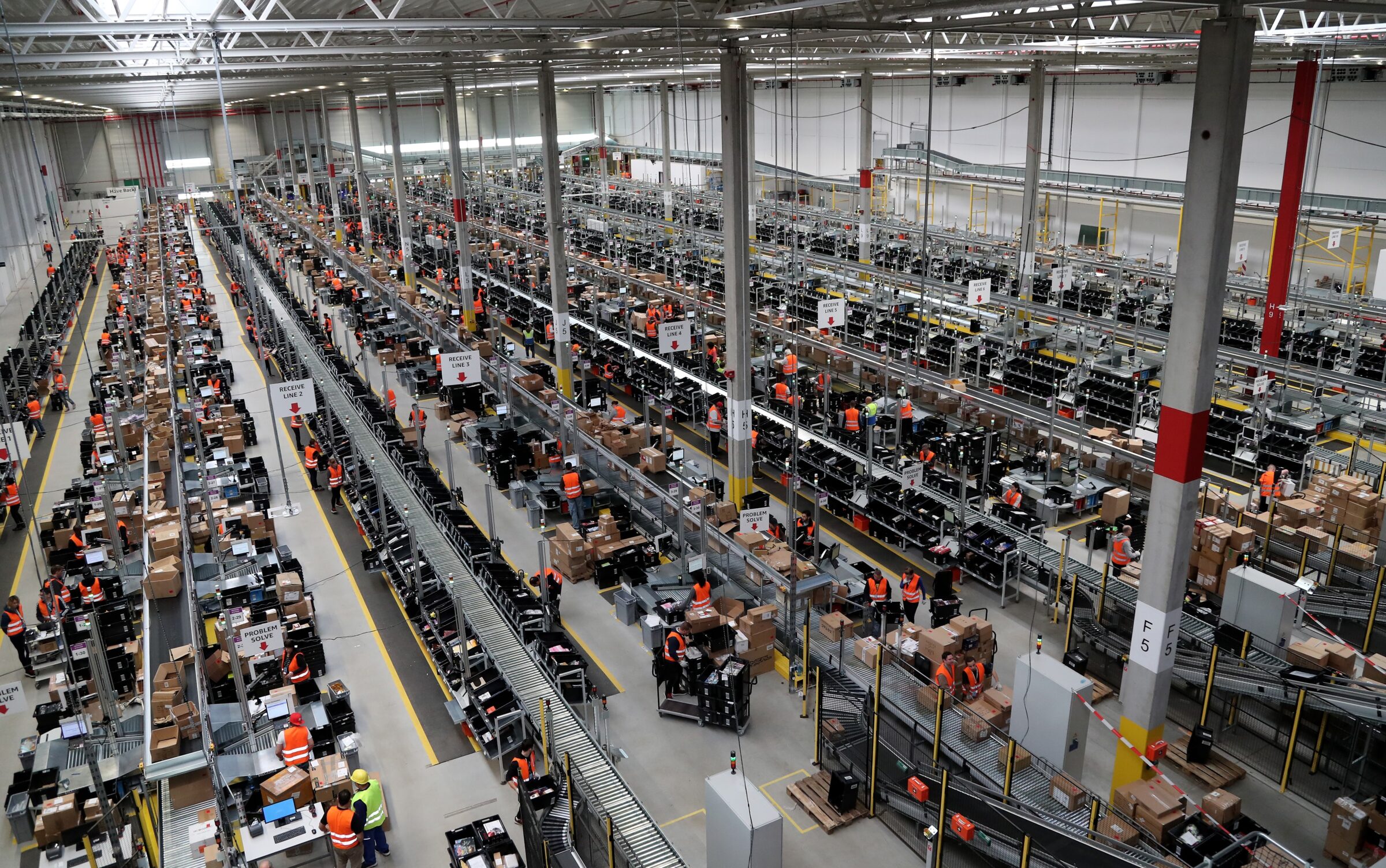
The European Parliament’s employment committee has highlighted the need for regulating automated control of workers after visiting Amazon warehouses in Germany and Poland this week.
Seven of the committee MEPs visited Amazon warehouses employing some 5,000 workers on Monday and Tuesday (26-27 October) ahead of the Commission’s Quality Jobs Act proposal expected in December.
The trip follows the committee’s hearing on working conditions in Amazon in January, where workers raised concerns about efficiency goals, safety, and surveillance using AI tools, which may be regulated more rigorously as a part of the upcoming act.
According to a 2023 survey by UNI Europa, a labour union federation, about a half of Amazon’s employees said their work had a negative impact on their mental and physical health.
Workers’ progress throughout the day is usually watched through security cameras, but also the work badges scanned in check points in various locations in the warehouse, and scanning devices used to identify products.
In the city of Sosnowiec, home to one of Amazon’s Polish warehouses, employees are overworked by “constant pressure of being judged, which is very hard to cope with mentally,” Agata Wypiór, recently-named vice secretary of Amazon’s European Works Council and Solidarność union leader told EUobserver.
Leaving worker management and performance monitoring to algorithms means “these processes become almost invisible,” Li Andersson, head of the delegation, told EUobserver.
“The way the workers describe it, it sounds like a digital panopticon: when you work faster you have to work even faster.“
Workers themselves often do not know what data is collected on them and how it is being used to set productivity targets, Anderssen highlighted.
This article continues, but the full version is available only to EUobserver.com subscribers. Visit account.euobserver.com/membership
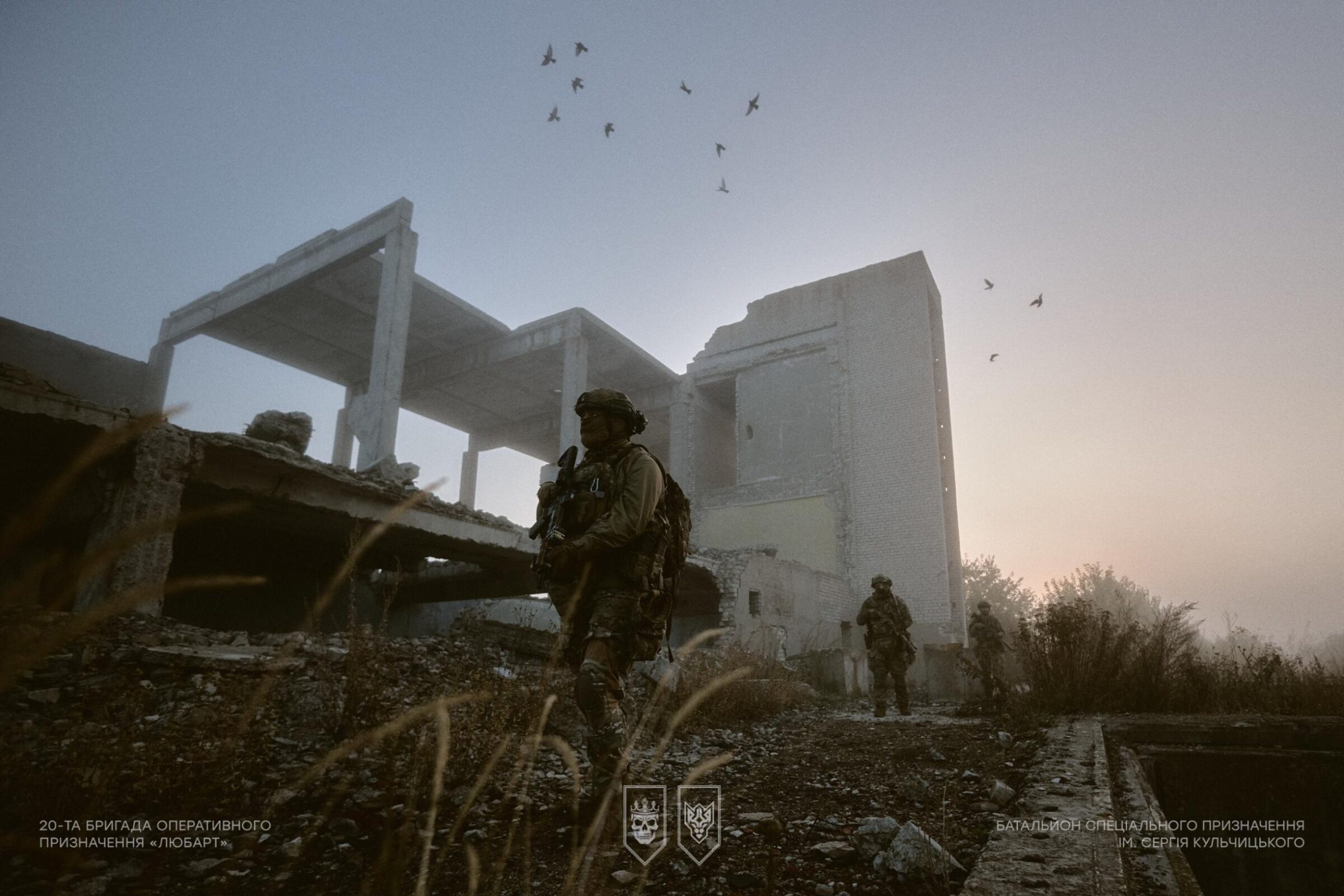
Fighting near Kostiantynivka through the eyes of a missing Ukrainian soldier: hunger, thirst, exhaustion and, ultimately, disappearance.
Rubikon released a video of an attack on a Ukrainian position in southern Kostiantynivka — an area Moscow has claimed to have captured for months.
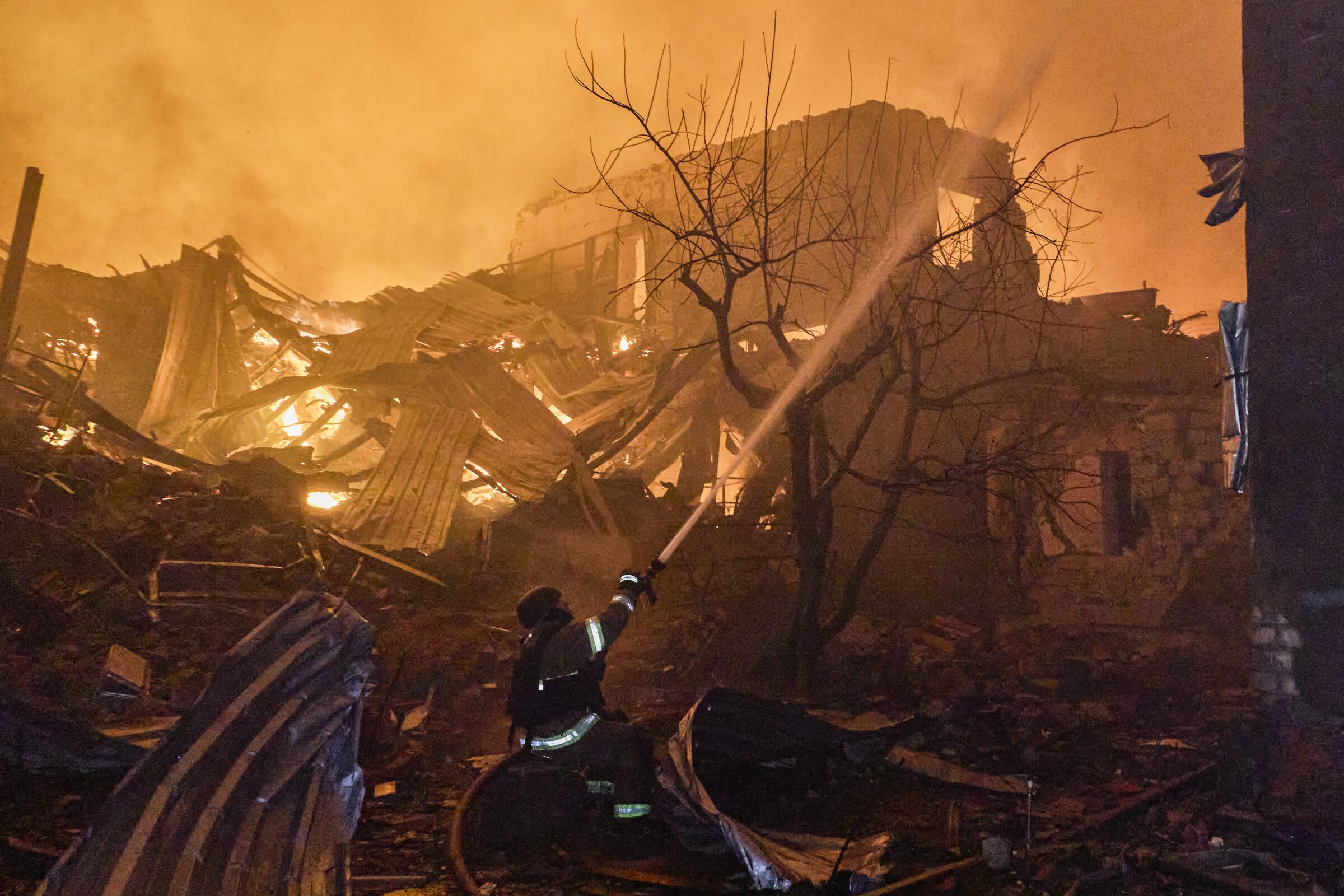
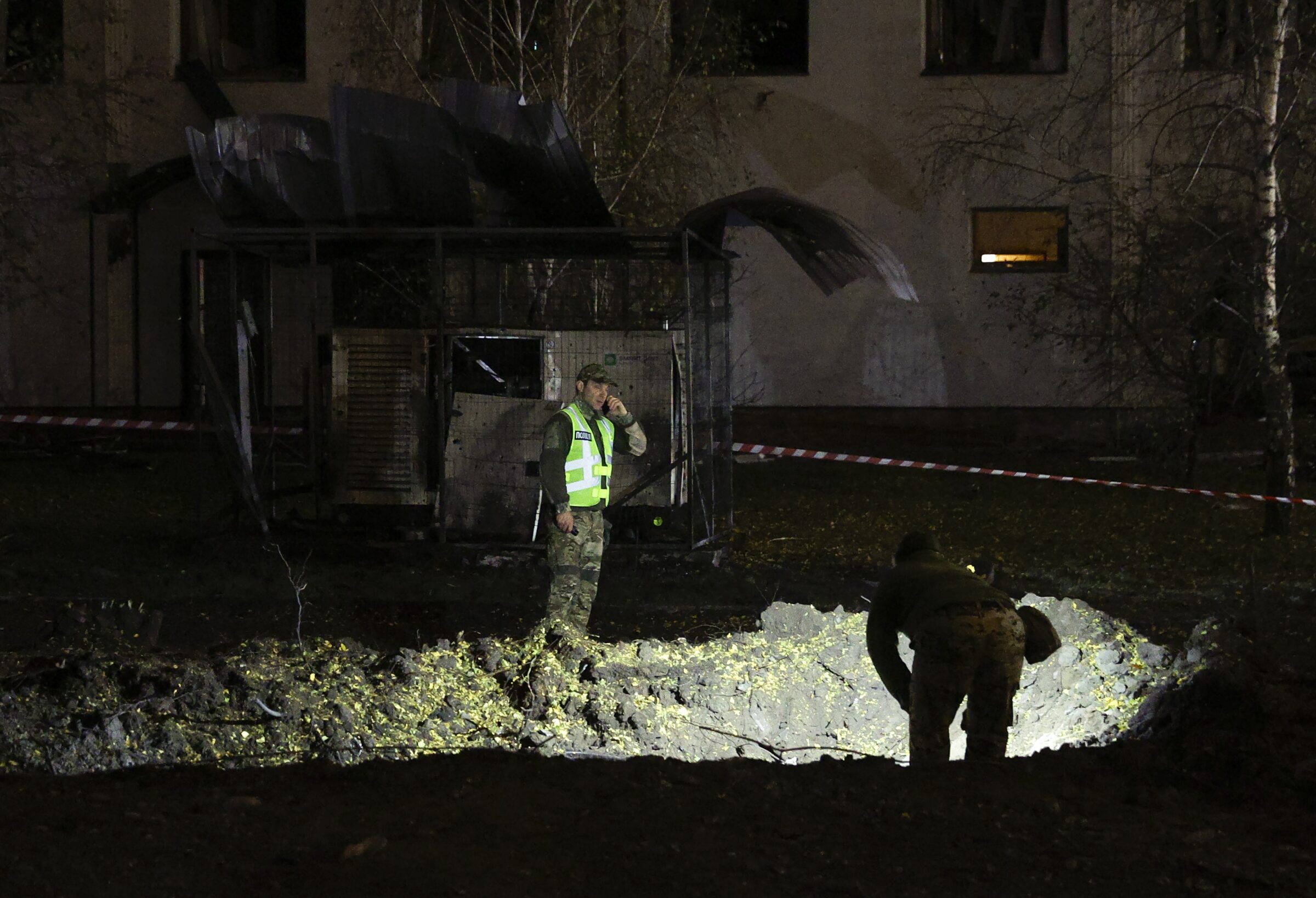
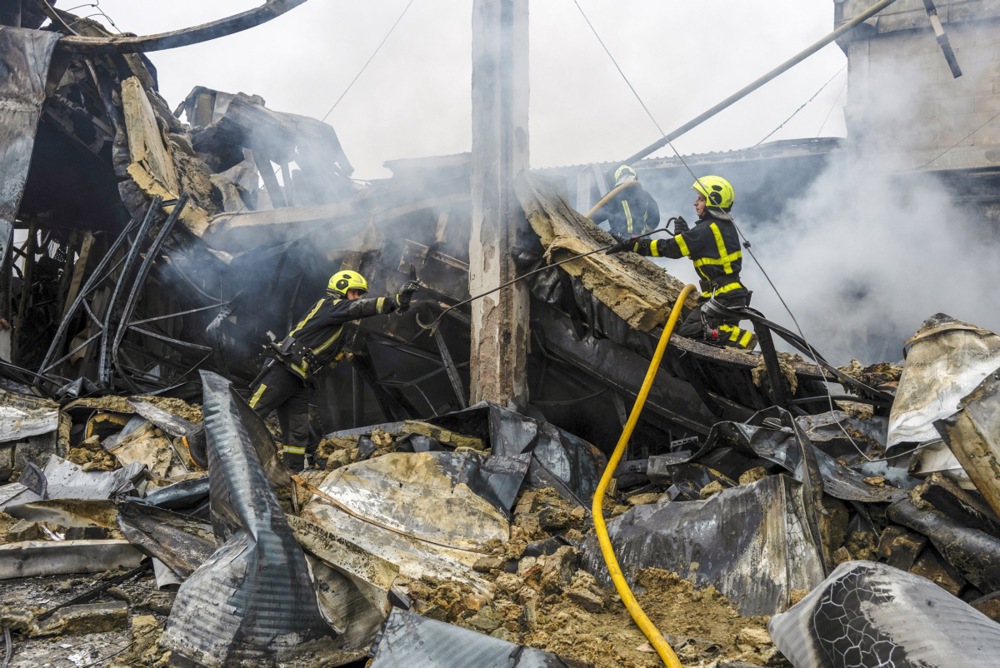
Russians used ballistic missiles against Kyiv’s Pivdennyi Bridge, leaving a large hole in it and forcing its closure.
Near Komar, Ukrainian soldiers reached the village of Vesele, cutting the distance to Velyka Novosilka by a third.
Maps of the day: Kostiantynivka, Komar
Videos of the day— the aftermath of the Russian attack on a Kyiv bridge; a drone attack on a Russian convoy, seen from both Ukrainian and Russian cameras.
Fighting near Kostiantynivka through the eyes of a missing Ukrainian soldier: hunger, thirst, exhaustion and, ultimately, disappearance. Despite Russian claims that it has captured the city, fighting continues for the first city in the belt of Donbas “fortresses”. Further details can be found in the second part of the Ukraine Battlefield update.
Little, however, is known about the people holding Ukraine’s defences despite Russia’s superiority and their immense hardship. Ukrainian newspaper Hromadske published a lengthy report on the fate of one of them.
His name is Hennadii Osadchyi. He is 42, has a wife, Nadya, and an 18-year-old daughter. They live in Kropyvnytskyi, in central Ukraine.
He was mobilised in autumn 2025 and, on 16 December that year, was sent to the front in Kostiantynivka as a member of the 100th Brigade. By the time he went silent, he had spent 230 days defending the city without rotation.
His wife decided to speak about what he experienced during those seven months. Her information comes from the messages they exchanged. When Hennadii enlisted, he weighed 96kg.
By the time he went silent, he weighed half as much. His messages to his wife explain this dramatic change.
This article continues, but the full version is available only to EUobserver.com subscribers. Visit account.euobserver.com/membership
New research by Corporate Europe Observatory (CEO) and LobbyControl shows that Big Tech lobbying is pushing the EU towards sweeping deregulation of data protection rules.
The new publication finds signs of an intensive lobbying campaign between Big Tech and Germany and Ireland which are helping to gut fundamental European data protection safeguards.
The report documents extensive contacts between Big Tech companies and European policymakers over the EU Commission’s proposed Digital Omnibus.
The aim is to change and influence how personal data are used to develop and operate AI systems, warns CEO.
“It is a really drastic change,” Bram Vraken researcher and campaigner at CEO told EUobserver.
Introduced by the commission last November, the Digital Omnibus forms part of the EU executive’s wider drive to simplify regulation and strengthen European competitiveness.
The commission has presented the proposal as a way to make Europe “simpler and faster” and to “adapt” its regulatory framework to a “more volatile world”.
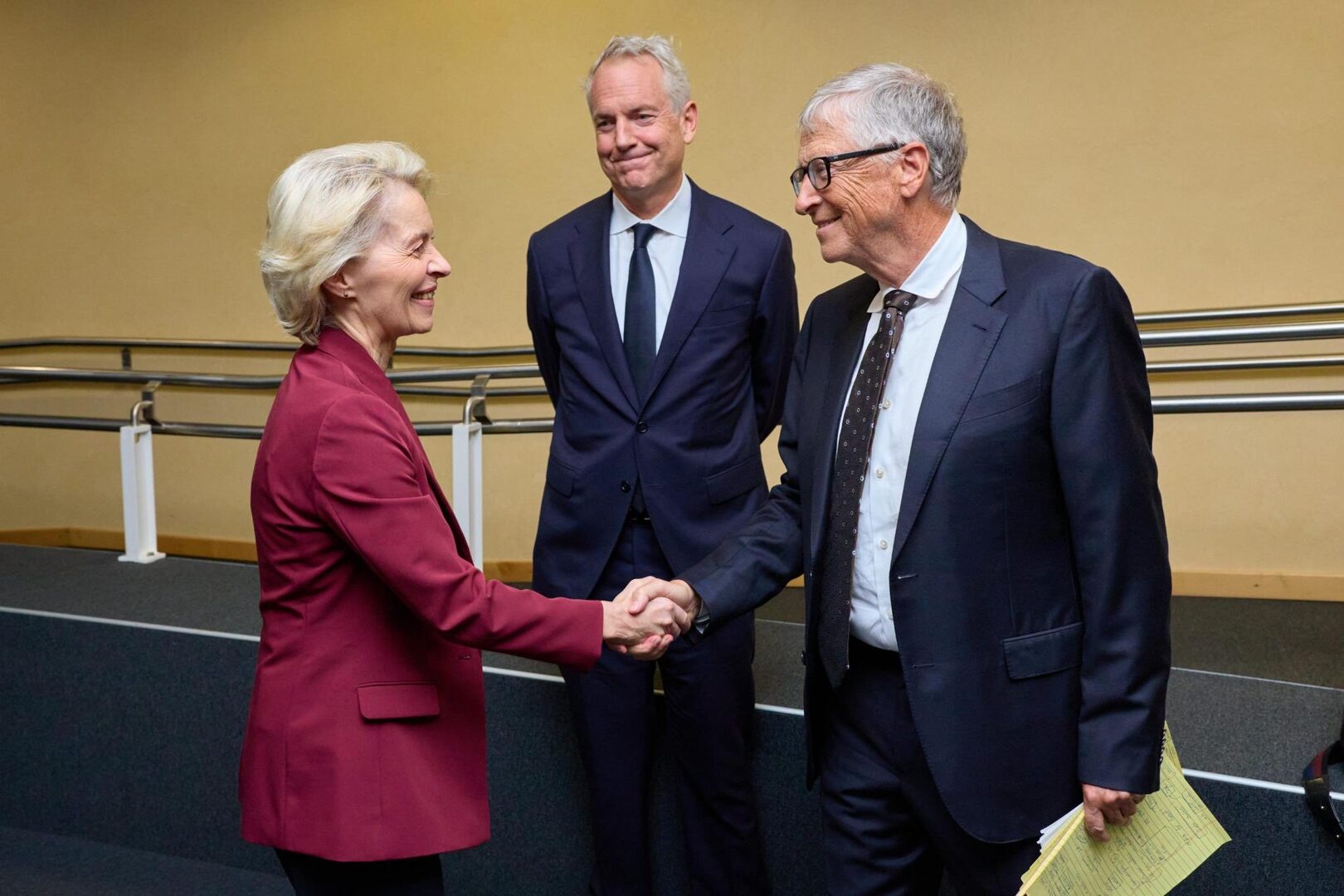
The Digital Omnibus “provides a simple, innovation-friendly environment for our European AI ecosystem to grow,” said commission’s president Ursula von der Leyen.
But the proposed changes potentially create broad exemptions from existing data protection rules for AI companies.
“What we see is a creation [of] this huge backdoor, which in many cases will make the GDPR (General Data Protection Regulation) meaningless,” Vraken said.
If adopted by the European Parliament, the changes would allow companies to collect people’s personal data to train and operate AI systems without consent.
Google and Meta
Under the parliament’s rules, all MEPs and their assistants must publicly declare scheduled meetings with lobbyists and third-country representatives and access to these information is public.
From November 2025, CEO and LobbyControl identified 655 meetings with lobbyists in the parliament, the report says. This comes as Big Tech lobby budgets hit record levels.
This article continues, but the full version is available only to EUobserver.com subscribers. Visit account.euobserver.com/membership
Two graphs show that Ukrainians are currently attacking at least as much as Russians. They are also advancing just as often.
The map, meanwhile, illustrates the territory Russians have captured in Donbas this year. It is smaller than in previous years.
New tanks and other equipment have begun appearing in Russian storage facilities. Russia is preserving them, possibly for another war.
Videos of the day: a Russian quad bike accident at the front; a Russian worker climbing an anti-drone net; Ukrainian children playing with a Russian drone.
Part of the population still believes that Russia is winning the war. It does not matter that it has failed to subjugate Kyiv for more than four and a half years, or to capture Donbas even after 12 years. It still has 20 percent of Donetsk oblast left to occupy — not 10 percent, as Russian president Vladimir Putin claims.
Of course, victory in war can be measured in different ways, and the movement of the front is not always decisive. But when it comes to activity at the front itself, the battlefield is essentially frozen. And Russian momentum is far weaker than it was at this time a year ago.
In today’s Ukraine Battlefield update, we present two graphs and one map showing that Russia is not currently winning the war on the battlefield.
The first graph suggests that Ukrainians are now launching attacks more frequently than Russians. It was published by the Ukrainian account Oko Hora.
It calculated the ratio of attacks on the basis of data from the Ukrainian general staff. The staff reports the number of engagements and the number of Russian attacks, meaning that the difference between them indicates Ukrainian attacks.
This methodology may not be precise, but other battlefield reports also suggest far greater Ukrainian activity than a few months ago or last year.
This article continues, but the full version is available only to EUobserver.com subscribers. Visit account.euobserver.com/membership
This year, in France, a small book was published with major implications for the future of Europe:Notre déni de guerre [Our Denial of War] written by a military historian, Stéphane Audoin-Rouzeau.
Audoin-Rouzeau specialises in a subject that was long regarded a niche field: the First World War.
He delves into facts, developments, and societal, political and social undercurrents that are long past and therefore seem of little concern to most people.
But according to him, these matters are more relevant to modern Europeans than ever before. The more time passes, the more parallels he sees between the period around the First World War and the times we now live in.
With one very significant parallel: the denial that war is drawing nearer.
His argument is that Europeans have enjoyed peace for so long that they no longer know what war is. They don’t recognise it, cannot see it coming and therefore don’t know how to avert it.
Many have come to believe that if they don’t attack anyone or declare war on anyone, no one will attack them in return – the typical logic of people who have only known peacetime.
Europe’s problem, in his view, is that not everyone in the world lives in peacetime, and that others therefore operate according to a different logic – the logic of wartime.
This article continues, but the full version is available only to EUobserver.com subscribers. Visit account.euobserver.com/membership
A historically-high number of voters have chosen parties classified as authoritarian or populist, according to new research looking at 31 countries across Europe, not just the EU.
Germany saw the starkest rise, with the Alternative for Germany (AfD) getting over 20 percent of the last national parliamentary vote, while in contrast parties classified as radical left split the 13.8 percent of votes between them.
The Authoritarian Populism Index, published by two European think tanks, EPICenter and the Nordics-based Timbro late last week (22 October), analyses parliamentary election results for 260 parties in 31 countries since 1946, or since the year free elections were first held.
The high support for populists is a result of mainstream parties not being able to “adequately address the concerns of our time,” Emelie Franzén, EPICenter’s research coordinator, told EUobserver.
The populists’ success is a “result of a lack of trust towards the elites,” Mateusz Michnik, economic analyst for EPICenter, told EUobserver. He also added that populists are more effective communicators than mainstream parties, especially in crisis situations, such as the Covid pandemic, the migration wave of 2015, or Russia’s 2022 attack on Ukraine.
The Index has been classifying populist parties since 2016, defining them as groups where representing the people above the elite is “a central organising principle of their political worldview,” the author says.
Reinhard Heinish, political science professor in Salzburg, told EUobserver that the report “combines different hard-to-measure concepts, and needs to interpreted with some caution.”
Despite this overarching characteristic, their profile is far from uniform, the report’s author, Andreas Johansson Heinö, Timbro’s director, warned.
“Most are culturally conservative, while economically they are almost evenly divided between left and right.” The populist parties included in the study tend to be eurosceptic, but only a minority supports leaving the EU, he added.
Throughout the 1950s and 1960s, about 10 percent of Europeans chose authoritarian or populist leaders. Since 2000, the number started to increase, reaching just under 30 percent in 2019.
Now, parties outside of the political mainstream have seats in 11 out of 31 European governments.
“Populists can ‘infect’ other political parties with populism,” Michnik said, which he thinks explains a surge of anti-migration policies across the continent.
Contrary to Germany, Bulgaria, and Norway, which recorded the largest increases in the past years, Hungary’s score radically decreased with the April elections that brought an end to Viktor Orbán’s rule.
Ukrainian pressure towards Velyka Novosilka has slowed, but not stopped.
The Russian offensive near Orikhiv has stalled, as elsewhere, and Z-channels are again looking for reasons why reality does not match their maps.
The weekend was marked by Storm Shadow missiles, which destroyed factories producing Iskander components.
Russians are attacking bridges in Zaporizhzhia.
Two people died on a train in Voronezh after a Ukrainian drone fell on it; according to the Russians, it was debris from a downed aircraft.
Russians destroyed a Czech Dita howitzer.
Maps of the day – Velyka Novosilka direction; Orikhiv
Videos of the day– destruction of the Czech Dita howitzer; Storm Shadow missiles; a tank destroyed a position on the frontline with direct fire; a MiG-29 shot down a drone.
Ukrainian pressure towards Velyka Novosilka has slowed, but not stopped. The battle for Dobropillia continues, but without any major developments. Today, therefore, attention turns to the section of the front that was the main focus in spring, when the Ukrainian army managed to clear hundreds of square kilometres and push the Russians out of 26 villages.
This is where the borders of three regions meet: Donetsk, Zaporizhzhia and Dnipropetrovsk oblasts. It has received less attention in recent months because there have been more active areas of the front, but the creeping Ukrainian counteroffensive has not stopped and the Russians must now seriously consider the risk it poses to their forces in the direction of Velyka Novosilka.
This town was one of the launching points for the unsuccessful Ukrainian offensive in summer 2023. The Russians captured it in early 2025 and have since moved slowly westwards and north-westwards. They have not got far at all. Following the events of spring, the front is now less than 15 km from Velyka Novosilka.
Now, under ideal circumstances, the Russian army risks losing some of the gains it has made in this sector during nearly two years of heavy fighting.
This article continues, but the full version is available only to EUobserver.com subscribers. Visit account.euobserver.com/membership
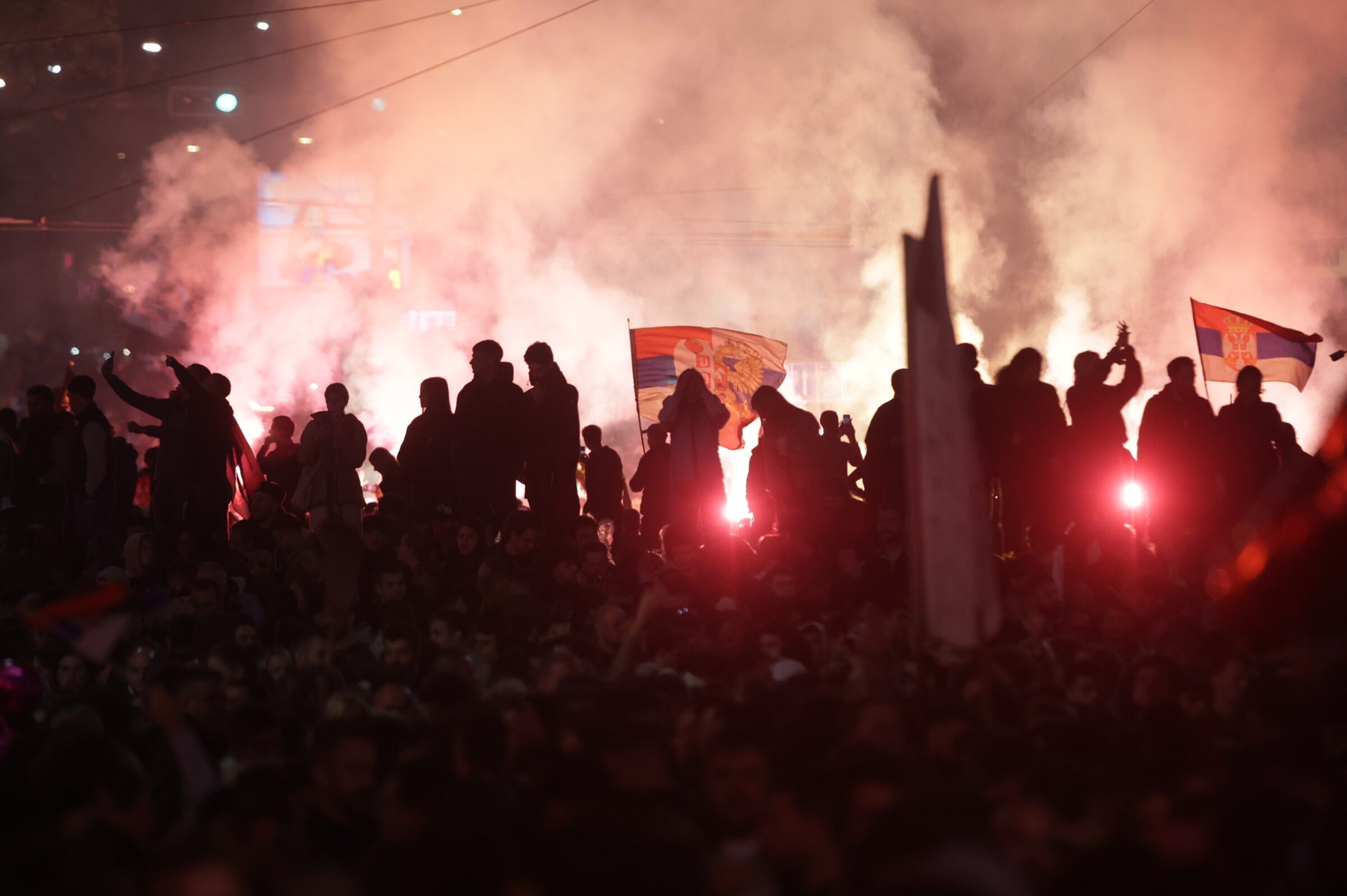
“Tonight we celebrate victory, tomorrow we build the future,” said Radomir Sajčić, professor at Belgrade University, speaking on behalf of the students at their headquarters on Sunday’s evening (25 October). “The voice of the people is being heard”.
The student-backed list won Serbia’s parliamentary election at the weekend, in a vote that amounts to the biggest challenge so far to president Aleksandar Vučić’s long-standing grip on power.
And that night, Vučić (unexpectedly) acknowledged defeat. “Vox populi, vox dei,” [The voice of the people is the voice of God], he said, marking a significant moment in the Serbian political landscape that Vučić has dominated for more than a decade.
The 56-year-old politician served as prime minister from 2014 to 2017, then won the 2017 and 2022 presidential elections. Critics accuse him of authoritarianism, control over the media, and manoeuvring between the European Union, Russia, and China.
However, this years historic turnout (nearly 70 percent ), the highest since the break-up of Yugoslavia in 1992, has overturned his SNS party (Serbian Progressive Party).
In the 250-seat parliament, the Student’s List will have the majority – 140 seats, and second comes Vučić’s SNS with 104 seats. The remaining seats will be shared mainly between ethnic national-minority parties.
“It was effectively a referendum on president Aleksandar Vučić,” the Serbian pro-democracy group Kreni-Promeni, who backed the Students’ List, told EUobserver.
From student protests to electoral change
The opposition was unable to seriously challenge Vučić in the previous parliamentary elections, partly because of its fragmentation. However, a significant turning point in Serbian politics came in November 2024, when 16 people died after a canopy collapsed at the railway station in Novi Sad.
The tragedy then sparked massive demonstrations across Serbia, led primarily by students. Hundreds of thousands of people took part. They blamed the disaster largely on the government and its corruption.
The student protests gave rise to Vučić’s main challenger in this year’s elections: the Student List (SL). The 250 candidates running for parliament included individuals selected by students, primarily academics.
“The students have selected prominent citizens – experts in their own fields,” Miloje Savić, a volunteering poll observer, told EUobserver. “They know which values they are supposed to protect and represent,” he added.
The student electoral list was led by Ilija Srdanović, a professor at the Faculty of Medicine in Novi Sad.
The weekend result thus represent a major political breakthrough for a movement that emerged less than two years ago from protests against the government’s long-standing corruption.
For the SNS, this defeat is “a huge blow to him [Vučić]”, senior research associate at the University of Belgrade, Jelena Vasiljević told EUobserver.
But, as the poll winner and Vučić’s most successful opponent, the SL is not out of the woods yet.
Students smeared as ‘blockaders‘
Even as he acknowledged defeat, Vučić continued to use the same online rhetoric, referring to winners as the “students’ blockade list”. Vučić also warned of investor uncertainty and damage these results might have on the gas trade.
Serbia's Vučić after conceding defeat in election:
What brought us down is this verified revolution, which they carried out with direct support from various European countries, and the deep American state, the one against President Trump.
Taken together – the language and the economic warnings – offer an insight into how the SNS and Vučić will depict the incoming government.
“They would be framing the student movement as not as a legitimate political power, but as an extension of the protest movement and as a risk to economic stability,” Vanesa Valcheva, head of research at Balkan Free Media Initiative (BFMI), told EUobserver.
This article continues, but the full version is available only to EUobserver.com subscribers. Visit account.euobserver.com/membership
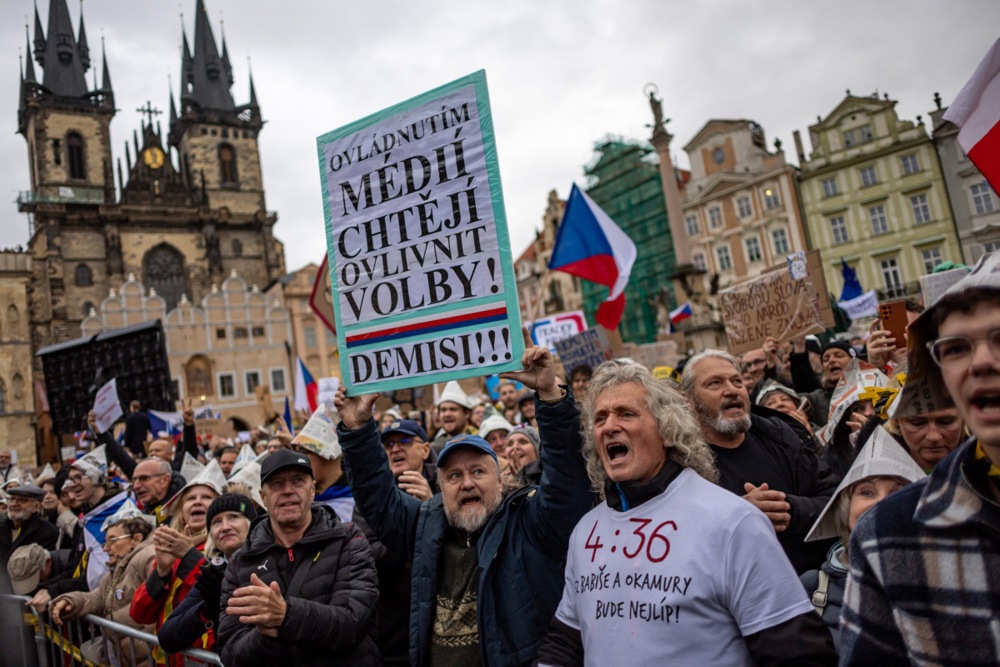
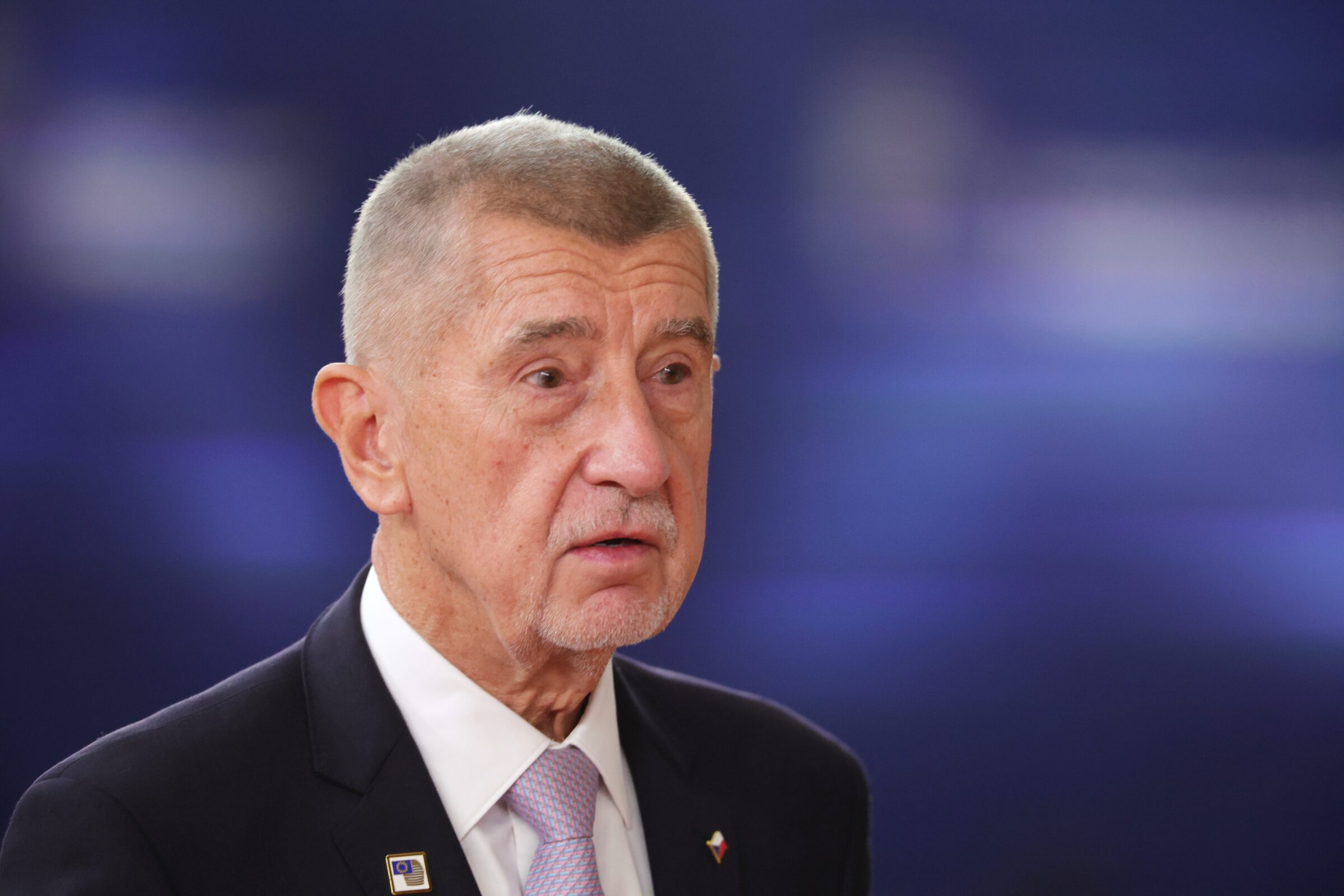
The lower house of Czech parliament became a nighttime battleground for the future of the country’s public service media at the weekend, when MPs pushed through the abolition of public service media licence fees in the bill’s first reading in the chamber on Saturday (24 October).
Czech MPs voted to pass a bill that lays the groundwork to abolish TV and radio licence fees and move public media under the state budget.
The weekend vote was not yet a vote on the law’s final approval: the government coalition only needed to prevent the bill’s rejection which the opposition had sought.
The controversial vote was scheduled for 4.36am on Saturday – by no means a typical time for such a vote. Opposition parties had failed to postpone the vote, and also did not have enough numbers to reject the bill.
Out of 177 lawmakers present, 96 MPs voted in favour of the bill, while 81 opposition MPs voted to reject it. Prime minister Andrej Babiš did not take part in the vote.
MPs from the Czech Republic’s five opposition parties also failed to pass a proposal to return the bill for redrafting to the coalition formed by ANO (led by the PM) and the far-right parties Freedom and Direct Democracy (SPD) and Motorists to Themselves.
The bill will now go to the parliament’s media and culture committee. This will be followed by lengthy debate at the law’s second reading, where amendments may be submitted. The proceedings will likely last several days.
4.36am vote planned at last-minute
Babiš’s governing majority only added the agenda item for ending licence fees on the Chamber of Deputies’ (lower house of parliament’s) agenda on Friday morning. It even took by surprise the MPs of ANO, SPD and Motorists.
The coalition leadership formed by Babiš and foreign minister Petr Macinka (Motorists) had kept the plan secret all week, so that it would not become public and opposition parties could not prepare obstruction tactics.
Protesters had gathered outside the parliament through the night in the early hours of Saturday morning. Demonstrations carried on throughout the Czech Republic over the weekend.
This article continues, but the full version is available only to EUobserver.com subscribers. Visit account.euobserver.com/membership
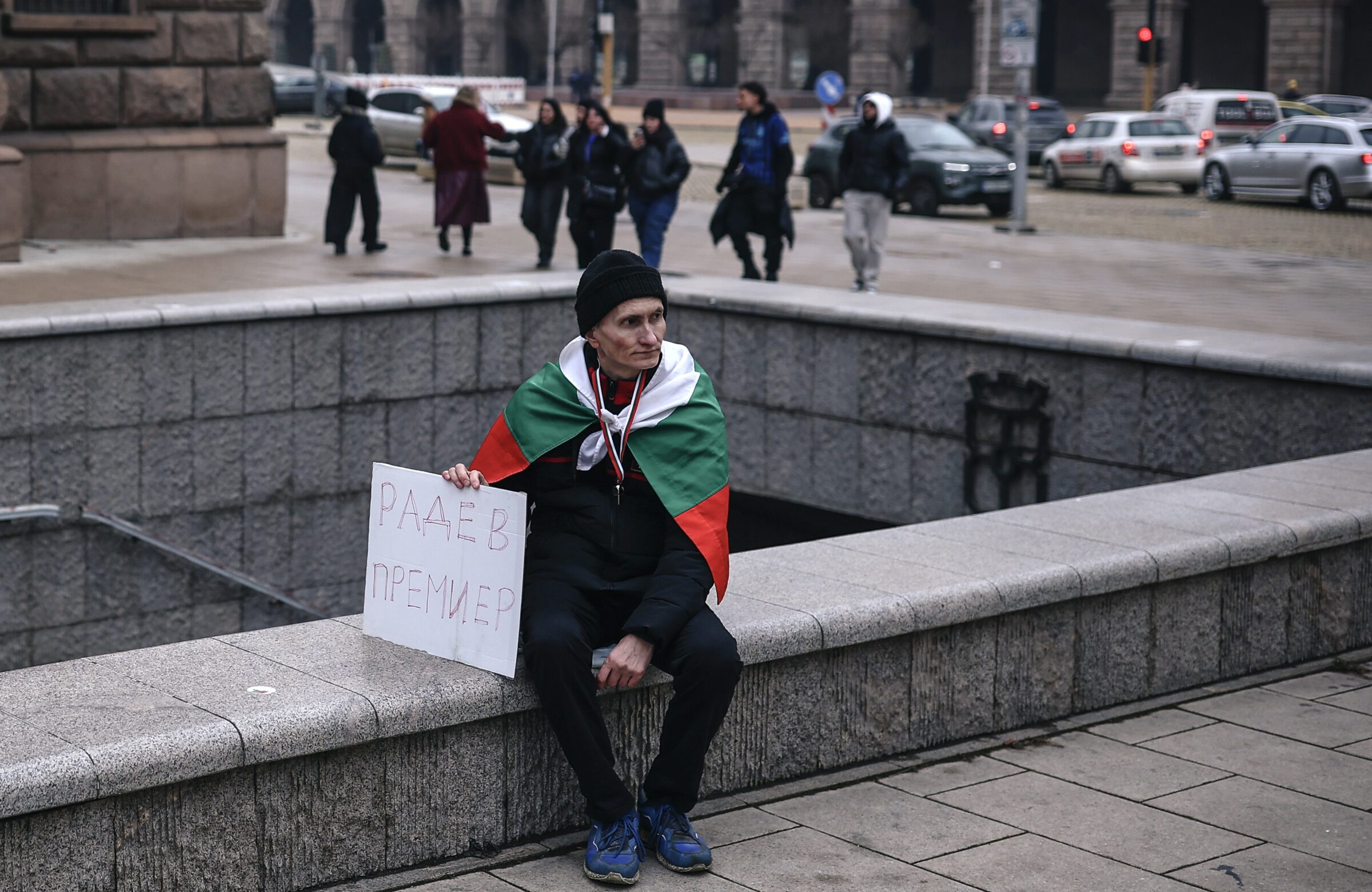
Incumbent president Iliana Yotova is leading Bulgaria’s 2026 presidential election race, alongside her running mate, Kiril Vulchev, securing 47.3 percent support among likely voters, according to a poll released on Wednesday (21 October).
Andrei Gyurov, a former caretaker prime minister, and his running mate, Georgi Kandev, rank second with around 30 percent. Leaving the pro-Russian Kostadin Kostadinov and Petar Volgin is in third place on just over ten percent.
Bulgaria is voting on Sunday (25 October) and the vote can be seen as “a test of the government’s stability”, according to Ivaylo Iliev, a political scientist, with whom we analyse Bulgarian presidential elections in three points.
1. A test of the government’s stability
The election could consolidate political influence around prime minister Rumen Radev, or expose the limits of his camp’s support.
The PM’s Progressive Bulgaria, which secured a parliamentary majority in April 2026, is facing criticism over its budget plans and handling of security threats. Recent attacks on merchant vessels in the Black Sea have raised questions about Bulgaria’s ability to protect its interests and reassure its allies.
Iotova, who served as Radev’s vice-president for nine years, is closely associated with the prime minister. And her victory could be interpreted as an endorsement of the governing camp.
“Radev has his candidate in these elections and he is obviously the favourite to win a second round,” Iliev says.
However, the Black Sea attacks have “definitely negatively affected both” Iotova’s campaign and public confidence in the government’s security response, he adds.
The government’s response, alongside its nuanced position on Russia’s war against Ukraine, may appeal to voters sceptical of confrontation with Moscow. At the same time, it also risks complicating Bulgaria’s relations with its European and Nato partners.
“Radev demonstrates two different types of behaviour”, says Iliev.
On the domestic front, he is “balanced”, “vague” or even “without specifics”, Iliev says. For Radev does not want “to cause discontent among his pro-Russian voters”.
On the foreign policy however, Radev is more seeking to get as close as possible to the European consensus, but “with a minimal effort.”
2. Taking the government to account?
The second question is whether the presidency can act as a counterweight to the executive or will reinforce the same centre of political influence.
Gyurov’s campaign has warned against putting “all the eggs in one basket”. Concentrating power around Radev and Iotova could weaken independent scrutiny he says.
A Gyurov victory could give the presidency a more “independent voice”, says Iliev.
However, institutional checks and balances do not necessarily translate into electoral support.
This article continues, but the full version is available only to EUobserver.com subscribers. Visit account.euobserver.com/membership
Russian journalists reveal what the Kremlin and US are discussing.
Starshield was supposedly fixed, but that doesn’t seem to be the case.
Russians advance in Rai-Oleksandrivka towards Sloviansk.
Russia loses two combat Sukhoi aircraft in accidents in one day.
Map of the day: Rai-Oleksandrivka
Videos of the day: Kramatorsk evacuation; Russian Su-30 crashes; how helicopters hunt drones.
Russian journalists have described the nature of talks between the Kremlin and the US. A demilitarised zone in Donbas. A Ukraine without Nato membership but is allowed to join the EU membership in return. Sanctions against Russia eased, Russian gas in Europe and news talks on the Nord Stream 2 pipeline. And America makes its own deals with Russia.
This is how, according to The Economist, the US proposal to the Kremlin for ending the war sounded, presented in Moscow on Wednesday (21 October) by Steve Witkoff, Trump’s negotiator.
It sounds like something Russia might welcome, but that does not appear to be the case. At least not according to the findings of the Russian exile website Verstka, which a day later published an extensive report on the mood among Russia’s Kremlin-linked elite.
The article, signed by the newspaper’s editorial board, contains numerous quotes from government officials and people close to the regime, whose views on the prospect of swiftly reaching a peace deal and ending the fighting are sceptical.
Verstka wrote that war fatigue was mounting among these people, whose names it naturally did not disclose, but that they fully defer to Russian president Vladimir Putin and are waiting to see what he agrees with US president Donald Trump.
“It can be said with certainty that American sympathies have shifted to our side. We have been working on this for a year and a half,” a source close to the foreign ministry told the journalists, describing Moscow’s strategy.
Russia achieved this through the following argument: since Ukraine considers itself a victim — which it undoubtedly is, editor’s note — and asks for assistance, but is unwilling to make concessions in return for that assistance, it is no longer in fact a victim, but a player with ambitions of its own, which Western taxpayers are unwilling to fund.
Incidentally, the Slovak government uses very similar rhetoric and arguments.
According to the same source, Moscow will emphasise during the talks the hopelessness of Ukraine’s supposed situation.
Another quoted voice was a political strategist directly linked to the Kremlin, who pointed out that Trump’s son-in-law Jared Kushner did not directly take part in the talks in St Petersburg on 21 October, reportedly due to illness.
Nevertheless, this source also praised the US approach, even if Trump’s dispute with Ukraine proved only short-lived: “We have nothing to lose from these solutions. And we could gain both an improved budget and an advantage on the battlefield.” At the same time, the domestic political strategist saw no fundamental changes that could lead to an end to the fighting.
The extent of the irrationality prevailing within the regime was illustrated by statements from another unnamed representative of a formally non-governmental organisation working directly with the Kremlin.
In his analysis, he claimed that Ukrainian president Volodymyr Zelensky had created a dictatorial system from which neither elections nor a coup could remove him, and that the war would not end while he remained in office. He also cited reports by Russia’s foreign intelligence service claiming that Kyiv was cooperating with Mexican drug cartels.
Another government official had low expectations of the Americans: “For almost two years now, we have been saying that Trump is supposedly one of us and that the talks are constructive, but they have produced no results. We are fighting, burning, drowning, suffering alongside our homeland.”
The man spoke of a “peace wing”, allegedly comprising people in the presidential administration responsible for domestic policy and economic circles, but this did not mean that there was any open opposition to the war.
“There is no escape from the ship. We are waiting for them to have had enough of the war,” the official said.
This article continues, but the full version is available only to EUobserver.com subscribers. Visit account.euobserver.com/membership
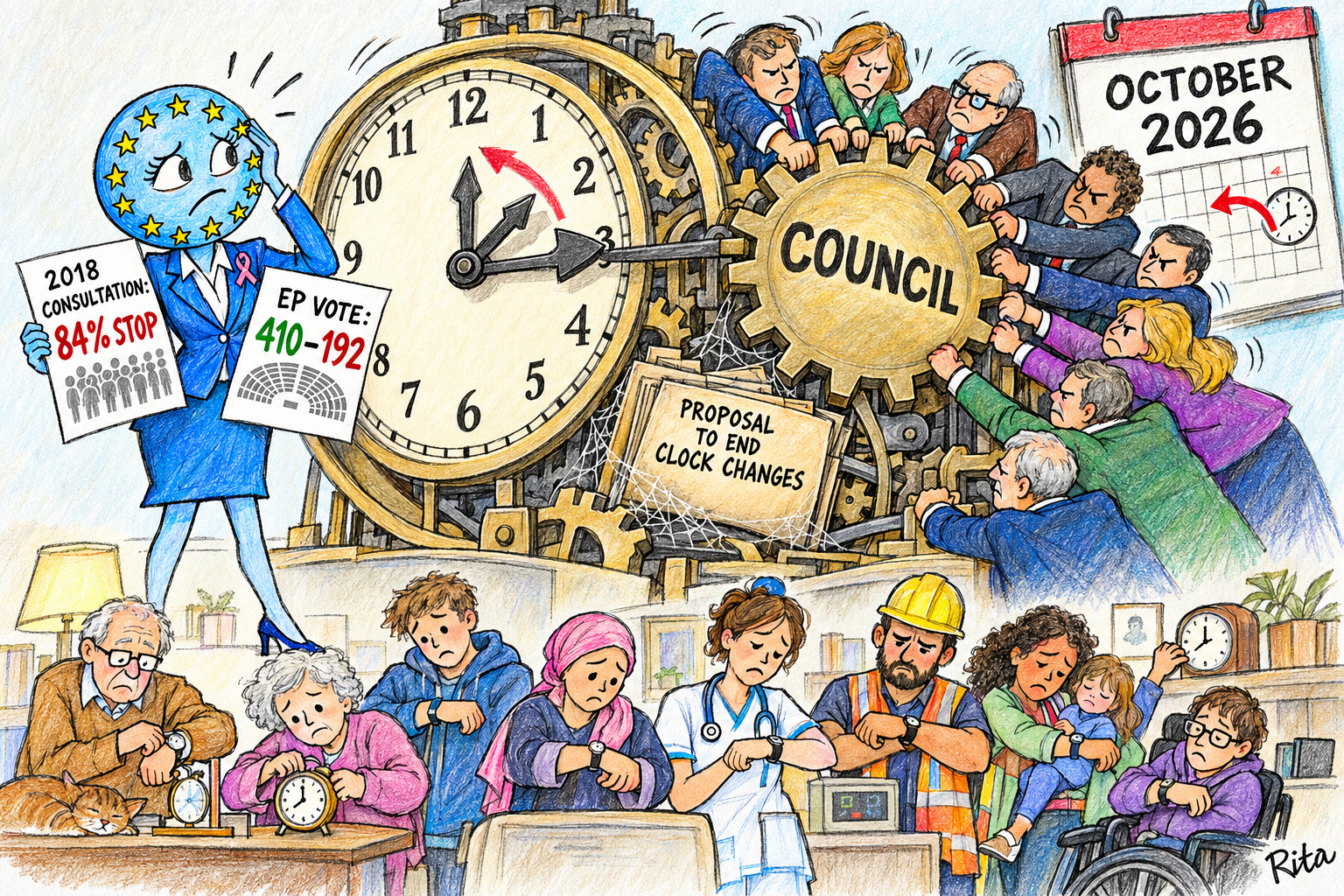
Europeans made their preference clear. Parliament voted. So why are we still changing the clocks?
On Sunday (25 October), Europeans will once again turn their clocks back by one hour. The familiar ritual will again raise the same question: did the European Union not decide years ago to end seasonal clock changes?
The question entered the European agenda largely from the bottom up.
Citizens repeatedly contacted and petitioned the European Parliament, raising concerns about health, sleep disruption and the continuing usefulness of changing the clocks twice a year.
A citizens’ initiative presented to the Finnish Parliament in 2017 gave the issue further momentum. Finland could not end the practice alone because it was regulated at EU level.
On 8 February 2018, the European Parliament called on the EU Commission to assess the existing directive and, if necessary, propose its revision.
84% public support for ending clock changes…
The commission subsequently launched a public consultation. It received approximately 4.6 million responses from citizens, the highest number ever recorded for an EU consultation at that time. Among those who participated, 84 percent supported ending the twice-yearly clock changes.
The consultation was not a referendum, and participation varied considerably between member states. Nevertheless, millions of Europeans sent a clear political message.
Jean-Claude Juncker highlighted the issue in his 2018 State of the Union address. Shortly afterwards, the commission proposed ending seasonal clock changes while allowing each member state to choose permanent summer time or permanent standard time.
…and MEPs agree
In March 2019, the European Parliament approved the proposal in plenary by 410 votes to 192, with 51 abstentions. The final clock change was expected in 2021.
Yet 2021 came and went, and Europeans continued adjusting their clocks every March and October.
Parliament has not reversed its position, and the commission has not formally withdrawn its proposal. The file remains blocked because member state governments have never agreed on a common position in the Council.
No simple solution for 27 states
Ending the clock change sounds simple until governments must decide what replaces it. Should countries remain permanently on summer time or standard time? What happens if neighbouring countries make different choices? How would a patchwork of time zones affect transport, aviation, trade and the single market?
These are legitimate questions.
A poorly coordinated decision could create new problems while solving the old one. Some governments also requested a more detailed assessment of the consequences. The pandemic and the crises that followed then pushed the issue further down the political agenda.
However, the crisis cannot explain indefinite inaction. Eight years after the Commission presented its proposal, the Council has still not adopted a position. Without it, negotiations with Parliament cannot move towards a final agreement.
This is where a practical question about clocks becomes a problem of democracy, accountability and political communication.
Citizens were encouraged to participate. Millions did. Parliament responded adequately. The commission presented the consultation as evidence that Europe was listening. Its president announced that clock-changing would stop, and Parliament endorsed the proposal with a clear majority.
Then the process got stuck.
Twice a year, Europeans are reminded of this promise, but receive little to no explanation about who is blocking progress, which governments support which option or how the disagreement might be resolved.
Simply saying that “the EU failed” would, however, hide who has the concrete political responsibility. The EU is a complex, multilevel decision-making system in which responsibility is shared among different institutions and member state governments. Parliament adopted its position, while national capitals failed to agree in the council.
Those governments should explain their positions instead of allowing “Brussels” to absorb the blame like often happens, for their collective indecision.
The European Commission also has certain responsibility because her proposed legislation left the most difficult question, the choice of permanent time, to individual countries.
In any case, the EU risks turning, or did turn, an example of successful citizen agenda-setting into an example of participatory failure.
The issue may not be Europe’s most urgent challenge right now, but credibility and a positive image is also built through implementation of citizens’ demands such as this one.
People notice when a widely announced change does not happen, especially when it impacts directly and negatively their daily life. They also notice when nobody explains why.
Member state governments should state publicly whether they favour permanent summer time, permanent standard time or retaining the current system. The council should put the issue back on its agenda and strive to achieve an agreement.
And if this is not possible, Europeans deserve a clear explanation why their participation led nowhere.
France is facing one of its worst political, social and fiscal crises in years, and there is a sense things will get worse before they get better.
What started in September as high-school protests over teacher shortages and poor education standards in the Paris suburbs later grew into a much wider revolt over soaring fuel and living costs, a public sector pay freeze and a proposed austerity budget.
Last Saturday (17 October), public anger exploded into nationwide riots. More than half a million people took to the streets across France. Most marched peacefully. But violence broke out on the sidelines in several cities, with looting, arson and clashes with police.
When things finally calmed down, nearly 2,400 people had been arrested, interior minister Laurent Nuñez later said.
But even as protesters demand more teachers, smaller classes, higher wages and cheaper fuel, investors have been selling off French government bonds, worried that France cannot rein in its spending.
The gap between French and German 10-year borrowing costs, an important gauge of financial stability in the eurozone, reached almost 151 basis points on Tuesday, the widest since the eurozone debt crisis of 2011-2012.
But French politics is too divided to agree on the spending cuts bond traders want to see. And with presidential elections due in April, a quick resolution looks unlikely.
That leaves the central bank. The European Central Bank (ECB) could buy up French debt to bring borrowing costs down. It may even be forced to, if bond market panic spreads. But bailing out France is politically explosive, and depends on the judgement of the bank’s 27-member governing council.
For the time being, the ECB “is unlikely to say or do anything helpful,” Shahin Vallée, a senior associate fellow at the German Council on Foreign Relations (DGAP), wrote in a recent blog post.
Vallée, who is now an advisor to institutional investors, previously worked for Herman Van Rompuy who was European Council president during the eurozone crisis. He then joined Emmanuel Macron, France’s economy minister at the time, as advisor.
That background means he can speak with authority on everything from macroeconomics and bond markets to French politics and fiscal woes. EUobserver reached out to him to see what comes next.
Last week you were in Bangkok, where the IMF urged rich and poor countries to cut deficits and get debt under control. Is that the right medicine for France?
This article continues, but the full version is available only to EUobserver.com subscribers. Visit account.euobserver.com/membership
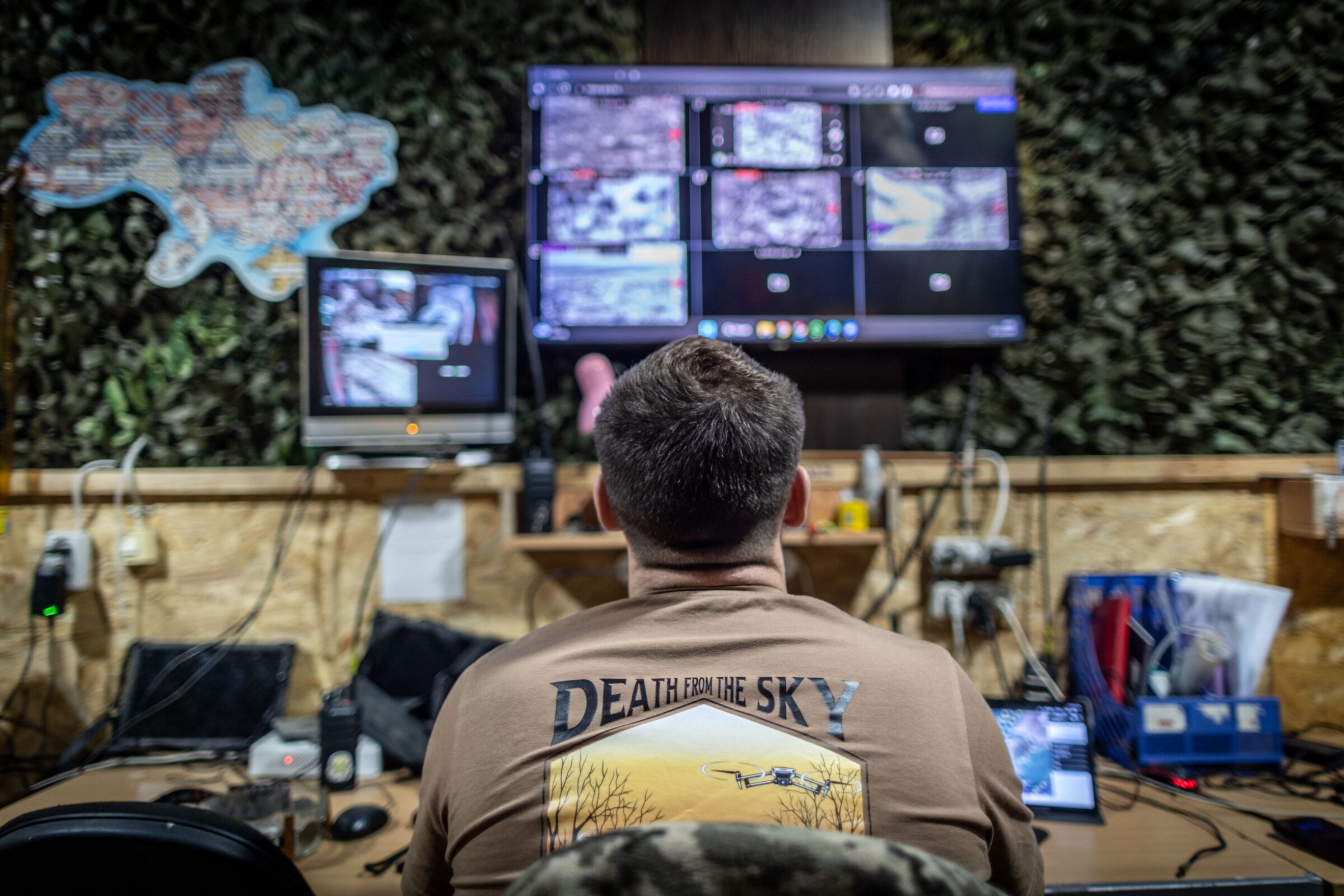
Soldiers told the New York Times how they survived six months in the kill zone.
Basic rules for survival.
Modern warfare: masses of equipment versus courageous individuals.
Following peace talks, the humanist Putin sent ballistic missiles to Ukraine.
Map of the day: the successful Operation Vivaldi.
Videos of the day: the underground Operation Veles into the Russian rear and an aerial drone duel.
Soldiers speak about their six months in the kill zone. When the 128th Mechanised Brigade asked at a training ground last autumn who was willing to go into the ‘kill zone’, the term used for the most dangerous stretches of the 1,200-km front, two soldiers volunteered.
And the rest visibly breathed a sigh of relief.
Hennadiy and Mykhailo, whose story was reported by the New York Times, spent a long six months “at zero” rather than one, and described in detail how they managed to survive on the front line in the Zaporizhzhia region.
Their account shows how, despite drone warfare, the basic work — holding or capturing new positions — is still done by infantry, which remains indispensable even in this war, where a technological advantage can mean the difference between life and death.
Both set out by car from the village of Prymorske and, when they were about 1.5 km from their destination, began a slow and extremely dangerous journey.
It was most dangerous when they had to move.
This article continues, but the full version is available only to EUobserver.com subscribers. Visit account.euobserver.com/membership
For years, Serbia’s opposition has struggled to turn public discontent into a credible challenge to Aleksandar Vučić’s political dominance. On Sunday (25 October), a student-led movement that began with demands for accountability after a deadly train station collapse will attempt to do what established opposition forces have repeatedly failed to achieve: translate civic mobilisation into political change.
The upcoming parliamentary elections are about more than the (re)distribution of seats. They represent the endeavour citizens want and need in a democratic society.
For several years now, “the students operate according to the principles of direct democracy,” senior research associate at the University of Belgrade, Vasiljević told EUobserver. They gather in “plenums” and make collective decisions.
The motor behind that movement was anger. The lack of accountability after the collapse of a canopy at Novi Sad railway station on 1 November 2024, which killed 16 people was the main trigger.
Since then, protests have been taken place around in the country. Eventually, they grew into a nationwide challenge to the government. The student movement even marched from Belgrade to Brussels and Strasbourg to appeal to the EU institutions.
“It brought some irreversible changes that will have a lasting impact on society,” said Vasiljević.
And these changes could be now transposed into politics. “The country has been held captive for far too long by one ruling party and, in fact, one ruling elite,” Miloje Savić, a volunteering poll observer, told EUobserver.
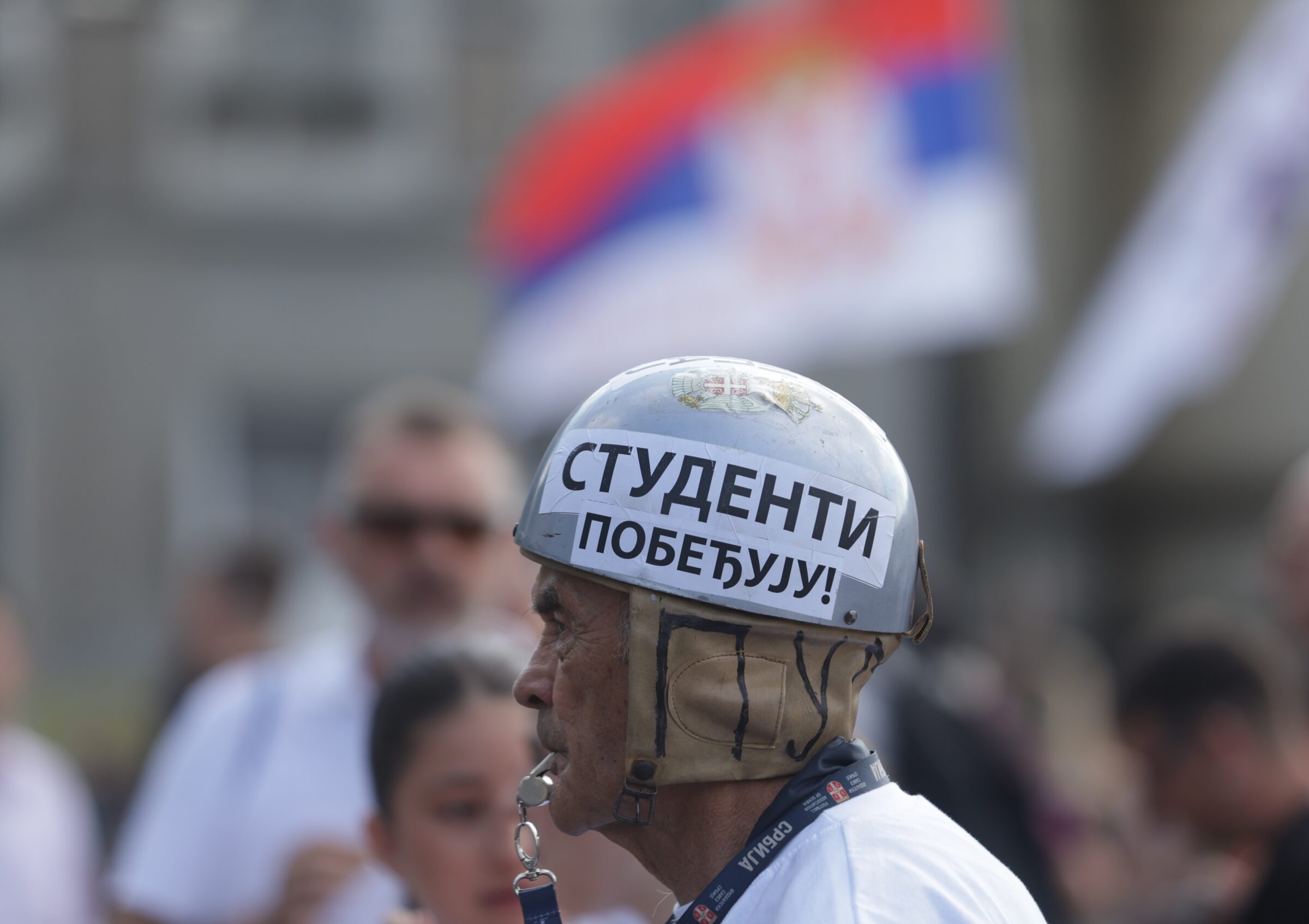
A protester shows a patch reading ‘Students are winning’ during a mass student-led anti-government rally in Belgrade. Source: EPA/Andre Cukić.
For many Serbs, as for Savić, the students’ organisation represent “a tectonic shift in how society is organised and how it should function.”
The Student List, now the electoral vehicle for the mobilisation, has given people frustrated with established politics a new focus for their demands. The main idea being that political participation can be rebuilt from the ground up.
“It is not a good time to be living in Serbia. And during my life, I can’t remember a time when it was,” Ivan Bartoš, a 31-year-old organiser of student protests in Bački Petrovac told EUobserver.
Serbia, as many European countries, is suffering from an ageing population. It brings to the social debate a generational difference. On one side, the middle-aged and “corrupted” regime led by Vučić, on the other, a proposal of change without real political experience.
And the question that is heard in the run-up to the elections is “does Serbia need a professional politician who has been trained for years in kleptocracy, or is society willing to take a risk?”
Vučić’s ‘men in black’?
Yet the movement’s rise has exposed a fundamental tension: society may be changing faster than the institutions through which change must be delivered.
“The institutions have been captured and controlled by the regime. There is not enough institutional space to accommodate these political changes,” Vasiljević said.
Previous Serbian elections have been accompanied by allegations of vote-buying, voter intimidation and ballot-box stuffing. After the last ones, held in December 2023, European MP’s called for “independent investigations into the irregularities”.
Knowing what is at stake, the Student List is trained an unprecedented number of poll monitors (15,000), seeking to protect the vote and document potential irregularities.
Attacks on opposition representatives by groups of unidentified men dressed in black have repeatedly raised concerns during the rule of Vučić’s Serbian Progressive Party (SNS).
The media are not safe either.
This article continues, but the full version is available only to EUobserver.com subscribers. Visit account.euobserver.com/membership
Poland’s governing coalition voted in parliament to loosen abortion law on Tuesday (20 October) – but the country’s conservative president is expected to block the change.
Poland has one of Europe’s harshest abortion laws, allowing only two exceptions to a general ban: in case of rape or danger to the woman’s health.
The amendments, passed by a narrow majority, would allow for abortions in cases of severe deformation of the foetus, and partially decriminalise helping others terminate their pregnancy.
Currently, doctors fear facing up to three years in prison for performing an illegal abortion. At least six women have died because they were denied an abortion in the last six years.
This article continues, but the full version is available only to EUobserver.com subscribers. Visit account.euobserver.com/membership
Battle for Dobropillia — huge Russian losses and the brutal destruction of the city.
A possible explanation for inaccuracies in Russian maps — they are lying to improve their position in ceasefire negotiations.
The Wall Street Journal said Elon Musk came up with the idea of cutting off Ukraine’s military Starlink.
How the Starshield restriction has affected the front line.
Maps of the day — a Russian death field between Rodynske and Dobropillia, plus an overall view of the front.
Videos of the day — the funeral of five children killed by Russian bombing; a driver in Kyiv burned alive after a drone strike; war criminal and liar Sergei Lavrov speaks about the bombing of Ukraine; a cat alerted an operator to approaching Russians; an interceptor drone shot down a Geran.
The battle for Dobropillia in images and maps — huge Russian losses and the brutal destruction of the city. The heaviest fighting is currently taking place on this section of the front. Following its defeat in the north near Lyman, the Russian command is now trying here, in the south, to bypass the Sloviansk-Kramatorsk agglomeration, since a direct attack from the east has also failed.
The Kremlin has currently deployed its largest forces to the area north-east of Pokrovsk, where it is trying to break through Ukrainian defences.
Described this way, it sounds highly technical. People can detach emotionally from information written in this manner and follow events merely as arrows on maps.
In reality, however, the arrows conceal tragedies that are very difficult to imagine. This week, visual evidence emerged that may better convey the scale of human suffering and losses on both sides.
The first shows the city of Dobropillia itself from the air after Russian bombardment that is slowly consuming it.
This article continues, but the full version is available only to EUobserver.com subscribers. Visit account.euobserver.com/membership
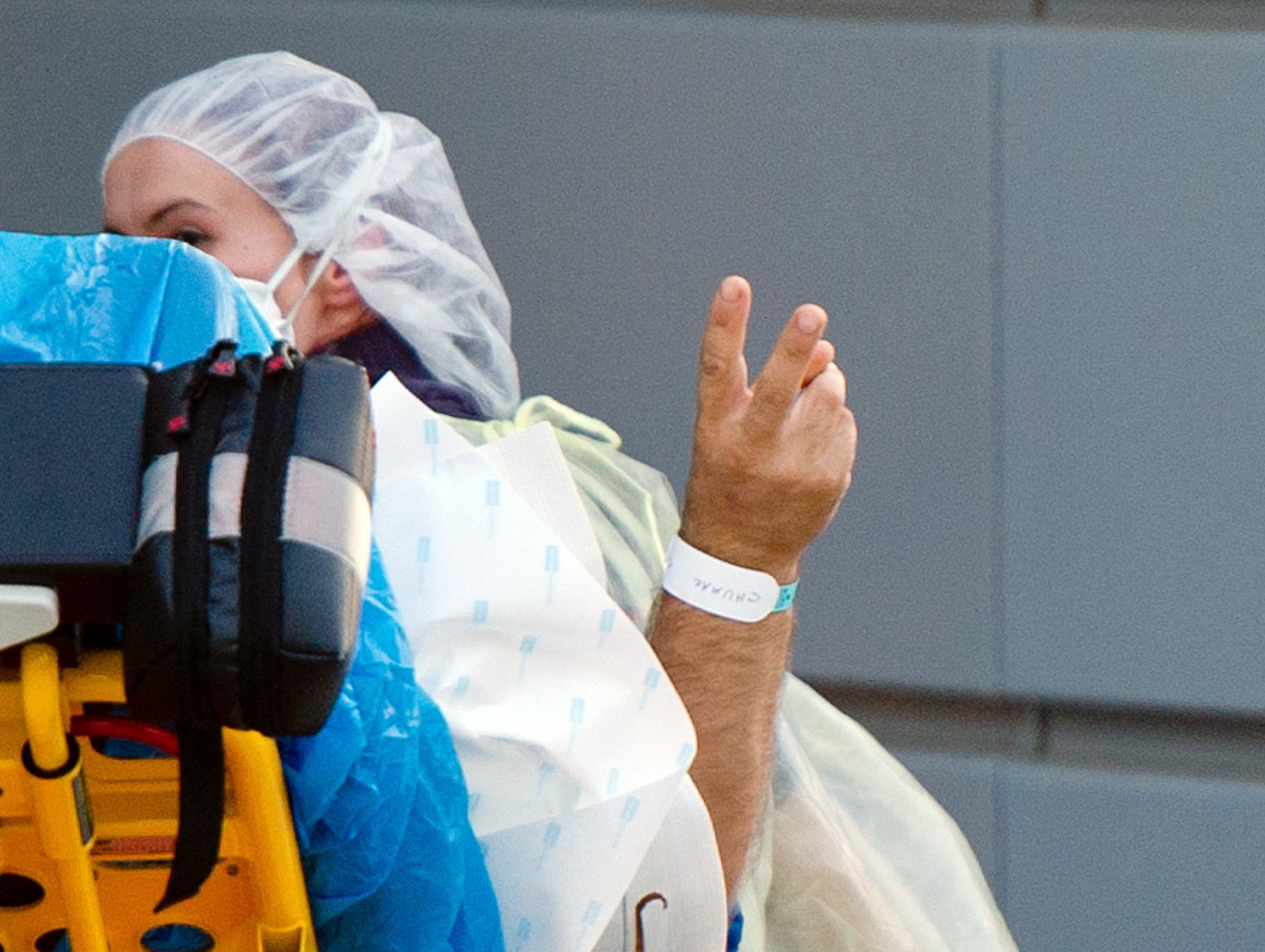
For the first time, Ukrainians rescued a wounded soldier by air.
He spent 500 days at the front, during which he had to amputate his own legs.
How the operation unfolded and what Ukrainians had to do to distract Russian drones.
Rubio repeats Putin’s claims about occupied territory in the Donetsk region.
Videos of the day: the first capture of a Russian tank this year; a swarm of Ukrainian drones.
The information in this text is a summary of events on Monday (19 October). The situation may have changed since then.
Hardly a week passes without some new development being reported on the frontline of Russia’s war in Ukraine. This time, Ukrainians demonstrated something truly unique. For the first time, they succeeded in evacuating a wounded soldier using a heavy rotary-wing aerial drone.
The story was published by the 30th Separate Mechanised Brigade and reported by a journalist from the Oboronka website, who spoke to both the operators and the wounded soldier. The evacuation took place near Kupiansk in the Kharkiv region, on the left, or eastern, bank of the Oskil river.
Infantryman Kostiantyn ‘Magura’ Vlasenko of the 2nd Mechanised Battalion of the 30th Separate Mechanised Brigade was tasked, together with a comrade, with heading into the grey zone in early June 2025.
Initially, they hid in one place, but when their position was flooded, they had to leave the building and take shelter elsewhere. Returning was impossible because of the dangerous situation. His comrade later died.
In February this year, Magura was also wounded by a Russian drone. Munitions dropped from the drone injured both his legs. According to Oboronka, he had to amputate his own lower limbs in order to survive.
The website did not give details of how he managed to do this. Similar cases have, however, occurred in the past.
In 2018, for instance, during an exercise in Slovakia, an American soldier was trapped beneath a tank. He amputated his own leg to save a fellow soldier, for which he was named Soldier of the Year in 2021.
In Magura’s case, this meant he was left immobile, and it was clear that he would not return from the front by himself.
Ukrainian units considered how to help him. The situation was extremely difficult in this respect.
This article continues, but the full version is available only to EUobserver.com subscribers. Visit account.euobserver.com/membership
Before the Czech election results were announced, a WhatsApp group used to alert journalists of prime minister Andrej Babiš’s public appearances went quiet. Reporters asking if and when the ANO leader would make a statement, were met with the same answer from party officials: ‘we don’t know’.
Anticipating poor run-off results for the Senate (upper house), the party had not planned any major press events. Instead, Babiš arrived at his local polling venue – a sports hall – on Saturday (17 October) afternoon, to concede defeat.
In the 2024 Senate elections, ANO had gained eight seats, but this year lost the one seat it was defending.
The opposition party of Mayors and Independents (STAN) performed best, winning ten of the 14 seats it contested.
Having climbed in the polls in recent months, the party now believes it could lead the opposition into the next general election against the ANO-led government.
Pro-Babiš candidates defeated
Babiš and his supporters could hardly have asked for a better starting position this year: ANO was defending just one mandate, and its senate group had 15 seats before the vote.
Babiš said his party had an exceptional chance to break the opposition parties’ long-standing majority to take control of the upper house.
But that goal was quickly out of reach. ANO would have needed to win in all 27 districts, but fielded candidates in only 24 of them.
When only 13 ANO candidates advanced to the second round, the prime minister’s appearances in the days before the vote suggested he no longer believed ANO could win. “The second round will see the same old story – everyone will join forces against us,” Babiš said.
ANO also fielded low-profile or inexperienced candidates, while STAN party leader Vít Rakušan personally travelled to support candidates throughout the campaign.
Analysts have attributed ANO’s poor performance to its poor choice of candidates. They point, among others, to Sandra Tsoukernik, the wife of a controversial businessman in the gambling industry who ran in the Tachov and Cheb district against incumbent senator Miroslav Plevný, a professor of economics.
Tsoukernik diligently toured her district, but unlike Plevný she did not speak about her programme at meetings with voters — or anywhere else.
Although Tsoukernik managed to fill town squares by hiring the pianist Michal David, this was widely viewed as a publicity stunt.
This article continues, but the full version is available only to EUobserver.com subscribers. Visit account.euobserver.com/membership
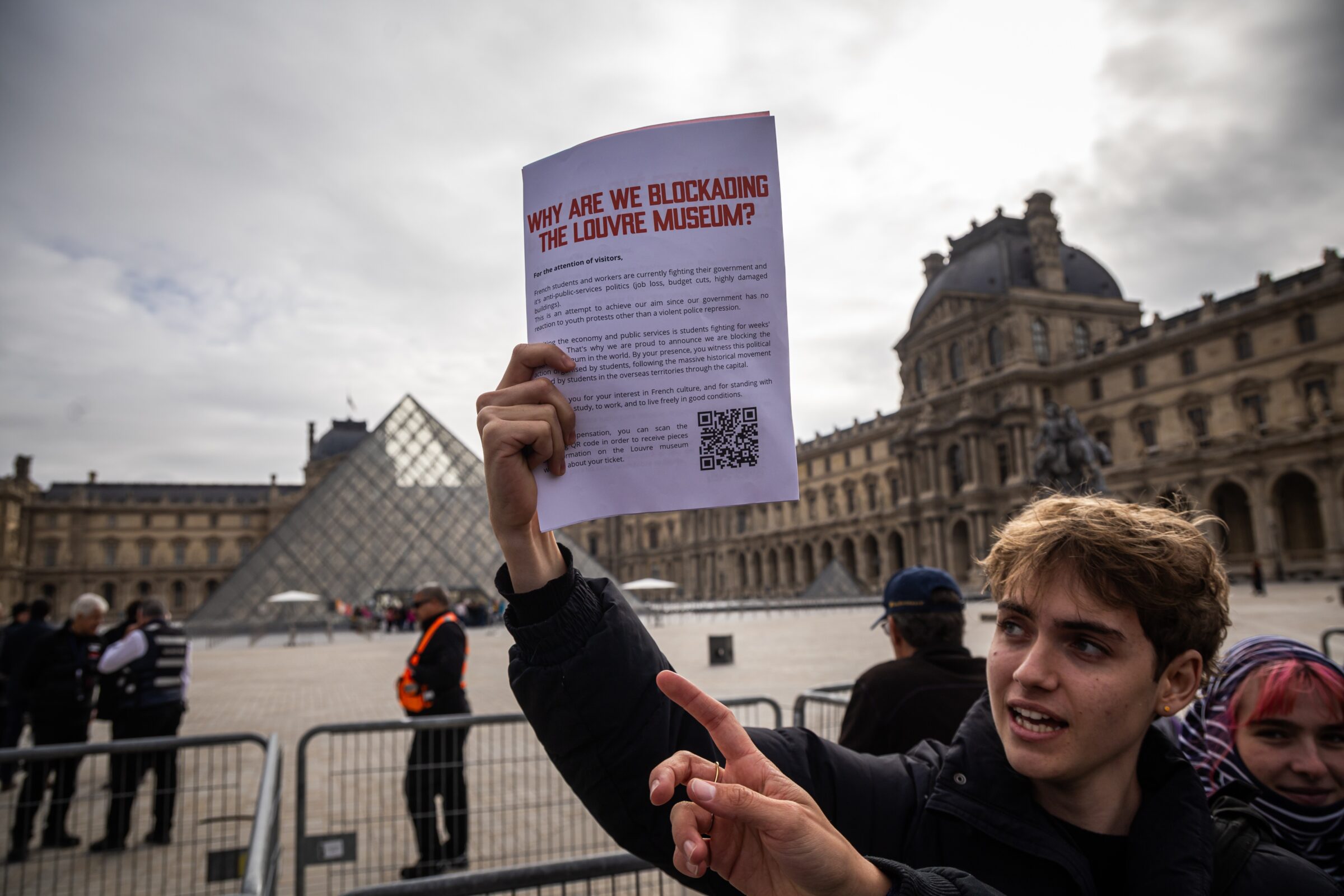
In Paris, students have protested over shortages of teachers, overcrowded classrooms and deteriorating school buildings.
In Spain, the eviction of 87-year-old Maricarmen Abascal — who died on 7 October — became a rallying point for housing protests.
In Tirana, students joined wider demonstrations over education costs and corruption allegations.
These are not parts of a single movement, and the protests do not have one common cause. But they bring into focus a shared challenge: whether young people can see a credible route from education to decent work, and from financial dependence to a life of their own.
France: school conditions shape the starting line
Since September, French students have demonstrated over teacher shortages, overcrowded classes and deteriorating school buildings. Their demands concern more than the day-to-day running of schools. They also raise a question about equal opportunity: can public education give every student the tools to move forward, regardless of where they live or what their family can afford?
The wider figures help explain why that question matters.
In 2025, 25.5 percent of people aged 15–29 in France were at risk of poverty or social exclusion, compared with 24.2 percent across the EU, according to Eurostat.
In August 2026, unemployment among under-25s stood at 20.6 percent, against 8.2 percent for the population as a whole. The corresponding EU rates were 15.4 percent and 6.1 percent.
These figures do not show that school shortages cause youth unemployment. They do show how difficult the step from education into work remains for many young people and why well-resourced schools matter most in areas with the fewest opportunities.
Housing can make that transition harder still. In Paris, one-in-two private tenants under 30 spends more than 51 percent of their income on rent. A Eurostat indicator also shows that 70 percent of 20–24-year-olds and 25 percent of 25–29-year-olds either live with their parents or are financially connected to their household.
France scored 66 out of 100 and ranked 27th of 182 countries in Transparency International’s 2025 Corruption Perceptions Index. The index measures perceptions of public-sector corruption, not the number of proven incidents. It does not explain the school protests, but it underlines why transparency and accountability matter when public services and resources are at stake.
Spain: when housing delays independence
Abascal’s eviction from the Madrid flat where she had lived for decades prompted demonstrations in several Spanish cities and renewed calls for stronger tenant protections. Her case was not a youth protest, but it put a human face on a housing crisis that also shapes whether younger people can leave home and build an independent life.
In 2025, 67.1 percent of Spaniards aged 18–34 lived with at least one parent, according to Spain’s National Statistics Institute.
Among those living with a parent, 28.3 percent said they could not afford to rent. The average age at which young people left home was 30.2, compared with 26.3 across the EU, according to Eurostat.
Housing pressure does not operate in isolation. In 2025, 27.6 percent of Spaniards aged 15–29 were at risk of poverty or social exclusion, above the EU rate of 24.2%.
In August 2026, unemployment among under-25s was 22.7 percent, more than twice the overall rate of 10 percent. When joblessness is so much higher among the young and rent is beyond the reach of many, delayed independence cannot be reduced to personal preference.
Spain scored 55/100 in the 2025 Corruption Perceptions Index, ranking 49th of 182 countries. That score does not establish a link between corruption and housing protests. But when people are asking for effective action on housing, transparency over how decisions are made — and accountability for whether they work — are part of the debate.
Albania: growth is not enough if young people see no path forward
In October, students in Tirana protested over education costs and corruption allegations, joining a broader anti-government movement. Their participation brought education and young people’s prospects into a wider debate about living costs, employment and trust in public institutions.
Albania’s official figures show that 19 percent of the population was at risk of relative poverty in 2025, while 31.2 percent experienced severe material and social deprivation, according to INSTAT. The two measures describe different aspects of hardship: one compares household income with the national poverty threshold; the other captures enforced inability to afford basic goods and activities.
Young people also face a difficult entry into the labour market. The World Bank’s ILO-modelled estimates put overall unemployment at 10.9 percent in 2025, rising to 25.6 percent among 15–24-year-olds. The estimated average age of leaving the parental household seemed to be 30.9, compared with 26.3 in the EU, according to Eurostat’s dataset. Together, however, these indicators describe the hurdles between education, employment and independence.
Albania scored 39/100 and ranked 91st of 182 countries in the 2025 Corruption Perceptions Index. The measure is not a count of actual cases, but corruption allegations are part of the protests themselves. That makes transparency, accountability and public trust more than abstract principles: they shape whether people believe institutions respond fairly to their concerns.
Behind the statistics
Behind the statistics are millions of young people struggling to turn their ambitions into reality. The obstacles reinforce one another: under-resourced schools can narrow choices, unemployment can delay financial independence, and high housing costs can prolong dependence on family.
Across the EU, house prices rose by 55.4 percent and rents by 26.7 percent between 2010 and 2024, often outpacing income growth, according to Eurofound.
That is why the response cannot be confined to one policy area. It means properly staffed and maintained schools, routes from education into decent work, more affordable and social housing, targeted help with rent, and stronger protections for tenants.
Young people should also have a meaningful say in policies that shape their education, employment and housing.
A strong welfare state and effective social protection can help ensure that a young person’s prospects are not determined solely by family income or place of birth. If a low-income family cannot support a young person’s move towards independence, financial dependence can pass from one generation to the next. Tackling that cycle is part of building social justice and societies in which young people can plan a future with greater confidence.
The future will show whether today’s protests lead to lasting policies. The test will be whether young people can study, find decent work and afford a home without their prospects being set by the circumstances into which they were born.

 Login