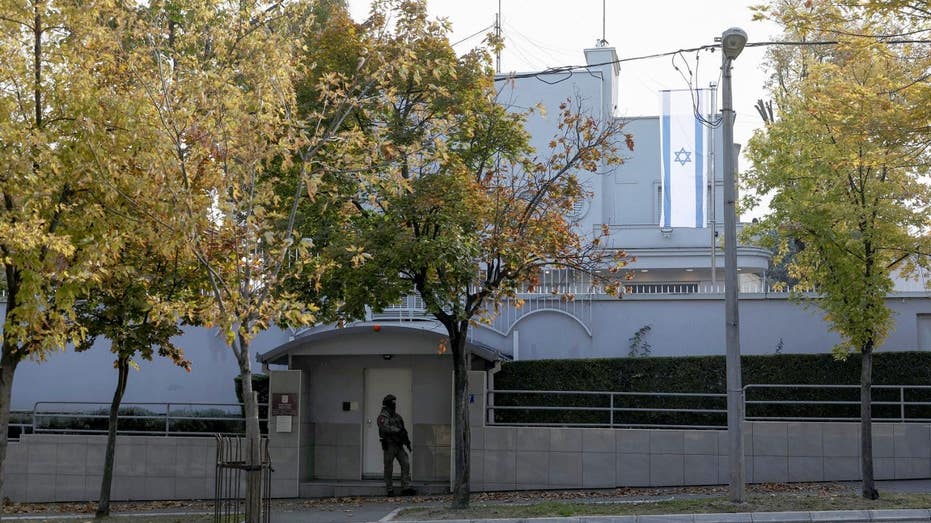
An assailant armed with two knives attacked a member of Serbia's Gendarmerie guarding the Israeli Embassy in Belgrade shortly after midnight Wednesday, prompting the officer to fatally shoot the attacker in self-defense, according to Serbian authorities.
The assailant, who was a minor, allegedly shouted "Allahu Akbar" — or "God is great" in Arabic — as he slashed the officer in the face, leaving the officer "slightly injured."
Interior Minister Ivica Dacic said authorities are treating the incident as a terrorist attack, adding that security forces had been monitoring the assailant.
Dacic said the attacker supported ISIS and displayed a black flag bearing the terrorist group's symbol on his Instagram account. The attacker was believed to be Serbian and from the town of Sabac, Dacic added.
Israel's foreign ministry confirmed the "attempted terrorist attack," and said the incident was under investigation by the relevant authorities.
"The attacker was neutralized by local police. No embassy personnel were injured, and the mission was closed at the time of the incident, which occurred late at night," the statement said.
According to Serbian prosecutors, an unidentified person wearing black clothes opened the door to the security booth outside the embassy around 12:15 a.m. local time.
Prosecutors said the attacker then walked toward the officer inside, identified as D.S., and threw one of his knives in his direction, hitting the officer in the left cheek.
D.S. then retrieved his service weapon and fired multiple rounds, killing the attacker on the spot, according to the office of the Higher Public Prosecutor in Belgrade.
Photos from the scene hours after the attack show heavily armed police officers standing at the entrance of the embassy.
Dacic said Serbia had raised its terrorism threat level to the highest level, prompting an increased police presence at sensitive sites and crowded public spaces across the country.
In June 2024, a crossbow-wielding assailant wounded a Serbian police officer guarding the Israeli Embassy in Belgrade before the officer returned fire, killing the attacker.
British prosecutors charged two men Tuesday under the U.K.’s National Security Act following an incident at RAF Fairford, a key base used by the U.S. military’s heavy bombers.
Mohmed Abdulkarim, 24, of London, was charged with assisting a foreign intelligence service. Nouman Essghir, 24, was charged with entering a prohibited place for a purpose prejudicial to the United Kingdom, according to the Crown Prosecution Service.
British counterterrorism police said they believe the foreign country Abdulkarim was assisting was Iran, Reuters reported.
The charges follow a September incident near RAF Fairford in Gloucestershire, England. British police arrested five men outside the base in the early hours of Sept. 27, according to Reuters.
The base had been used by U.S. bombers to carry out strikes against Iran. About a dozen B-1 bombers were among the aircraft later withdrawn from RAF Fairford and returned to their home stations in the United States on security grounds, according to previous Fox News reporting.
RAF Fairford serves as a key European operating location for U.S. heavy bombers and has supported American military missions.
Frank Ferguson, chief crown prosecutor for the CPS Special Crime and Counter Terrorism Division, said the agency decided to prosecute the two men following a "complex" counterterrorism investigation.
"We will continue to work closely with our partners as this complex investigation continues," Ferguson said.
Both men were expected to appear Tuesday at Westminster Magistrates’ Court.
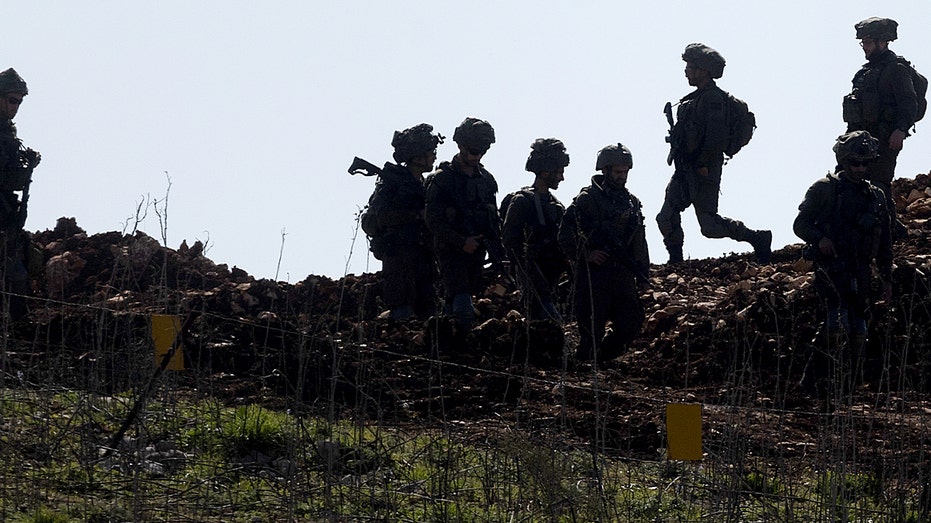
The Israeli military launched large-scale domestic military exercises on Sunday to counter surprise border infiltrations and ground raids across northern and central Israel, mobilizing multiple divisions and air assets amid rising regional tensions.
The drills, set to continue over 48 hours, came as an Israeli security expert invoked the 1973 Yom Kippur War, when Egypt and Syria used exercises to disguise preparations for a surprise attack, warning that escalating tensions in the region could in fact trigger what he described as a "dangerous miscalculation."
The large-scale maneuvers, the IDF said, involve the Northern Command’s 210th Division, the West Bank Division, and the Central Command’s 98th and 96th divisions, alongside the Israeli Air Force.
The exercise, scheduled just ahead of Israel's elections Oct. 27, aims to "maintain the forces’ alertness and readiness, strengthen the ability to defend communities, and make full use of aerial capabilities for defense in the area," according to the IDF.
On Friday, the IDF said troops would practice "a variety of scenarios, including a surprise attack and infiltration into Israeli territory by air and land," incorporating lessons learned from the Oct. 7, 2023, Hamas-led attacks on Israel.
"This exercise is mostly about non-state actors with or without Iranian support," Israeli national security analyst Dr. Ehud Eilam told Fox News Digital.
"It's aimed at those in Syria, Lebanon, and Jordan who might try to infiltrate into Israel or send ground raids. Some are supported by Iran; others are not. It could be planned by Iran or be a local initiative."
"This is a massive exercise, the biggest one in recent years, aimed at protecting the borders," the former Israeli Ministry of Defense researcher added.
"It's all about making sure that the election day on October 27 will run smoothly. It's also a message to Iran and others: don't try to provoke us during election day, so nothing will be disrupted."
The Israeli drills followed a show of force by Tehran days earlier, during which the Islamic Revolutionary Guard Corps (IRGC) fired roughly 30 ballistic missiles across two distinct weapon classes, according to reports.
That live-fire display highlighted Iranian strike capabilities and sparked renewed alerts about commercial shipping in the Strait of Hormuz and prompted the Israeli military to heighten its alert level while maintaining maximum readiness for a targeted strike against Iran.
During a visit to the IDF's Central Command on Wednesday, Chief of Staff Lt. Gen. Eyal Zamir warned that the risk of escalation was growing.
"Given the numerous warnings across all fronts and the sensitivity of the current period, the potential for escalation has increased," Zamir said.
"To ensure better operational control on the ground, we have reinforced our troop deployments across all sectors, including moving the 98th Division into the area to strengthen security and stability."
"Part of mutual deterrence: a few days ago, Iran had their own pretty big exercise, and that was actually more intimidating as far as Israel is concerned because they launched missiles and prepared for a war with Israel," Eilam said.
"This exercise on Sunday and Monday is against Iran's proxies and allies at the border of Israel."
Sunday’s Israeli drill also followed an Oct. 19 mission in which Israeli fighter jets and aerial refueling tankers flew 800 miles across Syrian and Iraqi airspace to Iran’s border.
Washington was notified in advance and viewed the maneuver as a non-kinetic show of force following the postponement of a broader strike package earlier in the month.
Despite the deterrence signals, Eilam warned that large-scale military exercises carry the "risk of miscalculation" and particularly when troop movements could be mistaken for preparations for an attack.
"During the Cold War, every time the Soviet Union or NATO carried out a major drill, having so many troops in the field meant they might attack if that was the intention," Eilam said.
He pointed to the 1973 Yom Kippur War, when Egypt and Syria used military exercises to help conceal troop buildups along Israel's borders.
Israeli intelligence largely dismissed the movements as routine drills, allowing the two countries to achieve strategic surprise when they launched a coordinated, two-front attack on Yom Kippur.
"The classic example in Israel is 1973, when Egypt and Syria conducted a major exercise just before the war that turned into the actual attack," the analyst said.
"Israel and Iran are now watching each other very closely and both sides suspect the other might strike first," Eilam added before stating that there is the chance of what they call "miscalculation — that each side suspects the other and strikes first by mistake."
"It's all about sending messages to each other."
"It remains uncertain whether there will eventually be an Israeli attack on Iran because it depends on U.S. authorization," Eilam concluded.

 Login