❌

Reading view

AfD Data Leak Exposes Questions Over Alice Weidel’s Campaign Funding and Party’s Internal Divisions

More than 420,000 leaked emails have reopened a controversy over illegal donations to Germany’s Alternative for Germany party, while newly examined correspondence reveals previously undisclosed disagreements within its leadership. The revelations could also influence the continuing debate over the party’s constitutional status.

Germany’s Alternative for Germany (AfD) is facing renewed scrutiny after hackers published a substantial archive of internal correspondence, exposing details of party finances, political strategy and disputes among senior officials.

The material, released on 19 October 2026, comprises approximately 421,000 emails and nearly 50,000 accompanying documents, amounting to some 281 gigabytes of data. The files cover more than a decade of party activity, including correspondence involving co-leader Alice Weidel, former chairman Alexander Gauland and other senior figures.

The AfD confirmed that its hosting provider had suffered a cyberattack in September. According to the party, the attackers obtained information from a limited number of email accounts, many of which had not been actively used for several years.

The identity of those responsible remains unknown.

The documents are being examined by several investigative teams, including ZDF, Der Spiegel and Austria’s Der Standard, with technical assistance from the Organised Crime and Corruption Reporting Project (OCCRP).

The Swiss donations controversy returns

The most consequential findings so far concern Weidel’s knowledge of illegal campaign donations received during Germany’s 2017 federal election.

At the time, approximately €132,000 was transferred through Swiss companies into accounts belonging to the AfD’s Bodensee district organisation. The payments were designated for Weidel’s election campaign, particularly its social media activities.

When the transactions became public in 2018, Weidel maintained that she had not known about the money until September 2017 and described the donations as unsolicited.

However, correspondence examined by German investigators and journalists raises questions about that account.

In an email dated 10 July 2017, attributed to Weidel, she told her district treasurer that campaign donations had been promised and requested that the party’s bank account be checked twice weekly.

She also asked to receive confirmation of incoming payments so that campaign expenditure could be planned.

Four days later, the first payment arrived from Switzerland.

Further correspondence indicates that Weidel arranged a separate campaign account and obtained authority to direct expenditure from donations earmarked for her election activities.

The latest investigation, published on 26 October, provides additional details about the account’s management and how the party handled the ensuing controversy.

The leaked correspondence also reportedly includes invoices relating to the purchase of approximately 25,000 Facebook followers for Weidel’s campaign. The extent to which those accounts were automated, and their influence on voters, has not been established.

The AfD was previously ordered to pay approximately €396,000 for accepting the unlawful donations. Criminal proceedings involving Weidel and other district officials were discontinued in September 2021 because prosecutors found insufficient evidence of criminal wrongdoing.

Weidel’s spokesman has rejected suggestions that she misrepresented events. He maintains that she had discussed possible contributions with several potential supporters but had neither anticipated specific amounts nor expected the payments from the Swiss companies concerned.

The new material does not establish that Weidel knew the identity of the ultimate donor or participated in concealing the source of the funds.

Emails reveal divisions over the party’s radical wing

Another development concerns Weidel’s earlier relationship with Björn Höcke, the influential leader of the AfD’s Thuringia organisation.

According to correspondence examined by WELT, Weidel expressed serious reservations between 2015 and 2017 about the influence of nationalist and extremist elements within the party.

She warned colleagues that associations with the anti-Islam Pegida movement and the far-right National Democratic Party risked alienating mainstream conservative voters, particularly in western Germany.

Her private concerns contrast with her subsequent accommodation of Höcke’s influence within the AfD.

The correspondence provides evidence of the internal disagreements that accompanied the party’s transformation from an initially Eurosceptic political movement into one centred increasingly on immigration, national identity and opposition to Germany’s established parties.

The revelations are particularly relevant because Weidel now promotes proposals for substantial changes to Germany’s relationship with the European Union.

As EU Today previously reported, she has advocated withdrawing Germany from the euro and the Schengen passport-free travel area.

Could the material influence an AfD ban?

The leak arrives amid continuing legal and political arguments over whether the AfD threatens Germany’s constitutional democratic order.

In May 2025, the Federal Office for the Protection of the Constitution classified the party as a confirmed right-wing extremist organisation. However, a Cologne court issued an injunction in February 2026, preventing that classification from taking effect pending a final judicial decision.

The court acknowledged evidence of anti-constitutional tendencies within the AfD but found that the material presented was insufficient at that stage to establish that they characterised the party as a whole.

The leaked emails could potentially become relevant to future assessments.

Germany’s Interior Ministry has confirmed that domestic intelligence authorities can, in principle, consider available information when evaluating possible threats to the constitutional order.

Nevertheless, whether unlawfully obtained correspondence could be admitted as evidence, and what weight it would carry, would require separate legal examination.

A party ban can be imposed only by the Federal Constitutional Court. The present disclosures do not themselves establish the legal conditions necessary for such a decision.

Questions over authenticity and data protection

The scale of the archive introduces further complications.

The material reportedly contains bank statements, membership records, personal correspondence and other confidential information involving thousands of individuals.

Journalists have verified portions of the correspondence by comparing messages with independently retained originals. Handelsblatt’s examination, for example, identified previously exchanged emails whose contents matched records held by its own reporters.

However, verification of individual communications does not establish the authenticity of every document in the archive. Fabricated messages have also circulated online.

In an official statement on 21 October, the AfD described the breach as criminal data theft and said it would not authenticate individual documents for journalists.

The party has also reported the incident to the authorities.

For Germany’s political institutions, the affair now presents several distinct questions: whether historical campaign finance arrangements were accurately disclosed, what the correspondence reveals about the party’s internal decision-making, and whether any of the documents provide evidence relevant to ongoing constitutional scrutiny.

Those questions remain open as investigators and journalists continue examining the archive.
  •  

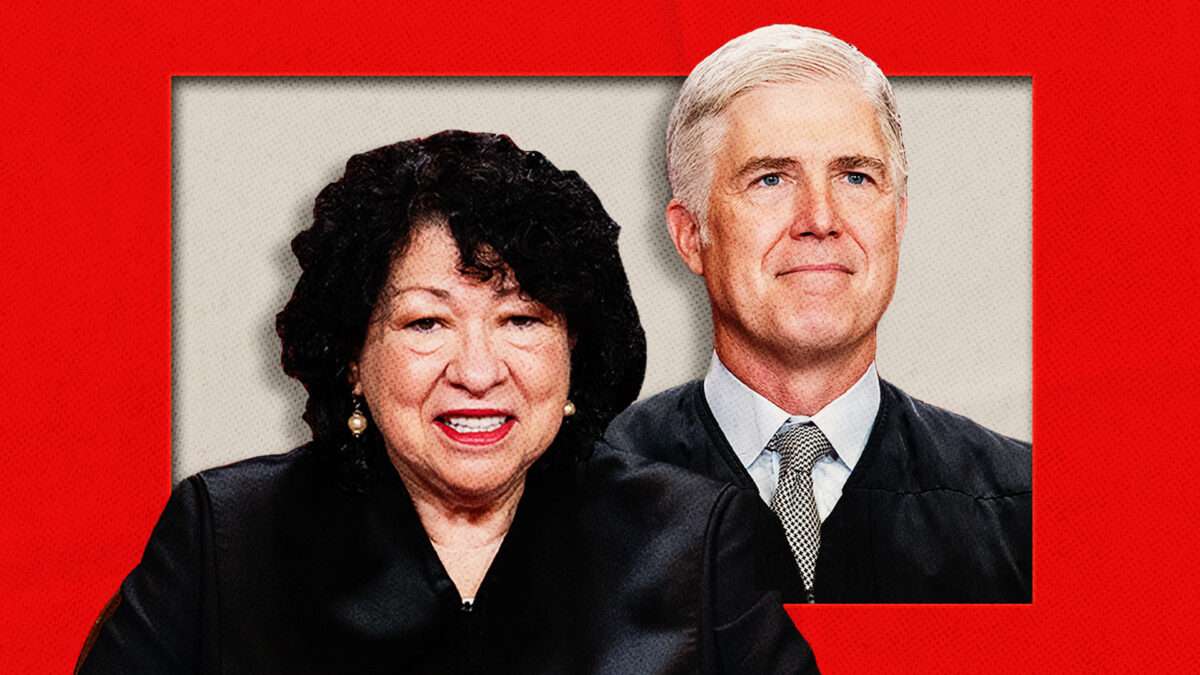
Gorsuch and Sotomayor Unite in Another Civil Liberties Case

Sonia Sotomayor and Neil Gorsuch | Eric Lee/Pool via CNP/SplashNews/Newscom/Fatima Ruiz.

One of the more interesting developments at the U.S. Supreme Court in recent years has been the rise of a kind of sporadic alliance in defense of civil liberties between Justices Sonia Sotomayor and Neil Gorsuch.

In 2018, for example, Gorsuch, joined by Sotomayor, blasted the Supreme Court for refusing to even hear arguments in Stuart v. Alabama, an important case about forensic evidence, criminal trials, and the Sixth Amendment right to cross-examine one's accusers.

Similarly, in United States v. Davis (2019), Sotomayor joined Gorsuch's majority opinion striking down a federal law that called for enhanced sentencing when a gun was used in connection with certain federal crimes because the law at issue was too imprecisely written to pass constitutional muster. "When Congress passes a vague law," Gorsuch wrote, "the role of courts under our Constitution is not to fashion a new, clearer law to take its place, but to treat the law as a nullity and invite Congress to try again."

Gorsuch and Sotomayor have also been on the same page in a number of Fourth Amendment cases, though Sotomayor's overall Fourth Amendment record is arguably stronger than Gorsuch's. In Torres v. Madrid (2021), for instance, the Supreme Court held that when the police shoot a fleeing suspect, it still counts as a "seizure" for Fourth Amendment purposes even if the suspect kept on the move after being shot. "The application of physical force to the body with the intent to restrain is a seizure," the Court held, "even if the person does not submit and is not subdued." Sotomayor joined that pro-civil liberties decision; Gorsuch, along with Justices Clarence Thomas and Samuel Alito, sided with the officers and voted in dissent.

Fortunately, the Gorsuch-Sotomayor band was back together last week to make some noise in support of the Bill of Rights in a dispute that pitted property rights against police powers. As Reason's Billy Binion reported, the Supreme Court declined to hear a case challenging a lower court's "categorical rule" that "property destroyed in the exercise of [a state's] 'police power' is immune to claims under the Takings Clause, the U.S. Constitution's pledge that government cannot usurp private property without fairly compensating the owner."

Sotomayor, joined by Gorsuch, strongly implied that she thought the lower court's rule was unconstitutional, though she accepted that "further percolation" on the issue was needed before the Court should step in. "Where, as here, a person alleges a 'classic taking in which the government directly appropriates private property for its own use' or to pay an outstanding debt, like a tax lien," Sotomayor wrote, "the talismanic invocation of the State's 'law enforcement authority,' may be insufficient to avoid the requirement of just compensation." (Citations omitted.) Sotomayor then urged the lower courts that are "considering this issue to take care that due deference to state police powers does not eclipse constitutional rights."

Just as Gorsuch's Fourth Amendment record has its blemishes, Sotomayor's record on property rights has also been less than impressive at times. So it is doubly welcome to see these two justices back in the trenches together on this particular civil liberties front.

Elsewhere in the Law

Writing at SCOTUSblog, Anastasia Boden, a senior attorney at the Pacific Legal Foundation, has an interesting article about the Supreme Court's landmark 1926 decision in Euclid v. Ambler, in which, as Boden put it, the Court ruled in favor of a town's "power to pass comprehensive zoning, and against a local developer who had argued the town's plan exceeded the city's police power and destroyed the property's value." In effect, the Court's ruling was "the birth of modern zoning."

One of the things that has long fascinated me about Euclid v. Ambler is the fact that the opinion was authored by Justice George Sutherland, who is probably best remembered today for his role as a leading judicial foe of President Franklin Roosevelt's New Deal. In Euclid v. Ambler, however, Sutherland endorsed a view of regulatory authority that has been celebrated by liberal academics as "a model of pragmatic and well-balanced Progressive jurisprudence."

I suppose we might call it an irony of legal history: The intellectual leader of the Supreme Court's anti–New Deal bloc actually left a greater mark on the law by shoring up the immense power of city planners.

The post Gorsuch and Sotomayor Unite in Another Civil Liberties Case appeared first on Reason Magazine.

  •  

Our Failed Constitution

by Andrew P. Napolitano, Lew Rockwell: “The natural progress of things is for liberty to yield, and government to gain ground.” — Thomas Jefferson (1743-1826) The U.S. Constitution was ratified to create and to restrain the government. It established boundaries beyond which the government may not venture, even when it invokes national security, public order, […]
  •  

A Religious Preschool Is Barred From a State's Universal Preschool Program. SCOTUS Will Decide What's Legal.

Religious school classroom | St Mary Catholic School/Facebook

On November 3, the U.S. Supreme Court will hear oral arguments in a case that asks whether Colorado has unlawfully discriminated against a religious preschool because the school is barred from participating in the state's universal preschool program due to its refusal to accept LGBTQ families. In addition to involving multiple hot-button political and cultural issues, the case also has big implications for the future of federal antidiscrimination law.

St. Mary Catholic Parish v. Roy is not about a state law that directly prohibits a religious preschool from operating. Rather, at issue here is a government requirement that any preschool that wants to participate in the state's universal preschool program, and receive the public benefits that follow, must first satisfy various criteria, including that "each preschool provider provide eligible children an equal opportunity to enroll and receive preschool services regardless of race, ethnicity, religious affiliation, sexual orientation, gender identity, lack of housing, income level, or disability."

According to the Catholic preschools overseen by the Archdiocese of Denver, however, complying with that rule would force the schools to violate their religious beliefs. "It is undisputed that these preschools would otherwise be eligible [universal preschool] providers," the schools told the Supreme Court. "They are excluded solely because of their religious exercise—namely, their religious practices of ensuring that all enrolling families are supportive of the Catholic Church's teachings on sex and marriage and of treating enrolled four-year-olds in accordance with their biological sex."

These schools can point to a pair of recent Supreme Court precedents that will very likely count in their favor. In Espinoza v. Montana Department of Revenue (2020), the Court held that if a state provides educational subsidies that help parents send their children to private schools, the state "cannot disqualify some private schools solely because they are religious." Then, in Carson v. Makin (2022), the Court held that Maine's tuition assistance program violated the Constitution by excluding private schools that offered "sectarian" education. "A State's antiestablishment interest," the decision said, "does not justify enactments that exclude some members of the community from an otherwise generally available public benefit because of their religious exercise."

I would expect the outcome of St. Mary Catholic Parish v. Roy to follow in this same general pattern and hold something to the effect that when a state provides an educational public benefit, it must make some sort of accommodation for the religious views of the recipients.


In Other Legal News

Justice Elena Kagan made news a few months back when she defended her conservative colleagues on the Supreme Court from the oft-heard charge that they are totally in the tank for President Donald Trump. "I don't see this as a court that is just like, 'We're just going to rubber stamp what the current administration does.' You know, quite the opposite," Kagan said. "I think that that is a bad rap." In support of her argument, Kagan pointed to the fact that the Supreme Court had recently ruled against Trump on the two big issues that Trump himself valued the most: tariffs and birthright citizenship.

Kagan was in the news again on Tuesday, this time because she publicly blasted those same conservative colleagues for issuing decisions on voting rights and political gerrymandering that, in Kagan's words, have produced "a democracy that does not work as well as it should." According to Kagan, the Court's conservative majority "has kind of blinded itself to the very deleterious effects of their rulings on how the political system works."

Does this mean that Kagan has now stopped defending the conservative justices from the pro-Trump charge? Not at all. In fact, as The New York Times put it, "she reiterated her defense of the conservative-dominated bench from a July appearance and said it was a 'bum rap' to suggest the court had been too deferential to Mr. Trump."

I don't know about you, but I find Kagan to be a refreshing public figure in these simplistic, partisan times. She is a staunch legal liberal with clearly stated objections to what the Supreme Court's conservative majority is getting up to, yet she refuses to be associated with the laziest progressive attacks on the Court. How many people of comparable public stature these days are willing to call out the shortcomings of their own side?

The post A Religious Preschool Is Barred From a State's Universal Preschool Program. SCOTUS Will Decide What's Legal. appeared first on Reason Magazine.

  •  

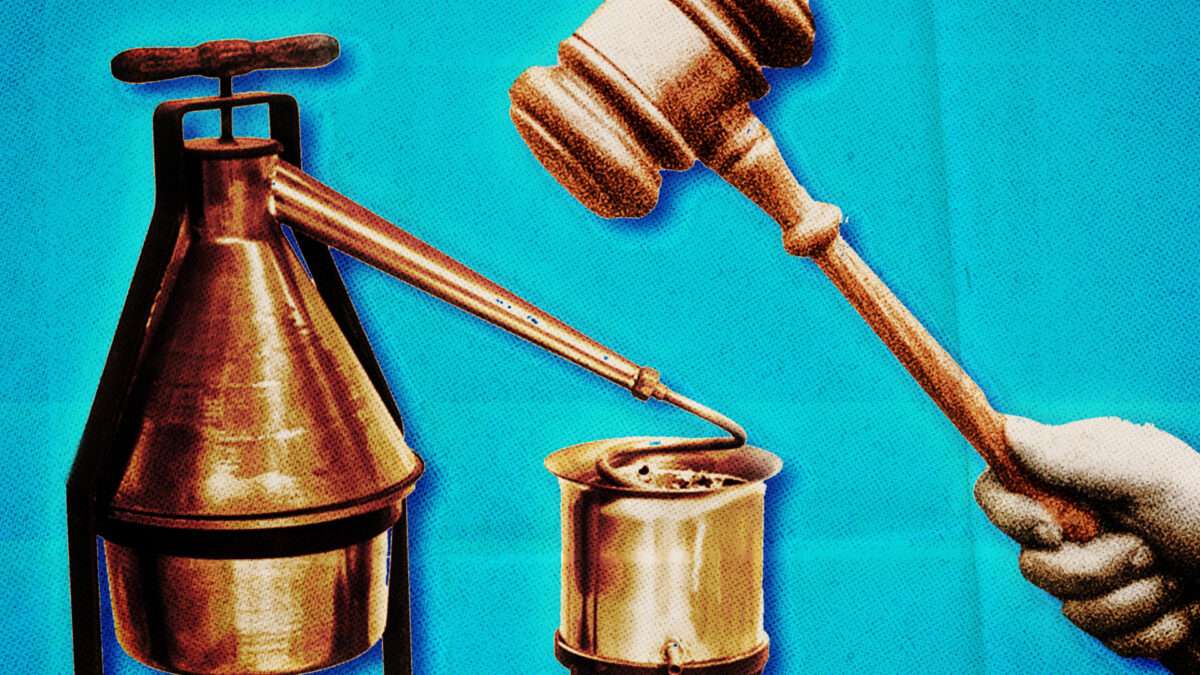
Trump Administration Urges SCOTUS To Uphold Federal Ban on Distilling Liquor at Home

homedistilling | Ioannis Syrigos/Dreamstime/Midjourney

The U.S. Supreme Court's 2026–2027 term just got a whole lot boozier. On Monday, the justices agreed to hear arguments later this year or next in the case of Department of Justice v. McNutt. At issue is whether the 1868 federal ban on distilling liquor at home is unconstitutional because it exceeds the lawful regulatory power of the federal government. If any modern Supreme Court case ever deserved its own drinking game, this one is it.

In April, the U.S. Court of Appeals for the 5th Circuit found the federal ban on home distilling to be unconstitutional because Congress lacked the proper authority to issue such a ban in the first place. It was not a legitimate exercise of the congressional authority "To Lay and collect Taxes," the appellate court reasoned, because "the purpose of a tax is to raise revenue for the government;" yet this law "amount[s] to an anti-revenue provision" that only "prevents distilled spirits from coming into existence." And if it does not exist, of course, the government cannot tax it.

The 5th Circuit also denied that the federal ban on home distilling could be saved by the government's appeal to the Necessary and Proper Clause, which says that Congress has the authority "To make all Laws which shall be necessary and proper for carrying into Execution the foregoing Powers, and all other Powers vested by this Constitution in the Government of the United States, or in any Department or Officer thereof."

But the federal ban on home distilling cannot be "necessary" to the execution of the enumerated taxing power, the 5th Circuit argued, because the provisions of federal law at issue "tax nothing, and are distinct from the regulation of distilling alcoholic products that is permitted by federal tax law."

Nor did the 5th Circuit find the ban to be "proper." "By purporting to ban activity without a plain connection to the exercise of Congress's taxation power," it held, "Congress has essentially—and 'improperly'—invaded the reserved police and regulatory power of the states."

The Trump administration lost this case at the 5th Circuit and has now successfully urged the justices to hear its appeal. In its petition seeking review, the Trump administration faulted the 5th Circuit for its overeagerness to "second-guess" the "legislative judgment" of Congress. Instead, the Trump administration argued, the federal judiciary owes a great deal more deference to the federal government's regulatory priorities in a case like this. "A law is necessary and proper if it is 'convenient' or 'useful' for carrying an enumerated power into effect, and 'plainly adapted' to that legitimate end," the Justice Department's brief argued. "That is the case here."

This case may lead to an interesting divide among the Supreme Court's more conservative members. In United States v. Comstock (2010), a 7–2 Supreme Court embraced the Necessary and Proper Clause as sufficient constitutional grounding for the Adam Walsh Child Protection and Safety Act, which had empowered federal officials to order the indefinite civil commitment of "sexually dangerous" individuals who had already finished serving their prison sentences. Chief Justice John Roberts joined the majority opinion in that case, while Justice Samuel Alito voted in concurrence. In other words, they both endorsed a broad view of congressional power under the Necessary and Proper Clause. By contrast, Justice Clarence Thomas, joined by the late Justice Antonin Scalia, voted in dissent. The Comstock ruling, Thomas protested, "comes perilously close to transforming the Necessary and Proper Clause into a basis for the federal police power that 'we always have rejected.'"

Are we about to see a similar Alito-Thomas split over the proper reach of federal power in this case? And what about Justices Neil Gorsuch, Amy Coney Barrett, and Brett Kavanaugh? Will one or more of them play the Scalia part and similarly reject the Trump administration's broad reading of the Necessary and Proper Clause?

Stay tuned.

The post Trump Administration Urges SCOTUS To Uphold Federal Ban on Distilling Liquor at Home appeared first on Reason Magazine.

  •  

Who is the Guardian of the Constitution?

Dominic Cummings is right, says Professor James Alexander: the idea that civil servants are the 'guardians of the constitution' is pernicious in the extreme. But who then should play such a lofty role?

The post Who is the Guardian of the Constitution? appeared first on The Daily Sceptic.

  •  
❌