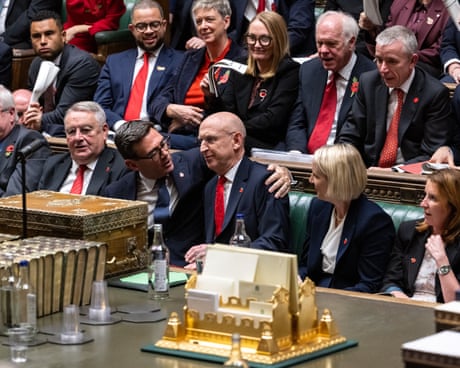
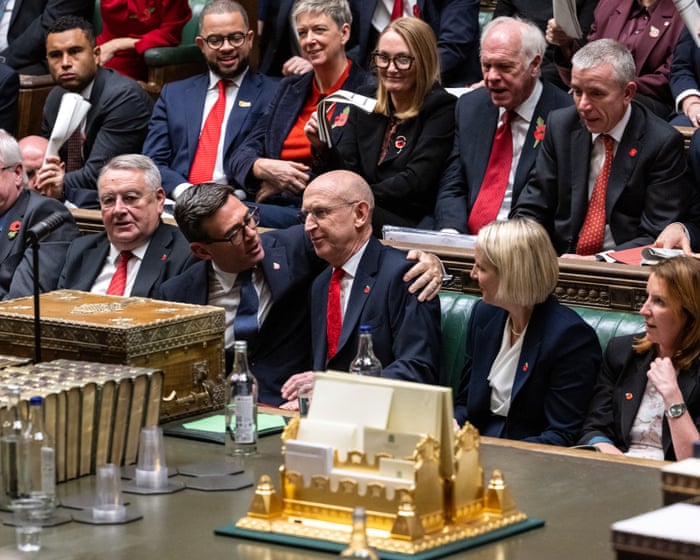
John Healey raised taxes on banks and landlords to fund a £100 winter handout for 20 million families as official forecasts made clear there is no end in sight for the cost of living crisis.
In his first budget, the chancellor blamed “global economic storms” for the grim outlook, as the war in Iran drives up oil and gas prices.
Four in 10 Americans say their personal finances are deteriorating, according to a new poll released shortly before November’s midterm elections. In the NPR/PBS News/Marist Poll, 40 percent of people said their “personal family finances” have declined in the last 12 months, while 16 percent said the opposite. Forty-one percent said their personal family finances…
À compter du 20 novembre, de nouvelles règles européennes doivent renforcer l'encadrement des découverts bancaires, y compris ceux inférieurs à 200 euros. Une réforme qui concerne également les Gersois, mais qui ne...
Brian Rooney and his late wife, Tina, who died in 2013.
Courtesy of Brian Rooney
Brian Rooney, 60, filed for Chapter 7 bankruptcy in 2024.
During his late wife's illness, he built up medical and credit-card debt.
After she died, the grief made it difficult for him to sustain his business.
This as-told-to essay is based on a conversation with Brian Rooney, the 60-year-old founder of Chapter7Reset.com, who lives in Conroe, Texas. He lost his wife in 2013. The essay has been edited for length and clarity, and the details verified.
When you're grieving, you're not thinking about how to move a business forward, capture new market share, or adapt to new technologies. You're not thinking straight because you're overwhelmed by a cloud of loss, pain, and sorrow. Some days, you're just trying to get through morning to night.
In 2013, I lost my wife, my partner, and my life. I still had to deal with the financial reality. I had underestimated what grief would do to my ability to run a business.
Tina was the yin to my yang
My wife, Tina, and I had 24 great years together. She was the yin to my yang. We met through a mutual friend, got to know each other, and fell in love. She was a strong, independent thinker. She was loving, kept me in check, and was an outstanding mother.
Our five kids were all born close together, and I was very involved in their lives. One of the reasons I started a business was because I wanted to be the dad who could be at home, coach my sons in basketball, and play in recitals with my daughter.
We'd tried both working early on, but Tina stopped early on in our relationship. I was the breadwinner, and she managed the kids.
I launched my email-marketing business in 2000. For a time, it did very, very well.
Brian Rooney and his late wife, Tina, were together for 24 years.
Courtesy of Brian Rooney
My wife was diagnosed with cancer
In 2011, things felt almost too good to be true. Then Tina noticed a little bump in the roof of her mouth. She went to the dentist; they did a biopsy, and we didn't think too much about it. Weeks later, I was sitting in my home office when she came over with the phone. With a very disturbed look, she said, "I have cancer."
Our lives turned upside down.
At first, because the cancer wasn't very aggressive, we tried homeopathic remedies. Then came chemotherapy, radiation, and major surgeries. The treatments were costly, and while the Affordable Care Act covered quite a bit, we still had high deductibles. Some hospitals wouldn't admit her until the deductible had been paid.
I would sit at the table with spreadsheets, trying to work out the finances. I was trying to be strong for my wife, but sometimes I'd go to the corner of the room and cry. The unspeakable thing to consider was that I might lose my wife because I couldn't afford to pay for it all.
Brian and Tina Rooney had five kids.
Courtesy of Brian Rooney
A lot of the medical bills were paid with credit cards, and we ran up a lot of credit-card debt. I had six mouths to feed, for which I relied mostly on credit cards. I sold my music gear, like my guitars and amps. We moved from a beautiful rental house in a nice area of Texas to a much less expensive apartment. We weren't going to shows, basketball games, or on trips. None of that bothered me. The focus was on getting Mama healthy.
Friends and family stepped in here and there to help out. My kids were approaching adulthood, so they didn't need much looking after, but working from home let me adjust my schedule as needed.
I couldn't keep the business moving forward
There were days when I couldn't touch the business. It was mostly automated, but there were things I needed to step in and manage. If a server went down, I'd need to stay up all night to fix it while checking on my wife in the other room.
I wasn't resting or sleeping. I wasn't able to drive the business forward.
During that time, the industry was changing. New technology became available, and we weren't able to keep up. I was so focused on Tina's care that we missed opportunities. We had contractors and a business partner, and I wish I'd outsourced a lot faster. I didn't realize how fast I was losing.
I became a widower at 47
Tina Rooney died at 49.
Courtesy of Brian Rooney
Tina died in November 2013. She was 49, and I was a 47-year-old widower.
Those first few weeks, I'd wake up, roll over, realize she wasn't there, and know that she never would be again. I would talk myself out of bed, one body part at a time.
The business was still there. My business partner was focused on the technical side, but I had the marketing and entrepreneurial mindset. A lot of things that needed to get done didn't get done. Honestly, at that point, I didn't care. It was a dark time for me
I wanted a clean slate
The business was declining, and meanwhile, I'd built up hundreds of thousands of dollars in credit-card and medical debt. I thought I could put everything on my credit cards, turn things around, and pay it down. Things never turned around, and as the business continued to decline, there was less money to draw from it.
In 2021, I got remarried. My second wife knew about the financial mess I was in. The interest and penalties were compounding so quickly. There was constant pressure from phone calls, letters, and demands for payment. I wanted relief and a clean slate.
In early 2024, after speaking with my business partner, we decided to dissolve the business. Later that year, I filed for Chapter 7 bankruptcy.
I felt both relief and shame after filing for bankruptcy
When I filed for bankruptcy, I had no assets because I'd sold them all to pay my bills. When the debt was wiped out, I felt relief and shame, but the relief took over once I stopped getting phone calls and letters.
It was time to rebuild. I got a sales job, which I hadn't had in decades. I did AI certification training and started rebuilding my credit with credit-rebuilding cards. I launched ChapterSevenReset.com, a free guide to help people in a similar position.
One of the hardest lessons was that we didn't have a life-insurance policy on Tina. It never dawned on me because she wasn't contributing financially. I never considered how caring for her and my grief would take away from my generating income. My second wife and I both have life insurance policies for each other.
Nowadays, my friends say the "old Brian" is back. I've made peace, as best you can, with the fact that Tina is gone. I'm like an amputee. There's a part of me that's missing, and that part will always be missing. It itches. It's always there.
At the University of California campuses in Berkeley, Irvine and Santa Barbara, students get an unwitting education in navigating the housing market.
The University of California, Santa Barbara, recently said incoming undergraduates would be guaranteed on-campus housing for just two years, up from one before.
Oil drilling rigs in Prudhoe Bay, Alaska. The Polar LNG plan called for the company to tap into the giant load of natural gas available in the state’s northern reaches.
The 30-year, fixed-rate mortgage dropped slightly to 7.32 percent as prospective home buyers continue to struggle with affordability. But home prices are starting to drop in some areas.
The Ministry of Finance in Paris (Bercy). Jean-François Gornet / Flickr, CC BY-SA
France has crossed a critical threshold as its public debt exceeded €3.5 trillion in the first quarter of 2026, reaching 117.5% of GDP. The French Court of Auditors has sounded the alarm over what it describes as an “alarming” fiscal situation, as public deficits hit record levels and debt-interest costs continue to soar.
The Ministry of Finance in Paris (Bercy). Jean-François Gornet / Flickr, CC BY-SA
Public Debt Exceeds €3.5 Trillion
During the first quarter of 2026, France’s public debt passed the symbolic milestone of €3.5 trillion, reaching €3.5361 trillion at the end of March. The figure underscores the scale of the country’s budgetary challenges.
To put this amount into perspective, France would theoretically have to sell its entire gold reserve, all publicly traded and privately held state assets—including companies such as EDF, Engie, and Airbus—as well as all government-owned buildings and land in an attempt to repay the debt in a single payment. Even such a drastic measure would likely fall short.
In just one quarter, France’s Maastricht-defined public debt increased by €75.6 billion, a sharp rise in a very short period. This growing debt burden reflects a longstanding reality: for more than fifty years, the French government, local authorities, and social security system have collectively spent more each year than they have collected in revenue, particularly through taxation. To cover this structural gap, France has continued borrowing from financial markets.
Debt-to-GDP Ratio Nears Historic High
Beyond the headline figure, analysts and financial institutions are particularly concerned about debt relative to economic output. According to France’s National Institute of Statistics and Economic Studies (INSEE), public debt now equals 117.5% of gross domestic product.
The increase has been dramatic. In 1980, public debt represented only 20% of GDP. By 2000, it had risen to approximately 60%. Over four decades, the debt-to-GDP ratio has nearly increased sixfold.
The current level of 117.5% is approaching the all-time record of 117.8% recorded in the first quarter of 2021 during the COVID-19 pandemic. At that time, President Emmanuel Macron launched an unprecedented economic rescue effort, pledging to spend “whatever it takes” to prevent economic collapse.
Although the health crisis has long since passed, France’s debt trajectory has not slowed significantly. Within the European Union, only Greece and Italy have higher debt ratios, making France the third most indebted country in Europe.
Warnings from the Court of Auditors
In response to what it views as a critical situation, France’s independent Court of Auditors, responsible for overseeing public finances, issued a warning report describing the state of the nation’s finances as “alarming.”
The report, revealed by France Inter and released ten months before the 2027 elections, calls for “strong, credible, and swift measures” to restore fiscal stability.
The court highlights several aggravating factors. First, France remains the only country in the eurozone whose debt level is higher today than it was at the end of the COVID-19 crisis. Second, public deficits continue to break records. France posted a budget deficit equal to 5.1% of GDP in 2025, the second-highest in the eurozone after Italy.
The government’s goal of keeping the deficit at 5% is viewed as unrealistic by the Court of Auditors, which fears a further deterioration of public finances.
Debt-Interest Costs Are Soaring
A particularly troubling development is the rapid increase in debt-servicing costs. As debt accumulates and interest rates rise in financial markets, the amount spent on interest payments has grown dramatically.
In the current state budget, debt-servicing expenses have become the government’s single largest expenditure category, surpassing spending on the national education system (excluding pension obligations).
Paradoxically, this situation coincides with a significant increase in taxation. Taxes rose by €38 billion across 2025 and 2026 as part of efforts to limit further deficit growth. Yet France already has the highest overall tax burden in Europe when taxes and social contributions are combined.
This creates both political and economic tensions: higher taxes have not been sufficient to slow the growth of public debt, raising questions about the effectiveness of current fiscal measures.
France’s current trajectory highlights a troubling economic reality: structural public spending is growing faster than tax revenues, creating a persistent deficit that is difficult to eliminate.
Programs such as social welfare, pensions, healthcare, and public investment involve long-term commitments, while tax revenues tend to fluctuate with economic conditions.
This divergence between economic growth and debt growth raises a fundamental question for France’s public finances. If GDP expands by only 1% to 2% annually while debt continues to grow by 3% to 4% per year, the debt-to-GDP ratio will inevitably continue rising unless major policy changes are implemented.
French voters heading to the polls in 2027 will likely face a difficult choice between maintaining current levels of public services and restoring fiscal sustainability.
Breaking the Debt Spiral
To reverse the trend, experts and institutions such as the Court of Auditors recommend a combination of measures: controlling the growth of public spending, improving the efficiency of existing expenditures, broadening the tax base without increasing marginal tax rates, and accelerating economic growth to boost revenues.
As the eurozone’s second-largest economy after Germany, France possesses significant economic resources. However, meaningful structural reforms will require political consensus and a willingness to accept difficult compromises.
In the short term, the government must demonstrate that its deficit-reduction commitments are credible. In the medium term, comprehensive reforms of public spending—particularly in pensions and healthcare—appear unavoidable. Over the long term, only sustained economic growth combined with spending discipline will be capable of reversing the debt dynamics that have characterized France for decades.

 Login