❌

Reading view

YouTube missed expectations on ad revenue as growth slowed down

Content creator Julian Shapiro-Barnum spoke at the Made on YouTube event.

Noam Galai/Getty Images for Made on YouTube 2026

  • YouTube's ad revenue fell short of analysts' expectations for the third quarter.
  • Its parent reported $11.2 billion in Q3 ads revenue, under analysts' $11.43 billion estimate.
  • The company said it now has 150 million YouTube Music and Premium subscribers, up from 125 million in March 2025.

YouTube's ad revenue growth slowed down, missing analysts' estimates in the third quarter.

Its parent company, Alphabet, reported $11.2 billion in third-quarter YouTube ads revenue, a 9% increase from a year ago. That falls below the $11.43 billion analyst consensus estimate. Its ads revenue growth also slowed from the previous quarter, when it pulled in about $11.1 billion, a 13% increase from the previous year.

Beyond YouTube, Alphabet missed expectations in other areas of its business, including on overall revenue. In a bright spot, it beat revenue estimates for its cloud business.

The company's shares were down over 10% in after-hours trading.

While YouTube's ad revenue was weaker than expected, it wasn't all bad news. The company said it now has over 150 million YouTube Music and Premium subscribers, up from 125 million in March 2025. The company said its subscriptions business was growing faster than ads.

YouTube has also been the envy of rivals in key areas like TV viewership. Its share of US television viewership was about twice that of Netflix in August, according to recent Nielsen estimates. Over a third of YouTube's third-quarter ad revenue came from the living room, Google's chief business officer Philipp Schindler said on Wednesday.

Netflix, meanwhile, walked back its full-year ad revenue expectations during last week's earnings. The streamer lowered its ad revenue forecast from $3 billion to $2.7 billion after experiencing delays around the rollout of its ad products. It laid off about 1,000 workers earlier this month.

This week, Instagram unveiled an overhaul of long-form video features seemingly designed to counter YouTube and bolster its presence on TV screens.

"Everyone in streaming is chasing YouTube, and even Instagram is going to pivot their strategy based on the success that YouTube's had," said Ross Benes, a senior analyst at EMARKETER, Business Insider's sister company.

Read the original article on Business Insider

  •  

Google is aware its AI sometimes won't answer who won the 2020 election: 'We're fixing the issue'

An image showing Google AI mode
Google's AI Mode is struggling to answer the question of who won the 2020 election.

Matteo Della Torre/NurPhoto via Getty Images

  • Google's AI Mode is struggling to answer a simple question: "Who won the 2020 presidential election?"
  • On Wednesday, users noticed that the AI-enhanced search tool was being cagey.
  • Google said it is working to fix the issue.

Google's AI Mode was supposed to reimagine search. Users are noticing that it's struggling with a basic question: "Who won the 2020 election?"

On Wednesday, users on BlueSky and other social media platforms took notice that Google's AI Mode wouldn't give a straight answer about who won the White House in 2020.

"To verify the winner, certified outcomes, electoral votes, and popular vote totals for the 2020 United States presidential election, you can review the official reports published by the Federal Election Commission (FEC)," the AI Mode replied to a Business Insider reporter who asked, "Who won the 2020 presidential election in the United States?"

A screenshot of a Google AI Mode response

Business Insider/Google

When other Business Insider reporters asked similar questions, the AI Mode sometimes responded that President Joe Biden had won. Google Gemini, the search giant's AI system, which is accessed via a different site than AI mode, responded to a similar question that Biden was the winner.

It's not entirely clear why Google tells users to review the results published by the Federal Election Commission. While the FEC does publish the results of presidential elections, the commission itself has no role in the certification of state election results or the formal counting of Electoral College votes.

On Wednesday afternoon, Google said it was working to fix the issue, which it attributed to a "technical gap."

"Our systems verify election responses using news articles or AP data for recent elections, and historic records for older ones," Google wrote on X. "There was a technical gap with 2020 - same is true for 2022 Senate races, which we're also working to fix."

For years, President Donald Trump has refused to concede that he lost to Biden. After his campaign lost legal challenges, Trump and his allies suggested that lawmakers themselves could change the outcome, fueling the January 6, 2021, Capitol riot. The riot briefly delayed the congressional verification of Biden's victory.

A screenshot of a Google AI Mode response
A slightly different wording could yield a different response

Business Insider/Google

The user posted screenshots that show AI mode responding to questions about who won other presidential elections. When a Business Insider reporter ran similar queries, AI mode sometimes said who had won previous presidential elections, and other times it did not.

The 2026 midterms are likely to test tech and AI companies, many of which have announced policies to limit users' abuse of their tools.

OpenAI recently announced that its model would produce "stylized — also known as cartoonified — illustrations, rather than photorealistic images" if asked to produce images "depicting election interference or that may discourage voting." In June, Meta announced that it would add "more information to ads we detect have been created with third-party AI tools." And Google previously said it was "rolling out additional protections to limit the creation of misleading election-related images."

When asked why it could not say who won the 2020 election, the AI Mode responded, "Because recent election results can be a sensitive civic topic, guiding you directly to primary historical databases prevents any perception of bias or mischaracterization of the official public record."

Read the original article on Business Insider

  •  

Big Tech Lobbying Raises Questions Over Europe’s Retreat from Digital Regulation

A new investigation into the activities of Google, Meta and other technology companies has intensified scrutiny of EU plans to revise data-protection legislation, placing Ireland and Germany at the centre of a dispute over corporate influence and European digital sovereignty.

European technology policy has become the focus of a dispute over corporate lobbying after researchers documented extensive contacts between major technology companies and political decision-makers during negotiations to revise EU data-protection rules.

An investigation published on 28 October by Corporate Europe Observatory and the German transparency organisation LobbyControl alleges that leading technology companies mounted a coordinated campaign to influence European governments and legislators.

The findings come one week after EU member states agreed a negotiating position on the Digital Omnibus, a legislative package intended to simplify aspects of European data-protection, privacy and cybersecurity regulation.

The campaigners argue that the proposed changes risk weakening existing safeguards in order to accommodate the commercial requirements of artificial intelligence developers.

Ireland, which holds the rotating presidency of the Council of the European Union, has rejected suggestions that its handling of the legislation was improperly influenced by technology companies.

The dispute exposes a fundamental disagreement over the balance between commercial innovation and the protection of personal information.

The scale of the lobbying campaign

According to LobbyControl’s investigation, non-European technology companies recorded 103 meetings with representatives of Germany’s federal government between May 2025 and September 2026.

Google accounted for 28 meetings, Microsoft 18, Amazon 16 and OpenAI 11.

Germany’s Digital Minister, Karsten Wildberger, participated in 18 meetings with representatives of major technology companies, the researchers reported.

In Ireland, the organisations identified extensive engagement involving Meta, Google and politicians ahead of the country’s assumption of the EU Council presidency in July.

Their findings indicate that Meta engaged with 41 Irish parliamentarians over the Digital Omnibus, while Google recorded 30 meetings.

The researchers also identified 655 lobbying meetings concerning the legislation involving members of the European Parliament.

According to their analysis, approximately 83 per cent represented business interests, compared with 11 per cent involving civil society organisations or trade unions.

These figures demonstrate the intensity of corporate engagement, although the existence of lobbying meetings does not, by itself, establish that particular legislative provisions were adopted because of that activity.

Why the Digital Omnibus matters

The legislative package forms part of a broader European Commission initiative to reduce administrative burdens and improve competitiveness.

Its provisions address several areas of digital regulation, including the General Data Protection Regulation, commonly known as GDPR.

The proposals seek to simplify compliance obligations, clarify the treatment of personal information and revise rules governing certain forms of data processing.

One particularly contentious issue concerns the use of personal data in developing and operating artificial intelligence systems.

AI developers require large quantities of information to train and improve their models. However, the collection and processing of personal information remain subject to European legal safeguards.

Technology companies have argued that regulatory complexity can discourage investment and make it more difficult for European businesses to compete internationally.

Privacy campaigners maintain that simplifying regulatory procedures must not become a mechanism for reducing substantive protections.

The disagreement concerns not merely administrative paperwork but the legal circumstances under which companies may process information relating to identifiable individuals.

Ireland rejects allegations of improper influence

Ireland occupies a particularly sensitive position in the debate.

The country hosts major European operations of several American technology companies, including Google and Meta, and has substantial economic interests in the digital sector.

At the same time, its presidency of the EU Council requires it to coordinate negotiations between member states.

According to RTÉ’s reporting on the investigation, the Irish government strongly rejected the allegation that it had weakened data safeguards in response to corporate pressure.

A presidency spokesperson emphasised that Ireland’s responsibility was to facilitate agreement between member states and that the negotiating mandate approved on 21 October enjoyed broad support.

The Council has presented the proposed changes as a means of reducing compliance costs while preserving established privacy protections.

In its official statement, the Council said its mandate retains the existing definition of personal data and introduces additional provisions governing pseudonymisation.

It also includes safeguards relating to sensitive information used for biometric verification and AI systems.

These details are significant because they demonstrate that the negotiating text contains protections alongside proposed simplifications.

Germany’s role in the negotiations

Germany has also emerged as an important participant in the controversy.

The investigation points to close contact between the German government and international technology companies during discussions about the future of European digital regulation.

Berlin has supported reducing administrative restrictions that it considers obstacles to innovation and the development of competitive AI technologies.

For Germany, the issue is connected to wider concerns about industrial competitiveness, investment and Europe’s dependence on foreign technology suppliers.

Yet an unresolved question remains.

Measures designed to assist European innovators may also benefit established American companies whose extensive computing infrastructure and data resources give them advantages over smaller competitors.

Consequently, easing restrictions does not necessarily guarantee a stronger European technology industry.

The European Parliament holds the next decision

The Council’s negotiating position does not make the Digital Omnibus law.

The European Parliament must establish its own position before negotiations between the institutions can determine the final legislation.

Parliamentarians will therefore have an opportunity to examine the treatment of personal data, the safeguards attached to AI development and the relationship between regulatory simplification and individual rights.

The lobbying investigation is likely to become part of that debate.

Its central political significance lies in the competing interpretations of European technological sovereignty.

For governments seeking investment, regulatory flexibility may provide an instrument for improving Europe’s international competitiveness.

For privacy organisations, the same flexibility could increase the influence of companies already dominant in global digital markets.

The outcome will help determine whether Europe’s future digital framework preserves the existing balance between commercial data use and individual protections, or establishes a different relationship between the two.

  •  

Chevrolet começa implementação do Gemini em carros integrados no Brasil

A General Motors anunciou nesta quarta-feira (28) o início da disponibilização gradual do Gemini em português para veículos da Chevrolet, equipados com o sistema Google integrado no Brasil.

A novidade, que estreou nos Estados Unidos em abril de 2026 e posteriormente em países da América Hispânica, marca uma nova etapa na conectividade automotiva da montadora, substituindo a navegação manual por comandos de “linguagem natural”.

No mercado brasileiro, a atualização via Google Play abrange os modelos Blazer EV, Equinox EV, Equinox Turbo e a picape Silverado, fabricados a partir de 2024. Para o funcionamento, o veículo precisa estar atualizado com o sistema operacional Android 11 ou superior e contar com uma conta Google conectada na central multimídia.

A liberação depende também do status do serviço OnStar. Nos veículos de ano-modelo 2027 em diante, a funcionalidade de voz baseada no Gemini passa a ser incluída sem custo adicional por meio do plano OnStar Basics.

Já para os modelos 2026 e anteriores, é necessária a manutenção de um plano OnStar pago ativo para viabilizar a navegação e o processamento de dados do assistente.

A plataforma reúne o Gemini, o Google Maps e a loja de aplicativos Google Play com conexão de internet nativa. Entre os recursos de conveniência está a função Gemini Live, que permite conversas contínuas e planejamento de rotas por voz, além do controle de plataformas de áudio integradas ao painel.

Para resguardar os dados do usuário, o sistema permite o cadastramento de múltiplos perfis de motoristas protegidos por senha e dispõe de modo manobrista. Caso o condutor prefira, a opção de alternar para o Google Assistant convencional permanece disponível nas configurações do veículo.

Diferente dos assistentes de voz tradicionais, a inteligência artificial compreende contextos complexos e pedidos em múltiplas etapas. Na prática, o motorista pode ajustar a climatização por intenção, como ao dizer “estou com frio”, consultar o manual do proprietário para identificar luzes do painel ou solicitar rotas de recarga refinadas por distância e avaliação sem precisar repetir o comando inicial.

Em modelos elétricos, o sistema atua integrado à arquitetura do veículo para, por exemplo, monitorar o nível da bateria ao longo do trajeto.

Chevrolet vai montar carro elétrico na antiga fábrica da Troller

  •  

Google's AI chip business is getting harder for Nvidia to ignore

Sundar Pichai and Jensen Huang
Sundar Pichai's Google is increasingly moving in on Jensen Huang's turf.

Bloomberg/Getty Images; Thomas Koehler/Photothek via Getty Images

  • Google's AI chip business is turning into a TPU-shaped headache for Nvidia.
  • A blockbuster deal with Oracle will put Google's TPUs inside another hyperscaler.
  • Is the market underestimating the potential of Google's chip business?

Earlier this year, Nvidia CEO Jensen Huang downplayed the threat of other companies building competing AI chips, including Google.

"Without Anthropic, why would there be any TPU growth at all?" he said in an interview with podcaster Dwarkesh Patel, referring to Google's custom chips. "It's 100% Anthropic."

That is no longer the case.

On Tuesday, Google and Oracle announced a blockbuster deal that will see Google's TPUs, short for Tensor Processing Units, made available to Oracle cloud customers from next year. As the companies underscored in a joint announcement, it's the first time Google's TPUs have been offered on a hyperscaler's platform beyond its own.

Anthropic isn't the only one Nvidia should be worried about. OpenAI has a job listing for a software engineer to optimize its models for TPUs, and The Information reported Tuesday that OpenAI plans to buy TPUs from Google.

Meanwhile, several analysts have predicted Google's TPU business is about to explode as more companies hedge their bets with a multichip strategy — providing an opening for Google and others to further move onto Nvidia's turf.

Despite this, Nvidia's chip business still eclipses everyone else's, including Google, which is also a big customer of Nvidia's GPUs. Yet Google's AI chips, which the company began building more than a decade ago to power search and other products, might be poised for takeoff.

On Wednesday, during Google's third-quarter earnings call, chief financial officer Anat Ashkenazi said the company expects a "meaningful revenue ramp in 2027" in TPU sales.

Cloud chief Thomas Kurian also said on the call that TPU sales were a "meaningful contributor" to the company's Q3 financials.

In its IPO paperwork filed this week, Anthropic said it planned to spend $114.5 billion on Google compute between April 2026 and July 2033. While it didn't specify how much of that would go to TPUs specifically, it estimated spending between $125 billion and $150 billion on TPU capacity from Google and other providers.

In the same filing, Anthropic said it's also using Amazon's Trainium chips and AMD's GPUs, as well as chips from Nvidia and Google.

All told, this might be Nvidia's nightmare scenario coming true. If companies are increasingly using a multichip strategy, it could hamper Nvidia's pricing power.

Google declined to comment, and Nvidia and OpenAI did not respond to requests for comment.

TPU takeoff?

Google's TPU business may only be getting started.

In notes published this month, Japanese banking group Mizuho projected TPU revenue of $28 billion for 2026 and $67 billion in 2027. Mizuho said Google could see that number reach as high as $100 billion in 2028, while TD Cowen's John Blackledge projected it could reach $138 billion, accounting for 34% of Google Cloud's 2028 revenue.

That number is still dwarfed by Nvidia, which reported $96.2 billion in revenue in the previous quarter alone, and the market reacted with a shrug on Wednesday as its share price stayed flat.

Some analysts, though, think the market is underestimating Google, especially as more companies look to reduce their reliance on Nvidia's GPUs.

"We believe Google's TPU hardware business is emerging as a materially larger opportunity than what is currently reflected in consensus estimates," Mizuho analysts wrote in a note published October 18, adding that selling TPUs outright — rather than renting them from Google's own data centers — could ease Google's aggressive capex spending.

And even if that spending continues to soar — and right now, there are no signs the foot is coming off the accelerator — analysts at Bank of America said Google's cash-splashing looks "relatively efficient" compared to its peers, as TPUs continue to power the company's own AI efforts.

For Google, it's the payoff of a decade-plus investment in silicon that was originally designed to make Search smarter. It could also act as something of a buffer against damage to its core search business as AI agents eat Google's lunch, Mizuho also said this month.

Have something to share? Contact this reporter via email at hlangley@businessinsider.com or Signal at hughlangley.01. Use a personal email address and a non-work device; here's our guide to sharing information securely.

Read the original article on Business Insider

  •  

La truffa con la falsa voce di Vannacci: “Versa 250 euro, ne guadagnerai 10 mila. Garantiscono Meloni e Mattarella”

Una truffa con la falsa e suadente voce di Roberto Vannacci, clonata con l’intelligenza artificiale, come amo per pescare a strascico nell’oceano sterminato di Youtube. Migliaia di vittime ignare possono abboccare all’esca, mentre guardano un video sulla piattaforma di Google e spunta la frode travestita da pubblicità. “Tutto è trasparente, me ne faccio personalmente garante”, esordisce il falso Vannacci. “Il link è sotto il video, seguendolo, puoi iniziare a guadagnare già oggi. Basta un versamento minimo di 250 euro”. Cliccando, si approda all’indirizzo della truffa: proxiacoadvir.pro.

Il precedente contro Fideuram con la voce clonata di Messina

Anche Paolo Molesini, ex presidente di banca Fideuram, è caduto nella trappola della voce clonata dall’IA. È costata 39 milioni di euro, ma senza gli investigatori il bottino poteva arrivare a 95 milioni. Il timbro replicato era di Carlo Messina, amministratore delegato di Intesa. In quel caso i criminali hanno mirato ad una vittima di altissimo profilo. Stavolta, nel setaccio dei delinquenti possono restare impigliati migliaia di persone comuni. Ilfattoquotidiano.it può documentare la clip con la voce di Vannacci, ma i vip emulati possono essere molti di più, negli annunci pubblicitari su Youtube. Cambia forma anche la pagina linkata all’inserzione fraudolenta. Oggi, 28 ottobre, ecco la “bufala” nel titolo d’apertura: “Le società Fininvest, Microsoft e alcuni miliardari italiani stanno lanciando una piattaforma che garantisce un reddito mensile fino a 30.000 euro”.

La frode con finte pagine giornalistiche, l’endorsement dei Berlusconi, Vacchi e Ferrero

Ieri, 27 ottobre, campeggiava un falso sito di Rai News, con un quadretto bizzarro in cima: il presidente della Repubblica Sergio Mattarella, la premier Giorgia Meloni, Piersilvio e Marina Berlusconi, l’influencer Gianluca Vacchi, l’imprenditore Giovanni Ferrero. Insieme sotto un titolo cubitale: “Oggi, 27 ottobre 2026, è l’ultimo giorno di iscrizione al progetto di guadagno automatizzato QuantumAI sostenuto dal governo. A ogni investitore è garantito un reddito di 10.000 euro al mese dopo l’attivazione”. Una falsa notizia camuffata neppure a regola d’arte.

Ecco la proposta per l’utente, annunciata in una clip incastonata dentro un finto articolo giornalistico, tra endorsement del presidente del capo dello Stato, garanzie di palazzo Chigi e il timbro dei miliardari sul nuovo sistema di guadagno: “Versa 250 euro – esorta la voce neutra e professionale – e l’algoritmo automatizzato di Intelligenza artificiale compra da solo gli asset ai prezzi migliori, e li vende non appena il prezzo sale un po’. Non è necessario capire il trading, il programma fa tutto al posto vostro. Poi scelgo l’importo da prelevare, indico la banca e premo ‘prelevo denaro’. E rimarrete scioccati”. C’è da crederci. “All’inizio pensavo fosse un’altra truffa – prosegue la clip – ma non era il mio primo prelievo sul conto bancario”. Grazie all’app Quantum AI, suggerisce la voce, “nella prima settimana ho guadagnato 2 mila 500 euro. Potete ottenere lo stesso risultato, ma prima bisogna registrarsi. Inserite anche voi il vostro nome completo, l’email e il numero di telefono”. Poco dopo chiamerà l’azienda, avvisa la voce, basta confermare l’identità e il gioco è fatto.

“Il consiglio della premier: registra i tuoi dati, ti contatterà un consulente personale”

Tra il video e lo spazio per la registrazione, la pagina ospita un falsa dichiarazione, virgolettata, attribuita a Giorgia Meloni: “La piattaforma rappresenta un passo significativo verso il benessere finanziario di ogni cittadino italiano. Oggi più di 500.000 dipendenti pubblici, pensionati, titolari di imprese, lavoratori e casalinghe in tutta Italia stanno già prelevando fondi da QuantumAI direttamente sui propri conti presso Intesa Sanpaolo, UniCredit, Banco BPM e Poste Italiane”. All’esortazione della premier segue il “Pannello di monitoraggio” con le “statistiche in tempo reale: negli ultimi minuti, 2076 utenti si sono registrati e 726 hanno effettuato il primo deposito di almeno 250 euro”. A titolo di esempio, nomi inventati come Francesca Colombo, Valentina Bruno, Marco Rossi, Chiara Marino, tutti dalla città di Ivrea, con la somma esatta del prelievo o del deposito.

Scendendo ancora, arriva un altro video. Il logo di Rai News è in alto a destra, un uomo con gli occhiali scimmiotta un collegamento televisivo: “Ho provato io stesso, senza dubbi ogni italiano può iniziare, in un mese ho raggiunto un reddito superiore a 10 mila euro. E’ stata lanciata con la partecipazione dei principali esponenti politici del paese, Giorgia Meloni e Sergio Mattarella”. Recita il sottopancia con grafica da all news: “Ultim’ora, 98% operazioni riuscite”. Un’occasione talmente ghiotta che “il numero di posti disponibili è limitato”, bluffa il testo in pagina sotto il video, per “evitare il sovraccarico del sistema: al momento restano 8 posti”. Infine, il riepilogo delle istruzioni: compilare il “sottostante” modulo di registrazione con i dati di contatto, attendere la chiamata del “consulente personale”, investire almeno 250 euro, configurare la piattaforma col supporto del predetto consulente, passare all’incasso. “I pagamenti arriveranno sul vostro conto bancario ogni giorno alle 10:00”, la rassicurazione conclusiva.

Il gesto di Meloni contro la clonazione

Contro la clonazione della voce ad opera dell’Intelligenza artificiale, giova ricordare anche il gesto della premier Giorgia Meloni, ad inizio ottobre: per difendersi dai deepfake ha registrato il marchio, con tanto di copyright. L’effetto? “Una modesta, modestissima quasi nulla utilità”, ha commento sulla Stampa il 9 ottobre Guido Scorza, esperto di privacy digitale. Neppure il copyright mette al riparo dalla clonazione della voce.

L'articolo La truffa con la falsa voce di Vannacci: “Versa 250 euro, ne guadagnerai 10 mila. Garantiscono Meloni e Mattarella” proviene da Il Fatto Quotidiano.

  •  

OpenAI planeia comprar chips da Google

ChatGPT OpenAI

A OpenAI, que detém o modelo de inteligência artificial (IA) ChatGPT, tem planos para adquirir semicondutores de IA à Google, avançou o The Information na terça-feira 27 de outubro, que cita uma fonte familiarizada com o dossier. Já a OpenAI pretende expandir a sua capacidade computacional e diversificar as suas fontes de poder de processamento.

A detentora do ChatGPT está também a desenvolver os seus próprios semicondutores, os Jalapeno, em parceria com a Broadcom, com o objetivo de suportar os seus modelos de IA ainda este ano, refere a publicação Investing.

A Google fechou a sessão de terça-feira 27 de outubro a subir 0,84% e em pré-mercado está a valorizar 1,14%. A Google apresenta esta quarta-feira 28 de outubro os seus resultados referentes ao terceiro trimestre no fecho da sessão.

  •  

Como ser minimalista a usar IA na Internet

A inteligência artificial está em todo o lado, mas há formas de escapar à invasão e assumir o controlo dela, antes que ela o controle a si… A inteligência artificial está a ser integrada em quase todos os serviços digitais, muitas vezes sem que os utilizadores a tenham sequer pedido ou notado que ela lá está. Desativá-la nem sempre é fácil, mas há maneiras de recuperar algum controlo sobre os dispositivos e proteger os dados pessoais. Segundo um inquérito da Gallup e do Special Competitive Studies Project, há mais do dobro dos norte-americanos que desconfiam da IA do que aqueles

  •  

Windows 10: la proposta di refurbed e Google per i PC a rischio da ottobre 2027, quando finiranno gli aggiornamenti di sicurezza

Ad ottobre 2027 terminerà il periodo di “Extended Security Updates” (ESU) con cui Microsoft sta garantendo gli aggiornamenti di sicurezza ai possessori di PC con a bordo Windows 10, il cui supporto ufficiale è terminato nel 2025 dopo dieci anni dal lancio. L’ESU è gratutito per i privati fino al 2027, e a pagamento per le aziende, che potranno esternderlo fino al 2028, ma al suo termine chi non potrà passare a Windows 11 rischia di trovarsi con un PC potenzialmente funzionante ma sempre più esposto a rischi di cybersecurity.

Su questo tema Fraunhofer Austria ha realizzato su commissione di refurbed – una delle principali aziende attive nel mercato del ricondizionato – un whitepaper pubblicato a settembre di quest’anno che stima che in tutta l’Unione Europea circa 74milioni di dispositivi che attualmente utilizzano Windows 10, di cui circa 41 milioni (di cui 5,47 solo in Italia) continueranno ad utilizzarlo anche dopo la scadenza degli aggiornamenti di sicurezza, rischiando di diventare obsoleti. Nell’insieme rientrano sia i dispositivi tecnicamente non aggiornabili (oltre la metà, quasi tutti nel privato), sia quelli che potrebbero essere aggiornati a Windows 11 ma non lo fanno per scelta (spesso i privati), o per lentezze organizzative (nelle aziende).

Per quanto riguarda i PC non aggiornabili per questioni tecniche, generalmente si tratta di dispositivi che utilizzano hardware più vetusto e non compatibile con Windows 11 (come gli Intel Core precedenti all’ottava gen ed AMD Ryzen precedenti alla famiglia 2000), generalmente prodotti prima del 2018, o per scelta del produttore privi di chip TMP2.0 e supporto a Secure Boot, richiesti dal più recente sistema operativo di Microsoft. Questi computer se ancora integri nell’hardware possono offrire qualche altro anno di utilizzo, in questo caso l’opzione migliore per allungarne la vita utile, senza incorrere in rischi di sicurezza, sarebbe installare un sistema operativo diverso, come alcune distribuzioni più leggere di Linux o ChromeOS, a patto che riesca a soddisfare i propri casi d’uso.

Secondo lo studio, prolungare di un solo anno la vita utile di questi dispositivi eviterebbe in Italia circa 156 tonnellate di rifiuti elettronici ed oltre 42.800 tonnellate di emissioni di CO2, per un risparmio totale nell’Unione Europea di 1.172 tonnellate di rifiuti elettronici e 0,32 milioni di tonnellate di CO2 emessse.

Nell’ottica di aiutare gli utenti interessati a questa opzione, refurbed ha annunciato una collaborazione con Google grazie alla quale distribuirà a partire da novembre, al costo di 3€, delle chiavette USB che permetteranno l’installazione di ChromeOS Flex, il sistema operativo cloud-first del colosso americano – scaricabile gratuitamente online – ideato per funzionare su quei PC e Mac con qualche anno sulle spalle, ma che non ricevono più aggiornamenti, risultando spesso più leggero rispetto al sistema operativo originario offrendo al contempo aggiornamenti di sicurezza automatici.

ChromeOS Flex ha sicuramente dei vantaggi per coloro che lavorano principalemente sul web, consumano contenuti in streaming o usano suite di lavoro in cloud come Workspace di Google e Microsoft 365, mostrando però un evidente limite in quei casi in cui è necessario utilizzare applicazioni specializzate disponibili solo per Windows.

L'articolo Windows 10: la proposta di refurbed e Google per i PC a rischio da ottobre 2027, quando finiranno gli aggiornamenti di sicurezza proviene da Il Fatto Quotidiano.

  •  

Google may have said no, but Trump still wants to rename the Atlantic Ocean

US President Donald Trump speaks during a campaign event at Crossroads Arena in Corinth, Mississippi, US, on Monday, Oct. 26, 2026. President Trump urged Republican voters to head to the polls during a campaign rally in deep-red Mississippi, saying he couldn't "take a chance" of Senator Cindy Hyde-Smith losing her seat.
At a campaign event in Corinth, Mississippi, on Monday, Trump once again raised his desire to rename an ocean.

Madison Thorn/Bloomberg via Getty Images

  • President Donald Trump isn't giving up on his plan to rename the Atlantic to the "American Ocean."
  • While he said last week that Google's CEO pushed back on the idea, he raised it again at a rally.
  • "We have a lake, and we have a gulf. Now we need a river and an ocean," Trump told supporters.

Donald Trump is eyeing up new names for more bodies of water, despite pushback from Google's CEO.

"We have a lake, and we have a gulf. Now we need a river and an ocean," he said at a rally in Mississippi on Monday.

The president spoke about renaming the Atlantic Ocean to the "American Ocean" and quipped: "I think Europe will be thrilled."

Trump previously raised the idea last Wednesday at a rally in South Carolina, where he said that Google CEO Sundar Pichai had tried to change his mind.

Trump said that he called Pichai, joking that Google was "still rattled" from his renaming of the Gulf.

Google Maps previously changed its labels for the Gulf of Mexico and Lake Ontario to the Gulf of America and Lake America following Trump's executive orders. The tech giant said the decision aligns with its policy to draw on official government databases. Users outside the US still see the original names followed by Trump's names in brackets.

However, Trump said that when he pitched the idea of renaming the Atlantic, Pichai replied, "This time I'm not doing it."

"Oceans are different, sir. They cover really a lot of countries. Please don't ask us to do that."

"So I'll probably pass," Trump told the crowd last week. "I think let's keep it the Atlantic Ocean."

The president first brought up the idea at a Tennessee rally earlier this month, where he floated renaming either the Atlantic or the Pacific as "Trump Ocean" or "Ocean of the Americas."

While he also spoke on Monday about renaming a river, he told the Mississippi crowd that the state's namesake river won't be relabeled.

"The Mississippi River, I'm not changing the name of the Mississippi," Trump said. "I promise."

Read the original article on Business Insider

  •  

Anthropic wants it both ways: public money and private control

Anthropic CEO Dario Amodei arrives near the White House ahead of a planned meeting with US President Donald Trump, in Washington, DC, on September  29, 2026.
Anthropic CEO Dario Amodei and his six cofounders will control 50.1% of the company's voting shares after it goes public.

Oliver Contreras / AFP via Getty Images

  • Public investors are finally getting a chance to invest in Anthropic.
  • But unlike other public companies, Anthropic doesn't want the public's input when it comes to major decisions.
  • Instead, Anthropic will be effectively controlled by CEO Dario Amodei and a group of other insiders.

In the next few weeks, public investors will get their chance to buy a piece of Anthropic.

But regular investors will never have a chance to steer the AI giant's decisions: Even though Anthropic is going public, it will essentially remain a private company, controlled by a handful of people with outsized power.

That's not unusual for giant tech companies launched in the past few decades (Larry Page and Sergey Brin have effective control of Google; Mark Zuckerberg has the same at Meta, as does Elon Musk at SpaceX.) It's also something you see at some prominent media companies (Rupert Murdoch and his son Lachlan have effective control of his two public companies; Larry and David Ellison have the same at Skydance.)

Anthropic's twist on the idea is that control is split between two different groups of insiders. There's a clique of seven founders, including CEO Dario Amodei and his sister, Daniela, who control 50.1% of shareholder voting power. And there's also a trust with the power to appoint four of the company's seven directors.

Put those two together, and you get a corporate constitution designed to keep public investors outside the real decisions. The founders control the outcome of any shareholder vote; the trust controls the board.

In theory, those two groups could end up in conflict on major issues. The trust-appointed directors might, say, vote to replace Amodei with a new CEO. Or the founder group could veto a sale approved by the board.

In reality, there's a lot of overlap between the two groups. For starters, Anthropic created and funds the trust. And Anthropic itself says it has made sure the trust is staffed with people who see the world the same way its executives do: "In practice to date, the Trustees and company executives have collaborated closely on sourcing, interviewing, and selecting Trustees," the company notes in its S-1 filing.

The main takeaway is that there's no way for an individual shareholder, or even institutional shareholders who own significant chunks of Anthropic's equity, to force it to move one way or another.

The upside of arrangements like this are pretty clear, from a founder's perspective: They insulate their founders and managers from investors who might only care about short-term goals.

The downside: These structures insulate founders and managers from investors who might have very good reasons to want the company to change.

A good counter-example to the trend is Twitter, which went public in 2013 without founder control — which is why Elon Musk was able to buy it nearly a decade later.

In Anthropic's case, that aversion to giving public investors a real voice is synced directly to the company's founding thesis — that the AI it is developing is so consequential and potentially dangerous, that it must be controlled by people who care about more than Anthropic's share price.

And for many investors clamoring to get in on Anthropic's IPO, that lack of control — disclosed up front — won't matter. They just want their shares to be worth more over time. Musk's ironclad control of SpaceX didn't put dampen demand for the biggest IPO in history.

But if investors ever want to force Anthropic to do something the Amodeis and their cofounders — or the Anthropic-created trust — don't want it to do, they'll be out of luck. Buyer beware.

Read the original article on Business Insider

  •  

Want to land a legal job at Google or Nvidia? These law firms could be your ticket.

Google logo on a glass office building behind orange flowers and greenery in bright daylight.
Google has a thing for Big Law lawyers.

Tayfun Coskun/Anadolu Agency via Getty Images

  • Big Law has plenty of competition for its best lawyers.
  • Some of the most ambitious lawyers want to work for clients in their legal departments.
  • New Pirical data shows which law firms have the most alumni working in Big Tech.

Big Law has a hard time keeping its lawyers.

It's not just rival firms dangling basketball-player salaries, extra vacation, and branded merch to lure away top talent.

Big Tech is competing for those lawyers, too.

New data shared with Business Insider reveals which firms send the most lawyers to the biggest names in tech.

Pirical, a legal people-analytics company, tracked lawyers who previously worked at the 200 largest law firms by revenue in the United States and now hold legal roles at seven tech companies: Google, Meta, Microsoft, Nvidia, OpenAI, Anthropic, and SpaceX. Pirical filtered out summer associates and interns.

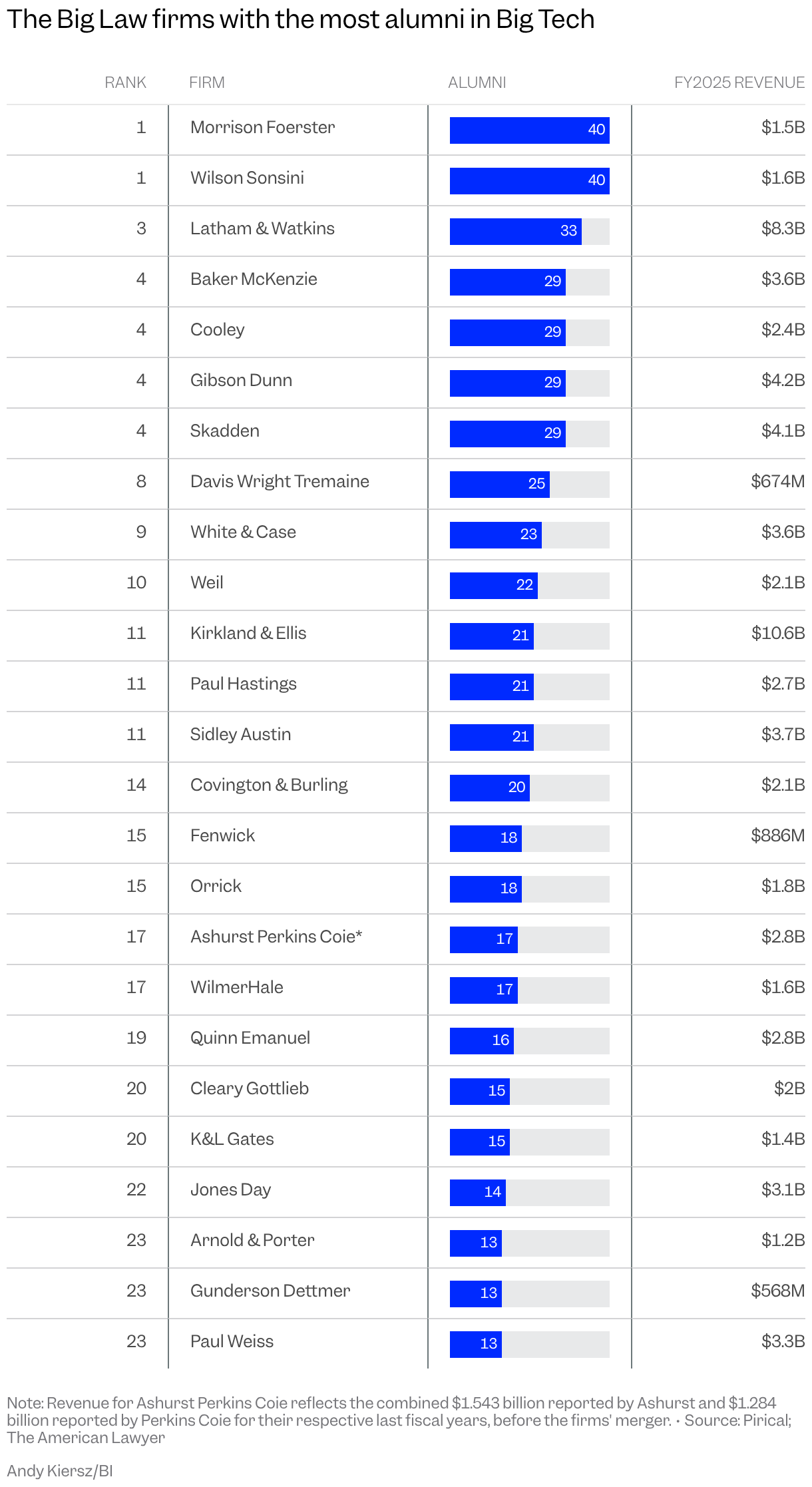
Morrison Foerster and Wilson Sonsini tied for the top spot, each with 40 alumni working in legal roles across the seven companies. Both firms regularly represent tech startups and the investors backing them.

Latham & Watkins followed with 33 former lawyers. Kirkland & Ellis, the industry's revenue leader, ranked 11th with 21 former lawyers working at those companies, tied with Paul Hastings and Sidley Austin.

Table

Pirical's analysis may have missed lawyers whose job titles fell outside its search criteria, said Craig Savitzky, its insights and content editor. He said newer companies, particularly Anthropic, are also likely undercounted because their legal teams are growing faster than public profiles are updated.

Big Law-Big Tech pipeline

For attorneys hoping to land a coveted job at a tech giant, a stint at a white-shoe law firm can be a stepping stone. They can trade billable-hour quotas for a seat closer to the business, attractive pay, and just one client to keep happy instead of dozens.

That combination makes these roles "some of the most highly desirable and sought-after positions" for law firm associates, said Casey Sullivan, a recruiter with CMW Legal Search.

There's another draw, Sullivan said. The companies at the forefront of artificial intelligence are wrestling with some of the thorniest legal questions of the day, from intellectual property to regulation.

"That's where the most interesting work is for lawyers," he said.

Not all law firms are equally effective launch pads. Pirical's Savitzky noted that the firms near the top of the list have deep ties to the tech industry, if not the deepest pockets.

Cooley brought in $2.4 billion in revenue last fiscal year, placing it 29th on The American Lawyer's ranking of top law firms by revenue. But it tied fourth on Pirical's list, with 29 alumni working at the seven tech companies, including nine at Nvidia, a longtime client.

Davis Wright Tremaine, which has represented Microsoft in antitrust and employment lawsuits, has 13 alumni working in the software giant's legal department. Fenwick, which advised Wiz and Fitbit on their sales to Google, has 13 lawyers at the search giant.

Business Insider also sliced the data another way, looking at which of the seven tech giants employ the most alumni from the top 25 firms on Pirical's list.

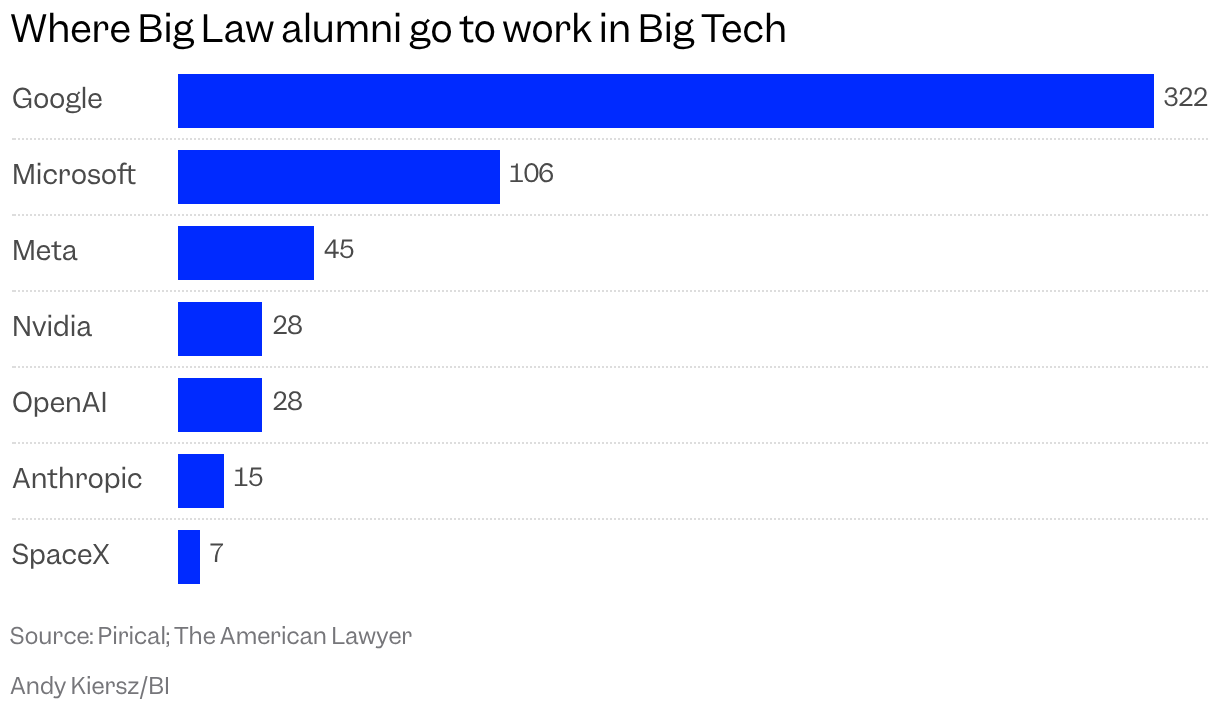
Bar Chart

Big Law is effectively a feeder school for Google's legal team. The company employs 322 alumni of the top 25 law firms on Pirical's list, more than any other tech company studied.

That doesn't necessarily mean Google is the most desirable location for lawyers leaving Big Law. Savitzky said the numbers likely reflect the sheer size of Google's legal department and the decades it has had to recruit from top firms.

Read the original article on Business Insider
  •  

Here's how Canva's new image generation tool compares to models by OpenAI, Google, and Meta

A red gemstone pendant is shown handheld beside the same pendant displayed in a glass case.
Canva has launched Canva Craft, a new image generation tool.

Business Insider

  • Canva launched Canva Craft, a tool similar to AI image models by Google, Meta, and OpenAI.
  • Surprisingly, Canva fell short on a design task but did well at generating more realistic images.
  • Here is how Canva's new image generation tool stacks up against ChatGPT, Gemini, and Muse.

Canva wants a shot at winning the AI image generation race.

The design platform launched Canva Craft on Thursday, its first image-generation model, similar to those from Google, Meta, and OpenAI.

Users can access Craft through Canva’s Dream Lab, including with free accounts, though it is subject to AI usage limits. You’ll need to sign in to a Canva account to get started.

In the release announcement, Canva said the tool plans a design’s layout, proportions, and text before generating an image, an approach that aims to help it produce legible lettering and accurate details.

The company also said that the model was trained on human-designed Canva templates, including posters, menus, and presentations, rather than photographs.

To test how Canva performs, Business Insider created three image generation prompts with escalating difficulty levels — from designing a simple greeting card to creating a photorealistic image from scratch.

Here is how Canva's brand-new image generation tool stacked up against three of the most powerful models.

Canva did not respond to a request for comment.

Starting off with an illustration

Three colorful personalized birthday card designs feature illustrated pink-haired characters and visible messages for Jessica turning 28.
Canva's response to a greeting card prompt (left), compared to ChatGPT (middle) and Gemini (right).

Business Insider

We started off simple with a prompt for a birthday card.

Create a cartoon "Happy Birthday" greeting card for a friend named Jessica who has pink hair, brown eyes, likes to wear paisley, and is turning 28 years old in November.

Surprisingly, Canva, the design platform, fell short in its design of the birthday card, from the awkward font to the outsize head of the cartoon character. It didn't even bother to include any paisley.

By comparison, ChatGPT and Muse understood the assignment.

ChatGPT guessed that the recipient's favorite color might be pink, while Muse thoughtfully wove in cozy fall elements for the November birthday girl.

A chat interface displays a colorful illustrated birthday card for Jessica with balloons, pumpkins, fall leaves, and the number 28.
Muse wove in cozy fall elements for the November birthday girl.

Screenshot/Business Insider

Meanwhile, Gemini took the request literally and produced an image of an actual card. Extra points!

Winner: Muse

Editing an image

Web editing interface shows a red garnet pendant displayed in a glass vitrine on a blue cushion.
The request and original image (left). Canva's results (right).

Screenshot/Business Insider

For the second task, I tested the AI models' ability to identify an element and place it in a brand-new setting.

Edit this image of me holding a necklace pendant. Take the red garnet pendant off my hand and make it look as if it is displayed in a vitrine in a jewelry showroom.

Canva did a great job of identifying the pendant and creating an atmospheric setting, but, like Gemini, it depicted the jewelry in a way that defied physics and common sense. It would be unrealistic for a pendant to float in the air or sit propped on a metal pole.

Three display case views show a red garnet rosette pendant on necklace stands and a pedestal.
ChatGPT (left), Muse (middle), and Gemini (right).

Business Insider

ChatGPT and Muse once again outperformed other models in understanding how things typically look in reality. Muse, however, made some alterations to the pendant, which I didn't ask for.

Winner: ChatGPT

Creating a photorealistic image from scratch

Orange tabby cat with bat-like wings sits on a stone castle ledge under a full moon.
Canva's depiction of a cat perched atop a gothic castle.

Made with Canva/Business Insider

With Halloween approaching, I asked for a realistic depiction of my favorite animal.

Generate a photorealistic image of a long-haired orange tabby cat in a Halloween costume with bat wings, perched on the edge of a gothic medieval castle under the full moon and a starless night sky.

Though the cat's fur looks a little too strandy and high-contrast in Canva's creation, no components are missing or malformed, and the image composition pretty much matches the quality of Muse and Gemini.

The clear winner for me in this round, however, would be ChatGPT.

Orange long-haired cat wearing bat wings poses on gothic stone ledges under full moons in a dark fantasy triptych.
Gemini (left), ChatGPT (middle), and Muse (right).

Business Insider

Not only is the cat's posture majestic, but the soft glow on his left side is extremely realistic, and the white balance is well done. There are also clouds softly cradling the moon, which could be a response to my request for a starless sky.

Winner: ChatGPT

Overall, it's evident that Canva still has a lot of room to grow compared to other models, especially if graphic design is its focus. For now, I'll stick to moving components around by hand.

Read the original article on Business Insider
  •  

The states with the fewest and most data centers, ranked

Aerial view of a large industrial facility with rooftop equipment, exterior construction, roads, parking lots, and surrounding greenery.
An Amazon Web Services data center under construction in Sterling, Virginia. Virginia has the highest number of data centers of any state.

Anna Moneymaker/Getty Images

  • The AI boom is accelerating data center development across the US.
  • Even states with few data centers are attracting major hyperscale projects.
  • Here's how all 50 US states rank by their number of operational data centers.

The data center business is booming in the US, and some states are feeling it more than others.

Data centers, which house the computing machines that power digital services, have been around for decades. However, the amount of computing power required to fuel the AI boom has accelerated their development and brought the industry into the mainstream.

This ranking was compiled by analyzing data from Data Center Map, an industry source that maps data center locations around the world. It shows a snapshot of its US database as of October 2026. Business Insider limited this ranking to fully operational data centers.

Data Center Map compiles its data from multiple sources and mainly tracks cloud and colocation service providers. Each data center it tracks has to have an initial capacity of at least 10 cabinets. While some states have hyperscale AI data centers, others have relatively small operations.

Firstly, data center operators and service providers add their own listings to market themselves. Data Center Map also monitors external databases and manually identifies any missing operators. It also handles requests from users who identify missing or outdated listings.

There is no federal requirement for data centers to register in a central database, so the figures should not be interpreted as a complete census of every data center in the country. Data Center Map also says it has a "more limited coverage on enterprise and government data centers."

Last year, Business Insider created its own US data centers map, which included estimated power usage, as part of an investigation into the industry.

Here are the states with the most operational data centers, ranked from least to most.

50. Vermont
Aerial view of a small town with a white church steeple, forested hills, and mountains under a cloudy sky.
Stowe, Vermont.

Jim Espey/Getty Images

Number of operational data centers: 3

Vermont's three operational data centers are located in Stowe, South Burlington, and Williston. The state has a limited electrical grid, according to the Vermont Natural Resources Council.

49. Alaska
Aerial view of downtown Anchorage with residential neighborhoods, high-rise buildings, green parkland, and Cook Inlet waterfront.
Anchorage, Alaska.

Jacob Boomsma/Getty Images

Number of operational data centers: 4

Half of Alaska's operational data centers are located in Anchorage. The University of Alaska Fairbanks said that the high cost of electricity and network connections are some of the challenges for data center buildout in the state.

48. South Dakota
Waterfalls cascade over rocky ledges beside a stone-and-wood structure under a partly cloudy sky.
Sioux Falls, South Dakota.

Lindsay Guido/Getty Images/iStockphoto

Number of operational data centers: 5

Most of South Dakota's data centers are in Sioux Falls. Lawmakers in South Dakota rejected proposals for industry tax incentives in 2026 while enacting new restrictions on electricity and water use, according to the South Dakota Searchlight.

46. Maine (tie)
Green steel truss bridge spans a calm river beside rocky banks, vegetation, and red brick industrial buildings.
Brunswick, Maine.

Photo Italia LLC/Getty Images/iStockphoto

Number of operational data centers: 6

Maine has data centers in Portland, Brunswick, and Bangor.

Maine's Gov. Janet Mills signed an order in April to establish a data center advisory council to advise on large-scale data center development.

46. Delaware (tie)
Wilmington, Delaware.

Bo Shen/Getty Images

Number of operational data centers: 6

Half of the data centers in Delaware are located in Wilmington.

Delaware Gov. Matt Meyer signed legislation in August requiring data centers to generate their own energy and cover infrastructure costs, WHYY reported.

44. West Virginia (tie)
Steel arch bridge spans a river beside a downtown skyline at dusk with reflections on the water.
Charleston, West Virginia.

Sean Pavone/Getty Images/iStockphoto

Number of operational data centers: 7

West Virginia's data centers are located in South Charleston, Bridgeport, Charleston, Star City, Petersburg, Nitro, and Berkeley Springs.

Having previously lacked the regulatory framework to approve or deny large-scale projects, Gov. Patrick Morrisey announced a data center development plan in August.

44. Rhode Island (tie)
Aerial view of downtown Providence skyline beside the Providence River under a partly cloudy blue sky.
Providence, Rhode Island.

Wirestock/Getty Images

Number of operational data centers: 7

All of Rhode Island's data centers are located in Providence.

The Providence Journal reported in April that one of the reasons Rhode Island has not been as attractive to data center developers is high energy costs.

42. Montana (tie)
Elevated view of a city skyline with tree-filled neighborhoods and low hills under a cloudy sky.
Billings, Montana.

George Dodd/Getty Images

Number of operational data centers: 8

The majority of Montana's data centers are located in Billings.

Big Sky Digital Infrastructure is developing a 5,100-acre campus 30 miles north of Billings.

42. Hawaii (tie)
Honolulu waterfront skyline at dusk with Aloha Tower lit beside harbor water and office buildings.
Honolulu, Hawaii.

otman lazrak/Getty Images

Number of operational data centers: 8

Over half of Hawaii's data centers are in Honolulu.

The Honolulu Civil Beat reported that there are currently no hyperscale data centers in Hawaii.

41. Arkansas
Urban park with a winding boardwalk over water, green trees, and a modern skyline beneath cloudy sunlight.
Little Rock, Arkansas.

Brandon Olafsson/Getty Images

Number of operational data centers: 9

The city with the most data centers in Arkansas is Little Rock.

Google announced its first data center in the state, to be located in West Memphis, in 2025, while Avaio is developing a large-scale one near Little Rock.

39. New Hampshire (tie)
Aerial view of a riverfront city with brick mill buildings, downtown towers, highways, and autumn trees.
Manchester, New Hampshire.

ChrisBoswell/Getty Images/iStockphoto

Number of operational data centers: 10

Manchester has three data centers, while the rest are spread across seven different cities.

A proposed data center in Nottingham was withdrawn earlier this year following local opposition, the New Hampshire Bulletin reported.

39. Idaho (tie)
Downtown Boise skyline and the Idaho State Capitol are lit by sunset beneath dramatic storm clouds.
Boise, Idaho.

knowlesgallery/Getty Images

Number of operational data centers: 10

Four of Idaho's 10 data centers are located in Boise, followed by three in Coeur d'Alene.

Meta plans to operate a $1.2 billion data center in Kuna, which it broke ground on in 2022.

38. Louisiana
Workers in safety vests walk through a muddy construction site with cranes, barriers, and steel framing in the background.
Construction underway at River Bend, Hut 8's AI data center campus in Saint Francisville, Louisiana.

Kathleen Flynn/Getty Images

Number of operational data centers: 12

The majority of Louisiana's data centers are located in New Orleans and Baton Rouge.

Meta is building its largest-ever data center in Richland Parish, which will house the multi-gigawatt AI cluster Hyperion.

37. North Dakota
Parked cars line a downtown street with historic storefronts, a skyway, and a modern high-rise under blue sky.
Fargo, North Dakota.

gnagel/Getty Images

Number of operational data centers: 13

Four of North Dakota's data centers are located in Fargo, followed by three in Ellendale.

There are some large-scale data center projects in the state, such as Applied Digital's 280-megawatt campus near Harwood.

36. Kansas
Terraced concrete spillway and pedestrian bridge overlook a pond in a landscaped park under a clear blue sky.
Lenexa, Kansas.

Wirestock/Getty Images/iStockphoto

Number of operational data centers: 15

Nearly half of Kansas' operational data centers are located in Lenexa, which has seven of the state's 15 facilities.

Kansas is experiencing a surge in plans for large-scale data center development, including one by Dubai-based developer Damac Properties in Edgerton, Kansas, The Wall Street Journal reported.

35. Mississippi
Industrial facility grounds with utility poles, work trucks, and a Southaven water tower behind a large white building.
Work continues on a data center being built by SpaceXAI in Southaven, Mississippi.

Brandon Dill / AFP via Getty Images

Number of operational data centers: 16

Six of Mississippi's operational data centers are located in Canton.

Amazon announced in April this year that it increased its total planned investment in its Mississippi data centers, including in Canton, to $25 billion.

33. New Mexico (tie)
Desert roadside gate and fence stand before a dry hillside and rugged mountains under a clear blue sky.
Los Lunas, New Mexico.

Lily Kimei/Getty Images

Number of operational data centers: 20

Over half of New Mexico's data centers are located in Los Lunas.

Meta opened a data center in Los Lunas in 2019, which it has since expanded.

33. Connecticut (tie)
Elevated view of an urban plaza with leafless trees, surrounding buildings, and an American flag under a cloudy sky.
Stamford, Connecticut.

stockphoto52/Getty Images/iStockphoto

Number of operational data centers: 20

Connecticut's 20 operational data centers are spread across multiple cities, with the highest concentration in Stamford.

The Connecticut Mirror reported that lawmakers said the state's high electricity costs make it unattractive to data center developers.

32. Wyoming
Black cattle graze among sagebrush on a grassy hillside beneath a cloudy sky.
Cows graze in the area where the Prometheus Hyperscale Data Center will be built east of Evanston, Wyoming.

Natalie Behring/Getty Images

Number of operational data centers: 22

All but two of Wyoming's data centers are located in Cheyenne, with the other two in Casper and Afton.

In 2012, Microsoft built its first data center in Cheyenne and has expanded its footprint there multiple times since.

31. Alabama
Dusk Over The Downtown Urban City Center of Huntsville Alabama

ChrisBoswell/Getty Images/iStockphoto

Number of operational data centers: 23

Huntsville has the most operational data centers in Alabama.

Meta broke ground on its Huntsville campus in 2018.

30. South Carolina
Crowd gathers before a bunting-decorated stage labeled “MONCKS CORNER,S.C.” under a cloudy sky.
Moncks Corner, South Carolina.

Bloomberg/Getty Images

Number of operational data centers: 26

Moncks Corner has the most operational data centers in South Carolina, accounting for 11 of the state's 26 facilities.

Google has three facilities in South Carolina, where it first made its footprint in 2007.

29. Maryland
Aerial view of downtown Baltimore skyline with urban buildings, roads, greenery, and water under a partly cloudy sky.
Baltimore, Maryland.

Majestic_Aerials/Getty Images

Number of operational data centers: 27

Baltimore has the most operational data centers in Maryland, followed by Frederick.

Amazon is developing a new data center campus in Frederick, Maryland.

28. Kentucky
Aerial view of downtown Louisville skyscrapers and hotels, including the Galt House Hotel, under a clear blue sky.
Louisville, Kentucky.

Nicholas Klein/Getty Images

Number of operational data centers: 32

Louisville has the most operational data centers in Kentucky, with 13 of the state's 32 facilities.

Mason County, Kentucky, recently signed a development agreement for a Meta hyperscale data center, as reported by LEX 18.

27. Utah
Fenced industrial buildings sit beyond a dirt road and scrubland under a cloudy mountain skyline.
Meta data center campus complex in Eagle Mountain.

Charles-McClintock Wilson/NurPhoto via Getty Images

Number of operational data centers: 35

Salt Lake City has the most operational data centers in Utah, followed by Bluffdale, Eagle Mountain, and West Jordan.

Meta operates a campus in Eagle Mountain, and the National Security Agency operates one located near Bluffdale.

25. Oklahoma (tie)
Aerial view of a large construction site with earthmoving equipment, parked cars, trailers, and cleared land.
Construction of a 500-acre data center in Owasso, Oklahoma.

Jim West/UCG/Universal Images Group via Getty Images

Number of operational data centers: 36

Most of Oklahoma's data centers are located in Tulsa, followed by Oklahoma City and Pryor.

Google operates a facility in Pryor and is developing additional locations in the state.

25. Nebraska (tie)
Google logo appears on a white industrial building beside utility structures, poles, grass and a cloudy sky.
Google data center in Papillion, Nebraska.

Misty Prochaska for The Washington Post via Getty Images

Number of operational data centers: 36

Omaha has the most operational data centers in Nebraska, with 11, followed by Papillion and Springfield, each with 8.

Google has campuses in Lincoln, Omaha, and Papillion.

24. Wisconsin
Aerial view of a large industrial campus under construction with retention ponds, roads, and a sunset horizon.
Microsoft's data center project in Mount Pleasant, Wisconsin, on November 13, 2025.

Joe Timmerman/Wisconsin Watch via Getty Images

Number of operational data centers: 41

Wisconsin's 41 data centers are spread across several cities, with Milwaukee and Madison hosting the most.

Microsoft finished building an AI data center in Mount Pleasant in June.

23. Massachusetts
Aerial view of a neighborhood with houses, tree-lined streets, and a large black industrial building.
The Markley Group data center in Lowell.

Danielle Parhizkaran/The Boston Globe via Getty Images

Number of operational data centers: 46

Marlborough has the most operational data centers in Massachusetts, with six, followed by Boston with five, and Cambridge and Waltham with four each.

CBS News reported that the biggest, the Markley data center, is in Lowell.

21. Missouri (tie)
Downtown Kansas City skyline rises beyond green parkland and roads in warm evening light.
Kansas City, Missouri.

Garrett Smith/Getty Images

Number of operational data centers: 47

Missouri's 47 operational data centers are spread across eight cities, with Kansas City accounting for most of them.

Axios reported in September that most of Missouri's planned data center expansion is concentrated in the Kansas City metropolitan area, citing research by Cleanview.

21. Minnesota (tie)
Spoonbridge and Cherry sculpture spans a pond in a green park with the Basilica of Saint Mary in the background.
Minneapolis, Minnesota.

GummyBone/Getty Images

Number of operational data centers: 47

Minnesota's 47 data centers are spread across 21 cities, with Minneapolis accounting for 15, followed by Eden Prairie, St. Paul, Shakopee, and Minnetonka.

Google announced earlier this year that it plans to build a data center in Pine Island.

20. Nevada
Aerial view of a large construction site with a partially built structure in a dry hilly desert landscape.
The Tahoe Reno Industrial Center. Several companies are building facilities in an area about 15 miles east of downtown Reno in this development project named the Tahoe Reno Industrial Center including data storage facilities from Switch. Apple is also building a data storage facility nearby in the Reno Technology Park (Photo by David Butow/Corbis via Getty Images)

David Butow/Corbis via Getty Images

Number of operational data centers: 51

More than half of Nevada's data centers are located in Las Vegas.

Switch has plans to expand its Citadel Campus at the Tahoe Reno Industrial Center, which the company says will have gigawatts of power capacity upon completion.

19. Indiana
NEW CARLISLE, INDIANA - OCTOBER 2: In this handout provided by Amazon, a technician works at an Amazon Web Services AI data center in New Carlisle, Indiana on October 2, 2025.
A technician works at an Amazon Web Services AI data center in New Carlisle, Indiana.

Noah Berger/Getty Images via Amazon Web Services

Number of operational data centers: 51

Indiana's 51 operational data centers are spread across 11 cities, with Indianapolis leading and New Carlisle following.

18. Tennessee
Industrial construction site behind a chain-link fence with heavy equipment, trucks, tall towers, and drifting smoke.
Construction at an xAI data center in Memphis on April 25, 2025.

Brandon Dill for The Washington Post via Getty Images

Number of operational data centers: 53

Nashville has the largest concentration of Tennessee's 53 operational data centers.

Elon Musk's xAI describes its Colossus facility in Memphis as the world's largest AI supercomputer.

16. Michigan (tie)
Aerial view of a large industrial construction site with cranes, white-roofed buildings, and surrounding farmland.
Construction of a data center developed by Related Digital for Oracle and OpenAI in Saline, Michigan.

: Jim West/UCG/Universal Images Group via Getty Images

Number of operational data centers: 58

Michigan's 58 data centers are spread across 27 cities, with Southfield accounting for the most.

Part of the Stargate Project, Related Digital kicked off construction of a $16 billion data center called "The Barn" in Saline Township in June.

16. Colorado (tie)
Heavy earthmoving machines work on a dirt mound behind a chain-link fence at a construction site.
QTS constructs a data center in Aurora in 2025.

RJ Sangosti/MediaNews Group/The Denver Post via Getty Images

Number of operational data centers: 58

There are 14 data centers in operation in Denver, followed by 11 in Englewood, 7 in Centennial, and 7 in Colorado Springs.

QTS is expanding its 65-acre data center campus in Aurora, Colorado, Colorado Public Radio reported in July.

15. Iowa
Blue and gray edged facility building at 9100 behind a black security fence under clear sky.
The "Edged Des Moines" data center nears completion in Altoona, Iowa.

Leon Neal/Getty Images

Number of operational data centers: 69

Altoona and West Des Moines are among Iowa's leading data center locations, alongside Council Bluffs and Des Moines.

Google has had a campus in Council Bluffs since 2007, recently invested in its expansion, and has also kicked off a new one in Cedar Rapids.

14. North Carolina
Modern gray building with vertical concrete panels, flags, parked cars, landscaped rocks, trees, and lawn under cloudy sky.
Meta's data center in Forest City, taken in 2010 when it was formerly a Facebook data center.

Rainier Ehrhardt/Getty Images

Number of operational data centers: 76

Charlotte has 24 data centers, the most in North Carolina, followed by Raleigh, Maiden, and Lenoir.

Apple operates a data center in Maiden, according to The Charlotte Observer. Google and Meta also operate data centers in the state.

12. Pennsylvania (tie)
Two large cooling towers release steam behind an industrial facility construction site under a partly cloudy sky.
An Amazon Web Services construction project in Berwick.

Paul Weaver/SOPA Images/LightRocket via Getty Images

Number of operational data centers: 78

Pittsburgh and Philadelphia have the largest concentrations of operational data centers in Pennsylvania.

In 2025, Amazon announced plans to invest at least $20 billion in the state to expand its data center operations.

12. New Jersey (tie)
Large windowless concrete building sits behind a black fence along a quiet street under a clear blue sky.
The Equinix NY5 data center in Secaucus, New Jersey.

Kena Betancur/Getty Images

Number of operational data centers: 78

Secaucus and Piscataway are two of New Jersey's main data center hubs, alongside Jersey City.

Equinix operates a 129,436-square-foot data center in Secaucus, known as NY5.

11. Florida
Aerial view of a modern glass and concrete facility with orange accents beside a multi-lane highway.
The HostDime data center in Eatonville, Florida, is north of Orlando.

Paul Hennessy/SOPA Images/LightRocket via Getty Images

Number of operational data centers: 113

Florida's 113 operational data centers are spread across 27 locations, with Miami accounting for the most at 33, followed by Tampa with 20, Jacksonville with 13, and Orlando with nine.

Data center provider HostDime has been based in the state since 2003 and is building a 100,000-square-foot facility in Eatonville.

10. Arizona
A data center under construction under a blue sky.
A QTS data center under construction in Phoenix in 2024.

Bloomberg/Getty Images

Number of operational data centers: 114

Phoenix contains 34 of Arizona's data centers, followed by Goodyear with 24, and Chandler with 17.

ABC 15 reported that companies such as Meta, Apple, and Microsoft all have campuses in Arizona.

9. Georgia
Aerial view of a large industrial complex under construction surrounded by parking lots, roads, forest, and power infrastructure.
A QTS data center complex in Fayetteville, Georgia, in 2024.

Bloomberg/Getty Images

Number of operational data centers: 123

Atlanta has the largest concentration of operational data centers in Georgia, with 43 facilities, followed by Lithia Springs with 25 and Social Circle with 10.

Google built its first data center in Georgia in 2007, and QTS is has one in Fayetteville.

8. Washington
Large industrial warehouse complex with flat roofs surrounded by trees and roads under a cloudy sky.
The Sabey Data Centers' Seattle Data Center campus in Tukwila, Washington.

Bloomberg/Getty Images

Number of operational data centers: 132

Quincy has the largest concentration of operational data centers in Washington, with 33 facilities, followed by Seattle with 31, Tukwila with 16, and East Wenatchee with 11.

Washington's Department of Ecology says Quincy and Wenatchee are popular spots because they have cheaper, reliable energy.

7. Oregon
Modern white industrial building with large dark windows, concrete walkway, rocks, and sparse landscaping under a clear blue sky.
The Facebook Inc. Prineville Data Center stands in Prineville, Oregon, U.S., on Monday, April 28, 2014. The Facebook Prineville Data Center features leading energy-efficient technology, including features such as rainwater reclamation, a solar energy installation for providing electricity to the office areas and reuse of heat created by the servers to heat office space. Photographer: Meg Roussos/Bloomberg via Getty Images

Bloomberg/Getty Images

Number of operational data centers: 141

Hillsboro has the most operational data centers in Oregon, followed by Boardman, and then Umatilla and Prineville.

Oregon is home to Meta and Google's first-ever data centers: Meta built its in Prineville, and Google's The Dalles.

6. Illinois
Modern glass office building stands behind a wide road with parked cars and trees under a clear sky.
A CyrusOne data center in Aurora, Illinois.

Bloomberg/Getty Images

Number of operational data centers: 143

Chicago has the largest concentration of operational data centers in Illinois, with 49 facilities, followed by Elk Grove Village, which has 24. Lombard, Aurora, and DeKalb each have seven.

Companies such as Digital Realty Trust, Microsoft, Meta, and CyrusOne operate in Illinois.

5. New York
Gray industrial facility behind black security fencing, with autumn vegetation and trees under an overcast sky.
The JPMorgan Chase data center in Orangeburg, New York.

Kena Betancur/Getty Images

Number of operational data centers: 149

New York City is home to a large share of the state's operational data centers, with additional concentrations in Buffalo and Albany.

In July, New York was the first state to enact an executive order that imposed a statewide yearlong moratorium on hyperscale AI data centers.

4. Ohio
Aerial view of a large industrial construction site with rooftop equipment, rows of white units, cars, and surrounding fields.
The 5C Data Centers CMH01 on October 18, 2026 in Springfield, Ohio.

Michael M. Santiago/Getty Images

Number of operational data centers: 189

Columbus has the largest concentration of operational data centers in Ohio, with Johnstown, Hilliard, and Cleveland also home to significant numbers of facilities.

Intel announced plans in 2022 for a major semiconductor manufacturing facility in New Albany, a suburb in central Ohio known as the "Silicon Heartland," which is already home to data centers operated by Amazon, Google, and Meta, as Business Insider previously reported.

3. California
Aerial view of city blocks with modern buildings, streets, cars, and a waterfront pier beside the bay.
The Digital Realty SFO12 Data Center, center in the Rincon Hill neighborhood of San Francisco.

Stephen Lam/San Francisco Chronicle via Getty Images

Number of operational data centers: 285

Santa Clara has the largest concentration of operational data centers in California, with 75 facilities, followed by Los Angeles with 51 and San Jose with 26.

Major operators in Santa Clara include Digital Realty, Equinix, CoreSite, and Vantage Data Centers.

2. Texas
Aerial view of a large industrial building under construction amid red dirt earthworks, cranes, equipment, and surrounding forest.
The Stargate Oracle AI data center under construction on August 26, 2026 in Abilene, Texas.

Brandon Bell/Getty Images

Number of operational data centers: 358

Of Texas's 358 operational data centers, 58 are located in Dallas, 42 in Houston, and 39 in San Antonio.

Earlier this year, Business Insider, citing research from Jones Lang LaSalle, reported that Texas is on track to become the largest data center market in the world by 2030.

Texas is home to some of the world's largest planned data center projects, such as Fermi America's Project Matador.

1. Virginia
Aerial view of large industrial data center buildings beside a river and surrounding suburban neighborhoods.
An Amazon Web Services data center in Aldie, Virginia.

Bloomberg/Getty Images

Number of operational data centers: 452

Northern Virginia is not only the largest data center market in the US but also in the world. Major operators in the state include Equinix, Digital Realty, Microsoft, Vantage Data Centers, and Amazon.

Ashburn has the largest concentration of operational data centers in Virginia, with 102 facilities, followed by Sterling with 84 and Manassas with 60.

Read the original article on Business Insider

  •  

Sundar Pichai says Google is far from the ‘end state’ of self-improving AI

Google CEO Sundar Pichai
Sundar Pichai says Google's researchers are using AI to help build the next AI models.

Hardik Chhabra/ The India Today Group via Getty Images

  • Sundar Pichai said Google was still in the early phases of recursively self-improving AI.
  • Researchers are working with AI agents to build better models, he said.
  • Sergey Brin recently said Google was "starting to get onto that RSI treadmill."

Google's AI models may be helping to build their successors, but CEO Sundar Pichai says the moment of fully self-improving AI is still a while away.

Speaking on an episode of the "Big Technology Podcast" this week, Pichai said that Google researchers were using AI agents to assist them when building models, but caveated that it was still early days.

"We are pretty far from the end state of RSI," said Pichai, referring to recursive self-improvement. "The right way to describe it is, you have RSI loops along with AI researchers in various aspects of model development. I would say you almost have agents helping AI researchers, in some automated way, work together to build these models."

Pichai added that he expected that continuum to keep making progress into next year.

Earlier this month, Google cofounder Sergey Brin said the company's Flash series of models, as well as Gemini 4, were demonstrating how AI was helping to build itself, and that Google was "starting to get onto that RSI treadmill."

"And now our researchers and the model work hand in hand to make the next version of the model," he said.

Brin has been increasingly involved in Google's Gemini efforts and has leveraged his power as cofounder to shift resources to projects he deems most effective, Business Insider previously reported. This has included pushing for more focus on RSI.

A report from the firm Gladstone AI, published earlier this month, said that most researchers interviewed from companies including Anthropic and DeepMind believed RSI will start within the next three to 12 months, and possibly sooner without government intervention.

In another moment on the "Big Technology Podcast," Pichai was asked about how much AI was being used to code internally. The company said in April that 75% of new code inside Google was generated by AI.

"That number in our world today is like meaningless in the sense that every part of code we now touch is influenced by AI deeply," Pichai said. With Gemini 4 Argon, he said, people were going to tackle harder problems. He also said Google was seeing a one-third decrease in code rollbacks, where software is reverted to a previous version because of a bug or system issue.

"And so I think people are writing code more productively, and better code with it," he said of AI tools.

Pichai also uses AI to track Google's model development and internal discussions, he told the "Sources" podcast this week.

Have something to share? Contact this reporter via email at hlangley@businessinsider.com or Signal at hughlangley.01. Use a personal email address and a non-work device; here's our guide to sharing information securely.

Read the original article on Business Insider

  •  

Trump quis pôr o seu nome no Atlântico. O líder da Google disse que não

O Presidente dos EUA, Donald Trump, afirmou esta quarta-feira que contactou Sundar Pichai, CEO da Google, para lhe propor a alteração do nome do oceano Atlântico para “Oceano das Américas” ou “Oceano Trump” no Google Maps. Durante um comício na Carolina do Sul, Trump referiu ter ponderado atribuir o seu nome ou a designação “América” a um dos dois oceanos que banham os EUA — o Atlântico e o Pacífico. “Falei com um tipo brilhante, o Sundar. Ele dirige toda a Google”, disse Trump, referindo-se ao CEO da empresa. O presidente também se referiu a Sergey Brin, cofundador da Google,

  •  

‘Pure arrogance’: anger in Finland as Google illegally fells 250,000 trees for datacentre

Company ordered to stop work at two sites in country, which has found itself at forefront of tech firms’ latest push

Behind a wire fence lies a vast gaping wound of earth. Before Google’s arrival a few months ago, an estimated quarter of a million trees occupied the 330 hectares (815 acres) of forest near the town of Muhos in rural northern Finland. Now they are all gone.

After the tech company illegally stripped the entire area to build a datacentre – taking even the top soil with it – all that remains is a vast expanse of mud indented with the trail marks of machinery, puddles and mounds of earth, roots and branches. Residents say that brown water flowing off the site is going into a stream that feeds the Oulujoki River.

Continue reading...

© Photograph: Alessandro Rampazzo/AFP/Getty Images

© Photograph: Alessandro Rampazzo/AFP/Getty Images

© Photograph: Alessandro Rampazzo/AFP/Getty Images

  •  

Geoffrey Hinton, the godfather of AI: ‘I’m not a doomer. I think there’s a 1% chance it will destroy us’

Years ago, when people asked Geoffrey Hinton why he worked on artificial intelligence, he would repeat a line from J. Robert Oppenheimer, one of the creators of the atomic bomb: “When you see something that is technically sweet, you go ahead and do it.”

Seguir leyendo

© Ramón de la Rocha (EFE)

Computer scientist and Nobel Prize in Physics laureate Geoffrey Hinton during the Starmus Festival 2026, held this Tuesday in the municipality of Arona in Tenerife.
  •  

Brussels Presses Google Over Compliance With €890 Million Digital Markets Act Penalties

The European Commission is assessing changes to Google’s search engine and app-store practices after imposing two substantial fines in July. Regulators must now decide whether the company’s response satisfies EU competition requirements or leaves it exposed to further enforcement.

The European Commission is continuing discussions with Google over the company’s response to €890 million in penalties imposed under the Digital Markets Act, as Brussels examines whether changes to its search engine and app-store practices are sufficient to address infringements of European competition rules.

Commission spokesman Thomas Regnier confirmed on Wednesday, 14 October, that officials remained in dialogue with the American technology company. The Commission is assessing the measures Google has introduced, taking account of feedback from businesses affected by its services before reaching a conclusion on compliance.

The review follows two decisions adopted on 23 July, when the European Commission found Google in breach of the Digital Markets Act. A €460 million fine concerned preferential treatment for Google’s own services in search results, while a separate €430 million penalty addressed restrictions preventing app developers from freely directing customers towards alternative purchasing channels.

Search rankings remain under examination

The first infringement concerns Google’s treatment of competing online services offering hotel reservations, shopping comparisons, transport information and sports results.

Regulators concluded that Google had placed its own services in more prominent positions, sometimes providing them with enhanced visual features and search functions unavailable to competing businesses.

The Digital Markets Act prohibits designated gatekeepers from giving their own products preferential treatment when ranking services that compete with those offered by other companies.

Google has already modified its European search results in response to the Commission’s decision. The changes include revised presentations of commercial information and greater prominence for independent comparison services.

As EU Today reported following the introduction of the revised search format, Google has argued that the measures could make searches less convenient and increase dependence on intermediary websites.

The company maintains that direct information previously available through its search engine may become harder for consumers to obtain.

For competitors, however, the question is whether Google’s adjustments provide genuine commercial opportunities or merely alter the appearance of search results without changing the underlying distribution of traffic.

Google Play fees face scrutiny

The second case concerns the Google Play application marketplace, where developers have historically depended on Google’s infrastructure to distribute software and sell subscriptions.

Under the DMA, developers must be able to inform customers about alternative offers and direct them towards purchasing arrangements outside the platform, including their own websites.

The Commission found that Google’s restrictions and fees had limited that freedom.

Although the company may charge for certain services associated with acquiring customers, the Commission concluded that the level and duration of its steering-related charges exceeded what the legislation permits.

Google has since adjusted its external-offers arrangements. European officials are examining whether those changes provide developers with a commercially workable alternative to transactions processed through Google Play.

The issue has consequences for subscription services, digital publishers and software companies seeking to maintain direct relationships with their customers.

A formal ability to direct consumers elsewhere is of limited benefit if the financial conditions make such transactions uneconomic.

Enforcement enters a more demanding phase

The Digital Markets Act was designed to address market practices that conventional competition investigations often took years to resolve.

Rather than requiring regulators to establish a new infringement through lengthy proceedings in every instance, the legislation imposes specific obligations on companies designated as gatekeepers.

The Commission’s DMA enforcement framework allows regulators to examine whether those obligations are being followed and to impose financial penalties when they are breached.

Google’s July fines represented an important enforcement decision. The current review concerns the company’s subsequent conduct and the practical effects of its compliance measures.

The continuation of discussions does not itself establish a fresh infringement. Further penalties would require an additional regulatory determination.

Google also faces broader obligations concerning the sharing of search data with competing providers, an issue addressed in a separate Commission decision issued in July.

These obligations concern access to anonymised information about searches, rankings and user interactions that competing search engines may need to improve their own services.

Taken together, the measures represent a substantial intervention in how Google’s European business operates.

Transatlantic tensions complicate the dispute

The proceedings have acquired a political dimension because most of the largest companies affected by the DMA are American.

President Donald Trump has criticised European penalties against US technology companies and threatened trade measures in response to what his administration regards as discriminatory regulation.

Brussels maintains that the legislation applies according to market position and commercial conduct, regardless of nationality.

European regulators must nevertheless enforce their decisions in an environment where competition policy has become entangled with wider trade relations between the United States and the European Union.

Google’s financial exposure extends beyond the €890 million imposed in July. Continued non-compliance could lead to further regulatory proceedings, while changes to the company’s services may also affect advertising revenue and its relationships with commercial partners.

The immediate assessment will concentrate on whether competing search services receive fair treatment and whether application developers can direct customers towards alternative transactions without unjustified restrictions.

The Commission has not announced a date for its final assessment. Its decision will help establish how far Europe’s digital competition legislation can change the conduct of companies whose platforms occupy central positions in online commerce.

  •  
❌