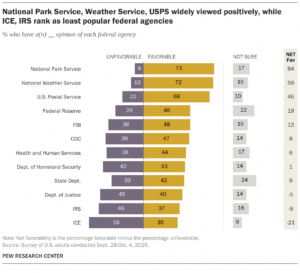
A recent Pew Research Center survey finds that Immigration and Customs Enforcement (ICE) is by far the most unpopular federal agency, easily outstripping even the widely despised IRS. According to Pew, 56% of Americans disapprove of ICE, compared to only 35% who approve. That's substantially worse than the IRS (which is disapproved by only a 46-37 margin).
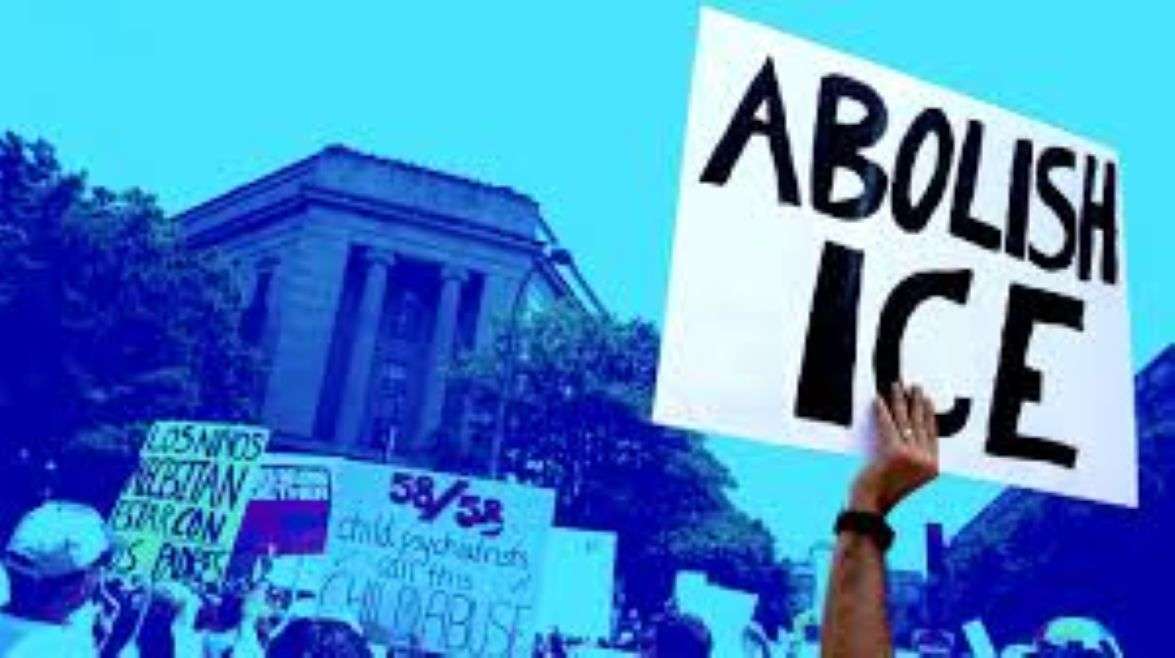
Other recent surveys show growing public support for abolishing ICE. For example, a July YouGov poll indicates that 48% support abolition, compared to 40% who oppose it. Another survey, conducted in March of this year, showed a similar 50-39 margin in favor of abolition.
The fact that ICE is unpopular doesn't by itself prove the agency should be abolished. Having written a book and many other publications on widespread public ignorance about government policy, I would be the last to argue that popularity is a good metric of a policy's - or an agency's - merit. But, in this case, public opinion is right. As I explained in an August 2025 article in The Hill, and a follow-up piece for the Boston Globe, (non-paywalled version here), ICE's many abuses do indeed justify abolishing it. And the case for doing so has been strengthened by more recent events, such as the brutal killing of two US citizens in Minnesota.
As explained in my article in The Hill, abolishing ICE would not completely end interior deportations. But it would make them heavily dependent on the cooperation of state and local governments, thereby strengthening constitutional federalism and reducing incentives for abuse, at least to a significant degree.
In that article, I also explain how support for abolition be further bolstered by combining it with shifting ICE funds to state and local law enforcement. This undermines the principal political obstacle to abolition: the fear that getting rid of ICE would increase crime. Transferring the funds to state and local police would help defuse such concerns, win the support of law enforcement agencies, and foster genuine reductions in violent and property crimes; social science evidence shows that putting more police on the streets has that effect, whereas deportations do not.
The White House is touting arrests of violent illegal alien criminals across the state of Ohio ahead of President Donald Trump's rally on Wednesday evening in Chillicothe, Ohio.
Democratic Senate nominee Angie Nixon is facing bipartisan blowback by touching the third rail of southern Florida politics by saying something that could alienate the region’s substantial Cuban American population.
Portugal’s right-wing populist party CHEGA has said today that the “solution to the housing crisis is remigration”, challenging the government to “enforce the law” and encourage foreigners who may disrupt
ISLAMABAD – Pakistan delivered setback to Taiwan’s aviation industry by shutting its skies to Taiwanese airlines, forcing international passenger jets to abandon their usual flight paths and take alternative routes through Russia in dramatic move that reinforces Islamabad’s unwavering support for Beijing.
The restrictions disrupted flights operated by Taiwan’s leading carriers, China Airlines and EVA Air, particularly on busy routes connecting Asia with Europe. Defence Minister Khawaja Asif publicly confirmed the government’s position saying Islamabad’s aviation policy strictly follows the One-China principle, under which only airlines from mainland China are permitted to use Pakistani airspace.
The development is unsual escalation of diplomatic dispute surrounding Taiwan into international aviation, with South Asian nation introduced first such restriction. There has also been no prominent official response so far from Taiwan’s Foreign Ministry or the Chinese government specifically addressing the reported Pakistani decision.
The first signs of change reported earlier this week, when aviation tracking platforms started recording unexpected shift in the routes used by Taiwanese passenger aircraft. Data from Flightradar24 shows that China Airlines and EVA Air crossed Pakistan during certain long-haul journeys, begun steering their aircraft away from the country.
Instead of following their established flight corridors, more than 10 Asia-Europe services reportedly diverted northward through Russian airspace. The sudden change caught the attention of aviation analysts, who observed Taiwanese aircraft taking substantially different routes between October 25 and 27.
For Taiwanese airlines, Pakistan’s decision is another blow as Taiwanese commercial carriers already face restrictions on flying across mainland China, leaving them with limited corridors for their long-distance journeys to European destinations.
Pakistan’s airspace provided key passage through South Asia, allowing certain aircraft to avoid more complicated and potentially longer routes. With that corridor now reportedly blocked, airlines must reconsider how they connect Asian cities with major European aviation hubs.
Another option takes aircraft northward through Russia, a route that Taiwanese carriers had largely avoided amid Russia-Ukraine war. Russian option reportedly become more attractive with the beginning of the International Air Transport Association’s winter scheduling season on October 25.
Beyond the disruption to international flights, Pakistan’s decision carries considerable political significance. Islamabad maintained a consistent position on Taiwan for decades, recognising Beijing as the sole legitimate government of China and supporting its claim that Taiwan is an inseparable part of Chinese territory.
Pakistan’s Foreign Office reaffirmed that position earlier in 2026 amid renewed international tensions over the Taiwan Strait. The same commitment has repeatedly appeared in joint statements issued by Islamabad and Beijing, reflecting the two countries’ close strategic and diplomatic relationship.
China and Pakistan describe their partnership as ironclad and all-weather, with cooperation spanning defence, economic development, infrastructure and regional security. The latest aviation development gives that diplomatic position a practical dimension, extending Pakistan’s support for Beijing into decisions affecting international commercial air traffic.
Islamabad already restricted Indian aircraft from using its airspace, with restrictions extended through aviation notices amid tensions between the nuclear-armed neighbours.
Together, they have pursued cases against the president’s enemies and protesters and amplified false claims of widespread election fraud, often citing thin evidence.
WELLINGTON – Immigration New Zealand has introduced four key changes to its student visa rules, revising work rights, compliance requirements, visa processing procedures and timelines for students nearing the end of their courses.
Reports said the new rules took effect on October 27, 2026, and apply to international students covered by the relevant visa conditions.
The changes are expected to affect how international students manage their employment during studies, meet visa requirements and plan their next steps after completing their courses.
Revised Work Rights for Research Master’s Students
Under the updated rules, research-based master’s students will no longer have unlimited work rights while studying. Instead, they will follow the same conditions as other master’s students.
Eligible students will be permitted to work up to 25 hours per week during academic terms and full-time during scheduled holidays, subject to their visa conditions.
Stricter Assessment of Visa Compliance
Immigration New Zealand has also tightened English-language requirements when assessing whether students can comply with the conditions attached to their visas.
The revised approach introduces additional considerations into the assessment process for international student visa applicants and holders.
Expanded Powers to Pause Visa Processing
Under the new rules, Immigration New Zealand can suspend student visa processing in a wider range of circumstances. These include situations in which authorities investigate possible non-compliance by educational institutions.
The change expands the circumstances in which visa applications may be put on hold while compliance concerns are examined.
Extended Time to Decide on Next Steps
Another key change concerns students whose visas expire one month after their courses end. These students will now have two months to decide on their next steps.
However, the existing March 31 expiry date for visas covered by the relevant schedule will remain unchanged.
What the Changes Mean for International Students
The updated rules make it important for international students in New Zealand to understand their individual visa conditions, particularly regarding permitted working hours, English-language requirements and the timing of their next immigration steps.
Students should review the conditions attached to their visas and seek clarification from Immigration New Zealand where necessary to ensure they comply with the revised requirements.
Vice President JD Vance said at a Michigan campaign rally that Democrat Senate candidate Abdul El-Sayed lied about being an immigrant from another continent, pointing to the candidate’s past statements about his own origins.
Susan and Michael Pretti say they have been ‘ignored and misled’ in quest for justice over son’s killing by US agents
The parents of Alex Pretti, the 37-year-old nurse killed by federal immigration agents in Minneapolis earlier this year, accused federal officials of stonewalling them and shielding their son’s killers.
During a press conference on Tuesday, Michael and Susan Pretti made their first public remarks since their son’s death in January, calling for the Department of Justice to hold those involved in their son’s death accountable. The federal government has not provided them with meaningful information about the case, they said.
More than 27,000 immigrants were informed, this year, that they should leave Portugal. However, only around 800 complied with the voluntary departure notice, according to figures provided by the Minister
The parents of the Minneapolis nurse who was fatally shot by federal agents in January said on Tuesday that the government had ignored and misled them.
State and local plans for Election Day include how to react to potential ICE raids, misbehavior by federal election monitors and attempts to seize votes or machines.
Texas National Guard members in Illinois (Brian Cassella/TNS/Newscom)
On October 23, in the case of Newsom v. Trump, the US Court of Appeals for the Ninth Circuit ruled Donald Trump's June 2025 federalization of the National Guard in Los Angeles was likely illegal. This decision has little immediate effect, because the National Guard deployment ended months ago, after the Supreme Court ruled against Trump in a related Illinois case. But it has important implications for judicial review of executive invocation of emergency powers to use the military domestically. Among other things, it emphasizes that such actions are reviewable, and the president should get only limited deference. It also adopts a properly restrictive definition of "rebellion" (which is one of the conditions that might justify federalization of the National Guard).
Trump federalized the Guard in response to anti-ICE protests. The district court ruled his action was illegal and issued an injunction blocking it. But the Ninth Circuit lifted the preliminary injunction, in a decision I criticized at the time.
The relevant statute 10 U.S.C. Section 12406, can only be used to federalize state forces in one of the following situations:
1) the United States, or any of the Commonwealths or possessions, is invaded or is in danger of invasion by a foreign nation;
(2) there is a rebellion or danger of a rebellion against the authority of the Government of the United States; or
(3) the President is unable with the regular forces to execute the laws of the United States
Last year, the Ninth Circuit ruled (incorrectly, I think) that Trump's action might have been permissible under Subsection 3: a situation where "the President is unable with the regular forces to execute the laws of the United States." As the Ninth Circuit acknowledges in their most recent decision, this basis for Trump's actions was undermined by the Supreme Court's December ruling in the related case of Trump v. Illinois, which held that Subsection 3 can only be invoked when the president is authorized to use regular federal military forces to enforce the law, and those forces are inadequate. These circumstances do not apply to the anti-ICE protests in Los Angeles and Chicago.
No one claims that the situation in Los Angeles amounted to an "invasion" by a "foreign nation." Thus, in its most recent decision the Ninth Circuit considered whether Trump's actions were authorized by Subsection 2, which allows federalization of the guard when "there is a rebellion or danger of a rebellion against the authority of the Government of the United States."
The majority opinion by Judge Jennifer Sung holds that the determination that there is a "rebellion" is subject to judicial review and can be invalidated " if it "did not reflect a colorable assessment within a range of honest judgment." I think this is overly deferential. For reasons I outlined in an article published last year, there should be little or no deference when the executive invokes extraordinary emergency powers. Still, the Ninth Circuit standard is far from a blank check, and does allow invalidation of executive actions where the claim of rebellion is blatantly wrong - as it was here.
Following the district court, the Ninth Circuit defined "rebellion" as "a violent, armed, organized, open and avowed uprising against the government as a whole." This differentiates "rebellion" from smaller-scale violence or other violations of law. I think that definition is largely correct. The court summarizes a wide range of historical evidence supporting it.
The Ninth Circuit also concluded that events in Los Angeles did not even come close to meeting that standard. There were some violations of law by protestors, and some small-scale violence. But no systematic effort to overthrow the government or anything close to it. If anything, both this issue and the definition of "rebellion" are easier calls than the court suggests.
Judge Sung, author of the majority opinion, is a liberal Biden appointee. But her opinion was joined by Judge Eric Miller, a conservative Trump appointee and onetime clerk for Supreme Court Justice Clarence Thomas. This suggests the issue here cuts across ideological and jurisprudential lines. Judge Mark Bennett, another Trump appointee, dissented, but mostly on procedural grounds.
Judge Bennett did also take issue with the majority's conclusion that if Trump's federalization of the National Guard exceeded his statutory authority, it also violated the Tenth Amendment, which reserves to the states or to "the people," those "powers not delegated to the United States by the Constitution." He argues that the power to call forth the National Guard is delegated to Congress by the Calling Forth Clause of the Constitution, which gives Congress power "[t]o provide for calling forth the Militia to execute the Laws of the Union, suppress Insurrections and repel Invasions." This is true enough. But in situations where Congress has not exercised that authority, states retain total control over their militia (of which the National Guard is the principal modern example), and that control is protected by the Tenth Amendment. Indeed, such control over state military forces is a central element of state sovereignty. Overriding it without proper constitutional authority qualifies as unconstitutional "commandeering" of state government forces. As the majority explains:
The federal government—whether the President or Congress—violates the Tenth Amendment by commandeering state personnel to enforce or administer federal law. Printz v. United States, 521 U.S. 898, 925 (1997) (Under the Tenth Amendment, "the Federal Government may not compel the States to implement, by legislation or executive action, federal regulatory programs."). If, for example, the President commandeered state police to help federal officers enforce federal immigration laws, that would violate the Tenth Amendment….
California National Guard members are state personnel, unless properly federalized… The President purported to convert the Guard into federal personnel by issuing federalization orders. If those federalization orders had been valid, then the President would have deployed federal officers in Los Angeles, and no commandeering of state personnel would have occurred. But because the President lacked authority to federalize the California National Guard, the federalization orders were invalid, and the deployed Guard members remained state personnel….
In other words, because the deployed members of the California National Guard were not properly federalized, they remained the legal equivalent (for Tenth Amendment purposes) of the state police. And because the challenged executive orders compelled those state officers to help federal officers enforce federal law, the orders violated the Tenth Amendment….
The Tenth Amendment protects States against overreach by the "Federal Government," whether "by legislation or executive action." Printz, 521 U.S. at 925, 935. The President cannot command state officials to enforce federal law even if a federal statute would authorize him, under some other circumstances, to call those officials into federal service. If the statute did not authorize the President to federalize the California Guard members here…, then the federalization orders were invalid, the Guard members remained state personnel, and Defendants violated the Tenth Amendment by commandeering those state personnel to administer federal immigration laws.
Exactly so. The majority and dissent consider a number of procedural issues, which I will not try to address. The majority also parses a variety of relevant precedents in detail. I may have more to say about some of them in future writings.
For the moment, this decision has little immediate effect. But it sets an important precedent in favor of judicial review of executive invocation of emergency powers, and on the meaning of "rebellion."
From deportations without due process to random and discriminatory detentions and searches, the Trump administration's immigration crackdown raised many constitutional concerns. Now, in a lawsuit advancing in federal court, 27 religious organizations say the administration's immigration policies violate another constitutionally protected activity: Americans' right to the free exercise of religion.
Last week, the D.C. Circuit Court of Appeals ruled that the religious groups' lawsuit, docketed as Mennonite Church USA v. Department of Homeland Security (DHS), could continue. The lawsuit was brought against the federal government in February 2025, after the Trump administration overturned a longstanding policy that heavily restricted immigration raids around "sensitive sites," including churches, schools, hospitals, daycares, playgrounds, rehab facilities, funerals, and weddings. This policy was most recently outlined in a 2021 memo—dubbed the "Mayorkas Memo" for Alejandro Mayorkas, the DHS secretary at the time—but U.S. immigration enforcement first established the standard in 1993.
After repealing the Mayorkas Memo, the DHS issued a one-page document instructing officers to use "a healthy dose of common sense" when deciding whether to operate at previously protected sites.
Unsurprisingly, religious leaders are concerned about the sudden allowance of federal police into their sacred spaces. In their complaint, each of the 27 faith organizations suing the DHS describes how the risk of immigration enforcement impedes their religious exercise. The Church of the Brethren says a DHS enforcement action would "destroy all sense of peace and safety in what is supposed to be a place of sanctuary for congregants."
The Central Conference of American Rabbis writes that immigration enforcement against a synagogue would induce fears of "the persecution of Jews by government agents before and during the Holocaust."
"We have congregations which have reported members no longer feel comfortable attending services, members who are concerned for their safety, congregations which have had to add costly security measures," Carey McDonald, executive vice president of the Unitarian Universalist Association—one of the 27 plaintiffs—tells Reason.
The fear of police action driving down attendance isn't just a financial problem, McDonald says; it is fundamentally an attack on Unitarian Universalists' (U.U.) beliefs. "A core part of our theology and our practice is to welcome the stranger. To force us to choose between our long-held theological commitment[s] vs. trying to keep our people physically safe…this is a violation of our constitutionally protected rights."
The DHS repealing the Mayorkas Memo isn't the only way immigration police have infringed U.U. religious expression. In August, it was revealed that federal agents had been spying on churches in Minneapolis—even before January's protests against "Operation Metro Surge."
McDonald tells Reason that First Universalist Church of Minneapolis, which had hosted an anti-ICE event led by the Sunrise Movement in December 2025, was one of the targeted churches. "This is direct evidence from the government itself that it is seeking to interfere with our rights to practice our faith. We must assume that this is not an isolated incident."
Indeed, it isn't; the DHS has conducted arrests and surveillance on plenty of other churches across the country. In January 2025, a man in Georgia was arrested by Immigration and Customs Enforcement (ICE) during a church service. By August 2025, Religion News Servicerecorded "at least 10 instances of apparent immigration enforcement activity conducted by ICE or other federal agents on or immediately near church grounds since [President Donald] Trump's inauguration." In February of this year, CBS News reported that two men in New Jersey were taken away while they were "just about to head inside" a Pentecostal church for their Sunday worship.
Because of these tangible harms, the D.C. Circuit ruled that the 27 plaintiffs have standing, writing, "[the plaintiffs] are directly injured by the government's already-implemented policy of enforcing immigration laws at houses of worship, they likely have met the standard for showing 'imminent' harm," as outlined by the Supreme Court.
The case is now being sent back to the D.C. District Court, which will have to decide on all three of the plaintiffs' legal claims. Two of those claims are about religious freedom: One appeals to the Religious Freedom Restoration Act (RFRA), which plaintiffs say must protect the congregations from DHS activity that "substantially burdens" their exercise of religion. The second argument says DHS enforcement violates the First Amendment's Free Exercise Clause, which protects religious expression and association. While judicial precedent clarifies that certain compelling state interests can override the clause, the plaintiffs argue there are less intrusive ways to achieve the state's interest in immigration enforcement. The third claim is more procedural, arguing that the department's sudden rescission of the Mayorkas Memo violated the Administrative Procedure Act by not sufficiently considering the impact on religious organizations.
The plaintiffs are first seeking an immediate injunction against all DHS activity around their houses of worship, but the proposed order submitted in 2025 would also re-implement the Mayorkas Memo while litigation is ongoing, overturning the Trump administration's rescission.
Mennonite Church v. DHS is one of four lawsuits challenging the rescission of the Mayorkas Memo by DHS. Two of those lawsuits have resulted in preliminary injunctions, while the third is still pending.
Struggling to find steady work, many migrants who have arrived recently from Senegal have adapted with a relentless sidewalk hustle, sustaining their families through street vending.
Matteo Salvini has secured another four-year term as the leader of Italy’s League party after winning the leadership election at an extraordinary party congress in Milan. Salvini defeated his challenger, Massimo Garavaglia, by a decisive 465 votes to 146.
During the congress, Salvini sharply criticized internal party dissent, targeting unnamed critics who had pressured local officials to boycott major party rallies, labeling their actions a “betrayal” of the League’s values, writes Il Giornale.
Last week, in the wake of the violent riots in Milan, Salvini had posted on X after an approved security decree: “More troops for Safe Streets, including 500 already in Milan, delayed arrests thanks to cameras, and greater powers for the Armed Forces and Law Enforcement,” he wrote, adding that the government will also seek to enact legislation for “the revocation of citizenship and residence permits for adults who commit crimes, and the impossibility of obtaining citizenship for minors who deal drugs, loot, or vandalize.”
DA STASERA È LEGGE!
Più militari per Strade Sicure, di cui 500 già a Milano, arresto in differita grazie alle telecamere e più poteri alle Forze Armate e alle Forze dell’Ordine.
E poi avanti, in prospettiva, con la revoca della cittadinanza e del permesso di soggiorno ai maggiorenni che commettono reati e con l’impossibilità di ottenere la cittadinanza per i minorenni che spacciano, saccheggiano o devastano.
Chi sbaglia paga.
Perché chi devasta una vetrina o aggredisce una commessa non è un rivoluzionario: È UN COGLIONE.
Looking ahead to upcoming elections, he declared that the party’s focus must remain firmly on “identity, autonomy, and federalism,” asserting that the League would not settle for simply being a minor partner in a center-right coalition.
In his pre-election address, Salvini had also staked out a hardline foreign policy stance, demanding an immediate halt to Italian financial and military aid to Ukraine. He announced that his re-election gives him a direct mandate to challenge the current government coalition on this issue, going as far as to question whether funds sent to Kyiv were being misdirected by corrupt officials close to President Zelensky.
Declaring a firm “No” to a European army, Salvini told those gathered, “We will defend our borders ourselves.”
Italian Prime Minister Giorgia Meloni offered her congratulations to Salvini on his reelection. “Let us continue to work together, with responsibility and determination, in the interest of Italy,” she posted to X.
Congratulazioni a @matteosalvinimi per la riconferma alla guida della Lega. A lui e a tutta la comunità del partito i miei auguri di buon lavoro. Continuiamo a lavorare insieme, con responsabilità e determinazione, nell’interesse dell’Italia.
The draft resolution, published by the Economy Ministry, would establish an annual list of in-demand professions and standardize the assessment of foreign applicants’ qualifications.
Undocumented immigrants are taxpayers. Why shouldn't their children, for whom they have often sacrificed so much, enjoy the benefits their parents have worked to earn?

 Login