Content creator Julian Shapiro-Barnum spoke at the Made on YouTube event.
Noam Galai/Getty Images for Made on YouTube 2026
YouTube's ad revenue fell short of analysts' expectations for the third quarter.
Its parent reported $11.2 billion in Q3 ads revenue, under analysts' $11.43 billion estimate.
The company said it now has 150 million YouTube Music and Premium subscribers, up from 125 million in March 2025.
YouTube's ad revenue growth slowed down, missing analysts' estimates in the third quarter.
Its parent company, Alphabet, reported $11.2 billionin third-quarter YouTube ads revenue, a 9% increase from a year ago. That falls below the $11.43 billion analyst consensus estimate. Its ads revenue growth also slowed from the previous quarter, when it pulled in about $11.1 billion, a 13% increase from the previous year.
Beyond YouTube, Alphabet missed expectations in other areas of its business, including on overall revenue. In a bright spot, it beat revenue estimates for its cloud business.
The company's shares were down over 10% in after-hours trading.
While YouTube's ad revenue was weaker than expected, it wasn't all bad news. The company said it now has over 150 million YouTube Music and Premium subscribers, up from 125 million in March 2025. The company said its subscriptions business was growing faster than ads.
YouTube has also been the envy of rivals in key areas like TV viewership. Its share of US television viewership was about twice that of Netflix in August, according to recent Nielsen estimates. Over a third of YouTube's third-quarter ad revenue came from the living room, Google's chief business officer Philipp Schindler said on Wednesday.
Netflix, meanwhile, walked back its full-year ad revenue expectations during last week's earnings. The streamer lowered its ad revenue forecast from $3 billion to $2.7 billion after experiencing delays around the rollout of its ad products. It laid off about 1,000 workers earlier this month.
This week, Instagram unveiled an overhaul of long-form video features seemingly designed to counter YouTube and bolster its presence on TV screens.
"Everyone in streaming is chasing YouTube, and even Instagram is going to pivot their strategy based on the success that YouTube's had," said Ross Benes, a senior analyst at EMARKETER, Business Insider's sister company.
Connor Harvey leads a protest outside Liberty Mutual's Boston headquarters.
Lane Turner/The Boston Globe via Getty Images
"Liberty Biberty" is a much-hated new yellow puppet mascot for Liberty Mutual, appearing in ads.
People are so riled up that there was a protest at its Boston HQ. Its organizer called the mascot "a disgusting little creature."
But this kind of cheeky "hate" might actually work in Liberty's favor, an ad expert says.
On Sunday, a small crowd took to the streets of Boston to protest, holding signs, chanting, with one person even appearing in full costume and face paint. The protest took place in front of the Back Bay headquarters of insurance company Liberty Mutual. The protest was not against some sort of corporate malfeasance, political, or even a social justice issue.
They were protesting the existence of Liberty Biberty, the new fuzzy yellow mascot that appears in the insurance giant's TV ads.
People, for some reason, really hate the Liberty Biberty puppet.
There's a Facebook page with over 40,000 people devoted to hating it. There's TikToks. Reddit threads. I even saw a ghastly tattoo depicting the spherical character being fed into a meat grinder. John Oliver did a segment about it on HBO's "Last Week Tonight" recently.
The concept of the ads is surreal and self-referential. Liberty Biberty is a yellow puppet who has appeared in a few TV ads so far. In one, he appears on someone's car and tells them about the benefits of auto insurance, and then is carried off by a hawk. In another, he chats to a bored bartender, and then meets the aforementioned hunky actor prone to malapropisms.
Liberty Mutual is well aware of the, ahem, passionate response.
"We're encouraged by how strongly people are engaging with him, whether they love him or feel differently," Jenna Lebel, Liberty Mutual's chief marketing officer for US retail markets, told Business Insider. "We've been encouraged by the early results, including independent testing that shows Biberty performing above average on attention and brand attribution."
Insurance companies' advertising strategies for the last decade or more has been focused on a series of recognizable characters like Flo from Progressive, Jake from State Farm, and "Mayhem" from Allstate. Let us not forget the forefather of them all, the Geico gecko. Liberty Mutual has also had Doug and the LiMu Emu, as well as a hunky actor prone to malapropisms — hence "biberty." (Don't worry: Doug and the LiMu Emu are still active, Liberty Mutual's PR person assured me. Some complaints about Biberty were that people thought it had replaced the popular human/avian duo.)
Young people are watching less and less linear television, and so see fewer traditional ads, with one big exception: sports. Most of the people I talked to mentioned seeing the Liberty Biberty ads during baseball or football games, week after week.
The repeated exposure to the ads seems to be getting under people's skin.
"I think Liberty Bibberty is just a disgusting little creature," Connor Harvey, the organizer of the protest in Boston, told me. The 19 year old content creator from New Hampshire said that he considers himself a "sucker for weird advertising," but that the fluffy yellow orb seems to be intentional ragebait — purposely meant to be annoying.
"The new Biberty campaign has definitely sparked a conversation, with a wide range of reaction and opinion. We're listening to all of it," Lebel said.
Zach Johnson, 40, manages a machine shop in North Carolina and was inspired to start the Facebook group "Liberty Biberty Hate" after seeing the ad multiple times while watching TV with his wife one night. "It's a terrible mascot. Plus, they have more mascots than I can think of," he said.
The over-the-top hate towards the mascot is certainly a bit tongue in cheek; although some people may find it genuinely annoying, it's not offensive or tone deaf like the infamous Kendall Jenner Pepsi ad.
That means all that hate may actually be a good thing for Liberty Mutual.
"I think there's a real opportunity right now to jump in and have fun with this moment in a way that, frankly, a lot of brands would absolutely die for," said Simon Bruyn, ad industry vet and co-founder of the marketing strategy firm Significant.
"For that Gen Z and younger culture, who might be starting to get into insurance decisions, you suddenly have a very clean crossover into an internet nascent brand that feels like something you could really, really have fun with and play and own that idea of faux outrage," Bruyn said.
Harvey, the protest organizer, isn't in the market for home or auto insurance — for now. "I'm on my mom's insurance," he told me.
Drop Site reveals the sources of funding to keep 82-year-old incumbent CA Rep. Doris Matsui (D) from losing to progressive challenger Mai Vang, who rejected AIPAC money and called out Israel's genocide
Andrew Morse ran digital for CNN, then spent more than three years running The Atlanta Journal-Constitution. Now he's cofounded Phareo, a platform aimed at creators and people who like them.
Andrew Morse
The startup world is littered with companies that tried to become the next YouTube.
Andrew Morse is trying it again, anyway.
Morse's pitch: a curated app that gives creators incentives a reason to give it exclusive content.
Are you sick of the algorithms that serve you video on giant platforms like YouTube and TikTok?
Or are you a video-maker who's sick of the algorithms that don't serve your stuff to would-be watchers?
Andrew Morse would like to talk to you.
Morse, who spent years working in big media (Bloomberg, CNN) and most recently in local news (The Atlanta Journal-Constution), is building Phareo, a startup he hopes will one day rival internet media heavyweights. The secret sauce, he says: his own AI-powered discovery engine that will make both video-watchers and video-makers happy.
This is, to put it politely, a very tall order.
But it's still worth talking about, since Morse is homing in on a problem you hear a lot about in creator circles these days: the sense that people who make content are getting increasingly bad deals from platforms, because they can't control who sees their stuff.
Phareo (the name is an allusion to Pharos, the ancient lighthouse of Alexandria) says it can solve that problem by giving creators real incentives to make exclusive stuff for the company, via levers like revenue share and options. Morse plans to launch in January with an initial group of 25 creators. The app will start out as a free, ad-supported service, but he hopes to eventually offer a paid tier.
I talked to him this week about his plans, the shifting media landscape, and why he's increasingly worried about the creator economy — at the same time he's launching a creator economy app. This is an edited excerpt of our conversation:
Peter Kafka: You have a classic chicken/egg problem: Consumers are not going to use a new app unless it has compelling content they can't get somewhere else. Content-makers don't want to put their stuff there unless there's a big audience.
Andrew Morse: It is the most important question we have to solve. It starts with dissatisfaction, and it starts with a belief from consumers and creators, that they're not being currently served as well as they could be. So we're working with creators who believe that there has to be a better alternative.
We don't really have anything to lose, given the direction that the platforms are taking and given the overreliance that their creative work has on algorithms that don't serve them. We're going to build with creators and try to build a super-passionate core and grow from there.
But YouTube, TikTok, Reels, etc do a great job of giving me tons of video. And they have unlimited content. How do you move me over from the platforms I'm already using?
It's an ironic conundrum — we're trying to solve the discovery problem, but we have to be discovered ourselves.
Over the years, I've seen many companies say they're trying to solve a discovery problem. But it doesn't seem like consumers have a discovery problem. It's the content owners who have a problem getting their stuff in front of consumers. What's the incentive for consumers to move to a platform content-owners like?
There's an inherent assumption that consumers are satisfied with the platforms. I don't think that that's true. I think consumers are on these platforms because they have to be. Whether they're getting what they want in an efficient way is an entirely different story.
Any advice for your former CNN colleagues who are now working for David Ellison?
Stay focused on the work. It's always the journalism that matters. And the truth and the facts and great storytelling will always rise to the top.
We have seen a steady stream of journalists leaving places like CNN and starting their own thing. Do you think that trend accelerates or stalls out as people realize how difficult it is to do solo media for a living?
I'm concerned about this creator economy — which is really about about businesses that have built themselves on the back of YouTube. If you go back to 2016, 2017, a number of really clever, really creative businesses were built on the back of social platforms. When the algorithms changed, it became almost impossible for these businesses to stay afloat. It was hard for us at CNN, but we had a big enough business that we were able to mitigate and ride the wave. For these other companies, it was disastrous.
I think you're going to see more and more people trying to go out on their own — and that's what scares me. Because I think that the sands may begin to shift a little bit.
Dalet Labs, an AI commerce startup, is coming out of stealth mode with a $7 million pre-seed round.
It's launching a new app called Scene, where you can scroll through shoppable, AI-generated images.
Read the 5-page pitch deck the startup used to raise capital — months before finalizing its product.
Would you shop from a feed of AI-generated images?
The startup Dalet Labs is betting you will.
The AI-commerce company exclusively told CMO Insider that it raised a $7 million pre-seed round led by Lightspeed Venture Partners and is launching its first product, a shopping app called Scene.
Founded by Omer Bar-Tal in 2025 after he left the AI video startup Runway, Dalet Labs recently came out of stealth mode. The startup raised its pre-seed in late 2025, before finalizing its product road map. In addition to Lightspeed, venture capital firm SV Angel and individual angel investors participated in the round.
Lisa Han, the Lightspeed partner who led the round, said that Bar-Tal has a combination of "video AI research expertise" and a "deep understanding of what consumers want."
Scene, which became available on the Apple App Store in the US on Wednesday, lets people scroll through a feed of shoppable AI-generated images. The app will be invite-only at launch, and isn't yet available on Android. While the images of people or scenes are AI-generated, the products themselves come from real brands across categories like fashion, home decor, and sports.
Scene is a feed of AI-generated images that link directly out to actual products.
Dalet Labs
Bar-Tal envisions Scene as a tool people can turn to when they want to buy something but are still uncertain about exactly what they have in mind. It's similar to scrolling through Pinterest or TikTok in hopes of being inspired to buy something, but Bar-Tal said there's a key difference: You come to Scene to shop, not be entertained.
Bar-Tal sees Scene as a virtual "mall" where users can window-shop, save items to their cart, and make purchases.
Commerce has become an increasingly attractive use case for AI tools like chatbots and agents (including Meta's Muse). However, Bar-Tal argues that AI shopping tools are missing something.
"AI is amazing when you know what you want, but it's really important to actually have an ability to discover and to see things," Bar-Tal said. Agentic commerce, he added, "misses the point in shopping — which is essentially a delightful experience."
As a Scene user scrolls and interacts with products linked in the app, the feed adapts to what type of brands or items the user is interested in. Then, Scene uses AI to generate scenes with people wearing or using those items.
Bar-Tal did not comment on which third-party models Dalet Labs uses.
Bar-Tal said Dalet Labs doesn't see its product as replacing influencers, but rather as "complementary."
"The content here is AI, but it is not aiming to replace creators because we are not aiming to create entertainment," he said.
However, even if Scene isn't competing with influencers for entertaining content, it's still competing with their business model: making money by promoting brands' products and ultimately driving sales.
Scene has a catalog of hundreds of brands and retailers, Bar-Tal said, and is making more partnerships. The company did not share further details on what brands Dalet Labs has already established relationships with.
Bar-Tal said the company is also leveraging affiliate marketing to monetize the app early on, working with affiliate networks to earn from each in-app transaction.
Dalet Labs' Scene is entering a crowded market of apps offering people ways to discover brands and goods, like TikTok's growing Shop presence in the US or Pinterest's visual search prowess. Startups like Doji and Alta have also raised millions on the promise of tech that lets people try on clothes using AI-generated versions of themselves.
How will Dalet Labs get people to download an entirely new app?
Using influencers and social media to promote the app will be a core part of Dalet Labs' user acquisition plan. It also plans to roll out a coupon campaign during the holidays, offering new users discounts on purchases made through the Scene app. Bar-Tal didn't share whether the discounts would be funded by Scene or by brand partners.
The New York-based startup, meanwhile, is using its pre-seed funding to hire more engineers and researchers to build out Scene.
Read the 5-page pitch deck Dalet Labs used to raise its $7 million pre-seed:
Courtesy of Dalet Labs
The deck starts with background on the technology
Courtesy of Dalet Labs
Here's what the slide says:
For over half a century, every major shift in computing has been driven by an interface revolution.
The move from terminals to graphical user interfaces (GUIs) transformed computers from expert tools into mass-market products.
The rise of the web and mobile extended that pattern: each new medium made digital interaction more visual, intuitive, and consumable.
Text, by nature, demands active cognitive effort; Visual interfaces go a step further by allowing users to grasp high bandwidth information almost instantly with minimal cognitive effort.
Then it explains Dalet Labs' thesis
Courtesy of Dalet Labs
Here's what the slide says:
Today, artificial intelligence represents the most profound computing shift since the PC. Yet, paradoxically, our interface to AI remains stuck in the terminal era.
We converse with models through text prompts and receive text streams in return in synchronous manner. Our product thesis is simple and inevitable: AI requires a native GUI.
We believe the GUI to AI will not be code-based, but rather generated by media models.
It then outlines the competition
Courtesy of Dalet Labs
Here's what the slide says:
The core product of AI consumption platforms is inseparable from their textual chat interfaces.
For example, the OpenAI brand is strictly associated with the chat interface of ChatGPT.
Moreover, by decoupling the user interface from any specific model provider, we can integrate multiple frontier models (OpenAI, Anthropic, Google, or open-source systems) and focus our innovation on the new media generation GUI platform. This modularity becomes increasingly valuable as AI models are commoditized. In addition, their technical stacks are anchored in the code generation paradigm, in contrast to our focus on Media Models.
Finally, it introduces Dalet Labs' founder
Courtesy of Dalet Labs
Here's what the slide says:
Omer Bar-Tal
Research experience from Weizmann Institute.
Built the first method for editing real-world videos using text
Papers in CVPR, ECCV, ICML, ICLR etc.
Trained video foundation models (Google, Pika, Runway)
Built creative applications with media models (eg video editing, reference-to-video, etc.)
The workaround may only be a temporary fix, however.
Apple recently implemented new restrictions in its Safari browser designed to stamp out "identity resolution," a method used to track users across different devices and websites by linking data points such as IP addresses, email addresses, and other identifying information collected about them.
Adtech has largely united around a proposed solution: Move the identity resolution process so it takes place inside publishers' and adtech companies' servers rather than in the browser, where Apple has more control. Adtech industry execs have said the move will mitigate disruptions to publishers' revenue and measurement from Apple's blockers, while still allowing them to respect users' privacy choices.
Privacy experts, on the other hand, say that while the server-side shift might succeed temporarily, it's far from a permanent solution. Apple has made it clear that attempts to circumvent its tracking protections could trigger further restrictions on adtech companies.
"It's tough to predict how long Apple would need to find ways to block workarounds, but adtech companies that bet against the browser are in for a rude awakening at some point in the future," said Zach Edwards, a cybersecurity researcher and cofounder of the adtech transparency platform DecryptAds.
The stakes extend beyond the adtech companies whose technology Apple is blocking. Publishers and advertisers have increasingly relied on identity resolution to target specific audiences and to measure whether campaigns are working. If identity resolution becomes less effective, advertisers could shift more of their budgets away from web publishers and to platforms like Google and Meta that have reams of their own logged-in user data.
Anthony Katsur, CEO of the IAB's Tech Lab, which created the Trusted Server project, said its estimates show that the Apple-powered browser ecosystem accounts for 40% of total web traffic, which leaves a large chunk of potentially unaddressable ad inventory.
"That creates tremendous downside for media companies to then prove themselves to agencies and brands they work with that, yes, a consumer saw this ad, and they converted," Katsur said.
How Apple could thwart adtech's server-side solution
How could Apple block identity resolution if the data matching occurs only on servers outside its control?
There is a precedent. When Apple blocked third-party tracking cookies in Safari, some adtech companies used a workaround called CNAME cloaking. It made third-party trackers appear to Safari as if they belonged to the website a reader had chosen to visit — known as "first-party" activity. Apple soon identified and developed protections against that tactic.
Edwards said many server-side tracking systems still rely on cookies or other identifiers stored in a user's browser to recognize them across websites. Apple can block the collection of identifying information before it reaches the server.
Privacy-focused browser company Brave, for example, already blocks scripts that are known to collect and record information used for server-side identification, said Pete Snyder, the company's principal researcher.
Katsur of the IAB Tech Lab said the switch to server-side isn't an attempt to trick the browser.
"This isn't about circumventing consumer privacy preferences; this isn't about circumventing regulations; it's about moving the advertising stack to a publisher-controlled server-side solution that complies with legal regulations," Katsur said.
He added that through the Trusted Server, publishers can also strip out unwanted third-party tracking identifiers from ads.
Katsur acknowledged Apple was likely to clamp down on server-side identity resolution eventually, but that the tech giant risks breaking essential web functionality if it goes too far.
The consumer opt-out option
Some server-side matching may be impossible for Apple to stop through browser technology alone. If someone provides their home address to an e-commerce site for delivery of their purchase, Apple's Safari can't prevent the retailer from knowing it. The retailer could then potentially use that information to match the customer against other databases.
Snyder said it's why Brave supports consumer opt-out mechanisms like the Global Privacy Control signal, a browser setting that tells a website a user doesn't want their data sold to or shared with third parties for targeted advertising, a preference companies must honor where the law requires it. Starting January 1 next year, the state of California will require browsers to provide an easy-to-find setting that lets users opt out of having their personal data sold or shared.
"Protecting users against this kind of tracking requires 'privacy in depth,' or using a wide range of privacy protections, by default and automatically, to minimize how often users share identifiers, and to, whenever possible, block sites trying to collect those identifiers," Brave's Snyder said.
Moving identity resolution to servers may temporarily put the method out of Safari's current reach, but not necessarily out of Apple's sights.
"This is basically a cat-and-mouse game, but the cat in this instance is a trillion-dollar company controlling one of the most valuable user data supply chains in the world," Decrypt Ads' Edwards said.
Hugo Veiga and Diego Machado — the former AKQA global chief creative officers — spent two decades building brands at some of advertising's most storied creative agencies. Their next bet: a new type of agency that wants to be paid not just in cash, but in a share of the businesses it helps build.
Veiga and Machado exclusively told CMO Insider this week that they have launched !F Creative Capital, a company that combines conventional commissions with equity partnerships and revenue-sharing arrangements tied to clients' sales.
Rather than charging an upfront fee alone, !F Creative Capital offers creative consultancy in exchange for equity in companies it believes can grow. For example, it took a stake in the superfoods brand Authentic Fruits in a deal that includes a three-year creative engagement, a share of sales, and additional equity tied to sales performance. It has equity in CheckMy.Music, an AI platform that scans songs for plagiarism, and an equity partnership on a new project led by former Chelsea FC and Real Madrid manager Carlo Ancelotti.
A long-held complaint on Madison Avenue is that agency holding companies prioritize businesses such as media buying — and, increasingly, data, technology, and AI services — because they are easier to package, measure, and sell repeatedly than bespoke creative work. Veiga and Machado said that !F Creative Capital was born out of a desire to create a model that more effectively ties the value of creative ideas to business results.
"In many of the creative industries, everyone is too busy doing decks, doing keynotes, and losing the connection with the final thing," Machado said.
!F Creative Capital has also launched its own brands, including SNIFF, a pet company that lets dogs smell food before their owners buy it, and Baitts, a toothpick brand.
Elsewhere, the company is coproducing a feature film set for release next year, and it's preparing to launch an eight-week "School of Creative Entrepreneurship" to help people turn their ideas into businesses.
While !F Creative Capital has taken on commission-based creative work for brands including Corona and Cristiano Ronaldo's Globe Sports Award, Veiga and Machado said they are reinvesting that money into the equity-focused side of the business and their in-house projects. !F Creative Capital is self-funded and has a team of around 15 people spanning seven countries, along with a broader network of contributors.
'You have an idea, and you give it for free'
Veiga said the long-term vision is for !F Creative Capital to become independent from commission work as it builds its own brands and effectively becomes its own client. The result might look more like a holding company for brands than the creative agencies where the duo made their name.
"A lot of times you have an idea, and you give it for free, or you push to make it happen without owning that," Machado said of the agency business.
Adland's creative agencies have explored similar equity-focused business models in the past. Uncommon, the London-based studio in which Havas acquired a majority stake in 2023, took equity in the compostable coffee pod company Halo and the finance app Communion. In 2010, former Deutsch exec Mike Duda cofounded the hybrid early-stage venture firm and creative agency that later became Bullish. Anomaly, now owned by Stagwell, began incubating and acquiring stakes in brands in the 2000s.
Brian Wieser, CEO of the advisory and consulting firm Madison and Wall, said that while the equity model still persists in the agency industry, the practice isn't common and mostly ties to the individuals running those companies because the skill sets are different.
"Most people who can do venture well focus on venture capital," Wieser said. "But the right person with the right relationships can make this happen."
The fast-food giant's surprise decision to end its 32-year run as a FIFA World Cup sponsor shows how major global brands are reassessing the cost, clutter, and commercial return of sports' biggest properties.
McDonald's ran its largest-ever World Cup marketing push during this summer's tournament, and McDonald's CFO Ian Borden said on an August earnings call that the effort "underperformed versus our expectations."
The company said last week that it had decided not to renew its current deal, which is due to end this year. It also indicated to FIFA that it isn't looking to invest in next year's Women's World Cup, according to a person familiar with the matter.
Sports sponsorship is seen as a way for brands to tap into huge, live global audiences and associate themselves with the feel-good factor of athletes' achievements. Management consultancy Kearney estimated the global market for sports sponsorship and in-venue advertising at $52 billion in 2025 and expects it to grow by 8% to 9% annually through 2030, reaching about $80 billion.
While many marketers continue to spend heavily on sports, they often find it hard to measure the commercial uplift from their sponsorship outlays. Research from Forrester, published in 2025, found that 76% of US business-to-consumer marketing executives who invested in sponsorships the prior year reported struggling to calculate the return on investment, or ROI, of their sports sponsorships.
"They are gaining a lot of traction around brand awareness, but can't necessarily calculate the hard and fast ROI numbers to prove to their CFOs that the money and long-term commitment for these kinds of sponsorships are necessary," Mike Proulx, a Forrester VP, told me.
For McDonald's, the figures evidently didn't justify a renewal. The deal was valued at $40 million annually, per the research firm GlobalData Sport.
For a globally recognized brand such as McDonald's, the scope for the World Cup to deliver another spike in brand awareness and associated sales may have reached its ceiling. Heineken appeared to make a similar recalculation last year when it said it would end its 30-year UEFA Champions League partnership in 2027. The brewer said it was shifting its sponsorship focus to platforms "where spend is proportionate to value creation," while retaining Formula 1 and adding Premier Padel.
McDonald's CMO Morgan Flatley said in a statement last week that sports remains important to its marketing strategy. At the company's September investor day, Flatley said she was focusing her campaigns "on McDonald's collection of iconic IP, not someone else's." The company continues to sponsor dozens of sports properties, including France's Ligue 1 top-flight soccer league and the All-American Games.
The 2026 World Cup reached nearly 6 billion people worldwide across different platforms, according to FIFA, which helps explain why brands continue to spend heavily to be associated with it. While FIFA has not disclosed a final sponsorship total for the 2026 World Cup, its latest budget forecasts $2.8 billion in marketing-rights revenue across all commercial partnerships in the 2023 to 2026 cycle. That would be about 59% more than it generated across the 2019 to 2022 Qatar cycle. For the 2026 tournament, FIFA also introduced a program that allowed host cities to sell local supporter packages, making the sponsorship market increasingly crowded compared to previous years.
Rory Natkiel, founder of sponsorship effectiveness consultancy Box Count, said the additional host-city partners risked shrinking McDonald's "share of property" — the portion of the event's commercial attention it could realistically command.
That dynamic could make smaller or newer sports properties more attractive to mature global brands. While they might not offer the global scale of long-standing events like the World Cup, they can provide greater flexibility to tailor marketing to specific audiences and channels than the tightly controlled multiyear packages from major rights holders allow. For a company like McDonald's, that could open up an opportunity to offer consumers an experience they remember rather than a sponsorship they simply expect.
"If they start going into new sports and trying to attract a different audience to the global football audience — padel for a slightly more premium audience, or whatever it might be — it does create a new compelling angle and a new avenue for creativity," said Rory Stewart-Richardson, a longtime sports sponsorship executive.
Stewart-Richardson said he wouldn't be surprised if other legacy brands start recalibrating their sponsorship deals, focusing more on local markets and digital activations, with an emphasis on "building from the consumer out rather than trying to buy into temporary cultural relevance."
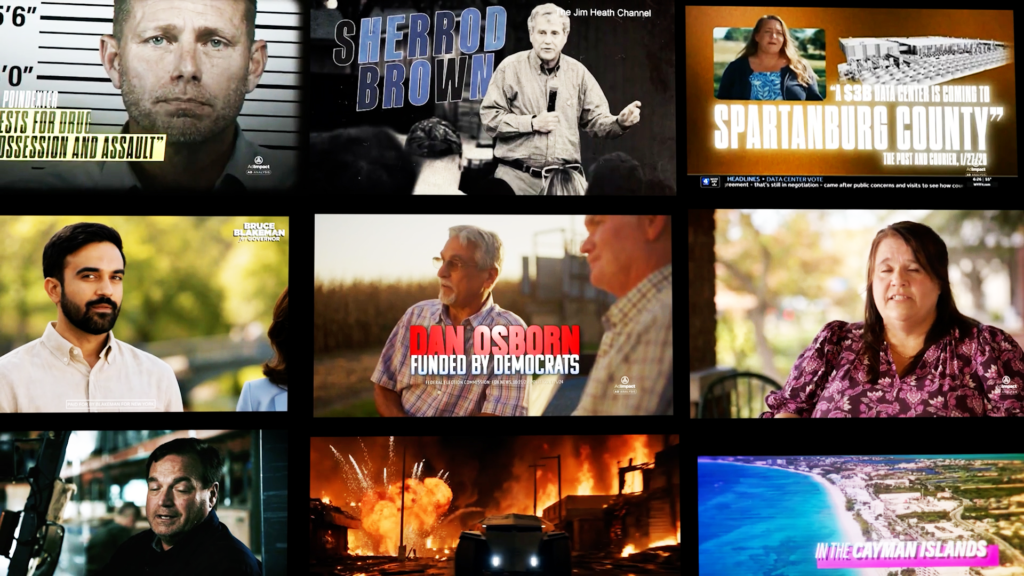
Despite how cringeworthy they are, political campaigns have spent $137 million on A.I.-generated ads for the midterms. And the lack of regulation on these ads is warping our sense of what’s real. The Opinion writer Rotimi Adeoye argues that while this kind of political satire falls under First Amendment protection, “you should be free to fake a politician, but you shouldn’t be free to hide the fact that you did.”
Campaigns and their allies are making their closing arguments, and they've spent more than the annual budgets of a handful of states doing it. Much of that money is aimed at voters' wallets, but the attacks are also getting more personal and more artificial. Lisa Desjardins explains.
Meta's Mark Zuckerberg and Adam Mosseri are betting on long-form.
Kevin Mazur/MG26/Getty Images for The Met Museum/Vogue
Instagram is opening its arms to long-form video again.
Adam Mosseri, Instagram's top exec, said longer videos will help the app stay "relevant."
Instagram is testing tools for creators making episodic content. But will it pay for them?
Instagram's top executive, Adam Mosseri, has a plan to keep the platform "culturally relevant" — by making it more like YouTube.
Meta-owned Instagram unveiled an overhaul of long-form video features on Monday, including a test of horizontal videos called "Features." Taken together, the changes make the app feel a lot more like YouTube.
"We want to be the most culturally relevant platform," Mosseri said in an interview with content creators and founders of Press Publish, Colin Rosenblum and Samir Chaudry. "To do that, we just need to show up where people are."
The context: YouTube has become a major hit on TV screens, and there's a growing appetite for Instagram-native shows with recurring episodes.
"Subway Takes," hosted by Kareem Rahma, is a prime example of Instagram's strengths and limits. The show started in 2023 as a short-form interview series and, as it grew, expanded with longer-form cuts on YouTube and the streaming platform Tubi. Instagram, however, is where Rahma's show still has its largest audience of 2.4 million followers.
Instagram doesn't want people to go to YouTube or Tubi to see longer versions of shows like "Subway Takes." That's leaving ad revenue and user engagement on the table. Its new tools are designed to entice creators and viewers to stay on its platform.
Here are Instagram's latest video tools and how creators can use them:
"Features" keep viewers within the Instagram ecosystem. Instead of leaving Instagram to watch the extended version of an interview or episode, it'll be relatively seamless to stay on Instagram and watch that longer-form content. Instagram's "Features" can be as long as 90 minutes, although the new format is, for now, only available to a limited number of creators in the US and Brazil.
Instagram is feeding more content to its TV apps. Instagram is also pushing its "Instagram for TV" app further. The app will feature various video content on TV services like Samsung, Amazon Fire TV, Google TV, and now Apple TV. People can now watch a feed of content their friends are also liking or resharing on TV.
Instagram-native shows can label their episodes more clearly with "Series." Within the main Instagram feed, Instagram is testing a way for shows on the app to seamlessly connect episodic content. Eligible creators can add videos to a Series, and a label appears over the content indicating that there are additional episodes. People can then watch those episodes in order from the start. This test is expanding to more countries through the end of the year.
Clips can directly drive engagement back to the original video. Instead of clipping content and praying that the audience will go the extra mile of clicking on an account and finding the original, longer-form video, Instagram is letting creators link up to 8 clips to one long video.
Instagram is expanding its offerings for long-form video content.
Meta
This isn't Instagram's first time dabbling in long-form content.
In 2018, it launched IGTV, a long-form video format and stand-alone app. In 2020, Instagram rolled out a program that let creators earn money from those videos on IGTV. Four years after launching, the company sunset the IGTV app and shifted its video efforts to Reels.
There are a few key elements missing from Instagram's big leap (back) into long-form video.
You can't watch the video while continuing to scroll through Instagram, or multitask by opening other apps while keeping the Instagram content in a picture-in-picture pop-up. There also aren't automated transcripts and subtitles yet. A spokesperson for Meta told Business Insider that there are plans for these features.
Will creators get a slice of the ad revenue pie?
For creators, one key question and pain point looms: Will Meta share the honeypot?
Mosseri told Rosenblum and Chaudry that Instagram is thinking about ways to test pre-roll and mid-roll ads that could lead to a revenue split. However, he said previous attempts by Instagram to build a creator monetization system comparable to YouTube's Partner Program didn't prove beneficial for the platform.
"We spend more money than we make back by a long shot," Mosseri said of Instagram's previous efforts at broad revenue-sharing programs.
Mosseri said that in its previous iterations of content monetization, creators typically didn't produce more content than they already did for free, and the content they did create tended to be lower quality.
Still, Instagram will need to "figure it out" as it tries to crack longer-form content, Mosseri said.
"I don't think of platform payments or performance-based incentives or bonuses as a revenue driver," Mosseri added. "I'd be psyched to scale them up for any of these formats — as long as we're breaking even."
Democrats are increasingly optimistic about the midterms. But they are being outspent by Republicans. And they are trying to compete in states that favored President Trump by large margins.
The fallout from Vivek Ramaswamy’s brutal spot targeting his Democratic rival in the Ohio governor’s race showed that even in the Trump era, a political attack can be seen as going too far.
The tech giant does not have an ad tier on its Apple TV streaming service, but one of the company's top ad execs tells THR that F1 is growing its share of the pie.
E.l.f. Beauty hosted an influencer activation at Coachella.
VALERIE MACON / AFP via Getty Images
Influencer marketing can be messy and unpredictable.
We asked top creator marketers about the main challenges they face when running campaigns.
Marketers said choosing talent, approving content, and forecasting reach create the most headaches.
Influencer marketing has ballooned into a $12 billion industry in the US. And yet, running campaigns can still feel unpredictable.
Business Insider asked more than a dozen executives at top brands like Poppi, E.l.f. Beauty, and the National Football League what challenges they face when working with creators. Three common pain points emerged.
First, it's tough to find relevant talent amid a growing pool of content creators. It can also be tricky to agree on content copy when balancing a brand's messaging goals with the creator's own voice. Lastly, campaign performance can be erratic as social-media algorithms become more personalized and harder to crack.
Buying influencer ads, unlike TV spots or display ads, requires a human touch. It's tough to automate (despite some attempts to do so). Forty-five percent of brands said they relied on manual processes like spreadsheets, emails, and DMs to run creator campaigns, according to a June survey of 209 executives conducted by Northwestern University and LTK.
"We're dealing with people, and making content is their time and their business, and it's hard," said Lindsay Burstein, senior director of integrated social and communications at Keurig Dr Pepper. "We're always looking for ways to do it faster and in a way that feels more real-time so that we're keeping up with the pace and the culture of the internet. But also knowing that these are people. They have lives. They have other commitments."
Read on for more details on the common pain points that emerged from our conversations with marketing executives at 14 brands. These execs were recently featured in Business Insider's 2026 list of innovative influencer marketers.
1. It's hard to find the right creators for your brand when there are so many
"The landscape of the influencer, creator, and affiliate model is changing every single day, and new people are coming in and identifying as an influencer," said Patrick O'Keefe, chief integrated marketing officer at E.l.f. Beauty. "I would love a model or a plan or a program that would capture all the new people coming into this space in real time."
"We've just seen this space get so much more saturated than it ever has before," said Kiara Kempski, vice president of global consumer marketing at The Knot Worldwide. "The game of scale is totally changing."
2. Breaking through the noise
"The feed is so loud right now," said Anna Doré, Rothy's vice president of brand and communications. "In this AI-driven algorithm world where we're all being served the same content on the feed, we, more than ever, are going to be looking to great tastemakers."
"There is a ton of content that's just content for content's sake that's out there," said Ian Trombetta, the National Football League's senior vice president of global social, creator, and content marketing. "The creative bar is going up in order for us to drive that organic reach and engagement."
Ninety to 95% of the content that we see in our own feeds is not from accounts we follow, Keurig Dr Pepper's Lindsay Burstein said. "Followership matters a little, but not nearly as much as I think it once did because the algorithms just don't favor it the way that we used to."
3. Agreeing on content that works for both a brand and a creator's audience
Some brands "are a little bit too prescriptive and don't allow the creators to do what it is that they really are good at, which is understanding their audience and how to create great content and formats that work for their audience," the NFL'sTrombetta said.
"Overbriefed" projects are "not the business that we want to be in," said Sophia Sesto, Poppi's vice president of culture. "We want to take these opportunities and work with the talent to make something special" and "lean into their personalities and let them carry the brand forward with us."
"For a long time, the industry treated creators as ad placements," said Samim Sadrzadeh, director of creator content and partnerships at Disney. "We think that significantly undersells the value they actually bring."
"We start from a pretty simple place, which is creators know their audiences better than we ever will," said Stacy Martinet, Adobe's chief content and creative officer. "The most effective approach has been to treat creators as creative partners, first and foremost."
The vice president backed an advertisement featuring Democrat Amy Acton’s mother, who has been estranged from Dr. Acton since her stepfather was charged with child rape.
The spending has hurt the Silicon Valley giant’s cash flow, which turned negative. Meta said it would issue a new class of stock to help it raise more money.

 Login