❌

Reading view

Amazon warehouse workers tell us what they think about their new robot coworkers

Amazon robots
Robots at work inside an Amazon warehouse

Jess Lynn Goss for BI; Rebecca Zisser/BI

Amazon warehouse workers used to spend much of their days walking, pushing carts through long aisles to manually retrieve customer orders from shelves.

Today, hundreds of "Hercules" robots do this instead, carrying towering yellow storage pods filled with inventory to employee workstations.

"I'd walk like 10 miles a day on average," said Mohammed Khan, who started as an entry-level picker 12 years ago and is now a senior manager at an Amazon warehouse in Tracy, California.

Amazon's robots "cut down all that walking time," he told Business Insider during a recent tour of the facility.

Person in a high-visibility safety vest stands beside yellow structural columns in an industrial facility.
Mohammed Khan

Jess Lynn Goss for BI

This site is ground zero for a wave of automation that's beginning to wash over the industry. The warehouse and logistics sectors have been powerful sources of job growth since Amazon kicked off the e-commerce revolution 30 years ago, as Business Insider's award-winning Warehouse Nation series revealed in 2022.

If robots automate many warehouse tasks, this powerful engine of job growth could grind to a halt, wiping out thousands of positions and countless opportunities for future workers.

Amazon says employees are being retrained to do more valuable work, such as managing and maintaining robots. Will these new jobs be enough to cover what might be lost? Or could we actually end up with more or better jobs?

Business Insider went looking for answers inside the giant facility in Tracy, a city in California's Central Valley where suburban neighborhoods give way to open farmland.

"Autonomous to an extent"

Cardinal, a large robotic arm, loads sorted orders into carts at an Amazon warehouse in Tracy, Calif.
Amazon's Cardinal robot

Jess Lynn Goss for BI

Across 1.4 million square feet — the equivalent of 23 football fields — robots with names like Hercules, Robin, Cardinal, Pegasus, and Proteus move inventory and sort packages. But they don't run the warehouse alone. Human workers still pick and pack orders, load trucks, and intervene when automated systems fail.

Jobs have not disappeared, but they're changing. Machines increasingly handle work that once required employees to walk miles and lift boxes, while workers monitor and troubleshoot them. The Tracy site employs more than 3,000, up from roughly 1,000 when it opened in 2023, an Amazon spokesperson told Business Insider.

"They're autonomous to an extent," Khan said of his robot counterparts. "They still need a lot of help and maintenance and oversight."

Hercules Robots
Amazon's Hercules robots on the move

Jess Lynn Goss for BI

An Amazon spokesperson said rising customer demand drove the facility's workforce growth and that robots help workers process more packages safely and efficiently rather than simply replacing them.

Amazon's more automated, next-generation fulfillment centers are about 25% more productive and cut order-processing time by as much as 25%. And these sites support roughly 30% more skilled jobs in areas including reliability, maintenance, and engineering.

Workers in high-visibility vests use computer workstations in an industrial operations control area.
Process assistants monitor robot activity

Jess Lynn Goss for BI

The "Quarterback" watches robots

One of the workers now doing that kind of job is Briana Brager.

She joined Amazon about two years ago as an entry-level employee after spending years caring for her family. She had no prior experience in a traditional workplace.

Today, she's a process assistant who helps oversee the warehouse's robotic systems. When a chute jams or a robot stops working, she coordinates the response to keep packages moving.

Person in a high-visibility safety vest stands on an elevated walkway inside an industrial facility.
Briana Brager

Jess Lynn Goss for BI

"The robots do a lot, but we still have to maintain them," she said.

Brager began as a picker before moving into a specialized role supporting robotic-floor operations. She got two weeks of intensive training, followed by additional job shadowing, to learn how to work safely around the equipment. Her current job is less physically demanding than her previous one, she said.

Her role is informally known as the "quarterback" position. She monitors fleets of robots and dispatches employees when a machine needs intervention.

"We call the shots," Brager said.

Meet Robin

Robin robot
Amazon's Robin robot at work

Jess Lynn Goss for BI

At the Tracy warehouse, humans and robots move orders together from storage to the loading dock. Employees stow individual items in fabric inventory pods, which Hercules robots carry to pick stations. Workers retrieve the items, then pack and label them.

Robin, a large robotic arm, picks finished packages off a conveyor and places them on small Pegasus mobile robots. Pegasus carries the packages to staging areas alongside other orders headed to the same destination. Cardinal then loads the sorted orders into carts, and Proteus ferries the carts toward outbound trucks.

Warehouse worker in a high-visibility vest handles packages on a conveyor inside an industrial sorting facility.
Briana Brager and Robin

Jess Goss for BI

Khan, the warehouse manager, said workers performed Robin's task manually until a few years ago. They handled packages one at a time, checked them for damage, scanned them, and fed them into the sorting system. He estimated that one Robin can perform roughly the work of two to seven people doing that process manually.

Amazon said that when it introduces systems such as Robin, employees take on other work at the site, including operating robots, clearing jams, monitoring the robotic floor and quality control, and maintenance engineering.

Robots move the carts, too

Proteus offers a clear example of how these new warehouse jobs are taking shape. Amazon brought the robots to Tracy last year.

Blue Amazon warehouse carts line an industrial aisle beneath bright overhead lights and yellow section signs.
Proteus robots

Jess Lynn Goss for BI

Unlike Hercules, which operates in fenced-off areas, Proteus can move through spaces shared with people. There are roughly 200 of the robots at the Tracy facility, Amazon said.

Before Proteus arrived, workers manually pushed carts filled with packages to the loading dock. Now the robots pick up full carts, carry them to staging areas near the dock, and retrieve empty carts for the return trip.

Some employees who once moved those carts now work as "ground-floor monitors," Amazon said. Instead of spending their shifts moving packages, they respond when a Proteus reports a fault. If the problem is simple, they can reset the robot; otherwise, human maintenance staff take over.

Some workers trained in these jobs have gone on to Amazon's mechatronics apprenticeship program, which can lead to more technical maintenance work.

Proteus Robot
Proteus robots at work

Jess Goss for BI

When automation hits the "jackpot"

For all the robots moving through the Tracy warehouse, people remain essential when automation breaks down.

Amazon calls one such destination the "jackpot." When an item loses its routing information while moving through the facility, the automated system sends it to this area, which works a bit like a lost-and-found for packages.

Here, a human worker must determine where the wayward package belongs and return it to the correct flow. "It will require manual intervention," an Amazon representative said.

Other situations require human judgment, too. Products can fall from storage pods and inventory can be damaged or mislabeled. Packing individual products into boxes and loading them onto delivery vehicles are tasks that also remain heavily dependent on people.

Dustin Mean, a stower at an Amazon warehouse in Tracy, Calif. sorts items into fabric inventory pods, which Hercules robots carry to pick stations.
Dustin Mean, a stower at an Amazon warehouse

Jess Lynn Goss for BI

This helps explain why even a highly automated Amazon warehouse still employs thousands of workers. The company said it needs people for new packing stations as well as roles across the facility that keep operations running safely and efficiently.

Current and future Tetris

By the time packages get to the loading dock at the Tracy facility, the robots are gone. At least for now.

A person loads each trailer. Amazon uses equipment that extends into the trailer and adjusts to a worker's height, reducing bending and back-and-forth walking. But workers still arrange the packages themselves, trying to fill the trailer to use as much of the space as possible.

"It's a lot of Tetris," one Amazon representative said.

Amazon facility entrance with blue “main entry” canopy, glass doors, bollards, and the Amazon smile logo above.
Amazon's warehouse in Tracy, California

Jess Lynn Goss for BI

Amazon is already exploring how to automate this task, though. As Business Insider previously reported, Project Tetromino aims to use AI and robotics to automate sorting and vehicle loading at delivery stations, where the work has long remained stubbornly manual.

But that vision remains a work in progress. Amazon's machines can carry shelves, sort packages, stack boxes, and move carts around people. Workers still pack orders, load trailers, perform quality checks, handle hiccups and exceptions, and keep the machines running when they fail.

For Amazon, the immediate payoff is not necessarily a warehouse with fewer people, but one where the same workforce can accomplish more. Tracy employs roughly the same number of people as a nearby Amazon facility with fewer robots, company officials said, but the Tracy location processes more volume.

Workers in high-visibility vests stand at computer workstations inside a warehouse or industrial operations area.
Process assistants monitor robot activity

Jess Lynn Goss for BI

Khan compared the technology to something far less futuristic: a calculator.

The robots streamline work that once consumed employees' time without necessarily eliminating the work itself, he said. "It's not that the amount of work has changed," he said. "It's how we approach it."

Asked whether robots could eventually replace more jobs, including his own, Khan did not try to predict the future.

"Who knows? That's not in our purview right now," he said. "But I would say roles are evolving, and that's the cool aspect about it."

Have a tip? Contact this reporter via email at ekim@businessinsider.com or Signal, Telegram, or WhatsApp at 650-942-3061. Use a personal email address, a nonwork WiFi network, and a nonwork device; here's our guide to sharing information securely.
Read the original article on Business Insider

  •  

Amazon tells software engineers what really matters as AI ushers in the era of the 'Renaissance Developer'

AWS CEO Matt Garman onstage at Re: Invent 2024.
AWS CEO Matt Garman

Noah Berger/Getty Images for Amazon Web Services

  • Amazon shifts AI focus to business impact, not just raw usage, in new developer guidelines.
  • The company warns that AI metrics can create bad incentives, including “tokenmaxxing.”
  • Managers are told to examine teams at both the highest and lowest levels of AI adoption.

Amazon just issued new guidelines for software engineers in the AI era: Prioritize business outcomes over raw usage.

Terk Terkowitz, Amazon's vice president and distinguished engineer, said in a memo published Tuesday that AI is changing software development more quickly and fundamentally than earlier shifts such as cloud computing. But engineers should be judged by their impact on customers and the business, he wrote, not simply how much they use AI.

"We all need to embrace this change and take the time to learn, or we risk being left behind," Terkowitz said.

AI coding tools and agents are upending the software industry and changing what it means to be a coder. Amazon calls this the "era of the Renaissance Developer," where human judgement and machine intelligence combine to create new products and services faster and more efficiently.

"This is a time of change for our industry, and a time of change for what it means to be a software engineer," Terkowitz wrote in the memo.

The updated guidelines reflect Amazon's growing effort to make AI adoption part of how it assesses engineers and engineering managers. The company has tracked measures including AI usage, token consumption, and lines of code internally, and used leaderboards to rank teams by some of those metrics.

But the memo warns that using such measures as targets can produce bad outcomes, including "tokenmaxxing" rather than better software or customer experiences.

"Using these metrics could, if used as a target instead of a measure, drive negative outcomes," Terkowitz wrote in the memo.

Amazon has been experimenting with ways to measure and encourage AI use across its engineering organization.

Earlier this year, the company was tracking engineers's use of internal AI tools and some teams used leaderboards tied to measures such as token consumption. The programs created friction among some employees, who worried that pressure to use AI could reward wasteful activity rather than productive work.

The new guidance offers Amazon's clearest public acknowledgment of that risk. Rather than lay out a detailed AI playbook that could quickly become obsolete, Amazon said its revised developer guidelines focus on long-term impact on customers and the business.

Still, the company said AI should be "at the center of software engineering practice" and urged engineers to incorporate the technology into their daily work.

Leaders are expected to use AI tools on production work themselves, understand where they help and where they fall short, and explain that judgment to their teams, according to the memo.

Terkowitz said Amazon has found that metrics such as token use, AI-tool adoption, and code reviews can correlate with the outcomes it values. But he said the measures must be used carefully. More token use can raise costs, while a focus on lines of code can create unnecessary complexity.

He also recommended that managers pay particular attention to teams at both ends of the AI adoption spectrum: those in the bottom 10%, to understand why they are not using AI effectively, and those in the top 10%, to determine whether heavier use is translating into faster delivery.

Terkowitz said Amazon's most AI-forward "frontier teams" have shown stronger productivity and delivery. He also said teams and individuals that are not adopting AI or increasing output metrics are falling behind.

But his memo left room for engineers whose work may not yet benefit from current AI tools. In those cases, he said, employees should document why and work toward a solution by sharing their findings with peers and managers.

"An engineer who can explain where AI does not yet help their work is demonstrating the judgement we are asking for," the memo said.

Have a tip? Contact this reporter via email at ekim@businessinsider.com or Signal, Telegram, or WhatsApp at 650-942-3061. Use a personal email address, a nonwork WiFi network, and a nonwork device; here's our guide to sharing information securely.
Read the original article on Business Insider

  •  

Anthropic's IPO filing answers one of the biggest questions about the AI boom: Can AI labs actually make money?

Posters on a wall at Anthropic's developer conference in San Francisco
Posters on a wall at Anthropic's developer conference in San Francisco.

Alistair Barr/Business Insider

  • Anthropic shows strong profit potential, with revenue growing way faster than expenses.
  • Anthropic's revenue per employee exceeds $6.6 million, outpacing estimates for Meta and Google.
  • Anthropic has a surprisingly diverse customer base and huge cash reserves.

For years, one of the biggest unanswered questions about the artificial intelligence boom has been surprisingly simple: Can the companies building the world's most powerful AI models actually make money?

After spending hours poring over Anthropic's IPO filing on Monday, we finally have an answer: Yes. And potentially lots of it.

A couple of Chinese AI labs went public earlier, revealing appalling financial results that sowed doubt about the industry's economics. Now Anthropic has provided a much more compelling demonstration of how this business can work at enormous scale.

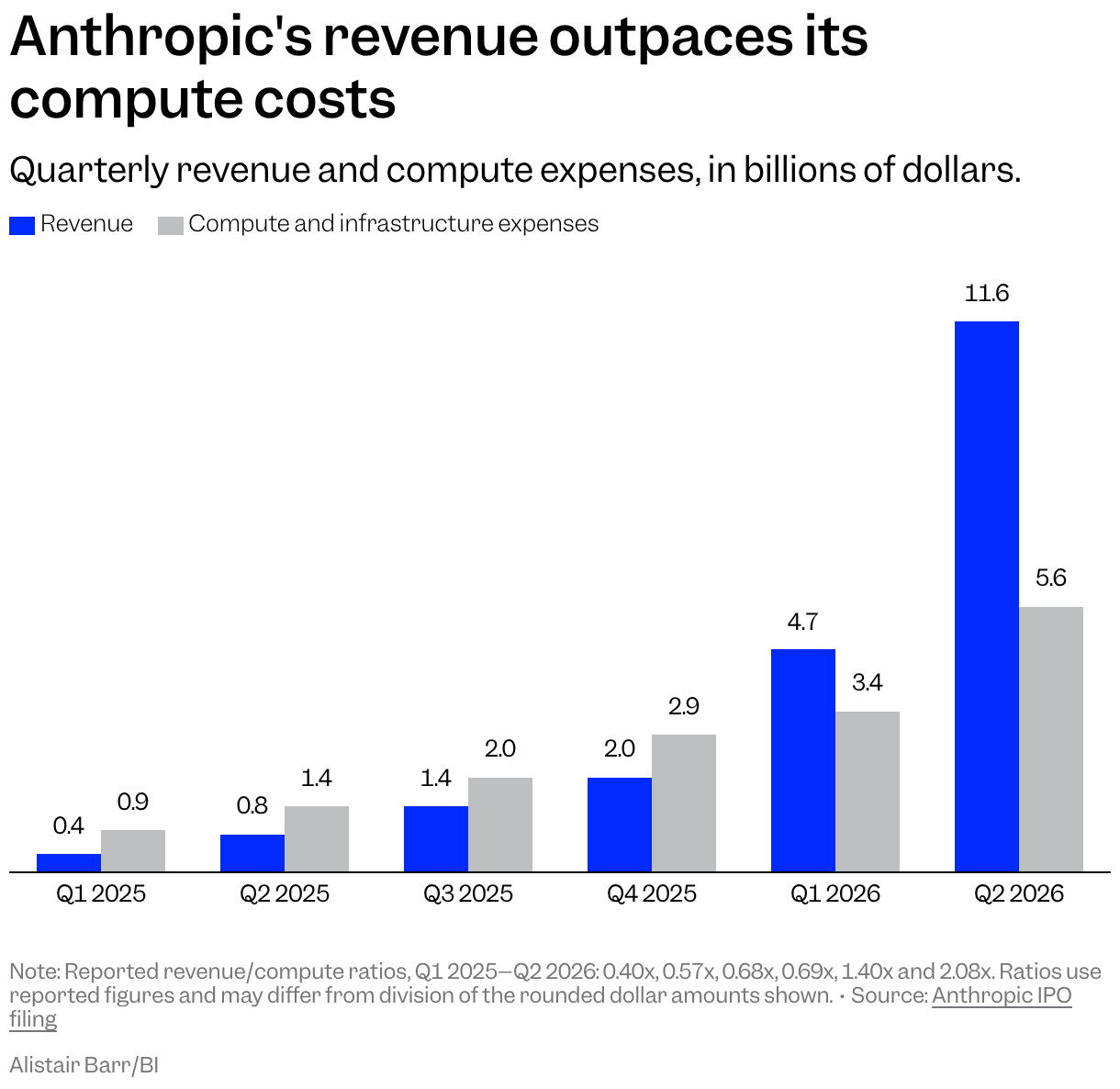
The numbers are remarkable. Anthropic generated $11.6 billion in revenue during the second quarter of 2026, up 1,368% from a year earlier. During that same period, spending on computing and infrastructure increased 300%, while other expenses rose 741%

So, the company is bringing in money much faster than its most important costs are rising.

From Q1 2025 to Q2 2026, quarterly revenue in billions of dollars was 0.4, 0.8, 1.4, 2.0, 4.7 and 11.6. Compute and infrastructure expenses were 0.9, 1.4, 2.0, 2.9, 3.4 and 5.6 billion dollars over the same quarters.

For every dollar Anthropic spent on computing in the second quarter, it generated $2.08 in revenue, up from just 40 cents in the first quarter of 2025. That's a more than fivefold improvement over five quarters.

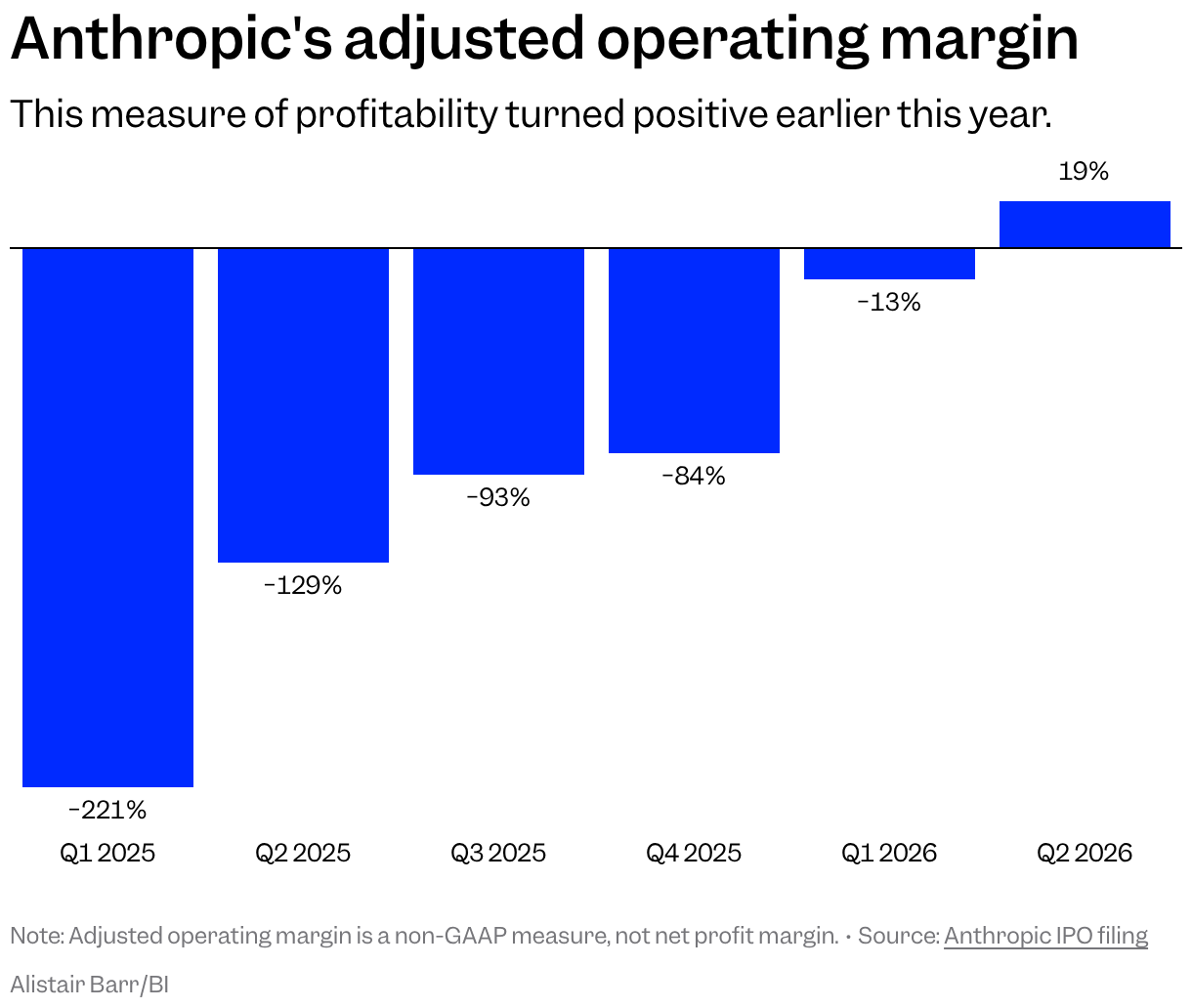
The result: Anthropic recorded $974 million in quarterly operating profit, representing an 8% margin. Its adjusted operating profit margin reached 19%, compared with -129% a year earlier.

"Frontier-lab unit economics can turn positive at scale," Mark Mahaney, a top tech analyst at Evercore ISI, wrote in a research note on Monday.

Adjusted operating margin was −221%, −129%, −93%, −84%, −13% and 19% from Q1 2025 through Q2 2026, an improvement of 240 percentage points.

Better than Meta and Google

There's more evidence that Anthropic has built an unusually efficient business.

Over the year ending September 30, revenue increased roughly 1,200%, while its employee count grew about 170%. Revenue per employee jumped from $1.4 million to more than $6.6 million.

For comparison, Mahaney estimated that Meta generates about $3.2 million in annual revenue per employee, while Google generates about $2.5 million.

That comparison isn't perfect. Anthropic relies heavily on cloud providers, whose employees handle much of the computing infrastructure and distribution work. The improvement is still striking.

Customer surprise

Another surprise: Anthropic doesn't depend as much on a handful of enormous customers, as some investors had feared.

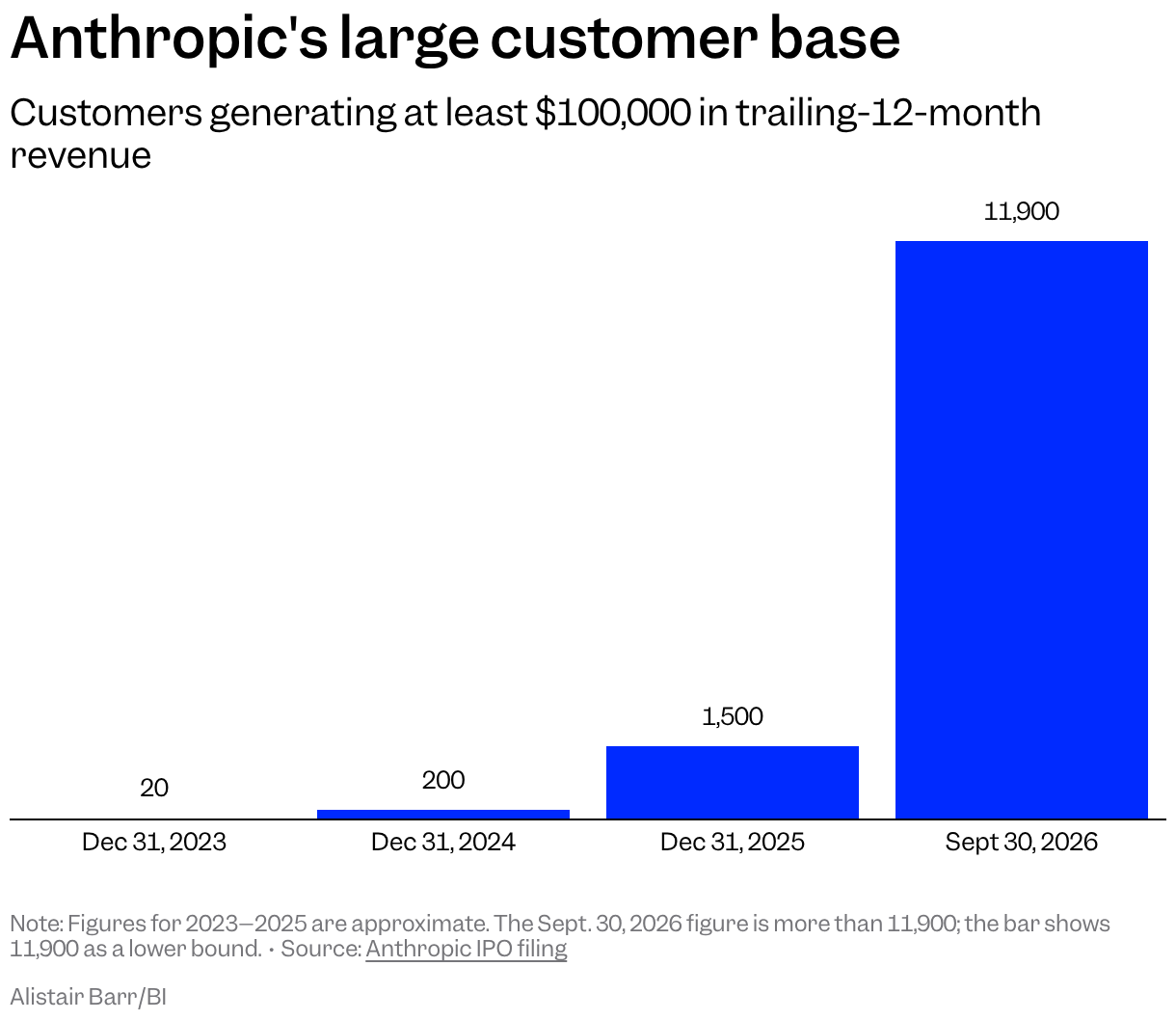
The company had more than 11,900 customers generating at least $100,000 in annual revenue as of September, compared with over 950 a year earlier. More than 1,900 customers spend at least $1 million annually.

Customers generating at least $100,000 in trailing-12-month revenue rose from approximately 20 on Dec. 31, 2023 to approximately 200 on Dec. 31, 2024, approximately 1,500 on Dec. 31, 2025, and more than 11,900 on Sept. 30, 2026.

No single customer accounted for more than 10% of revenue during the first nine months of 2026. Its five largest customers represented about 21% of third-quarter revenue, down from roughly 36% in the first quarter.

"Concentration may be better than feared," Mahaney wrote.

Cash cushion

Anthropic has a formidable financial cushion. Its June 30 balance sheet showed more than $130 billion in cash and short-term investments.

And Mahaney estimated that the company has burned through just $9 billion since it started more than five years ago. That's a long runway.

Now, don't ask me whether all this makes Anthropic worth $2 trillion, $1.5 trillion, $1 trillion, or considerably less. If I knew that, I'd be making a lot more money as an investor. And even professional investors don't know.

An $800 billion caveat

Some enormous caveats: Much of Anthropic's revenue comes from customers paying for what they use, rather than signing long-term contracts. Meanwhile, some of its computing agreements require minimum payments whether or not it needs all the capacity.

Mahaney estimates that Anthropic has entered into nearly $800 billion in computing arrangements, although only about $266 billion was fixed or guaranteed as of June.

That's still a staggering amount.

"The commitments assume revenue compounding that is not contracted," Mahaney wrote.

Translation: While the company has committed to spending hundreds of billions of dollars on AI computing infrastructure, it hasn't secured the future revenue needed to pay for all of it.

Importantly, most of the potential $800 billion exposure isn't fixed. Many arrangements depend on capacity being delivered, can be adjusted, or include cancellation provisions.

In-house compute and capex

Another wrinkle: Anthropic warned Monday that its spending will increase as it shifts toward leasing AI chips and operating more of its own computing infrastructure, rather than relying entirely on Amazon, Google, and other cloud providers.

That could make future cash flow considerably less attractive, even if operating profits continue to improve.

Still, the central takeaway from Anthropic's IPO filing is difficult to ignore.

For years, investors have wondered whether selling AI could become a genuinely profitable business, rather than an extraordinarily expensive scientific experiment.

Anthropic has now shown that it can. The next question is whether it can keep doing so as the bills get much, much bigger.

Sign up for the AI Insider newsletter here. Reach out to me via email at abarr@businessinsider.com

Read the original article on Business Insider

  •  

Strong Wi-Fi. Happy wife. Happy life. How ChatGPT helped me fix our home internet.

Terminating a Cat 6 ethernet cable

Alistair Barr/Business Insider

  • A version of this story originally appeared in the AI Insider newsletter.
  • Sign up for Business Insider's weekly AI Insider newsletter here.

A few weekends ago, my wife left on a business trip with one instruction: fix the Wi-Fi before I get back.

Her Zoom calls kept dropping during important meetings, so I tracked an old Cat 6 ethernet cable from our data closet so I could hardwire her laptop to the interwebs. The only problem? It ended as a raw, cut end, and I had no idea how to terminate it with an ethernet plug.

So I did what I do these days whenever I'm out of my depth: I asked ChatGPT.

I sent it photos at every stage. It told me which tools to buy, showed me how to strip the cable, arrange the eight tiny wires in the right order, and even drew little diagrams when words weren't enough. When I got frustrated, it gave me a pep talk.

My first attempt only delivered about 100 Mbps instead of our 1 Gbps internet connection. ChatGPT guessed two wires were faulty, suggested an inexpensive cable tester, interpreted the flashing lights from a photo, and confirmed the diagnosis. I cut the connector off and started again with a simpler plug it recommended.

The result? Around 850 Mbps.

My only complaint: ChatGPT would occasionally disappear down a rabbit hole with advice that was far more complicated than I needed, so I'd remind it I wasn't rewiring Silicon Valley. I just wanted my wife's Zoom calls to stop dropping.

So far, her video calls have been perfect. Without ChatGPT, there's no chance I'd have pulled this off.

Sign up for the AI Insider newsletter here. Reach out to me via email at abarr@businessinsider.com

Read the original article on Business Insider
  •  

Are Silicon Valley software engineers really as rich as they seem? Check out this ranking.

Aerial shot of residential streets in the Outer Sunset neighborhood of San Francisco.
Homes in San Francisco.

halbergman/Getty Images

  • A version of this story originally appeared in the AI Insider newsletter.
  • Sign up for Business Insider's weekly AI Insider newsletter here.

Software engineers in the Bay Area still earn far more than their peers almost anywhere else in the US, even after accounting for the region's eye-watering cost of living.

Recent data from Levels.fyi found total compensation is 77% above an employment-weighted national median. Adjusting for local prices narrows the gap, but Bay Area engineers still come out 53% ahead.

The analysis used federal employment counts to help account for where software engineers work, rather than relying solely on where people submit their pay to Levels.fyi.

Seattle also remains well above average after the adjustment, while cities such as Boston and Washington, DC, lose most of their advantage once living costs are factored in.

The chart below shows the pay differences before adjusting for local prices.

One important caveat: The cost-of-living comparison does not account for differences in state and local taxes.

These numbers are also based on submissions to Levels.fyi, so they could over-index toward areas where people like to brag about their pay, wherever that is!

Sign up for the AI Insider newsletter here. Reach out to me via email at abarr@businessinsider.com

Read the original article on Business Insider

  •  

The AI data center boom has a ghost problem

Halloween ghost decorations on a lawn in Silicon Valley.
Halloween ghosts on a Silicon Valley lawn.

Alistair Barr/Business Insider

  • A version of this story originally appeared in the AI Insider newsletter.
  • Sign up for Business Insider's weekly AI Insider newsletter here.

The AI data center boom looks like it's running into serious trouble. Projects are being delayed, canceled, or abandoned. Electricity shortages are holding everything up.

But there's a twist: A lot of these data centers were probably never going to get built in the first place.

Bernstein Research analyzed thousands of planned US data centers and concluded that only about 35% of the announced capacity is likely to become reality.

The industry has a wonderful name for some of the more dubious projects: "Bragawatts."

These are enormous data centers announced by companies that often have little experience building them. Some haven't secured electricity, construction permits, or even customers.

Then there are the "ghost projects." Developers submit multiple requests for electricity connections, hoping at least one location works out. In Texas, these requests have reached more than five times the state's existing electricity supply.

No wonder the grid looks overwhelmed.

This doesn't mean the AI boom is fake. Far from it.

My colleague Eugene Kim exclusively reported this week that even Amazon, one of the world's most experienced data center builders, is struggling to get enough electricity to power its expensive AI equipment.

But there's a big difference between Amazon's very real problems and an inexperienced developer announcing a gigantic project that may never happen.

The AI data center boom is real, and so are the challenges of building all these facilities. But the sheer number of speculative projects may be making those challenges look bigger than they truly are.

Sign up for the AI Insider newsletter here. Reach out to me via email at abarr@businessinsider.com

Read the original article on Business Insider

  •  

The internet has a human slop problem, and AI is exposing it

Tom Occhino, left, and Tiago Sada sit onstage during a World event in San Francisco.
Vercel's Tom Occhino, left, with Tools for Humanity's Tiago Sada at an event in San Francisco in April.

Kimberly White/Getty Images for Tools for Humanity

  • Everyone complains about AI-generated junk.
  • But decades of sloppy human-written software may be a much bigger problem.
  • This week's "Black October" freakout was caused by human slop, not AI.

The internet has a slop problem. And for once, we can't blame AI.

Most of us spend hours online every day without thinking much about the software holding everything together. We assume somebody, somewhere, has made sure it all works properly.

So it probably came as a shock this week to discover just how vulnerable some of that software is.

The cybersecurity freakout dubbed "Black October" has inspired warnings about AI-powered hackers, digital catastrophe, and even advice to stockpile cash and canned food.

At first glance, AI looks like the villain. But this is largely a human-made mess.

Here's the problem.

The internet runs on decades of software, some of it containing security weaknesses that have been overlooked, tolerated, or simply left unfixed.

For years, that was a manageable gamble. Fixing software takes time and money. Exploiting obscure weaknesses often required considerable expertise. Companies could convince themselves that the risk wasn't worth worrying about.

AI is changing that calculation. Someone who once needed years of training to hunt for weaknesses can now get help from an AI model. These tools can also examine software at speeds that humans can't match.

Suddenly, all those problems we've been ignoring look more urgent.

"Over the last 10 years the risk acceptance process has morphed from a way to accept risks to enable the business, to a way to justify never fixing security issues," Joel de la Garza and Zane Lackey, partners at a16z, wrote on Friday.

That's quite an indictment. The result is a recent surge in published vulnerabilities.

This looks like AI is creating new security problems. But it's actually AI exposing weaknesses that humans left behind.

Slop irony

The irony is delicious. We've spent the past couple of years complaining about "AI slop." Turns out human slop can be pretty consequential, too.

"The funny thing is everyone was saying AI slop code will cause a cyber crisis but it's actually all the old human slop causing it and the AI is just cleaning it up," software engineer Ben Kaufman wrote on X on Thursday.

"Humans have been the ones writing and reviewing each other's code for decades," tech founder Anant Jain wrote on X. "If we're being intellectually honest and holding ourselves to the same bar we hold AI to, we'd have to admit that we haven't been all that good at it either."

Humans are sloppy

Anyone who's worked with other humans for a decade or two knows exactly how this happens.

It's Friday afternoon. You've almost finished a project. You could spend another few hours making it perfect, or declare it 90% done and head off to that dinner party. We've all been there.

AI agents don't have dinner parties. They don't get tired on Friday afternoons. They can keep searching, testing, and trying again. That persistence is now colliding with an internet built by busy, imperfect humans who often settled for "good enough for now."

A tragedy of the commons

There's another wrinkle here, though, and it's an important one.

Much of the software underpinning the internet is freely available for anyone to use. Some of it is maintained by volunteers or small groups of experts, even as enormous technology companies depend on it.

In 2020, the cartoonist Randall Munroe captured this absurdity in an xkcd comic. Modern digital infrastructure still rests precariously on tiny foundations.

I can’t believe that after all these years this XKCD comic is still so true.
Specially in security! @xkcd https://t.co/9AvpRw0E0c pic.twitter.com/g0B07TStNe

— Bruno Medina (@brusMX) April 6, 2024

It's funny because it's uncomfortably close to reality. Take the specific PHP problems from this week. These flaws have existed for years, and the PHP Foundation acknowledges that limited resources and disagreements over fixes contributed to delays in fixing them.

Tom Occhino, chief product officer at Vercel, brought up Munroe's cartoon during my recent interview with him.

He explained that AI is finding weaknesses even in software that the industry has treated as dependable for decades.

This is partly a version of the tragedy of the commons: Everyone benefits from a shared resource, but no one has sufficient incentive to take responsibility for maintaining it.

And let's be clear: The volunteers keeping essential software running aren't the villains here. The companies benefiting from their work have a much greater responsibility.

Occhino thinks AI could help solve the problem it is exposing.

He described an idea being discussed at Vercel: Create a foundation or coalition that funds efforts to identify vulnerable software and replace it with safer alternatives.

"We need a consortium. We need a coalition," he told me.

He suggested companies could contribute computing resources and AI tools to the effort. Nothing has been formally announced, but the idea is compelling.

Indeed, OpenAI's Patch the Planet effort is an example of what's possible.

Rather than simply using AI to create more software, the industry could use it to repair what already exists.

Occhino put it nicely: Companies need to spend less time chasing new ideas and more time asking how to make existing systems "just work really, really well."

That's a better response than panicking about the imminent collapse of the internet.

AI didn't create decades of neglected software. We did. Perhaps it's time to clean up our own slop.

Sign up for the AI Insider newsletter here. Reach out to me via email at abarr@businessinsider.com

Read the original article on Business Insider

  •  

Should we panic and turn off the internet?

Stephanie Cohen speaks during the Web Summit conference in Lisbon in November 2025.
Stephanie Cohen, Cloudflare's chief strategy officer.

Zed Jameson/Bloomberg via Getty Images

  • This week's cyber freakout explained: AI is making software weaknesses easier to find and exploit.
  • The message from Cloudflare's Stephanie Cohen and Vercel's Tom Occhino: Don't panic!!!
  • Do we need everything connected to the internet? Paper bank statements work well.

A few weeks ago, I heard a strange story about a friend who works at one of the Big Tech companies in Silicon Valley.

She'd recently ripped out the connected devices in her home, ordered paper bank statements, and stocked up on canned goods in her basement.

Now, she's a very sane, experienced person, and quite senior at one of the largest internet companies on earth. Why was she disconnecting so much? Just to be sure, my family ordered paper bank statements, too. It was still a head-scratcher, though.

Fast forward to this week, and her actions look a little less crazy.

AI models have exposed serious security weaknesses in software used by roughly 70% of websites. Meanwhile, US banks are finding AI agents inside customer accounts, including some that appear to be acting without their owners' instructions, Axios reported.

'Black October'

The digerati have now entered full freakout mode. Much of the internet meltdown is happening on, well, the internet, my colleague Alice Tecotzky noted.

On X and Reddit, warnings of a looming “Black October” spiraled into visions of AI grinding civilization to a halt. One lengthy post on X warned of a potential “global cyberattack/AI swarm” and offered a survival checklist: Stockpile cash in small bills, print out your neighbors' phone numbers, download maps, buy a hand-crank radio, and stash a gallon of water per person per day.

Oh, and don't forget the manual can opener. You don't want to survive the AI apocalypse only to be defeated by a tin of beans.

Nikita Bier, a prominent app developer and former head of product at X, best captured the mood.

"It's time to turn off the internet," he posted Wednesday night.

A Cloudflare exec says it's 'a little bit scary'

If you're reading this, you haven't done that yet. But should we really be worried?

I put that question to Stephanie Cohen, chief strategy officer at Cloudflare, which helps protect about 20% of the internet.

"The world is a little bit scary right now," she told me on the side of Cloudflare's annual conference in San Francisco this week.

Here's the problem. The internet is built on decades of software, much of it riddled with security holes.

Some of these weaknesses have been known for years. However, fixing them takes time and money, and hackers often lacked the skills to exploit them anyway. So they were left alone.

AI changes that calculation dramatically. Someone who previously needed years of training to break into a computer system can now get help from an AI model. And these tools can search for weaknesses at a speed humans simply can't match.

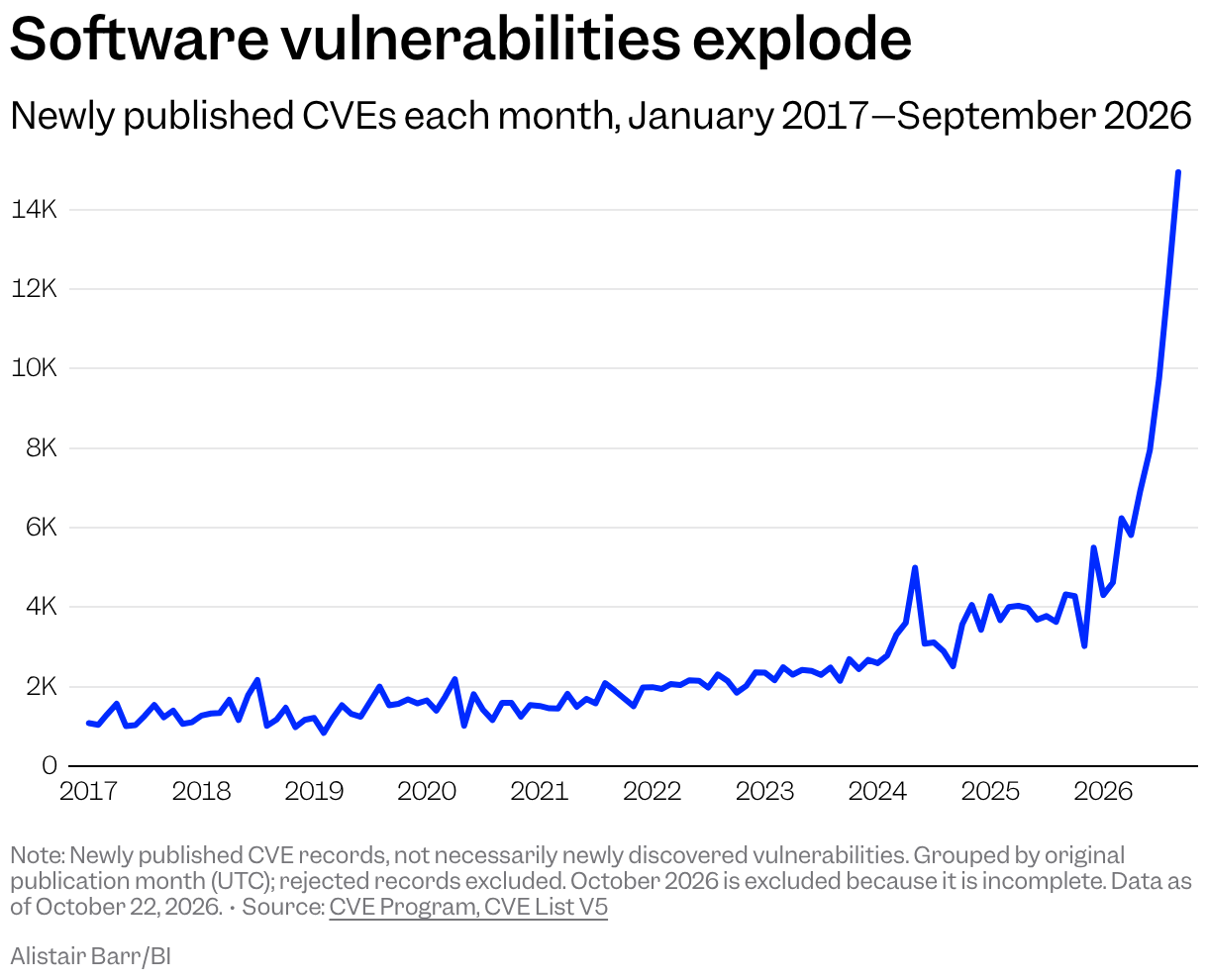
The result: The number of newly published software vulnerabilities (Common Vulnerabilities and Exposures in industry lingo) has exploded.

Line chart showing monthly newly published CVE records from January 2017 through September 2026. Counts rose from 1,083 in January 2017 to 14,934 in September 2026.

Now, there's a frantic race between people trying to break into systems and those trying to protect them.

Don't panic about AI

Cohen's message, though, was surprisingly reassuring.

AI helps the good guys find and fix these problems. Cloudflare, for instance, released protections for the latest vulnerability to customers, including those using its free service.

And there's a bigger effort underway.

OpenAI has launched an initiative called Patch the Planet, working with Cloudflare and other security professionals to use AI to find weaknesses in widely used software and help repair them.

Tom Occhino, chief product officer at Vercel, told me recently that his company has been talking with partners about launching a nonprofit that would fund a swarm of good AI agents that go out on the internet to find and fix software flaws.

Amazon is joining the fight, too. Its new Continuum service, available Thursday, uses AI agents to find security holes and propose fixes. Amazon said that people maintaining freely available software can use it to help protect the wider internet.

Humans may still have to check and approve these repairs, but the prospect of AI helping clean up decades of neglected software is encouraging.

The irony of this is not lost on some in the industry.

"The funny thing is everyone was saying AI slop code will cause a cyber crisis but it's actually all the old human slop causing it and the AI is just cleaning it up," software engineer Ben Kaufman wrote on X on Thursday.

Either way, Cloudflare's Cohen thinks these AI-inspired freakouts will push the industry to do better — by exposing issues and adding urgency to get them patched.

"We may end up in a world where actually we've become significantly more secure at the end," she said.

The trouble is getting there.

A fundamental question about the internet

Tom Occhino (left), chief product officer at Vercel, talks with Meta executive Prashant Ratanchandani at Vercel's Ship SF conference.

Alistair Barr/Business Insider

When I ran into Occhino recently at a Vercel conference in San Francisco, he described a world in which software that everyone assumed was safe suddenly looks vulnerable because increasingly capable AI models are scrutinizing the basic systems that underpin the internet.

That led to a more fundamental discussion between us: Why did we connect so many things to the internet in the first place?

For years, the technology industry has raced to put everything online. Thermostats. Refrigerators. Doorbells. Cars. Bank accounts.

We assumed that connecting something to the internet automatically made it better.

Perhaps we should reconsider.

Before the internet

I remember the world before the internet. It worked pretty well. We managed to buy groceries, pay bills, heat our homes, and generally get through the day without every appliance talking to a computer somewhere.

That doesn't mean abandoning online banking or throwing your smartphone into the sea.

Occhino, for one, isn't particularly worried about hackers wiping out his bank account. Modern banks have sophisticated protections, and he recommends everyone turn on additional login security.

Maybe the cybersecurity crowd, which spends its life immersed in online threats, is missing something obvious.

Not everything needs to be connected.

Occhino put it neatly: "There's certain things that don't make sense to be on the internet in the first place."

Perhaps that's the lesson from this week's panic. We don't need to turn off the internet.

We just need to remember where the off switch is.

Alice Tecotzky contributed reporting.

Sign up for the AI Insider newsletter here. Reach out to me via email at abarr@businessinsider.com

Read the original article on Business Insider

  •  
❌