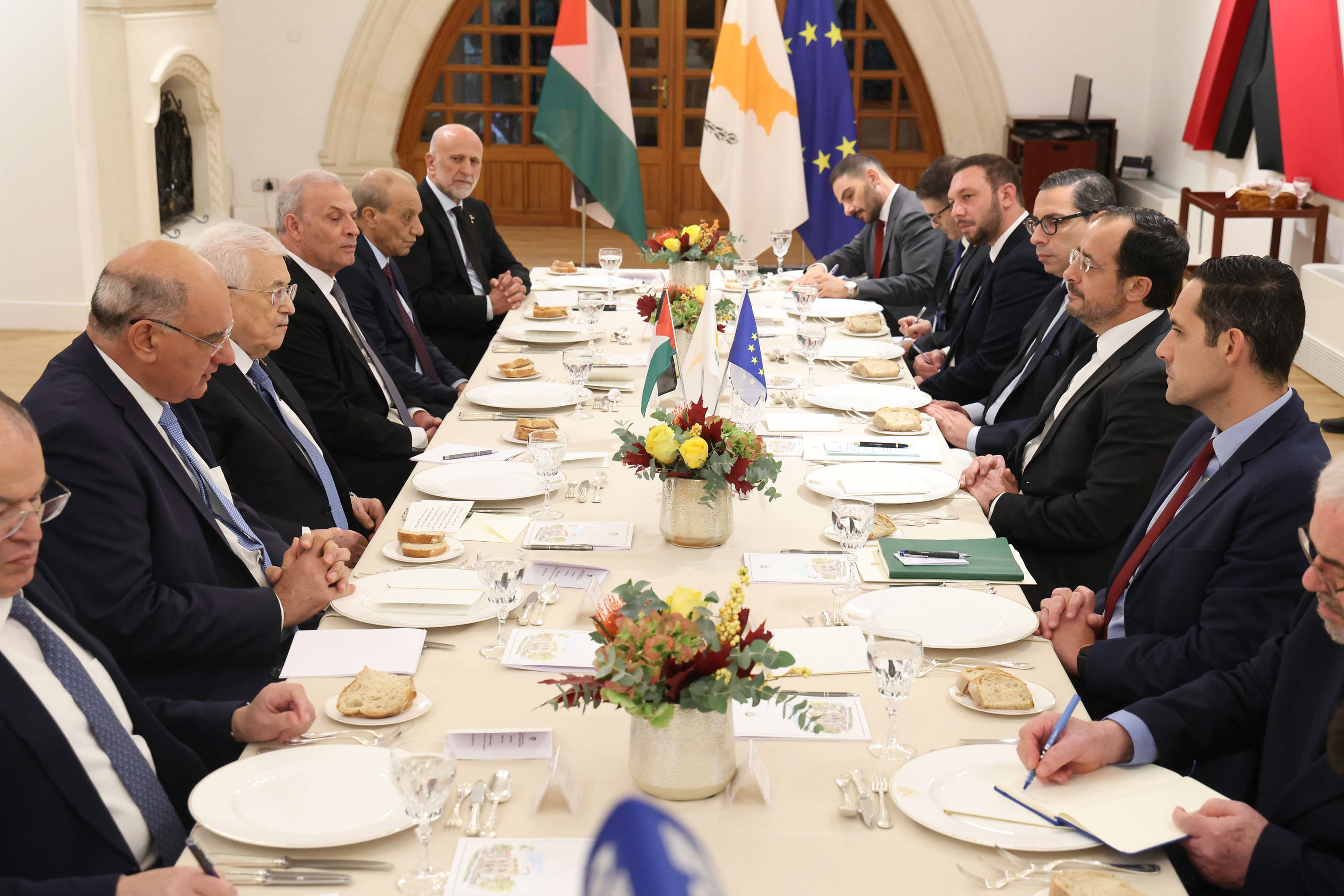
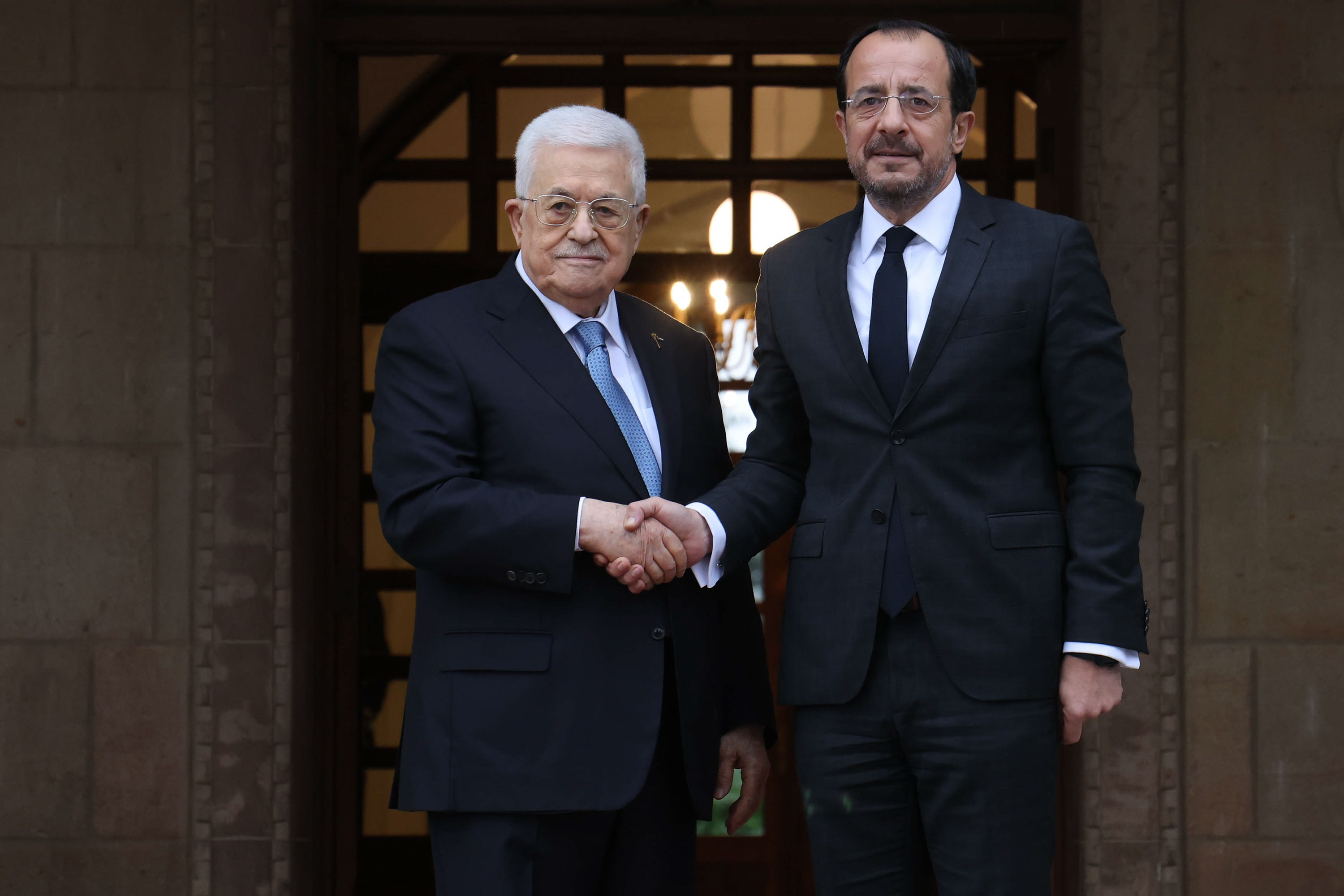
Cyprus can play a “very significant role” in a future peace process between Palestinians and Israelis, Palestinian President Mahmoud Abbas said on Thursday, as he attended a working lunch held at Cyprus’ presidential palace.
“You can play a very significant role. I will not dwell on the excellent relationship which exists between the Palestinian people and the Cypriot people and the Republic of Cyprus, but you also maintain excellent relations, and rightly so, with Israel,” he said.
As such, he said, “you can play a role in mediating between the two sides, based on a political solution rooted in international legitimacy and United Nations security council resolutions”.
Regarding relations between Palestine and Cyprus, he said that “the Palestinian people not only sense their geographical proximity to the Cypriot people, but also perceive a genuine warmth, an existential, human bond, with them”.
He then referred to wider recognition being offered to the Palestinian state by other countries in Europe in recent years, saying that “for some time now, there have been significant developments regarding the European position on the Palestinian issue”.
“By way of example, Spain, France, Germany, Italy and the Netherlands have expressed positions which are nearly identical to the Palestinian stance. This is particularly gratifying for us, as Europe, in general, can play a vital role in reaching a settlement and establishing peace in the region,” he said.
Cyprus ‘conveys concerns of states in region to Europe’
A greater European role in matters, he added, “would benefit all the countries in the region”.
Cypriot President Nikos Christodoulides, meanwhile, said that “the Republic of Cyprus stands ready to play any role you deem appropriate in fostering cooperation within our region”, and that “this is precisely what we strive to achieve through our foreign policy”.
“At the same time, as a European Union member state in this region, we convey the concerns of states in the region to Europe, while simultaneously representing the European Union within the region. We are pleased that this role we have undertaken has been recognised by other member states, as well as by EU institutions,” he said.
He added that “we cannot change geography” and said that for this reason “we must all work together, based on a positive agenda and a positive approach, to achieve our common goals.”
United Nations Cyprus problem envoy Maria Angela Holguin will meet President Nikos Christodoulides on Friday and Turkish Cypriot leader Tufan Erhurman on Monday, as she begins her latest round of contacts on the island.
Erhurman is currently not in Cyprus, having travelled to Ankara on Thursday to attend the Organisation of Turkic States’ leaders’ summit, and as such will meet Holguin on Monday, after he has returned to the island.
Towards the end of her stay, Holguin will hold a tripartite meeting with both Christodoulides and Erhurman on November 9.
The two leaders most recently met on Tuesday, and said after that meeting that both he and Erhurman had “agreed not to make further statements regarding specific issues” related to the Cyprus problem until, at the very least, when Holguin arrives.
Both men had also met the bicommunal technical committees on cultural heritage and on youth, as well as the civil society steering committee, following their one-on-one meeting.
Of those meetings, Christodoulides said that they were “constructive” and that “various views and suggestions were put forward” by committee members.
He added that those suggestions will be discussed by himself and Erhurman going forward.
Christodoulides insists Varosha proposal is ‘mutually beneficial’
Prior to Tuesday’s meeting, Christodoulides had stressed that his proposal to open and repopulate the fenced-off area of Varosha under the United Nations’ administration and open the port of Famagusta under the European Union’s control is “mutually beneficial”.
“I believe this is a mutually beneficial proposal. It creates a positive situation for both sides and serves as a practical test of whether we are truly committed to moving forward, specifically by taking bold confidence-building measures which also send a strong message to society as a whole,” he said.
Erhurman had said last week that he had rejected the proposal, lamenting that it fell short of an entry into force of the European Union’s direct trade regulation.
“Is this the entry into force of the direct trade regulation? No, it is not the entry into force of the regulation, but since [the port] would be under EU control, direct trade would begin,” he said.
As such, he said, the proposal was unbalanced.
The direct trade regulation is a pending EU regulation which would allow Turkish Cypriot goods, as certified by the Turkish Cypriot chamber of commerce, to be exported directly into Europe via the Green Line, and given preferential treatment inside the European single market as European goods.
It was proposed in July 2004, three months after the rejection of the Annan plan to reunify Cyprus by the Greek Cypriot side in a referendum, and shortly after the Republic of Cyprus’ accession to the EU.
Menelaou had cited progress on crossing points
Previously, Greek Cypriot chief negotiator Menelaos Menelaou had said that a dispute over the routing of the planned transit road between Athienou and the Nicosia suburb of Aglandjia “has been overcome”.
He said that the outstanding dispute now remains over the question of whether a planned crossing point to connect Louroujina, the southernmost Turkish Cypriot village, with nearby Lymbia, will open at the same time.
The Turkish Cypriot side’s position is that the road between Athienou and Aglandjia constitutes two crossing points, one in Athienou and one in Aglandjia, and that they are part of a package of four alongside plans for a crossing point in the eastern Nicosia suburb of Mia Milia, and one in Louroujina.
However, the Greek Cypriot side treats the road between Athienou and Aglandjia as one crossing point, counterweighted by the Mia Milia crossing point, and is therefore of the view that the Louroujina crossing point should only be opened if a second transit road, through the Turkish Cypriot Kokkina exclave in the Tillyria region, also be opened.
Palestinian President Mahmoud Abbas on Thursday offered his “warm thanks” to the Republic of Cyprus for the country’s “humanitarian and political support for the Palestinian people”, as he arrived in Nicosia to meet Cypriot President Nikos Christodoulides.
He made reference to the fact that the Republic of Cyprus has recognised Palestinian statehood since 1988, a move which he said “reflects the Republic of Cyprus’ position of solidarity for the rights of the Palestinian people”.
“I believe that the relation between Palestine and the Republic of Cyprus dates back to well before 1988, when there were very close relations between Cyprus and Palestine,” he said.
He then added that he wished to “stress in front of the whole world our warm thanks to the Republic of Cyprus for its humanitarian and political support for the Palestinian people and the Palestinian problem”.
“We are interested in the security of the region, and we are also interested in the security of Israelis. We do not want military friction and conflicts, and we want to solve the problem on the basis of the [United Nations] security council, based on international law, to the benefit of the whole region,” he said.
‘We are in favour of peaceful, popular resistance’
On this front, he stressed that “we have adopted a slogan which we are not embarrassed to say loud and clear, that we are in favour of peaceful, popular resistance which expresses the protest of the Palestinian people in cases where the rights of the Palestinian people are violated”.
He added during a planned one-on-one meeting with Christodoulides, “we will have an extensive opportunity to exchange views on the situation, and on the extent to which the Palestinian people is suffering, whether that is related to the Gaza strip, or the West Bank, or East Jerusalem, which is the legal capital of the Palestinian state, based on international resolutions”.
“For many years, we have been extending an olive branch to the Israeli side, so as to reach a settlement and for peace to prevail, not only directly between Israel and Palestine, but also between Israel and the neighbouring Arab nations, to the benefit of the entire region and world,” he said.
He also made reference to this week’s Israeli elections, saying that “we are still awaiting the final results and the final form of the Israeli government” which will be formed thereafter, but that “as soon as it is formed, we are willing to discuss with them the matter of peace”.
“When [the new Israeli government] is formed, your supporting role, given that you have such good intentions and that you are a neighbouring country, a neighbouring friendly country, will be to work towards a peaceful discussion which will have tangible positive results,” he said.
Christodoulides: Our position on the Palestinian issue is clear
Christodoulides, meanwhile, said of the Republic of Cyprus’ recognition of Palestinian statehood that “our position regarding the resolution of the Palestinian issue is clear, based on the agreed framework of United Nations resolutions”.
“At the same time, current circumstances highlight both the importance we place on our bilateral relations and our commitment to fostering conditions of security and stability in our region,” he said.
He also made reference to the humanitarian aid Cyprus sends towards Palestine and the training offered to Palestinian emergency workers at Larnaca’s Cyclops centre, before returning to the issue of geopolitics.
“Your visit takes place at a critical juncture for our region. I look forward to our discussion and exchange of views, as we explore how we can work together, through a positive approach, to foster conditions of security and stability in the region,” he said.
In this, he stressed that “the Republic of Cyprus is part of the solution to the problems in the region” and “not part of the problems”.
“We are constantly working within this positive framework, and, naturally, we remain at the disposal of Palestine, ready to play whatever role they deem necessary for the Republic of Cyprus to fulfil, so as to achieve our common goals,” he said.
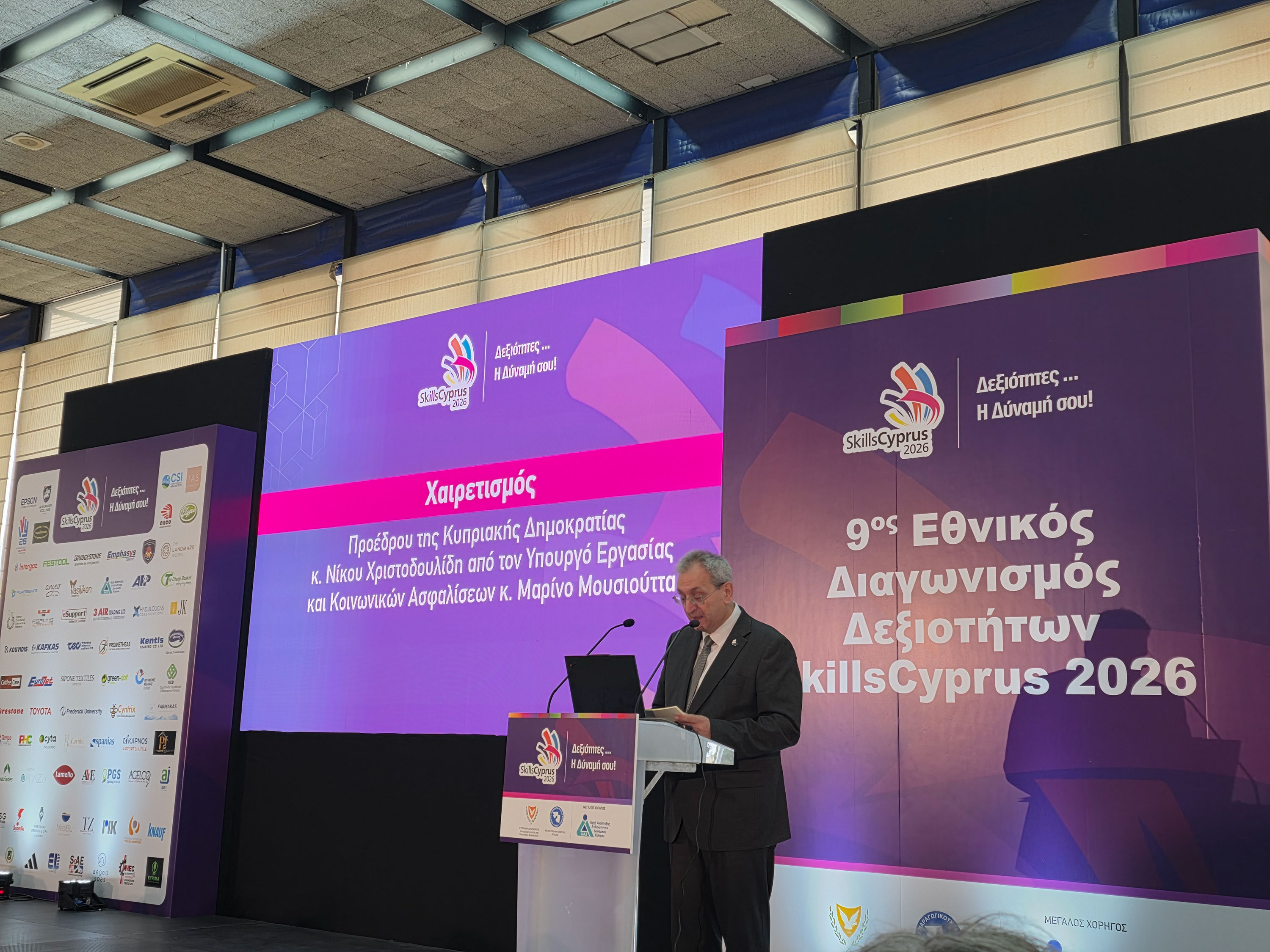
Only 17.9 per cent of secondary education students in Cyprus are enrolled in vocational education programmes, compared with an EU average of 52.4 per cent, President Nikos Christodoulides said on Thursday, highlighting the need to make technical and vocational training more attractive to young people.
In an address at the opening of the ninth National Skills Competition, SkillsCyprus 2026, at the State Fair in Nicosia, read on his behalf by Labour Minister Marinos Mousiouttas, Christodoulides said Cyprus continued to lag behind other EU member states in participation in technical and vocational education.
Citing the European Commission’s latest country-specific recommendations, he said that while Cyprus remained among the EU’s fastest-growing economies, challenges persisted in productivity, innovation and skills development.
The Commission had highlighted the need to address labour shortages and improve employment quality by increasing the participation of vulnerable groups in the labour market and expanding the capacity and attractiveness of vocational education and training.
“Skills competitions aim to contribute precisely in this direction,” Christodoulides said, adding that they helped demonstrate the “excellent prospects for career advancement and professional recognition” offered by technical and vocational fields.
He also referred to the establishment of the Technical Gymnasium, describing it as “an innovation that constitutes a milestone in the Cypriot educational landscape”.
The institution has already expanded since its introduction, he said, demonstrating both the gap created by the previous absence of such a specialised school and the preferences of students.
Christodoulides emphasised the importance of developing digital, green and entrepreneurial skills to prepare young people for the demands of the modern labour market.
Addressing the impact of artificial intelligence, he said technical and vocational occupations involving practical work, judgement, adaptability and problem-solving would not be easily automated.
“Technology will transform many of these jobs, but it will also increase the need for people with modern technical skills who can make use of new tools,” he said.
This, he added, was another reason to encourage young people to seriously consider technical and vocational education as a career path offering meaningful employment prospects.
The president also referred to government reforms, including the introduction of a new system for evaluating teachers and educational work, as well as tax reform, which he said would leave households with more disposable income and support young families and families with university students.
He placed particular emphasis on pension reform, which he said was entering its final stages and had three principal objectives: improving pension adequacy, particularly for low-income pensioners, ensuring fairness in the distribution of contributions and benefits, and safeguarding the system’s sustainability for future generations.
“It is, in essence, a social contract between generations, which we must strengthen today so that we can pass it on securely to our children,” he said.
Christodoulides linked investment in young people’s skills to stronger productivity, competitiveness, economic resilience and social cohesion.
“Internal strength, however, is not built only through numbers and equipment. It is built primarily through people, through the knowledge, skills and talent of our young people,” he said, adding that “every investment in the younger generation is an investment in our country itself”.
Referring to the competition’s international dimension, he said cooperation with European skills development organisations, including those from Greece, Slovenia, Croatia and Poland, reflected the government’s emphasis on international engagement and European cooperation.
Competition expands to 18 skills categories
Cyprus Productivity Centre deputy director Nikos Philippou said this year’s competition had been upgraded, with the number of skills categories increasing from 12 in 2024 to 18 in 2026.
Around 20 interactive “Try a Skill” stations have been established at the venue, allowing visitors to test their abilities in different technical and vocational fields.
The event will also feature presentations by professionals who have distinguished themselves in their respective sectors, while scholarships and prizes have been secured for competitors and visitors.
These include two full scholarships from the School of Automotive Engineering and 15 scholarships worth between €2,000 and €4,000 from Frederick University.
Philippou said the competition was also introducing a volunteering programme for the first time, with approximately 25 volunteers assisting with student tours and interactive activities.
He highlighted Cyprus’ success at the EuroSkills 2025 European competition, where the Cypriot delegation won a bronze medal in the team entrepreneurship competition.
Three-day event at State Fair
SkillsCyprus 2026 runs from October 29 to 31 at the State Fair in Nicosia, with young participants competing across 18 technical and vocational specialisations.
Organised by the Cyprus Productivity Centre, a department of the labour ministry, the competition aims to promote technical and vocational education, showcase young people’s skills and encourage them to pursue vocational careers.
Successful competitors will have the opportunity to join a preparation programme with the prospect of representing Cyprus at EuroSkills 2027, scheduled to take place in Düsseldorf, Germany, from September 22 to 26, 2027.
The competition is open to the public.
The Cyprus News Agency is among the event’s media sponsors.
The European Union and Turkey are preparing high-level talks before the end of October in an attempt to revive negotiations over Cyprus, following an initiative by United Nations Secretary-General António Guterres.
Cypriot President Nikos Christodoulides announced the planned meeting on 16 October during the European Council summit in Brussels, saying discussions would address both the resumption of negotiations over the island’s division and the possibility of improving relations between Ankara and the EU.
The initiative follows diplomatic contacts in New York involving Guterres, European institutional leaders and the Cypriot government. However, renewed differences over the conditions for negotiations have already cast doubt on whether the process can produce substantial progress.
On Sunday, 18 October, Christodoulides accused Turkish Cypriot leader Tufan Erhürman of imposing preconditions before formal negotiations could resume, particularly concerning arrangements for a rotating presidency in a reunited Cyprus.
The disagreement underlines the difficulties facing an initiative intended to reconnect the UN peace process with the EU’s broader relationship with Turkey.
Brussels seeks a negotiating role
Christodoulides said the planned meeting between the EU and Turkey would examine how to establish the necessary conditions for negotiations to restart within the previously agreed UN framework.
He indicated that any improvement in EU–Turkey relations would be linked to progress over Cyprus.
The president’s announcement in Brussels follows months of diplomatic consultations involving the Commission, European Council and UN.
European Commission President Ursula von der Leyen and European Council President António Costa have urged Turkish President Recep Tayyip Erdoğan to support the renewed peace initiative.
Turkey’s relationship with the EU encompasses trade, customs cooperation, migration and regional security. Ankara remains an EU candidate country, although accession negotiations have been effectively stalled for years.
Cyprus remains one of the principal obstacles to any substantial improvement in that relationship.
The island has been divided since Turkey’s military intervention in 1974. The internationally recognised Republic of Cyprus joined the EU in 2004, but EU law remains suspended in areas where its government does not exercise effective control.
The self-declared Turkish Republic of Northern Cyprus is recognised only by Turkey.
Disagreement over political equality
The UN has traditionally sought a settlement based on a bizonal, bicommunal federation with political equality between the Greek and Turkish Cypriot communities.
Negotiations collapsed at Crans-Montana in Switzerland in 2017 amid unresolved disputes over security guarantees, political representation, territory and the presence of Turkish troops.
Erhürman, who became Turkish Cypriot leader in 2025, has expressed support for renewed negotiations within a federal framework. However, he wants assurances about political equality and the structure of future talks.
The latest dispute concerns whether the principle of a rotating presidency between the two communities should be accepted before negotiations resume.
Christodoulides rejected that demand on 18 October, arguing that substantive questions should be negotiated together rather than settled in advance.
The Turkish Cypriot leadership regards rotating executive power as an essential element of political equality, while the Greek Cypriot side objects to making agreement on that arrangement a prerequisite for restarting discussions.
The disagreement has emerged despite recent efforts by the United Nations to improve relations between the communities.
In a statement issued on 13 October, the UN confirmed that Christodoulides and Erhürman had met in Nicosia and agreed to continue discussions, including participation in bicommunal initiatives.
The two leaders subsequently attended a joint event in Pyla, although their public differences persisted.
Turkey’s position remains decisive
A Cyprus settlement would require agreement not only between the island’s communities but also on Turkey’s military presence and the system of security guarantees established at independence.
Ankara has long maintained that Turkish Cypriots require effective political equality and credible security arrangements.
Greek Cypriot leaders argue that the continuation of foreign intervention rights and Turkish military deployments would be incompatible with a fully sovereign and reunited state.
The EU cannot resolve those differences independently of the UN process, but it can influence the economic and institutional framework within which a settlement might operate.
A comprehensive agreement would affect property ownership, trade, customs arrangements, border administration and the application of European law throughout the island.
The European Commission has sought a greater role in supporting the UN-led peace process, reflecting Brussels’ interest in progress towards a settlement.
Negotiations face immediate test
The UN Secretary-General’s personal envoy, María Ángela Holguín, has warned that the opportunity for renewed negotiations may be narrowing.
Disagreements over diplomatic representation, contacts with foreign missions and the status of Turkish Cypriot institutions have complicated relations between the two communities.
Christodoulides has also referred to a series of proposals intended to advance discussions, including the future of the fenced-off area of Varosha. Their full contents have not been publicly disclosed.
The proposed EU–Turkey meeting offers a separate diplomatic channel through which Brussels can assess Ankara’s willingness to support renewed negotiations.
No final date, detailed agenda or list of participants had been publicly confirmed by 18 October.
The immediate test will be whether the parties can agree on the basis for formal talks without attempting to settle disputed constitutional questions before negotiations begin.

 Login