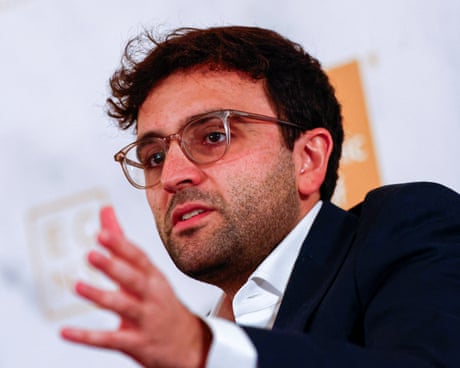
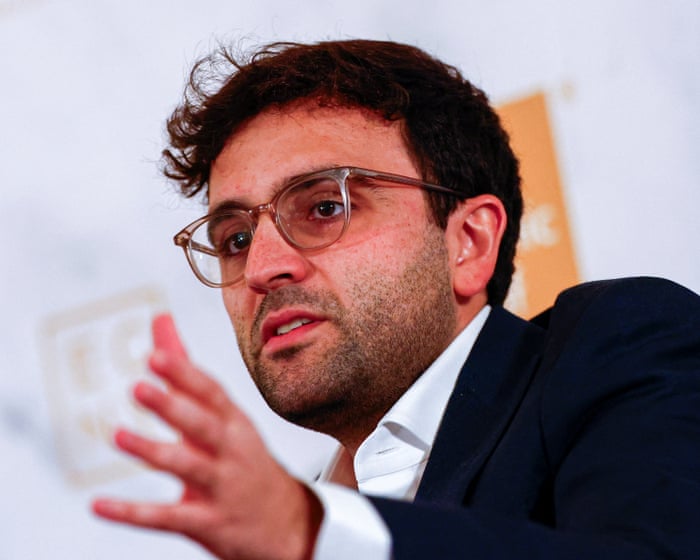
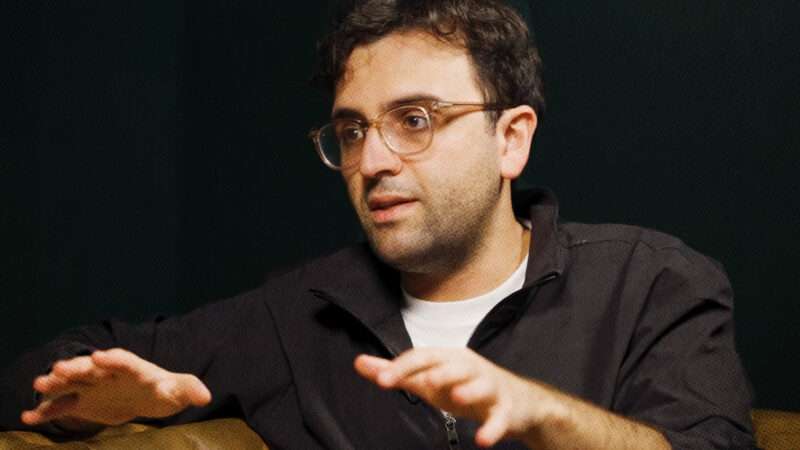
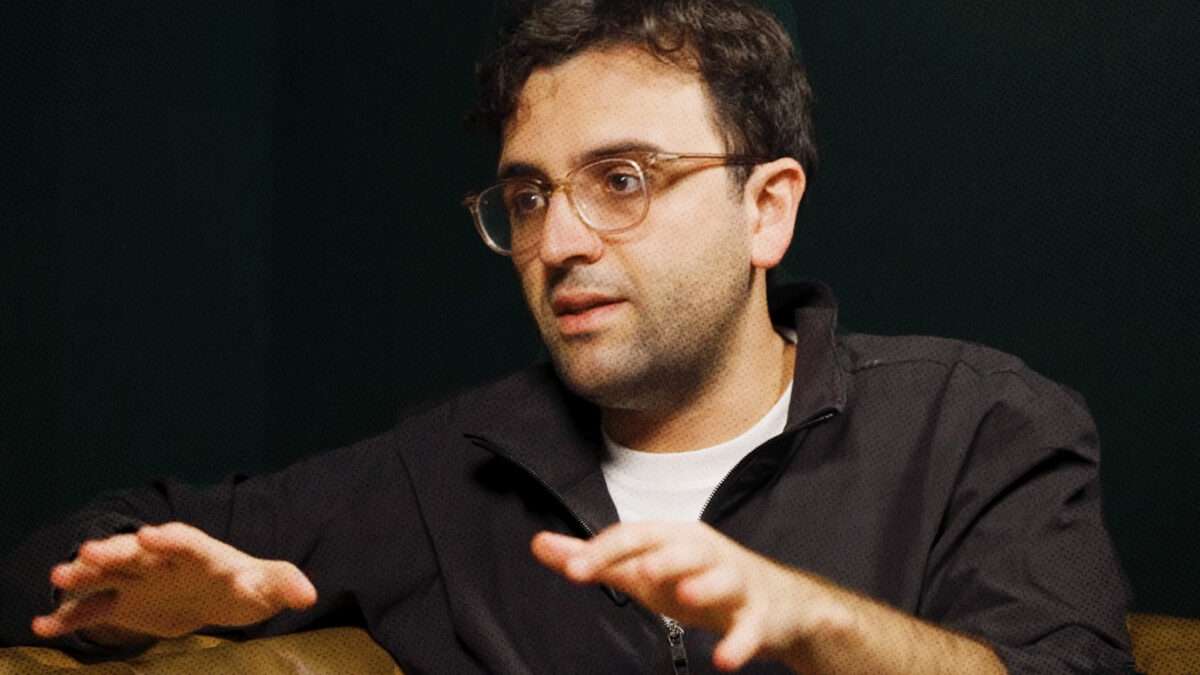
Kalshi CEO Tarek Mansour recently toldReason's Nick Gillespie there's a "big group" of lawmakers in both parties who are "actually" in favor of prediction market platforms. Utah Attorney General Derek Brown is not one of them.
On Wednesday, Brown filed criminal charges in state court against Kalshi, Mansour, and fellow co-founder and chief operating officer Luana Lopes Lara. Mansour, Lopes Lara, and Kalshi are charged with one count of general gambling promotion, a class A misdemeanor; one count of pattern of unlawful activity, a second-degree felony; and 12 counts of online gambling promotion, a third-degree felony.
The feud between Kalshi and Utah has been brewing for quite some time. In August, U.S. District Court Judge Robert J. Shelby found that federal law did not preempt Utah from enforcing its anti-gambling laws against Kalshi, meaning the platform could not legally operate in the Beehive State. Last week, Utah filed a civil suit against the prediction platform alleging it had continued to engage in a "brazen pattern of unlawful conduct." The criminal case comes a day after the U.S. Commodity Futures Trading Commission (CFTC) filed its lawsuit to block Utah from enforcing its anti-gambling laws against Kalshi.
Even though it's been illegal to use Kalshi in Utah since August, Special Agent Scott Eggerman of the Attorney General's Office was able to "create an undercover Kalshi account, using an undercover name and an undercover Visa Debit Card," according to Wednesday's complaint.
All of Eggerman's personal user information identified him as a Utah resident with a local phone number and bank account through a "Utah-based banking establishment." Over two weeks, Eggerman spent $114.87 on a dozen wagers spread across the NFL, MLB, a local college football game, and a Major League Soccer match involving Utah-based Real Salt Lake. In one instance, he lost $20 on a wager that the Troy Trojans football team would upset the Utah State Aggies.
Utah argues Eggerman should never have been able to set up an account, let alone place any wagers on the platform. When Kalshi challenged Shelby's ruling, it asked the U.S. Court of Appeals for the 10th Circuit for an injunction while the appeal proceeded. However, in September, the 10th Circuit denied Kalshi's request for an injunction pending appeal, meaning Shelby's order remained in effect while the court considered the case.
"A federal court has already ruled that Utah's gambling laws apply to Kalshi," Brown toldDeseret News. "Kalshi kept taking bets from Utahns anyway. That is illegal, and we're putting a stop to it."
Utah joins Arizona as the only two states to pursue criminal charges against Kalshi. However, the prediction platform has more than 20 lawsuits and cease and desist actions pending across the country, according to the National Conference of State Legislatures. The issue might soon come before the Supreme Court. Earlier this month, the NFL, 39 states, and Washington, D.C., filedamicus briefs, arguing that conflicting decisions in the 6th and 9th Circuit Courts of Appeals left them unsure whether the states or the CFTC has regulatory authority over prediction markets.
Kalshi is a supporter of Reason Foundation, the nonprofit that publishes Reason. In a statement to the Deseret News, a Kalshi spokesperson called the criminal charges a "crazy overreach" and said Brown was "playing politics." With Shelby's ruling still in effect, so long as Utah considers Kalshi a gambling platform, its continued operation violates state law. Still, the criminal charges are an attempt to strong-arm Kalshi into acquiescing to his demands instead of letting the pending court case play out.
Utah acknowledges that there's been a "rapid increase in volume on the Kalshi platform" from users in the Beehive State. Yet its attorney general seems intent on restricting adults in the state from spending their money as they see fit.
Firm calls charges, which include violating state gambling ban and profiting from illegal activity, ‘crazy overreach’
Utah on Wednesday filed criminal charges against prediction market operator Kalshi and two of its executives, months after a federal judge rejected Kalshi’s effort to prevent Utah from enforcing its strict anti-gambling laws against the activity.
The felony charges could represent a new tactic in how states try to assert regulatory authority over the fast-expanding activity, a clash that appears headed to a showdown at the US supreme court.
The Commodity Futures Trading Commission (CFTC) announced on Tuesday that it has filed a lawsuit against the state of Utah to stop the state’s efforts to shut down CFTC-registered contract markets. The lawsuit follows a lengthy battle the state has been fighting against prediction markets. In August, a federal judge in Utah ruled that the…
Prediction market platform Kalshi is expanding protections for young traders aged 18-20, which includes a new default monthly deposit limit. Accounts in the age range will default to a $2,500 monthly deposit limit, Kalshi announced in a press release Tuesday. They will be automatically placed into “special accounts” that will have extra protections and…
"I think capitalism is a good thing, but I think what we need to contend with and be aware of is that a lot of people are not part of it," Tarek Mansour, co-founder and CEO of prediction market platform Kalshi, recently toldReason's Nick Gillespie. "They don't feel like they're part of it. And that's a reality."
Mansour has set out to change that by making it easier for consumers to experience and participate in financial markets. Kalshi's premise is simple: Mansour says the platform matches traders with differing opinions on the outcome of future events, aggregating the "bits and pieces of information" siloed across the country, so long as that information isn't privileged or obtained illegally.
He's up against a rising number of federal and state lawmakers—not to mention the NFL, traditional sportsbooks, casinos, and other regulated gambling operations—who view Kalshi as yet another gambling app. "As of early 2026, more than 20 lawsuits and cease-and-desist actions are pending across the country, filed by state attorneys general, gaming regulators, tribal governments and private plaintiffs," according to the National Conference of State Legislatures. This includes Utah, whose attorney general, Derek Brown, escalated an ongoing legal dispute with Kalshi on Tuesday by filing a complaint against the prediction market in state district court. In his complaint, Brown called Kalshi an "unconscionable and illegal gambling operation." He accused the company of engaging in a "brazen pattern of unlawful conduct."
At the federal level, Bloomberg Lawreported last Friday that Sen. Ted Cruz (R–Texas) is preparing to introduce a bill after the midterm elections that would give state and tribal governments authority to regulate sports-related event contracts offered by prediction markets.
Cruz's state-by-state regulatory regime is exactly the kind of scheme Mansour wants lawmakers to avoid. Mansour recently toldReason that, ideally, there'd be a "federal uniform set of rules that apply across all 50 states." Those rules would then "promote and foster" a "multilateral, peer-to-peer idea," where, for example, someone in California, Oregon, or Washington could trade on an event's outcome based on information supplied by someone in Texas.
Mansour, who calls insider trading an "unfair dynamic that over time dries up liquidity," also argues that prediction markets are uniquely positioned to self-regulate because trades on Kalshi are "fully transparent," making it "easy to flag" suspicious trading patterns. The platform's users play a key role in that work. Mansour says that in February, when convicted fraudster and former Rep. George Santos (R–N.Y.) tried to engage in insider trading, Kalshi received "a hundred whistleblower complaints within a few minutes."
The company's public commitment to rooting out insider trading on its platform may be laudable. Still, it has done little to dispel the prevailing sentiment among state and federal regulators that Kalshi—and prediction market platforms writ large—is indistinguishable from traditional gambling markets.
Indeed, the legal cases against Kalshi are centered on state regulators' belief that the platforms' sports event contracts are the same as the bets offered by legal gambling operations like casinos and sportsbooks. Kalshi has argued that the U.S. Commodity Futures Trading Commission has exclusive jurisdiction to regulate the kinds of contracts it can offer under federal law, preempting states from exercising any gambling authority over prediction markets.
In March, Arizona became the first state to file criminal charges against Kalshi. Arizona Attorney General Kris Mayes accused the company of "running an illegal gambling operation and taking bets on Arizona elections, both of which violate Arizona law." Not everyone in the state shares Mayes' view. One Arizona resident, Zach, a 35-year-old man who makes a living trading sports-related event contracts on prediction markets, tells Reason he'd "move to another state" if Arizona succeeds in driving out prediction markets.
"There's nothing that is excluding other people from the profits that I'm making right now," he says. "I'm under no obligation to bet on Monday Night Football….I'm able to look at all the markets and decide which ones I want; I'm setting a limit order and just saying, 'OK, if I get my price, then hooray.' If I don't, then that's not something that I add to my portfolio."
Of course, not everyone acts as responsibly. Mansour knows that in any competition, including trading, "some people are going to win," while "some people lose." He believes in "individual freedom" and in the idea that "people should be able to choose" which financial markets they engage in, with "some regulations on irresponsible use" so that companies can't target people who exhibit addictive or destructive betting patterns.
The degree to which Kalshi and other prediction market platforms should be regulated will likely be a high priority for federal lawmakers after the midterm elections and in the next Congress. Mansour appears optimistic that there's enough bipartisan support for what he calls "sensible guardrails." He says there's a "big group" on both sides of the aisle that's "actually pro" prediction market platforms. There's reason to be skeptical of Mansour's claim, given that several members of Congress—such as Sen. Elizabeth Warren (D–Mass.), the ranking Democrat on the Senate Banking Committee—have said prediction markets need to be reined in.
In Mayes' case, her antipathy toward prediction markets might cost her at least one vote in Arizona's attorney general race. Zach says that with Mayes waging a legal battle against Kalshi, he'd have to take that into account "hypothetically, if someone knocked on my door tonight and they want me to vote for Kris Mayes to be reelected."
"If I'm not gonna vote on my own behalf, then who is, right?" he says. (Mayes might not be a fan of Kalshi, but with the platform's penchant for accurately predicting election winners, she can take solace in her current trading position, which shows an 84 percent chance she retains her position.)
Mansour says he's a "free market guy" who wants everyone to "have a shot in the competition." To succeed, he'll have to withstand a host of paternalistic government officials hell-bent on controlling financial decisions made by consenting adults.

 Login