François Picard is pleased to welcome Dr Joseph Downing, Senior Lecturer in International Relations and Politics at Aston University. In modern France, the politics of insecurity increasingly extends beyond questions of crime and public order to encompass deeper struggles over national identity, disappearance of the political centre and erosion of democratic values. The emergence of far-right extremist violence, alongside the persistent stigmatization of ethnically diverse working-class suburbs, raises urgent questions about the relationship between fiery and divisive political rhetoric and far-right radicalization. Downing examines these interrelated challenges against the backdrop of a deadly shooting in the Paris suburbs, allegedly motivated by racist and anti-Muslim hostility.
François Picard is pleased to welcome Vitalii Kim, Minister for Veterans' Affairs of Ukraine. "If Europe will not support us, we also will fight because it's our motherland," says Kim, insisting that Ukraine's determination to resist Russian aggression will endure regardless of the outcome of negotiations over European financial assistance. Yet behind this assertion of national resolve lies a more complex reality: a country confronting not only the immediate pressures of war, but also its mounting psychological, social and institutional consequences.
François Picard is pleased to welcome Vitalii Kim, Minister for Veterans Affairs of Ukraine. “If Europe will not support us, we also will fight because it's our motherland,” says Kim, insisting that Ukraine's determination to resist Russian aggression will endure regardless of the outcome of negotiations over European financial assistance. Yet behind this assertion of national resolve lies a more complex reality: a country confronting not only the immediate pressures of war, but also its mounting psychological, social and institutional consequences.
François Picard welcomes Igor Mladenovic, a French-Serbian sports writer, sports business analyst and former football commentator based in Luxembourg. For Mladenovic, the backlash in China over Kylian Mbappé's playful reference to a meme depicting him in the likeness of Mao Zedong illustrates a dilemma of the digital age: how a seemingly innocuous anecdote from a football superstar can escalate into a geopolitical firestorm.
On 28 May 2026, EU Today published an article concerning Cool Carriers and vessels commercially operated by it in the context of a number of cases involving the trafficking of prohibited substances. The article also referred by name to members of the company’s senior management.
We wish to clarify that Cool Carriers did not own the four vessels referred to in the article, nor did it employ their crews or exercise day-to-day onboard control of those vessels.
Cool Carriers has informed EU Today that neither the company nor Mikhail Ganyushin or Maxim Nazimok has ever been or is under investigation in relation to the matters reported in the article. EU Today is not aware of evidence establishing otherwise. We have also been informed on behalf of the company and the individuals concerned that none has been or is subject to sanctions imposed by the United States, European Union or United Kingdom.
Cool Carriers, Mr Ganyushin and Mr Nazimok deny any wrongdoing in connection with the matters referred to in the article.
EU Today did not intend to allege that Cool Carriers, Mr Ganyushin or Mr Nazimok knowingly participated in, facilitated or were complicit in the trafficking of prohibited substances referred to in the article. We apologise for any impression the article may have given to the contrary. We also apologise for not having approached Cool Carriers and the individuals concerned directly for comment before the original publication.
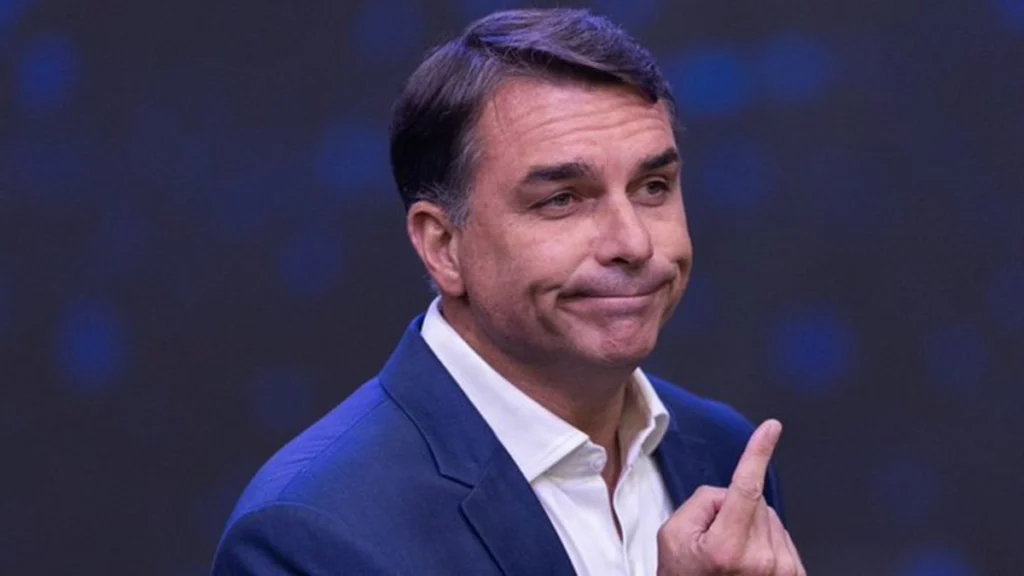
Brazilian President Says Far-Right Senator Should Have Stayed in the Country to Face Criminal Charges.
On Tuesday, President Luiz Inacio Lula da Silva called former presidential candidate Flavio Bolsonaro’s flight from Brazil to the United States a shameful act.
During a celebration of his 81st birthday in Brasilia, Lula said the far-right senator should have remained in the country to answer the criminal accusations against him.
“Those who have nothing to hide have nothing to fear. Democracy must be respected in victory and defeat. Brazil is our home, and it is here that we must face challenges, respect the justice system, and defend our country’s sovereignty,” the Workers’ Party leader said.
Lula then recalled that he had decided to remain in Brazil and serve prison time to “unmask” his accusers and prove his innocence in the Lava Jato case.
Earlier, Worker’s Party lawmakers asked Supreme Court Justice Alexandre de Moraes to order Flavio’s preventive detention and add him to Interpol’s Red Notice list.
Throughout Tuesday, Brazilian and Argentine media outlets tried to establish Flavio Bolsonaro’s whereabouts. The son of former President Jair Bolsonaro is already on U.S. soil with his wife and two daughters, a source close to his family told EFE.
However, no news about Flavio emerged throughout the day, and secrecy still surrounds his departure route and destination city in the United States.
“We still have no information about his whereabouts, only some reports that have appeared in the press,” Sen. Rogerio Marinho, Bolsonaro’s former presidential campaign coordinator, said.
“I received a message from him on my cellphone, a text message, in which he said he wanted to take some time for himself today and would speak with us later,” he told reporters after a meeting with Liberal Party leaders.
Following his electoral defeat, Flavio will also lose his seat in the Senate next February, when the new legislative session begins, marking the first time since 2003 that he will not hold public office.
An electoral victory for the far-right politician would have halted investigations against him, as Brazilian presidents cannot be held accountable during their terms for acts committed before their inauguration.
Timeline of the Flight
The day began with front-page reports in major local media outlets that Bolsonaro had left the country, defying a Supreme Court order barring him from leaving Brazil and requiring him to immediately surrender his regular and diplomatic passports.
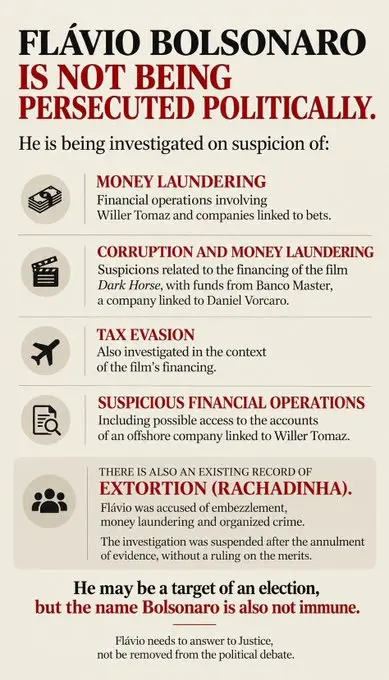
On Monday, Justice Alexandre de Moraes, the rapporteur in the trial that ended with Jair Bolsonaro’s conviction for attempting a coup, gave Flavio 24 hours to surrender his travel documents as part of a money laundering case being handled under seal.
That same day, the 45-year-old senator posted a video on social media saying he had no intention of leaving Brazil, that he would surrender his passports and that he would defend himself against what he described as a “clear attempt at intimidation.” However, the Federal Police canceled the documents on Tuesday after the deadline to surrender them expired.
By then, Flavio Bolsonaro was already on his way to the United States. Argentine media outlets reported that the far-right politician had crossed the border into Argentina to board a private plane bound for the United States from the city of Puerto Iguazu, in Misiones province.
However, the Argentine government said there was no record of the lawmaker entering the country and no formal asylum request.
On Tuesday, President Donald Trump’s administration confirmed that it would issue visas and formally receive Bolsonaro and his family. Trump, a close ally of the Bolsonaro clan, called Brazil’s election “fraudulent,” although he added that he does not govern Brazil when asked whether he would take any action in response.
Flavio will reunite with his brother Eduardo Bolsonaro, who has been living in the United States since March 2025 after fleeing Brazilian justice.
In a drawer at the herbarium of Kew Gardens, in southwest London, there is a dry twig collected in Ghana in 1974. (A herbarium is a library of pressed, dried plants, and Kew’s is among the largest in the world.) Its berries are tiny balls, each about the size of a match head, and they […]
François Picard welcomes Helena Ivanov, Associate Research Fellow at the Henry Jackson Society, a London-based foreign policy and national security think tank advocating liberal democracy, strong transatlantic alliances, robust Western defence capabilities and the international promotion of democratic institutions. Ivanov describes the election as a historic turning point in Serbian politics. After 14 years of Aleksandar Vučić's political dominance, the reported electoral victory of a student-led movement represents, more than a challenge to an entrenched political establishment.
François Picard welcomes Helena Ivanov, associate research fellow at the Henry Jackson Society, a London-based foreign policy and national security think tank advocating liberal democracy, strong transatlantic alliances, robust Western defence capabilities and the international promotion of democratic institutions. Ivanov describes the election result in Serbia as a historic turning point in the country's politics.
François Picard welcomes Jean-Rémi Girard, President of the SNALC teachers’ union, who places responsibility for France’s educational difficulties not simply on demographic change or fiscal constraints, but on years of political decisions that, he argues, have weakened the public education system. Against a backdrop of student protests, budgetary uncertainty and mounting concerns over educational inequality, Girard contends that the French government faces the formidable task of addressing a crisis largely of its own making.
From the 17th to the 20th century, Ukrainian lands were split between empires and states. Their rulers tried to assimilate Ukrainians and block their self-determination by going after what set them apart: their language and culture.
Nobody has an exact count of the bans. Historian Pavlo Hai-Nyzhnyk says there were more than 100 and that the real number is likely higher, because governors issued local bans too.
These measures differed in purpose and reach. Some restricted publishing, schooling, or official use; others suppressed cultural institutions or pushed assimilation. Most served the forced Russification of Ukrainians in the Russian Empire and the USSR. The timeline below is a selection of documented events, not a count of bans.
Russia has not stopped. Since 2014, schooling in Ukrainian has collapsed in the territories it occupies, and in 2025 it removed Ukrainian from the federal school programs it imposes there.
Here are some of the most important restrictions on Ukrainian language and cultural life imposed by the regimes ruling over Ukraine.
Graphic by Ganna Naronina from the article A short guide to the linguicide of the Ukrainian language. Click to enlarge.
17th century
1627: Muscovy. Moscow church authorities condemn Kyrylo Trankvilion-Stavrovetskyi’s Didactic Gospel, a collection of sermons printed in Ukraine in 1619, and order copies burned in Moscow.
1697: Polish-Lithuanian Commonwealth. An act requires tribunal and court decisions in the Grand Duchy of Lithuania to be written in Polish, displacing Ruthenian in those courts.
18th century
1720: Russian Tsardom. Peter I’s decree restricts the Kyiv and Chernihiv presses to approved reprints of church books and requires them to conform to Russian editions, suppressing local textual and linguistic differences.
1728: Russian Empire. Under the Decisive Points (Reshytelni punkty), the legal texts used in the Hetmanate’s courts are to be translated into Russian and compiled into a single code.
1730s: Russian Empire. Under Empress Anna, Kyiv’s archbishop is instructed to replace older locally printed church books with Moscow editions.
1769: Russian Empire. The Holy Synod refuses the Kyiv-Pechersk Lavra permission to print primers in the local language and tells it not to submit such requests again.
1775: Russian Empire. A Russian army destroys the Zaporozhian Sich, the Cossacks’ last stronghold and one of Ukraine’s own political institutions.
1780s: Russian Empire. Samuil Myslavskyi, metropolitan of Kyiv from 1783, insists on literary Russian as the only language of instruction at the Kyiv-Mohyla Academy.
1789: Polish-Lithuanian Commonwealth. The Commission of National Education orders the Ukrainian parish schools of Right-Bank Ukraine Polonized.
19th century
1847: Russian Empire. After suppressing the Cyril and Methodius Brotherhood, a secret society that called for a federation of free Slavic peoples, the authorities ban and withdraw from sale specified works by Taras Shevchenko, Panteleimon Kulish, and Mykola Kostomarov.
1859: Austrian Empire. Austrian officials back a plan to replace the Cyrillic alphabet used for Ukrainian in Galicia with a Latin one. Ukrainian opposition defeats the plan in what became known as the “alphabet war.”
1862: Russian Empire. The authorities close the Sunday schools, free schools for working adults and young people, including Ukrainian ones. They begin reopening under tighter control in 1864.
1863: Russian Empire. Interior Minister Pyotr Valuev’s circular tells censors not to approve Ukrainian religious, school, and popular-reading books, while still allowing fiction under censorship. It claims that most Little Russians themselves argue that “there was not, is not, and cannot be any special Little Russian language.”
1864: Russian Empire. The 1864 statute requires Russian as the teaching language in the elementary schools it regulates.
1869: Austria-Hungary. Polish becomes the internal language of administration and the courts in Galicia. The 1867 school arrangements had already strengthened Polish dominance, while leaving limited room for Ukrainian-language schooling.
1876: Russian Empire. Alexander II’s secret Ems Ukaz severely restricts Ukrainian publishing and bans Ukrainian publications from abroad, Ukrainian stage performances and public readings, and Ukrainian lyrics printed with music. Exceptions allow historical documents in their original spelling and fiction in Russian spelling under censorship.
1881: Russian Empire. New rules ease parts of the Ems Ukaz: Ukrainian plays may be staged with a governor’s special permission. Theater troupes performing only in Ukrainian stay banned.
1883: Russian Empire. Kyiv Governor-General Aleksandr Drenteln bars Ukrainian theater troupes from performing in the Kyiv, Podillia, Volhynia, Poltava, and Chernihiv governorates.
1910: Russian Empire. A circular from Pyotr Stolypin’s interior ministry tells governors to refuse registration to non-Russian national societies, Ukrainian ones included, and to review existing ones for closure. Kyiv’s Prosvita is dissolved the same year.
1914–15, 1916–17: Russian Empire. Russian occupation authorities suppress Ukrainian institutions and publications in Galicia and Bukovyna. The first occupation brings mass arrests and deportations, the destruction of Ukrainian books, and the arrest of Metropolitan Andrei Sheptytskyi.
1923: Soviet Ukraine. Dmytro Lebid, second secretary of the Communist Party of Ukraine, sets out the “theory of the struggle of two cultures,” which holds that the Russian culture of the city is more advanced than the Ukrainian culture of the village. The party rejects it and adopts Ukrainization the same year.
1924: Poland. Three laws of 31 July make Polish the state language of administration and the courts, keep limited rights for minority languages, and set school rules that favor Polish-Ukrainian bilingual schools over separate Ukrainian ones.
1924: Romania. The primary education law requires citizens of Romanian origin who have “lost their mother tongue” to send their children to Romanian schools. Ukrainian historians say it was applied to Ukrainians in Bukovyna.
1925: Poland. The Lviv Underground Ukrainian University, which had taught clandestinely since 1921, stops teaching after police raids and the Polish state’s refusal to recognize it.
1926: USSR. In a letter to Kaganovich and the Ukrainian Politburo, Stalin attacks Oleksandr Shumskyi and Mykola Khvylovyi and rejects Ukrainizing Russian workers “from above,” while still backing controlled Ukrainization of official institutions.
1932–33: USSR. A secret resolution of 14 December 1932 orders the Ukrainian-language paperwork and press of the North Caucasus switched to Russian at once and its schools prepared for teaching in Russian. In Soviet Ukraine, it puts Ukrainization under tighter party control and demands purges of “nationalist” elements. The repression of 1933 dismantles Ukrainization.
1938: USSR. A decree of 13 March makes Russian a compulsory subject in the non-Russian schools of the national republics and regions.
1947: Poland. In Operation Vistula, Polish authorities forcibly resettle about 150,000 Ukrainians to northern and western Poland, under an assimilation policy that sought to keep them below 10% of any locality.
1958–59: USSR. The school reform expands parents’ choice of teaching language and makes the study of Ukrainian optional in Russian-language schools in Soviet Ukraine.
1960s–70s: Romania and Poland. Romania nearly eliminates Ukrainian-language schooling from the mid-1960s. In Poland, Ukrainian schools and Ukrainian classes shrink.
1972: USSR. The party’s resolution on the USSR’s 50th anniversary promotes the “new historical community, the Soviet people,” an idea first voiced in 1961. Soviet ethnographers wrote that the spread of Russian among non-Russian peoples played the paramount role in forming this community.
1978: USSR. The USSR Council of Ministers orders wider study of Russian in the union republics. Ukraine’s implementing resolution of 2 November requires Russian from first grade in Ukrainian-language schools from the 1980/81 school year.
1983: USSR. A resolution of 26 May gives specified teachers of Russian in non-Russian schools in villages and small towns a 15% pay raise from 1984.
1984: USSR. The school reform resolution of 12 April adds two to three hours of Russian a week in grades 2 to 11 of non-Russian schools.
1989: USSR. The Communist Party’s party platform of 20 September calls for making Russian, by law, the language of the whole country alongside the republics’ state languages.
1990: USSR. The April 1990 law on the languages of the peoples of the USSR makes Russian the official language of the Soviet Union, while letting the republics set their own state languages.
21st century
2014–18: Crimea. Under Russian occupation, schooling in Ukrainian collapses. In 2013/14, 12,694 children studied in Ukrainian in 7 schools and 829 classes; by 2017/18, 318 children did, in one school and 13 classes, the UN human rights office reports, noting the figures conflict in places.
2020: DNR and LNR. The so-called DNR votes to amend its “constitution” on 6 March, dropping Ukrainian as a “state language” and leaving only Russian. The so-called LNR does the same in June.
2022: Occupied Kherson and Zaporizhzhia oblasts. Russia’s Education Ministry says on 12 August that schools in newly occupied areas will teach in Russian, with Ukrainian allowed only as an optional “native” language. Occupation authorities then cap Ukrainian at three hours a week, Human Rights Watch reports.
2023: Occupied Donetsk and Luhansk oblasts. Russia removes nearly all Ukrainian literature from local libraries, most likely destroying it, Ukraine’s National Resistance Center reports. The so-called LNR publishes a list of banned books.
2024: International Court of Justice. On 31 January, the court ruled, 13 votes to 2, that Russia violated the UN convention against racial discrimination in how it ran school education in Ukrainian in occupied Crimea.
2025: Russia. Education Ministry Order No. 729, in force since 15 December, removes Ukrainian language and literature from Russia’s federal primary and lower-secondary programs, the UN human rights office reports. Russia imposes these programs on schools in the occupied territories, where about 582,000 children study, the Almenda center says.
What we changed in October 2026
Editor’s note, 27 October 2026: We first published this timeline in 2017. Like many lists of bans on Ukrainian that circulate online, it repeated some claims that have no document behind them. In October 2026, we went back to historians’ work and to the decrees themselves.
We removed about fifteen entries. Most we could not confirm; a few were not about language. We corrected others where the documents say something different: some bans had exceptions, some dates were off by a year, and the end of Ukrainization came in 1932–33. We replaced the old count of 60 bans, which we could not trace, with a historian’s estimate. And we added what Russia has done to the Ukrainian language in the territories it has occupied since 2014.
If you have a document for something we left out, write to us.
Just before half past four, Marine Le Pen took to the stage under the stadium strobe lights at the Zénith Arena in Orléans. The radical-right leader, whom analysts say is on the doorstep of the presidency, is polarising, yet deeply and increasingly popular with her base, and has topped the popularity polls for months in France. This came 24 hours after the latest protests across the country, which included over ten thousand anti-Le Pen demonstrators outside the venue yesterday.
A coin-flip election in Brazil, with little separating the country's left-wing President, Lula, and his right-wing rival, Flávio Bolsonaro. The results of the run-off vote will become clear in a few hours.
It's a coin-flip election in Brazil, with little separating the country's left-wing President Luiz Inacio Lula da Silva and his far-right rival Flavio Bolsonaro. The results of the run-off vote will become clear in a few hours.
After the French protests turned into riots last weekend, the curfews, and then the alleged racist mass shooting yesterday on the outskirts of Paris, there has been much anxiety, planning and preparation ahead of today's protests.
Ukraine’s access to Starlink and Starshield satellite links has been restored to the speeds it had before restrictions that disrupted front-line operations for more than a week, Ukrainian President Volodymyr Zelenskyy said Saturday.
Ukraine's access to Starlink and Starshield satellite links has been restored to the speeds it had before restrictions that disrupted front-line operations for more than a week, Ukrainian President Volodymyr Zelensky said on Saturday.
FRANCE 24's François Picard and Selina Sykes are pleased to welcome New Orleans Saints running back Alvin Kamara as the National Football League (NFL) expands its international reach to Paris. As the Saints prepare to face off with the Pittsburgh Steelers, Kamara calls the occasion as "an opportunity unlike any other" while reflecting on his remarkable career, his interest in representing his country in flag football at the Los Angeles 2028 Olympics, and his ambitions to develop sporting opportunities in Liberia, his parents' country of birth.
Can Europe continue to sustain one of the world's most ambitious social models while falling increasingly behind its major economic competitors? For Pascal Lamy, former European Commissioner for Trade and former Director-General of the World Trade Organization, this question lies at the heart of the continent's mounting economic and political tensions.

 Login