Zazie Beetz also stars in the series from Rowan Joffé, based on a Swedish novel about a retired cop who must once again confront the murderer he helped put behind bars.
December is when streaming companies bring out the really big guns, but November is no wimp when it comes to major releases.
Today we are taking a look at what’s coming to streaming next month, so grab your comfy blanket, put the kettle on and let’s dive right in!
The Greatest – Prime Video (November 4)
The life of legendary boxer Muhammad Ali has been immortalised on screen before, but The Greatest casts a wider net and covers his whole life in detail over an eight-episode series.
Starring Jaalen Best as the legendary boxer, The Greatest follows the transformation of a young Cassius Clay into Muhammad Ali, exploring his struggles both inside and outside the ring.
A major plus for the series is the involvement of Michael B Jordan, who serves as executive producer.
Owen Wilson in Stick
Stick (Season 2) – Apple TV (November 4)
Guys, at this point I would watch anything released by Apple TV. A-ny-thing. I don’t know what’s happening over there, but their creative team is firing on all cylinders and it’s a wonder to behold.
Owen Wilson returns as Pryce ‘Stick’ Cahill, the washed-up golfer who, during season one, rediscovers his love for the sport by mentoring a young prodigy.
Wilson, who I strongly believe was born to play this part, now eyes his own comeback in season two, as he decides to return to professional golf and take a shot at winning the US Open.
Timothy Olyphant and the always welcome Marc Maron return, and to make the whole thing even better, Rhea Seehorn joins the cast as Pryce’s new coach. What more do you want?
The Lord of the Rings: The Rings of Power (Season 3) – Prime Video (November 11)
One does not simply walk into Mordor. Because it is currently under construction.
Amazon’s ambitious Tolkien adaptation returns for its third season, taking place five years after the fall of Eregion.
Sauron’s armies are spreading across Middle Earth, the Elves are fighting desperately to resist him and the Dark Lord is preparing to forge the One Ring.
Morfydd Clark returns as Galadriel, alongside Charlie Vickers as Sauron and Robert Aramayo as Elrond.
The season also introduces Jamie Campbell Bower, of Stranger Things fame, as Galadriel’s partner Celeborn, and Simon Pegg as the voice of the Balrog.
Guarding Stars – Netflix (November 18)
“Supernatural” star Jared Padalecki stars as Jack Stapleton, a famous action movie star who is in need of a new bodyguard. Leighton Meester is the reluctant professional who begrudgingly takes on the assignment and follows her client to his family ranch in Montana.
It is cheesy and predictable, so everything you want from a Christmas movie. Just what the doctor ordered for those cold winter nights to warm your heart!
The Altruists – Netflix (November 19)
Sam Bankman-Fried and Caroline Ellison were among the biggest names in cryptocurrency, and they were making billions before most people had caught up with this new thing.
By 2022, their empire had collapsed. Both eventually ended up in prison, with Bankman-Fried ordered to forfeit $11 billion.
The Altruists dramatises this extraordinary story of love and fraud over eight episodes. Honestly, given how crazy the whole story was, I doubt that the writers had to do any writing at all. Sometimes real life is far more bizarre and outrageous than anything a writers’ room can come up with.
Steps – Netflix (November 20)
There are always two sides to every story. For years we have been listening only to Cinderella’s side of the story, one that painted her stepsisters as evil.
Are they, though?
Ali Wong stars as Lilith, one of Cinderella’s misunderstood stepsisters, who embarks on an adventure to save the kingdom after she accidentally plunges everything into chaos.
Blade Runner 2099 – Prime Video (November 25)
One of science fiction’s most celebrated franchises makes the jump to television.
Set 50 years after the events of “Blade Runner 2049”, this eight-part limited series returns viewers to a futuristic Los Angeles where the distinction between humans and artificial beings remains dangerously blurred.
Hunter Schafer stars as Cora, a fugitive who assumes the identity of a Blade Runner, while Michelle Yeoh plays Olwen, a replicant approaching the end of her life.
Original Blade Runner director Ridley Scott serves as executive producer.
The Hunchback, Soul of Paris – Netflix (November 27)
Having read Victor Hugo’s The Hunchback of Notre Dame, I was always amazed by Hollywood’s lighthearted approach to the source material. The actual book is dark and heart-wrenching. There are no happy endings for anyone and definitely no singing gargoyles.
This film apparently decides to stick closer to the spirit of the novel, taking a far darker approach to Victor Hugo’s legendary character. I say “spirit” because the plot looks like a total deviation.
Set in Paris in 1830, against the backdrop of political unrest and a devastating cholera epidemic, the film follows a disfigured man hunted by authorities who want to use him for medical experiments.
The latest generation of Kindle’s 7-inch e-readers have a new look and new accessories. But are they worth the upgrade given Amazon’s new Kindle prices?
Israelis have voted but, it seems, have not chosen a clear winner.
Exit polls suggest that Prime Minister Benjamin Netanyahu’s right-wing bloc and his principal rival and erstwhile cabinet colleague, Gadi Eisenkot, who once headed the Israel Defense Forces (IDF), are neck and neck in the race to cobble together the 61 seats required for a majority in the 120-member Knesset.
However, whoever wins is unlikely to fundamentally change Israel’s strategic outlook.
A change in the leadership, that is, if Eisenkot becomes the Prime Minister, is unlikely to see any radical departure from Israel’s policies towards the Palestinian issue, Lebanon, Iran, the United States, and even India.
Held on 27 October 2026, it was the country’s first national election since the 7 October 2023 attacks and served as a critical referendum on Netanyahu’s long-standing rule amid protracted regional conflicts. Driven by massive mobilization in liberal bastions and Arab communities, voter turnout surged to 77.7%, marking the highest participation rate in Israel in nearly 30 years.
Arab-majority parties, meanwhile, appear to have made significant gains, potentially emerging as kingmakers in the negotiations that follow in a hung Knesset, though neither Netanyahu nor Eisenkot would like them to play that role, as yet.
For a clear picture to emerge, it will take weeks of complex coalition jockeying. The President of Israel will consult all factions before tasking a Knesset member with forming a government.
If neither Netanyahu nor Eisenkot can assemble a 61-seat majority through floor-crossing defections or a broad unity agreement, Israel will remain in political limbo, potentially triggering yet another national election in 2027.
Netanyahu’s Likud party seems to be emerging as the largest party, but that does not guarantee success in leading the next government; yet in his post-election address a few hours ago, he was confident he could form “a strong new right-wing government”.
However, the more consequential point is not simply whether Netanyahu survives. The more consequential question is whether his departure, should it happen, will fundamentally reorient Israel’s strategic vision. Because, though many considered yesterday’s election a referendum on Netanyahu, it was not necessarily on Netanyahu’s worldview.
Eisenkot and Netanyahu may differ sharply over leadership, accountability and the handling of the 7 October 2023 Hamas attack. They nevertheless share important assumptions about Israel’s security, the threat posed by Iran and the need to maintain overwhelming military superiority.
After all, Eisenkot is not a dove who opposed Netanyahu. He is a hawk who served under him, joined his war cabinet after the attack, and left in June 2024, citing the lack of a post-war strategy. His difference is not ideology, but statecraft.
Now he blames Netanyahu for the unprecedented security failure of October 7.
He has made accountability for that failure central to his challenge- the adequacy of intelligence and preparedness. He also questions Netanyahu’s subsequent conduct of the war and the absence of a convincing political endgame.
When, in September 2025, Eisenkot founded his “centrist” Yashar Party, his slogan was “Israel Must Win”, alongside concepts inspired by former hostages regarding “ a straight, direct path”.
He authored what is called “the Dahiya Doctrine”, which relies on disproportionate, heavy force directed at civilian and dual-use infrastructure in areas used by hostile forces to establish long-term deterrence.
He also strongly favors continuous, low-signature military and intelligence operations to degrade adversaries below the threshold of an all-out war. He explained this military philosophy as his advancement of MABAM (Hebrew acronym for Ma’aracha Bein HaMamilchamot or “Campaign Between the Wars”).
Eisenkot supports aggressive military objectives against Hamas, Iran, and Hezbollah, but sharply criticizes Prime Minister Benjamin Netanyahu over endgame strategy and domestic political motives. He accuses Netanyahu of prolonging conflicts for political reasons – to serve his own political survival rather than national security.
On Palestine, Eisenkot does not believe in the “two-state” formula. He has said Israel must heavily control the area between the Jordan River and the sea. He opposes a Palestinian state, though he would consider the Palestinian Authority preferable to continued Hamas rule if forced to choose.
He favors legal settlements in occupied territories “that serve national interest”, but opposes the present trend of Netanyahu encouraging “settlement blocks” and suggests outpost violence needs military policing, not civilian control.
On Gaza, his plan is blunt – destroying Hamas’s military wing and dismantling its leadership within 18 months through US President Donald Trump’s ceasefire plan or “creative” military means, while retaining an Israeli security corridor and allowing incremental reconstruction.
In other words, Eisenkot’s Palestine policy is essentially the same as Netanyahu’s in substance; it is a change of tone, not of map.
In Lebanon, Eisenkot supports a security zone while seeking stronger American and French involvement against Hezbollah. This is classic IDF establishment thinking — buffer, not occupation.
Netanyahu’s Lebanon war degraded Hezbollah significantly, and Eisenkot, as author of Dahiyeh, would not hesitate to use overwhelming force again. But he is more likely to couple it with a US-led diplomatic arrangement, giving Washington what analysts called “more room to pursue regional diplomacy, including Saudi-Israeli normalization”.
On Iran, Eisenkot has the same goal as that of Netanyahu – Iran must not get a nuclear weapon and deserves attacks. He has told supporters that the conflict is not finished, since Iran retains 440kg of highly enriched uranium, and that the war must end in destruction in case Trump-guided diplomacy of US-enforced restrictions around enriched sites and their eventual dismantlement fails.
In other words, while Netanyahu seeks military decisions to manage Iran, Eisenkot seeks military pressure to compel a diplomatic closure. But for Tehran, the threat remains the same, though Eisenkot may be more predictable for Washington and less prone to unilateral fait accompli.
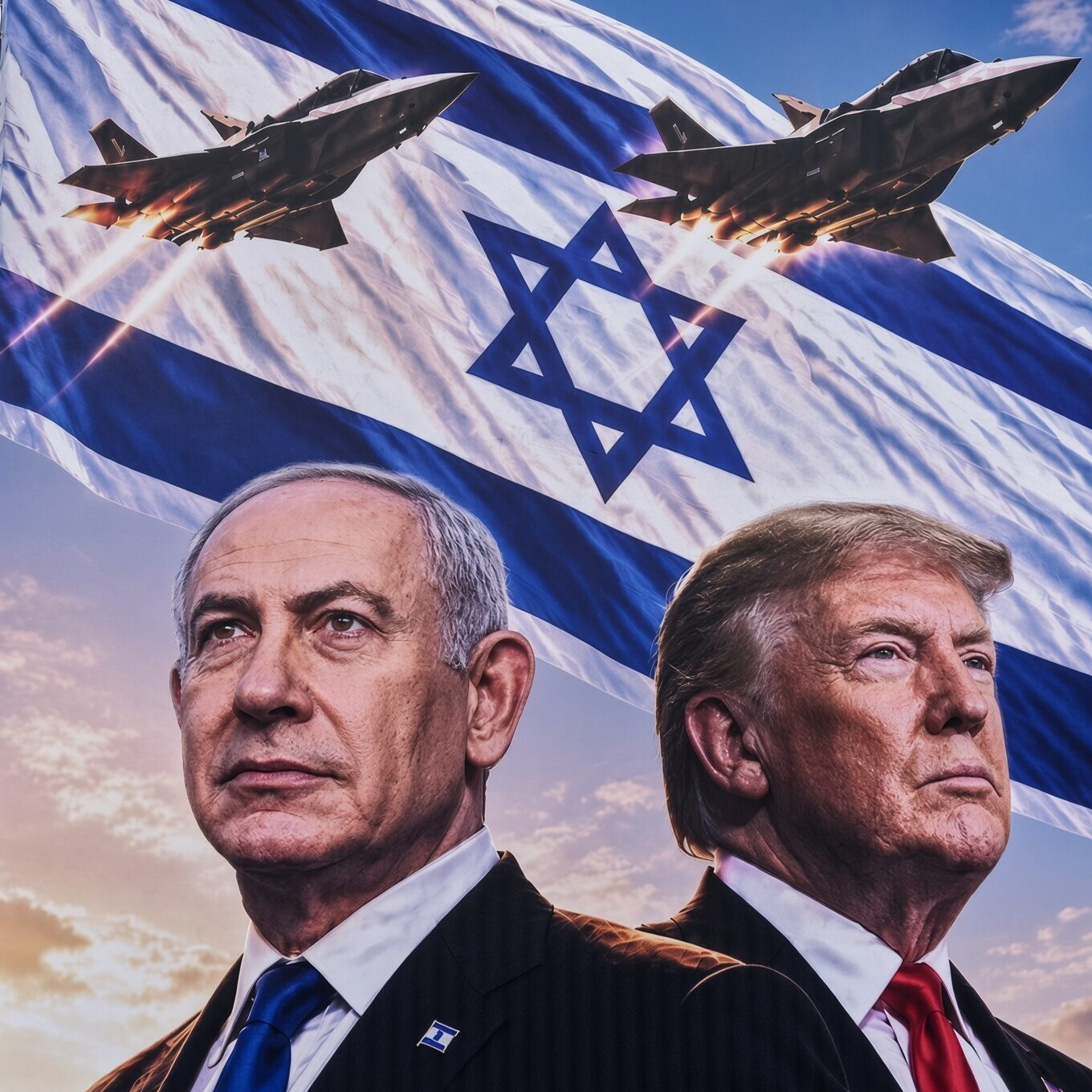
In fact, though Trump endorsed Netanyahu, he has no institutional reason to miss him if the latter fails to save his Prime Ministerial post. Trump’s loss will be strictly personal since he considers Netanyahu a close friend.
American support for Israel rests on intelligence cooperation, military technology, defense assistance and shared regional interests. These foundations are unlikely to disappear with Netanyahu.
File Image: Trump & Netanyahu
An Eisenkot government is likely to value a more structured relationship with Washington, with closer coordination on military operations and a clearer understanding of the political objectives behind them. An Israeli government that consults Washington more closely could reduce the risk of strategic miscalculation in the Middle East.
Similarly, it may be argued that though Indian Prime Minister Narendra Modi, like Trump, will feel sorry for not seeing Netanyahu remain the head of the Israeli government, Indo-Israeli relations on defense, water, agri-tech, and the I2U2 (India, Israel, United Arab Emirates and the United States) framework will continue, as the partnership is now bipartisan in both capitals.
Eisenkot has said nothing that would downgrade India. As the champion of MABAM, he would equally appreciate India’s need for calibrated kinetic options without full war.
An Eisenkot government may actually be smoother for New Delhi. Netanyahu’s far-right partners frequently embarrassed India with statements on Gaza that forced New Delhi’s official balancing, particularly when India’s principal opposition Congress party is a big votary of the Palestinian cause.
A centrist security government of Eisenkot, focused on Iran and Hamas, not on Temple Mount provocations, allows Delhi to maintain its “friend to both” — strong with Israel, credible with Palestine. This also makes it easy for Modi to maintain his pragmatic, open-ended image in the Gulf countries, which he has built solidly over the last 14 years.
However, for China, an Israel led by Eisenkot may not be exactly good news.
Under Netanyahu, Israel maintained a transactional relationship with Beijing. This was visible in major infrastructure projects like the Haifa port, Chinese tech investments, and a deliberate refusal to fully align with US technology bans. This strategy gave Jerusalem some diplomatic and economic autonomy from Washington.
By contrast, a government led by Eisenkot, a former Chief of Staff deeply integrated into CENTCOM interoperability, would likely prefer to restore institutional trust with the US.
He would not like his administration to risk being perceived by Washington as a backdoor for Chinese influence. While basic trade continuity will likely remain with China, screening on dual-use technology, critical infrastructure, and artificial intelligence could become significantly tighter.
In that sense, for China, an Israel led by Eisenkot becomes a less viable strategic hedge against American influence.
Viewed thus, a hung parliament has given Israel a choice between a familiar Prime Minister and a familiar General. It is unlikely that the overall strategic approach will change substantially, though the style could differ if the General becomes Prime Minister.
Eisenkot’s style is likely to be more institutional, more American-aligned, and more predictable.
Author and veteran journalist Prakash Nanda is Chairman of the Editorial Board of the EurAsian Times and has been commenting on politics, foreign policy, and strategic affairs for nearly three decades. He is a former National Fellow of the Indian Council for Historical Research and a recipient of the Seoul Peace Prize Scholarship.
The author can be reached at prakash.nanda (at) hotmail.com
On Oct. 27, 2006, Paramount unveiled Alejandro González Iñárritu's drama in theaters following its premiere in competition at the Cannes Film Festival.
Perry's sister Mia and various friends, former girlfriends and colleagues talk about the actor's genius and his demons in Mary Robertson's three-parter.
'Fresh Off the Boat' star Randall Park is the biggest name in this adaptation of the web series of the same name from production company American High.
On October 22, India’s Indo-Tibetan Border Police (ITBP) chief, Shatrujeet Singh Kapoor, stated while addressing ITBP personnel in Alwar, Rajasthan, that the threat from China continues to persist. He said there had been face-offs between Indian and Chinese troops at several locations in Arunachal Pradesh in the preceding days, and that these were continuing.
Kapoor stressed that conventional military methods alone would not suffice against China, given the People’s Liberation Army’s extensive modernization. He called for stronger drone and anti-drone capabilities.
The ITBP chief’s call for stronger drone and anti-drone capabilities needs to be viewed in the correct perspective. Media coverage of military threats tends to focus on an adversary’s high-value weapon systems—ballistic and cruise missiles, fighter aircraft, bombers, warships and tanks. These systems are conspicuous, expensive and relatively easy to identify, quantify and assess in terms of their capabilities and the threats they pose.
The threat from drones, however, is fundamentally different and often underappreciated. Their low cost, small signatures, ease of deployment, and the difficulty of reliably detecting, identifying, and tracking them make the threat particularly hard to assess.
Drone Evolution
Drone warfare has evolved rapidly since the start of the war in Ukraine in February 2022.
Initially, small drones were widely deployed for short-range reconnaissance and attack, including as loitering munitions. Their range was often limited by their dependence on line-of-sight communications and control.
Ukraine and Russia also fielded medium-altitude, long-endurance (MALE) drones, which provided reconnaissance and strike capabilities broadly analogous to those of close air support aircraft.
However, their effectiveness depends inversely on the strength of the adversary’s air defenses. As a result, both sides have increasingly relied on these drones for reconnaissance and target acquisition, rather than operating them freely in heavily defended airspace.
Drone warfare capabilities have improved significantly since the start of the war through advances in propulsion, navigation, communications and machine vision. The evolution from short-range reconnaissance and attack drones to low-cost, long-range precision-strike systems has created a capability that, in some missions, can compete with that of cruise missiles.
Propulsion
Initially, many drones relied on internal combustion engines, which could be noisy, while smaller electric drones offered quieter operation but generally had more limited range and endurance.
Advances in battery technology have improved electric propulsion, although energy storage remains a constraint.
The development and wider availability of relatively low-cost jet engines have enabled some drones to fly at high speeds and altitudes over long distances, potentially complicating ground-based detection and interception.
Communication
Line-of-sight communications remain important, particularly for smaller drones. Their limitations can be mitigated through relay systems and mesh networking, while satellite links can extend communications beyond the radio horizon.
Geostationary satellite links generally have higher latency than low-Earth-orbit (LEO) satellite links, which can provide lower-latency communications. Together with improved networking, these technologies have expanded the scope for remote piloting and long-range operations. However, communications remain vulnerable to jamming and disruption.
Navigation and Precision Attack
Drones have traditionally relied on satellite navigation (SatNav) and other navigation methods to reach their targets. SatNav is vulnerable to jamming and can become unreliable in contested environments. A significant advance has been the development of AI-enabled terrain matching and machine vision, which allow drones to navigate using terrain features and visual cues rather than relying solely on satellite signals.
Machine vision has also improved precision-strike capabilities through target identification. Meanwhile, advances in counter-drone technologies have helped shape the evolution of strike drones, driving the development of systems designed to overcome increasingly sophisticated defenses.
Drone Development Cycle
Drone development and operational fielding cycles are considerably shorter than those of manned aircraft and helicopters.
Lower development costs and shorter timelines allow drone warfare to evolve rapidly in response to battlefield conditions. Drone designs and capabilities can be tailored to the specific challenges of a battlefield and the objectives of a particular campaign.
The design and capabilities of attack drones depend on the targets they are intended to engage. Attacking bridges, troop concentrations, moving road vehicles, or logistical storage facilities presents different operational requirements and calls for different drone capabilities. These requirements must also account for the counter-UAS systems deployed by the adversary.
The same principle applies to drone interceptors: their capabilities must match the threats they are designed to counter. For instance, countering high-speed, jet-powered attack drones may require equally fast, jet-powered interceptors, although other interception methods may also be effective.
Both the targets to be attacked and the capabilities of the adversary vary from one conflict to another. Consequently, drone development is driven by the specific operational requirements of each battlefield and the continuing interaction between attack drones and the defenses designed to defeat them.
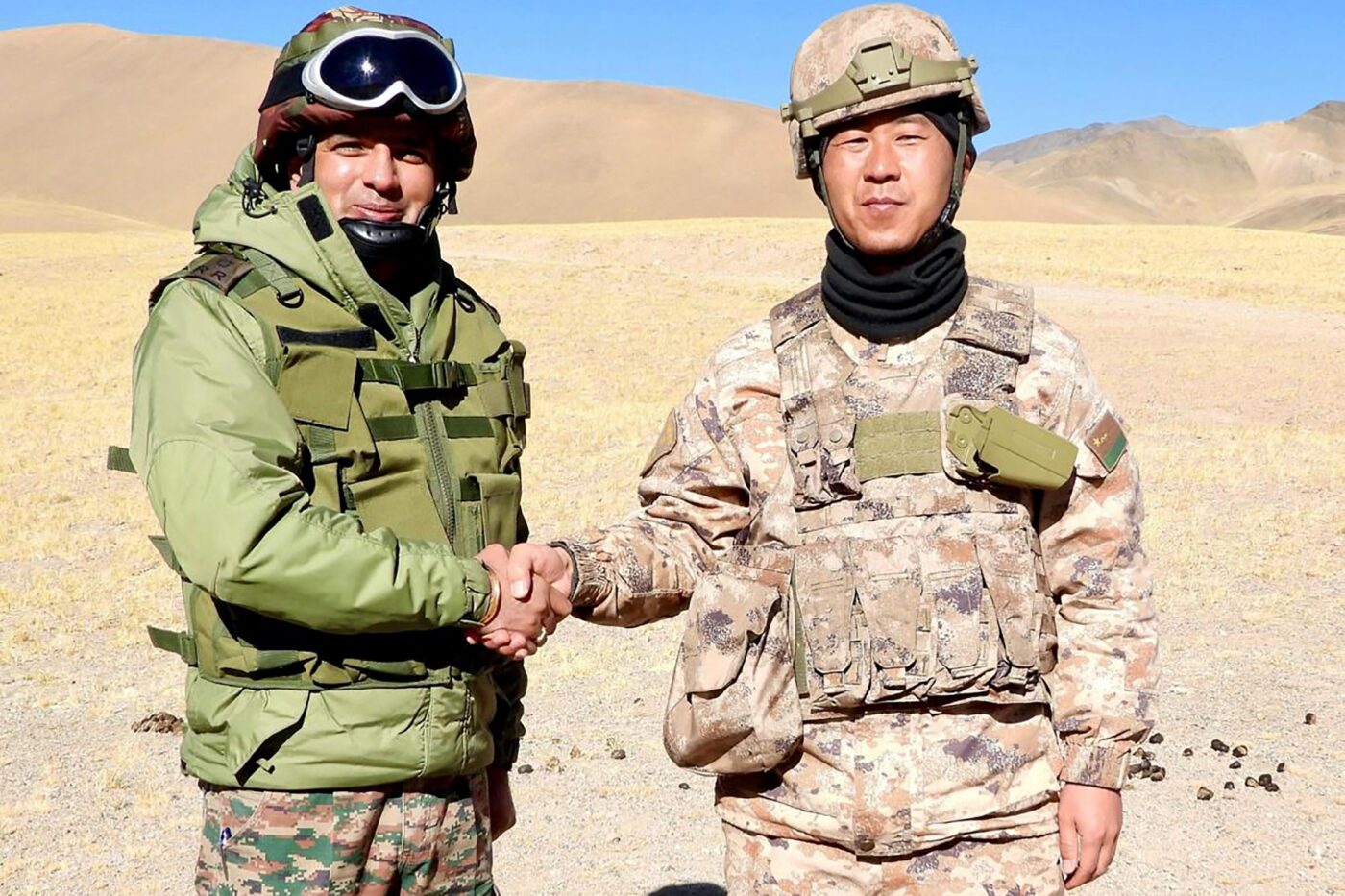
Indian and Chinese army troops greeted each other along the Line of Actual Control (LAC) near the Karakoram Pass in Ladakh on October 31, 2024, on the occasion of Diwali. Chinese troops greeted Indian soldiers and exchanged sweets on October 31 at two points along their contested border to mark a major Indian festival, army sources said, a week after leaders of the Asian rivals held their first bilateral meeting in five years. (Photo by Indian Army / AFP) / XGTY / RESTRICTED TO EDITORIAL USE – MANDATORY CREDIT “AFP PHOTO/INDIAN ARMY” – NO MARKETING NO ADVERTISING CAMPAIGNS – DISTRIBUTED AS A SERVICE TO CLIENTS
Drone Warfare Enabling Technologies
A formidable drone warfare capability cannot be built merely by developing drones with impressive specifications. It requires drones whose capabilities are tailored to specific targets and tactical scenarios. For example, interdicting road supply lines requires drones that can identify and engage moving supply trucks while distinguishing them from other vehicles. Such drones may be unsuitable for attacking bridges.
The key is to master the enabling technologies that allow drones to perform specific tasks.
These broadly encompass five areas:
Propulsion: Low-cost, efficient engines for the required combination of speed, range, and endurance.
Communication: Resilient, low-latency communications, including LEO satellite links, for responsive remote piloting and target engagement.
Navigation: AI-enabled machine vision and terrain matching for navigation that does not depend solely on satellite navigation (SatNav).
Precision attack: Machine vision and target recognition for accurate engagement of intended targets.
Warheads: Payloads tailored to the intended targets and desired effects.
A nation cannot become a leader in drone warfare simply by developing drones. It must master these enabling technologies and continuously improve them to meet evolving battlefield requirements.
India’s mastery of drone-warfare enabling technologies remains limited in several critical areas, particularly when compared with China’s industrial scale and technological capabilities.
The Chinese Threat
China has substantial capabilities in many of the enabling technologies discussed above. More importantly, it has a formidable drone-component manufacturing ecosystem spanning electric motors, flight controllers, sensors, machine vision, navigation and communications modules, as well as drone propulsion.
Its experience with mesh networking can support low-latency drone control and coordination. China is also developing large-scale LEO satellite constellations, although their specific contribution to military drone operations should not be assumed without further evidence.
China could potentially develop and field drones tailored to exploit specific vulnerabilities in Indian Army capabilities or tactics within relatively short periods. It could also adapt its systems to counter tactical innovations introduced by Indian forces.
Along the border, China’s industrial capacity could enable it to manufacture and field drones in large numbers, threatening Indian troop movements by day and night. Supply lines, radars, tanks and artillery could all face persistent drone attacks.
Without comparable capabilities, the Indian Army would risk losing operational ground.
Long-range precision strikes by Chinese drones could also threaten IAF airbases, radars, air-defense units and logistics bases, potentially degrading India’s ability and willingness to sustain a prolonged conflict.
If this scenario seems overstated, consider how Russia, despite possessing a formidable layered air-defense network, has struggled to prevent Ukraine’s sustained drone attacks.
Ukrainian long-range strikes have benefited from intelligence, surveillance and reconnaissance (ISR) support, including Western assistance. Satellite communications, including Starlink, have also played a role in some Ukrainian drone operations.
China possesses substantial ISR and communications capabilities of its own, although their effectiveness in a conflict along the Indian border would depend on operational conditions and the resilience of the systems involved.
Given India’s resource constraints and technological gaps, it could struggle to withstand a sustained, large-scale Chinese drone campaign unless it develops comparable capabilities in drone production, deployment, and counter-drone warfare.
Vijainder K Thakur is a retired IAF Jaguar pilot, author, software architect, entrepreneur, and military analyst.
Welcome to our weekly wrap of what’s happening on stages around town, kicking off with Lily Allen’s concert version of the theatrical work based on her album.
With a tactile dongle for on-the-fly customization and a metal chassis, the Wallhack M-001 is the most fun I've had reviewing a gaming mouse in a long time.

 Login