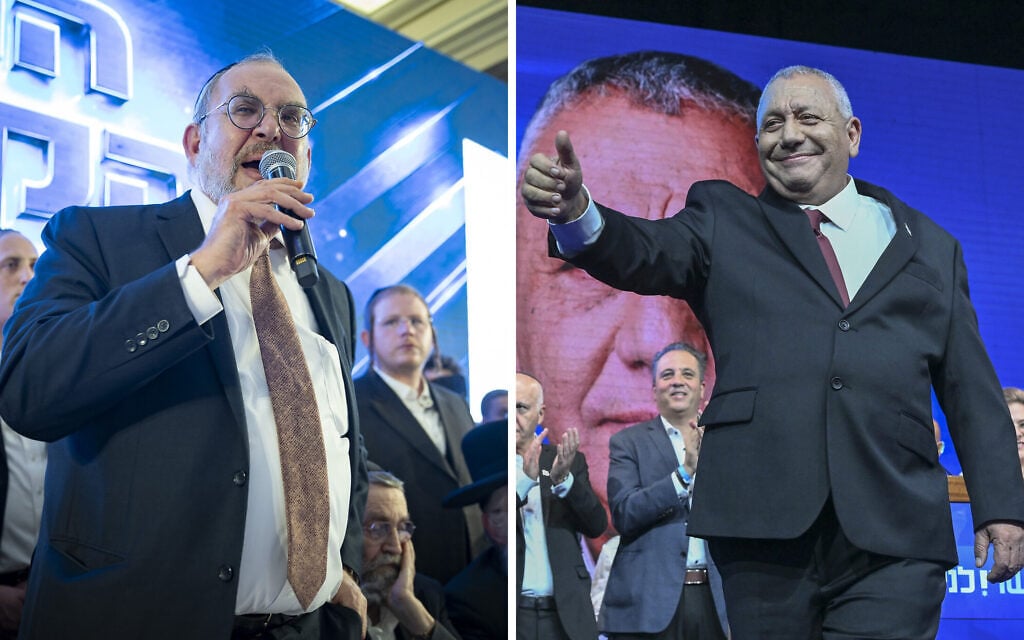
With both blocs short of a 61-seat majority, their leaders and respective allies must decide which divisive issues are worth prioritizing, and which promises are worth reneging on
The ultra-Orthodox United Torah Judaism party would abstain from votes rather than join the coalition, according to Channel 12; military draft remains major obstacle to agreement
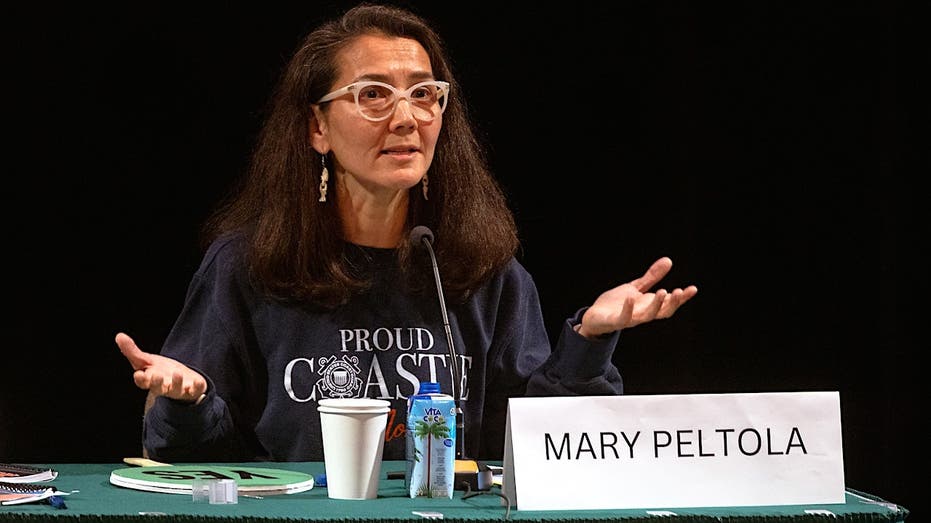
During a rally Wednesday, Alaska Democratic Senate candidate Mary Peltola dismissed a New York Times report alleging her campaign took part in an effort to peel votes away from incumbent Republican Sen. Dan Sullivan to a same-named rival, calling the story a "distraction" used to sell papers.
"This is just another distraction," Peltola said in a video shared on X by local Alaskan writer Matt Tunseth. "It's another diversion. Every day, it’s some new, you know, ‘Look over here moment.’ Not Dan Sullivan, registered Republican, incumbent, voted for this war in Iran 14 times. Lisa Murkowski quit voting for that war in Iran six months ago, and he’s doubling and tripling down."
The New York Times published an investigation Wednesday that described a covert operation, internally dubbed the "ballot composition project," to recruit spoiler candidates with the same name as Sullivan.
According to the report, a Peltola staffer was directed since 2025 to comb through state voter rolls to compile a list of Alaskans named Dan Sullivan.
The operation allegedly involved aides from the Democratic Senatorial Campaign Committee (DSCC), top campaign advisors, party lawyers and an operative who traveled across the state under assumed names.
"The plan worked. This spring, a retired teacher from a tiny fishing village along the Alaska Panhandle, reachable only by air and sea, announced his candidacy for Senate. His name was Dan J. Sullivan," the Times reported.
At the rally, however, Peltola dismissed the report, claiming that it was made to "get subscriptions."
"And this is not somebody who’s working in our best interest. And anybody who’s working in our best interest isn’t going to talk about the nonsense. This is all stuff to sell newspapers. This is all stuff to get subscriptions. Nobody at The New York Times cares about affordability in Alaska," Peltola said.
Fox News Digital reached out to the Peltola campaign and The New York Times for comment but did not immediately hear back.
Sen. Sullivan campaign spokesperson Nate Adams told Fox News Digital, "Instead of admitting she has been caught red-handed in a scheme to manipulate and deceive Alaska voters, Mary Peltola's response is to attack the media outlets she has been lying to for months."
Elisa Rios, Peltola’s former campaign manager who was fired in August, told the Times that while Peltola was not directly involved in orchestrating the project, she was "definitely aware."
In a previous statement to Fox News, the DSCC said it was not involved with the other Sullivan campaign.
"Republicans have a long history of recruiting and propping up candidates in an attempt to boost their own campaigns, including recruiting a prisoner with a New York address to run against Mary Peltola and spending nearly half a million dollars to secure a spot on the ballot in Alaska for an Arizona resident in the Senate race this cycle," a DSCC spokesperson said.
In a statement to The New York Times, Peltola’s campaign said, "The Alaskans for Mary campaign has no involvement with either Sullivan campaign and did not recruit any candidates into the race."
Jason Turkish, fiancé of Democratic Rep. Haley Stevens, who lost to El-Sayed in primary, says voting for Republican Mike Rogers is 'very simple' choice
Shin Bet, whose chief had praised vote on election day, stresses suspicions remain unproven and do not implicate Arab voters as a whole; police say no basis for Likud's claims of stolen election
Next week's election is a pivotal one for Colorado, as voters will decide a pair of ballot questions that could secure the state's low-tax, small-government reputation—or shatter it.
Confusingly, there is a slim possibility that they decide to do both. More on that in a moment.
The two competing ballot measures could hardly be more different. The first, Proposition 136, would cap individual and corporate income taxes at 4.4 percent—the state's current flat rate.
The other, Amendment 87, would rewrite the state's constitution to allow for a progressive income tax. It would also set new rates, ranging from 7.4 percent on income over $500,000 to 8.4 percent on income over $1 million. And it would offer a modest tax cut to the lower end of the income spectrum: Individuals earning less than $100,000 would pay 4.2 percent, while those earning less than $25,000 would pay 3.7 percent.
Even with those offsets, Amendment 87 would be a massive tax increase. Both advocates and opponents agree that it would generate about $2–3 billion in additional annual revenue for the state government.
For now, the higher tax rates created by Amendment 87 would only apply to incomes over $500,000. Unsurprisingly, supporters of the measure are framing this as an opportunity to make the wealthy "pay their fair share."
There are two reasons why that argument is a bit deceiving.
As Jared Walczak, a senior fellow at the Tax Foundation, points out, "the new rates would be statutory, while the authorization for a graduated-rate tax would be enshrined in the constitution, permitting the legislature to adjust rates later." Lawmakers would not have to get permission from the voters to make those changes, so Coloradans would be trading away their flat income tax for a new model where income taxes could be hiked by the legislature at any time.
Second, the new rates are not indexed to inflation. As a result, "a household making $450,000 a year in today's dollars would be moved into a higher tax bracket within eight years if their earnings increased by 3% annually," reportsThe Colorado Sun, which crunched the numbers. Such "bracket creep" would also push more workers over the $100,000 threshold, nullifying the small tax cut for workers making less than that.
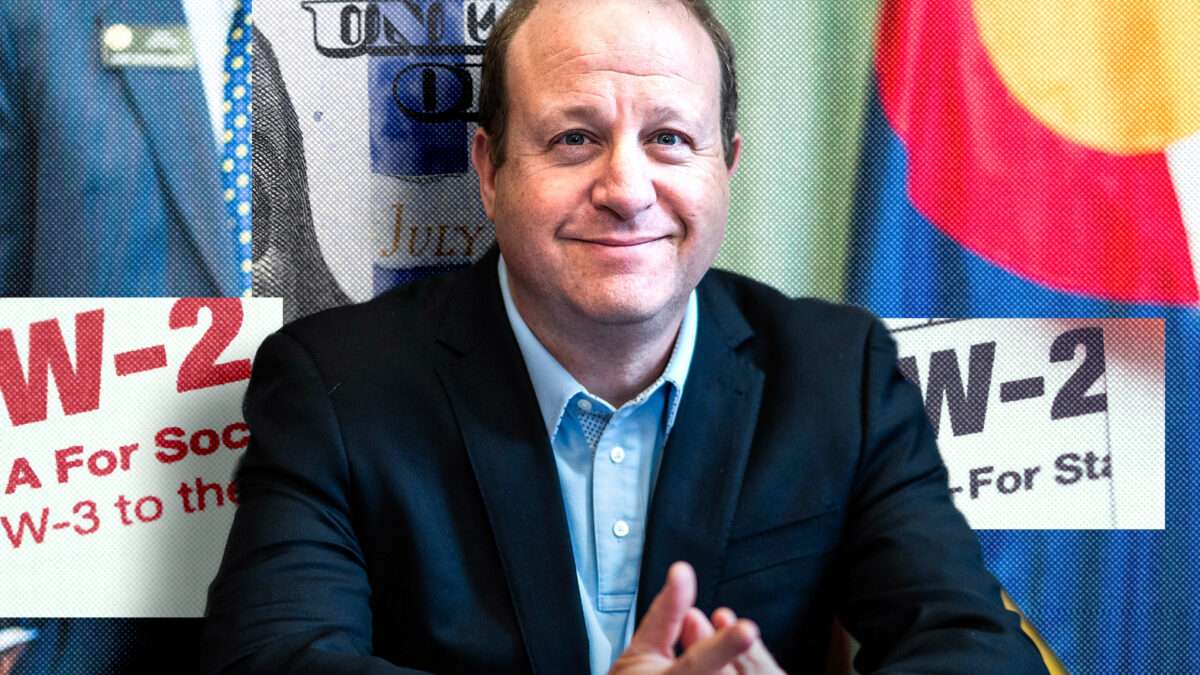
Politically, the progressive income tax proposal is dividing Democrats. The Colorado Democratic Party has endorsed Amendment 87 (along with many of its usual allies, like the AFL-CIO and the state's largest teachers union).
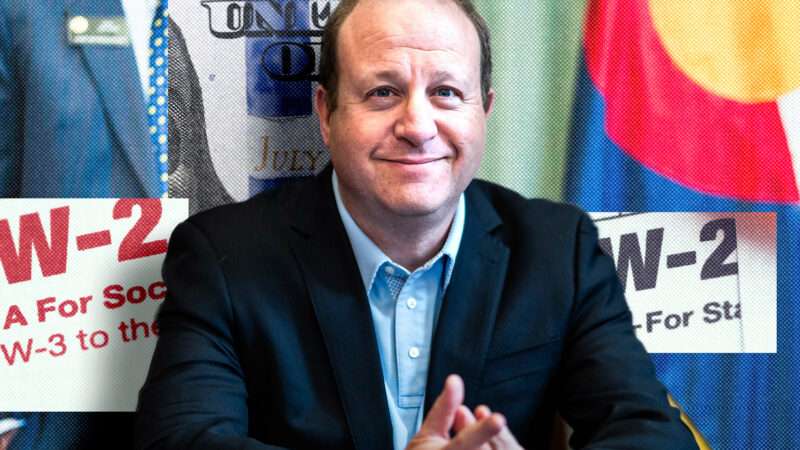
But Democratic Gov. Jared Polis has called the proposal "a huge blank check to politicians" that will "cripple our economy and reduce jobs."
In comments to a Denver TV station, Polis also highlighted how higher taxes in Colorado would make the state less competitive with its neighbors. "Utah has a very similar tax rate to what we have. If ours is double, we can't compete for businesses," Polis told Denver7. "It's game over. We will not be able to attract new employers to Colorado if the voters adopt this."
It's not just Utah. If the amendment passes, Colorado would have a significantly higher top income tax rate than any of its neighbors. (The current highest in that group is New Mexico, with its top rate of 5.9 percent.)
Under Colorado law, constitutional amendments typically need 55 percent approval to pass. However, Amendment 87 requires only a simple majority* because it technically repeals provisions in the constitution, rather than adding new ones. Similarly, Proposition 136—the one that would cap the income tax rate at 4.4 percent—requires just a simple majority.
It is possible, though unlikely, that both could pass. That would create a conflict, since the state's income tax can't be capped at 4.4 percent and also hiked to more than 7 percent on incomes over $500,000.
If that happens, the ballot question with the larger share of support would win, per state law. "In short, that means Amendment 87 would need to both win majority support from voters and surpass Proposition 136 in total votes to go into effect," explains the Denver Post, which has encouraged residents to vote against both ballot measures.
Accordingly, Proposition 136 must win majority support from the voters and surpass Amendment 87 (which needs 55 percent to pass, don't forget) to be implemented.
It is all a bit confusing, but the outcomes are worth watching. Colorado has long been a bit of an outlier among "blue" states for its relatively low taxes and booming population. It's now up to the voters to decide if that remains true.
*CORRECTION: This article incorrectly described how Amendment 87 could be passed into law.
The other Dan Sullivan in Alaska has drawn the most attention, but both parties are quietly trying to use little-known candidates in other battlegrounds to siphon votes, too.
Dan J. Sullivan, a retired teacher in Alaska, was recruited by Democratic operatives to join the race against Senator Dan S. Sullivan, a Republican, whose allies have been left worrying that voters will be confused.
Why do the ruling classes in China appear so paranoid, asks John MacNab. Surveillance is everywhere, yet Communist Party officials seem to live in a permanent state of paranoia and oversensitivity to perceived slights.
House Majority Leader Steve Scalise (R-La.) on Wednesday stressed that Republicans could hold on to their control of the House if there’s strong voter turnout on Election Day. NewsNation’s Katie Pavlich asked Scalise if he was preparing for a Democrat-led House that would look to investigate President Trump and his family or impeach Trump for…
House Majority Leader Steve Scalise (R-La.) on Wednesday stressed that Republicans could hold on to their control of the House if there’s strong voter turnout on Election Day. NewsNation’s Katie Pavlich asked Scalise if he was preparing for a Democrat-led House that would look to investigate President Trump and his family or impeach Trump for…
Republican Iowa gubernatorial candidate Zach Lahn vowed to protect girls’ sports, keep age-inappropriate books addressing transgender topics out of elementary schools, and safeguard unborn children during a recent gubernatorial debate, emphasizing the importance of protecting vulnerable populations and preserving Western cultural institutions.
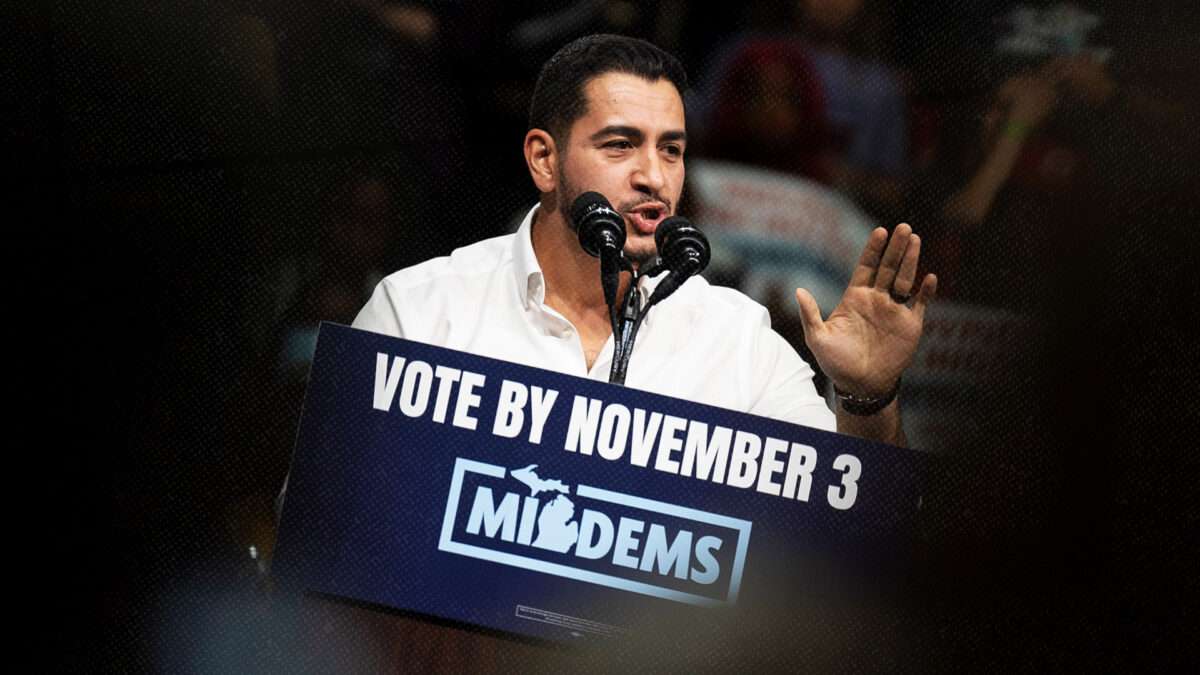
When Abdul El-Sayed ran for governor of Michigan in 2018, progressive media hailed him as the next Barack Obama. El-Sayed did not appreciate the comparison. "I get compared to Obama because my name is funny, and I'm brown, and my politics are about inspiring us to believe in each other again," he toldVox at the time.
In El-Sayed's telling, Obama was a "fairly centrist, middle-of-the-road" Democrat. He did not intend that as a compliment. El-Sayed believed the administration's policies were not nearly progressive enough—indeed, he believed Obama had betrayed the agenda he ran on. The far-reaching financial, environmental, and labor regulations that Obama pushed through were not nearly enough for El-Sayed.
El-Sayed ultimately fell short in the 2018 Democratic gubernatorial primary. Eight years later, he's a much savvier political operative; now running for the U.S. Senate, he has welcomed Obama's support this time. Yet El-Sayed's commitment to a left-wing agenda has hardly diminished. If he defeats his opponent, former Rep. Mike Rogers (R–Mich.), he will be one of the most far-left politicians to win a statewide election in recent memory—and in a purple-ish swing state that President Donald Trump won twice.
Like his friend and mentor Sen. Bernie Sanders (I–Vt.), El-Sayed is not a member of the Democratic Socialists of America (DSA); unlike Sanders, El-Sayed maintains that he is a capitalist rather than a socialist. Yet his political project has much in common with the DSA, and he has given every indication that he will align himself with DSA-affiliated members of Congress—veterans such as Rep. Alexandria Ocasio-Cortez (D–N.Y.) and likely newcomers such as Darializa Avila Chevalier and Claire Valdez, both of New York, who rode similar waves of populist resentment to victory over establishment Democrats.
El-Sayed's left-wing bona fides were evident during his debate with Rogers on October 8. The Democrat proposed giving the federal government vast new powers: up to 50 percent control over AI companies, a socialized health insurance program along the lines of Medicare for All, and price controls on the domestic oil industry. Asked what he would do to bring down the national debt and pay for all the new spending he wants, he had a simple, three-word answer: "Tax. Billionaire. Wealth."
El-Sayed's support for higher taxes exempts one important constituency: seniors. Like many Democrats—andRepublicans such as Rep. Nancy Mace (R–S.C.)—El-Sayed wants to exempt retirees from property tax increases, a policy that critics have branded "total boomer luxury communism" because it forces younger, less wealthy Americans to shoulder ever more of the social burden. The new wave of leftist Democrats think that higher taxes on the 1 percent, combined with cuts to the military budget, would be sufficient to pay down the debt while vastly expanding the social safety net.
In fact, El-Sayed has proposed tying Pentagon spending to education, such that an increase in money for the military would necessitate more funding toward schools. Don't expect this to work the other way around: Under El-Sayed's plan, a decrease in Pentagon spending would not force the government to stop throwing so much money at failing schools.
Ann Arbor and Onward
El-Sayed was born on Halloween in 1984. He grew up in Bloomfield Hills, an affluent, predominantly white suburb north of Detroit. His parents divorced when he was young, and El-Sayed lived with his Egyptian father and white stepmother. In high school, he was captain of the football, wrestling, and lacrosse teams. He continued to play on a club lacrosse team at the University of Michigan, which he attended from 2003 to 2007. (We overlapped briefly, though I never met him: I attended Michigan from 2006 to 2010.)
That meant going to Ann Arbor, a progressive college town with a long history of radical activism. Students for a Democratic Society (SDS), the prototypical '60s New Left student activist group, was founded in Ann Arbor in 1960; its first president, Alan Haber, still lives there. The White Panther Party, a sort of hippie counterpart to the Black Panthers, was based in Ann Arbor for a while; in the 1970s, the socialist Human Rights Party won multiple seats on city council. Liberalism, as well as radicalism, has thrived in Ann Arbor: The same year the SDS was born, future President John F. Kennedy came to the town to propose the international volunteer organization that eventually emerged as the Peace Corps. In the 2008 Democratic presidential primaries, the student-run Michigan Daily naturally endorsed the inspirational liberal candidate, Obama, over the establishment favorite, Hillary Clinton.
Over the course of the next decade—as left-wing enthusiasm for the Obama project faded and was replaced by bitter disappointment—El-Sayed enrolled in Oxford University and then Columbia University, pursuing a career in public health. (He never completed a residency, which has led to some scrutiny, even from friendly media figures, regarding his decision to describe himself as a physician.) In 2015, the mayor of Detroit appointed him the city's executive health officer. He resigned that position in 2017 to run for governor. That pattern repeated itself a few years later: He was appointed health director of Wayne County, which includes Detroit, in 2022, and resigned in 2025 to run for Senate.
Unlike in 2018, El-Sayed's hard-left politics and contempt for the Democratic establishment were now well-calibrated to prevail in the primaries. He defeated a more moderate candidate, Rep. Haley Stevens (D–Mich.), in part due to her support for Israel—an issue that El-Sayed frequently discusses. The same phenomenon has played out all over the country, with establishment Democratic figures paying a huge price when perceived as indifferent to voter outrage over Israel.
What works in the Democratic primaries does not always do as well in the general election. But while El-Sayed's politics are well to the left of the state he seeks to represent, the president's unpopularity may be enough to push him over the finish line. El-Sayed is narrowly ahead of Rogers in the latest polling. The Republican has finally resorted to breaking with the president on key policy issues—he has said that he wishes to end some of Trump's tariffs, conceding that "Canada is not our enemy"—but it may be too little too late.
Moreover, El-Sayed's left-wing foreign policy positions, which are not necessarily antithetical to libertarian views, count for more in Michigan than in other places. The state has a significant Arab-American population that politicians have ignored at their peril. In 2024, dissatisfaction with President Joe Biden's failure to curtail Israel's war on Gaza prompted many Arabs in Michigan to cast ballots for Green Party candidate Jill Stein, or even Trump, over Democratic nominee Kamala Harris. Republicans have sought to portray El-Sayed as insufficiently supportive of Israel, but that doesn't always play well in Michigan—particularly at a time when dissatisfaction with Trump's blunders in the Middle East is strong among Democrats, independents, and even many Republicans.
El-Sayed does have a possible Achilles heel on foreign policy: His association with the far-left Twitch streamer Hasan Piker. To many outside observers, the candidate's courting of Piker reads as a huge unforced error. Not only did El-Sayed seek the approval of an internet personality best known for praising authoritarian governments and evincing sympathy for terrorist groups, but he brought Piker to Michigan, put him in front of a camera, and made him a de facto representative of the campaign. For everyone except the toxically online, Piker is a bizarre and marginal shock jock, a man who says things like "America deserved 9/11." Piker is what happens when you pay too much attention to podcasts. He is also a reminder that while the insurgent left often claims to speak for ordinary, blue-collar working people, its agenda tends to be most popular with the affluent and elite-educated. In El-Sayed's showdown with Stevens, polls had her up 22 points with noncollege voters and 46 points with black voters. (Stevens herself is white.)
Yet El-Sayed prevailed, and he dealt with the Piker issue by shunting him to the sidelines. When asked about Piker, El-Sayed dutifully recites that a Twitch streamer from California has nothing to do with a Senate race in Michigan. (The obvious retort is Well, you brought him here.) He has also adopted right-coded language to explain why he should not be held responsible for Piker's inflammatory comments, tellingPolitico that he was over "this whole gotcha game, platform policing, cancel culture."
The GOP, meanwhile, may have gone overboard in the other direction. Rogers, a traditional Republican more in the George W. Bush mold than the Trump mold, is not exactly a right-wing firebrand, yet he could not stop himself from suggesting that El-Sayed has some sort of connection to Islamic terrorists. Just as Democrats should genuinely worry that linking up with people like Piker will cost them Jewish votes, Republicans should think more about whether reflexively calling Muslims terrorists is a bad strategy to win in Michigan.
After all, the form of radicalism that El-Sayed typifies is not really Islamic. It's not even foreign. It's the radicalism of left-wing economics, of making the federal government larger and more robust. He wants to prohibit corporations from buying houses and to punish companies like Airbnb over "housing dislocation." He wants to raise the capital gains tax, the inheritance tax, and the top marginal tax rates. He wants to give the Federal Trade Commission expansive new powers. He thinks higher education should be free for everyone. If he makes it to the Senate, El-Sayed will be a reliable vote for the Sanders agenda, including moratoriums on new data center construction, a much stronger Environmental Protection Agency, and, of course, Medicare for All. Indeed, one of El-Sayed's most frequent criticisms of Obama over the years has been that the Affordable Care Act did not go nearly far enough, and that it may have even been counterproductive to the mission of building a socialist health system.
Obama appeared alongside El-Sayed in Detroit on October 24. The candidate was savvy enough not to bring up his thoughts about Obamacare.
This Week on Free Media
I explain why it would be wrong to nationalize Elon Musk's companies.
Worth Watching
I finally watched You Can See Everything, Nathan Fielder's quasi-documentary about Theranos founder Elizabeth Holmes. It was made with considerable technical skill, and there's plenty to like about it—but ultimately I landed in the same camp as Reason's Christian Britschgi. We will discuss the film on this week's episode of Freed Up; look for that later today on the Free Media YouTube page.
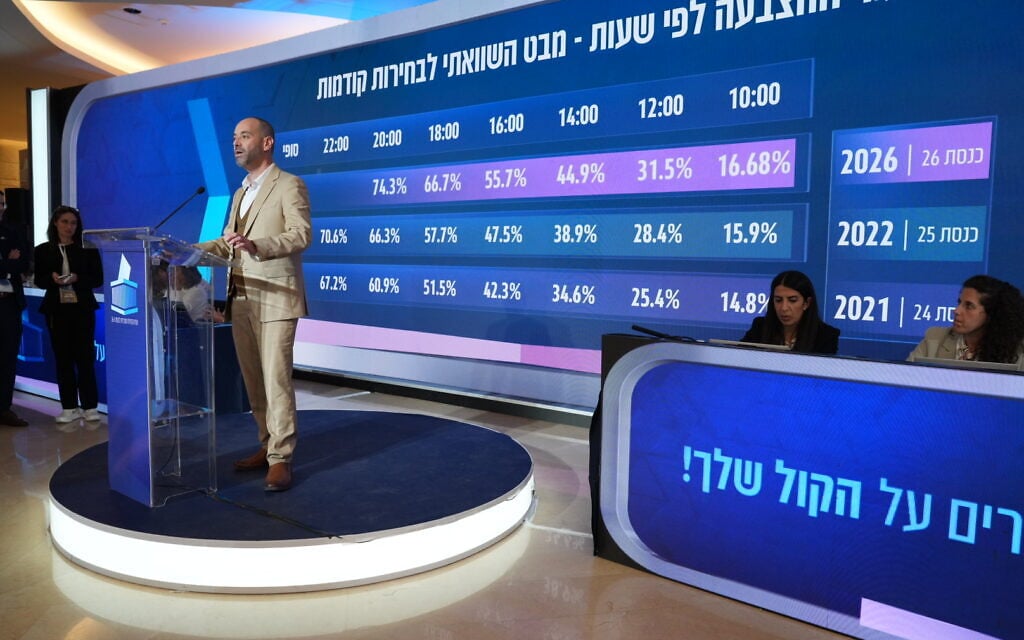
Security agency said to provide Sohlberg with info on possible Qatari campaign to sway Arab vote; Likud decries 'stolen' election, Eisenkot warns against delay in swearing in Knesset
Democrats need to flip four Republican-held Senate seats to regain the majority, but some of their targets are in states President Trump won by double digits in 2024. Our election data reporter Evan Reynolds explains just how difficult that might be.
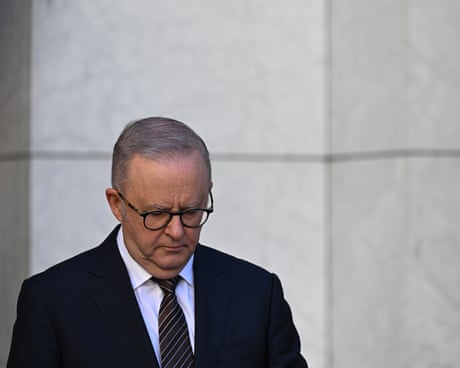
Anthony Albanese has ruled out major cuts to health, education and essential services in December’s mid-year budget update, but conceded savings are required as Labor struggles to curb accelerating inflation.
Amid growing pressure from within Labor’s own ranks, as well as from the opposition and business, Albanese said the Coalition was hypocritical in not supporting existing savings proposals, including the government’s plan to reduce the private health insurance rebate for people over 65.
President Trump had lashed out at Mary Peltola after The New York Times reported that her campaign and national Democrats helped recruit spoiler candidates to the race. He offered no explanation of what crime may have been committed.
President Trump campaigned this month for Senator Dan S. Sullivan of Alaska, a Republican running for re-election this year against Mary Peltola, a Democrat and former congresswoman.
Concerns raised about appointment of former federal senator, Amanda Stoker, who has previously supported the rights of people accused of sexual assault
Women’s safety advocates have raised concerns about the appointment of rightwing Queensland MP Amanda Stoker as the state’s minister for the prevention of domestic violence in light of her resurfaced statements that people should not “blindly” believe women who make allegations of violence.
Stoker, who was appointed to the role on Saturday, argued in a 2023 article that the recent push to believe complaints “rather than carefully assess[ing] relevant evidence” would harm innocent defendants.
The White House has been rocked by turnover and anxiety over the midterms. The president, who is tightening his inner circle, has lashed out at critics, held meandering rallies and feasted on a diet of news clips and “A.I. slop,” as one aide put it.

 Login