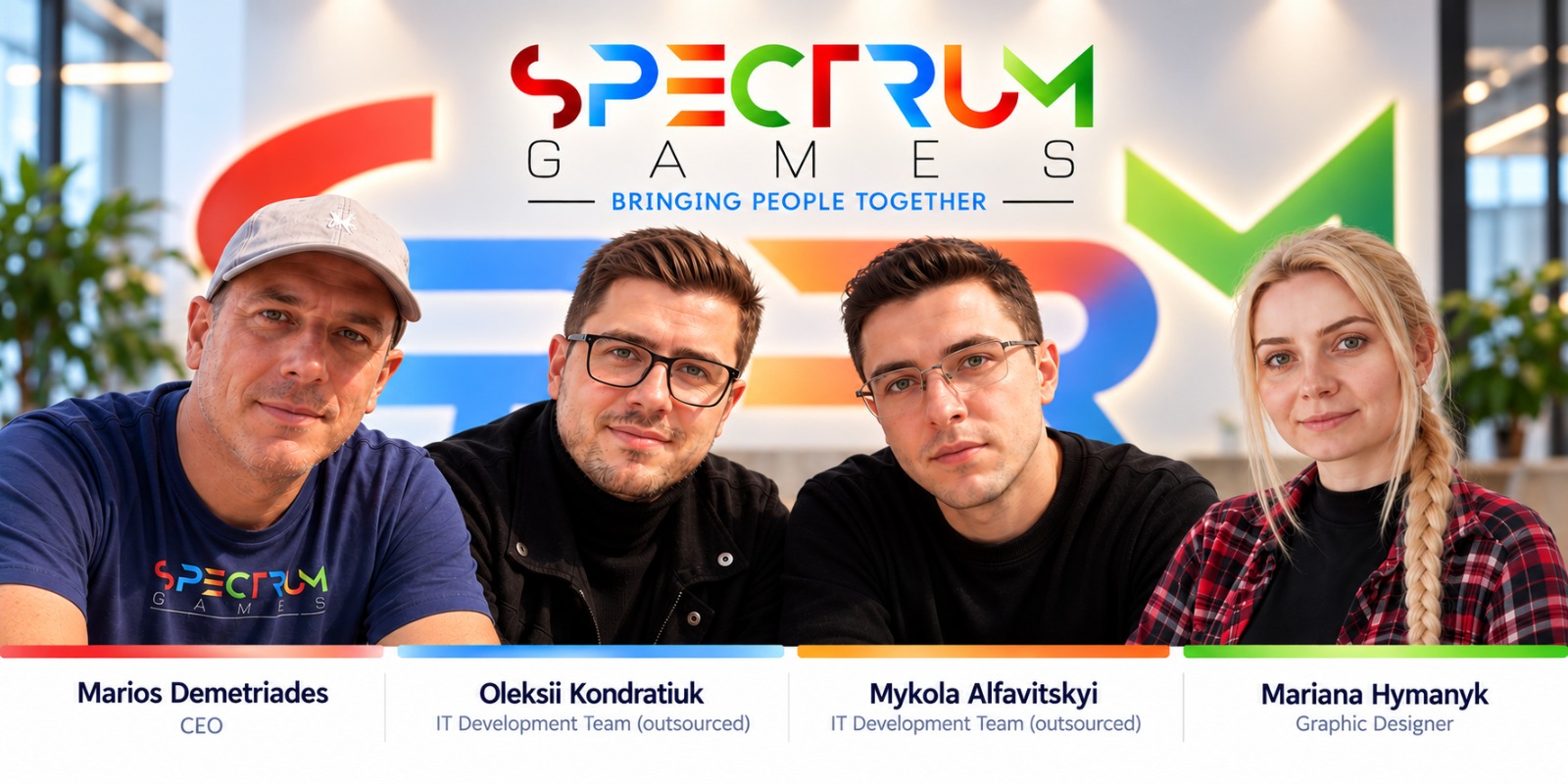
What began in 2019 as an initiative to bring traditional games into the digital age has evolved into a Cyprus-based gaming company with ambitions extending well beyond the island.
Founded by businessmen Harris Orfanides and Marios Demetriades, Spectrum.Games International Ltd has built its identity around a simple idea: gaming is not merely entertainment, but a means of connecting people across generations, cultures and geographical boundaries.
Today, led by CEO and principal shareholder Marios Demetriades, the company is expanding its presence while developing gaming concepts that combine technology, competition and cultural identity.
“For us, gaming has always been about more than entertainment. It is about bringing people together, preserving traditions and creating connections that go beyond generations and geographical boundaries,” Demetriades said.
From traditional favourites to digital communities
Established in late 2019 and launching online operations at the end of 2020, Spectrum Games recognised an opportunity to modernise familiar games without losing their social appeal.
Rather than focusing exclusively on new concepts, the company transformed traditional favourites into accessible multiplayer experiences.
Its portfolio includes Mpirimpa, Backgammon Premium and Tichu, each with established communities and distinct cultural traditions.
Its flagship game, Mpirimpa, has attracted almost 5,000 daily active users, predominantly from Cyprus and Greece, demonstrating the enduring popularity of traditional games when combined with modern digital platforms.
More than entertainment
What distinguishes Spectrum Games is its emphasis on social interaction.
While the global gaming industry continues evolving through sophisticated graphics and immersive technologies, the company has concentrated on making familiar games accessible, enjoyable and socially engaging.
Its platforms allow friends and family to play together regardless of location, while offering opportunities to meet new people and develop friendships.
Whether playing from home, during a break or while travelling, users can enjoy shared experiences that transcend physical distance.
The objective is not simply gameplay, but preserving the social traditions associated with games that have brought people together for generations.
Innovation with a Cypriot identity
Beyond its traditional portfolio, Spectrum Games is developing original concepts, including Stack Champs, a skill-based game combining accessible gameplay with competitive challenges, leaderboards and tournaments.
Another development is Stack Cyprus, a specially adapted version celebrating the island’s cultural identity and natural beauty.
Through gameplay, players will encounter locations and landmarks across Cyprus, introducing international audiences to the island while offering local players something culturally familiar.
“We want to demonstrate that a company based in Cyprus can develop innovative gaming experiences with international appeal, while celebrating the culture and traditions that make our island unique,” Demetriades said.
The initiative reflects the potential for Cyprus-based developers to create internationally appealing products inspired by their local environment, combining digital entertainment with cultural promotion.
Looking beyond Cyprus
Having established a growing player base in Cyprus and Greece, Spectrum Games is targeting additional markets where its existing games have cultural recognition.
Italy has been identified as the first potential expansion market for Mpirimpa, while the company continues promoting Tichu and Backgammon Premium in its established markets.
International growth, however, requires more than making games available in new territories.
Multilingual functionality, cross-platform accessibility, online tournaments and continuous product improvements are central to its expansion strategy.
The company is also exploring artificial intelligence and emerging technologies to strengthen customer support, improve player engagement and enhance the gaming experience.
These developments aim to support an increasingly scalable operation serving diverse international communities.
The challenge of competing globally
Access to funding remains one of Spectrum Games’ most significant challenges.
Although digital platforms allow smaller companies to reach global audiences, competing against established international gaming businesses requires substantial investment in development, marketing, technology and customer acquisition.
“Our ambition is to compete internationally, but access to funding remains one of our greatest challenges. With the right support and targeted government initiatives, Cyprus-based gaming companies could have a much stronger presence in the global market,” Demetriades said.
The company believes specially designed government funding programmes, similar to initiatives operating abroad, could help smaller developers compete more effectively.
Such measures could strengthen not only individual businesses but also Cyprus’ wider digital gaming and creative technology sectors.
For the island’s startup ecosystem, the challenge is ensuring promising locally developed products can secure the financial backing needed to scale internationally.
Building a global gaming community
Looking ahead, Spectrum Games aims to become an internationally recognised gaming company, combining traditional favourites with modern technology.
Its strategy centres on strengthening existing communities, developing original products and entering carefully selected international markets.
At the heart of that vision is the belief that successful gaming experiences are defined not solely by technology or competition, but by the connections they create.
From traditional card games played between friends to digital experiences showcasing Cyprus internationally, Spectrum Games is demonstrating how innovation can give familiar experiences new life.
For Demetriades and his team, the next chapter is about translating that philosophy into sustainable international growth while remaining rooted in the social and cultural values that inspired the company.
Before GetOffers.com, I worked in travel tech for several years. I started in customer support and later moved into sales. In both roles, I kept hearing the same complaints from business clients: a service fee was added to every ticket, and companies paid it because nobody had offered them another way to book.
Smaller firms had it worse. Most corporate travel tools were designed for large organisations, so a company of 40 people would end up booking through consumer websites. At the end of the quarter, the finance team had no clear picture of what had been spent or why.
There is no shortage of flights or hotels. What companies were really paying for was a chain of intermediaries, each adding its own margin, with no one competing for the booking.
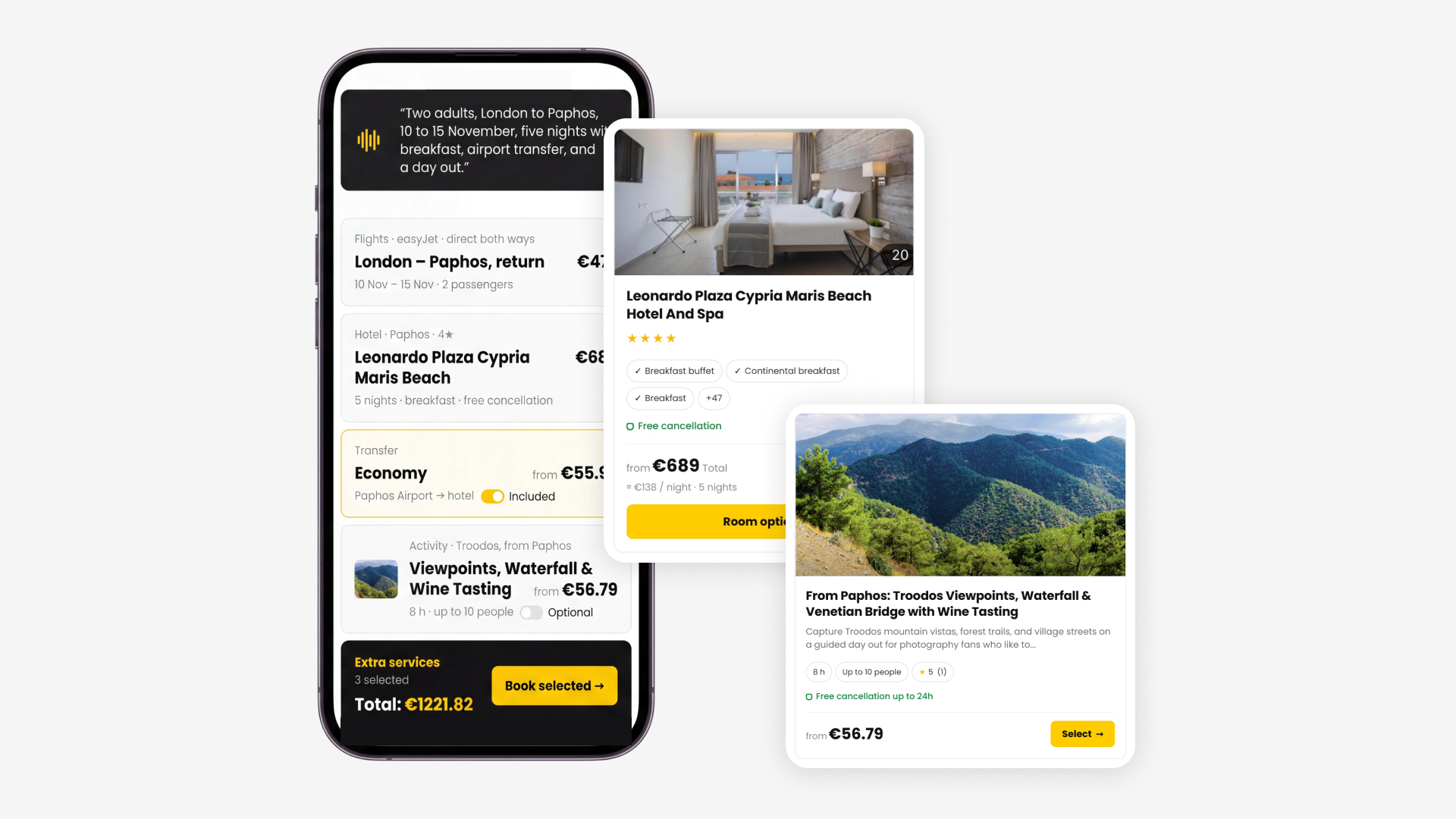
We launched GetOffers.com this year to give businesses net rates. A company describes the trip in one message, and competing offers from suppliers come back in the same conversation, alongside approval rules and reporting. Because we started recently, we could build the product around an AI assistant from the beginning.
A model for three markets
Large online travel agencies are built for people booking holidays. Established corporate platforms mostly serve large enterprises, with the pricing and implementation time that come with that. A mid-sized company that travels frequently but has no travel manager doesn’t really fit either model.
We work with three groups. Companies get net rates and can set travel policies, approve trips and see reports in the same place. Connecting is free, and in our standard model, we don’t add a GetOffers booking fee. We make our money through agreements with suppliers, including revenue sharing. The customer should see the full price and the supplier’s terms before approving the trip.
Travel agencies use the platform to build trips from net rates. The assistant assembles the whole trip from competing supplier offers, usually the most time-consuming part of a manager’s work, and the agency keeps its margin.
Hotels can offer guests transfers, excursions and eSIMs directly, without paying commission to an intermediary.
For clients, this mainly means lower prices and less time spent on bookings. For us, it means we don’t depend on a single type of customer.
Where AI helps
You can speak to the assistant or type to it at any time. A typical request might be: “I have a meeting in Limassol on Tuesday morning, I need to be back on Wednesday evening, and it has to be within our policy.”
The assistant puts competing offers side by side and highlights the one that fits best. Once the traveller or their manager agrees, it books everything, including the flight, hotel and airport transfer.
Before booking, though, it should ask about things you might not have mentioned. Are you taking equipment with you? Will you be arriving at the hotel late? Those answers could change what it recommends. I’d rather it asked than left you to sort out a problem when you get there.
At the moment, it’s most useful for routine work: searching, comparing prices, combining several services into one trip and checking everything against company rules. When a trip is complicated or something unusual comes up, a person still needs to make the decision. We tell clients that from the start.
Over the next five years, I expect assistants to do more before and after booking. If a team is going to a trade fair and nearby hotels are filling up, the assistant should warn them while rooms are still available.
With cancellations, it gets harder. A replacement flight might get you to the right city, but too late for the meeting. The hotel and transfer may need changing, too. That’s the work I’d like the assistant to take on, with the traveller agreeing to any changes in price or booking conditions.
Expense reporting will change as well. Most reports should be generated from booking data, so employees don’t have to collect receipts after every trip.
I don’t expect travel agents to disappear. Those who use these tools will be able to handle more clients, putting pressure on those who don’t.
Earning clients’ trust
GetOffers.com launched this year, and we’re not publishing figures yet. It’s too early for the numbers to say much.
The hardest part so far is getting companies to trust us with their travel. Some have used the same agency for years. Their agent knows who prefers an early flight, who approves the budget and who to call when plans change. I understand why they wouldn’t switch on price alone. We have to show we understand how they work and that moving their bookings to us won’t mean more work for them.
Working with three types of clients also makes growth harder to plan. Companies come to us for prices and choice, while suppliers want to see booking volume before offering good rates. We’ve already signed agreements with several major wholesalers, which lets us offer competitive prices before volume builds up.
Every client comes to us through direct conversations, and each one teaches us something about the product. The clients most open to trying it are independent agencies, whose managers spend hours assembling trips by hand, and mid-sized firms that travel internationally but have no one dedicated to travel. Both feel the problem most directly, so that is where we are focusing.
Growth plans and Cyprus
In three years, I’d like GetOffers.com to be the first place a travel agency or a company without a travel department goes when they need to put together a trip.
We’re currently concentrating on the product and our first clients. We’ll consider raising money when there’s a clear need for it, and we’re happy to talk to investors who know the travel sector. We plan to expand into new markets as client demand appears, rather than following a fixed timetable.
On the product side, we want the assistant to handle more of the trip after booking. That includes dealing with delays and cancellations, recording expenses automatically and connecting through our API to the accounting and HR systems companies already use.
Cyprus is an important market for us. It has been a difficult year for tourism here, and hotels are looking closely at every source of revenue. Services beyond the room, such as transfers or activities, can make a real difference. Hotels should be able to sell them without giving a large share to intermediaries.
The hotel association has just called for AI to become part of the national tourism strategy. I agree, but for smaller hotels, the tools have to be affordable and simple to set up. Otherwise, only the large chains will benefit.
Business travel is the other part of the picture. Limassol and Larnaca are home to many international companies whose staff travel constantly and the government is now supporting conference tourism outside the summer months. Business trips and events help hotels fill rooms in the quieter season, and that is where we would like to be useful.
Artificial intelligence is beginning to reshape the legal profession, with law firms increasingly exploring how emerging technologies can improve research, document analysis and other aspects of legal work without compromising professional judgement.
Speaking to the Cyprus Mail for the latest issue of Cyprus 4.0, Elias Neocleous, managing partner of Elias Neocleous & Co. LLC, explained that the development of NeoLaw.ai reflects a longer-term effort to integrate technology into legal practice rather than a response to the recent AI boom.
Developed as an internal legal support environment, NeoLaw.ai is intended to assist lawyers with research, complex documentation, case preparation, preliminary risk analysis and routine administrative work.
Neocleous argued that the value of AI lies not in replacing legal expertise, but in freeing lawyers to concentrate on areas where human judgement, creativity and professional responsibility remain essential.
The discussion also examined the safeguards required when AI is used in a profession where accuracy and confidentiality are fundamental, as well as the potential for Cyprus to develop into a regional hub for technology-enabled professional services.
Looking ahead, Neocleous considered how AI could gradually change the delivery of legal services and why the future of LegalTech may ultimately involve rethinking the role of the lawyer itself.
What problem in the legal sector led you to create NeoLaw.ai, and what gap were you trying to address that existing legal tools could not adequately solve?
The origins of NeoLaw.ai predate the recent surge of interest in large language models. Its development was not a reaction to technological fashion, but a continuation of a long-standing philosophy: that the legal profession must evolve in step with the broader trajectory of human progress. Automation, in various forms, has shaped industries since the industrial revolution; artificial intelligence represents simply the next phase of that continuum.
From our perspective, the gap was not merely technological, but conceptual. Existing tools often approached legal work as a process to be accelerated, rather than a discipline to be enhanced. Our objective was different. We sought to create an environment in which our lawyers are empowered – freed from repetitive tasks, yet supported in exercising judgement, creativity and precision.
Ultimately, NeoLaw.ai was designed not as a substitute for legal expertise, but as a mechanism to elevate it, ensuring that we serve our clients with greater clarity, consistency and foresight.
For someone encountering NeoLaw.ai for the first time, how does the platform work and what can it do for lawyers or legal teams in practical terms?
NeoLaw.ai is designed as an integrated legal support environment, embedded within the daily workflow of our lawyers rather than operating as a detached tool. In practical terms, it enables in-depth legal research across multiple sources, assists in the review and analysis of complex documentation and supports case preparation through structured insights and references to relevant case law.
It can also provide preliminary risk analysis, helping legal teams to identify potential issues at an early stage and contributes to the automation of routine administrative tasks that would otherwise consume valuable time.
Importantly, its development is not static. NeoLaw.ai evolves in parallel with our firm’s broader commitment to continuous improvement. Each use case informs further refinement, ensuring that the platform becomes progressively more aligned with the realities of legal practice and the increasing demands placed upon it.
What role does artificial intelligence play within the firm, and how have you approached issues such as accuracy, reliability and the risk of AI-generated errors in a legal context?
Artificial intelligence occupies a central, but carefully defined, role within the firm. It is not viewed as an autonomous decision-maker, but as a tool that enhances the capabilities of experienced practitioners. Accuracy and reliability are therefore not secondary considerations – they are foundational. Every output generated through NeoLaw.ai is subject to review by our legal professionals, ensuring that judgement remains firmly in human hands.
We approach this as a co-existing relationship: the system supports our lawyers, while our lawyers continuously refine and train the system through informed use. This dynamic mitigates the risk of error while strengthening the overall quality of output. In a legal context, where precision is inseparable from responsibility, such safeguards are essential. The objective is not simply efficiency, but the preservation- and enhancement – of professional integrity.
LegalTech is developing rapidly internationally. Where do you believe NeoLaw.ai can differentiate itself from the growing number of AI-powered legal tools entering the market?
NeoLaw.ai distinguishes itself not by attempting to compete with every emerging LegalTech solution, but by being deliberately and precisely tailored to the realities of our own practice. It has been developed around our internal processes, structures, templates and accumulated institutional knowledge – elements that no external platform, however sophisticated, can fully replicate. In that sense, its primary advantage lies in its alignment with how we actually work, rather than how legal work is generically modelled.
Equally important is our underlying approach. We have not built NeoLaw.ai with commercialisation as the driving force, but with a practical question in mind: how can this system meaningfully enhance the quality and efficiency of our legal services? This inward focus allows for a level of refinement and adaptability that would be difficult to achieve otherwise.
Finally, the platform is hosted entirely on our internal infrastructure, ensuring the highest standards of confidentiality and data security – an essential consideration in the legal profession.
What have you learned from developing and bringing NeoLaw.ai to market so far, particularly from working with lawyers and other users who are adopting AI into their professional workflows?
What the development of NeoLaw.ai has revealed, perhaps more than anything else, is that technological progress is ultimately a human question. The success of such an initiative depends less on the sophistication of the tool itself and more on the willingness of people to engage with it. It requires a team with vision-one that does not merely tolerate change, but recognises it as a constant parameter of professional life. In that sense, we have not sought to “invent” technology, but to thoughtfully integrate it into our existing systems.
Equally instructive has been the pattern of adoption. Even within a large and forward-looking organisation, the familiar dynamics of the bell curve apply – early adopters lead, others follow more cautiously. This has reinforced the importance of structured implementation and internal dialogue.
Perhaps most importantly, the process has sharpened our understanding of what truly matters in legal practice: distinguishing enduring value from operational noise, and identifying where change is genuinely necessary.
Do you see Cyprus developing a significant LegalTech ecosystem of its own, and what would need to happen for the country to become a stronger regional hub for legal technology and innovation?
Cyprus is unlikely, at least in the near term, to develop a LegalTech ecosystem on the scale of larger jurisdictions such as the United Kingdom, the United States, or key Central European markets. These are environments where the sheer volume and international reach of law firms create the natural demand that drives large-scale LegalTech innovation. By comparison, the Cypriot legal market is more focused and specialised, which inevitably shapes the direction and scale of technological development within it.
That said, the broader technology ecosystem in Cyprus is stronger than it has ever been. The entry of globally recognised innovation platforms, such as Plug and Play Tech Center, signals a meaningful shift. Combined with Cyprus’ strategic location, regulatory alignment with the European Union, and an increasingly sophisticated professional services sector, this creates a compelling foundation.
Rather than leading in LegalTech production, Cyprus is well positioned to emerge as a regional hub for technology-enabled services-where innovation is applied, refined, and integrated into high-value professional practice.
Looking beyond the current product, what opportunities do you see for AI to transform the legal profession over the next five years, and where do you expect NeoLaw.ai to fit into that transformation?
Over the next five years, artificial intelligence is likely to reshape the legal profession not through sudden disruption, but through gradual and structural refinement. The more routine aspects of legal work – research, document analysis and process management – will increasingly be absorbed by intelligent systems. This will not diminish the role of the lawyer; rather, it will reorient it towards judgement, strategy, and the exercise of professional responsibility.
The more important question, however, is not what AI can do, but how it is governed and integrated. The legal profession carries an inherent duty to uphold trust, accuracy, and accountability-principles that must remain intact as technology advances.
Within this transformation, NeoLaw.ai will continue to evolve as an internal framework that supports our lawyers in meeting these obligations. Its role is not to redefine the profession, but to ensure that we adapt to change without compromising its core values.
What makes you believe the future of LegalTech is not simply about automating existing legal processes, but about fundamentally rethinking how legal services are delivered?
The future of LegalTech cannot be confined to the automation of existing processes, because the legal profession itself is not merely procedural. At its core lies the role of the lawyer as a trusted advisor – someone who navigates complexity not only through technical knowledge, but through relationships built on trust, continuity and understanding. These relationships are not incidental; they are the foundation upon which effective legal counsel is delivered.
In parallel, lawyers often play a quiet but essential role in shaping legislative and regulatory frameworks. Through sustained engagement with institutions, policymakers and market participants, they contribute to the refinement of laws in a way that reflects practical realities. This is a function that cannot be automated – it requires judgement, dialogue and credibility developed over time.
Technology, therefore, must be understood as an enabler. By relieving lawyers of routine burdens, it allows them to invest more meaningfully in these higher-order functions: advising with clarity, fostering trust, and contributing to the evolution of the legal and regulatory environment itself.
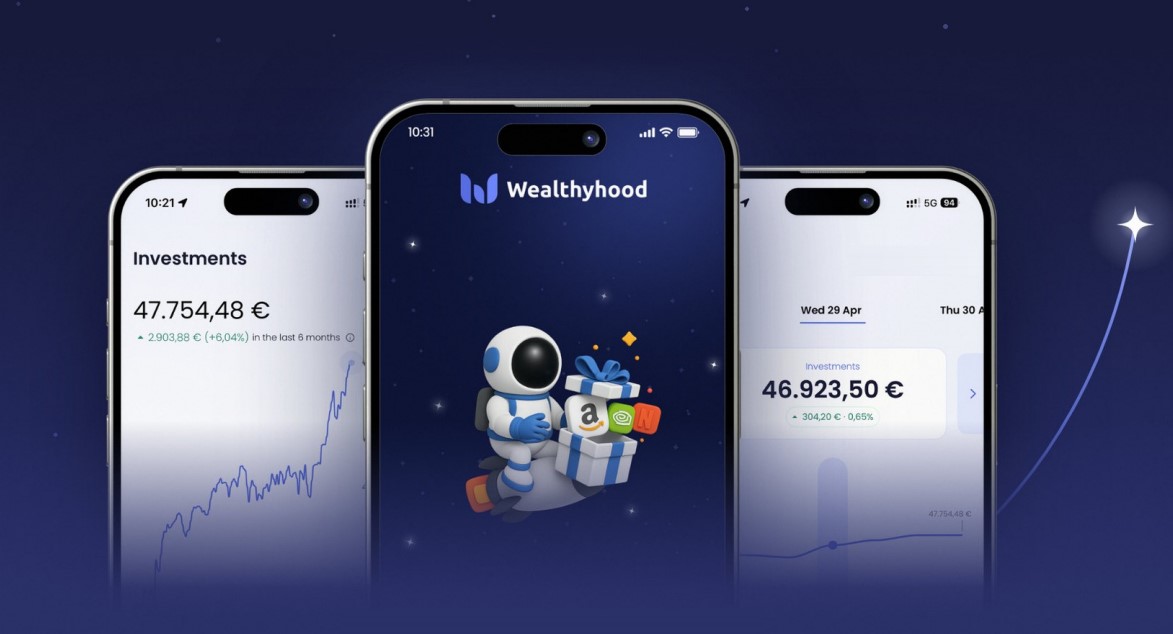
Investment platform Wealthyhood has recorded a five-fold increase in investors and an eight-fold rise in client assets in Cyprus between June and September 2026, with data from its partnership with the Bank of Cyprus pointing to growing interest in local shares, exchange-traded funds and accessible long-term investing.
The figures, published in ‘Wealthyhood’s Cyprus Investor Pulse 2026‘ report, cover anonymised and aggregated data from clients resident in Cyprus between June 1 and September 30, with the findings highlighting how lower entry costs and simpler account funding can encourage participation in financial markets.
Alexandros Christodoulakis, co-founder and chief executive of Wealthyhood, told the Cyprus Mail that the response from Cypriot investors had exceeded expectations in terms of the quality of their engagement.
“People in Cyprus didn’t need to be convinced that investing matters. What they were missing was a simple, trusted way to start, and once that existed, they moved quickly,” he said.
The report found that 88.6 per cent of clients who deposited money went on to buy a stock or exchange-traded fund (ETF), compared with 80.4 per cent among clients who signed up in Greece during the same period.
Christodoulakis said the company was encouraged by the extent to which customers were continuing to invest after opening their accounts, rather than simply registering and leaving the platform.
“Of those who joined in June or July and invested, 88.9 per cent were still invested on September 30,” he said.
“Seven in ten (70.3 per cent) have never sold an investment, and six in ten (59.1 per cent) made a second deposit within 30 days of their first,” Christodoulakis continued. “People are not trying the app once and walking away; they are building a habit.”
He added that four months of activity remained an early snapshot, but that the quality of engagement had been particularly encouraging.
Low entry barriers foster early activity and habit-building
The report also found that 58.4 per cent of new investors made their first investment within 7 days of signing up, while 14.4 per cent invested on the same day.
The typical first deposit was €100, while the typical first investment amounted to €55. Almost two-thirds of investors, or 64 per cent, started with €100 or less, suggesting that many were entering the market with relatively modest sums.
More than half, or 56.8 per cent, made their first investment in an ETF, which allows investors to buy into a collection of companies through a single product.
The most popular first investment was the Vanguard S&P 500 ETF, accounting for 16.6 per cent of first investments, followed by Bank of Cyprus shares at 10.2 per cent.
Christodoulakis said traditional barriers to investing included high minimum investment requirements, fees that eroded smaller amounts, paperwork and complicated terminology.
“Faced with that, many people who could invest simply never start. Not because they don’t care about their future, but because the first step looks expensive, complicated and opaque,” he stated.
Wealthyhood aims to address these obstacles by allowing customers to invest in international and local markets from €1, with zero commission and fractional shares, alongside an education hub containing more than 50 guides.
The platform also offers Autopilot, an automated investing service through which users can make regular investments without having to manage each transaction manually. The typical Autopilot user invests €150 a month, according to the report.
Christodoulakis said access to financial markets needed to be accompanied by a better understanding of investment products and their risks.
“Access alone isn’t enough, though. People also need to understand what they’re buying and why, which is why education sits at the core of the app, not in a corner of it,” he said.
Investor demographics reveal mature and higher-earning profile
The report’s demographic findings challenge the assumption that investment applications primarily attract younger users.
The typical investor in Cyprus is 40 years old, works full-time and declares an annual income of between €30,001 and €50,000. The largest age group is 35 to 44, accounting for 31.7 per cent of investors, followed by those aged 45 to 54 at 25.9 per cent and those aged 25 to 34 at 25.3 per cent.
People under 30 account for 19.3 per cent of investors.
Income levels were also higher than those recorded among investors in Greece. Some 31 per cent of Cypriot investors declared annual incomes above €50,000, while 24 per cent reported incomes below €20,000, compared with 58 per cent of investors in Greece in the latter category.
Full-time employees account for 86.5 per cent of investors, while 4.7 per cent are self-employed.
Finance and insurance is the most common industry, employing 31.5 per cent of investors, followed by information technology at 10.5 per cent and the public sector at 8.1 per cent.
Nicosia district accounts for 50.5 per cent of investors, followed by Limassol at 25.6 per cent, Larnaca at 14.9 per cent, Paphos at 5.1 per cent and Famagusta at 3.9 per cent.
Christodoulakis said the available data was not yet sufficient to establish how the investor profile had changed over time or to draw reliable conclusions about customers’ previous investing experience.
However, he said the behaviour observed so far pointed towards a cautious, long-term approach, characterised by small initial investments, ETFs and limited selling.
“One number I’d like to see change: about one in six new investors is a woman. Closing that gap is one of the biggest challenges for retail investing, in Cyprus and beyond,” he said.
He added that the market was increasingly being shaped by working people seeking greater control over their long-term finances, rather than traders attempting to profit from short-term market movements.
“As cost and complexity keep falling, I expect that profile to broaden, especially to younger people and to women,” he said.
Domestic shares drive engagement alongside global ETFs
The availability of domestic shares has also helped attract investors to the platform, with the Bank of Cyprus emerging as its most-bought individual stock.
Cypriot and Greek shares became available through Wealthyhood on July 17, allowing customers to hold domestic investments alongside international stocks and ETFs.
Customers can access Bank of Cyprus shares and 8 other companies listed on the Cyprus Stock Exchange, namely Vassiliko Cement, Demetra Holdings, Logicom, Cyprus Cement, Petrolina, Atlantic Insurance, Pandora Investments and GlobalWealth Group.
Within less than 3 months of the launch, 29.2 per cent of buyers had purchased at least 1 Cypriot share.
The Bank of Cyprus was bought by 35.8 per cent of stock investors, ahead of US technology company NVIDIA at 21.3 per cent and SpaceX at 12.6 per cent.
Among investors who purchased Cypriot shares, 82.6 per cent chose the Bank of Cyprus, followed by Vassiliko Cement at 16 per cent, Petrolina at 12.3 per cent and Logicom at 8.2 per cent.
The report found that domestic shares were bringing new participants into the market. For 52.8 per cent of investors holding Cypriot shares, a local company had been their first investment on Wealthyhood, compared with just 1.8 per cent among other investors.
Those holding Cypriot shares also had larger portfolios, with a typical portfolio 1.8 times the size of those held by other investors and containing 3 investments rather than 1.
Christodoulakis said familiar domestic companies could provide an accessible entry point for people who were less comfortable with international markets.
“People invest more readily in companies they know, and familiar local names are often the bridge into the market,” he said.
However, he stressed that local shares were complementing rather than replacing international investments.
The report found that 8.6 per cent of money invested since July 17 had gone into Cypriot shares, while Greek shares accounted for 12.3 per cent. Some 18.9 per cent of buyers had purchased at least 1 Greek share.
Across portfolios, 37.6 per cent of invested money was allocated to the United States, 21.1 per cent to global ETFs, 16.5 per cent to the rest of Europe, 11.3 per cent to Greece and 8.9 per cent to Cyprus.
The figures also showed the importance of ETFs in investors’ portfolios. The Vanguard S&P 500 ETF, which tracks the 500 largest US companies, had been purchased by 42.7 per cent of ETF investors and was held by 24.4 per cent of all investors on September 30.
Other popular ETFs included the Vanguard LifeStrategy 80 per cent Equity fund, purchased by 13.6 per cent of ETF investors, the SPDR MSCI World at 13.1 per cent and the iShares Nasdaq 100 at 11.9 per cent.
Among investors who still held investments on September 30, 42.5 per cent held only ETFs.
Dual exchange listings and long-term literacy goals
The report also examined access to shares listed in Athens. On September 30, 25.6 per cent of investors held at least 1 stock listed on Euronext Athens, including the Bank of Cyprus, while 7.6 per cent held a stock listed on the Cyprus Stock Exchange and 4.2 per cent held shares listed on both exchanges.
Athens-listed stocks accounted for 17.1 per cent of invested money, while Cyprus Stock Exchange-listed shares represented 2.1 per cent.
After the Bank of Cyprus, the most widely held Athens-listed stocks were Eurobank, at 5.1 per cent, followed by Allwyn and Alpha Bank, each at 2.8 per cent. Half of the 10 most widely held names were banks.
Christodoulakis said the company’s priorities in Cyprus were to improve financial education, encourage customers to turn initial investments into regular habits and expand the role of automated investing.
He said Wealthyhood and the Bank of Cyprus shared a responsibility to help close the financial literacy gap, particularly among younger people and women, by improving understanding of risk, diversification and the importance of time in investing.
“Giving people access to markets is only half of the job; helping them understand risk, diversification and time is the other half,” he said.
The company also wants to build on existing customer behaviour through services such as Autopilot, which can make regular investment contributions easier to maintain.
Christodoulakis said the first months of activity had demonstrated a clear appetite for accessible investing in Cyprus, but that the next challenge was to turn the initial momentum into sustained participation.
“Four months in, Cyprus has shown us the appetite is real. Now the work is to turn that early momentum into a generation of long-term investors,” he said.
The Enterprise Europe Network (EEN) in Cyprus will hold an online information session on November 19, 2026, to present funding opportunities available to businesses and organisations under the European Innovation Council’s (EIC) 2027 work programme.
The event, announced by the Cyprus Chamber of Commerce and Industry (Keve), which coordinates EEN activities in Cyprus, will explain the main funding instruments available under the programme and outline the most important changes and new developments planned for 2027.
The session is aimed at businesses and organisations seeking European funding to support innovation, develop new technologies and scale up their operations.
Participants will receive information on the EIC Pathfinder, EIC Transition and EIC Accelerator programmes, as well as the Strategic Technologies for Europe Platform (STEP) Scale Up initiative.
These instruments support different stages of innovation, from early-stage research and the development of technologies towards commercialisation to the growth of businesses seeking to expand their operations.
The event will also feature EEN2EIC, which will present its activities, services and tools designed to help innovative small and medium-sized enterprises (SMEs) and start-ups access EIC funding opportunities.
The special session will also explain how EEN2EIC supports businesses in improving their investment readiness, helping them prepare to attract funding and pursue opportunities under the European innovation funding framework.
Interested businesses and organisations can register through the event’s registration link provided by the organisers.
The European Union is attempting to establish itself as a developer of advanced artificial intelligence rather than primarily a regulator and consumer of technology produced elsewhere. An Italian-led consortium developing a large open-source AI model across all 24 official EU languages will provide an important test of whether Europe’s supercomputing infrastructure can support globally competitive systems.
Europe’s efforts to establish greater control over artificial intelligence technology are entering a new phase as the EUROPA consortium, led by Italian company Domyn, advances plans to develop one of the continent’s largest open-source AI models.
The initiative, supported by the European Commission and European high-performance computing infrastructure, aims to create an advanced artificial intelligence system capable of competing with models developed by leading American and Chinese companies.
Domyn chief executive Uljan Sharka told the Financial Times on 29 October that Europe possesses the technological resources and industrial expertise required to compete in advanced AI development.
However, he also identified two obstacles: the need for greater investment and the difficulty of persuading European businesses to adopt domestically developed systems.
These challenges extend beyond the development of a single language model.
They concern whether Europe can establish a commercially sustainable AI industry while reducing dependence on technology providers headquartered outside the EU.
The competition, launched in February, was designed to support the development of a European general-purpose AI model with more than 400 billion parameters.
EUROPA’s planned model is expected to contain approximately 500 billion parameters and support all 24 official EU languages.
The consortium brings together Domyn and Germany’s Fraunhofer research organisation, including the Fraunhofer IAIS and IIS institutes.
Its work will rely on the EuroHPC network of European supercomputers.
Under the competition arrangements, the winning consortium can obtain access to as much as 2.5 per cent of EuroHPC’s total computing capacity for one year.
This allocation is intended to address one of the largest barriers to advanced AI development: the enormous computing resources required to train models at this scale.
The final system is intended to be released under an open-source licence, allowing organisations to inspect, adapt and deploy the technology.
Nevertheless, parameter count alone does not demonstrate that a model is competitive.
Its actual performance will depend on training data, architecture, computational efficiency, evaluation results and the ability to perform reliably across different tasks.
A European Model for European Languages
One of EUROPA’s distinguishing objectives is its coverage of all official EU languages.
The commercial AI market has historically been dominated by models developed primarily for English-language applications, although leading international systems increasingly support multiple languages.
For Europe, linguistic capability has particular relevance to public administration, legal services, education and cross-border business.
A model designed specifically for the European market could potentially support specialised applications involving national legislation, administrative procedures and technical terminology.
However, multilingual availability will need to be assessed against measurable performance standards.
A system capable of producing fluent responses in a particular language is not necessarily equally reliable when interpreting specialised legal or scientific information.
The consortium will therefore need to demonstrate that linguistic coverage translates into practical capabilities rather than remaining principally a technical specification.
Europe’s Supercomputers Become Strategic Assets
The EUROPA project forms part of a wider effort to use European publicly supported computing infrastructure for commercial and scientific AI development.
The EuroHPC Joint Undertaking has invested in systems intended to provide advanced computing resources to researchers, businesses and public institutions.
Additional AI-focused infrastructure is being developed through the EU’s network of AI factories.
These facilities are intended to make specialised computing capacity available to organisations that would otherwise face considerable costs when developing or adapting AI systems.
However, infrastructure ownership does not necessarily provide complete technological independence.
European supercomputing projects continue to rely on internationally sourced semiconductor technology and specialised software.
Domyn itself has described a partnership with the American technology company Nvidia in its previous model-development work.
Consequently, European AI sovereignty is better understood as a question of control over important technological capabilities than complete separation from international supply chains.
Domyn’s Smaller Model Provides an Early Example
On 20 October, Domyn announced the initial release of Domyn Edge, a separate AI model containing four billion parameters.
According to the company’s technical announcement, the system was trained from scratch using approximately 13 trillion tokens on Europe’s Leonardo supercomputer.
Domyn has committed to making the model’s weights, training code, intermediate checkpoints and datasets available under open licences.
This approach is intended to improve reproducibility and allow external developers to examine how the model was constructed.
Domyn Edge is substantially smaller than the planned EUROPA system and should not be confused with it.
Nevertheless, the project provides an example of the company’s approach to developing AI models using European computing infrastructure.
Regulation Is Only Part of the Challenge
The EU has already established an extensive regulatory framework for artificial intelligence through the AI Act.
However, legislation governing the development and deployment of AI does not, by itself, create a competitive domestic technology industry.
Europe faces competition from American companies with substantial private investment, established cloud platforms and access to large commercial markets.
Chinese developers have also expanded their capabilities, including in open-weight AI systems.
EUROPA’s commercial prospects will therefore depend on more than technical performance.
European businesses must be willing to integrate the resulting technology into their operations, while developers will require dependable access to computing infrastructure and support services.
There is also the question of whether European institutions themselves will adopt domestically developed AI systems where they meet relevant security and performance requirements.
Without sufficient demand, even a technically successful model could struggle to establish a sustainable ecosystem.
The Test Will Be Commercial as Well as Technical
Domyn has indicated that it aims to release EUROPA during 2027, although public statements have differed over the precise timetable.
The company’s leadership has discussed a June target, while an earlier technical announcement referred to the second half of 2027.
The immediate challenge is completing development and demonstrating that the model can compete on performance, reliability and cost.
The longer-term challenge concerns adoption.
If European businesses and public institutions continue relying predominantly on foreign technology, access to an advanced European alternative may have only a limited effect on the market.
Conversely, a competitive and widely adopted open-source model could offer organisations greater control over deployment, customisation and sensitive information.
EUROPA is therefore more than a publicly supported technology experiment.
It is a test of whether Europe can convert research institutions, computing infrastructure and industrial expertise into AI products capable of competing in the international market.
The outcome will depend not simply on whether Europe can build an advanced model, but on whether organisations consider it sufficiently capable and economical to use.
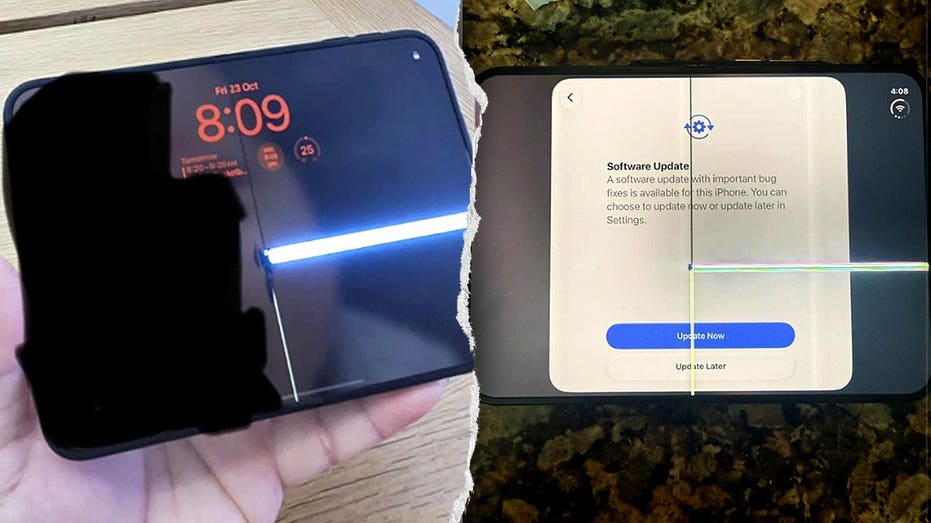
Apple's first foldable iPhone has barely reached customers, and some owners are already dealing with cracked screens. The iPhone Duo launched on Oct. 23 with a starting price of $1,999. Within hours, complaints began appearing online from people who said their new phones developed cracks along the folding display.
Even more concerning, several reports describe damage appearing in nearly the same location. Some owners say their phones made unusual noises before the screens failed. Others noticed bright white lines spreading across the display. Now Apple has acknowledged the issue and says affected customers can request replacements. However, the company has yet to explain exactly what's causing the failures.
Join our upcoming CyberGuy LIVE class: 5 Ways to Travel Smarter and Save Money
In this free live online class, Kurt "CyberGuy" Knutsson will share five practical ways to protect your trip and your wallet this holiday travel season. You’ll learn how to secure your phone and personal information, find better travel deals, avoid common scams, save money on bookings and use technology to make your travels easier and less stressful. No technical experience is needed.
Join us Saturday, October 31, at 11 AM ET / 8 AM PT. Register for free now at CyberGuyLive.com.
iPhone Duo screen problems appear days after launch
Apple spent years developing its first folding iPhone. The device opens to reveal a 7.6-inch display, giving people a much larger screen without carrying a separate tablet. When closed, it looks like a compact smartphone with a 5.4-inch outer display. The design generated enormous excitement when Apple introduced it in September. However, that excitement took an unexpected turn shortly after the first phones reached customers.
Multiple iPhone Duo owners have reported cracks developing along the center of the inner display. In several cases, a bright line of damaged pixels extended from the fold toward the right side of the screen. Some owners have shared photos of the damage on Reddit, along with accounts of how quickly their new phones failed.
One owner, u/leftyhyzer16, said the screen cracked before setup was complete, after opening and closing the phone only a few times. Another owner, u/Midnight_Slump, reported a failure within six hours and received a replacement from Apple. Reddit moderators also checked additional photos and Apple paperwork provided by the owner. They confirmed the damaged phone and its replacement were genuine. Meanwhile, u/chimchambam said the display failed after just three hours. That owner reported being turned away by an Apple Store before ultimately returning the phone through Verizon. All three owners described problems appearing after very little use. Their experiences don't tell us how widespread the issue is, but they help explain why these early screen failures are getting so much attention.
Apple acknowledges the cracked iPhone Duo screens
On Oct. 26, Apple acknowledged reports about the damaged displays. In a statement provided to news outlets, the company said: "We are aware of an issue impacting the inner display on a small number of iPhone Duo units." Apple has instructed affected owners to contact AppleCare for a replacement. That's encouraging news for anyone whose new phone has already failed, especially considering its $1,999 starting price.
However, Apple hasn't disclosed exactly how many devices are affected or identified what's causing the screens to crack. We also don't know whether the problem involves a manufacturing defect affecting certain phones or something in the overall design. We reached out to Apple for additional comment but did not receive a response before our deadline.
Why are the iPhone Duo screens cracking in the same place?
Here's what caught my attention. Several of the damaged screens appear to crack near the hinge, right where the phone folds. That's a pretty troubling place for something to go wrong on a $2,000 folding phone. So what's happening inside? The repair experts at iFixit took the iPhone Duo apart and used CT scans to get a closer look at its hinge. They spotted something that could help explain the damage. A small support bar may not move far enough out of the way when the phone folds. If the display presses against that bar, it could put enough pressure on the screen to cause a crack.
Now, I want to be clear. This is still a theory. iFixit hasn't confirmed that the support bar caused the reported damage, and Apple hasn't explained what's going wrong. But it does raise questions about how well the hinge and flexible screen work together, especially when people are already reporting similar cracks just days after buying the phone.
Repairing an iPhone Duo could be extremely expensive
Here's another detail that caught my attention. Although iFixit found that the iPhone Duo was more repairable than other foldable phones it had tested, replacing its inner display remains complicated. The company gave the device a provisional repairability score of 5 out of 10. More importantly, it reported that an out-of-warranty inner-screen repair costs $999. That's roughly half the starting price of the phone.
Fortunately, Apple says customers affected by this particular display issue should contact AppleCare for a replacement. An AppleCare+ subscription is not required to request help for the acknowledged defect. However, accidental damage and unrelated screen repairs may fall under different coverage terms. You can learn more in our guide to checking your Apple warranty and what it covers.
What to do if your iPhone Duo screen cracks
If you recently purchased an iPhone Duo, pay attention to how the hinge feels when you open and close the device. A sudden increase in resistance or an unfamiliar popping sound deserves attention. If you notice something unusual, avoid forcing the phone open or closed. Don't repeatedly fold it to see whether the problem happens again. If your screen develops cracks or bright lines, here are some steps worth taking.
Document the damage. Take photographs of the affected display if you can do so safely. Save your purchase receipt and note when the problem first appeared. These details may help when discussing the issue with Apple.
Contact AppleCare directly. Visit Apple Support at support.apple.com/contact or arrange an appointment at an Apple Store. Explain what happened and mention Apple's acknowledgment of the inner-display issue. Even if you purchased the phone through a wireless carrier, Apple recommends contacting AppleCare for this problem.
Back up your information before exchanging the phone. If your display still works, open Settings, tap your name, select iCloud, then tap iCloud Backup and choose Back Up Now. Make sure the backup finishes before handing over your device. If the screen no longer works, ask Apple about available recovery options.
Ask about replacement availability. Some affected customers have received immediate exchanges at Apple Stores. However, replacement inventory may vary. Contact Apple before making a special trip and confirm the next steps for your particular device.
Why one Samsung foldable fan is returning his iPhone Duo
The concerns go beyond cracked screens. My colleague Chris was excited to switch from his Samsung Galaxy Fold to Apple’s new iPhone Duo. But after trying it, he was so disappointed that he decided to return it to Best Buy and get an iPhone 18 Pro instead.
He found the interface buggy and cumbersome, missed having Face ID and felt the cameras fell short of his expectations. He also preferred the display quality of other phones. At nearly $2,000, he simply couldn’t justify keeping it, saying, "I think the craftsmanship is phenomenal. I love the heft and the solid nature of the device, but because I’m coming from a foldable, there were so many glaring missteps that Apple made along the way, and at first they were little, but little things add up to the point where you genuinely question whether this truly was ready for prime time."
Now, Chris’s phone didn’t crack. His complaints are about the overall experience. But when someone who already enjoys using a foldable phone decides Apple’s version isn’t worth keeping, that gets my attention. I still think the Duo has some impressive features, but between these early screen problems and Chris’s experience, I’d want to try one in person before spending that kind of money.
Kurt's key takeaways
I've been looking forward to seeing what Apple could do with a foldable iPhone, and I still think the Duo is an impressive piece of technology. But I have to admit, these early screen failures would make me nervous about spending nearly $2,000 on one. I give Apple credit for acknowledging the problem quickly and offering replacements. That's the right response. What I want to know now is why these screens are failing and whether Apple can prevent the same thing from happening to replacement devices. Then there's my colleague Chris, who already knows his way around a Samsung foldable and still found Apple's version disappointing enough to return it. That tells me Apple has some convincing to do beyond fixing the screen issue. At this price, I want a phone that feels like an upgrade, not one that makes me question what I'm giving up. For now, I'd be inclined to wait rather than rush out and buy one.
If you spent nearly $2,000 on Apple's newest iPhone and the screen cracked within days, would a free replacement restore your confidence, or would you demand your money back? Let us know by writing to us at Cyberguy.com
Sign up for my FREE CyberGuy Newsletter
Get my best tech tips, urgent security alerts and exclusive deals delivered straight to your inbox.
For simple, real-world ways to spot scams early and stay protected, visit CyberGuy.com – trusted by millions who watch CyberGuy on TV daily.
Plus, you'll get instant access to my Ultimate Scam Survival Guide free when you join.
We started Exyde as a marketplace for activities and experiences. It taught us how operators work, but it was a crowded market where building a real edge would be hard. We moved into building AI tools for those operators. Our first product, Lucy, was an assistant for their daily work, but still far from an AI employee.
The turning point came from inside our company. We were bootstrapped and close to hiring an operations specialist when I realised the technology was mature enough to build that role with AI instead.
We built Kira, always on and proactive, and I found myself chatting with her from my phone as I would with any teammate. It worked, so we built Alex for our catalogue, Aria for finance and Max for business development.
When we told friends and partners how we run the company, they asked us to build the same for them. They wanted the same method. That is when I realised the product was the way we work.
Roles and human oversight
ChatGPT and Claude are fantastic tools, but they depend on the person using them. In a team, everyone uses them in their own way, and quickly nobody is managing the result.
AI employees work the other way around. Each has a defined role, a place in the team and someone managing it, whether a human or an AI chief of staff.
Our core philosophy is to treat AI as we would people: we give them names, onboard and train them, provide feedback and correct mistakes.
Human supervision has to stay wherever someone is accountable for the outcome. How much depends on the risk and what the technology can do today.
But there is one difference I keep coming back to. A person avoids mistakes because a mistake can cost them their job, which is a kind of survival instinct. AI doesn’t have that.
Building differently
In the past, every new service and market meant hiring and managing more people. When I started Exyde, I wanted to build differently.
I had more work than time, and we had a limited hiring budget. We started with ChatGPT, Claude and automations. They made our lives easier, but only worked while I was prompting and coordinating. The question became how work continues when I am in a sales meeting or asleep.
That is what AI employees changed for me. For most of history, leverage came from people, capital and assets. Now AI is a source of leverage, too. It keeps working while you sleep. That idea is what Exyde is built on.
The opportunity for Cyprus
The frontier labs, including OpenAI, Anthropic, Mistral and DeepSeek, are building models that are extremely hard to beat. I don’t think competing with them is where the opportunity lies for Cyprus.
The opportunity is working with businesses, understanding how they operate and putting those models to work in daily operations.
That needs people who know the local market and how companies make decisions, in Cyprus, Greece, the rest of Europe and the Middle East. This is where a small team supported by AI can operate at a level that used to need a larger firm.
What AI will not solve is distance and density. A startup still needs to be close to its customers, capital and talent. Build here, where it is a fantastic place to test, but you need to go outside faster.
About Exyde
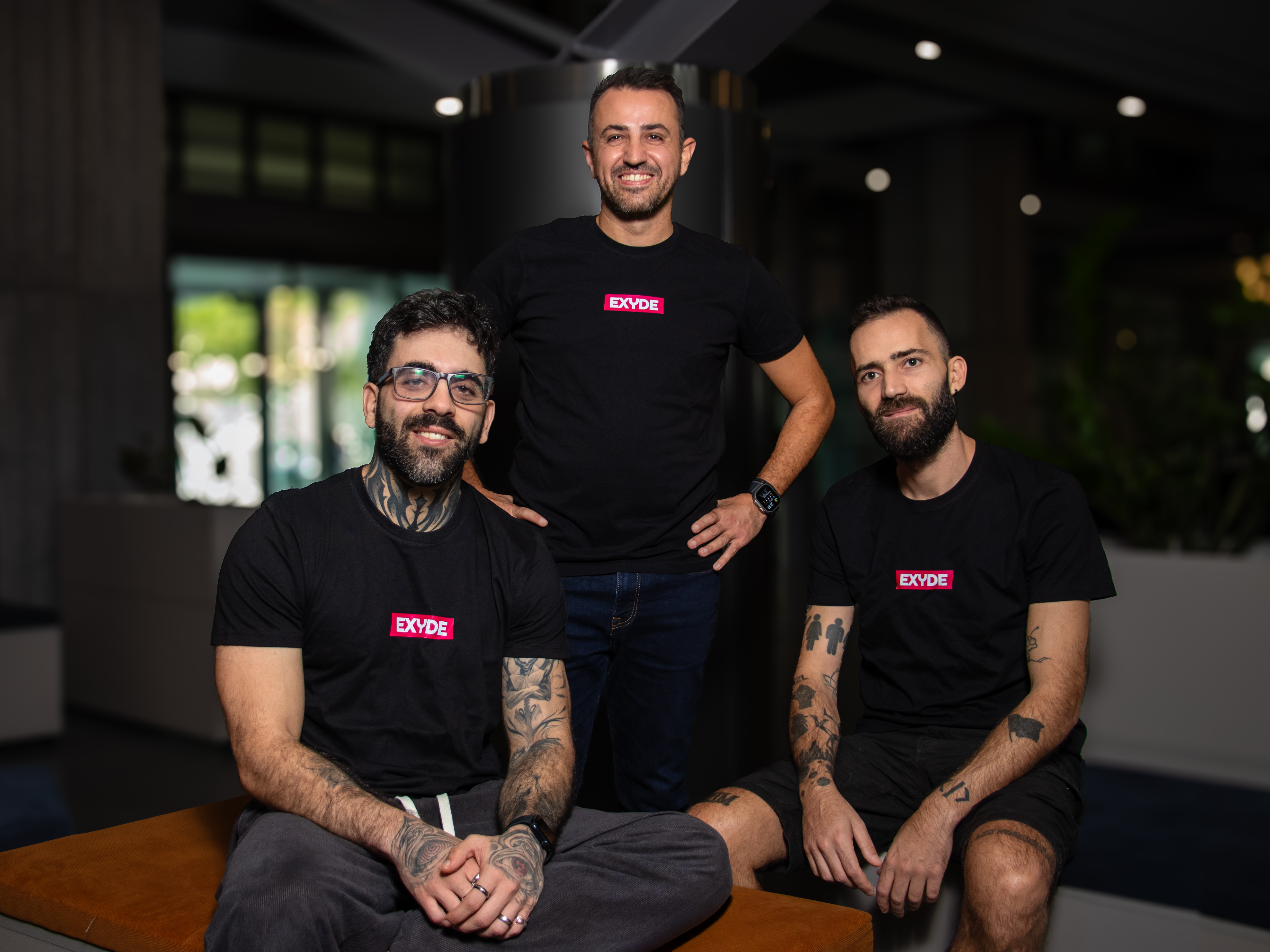
Exyde builds and manages AI teams for businesses. It is led by co-founders Michael Economou, Dakis Andreou and Marios Constantinou, who have worked together for more than ten years, including at Foody, which was acquired by Delivery Hero.
EMBIO Diagnostics CEO Constantinos Loizou discusses demand for portable testing, the international expansion of airbeld™ and the development of RapidX. In this interview, he explains how the Cypriot company is moving into industrial diagnostics and environmental monitoring, with plans to turn its technology and partnerships into sustained international commercial growth.
Testing at the point of use
B.EL.D™ is a versatile platform that can be adapted to several diagnostic applications. Today, we are seeing the strongest commercial demand in testing activated carbon and other porous materials, particularly in water filtration. Commercial customers are already using the technology to assess filter performance on site and identify saturation before it causes operational problems or contamination.
Building on this experience, we are finalising an application for assessing the porosity of building materials. Testing in this sector can still be slow and laboratory-dependent, creating a clear need for faster, reliable information at the point of use.
Our goal is to move critical testing from the laboratory to the point of decision, improving quality control, reducing waste and helping operators make better decisions.
Making indoor data useful
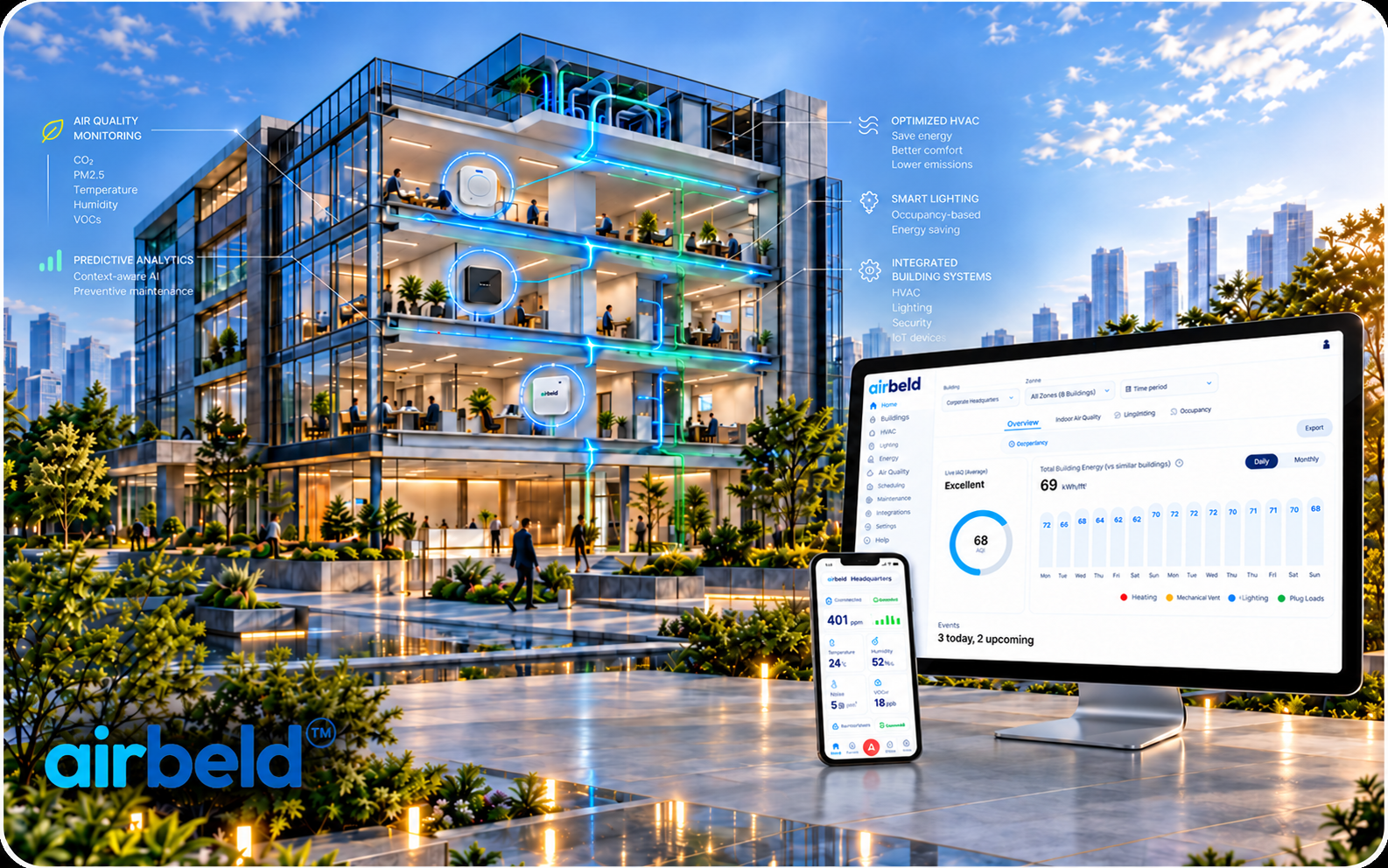
airbeld™ is designed to make environmental data useful and actionable. It is an indoor environment management solution for hospitals, offices, warehouses and other commercial spaces, where environmental conditions can affect health, productivity, operational risk and energy use.
One of our main lessons has been that organisations differ greatly in their awareness of these risks.
Some immediately understand the value of continuous monitoring, while others are only beginning to recognise the operational and financial costs of unmanaged indoor conditions. What organisations do not measure, they cannot manage.
We therefore focus on forward-looking customers and partners who see environmental intelligence as part of responsible building management. This approach has helped us build commercial momentum, secure distribution agreements and expand internationally. We are now developing our presence in the United States and preparing broader deployments across several commercial sectors.
Airbeld – Smart Building Analytics Dashboard
RapidX takes shape
RapidX is the industrial evolution of B.EL.D™, initially focused on assessing activated carbon filters in water treatment and measuring the porosity of structural building materials.
In both applications, the objective is to replace slow or indirect processes with faster, practical diagnostics at the point of use. In water treatment, this can help operators use filtration materials more efficiently and intervene before performance deteriorates. In construction, better information about material properties can strengthen quality control and support more efficient resource use.
RapidX also replaces perishable biosensors with longer-life components, combining robust hardware with digital analysis. Funding from the European Innovation Council will help us develop and validate the platform for broader industrial deployment.
RapidX can turn industrial diagnostics from a delayed result into an immediate operational tool, and we believe it could become an important driver of EMBIO’s international growth.
The next 24 months
Over the next 12 to 24 months, our priorities are to complete RapidX, expand the commercial deployment of B.EL.D™ and scale airbeld™ through international partnerships. We are working with organisations in building materials and industrial water management while pursuing broader applications for airbeld™ in corporate campuses, healthcare facilities, warehouses and major sports venues.
We are also using AI internally to accelerate research, product development and commercial decision-making. EMBIO is financially sustainable, and our next challenge is to turn our technology and partnerships into consistent international growth.
Our strategic investment partnership with ASBIS Enterprises is particularly important, giving us access to extensive distribution experience and more than 80 international markets.
We have developed the technology, established the right partnerships and demonstrated that a Cypriot company can compete internationally.
The next 24 months are about turning years of scientific development into global commercial impact. We are ready for that transition.
 Login