
❌

Reading view

NASA Advances Lunar Rover Development for Future Moon Base
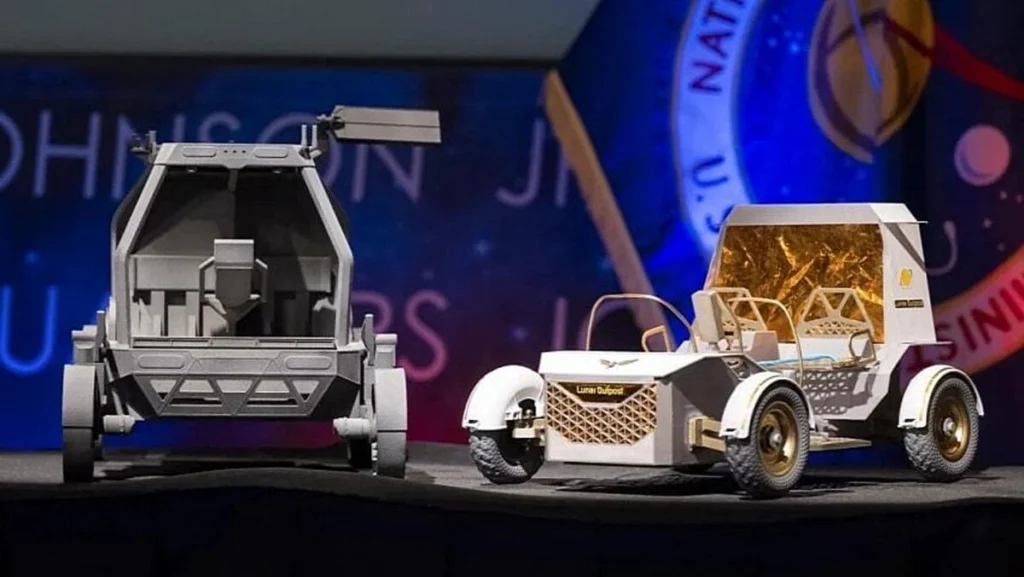
The rover will be delivered to the lunar surface by Blue Origin’s Blue Moon Mark 1 lander.

On Tuesday, NASA provided an update on the development of crewed and robotic lunar rovers to support its planned Moon Base initiative, highlighting efforts to develop the surface mobility capabilities needed for future exploration and sustained human operations on the Moon.

RELATED:

NASA Researchers Set Up in Spanish Village to Observe Total Solar Eclipse

NASA’s Volatiles Investigating Polar Exploration Rover is scheduled to embark on a mission to the lunar South Pole region in 2027 to explore permanently shadowed craters in search of water and other potentially valuable resources that could support sustainable lunar exploration.

The rover will be delivered to the lunar surface by Blue Origin’s Blue Moon Mark 1 lander and is expected to travel more than 30 kilometers, collecting data on local temperatures, lighting conditions and terrain.

NASA said the data could help scientists better understand the origin and distribution of water on the Moon and assess how lunar resources might be used to support future exploration.

Meanwhile, NASA has awarded task orders to Astrolab and Lunar Outpost to build the first phase of Moon Base rovers capable of carrying crew, called lunar terrain vehicles (LTVs), which are intended to reach the Moon ahead of crewed Artemis missions.

NASA is advancing work on robotic rovers and lunar terrain vehicles that will help explore the South Pole and support the early stages of a permanent human outpost.
The VIPER rover, assembled at Johnson Space Center, is scheduled to fly in late 2027 on Blue Origin’s Blue Moon… pic.twitter.com/U4hS3Sl6hQ

— Light Science 🇦🇷 (@LightSciencXXII) October 21, 2026

Blue Origin has been tasked with delivering the rovers to the lunar South Pole region by 2028 through NASA’s Commercial Lunar Payload Services initiative.

The LTVs will allow astronauts to explore geologically diverse areas near the lunar South Pole, collect samples and transport equipment. They will also be remotely operated from Earth to map the lunar surface before astronauts arrive.

According to NASA, the LTVs are designed to travel up to 10 kilometers on a single battery charge, support up to three moonwalks per Artemis mission, and carry up to 80 kilograms of lunar samples and tools.

“Lunar rovers are central to our surface mobility strategy,” said Robert Pickle, director of NASA’s Surface Mobility Office within the Moon Base Program. Their performance will help lay the groundwork for the mobility systems needed to build, operate and expand infrastructure for long-duration lunar exploration, he explained.

teleSUR/ JF

Source: Xinhua

  •  

Russia Releases 74-Year-Old American Prisoner as Witkoff Meets Putin in St Petersburg

Moscow has released retired American teacher Stephen Hubbard after more than four years in detention, following President Donald Trump’s personal intervention with Vladimir Putin and amid renewed US-Russian negotiations over Ukraine.

Russia has released Stephen Hubbard, a 74-year-old American citizen imprisoned since 2022, as US special envoy Steve Witkoff holds talks with President Vladimir Putin in St Petersburg on Wednesday, 21 October.

Putin announced the release during his meeting with Witkoff, saying Hubbard had already been transferred to Pulkovo Airport in St Petersburg in preparation for his return to the United States. Witkoff thanked the Russian president for securing the American’s freedom.

The development follows direct intervention by President Donald Trump, who confirmed on Tuesday that he had personally raised Hubbard’s detention with Putin and requested his release.

Hubbard, a retired English teacher from Michigan, had spent decades living abroad before moving to Izium, in Ukraine’s Kharkiv region, in 2014. Russian forces detained him in April 2022, during their occupation of the city following the full-scale invasion of Ukraine.

In October 2024, a Moscow court sentenced him to six years and ten months in prison after finding him guilty of serving as a mercenary for Ukrainian forces.

Russian prosecutors alleged that Hubbard had joined a Ukrainian military unit and received approximately $1,000 a month for his activities, including guarding military checkpoints.

His family rejected the accusations. His sister, Patricia Hubbard Fox, maintained that he had never participated in military operations, while his American lawyer, Martin De Luca, said the charges were fabricated.

The US State Department subsequently designated Hubbard as wrongfully detained, making his release a priority in Washington’s negotiations with Moscow.

Release coincides with renewed Ukraine diplomacy

Hubbard’s release comes during another round of intensive diplomatic contacts involving Washington, Kyiv and Moscow.

Witkoff arrived in St Petersburg following talks in Oslo on Tuesday with Ukrainian President Volodymyr Zelenskyy, Norwegian Prime Minister Jonas Gahr Støre and Finnish President Alexander Stubb. Jared Kushner, another representative of Trump’s administration, participated remotely.

The discussions addressed security arrangements, energy and economic questions connected with Russia’s war against Ukraine.

Witkoff travelled directly from Norway to Russia, where he was received by Kremlin representative Kirill Dmitriev before his meeting with Putin.

The release provides a concrete outcome from the latest US-Russian contacts, although no indication has emerged that it forms part of a broader agreement concerning Ukraine.

It also follows several previous cases in which American citizens detained in Russia have been released through negotiations between Washington and Moscow.

In August, former US Marine Robert Gilman was released on humanitarian grounds amid serious concerns about his deteriorating health.

Hubbard was the only American prisoner in Russian custody officially classified by Washington as wrongfully detained at the time of his release.

Neither side has announced whether Moscow received any concessions in exchange for his freedom, while the outcome of Witkoff’s wider negotiations with Putin remains unclear.

  •  

Cambodia and Laos are not pawns in a Chinese encirclement

In late September, China and Laos opened a Beijing-funded training and support center and an aviation academy at Ban Keun airport, about 50 kilometers north of Vientiane. China’s Ministry of National Defense says the facility will train Lao Air Force pilots and is “not directed against any third party.” Even so, much of the commentary […]

The post Cambodia and Laos are not pawns in a Chinese encirclement appeared first on Asia Times.

  •  

Regolare gli affitti brevi non basta a risolvere la questione della casa

Un regolamento europeo in attesa di approvazione permetterà di limitare gli affitti brevi. Darà un sollievo temporaneo alla questione abitativa. Per affrontarla in modo strutturale servono però interventi e politiche per le famiglie meno abbienti.

L'articolo Regolare gli affitti brevi non basta a risolvere la questione della casa proviene da Lavoce.info.

  •  
❌