❌

Reading view

Colombian President Dismisses Interior Minister Over Budget Failure
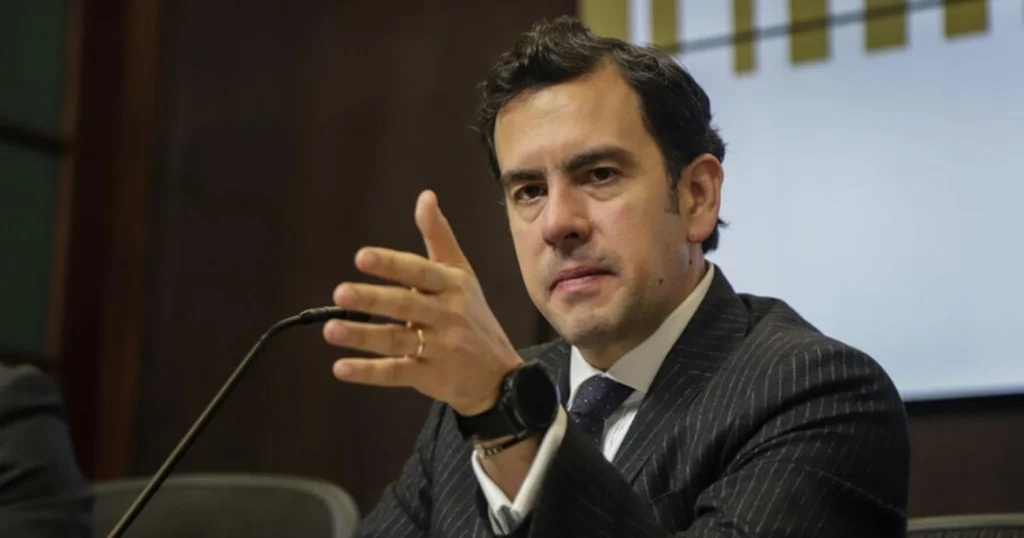
The Executive plans to cut the budget in social areas such as public health and energy subsidies for vulnerable sectors.

On Thursday, Colombian President Abelardo de la Espriella dismissed Interior Minister Rodrigo Lara following the crisis triggered by the failure of the 2027 National Budget bill in Congress.

RELATED: Colombia Budget Bill Faces Legal Challenge Over Text Discrepancy

The controversy arose after the Senate and the House of Representatives approved different versions of the budget without reaching a consensus before the constitutional deadline for the legislative process.

Faced with the impossibility of passing the initiative through parliamentary means, the government decided to use a decree to implement the national budget for the next fiscal year.

Senator Esmeralda Hernandez criticized the procedure followed during the legislative debate and attributed the failure to irregularities and errors committed during the discussion of the bill.

According to complaints, the version of the budget decreed by the Executive includes cuts in social areas such as public health, energy subsidies for vulnerable sectors, and programs for senior citizens.

The Colombian Congress approved a 634.9 trillion peso ($201.14 billion USD) national budget for 2027, cutting funding for peace accord bodies while increasing debt service and defense allocations.#News pic.twitter.com/FqIZRk6t8s

— Dubon007 (@gdubon007) October 20, 2026

To replace Lara, the president appointed Alejandro Ordoñez, former Attorney General and former ambassador to the Organization of American States, as the new Minister of the Interior. Ordoñez is one of the most prominent figures in Colombia’s conservative sector.

He served as Attorney General from 2009 to 2016, a period marked by controversial decisions, including the dismissal of Gustavo Petro, then-mayor of Bogota, a decision later overturned by international bodies.

While his appointment is being formalized, the Ministry of the Interior will be led on an interim basis by Minister of Justice Ivan Cancino, amid concerns about the country’s projected fiscal deficit.

The government confirmed that it will use the mechanism provided for in the budget legislation to directly enact the 2027 budget, arguing that this measure will guarantee the functioning of the State following the failure of the legislative process.

#Colombia | Artists and cultural workers rallied outside the Culture Ministry in Bogotá against a proposed nearly 30% cut to the sector’s 2027 budget.
Demonstrators demanded funding for cultural programs and payment for artistic work, warning the cuts are already affecting the… pic.twitter.com/lhtVLTRY0V

— teleSUR English (@telesurenglish) September 21, 2026

teleSUR: JP

Source: teleSUR

  •  

EU Parliament defies frugal capitals by seeking €7bn more for the EU’s popular Erasmus+ student scheme

The European Parliament overwhelmingly supported an increased budget and scope for the Erasmus+ student-exchange programme under the new EU budget on Thursday (22 October).

The plenary in Strasbourg opted for a €7bn increase in Erasmus+’s budget compared to the commission’s proposal, by 454 votes, with 34 abstentions, against 93, mostly from right-wing parties.

And it was an audacious move, seeing as ‘frugal’ EU capitals are pushing for €150bn of cuts to the commission’s draft.

But even a “slight increase” in Erasmus+ funds would mean more opportunities for thousands of people, said Bogdan Zdrojewski, a Polish centre-right MEP, who was the rapporteur on the file, during a parliamentary debate earlier on Wednesday.

Celebrating its 40th anniversary in 2027, Erasmus+ enables young people to study, live, and work in foreign countries both inside the 27 EU states and the programme’s 160 “associate” states worldwide.

Some 17 million people have taken part since it began, with an estimated 1 million babies also born to couples who met on exchange, in what the commission has long used as a flagship PR project for creating a feel-good factor about the EU.

Meanwhile, the UK will rejoin the programme in 2027, which means EU students will once more have the opportunity to also spend a semester in Britain, which hosts some of Europe’s and the world’s top universities.

And the parliament would also welcome Canada’s full participation in a few years’ time, Zdrojewski told press on Wednesday.

The EU Parliament would like to expand Erasmus+ to more vocational training. “Erasmus+ will be a programme for Europeans no matter what age, what stage of life,” Zdrojewski said.

And students from poorer homes should get more support to live in pricey cities abroad, he added.

The share of Erasmus+ participants who had fewer opportunities to travel under the present structure stood at 15 percent in 2023 – up from 10 percent only two years earlier, according to a commission evaluation.

“Far too often, it is still the parents’ financial situation that determines who can take part in Erasmus+ and who cannot,” said Sabrina Repp, a German socialist MEP, in Wednesday’s debate in Strasbourg.

Working students often cannot afford to quit their current job to go abroad, she added: “That is precisely what we must change.”

The EU budget talks are to be finalised early next year.

Some 83 percent of Erasmus+ participants say they gained professional skills that helped them in the labour market.

But in order for those opportunities to be available more widely, “we need more funding for this programme,” also said Lucia Yar, a Slovak liberal MEP in the Strasbourg debate.

  •  

On Borrowed Time: Ukraine's Economy in the War's Fifth Winter – KI Insights monthly briefing

Ukraine is heading into 2027 with a rising fiscal gap. Growth forecasts have been cut, inflation is rising, and the need for external financing seems to just keep going up. The economy is being squeezed by a labor market drained by mobilization and emigration, energy infrastructure has been decimated, and

  •  
❌