Concerns about the cost of artificial intelligence investment triggered sharp losses in American technology shares on Thursday, with the sell-off affecting European markets as investors reassessed the outlook for chipmakers and major digital companies.
The Nasdaq Composite fell 2.6 per cent, while the Philadelphia semiconductor index lost nearly seven per cent. Shares in Meta declined sharply after its latest earnings revived concern over the capital needed to expand AI infrastructure.
Trading stabilised in parts of Asia on Friday, but European shares remained under pressure. The retreat came alongside a rise in oil prices and renewed demand for US government bonds, underscoring investors’ sensitivity to several risks at once.
The underlying issue is whether the enormous spending commitments announced by technology companies can generate sufficient returns to justify current valuations.
Building and operating AI systems requires large data centres, advanced chips, electricity supplies and network infrastructure. The companies financing that expansion are investing before the full scale and profitability of future demand can be known.
Strong revenue growth can coexist with higher costs, rising debt and pressure on cash flow. For investors, the question is not simply whether AI will be widely used, but how its benefits will be divided among software companies, infrastructure providers and customers.
The latest market reaction follows earnings announcements that renewed scrutiny of spending plans. A one-day share-price fall does not establish that the AI sector is entering a prolonged contraction.
European exposure
Europe participates in the AI supply chain through semiconductor equipment, advanced manufacturing, energy infrastructure and cloud services. A repricing of major American technology companies can therefore affect European-listed firms even when their own operating results have not changed.
The Netherlands and France are among the markets with listed technology businesses exposed to global semiconductor demand. Falling shares may also reflect general risk aversion rather than a judgment about an individual company’s prospects.
European policymakers have argued for stronger domestic computing capacity and digital independence. The economic challenge is to support that capability without assuming every investment will earn a commercial return.
Energy prices add pressure
Brent crude’s rise to around $114 a barrel has intensified uncertainty about inflation and borrowing costs. Rising fuel prices can affect both households and power-intensive sectors, while higher interest rates tend to reduce the present value of expected future profits.
Global investors have consequently moved towards government bonds and other perceived safer assets. That shift reflects changing risk assessments, not a forecast that markets will necessarily keep falling.
Future earnings reports, capital-expenditure plans and evidence of customer demand will determine whether this week’s losses become a sustained correction or a short-lived reassessment.
For Europe, the sell-off puts renewed emphasis on the financing and competitiveness of its own technology ambitions.
If you're reading this, then the internet still works. But that's something that we shouldn't necessarily take for granted after this week's global cybersecurity meltdown.
"Think of it this way: someone discovered that millions of buildings in the country have the same broken lock, and now everyone knows how to open it," writes Matt Shumer in a lengthy post on X about the situation. "The lock maker has sent out a fix, but every building owner has to install it themselves, and many haven't yet."
This is the world we live in now. In August, more than 100 tech companies signed a letter warning about exactly this possibility. On Thursday, one of Anthropic's top information security officers wrote that cybersecurity threats "are going to get a lot worse before they get better." Major banks are rushing to secure themselves after reports of autonomous agents operating inside accounts (though many of them may have been authorized by account holders).
This is unlikely to be the last incident like this. Cybersecurity firm CrowdStrike says it saw twice as many "agentic intrusions" (hacking done by an autonomous or semiautonomous AI) in August as in July, and then the number doubled again in September.
Scary stuff, for sure. As is usually the case, however, prevention is better than panic.
Shumer's post contains many helpful suggestions for better online security—it is particularly important to secure your email accounts, since that is the gateway to so much of what we do online. Here's a 15-step plan to stay more digitally secure in the AI age. (And if you're really worried about everything falling to bits, Reason's got you covered there too.) If your devices and browsers have updates available, install them. And for the love of digital gods, don't click on random links in strange emails!
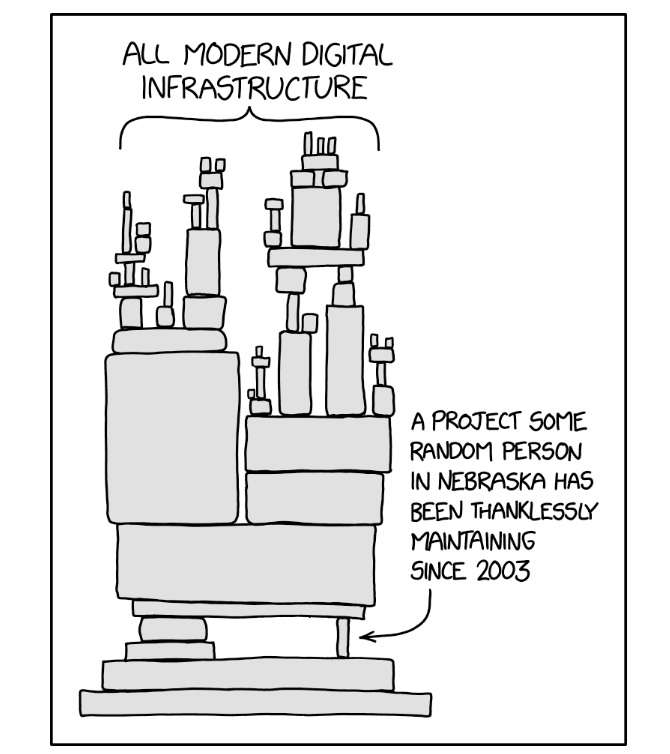
The man who (maybe) saved the internet? There is an old XKCD webcomic—and I'm dating myself as a very specific type of millennial by even referencing that—that seems to perfectly sum up what happened this week. Here it is:
Source: https://xkcd.com/2347
Here's the craziest part: That's basically true! Except the one random person lives in Czechia instead of Nebraska. His name is Ondřej Surý, and TheAtlantic's Charlie Warzel found him:
Surý, who lives in Czechia, does not work for the PHP Foundation. But alongside his day job as director of domain-name-system engineering at the nonprofit Internet Systems Consortium, in a volunteer capacity, he maintains and helps automate patches for the coding language. His work, with that of just a handful of others, has allowed countless websites and organizations to fix these vulnerabilities quickly. Over the past 48 hours, he's become arguably the unsung hero of the entire internet—despite the fact that the only compensation he receives is from modest donations. "Ondřej will save the internet today," a user in the PHP Subreddit wrote.
In the war between AI hackers and AI defenders, it's still humans who are the heroes. At least for now.
Art of the steal. Yesterday, in this space, I detailed how voters are fed up with the Trump administration's seemingly endless stream of corruption. But it's been a whole 24 hours, which means there is yet another scandal in the news—thanks to a Vanity Fairarticle about President Donald Trump's son-in-law Jared Kushner.
The article is an excerpt from a forthcoming book. In it, author Matthew Cole claims that Dutch investigators gained access to Kushner's phone with the help of Russian hackers. The evidence from the phone and other sources shows that Kushner has been taking money from the governments of Saudi Arabia and the United Arab Emirates to "push their agenda with Trump."
Kushner says the article's claims are "outrageous and categorically false."
But wait, there's yet another corruption story. The Justice Department is reportedly probing whether Trump ally Corey Lewandowski profited from his role as a top adviser at the Department of Homeland Security (DHS). The Washington Post reports that the investigation is based on a referral from the DHS inspector general and is focused on "contracting fraud."
It may or may not be connected to other allegations that surfaced in September, when The Wall Street Journalreported that Lewandowski approached officials in Qatar and the UAE about being hired to help with "visa issues" and other matters.
In both matters, Lewandowski has denied the allegations. He's no longer working for the department, having been fired earlier this yearamid a messy scandal involving then–DHS Secretary Kristi Noem, who was also canned.
Scenes from Virginia: Federal prosecutors indicted state Sen. L. Louise Lucas (D–Portsmouth), one of the most powerful Democrats in Virginia, on charges of racketeering and money laundering in connection with illegal marijuana sales. (Don't get me started on how dumb it is that recreational marijuana use has been legal here since 2021, but commercial sales are still forbidden. If it's legal to use something, it should be legal to sell it!)
Lucas pushed the failed Virginia redistricting effort and has been an outspoken critic of Trump. She plans to fight the charges. Virginia Gov. Abigail Spanberger, also a Democrat, said in a statement that the timing of the indictment, just days before the midterm elections, "further erodes the trust the American people deserve to have in the Department of Justice."
QUICK HITS
"The last thing José García-Sorto remembers after being shot in the chest is being pulled from his car, pinned to the pavement and handcuffed, his blood pooling around him on a Phoenix interstate. All he could think about was what would happen to his two young children if he died." The New York Times has a harrowing account of a Honduran immigrant who was shot by immigration officers last year. He's never been charged with a crime in connection with the incident, which suggests "the authorities did not find evidence that he had put anyone in danger."
The Cato Institute's annual ranking of "Freedom in the 50 States" is out. Arizona takes the top spot. How did your state do?
Is alchemy real now? A California company claims it has successfully turned mercury into gold.
The World Series begins tonight, and it ought to be terrific. Despite low payrolls, Tampa Bay and Milwaukee were the top teams in their respective leagues this year. They are deep, talented teams full of characters worth cheering—Brewers' star pitcher Jacob Misiorowski is a huge Pokémon nerd; Rays' star hitter Yandy Diaz escaped from Cuba after being imprisoned there. And this is the first World Series since 1980 to match two franchises that have never won a championship.
Alpha School, a private network, is spreading into public education. While its students’ test scores are high, some parents and educators say it doesn’t live up to the hype.
An Alpha private school in Austin, Texas. The Alpha network is small but growing rapidly. Its leaders have ambitions for the model to reach one billion students around the world.
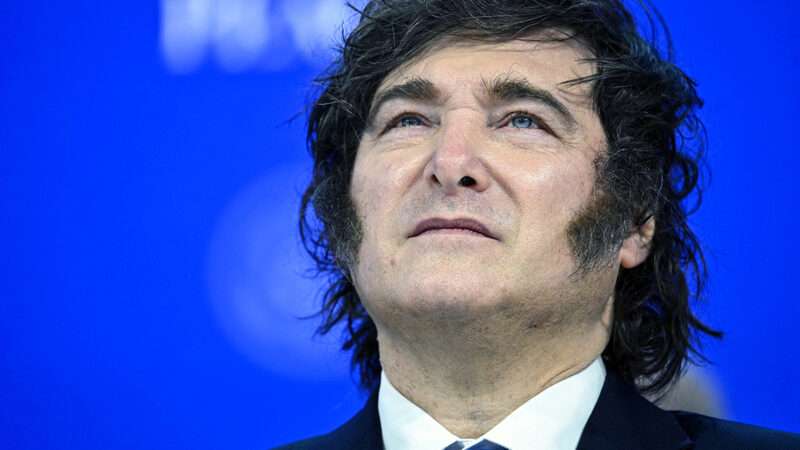
"As much as the industrial revolution freed us from the constraints of the human muscle, AI will free us from the constraints of the human brain, pushing productivity beyond our wildest dreams….Keep AI unregulated so that it is free to be developed without the deadly hand of premature and poorly understood regulation."
Argentine President Javier Milei wrote that on June 4 in the Financial Times as part of his push to bring AI companies to Argentina. The prior week, he had introduced legislation to boost AI based on three pillars: leaving AI unregulated, establishing a new legal category for nonhuman corporations operated by AI agents or robots, and keeping corporate taxes low. As of late September, the Senate has held hearings on the legislation but not advanced it.

 Login