
❌

Reading view

Moscow elites pleased with US envoy Witkoff and far from agreeing to peace (Ukraine Battlefield update, Day 1,702)

  • Russian journalists reveal what the Kremlin and US are discussing.
  • Starshield was supposedly fixed, but that doesn’t seem to be the case.
  • Russians advance in Rai-Oleksandrivka towards Sloviansk.
  • Russia loses two combat Sukhoi aircraft in accidents in one day.
  • Map of the day: Rai-Oleksandrivka
  • Videos of the day: Kramatorsk evacuation; Russian Su-30 crashes; how helicopters hunt drones.

Russian journalists have described the nature of talks between the Kremlin and the US. A demilitarised zone in Donbas. A Ukraine without Nato membership but is allowed to join the EU membership in return. Sanctions against Russia eased, Russian gas in Europe and news talks on the Nord Stream 2 pipeline. And America makes its own deals with Russia.

This is how, according to The Economist, the US proposal to the Kremlin for ending the war sounded, presented in Moscow on Wednesday (21 October) by Steve Witkoff, Trump’s negotiator.

It sounds like something Russia might welcome, but that does not appear to be the case. At least not according to the findings of the Russian exile website Verstka, which a day later published an extensive report on the mood among Russia’s Kremlin-linked elite.

The article, signed by the newspaper’s editorial board, contains numerous quotes from government officials and people close to the regime, whose views on the prospect of swiftly reaching a peace deal and ending the fighting are sceptical.

Verstka wrote that war fatigue was mounting among these people, whose names it naturally did not disclose, but that they fully defer to Russian president Vladimir Putin and are waiting to see what he agrees with US president Donald Trump.

“It can be said with certainty that American sympathies have shifted to our side. We have been working on this for a year and a half,” a source close to the foreign ministry told the journalists, describing Moscow’s strategy.

Russia achieved this through the following argument: since Ukraine considers itself a victim — which it undoubtedly is, editor’s note — and asks for assistance, but is unwilling to make concessions in return for that assistance, it is no longer in fact a victim, but a player with ambitions of its own, which Western taxpayers are unwilling to fund.

Incidentally, the Slovak government uses very similar rhetoric and arguments.

According to the same source, Moscow will emphasise during the talks the hopelessness of Ukraine’s supposed situation.

Another quoted voice was a political strategist directly linked to the Kremlin, who pointed out that Trump’s son-in-law Jared Kushner did not directly take part in the talks in St Petersburg on 21 October, reportedly due to illness.

Nevertheless, this source also praised the US approach, even if Trump’s dispute with Ukraine proved only short-lived: “We have nothing to lose from these solutions. And we could gain both an improved budget and an advantage on the battlefield.” At the same time, the domestic political strategist saw no fundamental changes that could lead to an end to the fighting.

The extent of the irrationality prevailing within the regime was illustrated by statements from another unnamed representative of a formally non-governmental organisation working directly with the Kremlin.

In his analysis, he claimed that Ukrainian president Volodymyr Zelensky had created a dictatorial system from which neither elections nor a coup could remove him, and that the war would not end while he remained in office. He also cited reports by Russia’s foreign intelligence service claiming that Kyiv was cooperating with Mexican drug cartels.

Another government official had low expectations of the Americans: “For almost two years now, we have been saying that Trump is supposedly one of us and that the talks are constructive, but they have produced no results. We are fighting, burning, drowning, suffering alongside our homeland.”

The man spoke of a “peace wing”, allegedly comprising people in the presidential administration responsible for domestic policy and economic circles, but this did not mean that there was any open opposition to the war.

“There is no escape from the ship. We are waiting for them to have had enough of the war,” the official said.

This article continues, but the full version is available only to EUobserver.com subscribers. Visit account.euobserver.com/membership
  •  

Putting the clocks back this Sunday – yet millions of Europeans don’t want to

Europeans made their preference clear. Parliament voted. So why are we still changing the clocks?

On Sunday (25 October), Europeans will once again turn their clocks back by one hour. The familiar ritual will again raise the same question: did the European Union not decide years ago to end seasonal clock changes?

The question entered the European agenda largely from the bottom up.

Citizens repeatedly contacted and petitioned the European Parliament, raising concerns about health, sleep disruption and the continuing usefulness of changing the clocks twice a year.

A citizens’ initiative presented to the Finnish Parliament in 2017 gave the issue further momentum. Finland could not end the practice alone because it was regulated at EU level.

On 8 February 2018, the European Parliament called on the EU Commission to assess the existing directive and, if necessary, propose its revision.

84% public support for ending clock changes…

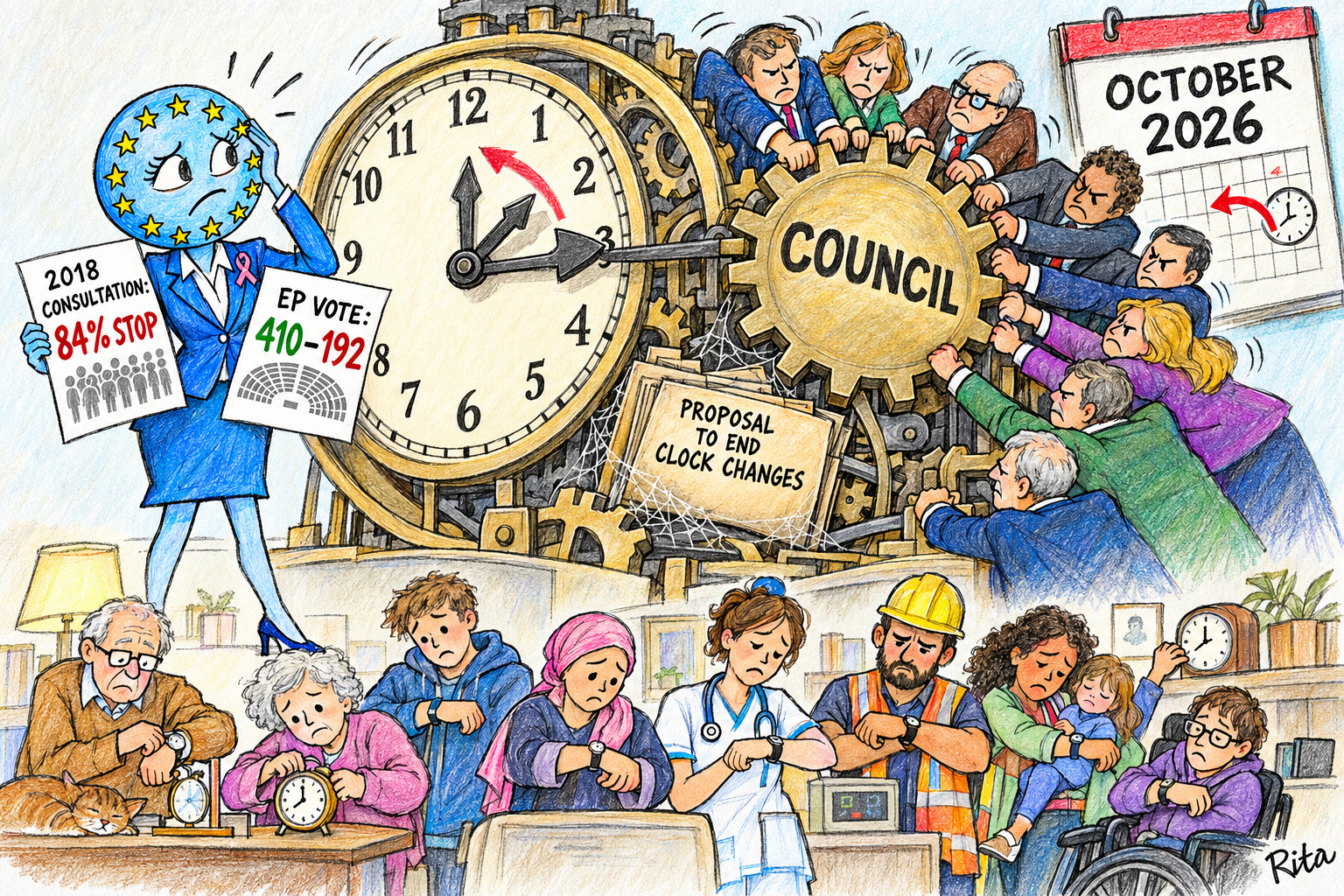
The commission subsequently launched a public consultation. It received approximately 4.6 million responses from citizens, the highest number ever recorded for an EU consultation at that time. Among those who participated, 84 percent supported ending the twice-yearly clock changes.

The consultation was not a referendum, and participation varied considerably between member states. Nevertheless, millions of Europeans sent a clear political message.

Jean-Claude Juncker highlighted the issue in his 2018 State of the Union address. Shortly afterwards, the commission proposed ending seasonal clock changes while allowing each member state to choose permanent summer time or permanent standard time.

…and MEPs agree

In March 2019, the European Parliament approved the proposal in plenary by 410 votes to 192, with 51 abstentions. The final clock change was expected in 2021.

Yet 2021 came and went, and Europeans continued adjusting their clocks every March and October.

Parliament has not reversed its position, and the commission has not formally withdrawn its proposal. The file remains blocked because member state governments have never agreed on a common position in the Council.

No simple solution for 27 states

Ending the clock change sounds simple until governments must decide what replaces it. Should countries remain permanently on summer time or standard time? What happens if neighbouring countries make different choices? How would a patchwork of time zones affect transport, aviation, trade and the single market?

These are legitimate questions.

A poorly coordinated decision could create new problems while solving the old one. Some governments also requested a more detailed assessment of the consequences. The pandemic and the crises that followed then pushed the issue further down the political agenda.

However, the crisis cannot explain indefinite inaction. Eight years after the Commission presented its proposal, the Council has still not adopted a position. Without it, negotiations with Parliament cannot move towards a final agreement.

This is where a practical question about clocks becomes a problem of democracy, accountability and political communication.

Citizens were encouraged to participate. Millions did. Parliament responded adequately. The commission presented the consultation as evidence that Europe was listening. Its president announced that clock-changing would stop, and Parliament endorsed the proposal with a clear majority.

Then the process got  stuck.

Twice a year, Europeans are reminded of this promise, but receive little to no explanation about who is blocking progress, which governments support which option or how the disagreement might be resolved.

Simply saying that “the EU failed” would, however, hide who has the concrete political responsibility. The EU is a complex, multilevel decision-making system in which responsibility is shared among different institutions and member state governments. Parliament adopted its position, while national capitals failed to agree in the council.

Those governments should explain their positions instead of allowing “Brussels” to absorb the blame like often happens, for their collective indecision.

The European Commission also has certain responsibility because her proposed legislation left the most difficult question, the choice of permanent time, to individual countries. 

In any case, the EU risks turning, or did turn,  an example of successful citizen agenda-setting into an example of participatory failure.

The issue may not be Europe’s most urgent challenge right now, but credibility and a positive image is also built through implementation of citizens’ demands such as this one.

People notice when a widely announced change does not happen, especially when it impacts directly and negatively their daily life. They also notice when nobody explains why.

Member state governments should state publicly whether they favour permanent summer time, permanent standard time or retaining the current system. The council should put the issue back on its agenda and strive to achieve an agreement.

And if this is not possible, Europeans deserve a clear explanation why their participation led nowhere.

  •  

[Interview] ‘If stress in France ends up contaminating the rest of the eurozone, the ECB will have to do something,’ says French economist

France is facing one of its worst political, social and fiscal crises in years, and there is a sense things will get worse before they get better.

What started in September as high-school protests over teacher shortages and poor education standards in the Paris suburbs later grew into a much wider revolt over soaring fuel and living costs, a public sector pay freeze and a proposed austerity budget.

Last Saturday (17 October), public anger exploded into nationwide riots. More than half a million people took to the streets across France. Most marched peacefully. But violence broke out on the sidelines in several cities, with looting, arson and clashes with police.

When things finally calmed down, nearly 2,400 people had been arrested, interior minister Laurent Nuñez later said.

But even as protesters demand more teachers, smaller classes, higher wages and cheaper fuel, investors have been selling off French government bonds, worried that France cannot rein in its spending.

The gap between French and German 10-year borrowing costs, an important gauge of financial stability in the eurozone, reached almost 151 basis points on Tuesday, the widest since the eurozone debt crisis of 2011-2012.

But French politics is too divided to agree on the spending cuts bond traders want to see. And with presidential elections due in April, a quick resolution looks unlikely.

That leaves the central bank. The European Central Bank (ECB) could buy up French debt to bring borrowing costs down. It may even be forced to, if bond market panic spreads. But bailing out France is politically explosive, and depends on the judgement of the bank’s 27-member governing council. 

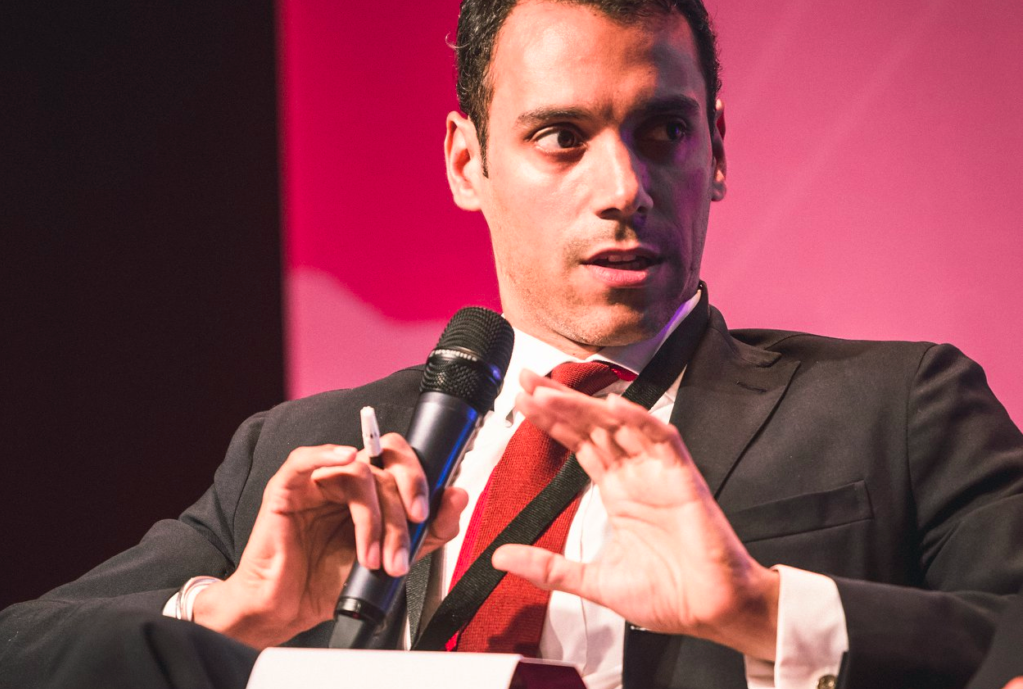
For the time being, the ECB “is unlikely to say or do anything helpful,” Shahin Vallée, a senior associate fellow at the German Council on Foreign Relations (DGAP), wrote in a recent blog post.

Vallée, who is now an advisor to institutional investors, previously worked for Herman Van Rompuy who was European Council president during the eurozone crisis. He then joined Emmanuel Macron, France’s economy minister at the time, as advisor.

That background means he can speak with authority on everything from macroeconomics and bond markets to French politics and fiscal woes. EUobserver reached out to him to see what comes next.

Last week you were in Bangkok, where the IMF urged rich and poor countries to cut deficits and get debt under control. Is that the right medicine for France?

This article continues, but the full version is available only to EUobserver.com subscribers. Visit account.euobserver.com/membership
  •  
❌