
❌

Reading view

Gaza Camp Fire Leaves More Than 800 Homeless After Drone Strike
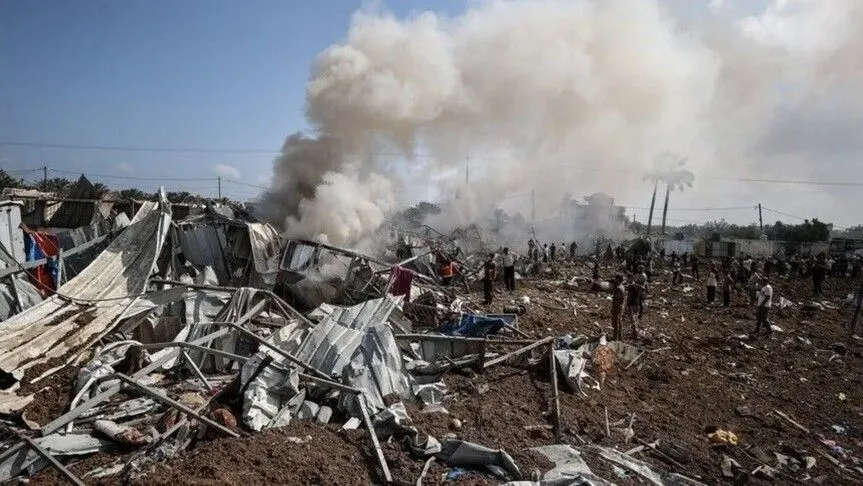
A camp for displaced people in the Gaza Strip was reduced to ashes after an Israeli drone attack. Photo: AA.

More than 800 Palestinians lost their homes after a fire gutted a displacement camp in the Shujaiya neighborhood of eastern Gaza City, in an attack the Gaza Ministry of Public Works and Housing blamed on Israeli military drones.


The blaze consumed the camp’s tents and nearly everything inside them, according to the Gazan Ministry, which said quadcopter drones operated by Israeli forces ignited the fire on October 26.

The fire affected more than 200 families, made up mostly of women, children, the elderly and people with vulnerable health conditions, the Gaza Ministry of Public Works and Housing detailed. The flames caused panic among residents, who have no housing alternatives.

RELATED: UN Commission Accuses Israel of War Crimes and Genocide in West Bank and Gaza

The Shujaiya camp sheltered families who had already fled their homes in other parts of the territory. Many had moved more than once since the war began, carrying whatever they could salvage each time.

💢🇵🇸 Over 800 Palestinians have been forced to displace yet again from Shujaiya, an eastern neighborhood in Gaza City, after Israeli forces set fire to a displacement camp, according to Al Jazeera.

Israeli quadcopter drones set the camp ablaze at around 8 p.m. local time on… https://t.co/9nyw5g9DGe

— Drop Site (@DropSiteNews) October 26, 2026

Drones Blamed

Palestinian authorities called the fire a flagrant violation of international humanitarian law and the Geneva Conventions. They framed it as part of a deliberate policy of forced displacement designed to push people out of the territory.

The Ministry of Public Works and Housing demanded urgent action from the international community, the UN Security Council, and the United Nations, and it asked those bodies to halt the attacks on civilians without further delay. It also pressed humanitarian agencies to deliver tents, temporary shelters, and essential supplies immediately to families left without roofs or belongings.

Local spokespeople linked the persistence of military operations to the tense electoral climate inside Israel, where security politics have hardened. Security operations have long featured in Israeli campaigns, and commanders face domestic pressure to show results even as international criticism mounts.

A ceasefire agreement announced on October 10, 2025, never produced calm on the ground. Israeli forces have maintained recurrent bombings, shootings, and demolition work across different parts of the Gaza Strip. Official records show the zionist offensive launched in October 2023 has now surpassed 74,000 deaths and left 175,000 people wounded.

Human rights organizations renewed their demands for a halt to hostilities and for safe, unobstructed access for humanitarian assistance. The widespread destruction of civilian infrastructure has made recovery more difficult for communities worn down by repeated strikes. Hospitals, schools, and homes lie in ruins across the territory.

Aid agencies describe the situation as catastrophic. Clean water, medicine, and fuel remain scarce, and the latest fire has multiplied the need for emergency shelter in a place where almost every building is damaged.

Palestinian officials say the fire is not an isolated event but a symptom of a broader campaign against civilian life, insisting the international response so far has fallen short of the scale of the crisis.

  •  

Association of Jurists Demands Release of Luisa González in Ecuador

The American Association of Jurists (AAJ) has demanded the immediate release of former Ecuadorian presidential candidate Luisa González, who remains in pretrial detention as part of the Labyrinth case—an investigation into alleged money laundering linked to the financing of the 2023 presidential campaign of the Citizen Revolution (RC) movement.

RELATED:

Ecuador Opposition Figure Luisa González Challenges Arrest

In a statement released on October 26, the organization described the opposition leader’s detention as arbitrary and questioned the precautionary measure, which was imposed just over a month before Ecuador’s local elections, scheduled for November 29.

The AAJ maintained that pretrial detention must be justified by specific procedural risks, such as the risk of flight or the potential to obstruct an investigation. According to the association, González had remained available to the judicial authorities since a raid conducted in January 2026; she had kept them informed of her international travel, returned to the country, and was subsequently arrested at her home.

“In the absence of a procedural risk, this measure functions as a preemptive sentence,” the organization stated, citing both the Ecuadorian Constitution and Inter-American jurisprudence to argue that the deprivation of liberty prior to a conviction should be an exceptional measure.

The AAJ also denounced the use of ongoing investigations—in which no verdict has been reached—as tools for electoral exclusion, noting that González’s detention occurs within a broader context of decisions that, in the organization’s view, restrict democratic competition.

⭕️ #ATENCIÓN | La Asociación Americana de Juristas condenó la detención de @LuisaGonzalezEc y exigió su libertad inmediata. La organización denunció el uso de la prisión preventiva y de investigaciones sin sentencia como mecanismos de exclusión electoral y alertó sobre la… pic.twitter.com/KaV7c1Tb36

— Radio Pichincha (@radio_pichincha) October 25, 2026

The text reads, “The American Association of Jurists condemned the detention of @LuisaGonzalezEc and demanded her immediate release. The organization denounced the use of pretrial detention and investigations without a sentence as mechanisms of electoral exclusion and warned about the proscription of the opposition in Ecuador. The AAJ will bring the case before the IACHR and UN organizations.”

In its statement, the association linked González’s case to a series of actions taken against opposition organizations and figures. These include the temporary suspension of the Citizen Revolution, the deregistration of other political parties, the suspension of the AMIGO movement, and the rejection of González’s candidacy.

The organization also pointed to the raid on the Quito municipal government offices and the decision to move up the date of the elections. According to the AAJ, these actions constitute a pattern of suppressing the political opposition in Ecuador. The organization argued that the American Convention on Human Rights limits the restriction of political rights and prohibits the suspension—even during states of emergency—of the judicial guarantees essential for their protection.

Furthermore, the legal organization announced that it will bring the case before the Inter-American Commission on Human Rights (IACHR), the United Nations Special Rapporteur on the independence of judges and lawyers, and the Working Group on Arbitrary Detention.

Additionally, it called on electoral observation missions to assess the conditions for fair competition in the elections scheduled for November 29. The statement was signed by Claudia V. Rocca, president of the AAJ Continental, and Vanessa Ramos, the organization’s secretary-general.

#Ecuador | Former President Rafael Correa denounced the arrest of Luisa Gonzalez, a former presidential candidate and a leading figure in the Citizen Revolution movement.https://t.co/X40VSCtbKF

— teleSUR English (@telesurenglish) October 23, 2026

  •  

‘Hello, is that The Hague?’ Sudan’s dead miners point a cold finger at Cairo


Egypt’s armed support for the Sudanese military junta under General Abdel Fattah al-Burhan took on a new and decidedly ugly dimension earlier this month with the killing of at least 114 people working an artisanal goldmine in northeastern Sudan.

The attack took place on October 10th. Survivors describe an aircraft circling before attacking the workings at Jabal al-Uqaydat. One injured miner, Ali Mohamed Hamza, said workers were preparing tea at about eight in the morning when it appeared overhead, making three circuits before striking on its fourth pass. Other accounts describe five strikes. The number of weapons and attack runs remains unverified, as does the final death toll. 

The New York Times placed the mine in Sudan’s Red Sea State, about 25 miles from the Egyptian frontier. Its reporting identified apparent Egyptian munitions in footage from the site. Subsequent accounts of that investigation described an unexploded Egyptian NASR 400 bomb, identified by Trevor Ball, a former American army explosive-ordnance specialist. This is significant physical evidence, although the identification requires further corroboration and manufacture alone cannot establish the operator.

On October 12th Egypt’s armed forces announced a third phase of a military and police campaign against illegal gold mining in the Eastern Desert. Warning leaflets had been dropped, it said, and operations were intended to protect national resources and enforce sovereignty. Cairo did not admit bombing the Sudanese mine or acknowledge casualties or crossing the frontier. Instead, its statement carefully described operations within Egyptian borders.

But taken together, the munition evidence, eyewitness accounts and Egypt’s own announcement mean Cairo can’t brush this off. Nor can they brush this off as an operation against the Rapid Support Forces. What it does suggest is that Egypt will use armed force indiscriminately against civilians wherever their Sudanese allies either won’t or can’t do it. 

This is all part of the wider story of Egypt’s involvement in Sudan. Reuters reported in February that satellite imagery showed Turkish-made Bayraktar Akinci combat drones at East Oweinat, an Egyptian airfield near Sudan. Egyptian officials acknowledged equipping two southern airports for border protection and military strikes. A separate Times investigation reported that drones operating from Egypt had attacked the RSF inside Sudan. 

All this goes well beyond diplomatic sympathy. Cairo provides political backing and, as its security officials have acknowledged privately to Reuters, logistical and technical assistance to General al-Burhan’s forces. Egypt simultaneously occupies a seat in the Quad mediation group alongside the United States, Saudi Arabia and the United Arab Emirates. It therefore possesses leverage both over the battlefield and over negotiations intended to end the war.  

The contradiction is sharp. The Quad’s September 2025 statement called for an independent, civilian-led government and a transition not controlled by either belligerent. But under Burhan’s leadership that’s not happening any time soon, which means that Egypt, for all its talk about supporting the sovereignty and territorial integrity of Sudan, will go its own way as it sees fit—even if that includes desperate miners trying to scratch a living from the soil of their own economically devastated country.  

Burhan’s response to the miners’ deaths was pusillanimous, tepid at best. On October 12th, he ordered a fact-finding inquiry involving prosecutors, judicial officials and security representatives. His administration said Sudanese and Egyptian authorities were communicating. But there was no condemnation of Cairo or any public demand that Egypt explain what had happened. Preserving the patron’s goodwill appears to be more important to Burhan than demanding answers about the deaths of his own countrymen. 

These miners were neither an invading army nor a rival government. They were people digging for survival on ground reported to be their own country’s soil. Their killing demands accountability, not diplomatic discretion. The junta’s tepid response suggests a grim hierarchy of obligations: the survival of its relationship with Cairo first; the lives of Sudanese citizens a distant second. 

As for Cairo’s behaviour, this looks decidedly like a war crime. If further investigation were to corroborate eyewitness accounts of the plane making several passes over the area before commencing its attack, then clearly they were having a good look at the facts on the ground. And they dropped their bombs anyway. Hello…? Is that The Hague?

  •  
❌