
❌

Reading view

Connecticut's New Restrictions on Flock Cameras Highlight the Dearth of Meaningful Privacy Protections
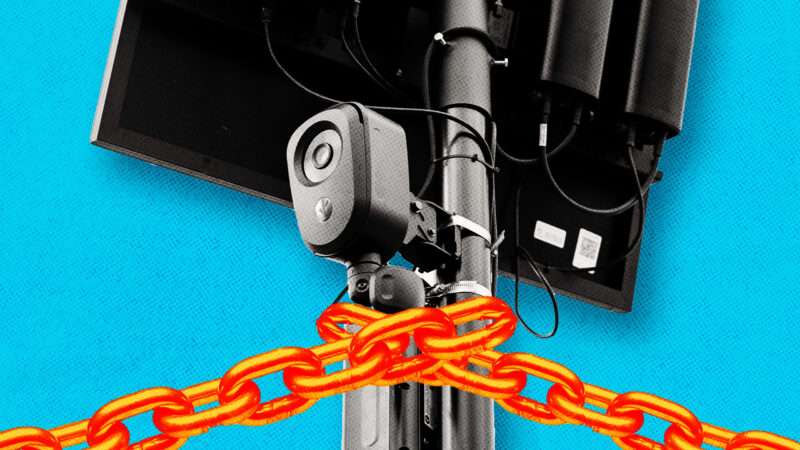
a license plate camera in chains | M. Scott Brauer/Zuma Press/Newscom/Cemil Adakale/Dreamstime/Fatima Ruiz

A Connecticut law that took effect at the beginning of October imposes new restrictions on police use of automated license plate readers (ALPRs), which enable what a federal judge recently described as "a type of indiscriminate mass surveillance." The law reflects the bipartisan backlash against AI-assisted cameras that record images of passing cars billions of times a week, building databases that police can use to track drivers, identify other vehicles in their vicinity, predict itineraries, and conduct searches based on a wide range of vehicle characteristics.

Connecticut previously imposed no statutory limits on ALPRs, a fact that underlines how readily police can access license plate data, which they can search without any sort of judicial review and often without meaningful internal supervision. But the law's provisions, while promising in some ways, fall short of the reforms recommended by critics who warn that unconstrained use of ALPRs threatens the privacy of innocent motorists across the country.

As of today, DeFlock's mapping project has identified nearly 145,000 ALPR cameras in the United States, most of which were installed by Flock Safety, the leading vendor. That network includes more than 1,500 cameras deployed by Connecticut law enforcement agencies, three-quarters of which use the technology.

The concerns underlying the new law, which Gov. Ned Lamont signed last May, echo objections raised in other states. Last February, for example, CT Insider reported that out-of-state agencies had searched ALPR data from Connecticut thousands of times for immigration enforcement purposes. When police in Johnson City, Texas, searched Connecticut data for a missing woman, the log noted that she "had an abortion," which reinforced concerns that ALPR information might be used to enforce abortion bans.

As elsewhere, ALPR critics in Connecticut also have complained about a lack of transparency. In April 2025, for instance, South Windsor began using Flock cameras without any public notice. The resulting consternation prompted the city council to cancel the program early this month. CT Mirror reports that South Windsor is "at least the sixth Connecticut community to end or suspend the use of ALPRs this year, following Windsor, Killingworth, Ledyard, Milford and Newtown."

Compared to those moves, the new state restrictions are pretty weak tea. But they include some potentially meaningful changes, and they highlight how lax oversight of ALPRs has been.

The new law restricts the sharing of ALPR data, which henceforth will be limited to Connecticut, Massachusetts, New York, and Rhode Island unless an agency in another state obtains a judicial warrant. The law says the data may not be used for immigration enforcement, to target conduct protected by the First Amendment, or for investigations related to "reproductive" or "gender-affirming" health care services. It also bars the placement of ALPRs near facilities that provide such services or organizations that primarily serve immigrants.

The original bill specified that ALPR data could be retained for no more than seven days unless it is tied to an ongoing criminal investigation, subject to a warrant, or used for toll enforcement. The final version of the bill extended that limit to 21 days. Flock's original default was 30 days. But last August, in response to widespread criticism of ALPR surveillance, the company began recommending a seven-day limit. Connecticut's Police Officer Standards and Training Council, which last month sent Lamont a report that included suggested reforms, thinks the state should adopt the seven-day standard.

Under the new law, police may search ALPR data to "assist in the recovery of a stolen motor vehicle," "assist in locating a missing or endangered individual," or "assist in the apprehension of an individual with an outstanding warrant." They also may query the database for information "relevant and material to a specific active investigation of a criminal offense in which there is reasonable suspicion that the offense has been or is being committed." When they do that, their agency must record "the reason for the access and any associated case number for the complaint or incident that is being investigated and is the basis for the access."

It is remarkable that Connecticut lacked such basic safeguards until now, and it is not clear how effective the new rules will be. Since July 1, 2025, Virginia has required that cops state a "specific purpose" for ALPR searches, including "the offense type." Yet last April, WHRO reported that Norfolk police often give "incomplete and imprecise reasons" for ALPR queries, including "suspect," "suspicious," and "investigation" or "inv."

Connecticut's "reasonable suspicion" requirement is more lenient than the standard that the Institute for Justice favors. The organization's model statute would generally require a warrant based on probable cause for ALPR queries. The proposed law makes exceptions for "exigent circumstances," stolen vehicles, and toll, parking, or traffic enforcement.

Connecticut's law also addresses the sort of blatant abuses that have fueled opposition to license plate cameras, including cases in which cops have been caught using ALPR data to stalk personal nemeses, ex-girlfriends, possibly unfaithful spouses, and objects of romantic interest. The law says an officer "who is found to have knowingly accessed, used or disseminated automated license plate reader data with malicious intent for purposes outside of the provisions of this section shall be subject to disciplinary action including, but not limited to, suspension, cancellation or revocation of certification" for police work.

The law establishes two additional remedies that could deter ALPR abuses. It authorizes the attorney general to sue ALPR contractors for damages and injunctive relief when they violate the new restrictions. It also allows "any aggrieved individual" to sue "a public agency" that flouts the rules.

"The law, for a first bite at the apple, is not bad," Ken Barone, manager of the University of Connecticut's Racial Profiling Prohibition Project, told CT Insider. Given that "there was a benchmark of nothing," he said, the attempt to constrain and track ALPR use is "a big step forward."

The post Connecticut's New Restrictions on Flock Cameras Highlight the Dearth of Meaningful Privacy Protections appeared first on Reason Magazine.
  •  

Can Marissa Mayer, Yahoo’s Former CEO, Help Fix A.I.’s Gender Problem? 

She made her name as a pioneer at Google, then as chief executive at Yahoo. Now Mayer is entering the crowded marketplace for A.I. assistants — and hoping to draw in more women with a product that tackles the mental load.

© Kelsey McClellan for The New York Times

Marissa Mayer has reinvented herself as a start-up founder, with a team of 10 engineers — a fraction of the armies of programmers she once commanded at Yahoo and Google.
  •  

The 'Big Bad' theory of billionaire tech bros

Jeremy Strong as Mark Zuckerberg, Elizabeth Holmes, and Elon Musk

Bloomberg/Getty; Jeremy Strong/Sony Pictures; Finn Gomez/Getty; Tyler Le/BI

Writing villains is supposed to be hard. No grand, world-dominating plan ever really makes sense in a story. Soon after "The Dark Knight" came out, David Goyer, its writer, told me the Joker had been a real relief. "Blessedly, because of who the Joker is, we just said, 'fuck the plan. We don't have to do it. He's the Joker. He's the anti-plan,'" Goyer said. "Trying to take over the world is such an impossible, stupid idea — as if anyone could do it with a single act, you know?"

Yet now very real people seem to try just that, on the regular. Except if you believe Hollywood, they're not insane clowns. They're billionaire tech bros. It's starting to seem like every movie and TV bad guy is a douchebag who got rich making stuff that works on your phone. Mark Zuckerberg in "The Social Reckoning," Elon Musk in "Musk," Elizabeth Holmes in "You Can See Everything," Sam Altman in the upcoming "Artificial," Sam Bankman-Fried in "The Altruists." In these stories, at varying levels of fictionality, the evil villains' megalomaniacal plans mostly make sense. Some of them even got away with it. America is eagerly consuming stories about them. "You Can See Everything" grossed $15 million on opening in just 855 theaters, twice what its producers expected.

The more interesting question is why these founders are our demons, all of a sudden. Chalk it up to the reality of the "techlash," the society-wide revulsion to Big Tech's ubiquity and power. But if you really want to understand the extent to which everyone thinks Silicon Valley is so uncanny these days, you should be watching a CBS legal procedural called "Cupertino." It's a sharp look at tech and its discontents — but more than that, it clarifies how widely the techlash is spreading.

"Cupertino" comes from the TV-making couple Michelle and Robert King, best known for the "The Good Wife" and "The Good Fight." In their new show, a slick lawyer played by Mike Colter gets iced out of the tech company he cofounded at the same time as a more junior attorney also gets ousted. The two join their wrongful-termination lawsuits against the company, eke out a big settlement, and start a firm to represent "little guys" against Silicon Valley giants. In one plotline, a drone maker tries to blame a mid-level coder for one of its bots falling out of formation during a show and killing a man — it turns out the company had changed batteries to accommodate a prospective military contract. In another, a mysterious whistleblower client asks for help to force an Anthropic-like company to put guardrails around its most powerful AI. Then the whistleblower claims to in fact be the AI.

It's all in good fun. The actors are beautiful. They banter well. Colter wears the hell out of a suit. Busy Philipps plays a Mackenzie Scott-like benefactor of the new law firm — if Scott used her incredible wealth to become a hardcore partier.

A CBS show like "Cupertino" picks bad guys that millions of people can easily recognize as deserving of comeuppance. It picked the overlords of Silicon Valley.

But thematically, there's depth. That Colter is the only Black person for miles does not go unremarked. His new partner Olivia Siffre (pronounced "cypher"), played by Rachel Keller, is a devout, cross-wearing conservative from the Midwest, an alumna of Liberty University. Their closest allies don't come from the ranks of coders, marketing, or venture capital but are instead service workers, tradespeople, and the waitstaff from a nearby TGI Fridays. (Alas, a fiction — there are no TGI Fridayses in the Valley.)

So see that class rage for what it is. The fantasy here is that the middle-American proletariat gets to stick it to bespoke-suited, arrogant C-level types and unkempt, geniuser-than-thou sex pests. Because for the last few years, those people have had all the power. "They always have a friendly audience, an accommodating interviewer who won't ask them anything controversial. And then they get into territory where the price is much higher," Robert King said in a recent interview. "They reveal who they really are: robotic, inhuman nerds who never got laid in high school and are now kind of crazy with power, self-importance, and a sense of entitlement."

The point is, the "little guys" fighting this good fight seem like they're supposed to be proxies for the viewer. "Cupertino" is a CBS procedural, the genre of shows like "NCIS" and its offspring — things that no one watches, except for 10 million people every week. That's a lot. CBS typically has the largest primetime viewership of any network, and the oldest — like, people in their 70s. It's all well and good for young coastal sophisticates to post about Elizabeth Holmes' inability to grasp the Who's-on-First routine, but "Cupertino" is aimed at America's parents and grandparents. And apparently they are excited to see the people who make their phones portrayed as the wealthy engines of every inconvenience — sources of half a billion dollars to Republicans only, builders of data centers, creators of chatbots that drive kids to death by suicide, purveyors of screens that watch you back. "Cupertino" debuted to rapturous reviews and more than 3 million viewers, beating "Grey's Anatomy" in its time slot.

A show like "Cupertino" is meant to have a low barrier to entry; it picks bad guys that millions of people can easily recognize as deserving of comeuppance. It picked the overlords of Silicon Valley.


Not so long ago it would've seemed preposterous to give a scrawny, socially awkward, brainy little guy the job of Big Bad. They're the assistant, or the butt of a particular kind of joke, like the spectrum-y heroes of the wildly popular "Big Bang Theory" — Klingon-speaking, physics-doing, Green Lantern oath-knowing clods. Still, I can think of examples of "bad guy, subtype: tech nerd" going back to the early days of science fiction. Mad scientists like Dr. Frankenstein or Dr. Jekyll, or various HP Lovecraft antiheroes, probably count. So too might the arrogant cyberneticist in Robert Heinlein's "Waldo."

A rough analog in the mid 20th century might be the rogue industrialist. After all, James Bond villains have often been tech-bro adjacent. Karl Stromberg in "The Spy Who Loved Me" wants to build independent ocean settlements; he's basically a seasteader. Hugo Drax in "Moonraker" is a eugenics-obsessed CEO who wants to build space stations, which sounds familiar. Max Zorin, played by Christopher Walken in "A View to a Kill," is an "industrialist" and the product of Nazi genetic experiments. But his megalomaniacal plan is to use a California natural disaster to gain a monopoly on silicon computer chips. That's just Jensen Huang on any given Tuesday.

The weirdest new phenomenon here is how personal it all is. Evil technology oligopolies have been representatives of oppressive capitalism in Hollywood for decades — but they were faceless. The anonymity was part of the terror. Think of the company that orders Bruce Dern to destroy the last forest in his spaceship biodome in "Silent Running," the Umbrella Corporation in "Resident Evil," or Cyberdyne Systems, creator of Skynet in the Terminator movies.

More recently, film and television have started identifying not just faceless corporations but specific tech-coded people as their worst-of-the-worst. And not just any people, but people geofenced into Silicon Valley: "Glass Onion," "Don't Look Up," "Ex Machina," "Devs," "Super Pumped" (fictionalized Uber), "WeCrashed" (fictionalized WeWork), "The Playlist" (fictionalized Spotify), and "The Dropout" (fictionalized Theranos), "Mythic Quest" — the list goes on.

Actually, Cyberdyne's a good example of one important way these depictions have changed; in 1984's "The Terminator," Cyberdyne is a Los Angeles-area heavy-industry firm. In 2015, "Terminator Genisys" moved Cyberdyne to a gleaming tech campus explicitly modeled on the headquarters of Oracle. It's an inside joke, though not the ha-ha kind. The movie's producers included Megan and David Ellison, children of Oracle CEO Larry Ellison. David now owns the merged studios of Warner Bros. and Paramount, and he just got a billion-dollar investment from Elon Musk. The new company, Skydance, includes in its holdings … CBS.

Christopher Walken's Bond villain has a megalomaniacal plan is to use a California natural disaster to gain a monopoly on silicon computer chips. That's just Jensen Huang on any given Tuesday.

"A sequence of Hollywood contemporary science-fiction movies identifies Silicon Valley capitalists as a new type of villain," write Northumbria University film studies scholars Joe Street and Russ Hunter in a 2024 paper. These new movies critique tech, they say, using an approach "in the grand tradition of cinematic science fiction touchstones such as the Cold War alien invasion films that allegorized fears of Communism in 1950s America."

In other words, movies about time-travelling killer robots and dead-eyed billionaires aren't so different, after all. Horror is about shared anxieties. Old-school mad scientists posed a threat because they dared to do experiments that contravened the laws of nature; they were evil for love of the game. The Silicon Valley bad guys are worse, because they do it for profit. "When presented with an innovation," Street and Hunter write, "the prime movers in these corporations think not of moral or ethical concerns and crucially not of the material impact of what they are doing — but only of the innovation's potential for financial gain."


Is Hollywood's techlash actually on the rise? The schlemiels of "Silicon Valley" premiered in 2014. I have tech-bro-villain articles in my files going back to 2022 at least. And the business world has always been fodder for stories filtered through the anxieties of the time—what was Ebenezer Scrooge if not a capitalist oppressor?

Mapping the full arc of technology-associated villains would be, in the words of Ted Underwood, "hard to code." Underwood's an English and information science professor at the University of Illinois at Urbana-Champaign, researching ways to identify literary trends across time, in big canons. "In addition to tracing the history of villains, you'd have to think how often these social types appear as heroes," he says. For every Max Zorin there's a Tony Stark. Ethan Hunt's nobody without tech aces Luther and Benji. "Star Trek" doesn't trek without Scotty, or Chief O'Brien. Every movie heist is basically a hack. And let me just say unto you: "MacGyver." "One hypothesis would be that what we're feeling right now with evil tech bro villains is just that the counterbalancing examples have dropped out," Underwood says.

Clearly, though, tech billionaires and their hangers on have actively tried to make themselves into main characters. Some of them seem to think they're the only real consciousnesses in a simulation, a virtual world populated with non-player characters like you and me. At minimum they evince a belief that they possess a greater depth of perception and knowledge. As the architect and tech historian Fred Scharmen once wrote, "for this particular kind of person, wealthy and powerful or not, intelligence comes paired with a certain kind of malignance. The Evil Nerd is sharp, and also mean, their big brains are oriented towards anger and destructiveness." The Thiels, Altmans, Musks, and Karps of the world turn what had been nerdy weakness into nerdy strength. They go on friendly podcasts and show up in pictures taken with presidents. We don't have to imagine them delivering what the screenwriter John Rogers, creator of the anticapitalist TV show "Leverage," calls the Evil Speech of Evil. They monologue at tech conferences! These guys embody their ideologies; l'enterprise, c'est moi.

And what happens if that kind of behavior gets depicted, week in and week out, on a popular legal procedural TV show? Even if that show airs on a network owned by one of those "evil nerds"? Hard to say. Maybe it'll be enough to turn some people into the Joker.

Read the original article on Business Insider

  •  

Amazon Faces Fresh EU Scrutiny Over Worker Surveillance and Algorithmic Management

Members of the European Parliament are visiting Amazon logistics centres in Germany and Poland this week to investigate working conditions and the use of digital monitoring systems, reopening a dispute between the technology company, European legislators and trade unions over employee rights.

The fact-finding mission, scheduled for 26th and 27th October, will examine how Amazon organises work, measures employee productivity and uses automated systems in warehouses. MEPs will meet management, employees, works councils and trade union representatives, with particular attention to whether technological changes are affecting workers’ health and their ability to exercise employment rights.

The investigation comes as the European Commission prepares its Quality Jobs Act, which is expected to address algorithmic management, occupational safety and working conditions across the European economy. Amazon’s extensive logistics network makes the company a prominent example of the questions legislators must resolve.

MEPs enter warehouses after prolonged dispute

The delegation is led by Li Andersson, chairwoman of Parliament’s Employment and Social Affairs Committee, and includes Belgian MEPs Liesbet Sommen and Estelle Ceulemans, alongside representatives from several other political groups.

According to the European trade union federation UNI Europa, MEPs will inspect facilities in Dortmund and Mönchengladbach on Monday before travelling to Poland on Tuesday.

The German visits will cover older warehouse operations and newer facilities incorporating robotics, allowing parliamentarians to compare different approaches to handling orders and managing employees. The Polish programme includes a major returns facility in the Katowice area.

The visit follows several years of strained relations between Amazon and the European Parliament.

In February 2024, Parliament withdrew permanent access badges from Amazon representatives following disagreements over the company’s participation in hearings and requests for visits to its warehouses.

Amazon disputed suggestions that it was avoiding scrutiny, maintaining that it had offered alternative arrangements for parliamentary visits during periods when its logistics operations were particularly busy.

Company executives eventually appeared before the Employment and Social Affairs Committee in January 2026, where they defended Amazon’s employment policies and workplace practices.

The controversy over digital surveillance

At the centre of the dispute is the increasingly widespread use of electronic systems to monitor productivity.

Warehouse employees commonly use handheld scanners, while automated systems can help allocate tasks, coordinate movements and identify delays in processing orders.

These technologies allow employers to manage substantial logistics operations with considerable precision. They also make it possible to collect detailed information about individual workers’ activities throughout their shifts.

Trade unions argue that such monitoring can create unreasonable performance pressure, particularly where targets are adjusted automatically or workers cannot challenge assessments generated by software.

The concerns are not confined to Amazon.

A European Commission survey examined by EU Today earlier this month found that 42 per cent of surveyed smaller and medium-sized businesses already used artificial intelligence or algorithmic management systems.

However, 49 per cent of respondents expressed distrust of automated systems making decisions about employees, illustrating the distinction between using technology to support management and delegating consequential decisions to algorithms.

Previous regulatory action

Amazon has already faced formal European regulatory scrutiny over workplace monitoring.

France’s data protection authority imposed a €32 million fine on Amazon France Logistique in December 2023, announcing the decision in January 2024. The regulator concluded that certain employee monitoring practices were excessively intrusive and breached data-protection requirements.

The investigation examined the collection and retention of detailed information from warehouse scanners, including productivity indicators and periods of inactivity.

Amazon rejected the regulator’s conclusions and subsequently appealed the decision. The penalty therefore needs to be distinguished from any final judicial determination of the dispute.

The case nevertheless demonstrates that workplace monitoring falls within existing European privacy legislation, independently of proposals for new employment rules.

EU Today has also reported on the application of European data-protection law to automated employment decisions, including the question of whether meaningful human review is available when software affects a person’s ability to work.

Amazon disputes allegations

Amazon maintains that its warehouse technology is intended to improve operational efficiency, safety and the reliability of deliveries.

In its January parliamentary testimony, the company defended its investment in employee training and insisted that workers have the right to join trade unions.

It also pointed to engagement with works councils and employee representative bodies across its European operations.

Trade unions contest the adequacy of those arrangements, particularly in Germany, where the ver.di union has repeatedly sought a collective agreement covering Amazon employees.

These competing positions will form part of the parliamentary delegation’s assessment.

Implications for EU employment legislation

The Commission’s Quality Jobs initiative addresses several questions raised by the Amazon dispute, including algorithmic management, psychosocial risks and the effectiveness of collective bargaining.

Legislators must determine how far employers should be required to disclose the operation of automated monitoring systems, how employees can contest decisions and what safeguards should apply when performance targets are generated by software.

Rules must also accommodate legitimate requirements for stock management, security and workplace safety.

The parliamentary visit will not itself establish whether Amazon has breached employment legislation. It is a fact-finding exercise intended to inform future policy discussions.

Its importance lies in giving legislators direct access to warehouse operations and employee accounts before deciding how European labour law should respond to increasingly automated workplaces.

  •  
❌