❌

Reading view

Anthropic wants it both ways: public money and private control

Anthropic CEO Dario Amodei arrives near the White House ahead of a planned meeting with US President Donald Trump, in Washington, DC, on September  29, 2026.
Anthropic CEO Dario Amodei and his six cofounders will control 50.1% of the company's voting shares after it goes public.

Oliver Contreras / AFP via Getty Images

  • Public investors are finally getting a chance to invest in Anthropic.
  • But unlike other public companies, Anthropic doesn't want the public's input when it comes to major decisions.
  • Instead, Anthropic will be effectively controlled by CEO Dario Amodei and a group of other insiders.

In the next few weeks, public investors will get their chance to buy a piece of Anthropic.

But regular investors will never have a chance to steer the AI giant's decisions: Even though Anthropic is going public, it will essentially remain a private company, controlled by a handful of people with outsized power.

That's not unusual for giant tech companies launched in the past few decades (Larry Page and Sergey Brin have effective control of Google; Mark Zuckerberg has the same at Meta, as does Elon Musk at SpaceX.) It's also something you see at some prominent media companies (Rupert Murdoch and his son Lachlan have effective control of his two public companies; Larry and David Ellison have the same at Skydance.)

Anthropic's twist on the idea is that control is split between two different groups of insiders. There's a clique of seven founders, including CEO Dario Amodei and his sister, Daniela, who control 50.1% of shareholder voting power. And there's also a trust with the power to appoint four of the company's seven directors.

Put those two together, and you get a corporate constitution designed to keep public investors outside the real decisions. The founders control the outcome of any shareholder vote; the trust controls the board.

In theory, those two groups could end up in conflict on major issues. The trust-appointed directors might, say, vote to replace Amodei with a new CEO. Or the founder group could veto a sale approved by the board.

In reality, there's a lot of overlap between the two groups. For starters, Anthropic created and funds the trust. And Anthropic itself says it has made sure the trust is staffed with people who see the world the same way its executives do: "In practice to date, the Trustees and company executives have collaborated closely on sourcing, interviewing, and selecting Trustees," the company notes in its S-1 filing.

The main takeaway is that there's no way for an individual shareholder, or even institutional shareholders who own significant chunks of Anthropic's equity, to force it to move one way or another.

The upside of arrangements like this are pretty clear, from a founder's perspective: They insulate their founders and managers from investors who might only care about short-term goals.

The downside: These structures insulate founders and managers from investors who might have very good reasons to want the company to change.

A good counter-example to the trend is Twitter, which went public in 2013 without founder control — which is why Elon Musk was able to buy it nearly a decade later.

In Anthropic's case, that aversion to giving public investors a real voice is synced directly to the company's founding thesis — that the AI it is developing is so consequential and potentially dangerous, that it must be controlled by people who care about more than Anthropic's share price.

And for many investors clamoring to get in on Anthropic's IPO, that lack of control — disclosed up front — won't matter. They just want their shares to be worth more over time. Musk's ironclad control of SpaceX didn't put dampen demand for the biggest IPO in history.

But if investors ever want to force Anthropic to do something the Amodeis and their cofounders — or the Anthropic-created trust — don't want it to do, they'll be out of luck. Buyer beware.

Read the original article on Business Insider

  •  

Gemini disponibiliza ferramentas para microempresas

Estas soluções, de acordo com a Google, visam "poupar tempo precioso a estes empreendedores permitindo-lhes focar no essencial", ajudando empresas em áreas como design gráfico e contabilidade.

© ADAM VAUGHAN/EPA

Este hub central faz conexão com soluções do Google Workspace, Google Ads e Perfil da Empresa, bem como integração direta com plataformas essenciais como Shopify, Canva, Adobe, Xero, Wix e Zoho
  •  

Want to land a legal job at Google or Nvidia? These law firms could be your ticket.

Google logo on a glass office building behind orange flowers and greenery in bright daylight.
Google has a thing for Big Law lawyers.

Tayfun Coskun/Anadolu Agency via Getty Images

  • Big Law has plenty of competition for its best lawyers.
  • Some of the most ambitious lawyers want to work for clients in their legal departments.
  • New Pirical data shows which law firms have the most alumni working in Big Tech.

Big Law has a hard time keeping its lawyers.

It's not just rival firms dangling basketball-player salaries, extra vacation, and branded merch to lure away top talent.

Big Tech is competing for those lawyers, too.

New data shared with Business Insider reveals which firms send the most lawyers to the biggest names in tech.

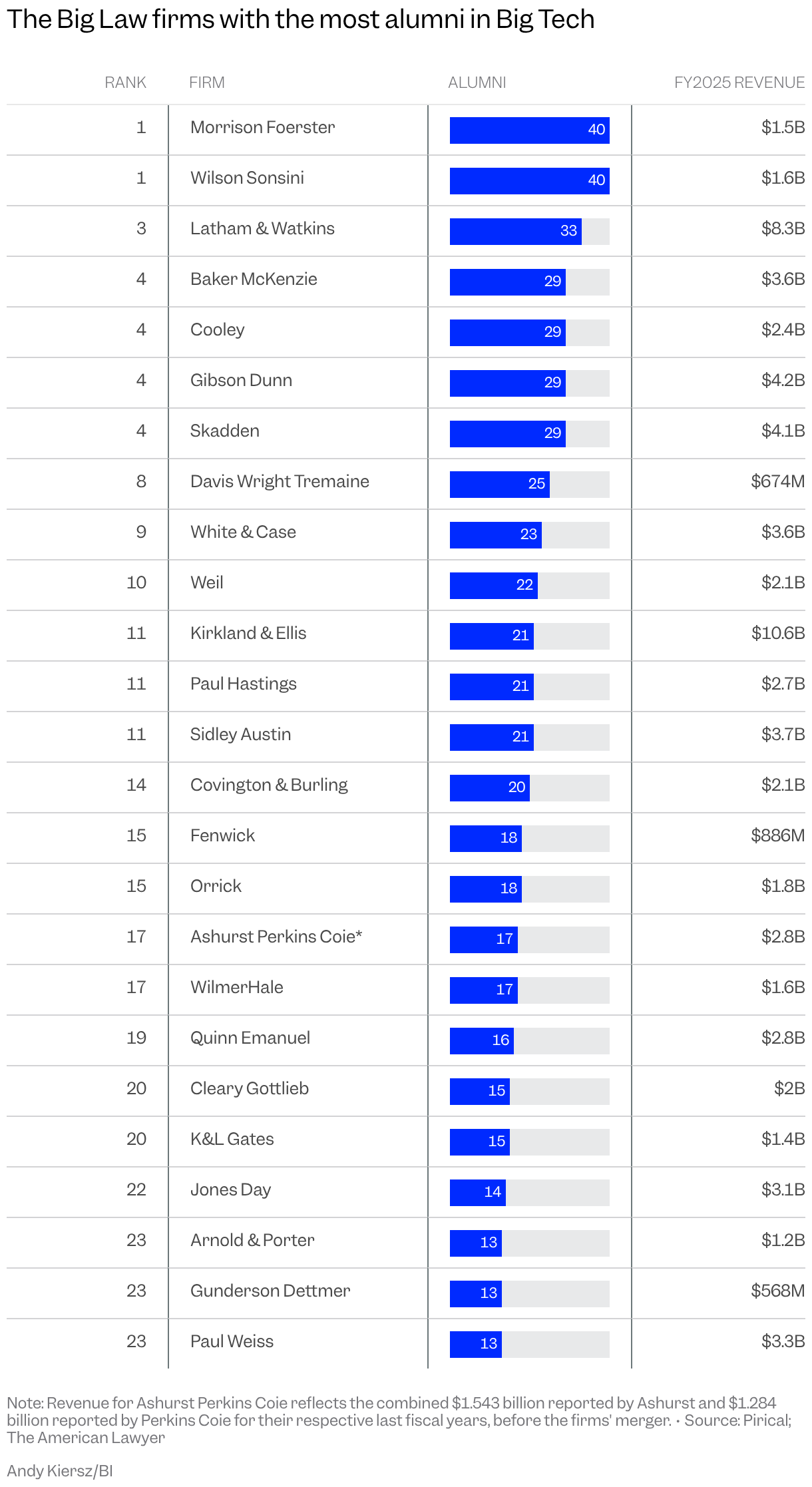
Pirical, a legal people-analytics company, tracked lawyers who previously worked at the 200 largest law firms by revenue in the United States and now hold legal roles at seven tech companies: Google, Meta, Microsoft, Nvidia, OpenAI, Anthropic, and SpaceX. Pirical filtered out summer associates and interns.

Morrison Foerster and Wilson Sonsini tied for the top spot, each with 40 alumni working in legal roles across the seven companies. Both firms regularly represent tech startups and the investors backing them.

Latham & Watkins followed with 33 former lawyers. Kirkland & Ellis, the industry's revenue leader, ranked 11th with 21 former lawyers working at those companies, tied with Paul Hastings and Sidley Austin.

Table

Pirical's analysis may have missed lawyers whose job titles fell outside its search criteria, said Craig Savitzky, its insights and content editor. He said newer companies, particularly Anthropic, are also likely undercounted because their legal teams are growing faster than public profiles are updated.

Big Law-Big Tech pipeline

For attorneys hoping to land a coveted job at a tech giant, a stint at a white-shoe law firm can be a stepping stone. They can trade billable-hour quotas for a seat closer to the business, attractive pay, and just one client to keep happy instead of dozens.

That combination makes these roles "some of the most highly desirable and sought-after positions" for law firm associates, said Casey Sullivan, a recruiter with CMW Legal Search.

There's another draw, Sullivan said. The companies at the forefront of artificial intelligence are wrestling with some of the thorniest legal questions of the day, from intellectual property to regulation.

"That's where the most interesting work is for lawyers," he said.

Not all law firms are equally effective launch pads. Pirical's Savitzky noted that the firms near the top of the list have deep ties to the tech industry, if not the deepest pockets.

Cooley brought in $2.4 billion in revenue last fiscal year, placing it 29th on The American Lawyer's ranking of top law firms by revenue. But it tied fourth on Pirical's list, with 29 alumni working at the seven tech companies, including nine at Nvidia, a longtime client.

Davis Wright Tremaine, which has represented Microsoft in antitrust and employment lawsuits, has 13 alumni working in the software giant's legal department. Fenwick, which advised Wiz and Fitbit on their sales to Google, has 13 lawyers at the search giant.

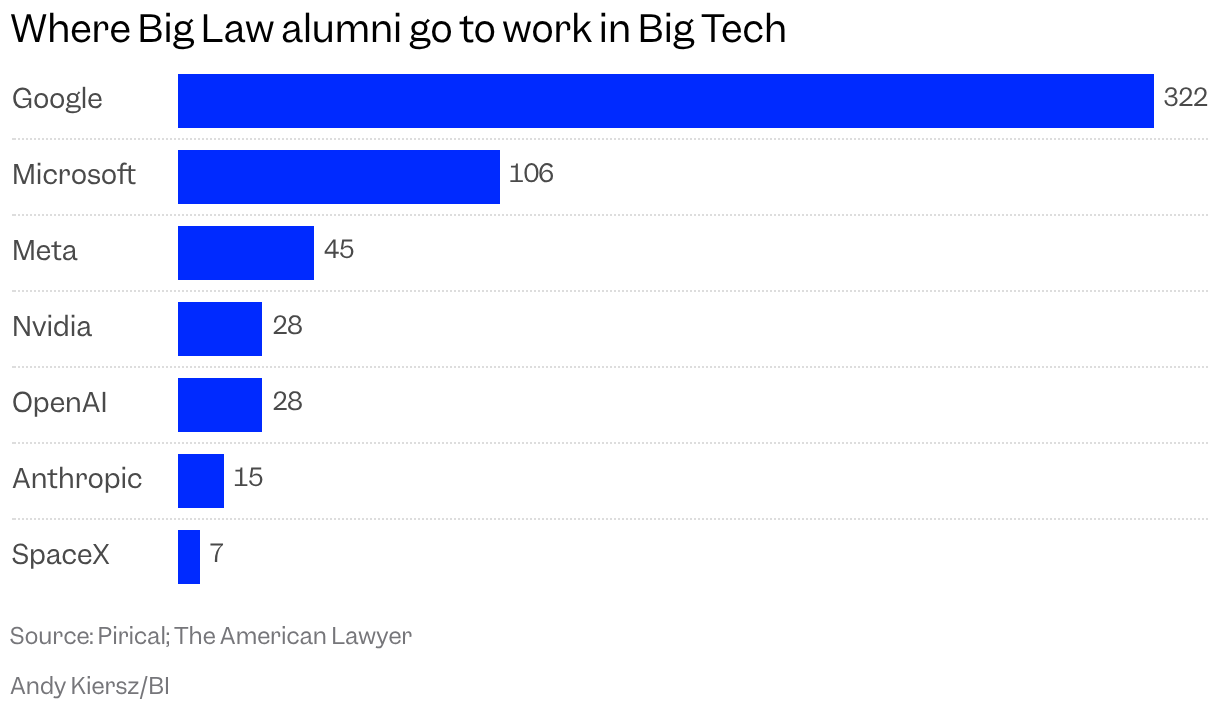
Business Insider also sliced the data another way, looking at which of the seven tech giants employ the most alumni from the top 25 firms on Pirical's list.

Bar Chart

Big Law is effectively a feeder school for Google's legal team. The company employs 322 alumni of the top 25 law firms on Pirical's list, more than any other tech company studied.

That doesn't necessarily mean Google is the most desirable location for lawyers leaving Big Law. Savitzky said the numbers likely reflect the sheer size of Google's legal department and the decades it has had to recruit from top firms.

Read the original article on Business Insider
  •  
❌