
❌

Reading view

Here's what Microsoft's buyout offers actually include

Microsoft CEO Satya Nadella
Microsoft CEO Satya Nadella.

Oliver Berg/picture alliance via Getty Images

  • Microsoft is offering buyouts to about 60,000 employees.
  • The offers are individualized to each employee based on their level, location, and tenure.
  • Business Insider reviewed offers to show what employees get when they leave the company.

As Microsoft sends out its buyout offers to more than a quarter of its workforce, specific offers reviewed by Business Insider reveal exactly what employees get if they choose to leave the company.

The offers are individualized for each employee based on their level, location, and tenure. Those reviewed by Business Insider confirm that the US buyouts align with the company's US standard severance offers. A Microsoft spokesperson said about 60,000 employees would be eligible for the buyout.

Microsoft uses a levels system to represent seniority, from entry levels starting at 59 to senior levels at 70, or vice president. The company offered buyouts to employees on select teams in the US, Canada, India, and the UK at level 70.

Offers reviewed by Business Insider show employees at internal levels 64 and below were offered one week of base pay per six months of service, and employees at levels 65 to 67 were offered two weeks of base pay per six months of service.

Buyout offers also include continued regular stock vesting and health insurance. The standard stock-vesting severance offer is six or 12 months for levels 67 and below, based on years of service.

Eligible employees will have until early December to decide whether to take the offer and exit at the end of the year, and there are no plans for another buyout at this time, a Microsoft spokesperson said.

Standard severance is capped at 39 weeks of base pay for levels 67 and below, while the standard severance offer for level 68 includes 12 months of salary.

Earlier this year, Microsoft rolled out a voluntary retirement program for employees. About 7% of Microsoft's US workforce, or about 8,750 people, were eligible at the time. As Business Insider previously reported, Microsoft's voluntary retirement program offer also aligned with the company's standard severance offer, including continued regular stock vesting for six or 12 months, based on years of service.

Earlier this year, another tech giant, Google, offered buyouts to staff in its business unit, Business Insider previously reported.

As more tech companies offer buyouts, some human resources professionals previously told Business Insider that this approach could soften job cuts, and also that when they're made available to workers of all tenures, companies risk losing talent.

Have a tip? Contact this reporter via email at astewart@businessinsider.com or Signal at +1-425-344-8242. Use a personal email address and a non-work device; here's our guide to sharing information securely.
Read the original article on Business Insider

  •  

Instagram is clearly jealous of YouTube — and is introducing a bunch of changes

NEW YORK, NEW YORK - MAY 04: (L-R) Mark Zuckerberg and Adam Mosseri attend the 2026 Met Gala celebrating "Costume Art" at the Metropolitan Museum of Art on May 04, 2026 in New York City. (Photo by Kevin Mazur/MG26/Getty Images for The Met Museum/Vogue)
Meta's Mark Zuckerberg and Adam Mosseri are betting on long-form.

Kevin Mazur/MG26/Getty Images for The Met Museum/Vogue

  • Instagram is opening its arms to long-form video again.
  • Adam Mosseri, Instagram's top exec, said longer videos will help the app stay "relevant."
  • Instagram is testing tools for creators making episodic content. But will it pay for them?

Instagram's top executive, Adam Mosseri, has a plan to keep the platform "culturally relevant" — by making it more like YouTube.

Meta-owned Instagram unveiled an overhaul of long-form video features on Monday, including a test of horizontal videos called "Features." Taken together, the changes make the app feel a lot more like YouTube.

"We want to be the most culturally relevant platform," Mosseri said in an interview with content creators and founders of Press Publish, Colin Rosenblum and Samir Chaudry. "To do that, we just need to show up where people are."

The context: YouTube has become a major hit on TV screens, and there's a growing appetite for Instagram-native shows with recurring episodes.

"Subway Takes," hosted by Kareem Rahma, is a prime example of Instagram's strengths and limits. The show started in 2023 as a short-form interview series and, as it grew, expanded with longer-form cuts on YouTube and the streaming platform Tubi. Instagram, however, is where Rahma's show still has its largest audience of 2.4 million followers.

Instagram doesn't want people to go to YouTube or Tubi to see longer versions of shows like "Subway Takes." That's leaving ad revenue and user engagement on the table. Its new tools are designed to entice creators and viewers to stay on its platform.

Here are Instagram's latest video tools and how creators can use them:

  • "Features" keep viewers within the Instagram ecosystem. Instead of leaving Instagram to watch the extended version of an interview or episode, it'll be relatively seamless to stay on Instagram and watch that longer-form content. Instagram's "Features" can be as long as 90 minutes, although the new format is, for now, only available to a limited number of creators in the US and Brazil.
  • Instagram is feeding more content to its TV apps. Instagram is also pushing its "Instagram for TV" app further. The app will feature various video content on TV services like Samsung, Amazon Fire TV, Google TV, and now Apple TV. People can now watch a feed of content their friends are also liking or resharing on TV.
  • Instagram-native shows can label their episodes more clearly with "Series." Within the main Instagram feed, Instagram is testing a way for shows on the app to seamlessly connect episodic content. Eligible creators can add videos to a Series, and a label appears over the content indicating that there are additional episodes. People can then watch those episodes in order from the start. This test is expanding to more countries through the end of the year.
  • Clips can directly drive engagement back to the original video. Instead of clipping content and praying that the audience will go the extra mile of clicking on an account and finding the original, longer-form video, Instagram is letting creators link up to 8 clips to one long video.
Instagram is launching more video tools.
Instagram is expanding its offerings for long-form video content.

Meta

This isn't Instagram's first time dabbling in long-form content.

In 2018, it launched IGTV, a long-form video format and stand-alone app. In 2020, Instagram rolled out a program that let creators earn money from those videos on IGTV. Four years after launching, the company sunset the IGTV app and shifted its video efforts to Reels.

There are a few key elements missing from Instagram's big leap (back) into long-form video.

You can't watch the video while continuing to scroll through Instagram, or multitask by opening other apps while keeping the Instagram content in a picture-in-picture pop-up. There also aren't automated transcripts and subtitles yet. A spokesperson for Meta told Business Insider that there are plans for these features.

Will creators get a slice of the ad revenue pie?

For creators, one key question and pain point looms: Will Meta share the honeypot?

Mosseri told Rosenblum and Chaudry that Instagram is thinking about ways to test pre-roll and mid-roll ads that could lead to a revenue split. However, he said previous attempts by Instagram to build a creator monetization system comparable to YouTube's Partner Program didn't prove beneficial for the platform.

"We spend more money than we make back by a long shot," Mosseri said of Instagram's previous efforts at broad revenue-sharing programs.

Mosseri said that in its previous iterations of content monetization, creators typically didn't produce more content than they already did for free, and the content they did create tended to be lower quality.

Still, Instagram will need to "figure it out" as it tries to crack longer-form content, Mosseri said.

"I don't think of platform payments or performance-based incentives or bonuses as a revenue driver," Mosseri added. "I'd be psyched to scale them up for any of these formats — as long as we're breaking even."

Read the original article on Business Insider
  •  

The feds made $627 million selling Anthropic stock from SBF's friends — but could have made billions

sam bankman-fried sdny
Sam Bankman-Fried and two of his co-conspirators held investments in Anthropic, the AI company that has since soared in value.

Bloomberg/Getty Images

  • The feds seized Anthropic shares last year from Sam Bankman-Fried's associates.
  • Several months later, the government sold them for $627 million.
  • If Anthropic IPO'd in November at $1.5 trillion, those shares would be worth nearly $4 billion.

Last year, the federal government made a windfall of $627 million when it sold Anthropic shares it had seized from associates of crypto fraudster Sam Bankman-Fried.

If it had held on to that stake, its windfall could have been a lot bigger.

The federal government last year sold shares of Anthropic that had belonged to Caroline Ellison and Nishad Singh, two co-conspirators in the FTX fraud case. The proceeds went to compensate victims of the fraud, a Justice Department spokesperson told Business Insider.

Anthropic's S-1 filing on Monday revealed how much the federal government made from the sale of those shares. The prospectus doesn't name Ellison and Singh specifically. It says the government in October 2025 sold 4,453,900 Series B shares of Anthropic that "had been forfeited by former holders in legal proceedings to which we were not a party."

The figure matches up exactly with the combined $50 million in shares that Singh and Ellison purchased for $11.2261 each in Anthropic's 2022 fundraising round, and later forfeited to the government.

The shares represent about a quarter of a percent of Anthropic today. But given the company's explosive growth, they are still worth a fortune.

Anthropic hasn't yet announced the stock price for its expected November initial public offering. At a $1.5 trillion valuation, the shares would be worth a total of about $3.94 billion. That would be six times as much as the government sold the shares for a year ago.

"One of the Justice Department's top priorities is returning forfeited funds to victims through the asset forfeiture program whenever the law allows," the DOJ spokesperson said.

The feds' stake in Anthropic

How the federal government came to own a chunk of Anthropic in the first place is a story involving a notorious fraudster and a complicated criminal forfeiture process.

Bankman-Fried participated in Anthropic's 2022 Series B fundraising round with Singh and Ellison. Singh purchased $40 million of the Series B shares, and Ellison acquired $10 million.

Singh and Ellison later pleaded guilty to crimes related to their work with Bankman-Fried and testified against him at his Manhattan federal criminal trial. The jury found Bankman-Fried guilty, and a judge sentenced him to 25 years in prison. The federal government took ownership of Singh's and Ellison's Anthropic shares by April 2025.

The US Marshals Service sold Singh's and Ellison's shares, rather than hold on to the red-hot Anthropic stock, Business Insider previously reported. The US Marshals Service Complex Assets Unit is typically tasked with dispensing shares of private companies acquired through criminal forfeiture.

Now we know that Anthropic purchased the stock from the feds in October 2025 at the price of $140.9676 per share, which is the same price Anthropic set for its Series F-1 stock in a fundraising round a month earlier.

Anthropic resold the shares to nine investors at the same $627 million total price it paid to purchase them from the federal government, so it didn't make a profit from the sale, according to the S-1 filing. It's not clear which nine investors purchased the shares originally owned by Singh and Ellison. Representatives for the US Marshals Service didn't immediately respond to a request for comment.

The Anthropic shares owned by Ellison and Singh took a different path than the $500 million in Series B shares owned by Bankman-Fried himself. His shares ended up as part of FTX's bankruptcy estate, which sold them in 2024 to a few dozen buyers for a total of $1.3 billion.

The federal government sent the proceeds from the sale of Ellison's and Singh's shares to the FTX bankruptcy estate, the Justice Department spokesperson said. Bankruptcy court filings show that the Justice Department transferred $638 million to the bankruptcy estate in late 2025.

The money has gone to repaying creditors, including FTX customers and investors who were scammed by the former crypto wunderkind.

Update: October 26, 2026 — This story has been updated to include a comment from the Justice Department.

Correction: October 27, 2026 — The federal government transferred the proceeds of the sale of Caroline Ellison's and Nishad Singh's Anthropic shares to the FTX bankruptcy estate, according to a DOJ spokesperson. An earlier version of this story misstated whether the funds had been transferred.

Read the original article on Business Insider

  •  

Here's the buyout package Skydance is offering employees who don't want to work in person 5 days a week

David Ellison
Skydance has called more employees back to the office under CEO David Ellison.

NYSE

  • Skydance, formed by the merger of WBD and Paramount, told employees to return to the office five days a week or take a buyout.
  • Many Paramount employees had been working fully in person, while WBD staffers were generally at three days a week.
  • Read the memo from Skydance's HR team detailing the standard buyout offer.

David Ellison's Skydance just shared its buyout offer for employees who don't want to return to an office five days a week.

Staffers across the company, which was formed by the merger of Paramount and Warner Bros. Discovery, were told on Monday that they'd soon have to work fully in person. The company didn't say if there were any exceptions to its new RTO mandate.

Eligible employees who aren't willing to work in person can opt to take a standard buyout package of two weeks of severance for every year they've been at Paramount or WBD, two people familiar with the offer told Business Insider.

Most eligible employees will receive that offer, a person familiar with Skydance's proposal said, though there could be exceptions on the timing or the amount received.

Staffers who've been offered severance must decide whether they're leaving the company by 11 p.m. ET on November 8, an HR email viewed by Business Insider said.

Paramount staffers assigned to an office had been required to work from an office five days a week since earlier this year, while WBD workers had been working in an office at least three days a week.

"We recognize that as we bring our teams together, not everyone will see their future here," Skydance's HR team said in an email to staffers.

Skydance's HR email said this buyout "is a one-time offer" and told employees that there are "no additional" offers planned.

Read the full email Skydance's HR team sent below:

As David and Ynon shared earlier today, we recognize that as we bring our teams together, not everyone will see their future here. For some, it may be the in-office policy or the pace of change. For others, it may instead reflect personal or professional goals. To give employees the option to decide what is best for them, we are offering a one-time Voluntary Buyout (VBO) Program to eligible employees.
A VBO gives an eligible employee the opportunity to volunteer to leave the organization in return for a separation package. You are receiving this email because you meet the eligibility criteria and may choose whether to participate in this program. We recognize this is an important personal decision. Please carefully consider the opportunity and notify us of your decision to accept or decline no later than 8:00 p.m. PT on November 8, 2026.
Before you decide, please keep the following in mind:
  • Participation is entirely voluntary.
  • This is a one-time offer; no additional BO programs are planned.
  • If you do not respond by the deadline, you will be considered to have declined the offer.
  • Once submitted, your decision may only be changed during your opt-in window.
  • You may wish to consult a personal financial, tax, or legal adviser before making your decision.
Please click here to indicate your decision and to review additional information, including an estimate of your severance and benefits.
We value your contributions and we want you to feel supported and informed as you consider your decision. For FAQs related to the VBO and our return-to-office policy, please visit the Skydance Integration Hub. For additional questions about the program or your individual offer, please visit My Paramount.
Read the original article on Business Insider

  •  

Skydance tells employees to return to the office 5 days a week or take a buyout

Ellison Ynon
Skydance CEO David Ellison and co-CEO Ynon Kreiz are implementing a five-day RTO policy.

NYSE

  • David Ellison's Skydance is telling staffers to work in the office five days a week.
  • Employees who aren't willing to work in person may be eligible for a voluntary buyout.
  • Skydance was formed with the merger of Paramount and Warner Bros. Discovery this month.

Skydance wants employees back in the office five days a week — and staffers who aren't willing to comply may be eligible for a buyout.

CEO David Ellison and co-CEO Ynon Kreiz informed employees at the media giant about the change on Monday afternoon. They said in a memo that the RTO order applied "across all of Skydance."

"We truly believe this is in the best interest of our company and our people," Ellison and Kreiz wrote in a memo to employees, which was viewed by Business Insider. "We've seen the benefits firsthand at Paramount, and we want every part of Skydance to share in them."

The memo did not mention whether there were any exceptions or say who's eligible for a buyout. It said employees who qualify for a buyout would get an "individual communication with their personalized details and terms, and a window to decide whether to accept this one-time offer."

Eligible employees can take a buyout package of two weeks of pay for each year they've been at the company. They must decide whether to take the offer by November 8 at 11 p.m. ET.

Skydance was formed earlier this month when Paramount completed its $110 billion acquisition of Warner Bros. Discovery. (The company previously went by Paramount Skydance.)

Most WBD employees have been required to work in person three days a week.

Paramount Skydance, for its part, had mandated that staffers in its New York and Los Angeles offices return to work in person five days a week in January. Staffers who weren't willing to work in person were offered a severance package. The company also called hybrid workers back in September for Phase 2 of its RTO policy.

Working in person will lead to employees "communicating openly and collaborating efficiently across every part of the organization," Ellison and Kreiz told staffers in the Monday memo.

"We believe in-person collaboration is vital to our culture and to the success of our business," Ellison and Kreiz said.

Read the full memo from Ellison and Kreiz:

Team,
At Skydance, our goal is to build the next-generation media and entertainment company, powered by creativity and technology. We are creative-first, audience focused, tech-forward and globally scaled. And in a world of endless choice and fierce competition for attention, we don't just want to succeed. We want to win.
To do that, we must be a strong, connected and agile company. Among our business and creative priorities, none matters more than building a strong culture, because it's the foundation of everything we want to achieve. Winning requires us to work as one team: one company, fully aligned. That means communicating openly and collaborating efficiently across every part of the organization.
In-Person Collaboration
We believe in-person collaboration is vital to our culture and to the success of our business. Especially in a creative company like ours, the best ideas come from people in the same room, sharing perspectives, challenging one another and solving problems. Being together isn't just about showing up. It's about inspiring one another, learning and coaching, forming friendships and having the casual conversations that spark something great.
With that in mind, we will adopt a five-day in-office policy across all of Skydance. We truly believe this is in the best interest of our company and our people. We've seen the benefits firsthand at Paramount, and we want every part of Skydance to share in them.
While many of you are already in the office five days a week, we understand this may be a significant change to the daily routines of others. To give you time to plan and adjust, we will take a phased approach by location. You will receive ample notice before changes take effect, and we will work closely with managers to support you through the transition.
Voluntary Buyout Program
As we bring our teams together, we recognize that not everyone will see their future here, and we respect that. To give eligible employees the option to move on in a way that works for them, we are introducing a Voluntary Buyout (VBO) Program. Those who qualify will receive an individual communication with their personalized details and terms, and a window to decide whether to accept this one-time offer.
We recognize this is a significant decision, and we want you to feel informed and supported. If this applies to you, please review your materials carefully and reach out to your leadership or HR representative with any questions. FAQs and other resources are available on the Skydance Integration Hub, and HR support is also available through My Paramount (legacy Paramount employees) or Ask Employee Connection on WBD One (legacy Warner Bros. employees).
Please know we don't take any of this lightly. We are clear about what we're building: a company that tells the stories people around the world love, embraces new ways to connect with audiences, and leads the next era of media and entertainment. We have the talent, the creative firepower and the ambition to do it, and we will get there together.
Thank you for your commitment, and for the creativity and passion you bring to your work every day.
Best,
David and Ynon
Read the original article on Business Insider

  •  

The app that sought to be the HBO of micro dramas is shutting down

BURBANK, CALIFORNIA - AUGUST 09: Tommy Harper attends The End Of Oak Street Premiere/Block Party at Warner Bros. Studios on August 09, 2026 in Burbank, California.  (Photo by Kayla Oaddams/Getty Images for Warner Brothers Pictures)
Film producer Tommy Harper has sought to bring a Hollywood sensibility to verticals.

Kayla Oaddams/Getty Images for Warner Brothers Pictures

  • Film producer Tommy Harper is shutting down his micro drama app VeYou after about six months.
  • Harper, who sought to build the "HBO" of the genre, said he would still produce for other platforms.
  • The micro drama space has shifted as tech giants push in.

The app that wanted to be the "HBO" of micro dramas is shutting down.

Prolific film producer Tommy Harper is shutting down his app, VeYou, after about six months. A message on VeYou said the service would end November 6.

Harper told Business Insider he would continue producing series, distributing them via TikTok's micro-drama app PineDrama, YouTube, and other partners.

Harper, whose credits include "Star Wars" and "Top Gun: Maverick," is one of several Hollywood vets trying to bring their prestige sensibility to micro dramas, the soapy, low-budget series that got their start in China and have exploded in the US.

The move shows how fast the space is changing as Big Tech companies lean in. Micro dramas — also called "verticals" — cost a fraction of a traditional feature-length movie, but apps often lose money because of the high cost of marketing, and VeYou didn't have massive financial backing.

"In the past year, TikTok, Meta, and YouTube all moved hard into short drama," Harper emailed. "When the three biggest attention platforms commit to a format, distribution is decided. The opportunity for an independent company is to be the best supplier to those platforms, not to compete with them for installs. So we're focused where we have the edge: making the shows."

Harper raised an undisclosed amount of seed funding for VeYou from investor S32, a venture firm started by Google Ventures founder Bill Maris, who's also backed 23andMe, Impossible Foods, and Nest. VeYou has made a handful of originals, starting with "Love Under Fire," a romance drama starring Kasey Esser, who wrote the series alongside Harper.

The micro drama market is changing fast

The micro drama space has changed dramatically in recent months.

In the past year, AI-generated characters have increasingly taken their place alongside human actors, and free, ad-supported offerings are competing with the "freemium" apps that had dominated the landscape.

A report by media consultancy Owl & Co. found two-thirds of films released by leading apps in the third quarter of this year outside China were AI-generated, up from 3% in the first quarter.

TikTok's free app PineDrama rolled out in January, and by the third quarter, it accounted for more than half of all micro drama views across 16 leading apps, according to the Owl & Co. report.

Other tech giants have also moved quickly into the space and made themselves bigger viewing destinations for micro dramas.

YouTube released a new feature that allows creators to bundle their short videos in a series of episodes or seasons, designed to be viewed sequentially.

On Meta, the dominant platform used by micro drama apps to acquire customers, some apps are running portions of their films lasting 20 minutes or more as ads to get people to subscribe.

Lori Golden-Stryer, the CEO of RIVR Media, a producing partner for VeYou, said VeYou's films set themselves apart through their scripts, acting, and direction. She said she was encouraged to see its series perform well on TikTok, based on platform data and her company's monitoring.

"People want live characters," she said. "I don't think they want AI. I've seen a lot of different verticals, and I'd like to think ours were a little cut above."

Read the original article on Business Insider
  •  

Microsoft is offering buyouts to around 60,000 employees. Read the memo.

Microsoft Chief People Officer Amy Coleman
Microsoft Chief People Officer Amy Coleman.

Microsoft

Microsoft is offering buyouts, according to a memo Chief People Officer Amy Coleman sent to employees Monday.

"The Voluntary Exit Offer reflects an important part of how we're evolving our approach to change: creating greater flexibility and, where possible, more ways for employees to shape their next chapter," Coleman wrote.

Microsoft's voluntary exit offer is the company's latest attempt to slim its workforce without another round of involuntary cuts. After spending heavily on AI infrastructure and reducing headcount this year, Microsoft is offering remaining employees a chance to leave, testing whether voluntary departures can cut costs.

Eligible employees in the U.S., Canada, India, and the U.K. at level 70, which includes senior leaders at the company, and below, will receive an email later Monday with the terms of the offer. Only some teams are participating, excluding sales organizations, some engineering, and some corporate functions.

Around 60,000 employees — or more than a quarter of the company's workforce — about will be eligible, a spokesperson told Business Insider, and the terms will be similar to Microsoft's standard severance.

The US severance package offered when Microsoft laid off employees earlier this year included a minimum of 60 days of base pay, during which employees will remain on the payroll, and, for most employees, up to a maximum of 39 weeks of base pay, based on seniority and tenure.

Employees at internal levels 64 and below received one week of base pay per six months of service, for example, and employees at levels 65 to 67 will receive two weeks of base pay per six months of service, according to offers reviewed by Business Insider.

Eligible employees will have until early December to decide whether to take the offer and exit at the end of the year, and there are no plans for another buyout at this time, Microsoft's spokesperson said.

The buyout offer follows Microsoft's Voluntary Retirement Program, which offered a retirement buyout to about 9,000 eligible employees based on age and tenure.

About one-third of eligible employees took the buyout, in line with expectations, a person familiar with the turnout told Business Insider in June. That buyout allowed Microsoft to lay off a lower percentage of its workforce compared to last year, the person said at the time.

Read the memo:

Introducing a Voluntary Exit Offer

Today, we're introducing a new Voluntary Exit Offer (VEO) to eligible employees within participating organizations. This offer gives eligible employees who may be considering a future outside the company a new choice to make that transition now with support. It also gives participating orgs another way to adapt their workforce to changing needs.

The Voluntary Exit Offer reflects an important part of how we're evolving our approach to change: creating greater flexibility and, where possible, more ways for employees to shape their next chapter. This builds on what we learned earlier this year through the Voluntary Retirement Program.

What employees should know

This offer will be available to eligible employees in participating teams in Canada, India, United Kingdom and United States at level 70 and below. This is a time-limited, voluntary program that gives those who are eligible the opportunity to leave Microsoft with financial support and career planning resources. Some organizations are providing the Voluntary Exit Offer, and some are not. Participation varies based on each business's priorities, customer commitments, and workforce needs.

Eligible employees will receive an email with a link to their Voluntary Exit Offer details within the next few hours.

Looking ahead

The Voluntary Exit Offer is new for us. We'll learn from it. At the same time, we'll keep helping people focus on the work that matters most, build new skills, and, where it makes sense, find new opportunities across Microsoft. There is no one-size-fits-all approach for every team or every employee. These are a few of the ways we're trying to meet different business needs while continuing to create opportunities for our own people to grow and contribute.

My promise is to continue to provide clarity, listen and learn, and keep improving.

Thank you for everything you continue to do for our customers, Microsoft, and for one another.

Amy

Have a tip? Contact this reporter via email at astewart@businessinsider.com or Signal at +1-425-344-8242. Use a personal email address and a nonwork device; here's our guide to sharing information securely.

Read the original article on Business Insider

  •  

Strong Wi-Fi. Happy wife. Happy life. How ChatGPT helped me fix our home internet.

Terminating a Cat 6 ethernet cable

Alistair Barr/Business Insider

  • A version of this story originally appeared in the AI Insider newsletter.
  • Sign up for Business Insider's weekly AI Insider newsletter here.

A few weekends ago, my wife left on a business trip with one instruction: fix the Wi-Fi before I get back.

Her Zoom calls kept dropping during important meetings, so I tracked an old Cat 6 ethernet cable from our data closet so I could hardwire her laptop to the interwebs. The only problem? It ended as a raw, cut end, and I had no idea how to terminate it with an ethernet plug.

So I did what I do these days whenever I'm out of my depth: I asked ChatGPT.

I sent it photos at every stage. It told me which tools to buy, showed me how to strip the cable, arrange the eight tiny wires in the right order, and even drew little diagrams when words weren't enough. When I got frustrated, it gave me a pep talk.

My first attempt only delivered about 100 Mbps instead of our 1 Gbps internet connection. ChatGPT guessed two wires were faulty, suggested an inexpensive cable tester, interpreted the flashing lights from a photo, and confirmed the diagnosis. I cut the connector off and started again with a simpler plug it recommended.

The result? Around 850 Mbps.

My only complaint: ChatGPT would occasionally disappear down a rabbit hole with advice that was far more complicated than I needed, so I'd remind it I wasn't rewiring Silicon Valley. I just wanted my wife's Zoom calls to stop dropping.

So far, her video calls have been perfect. Without ChatGPT, there's no chance I'd have pulled this off.

Sign up for the AI Insider newsletter here. Reach out to me via email at abarr@businessinsider.com

Read the original article on Business Insider
  •  

Nvidia's sales and marketing leadership is seeing a changing of the guard — and new faces are gaining influence

Jensen Huang in Stockholm, seen from a profile with a blurry background.
Nvidia CEO Jensen Huang.

Bloomberg/Getty Images

  • Nvidia's sales and marketing leadership is changing as its sales pitch evolves.
  • Veterans are retiring, opening the door to internal succession and outside hires.
  • Nvidia CEO Jensen Huang's daughter Madison is also gaining influence.

Nvidia's sales and marketing organizations are seeing a changing of the guard as the AI boom reshapes demands on leadership.

Veterans at Nvidia are retiring, opening the door for longtime employees. And CEO Jensen Huang is tapping talent from outside the company — and outside the chip industry — to meet new challenges.

Nvidia's sales pitch has evolved. It has already convinced companies to choose its chips. To keep growing, it has to convince more businesses to adopt AI. These customers care less about hardware specifications than how Nvidia's AI can be put to work.

Leadership changes are most visible in sales and marketing, said former vice president of corporate marketing Greg Estes, while other areas of the company, such as finance, legal, operations, and software and hardware engineering, have remained relatively stable.

In marketing, Nvidia tapped Google Cloud executive Alison Wagonfeld to become its first chief marketing officer earlier this year, while Microsoft veteran Nick Parker became its new sales chief in August. Neither comes from the chip industry, though both bring years of experience helping businesses adopt software and cloud services.

Nick Parker presenting onstage, wearing a pink collar shirt.
Nick Parker, Nvidia's EVP of worldwide field operations.

Bloomberg/Getty Images

At the same time, Huang's daughter Madison has gained influence beyond her formal marketing role, two former employees said.

Huang regularly reshapes Nvidia as the business evolves, said Scott Baker, a sales VP who retired in July after 26 years.

"It's truly a battleship spinning on a dime, and everyone gets aligned," he said.

Nvidia did not respond to requests for comment from Business Insider.

A 'deep bench' of younger Nvidia talent

Retirees this year include former sales EVP Jay Puri, VP of enterprise marketing Laura Fay, SVP of enterprise business Shanker Trivedi, and sales VP Kevin Connors.

Fay said Huang doesn't want to lose longtime executives, many of whom he personally recruited. But as they move on, the next generation is getting a chance.

Before leaving in April after 17 years, Trivedi made mentorship part of his mission. He was ready to pass the baton after years of grueling travel and seven-day workweeks.

"Time stops for nobody," the 69-year-old said.

Trivedi said Nvidia has a "deep bench" of younger sales and marketing talent who know its culture, market, and partners inside out, including Raj Mirpuri in AI cloud infrastructure, Kimberly Powell in healthcare, and Kari Briski in AI software.

When he retired, the company divided Trivedi's responsibilities among multiple leaders. As Nvidia's revenue soared during the AI boom, his job had ultimately become too big for one person.

"Better to flatten the structure and gain velocity," he said.

Another Huang is gaining influence

One insider bringing an unconventional background to Nvidia's marketing ranks is Jensen Huang's daughter, Madison Huang.

Madison formerly worked at French luxury conglomerate LVMH in hospitality marketing before joining Nvidia as an MBA intern in 2020. She has quickly ascended to senior director of product marketing for physical AI.

One former employee said Madison's experience working on luxury brands brought a fresh perspective to a marketing team traditionally staffed by semiconductor veterans.

Madison Huang arrives for a dinner event in Taipei in May 2026.
Madison Huang, senior director of product marketing for physical AI at Nvidia.

Bloomberg/Getty Images

Job titles can be fluid at Nvidia, and a second former employee said Madison's remit extends beyond physical AI marketing. They said she exerts authority across multiple parts of the company and directs teams at all levels on strategy and business decisions.

Madison is also among a small circle of executives known to travel with her father. And their close relationship gives her the ability to anticipate his needs during high-level meetings and appearances, the first former employee said.

"She 'speaks Jensen' very well," the former employee said, "so he doesn't have to explain himself to her."

Have a tip? Contact this reporter via email at gweiss@businessinsider.com or Signal at @geoffweiss.25. Use a personal email address, a nonwork WiFi network, and a nonwork device; here's our guide to sharing information securely.

Read the original article on Business Insider
  •  

Micro1 is making a $1 billion bet on AI's latest data craze

A San Francisco Muni bus emblazoned with Micro1 advertising drives on Mission Street.

Stephen Council/BI

  • Micro1 pledged to spend $1 billion on licensing companies' data for AI developers.
  • The startup snags Slack messages, Canva files, Google Docs, and as much other data as it can get.
  • By selling company data, CEOs have a new revenue stream that popped up this year.

As AI labs go on the hunt for real-world data, Micro1 is throwing everything at getting it for them.

The startup is one in a new class of fast-moving data brokers, gobbling up companies' internal data and packaging it for the likes of OpenAI, Anthropic, and other model developers. The executives who sell their companies' data to Micro1 find themselves suddenly participating in a new sector of the economy, where terabytes of mundane workplace interactions can be worth hundreds of thousands of dollars.

Ilya Brotzky, the CEO and cofounder of the recruiting startup VanHack, told Business Insider he was shocked when he filled out a Micro1 survey about his company's data and received a "substantial" offer.

"I didn't believe it, to be honest," he said. "I felt like it was a little too good to be true."

Micro1 says it pays $100,000 to $2 million for a single midsize company's data. It recently announced plans to spend $1 billion on the project over the next year. Brotzky and the other executives Business Insider spoke to for this story wouldn't share the exact amounts their companies received.

For Micro1, the new focus on workplace data matches a broader evolution in the industry, as Business Insider has written about in The AI Data Grab, a series about how tech giants are increasingly turning to workers, users, and the physical world to get data to train AI.

First, AI companies gobbled up text from the internet and corpora of old books. Then they realized that humans grading AI responses could improve their models. And now, companies are using complex simulations, built on real-world data, to improve the tenacity and skill of their AI.

Micro1 CEO Ali Ansari.

Micro1

Gartner estimated that spending on AI data is likely to surge from less than $1 billion last year to almost $6.5 billion in 2027. Micro1's chief revenue officer, William Almeida, told Business Insider in September that his company has been explaining to prospective customers why their data is suddenly so valuable for those simulations.

"Every time I talk to companies, I tell them, 'Hey, I see this as a booming business,'" Almeida said.

Slack DMs, Google Docs, Canva files: Micro1 wants all it can get

Micro1 has three ways of working with AI model developers.

First, it can take a company's raw data, transform it to protect privacy, and license it to a lab. In addition, Micro1 provides an in-progress AI agent to companies and gets feedback on how it works. The third route is the simulation: Micro1 takes a company's data up to a certain timestamp, freezes it, and then provides that "environment" to a model developer trying to teach its AI how to work from existing context.

Micro1 pays more for larger, more complex datasets, as well as for data that represents a unique type of work or knowledge. It usually wants to license a company's entire data corpus, so that an AI model can replicate what it would be like to be a human employee.

"The connection, the diversity, the traceability of all of these data points, they matter a lot when you think about model training," Almeida said.

Brotzky also received an offer from AI data startup Mercor to buy his company's data, though he opted for Micro1. Once Brotzky dug into Micro1's privacy process, he said he felt comfortable sharing all the data they requested. That included VanHack's Google suite, Confluence data, Slack messages, and customer relationship management software.

Grant Gooley, the CEO of the marketing agency MyPortal Marketing, also views his deal with Micro1 as an innovation. He has sold internal design files from Figma and Canva, as well as checklists from Monday.com.

"When we were building these processes years ago, I didn't think that we would be using it to support AI learning," Gooley said. "But doing that, it's very fulfilling."

CEOs pitch the deals to their workers

Micro1 and its rivals are full steam ahead. Still, there are open questions. Former and current employees aren't likely to get any compensation from — or a voice in — their work becoming AI fodder. Ifeoma Ajunwa, a law professor at Emory University, previously told Business Insider that data sales are an "ethically gray area."

When pitching to potential customers, Almeida tells them this business is in the early days.

"If you wait too much, you won't get the premium that the first companies are getting," he said.

VanHack's team got a confidence boost from the Micro1 deal, Brotzky said, because of the additional revenue stream it represents

Gooley said he's kept MyPortal Marketing's employees in the loop about the deal with Micro1 and hasn't heard any complaints.

"I told my team that this is something that you're going to tell your grandchildren about one day, because we are literally supporting the future growth of marketing agencies," Gooley said.

Have a tip? Contact this reporter via email at scouncil@businessinsider.com, or over text, Signal, Telegram, or WhatsApp at 415-757-8198. Use a personal email address, a non-work WiFi network, and a non-work device; here's our guide to sharing information securely.

Read the original article on Business Insider
  •  

Want to land a legal job at Google or Nvidia? These law firms could be your ticket.

Google logo on a glass office building behind orange flowers and greenery in bright daylight.
Google has a thing for Big Law lawyers.

Tayfun Coskun/Anadolu Agency via Getty Images

  • Big Law has plenty of competition for its best lawyers.
  • Some of the most ambitious lawyers want to work for clients in their legal departments.
  • New Pirical data shows which law firms have the most alumni working in Big Tech.

Big Law has a hard time keeping its lawyers.

It's not just rival firms dangling basketball-player salaries, extra vacation, and branded merch to lure away top talent.

Big Tech is competing for those lawyers, too.

New data shared with Business Insider reveals which firms send the most lawyers to the biggest names in tech.

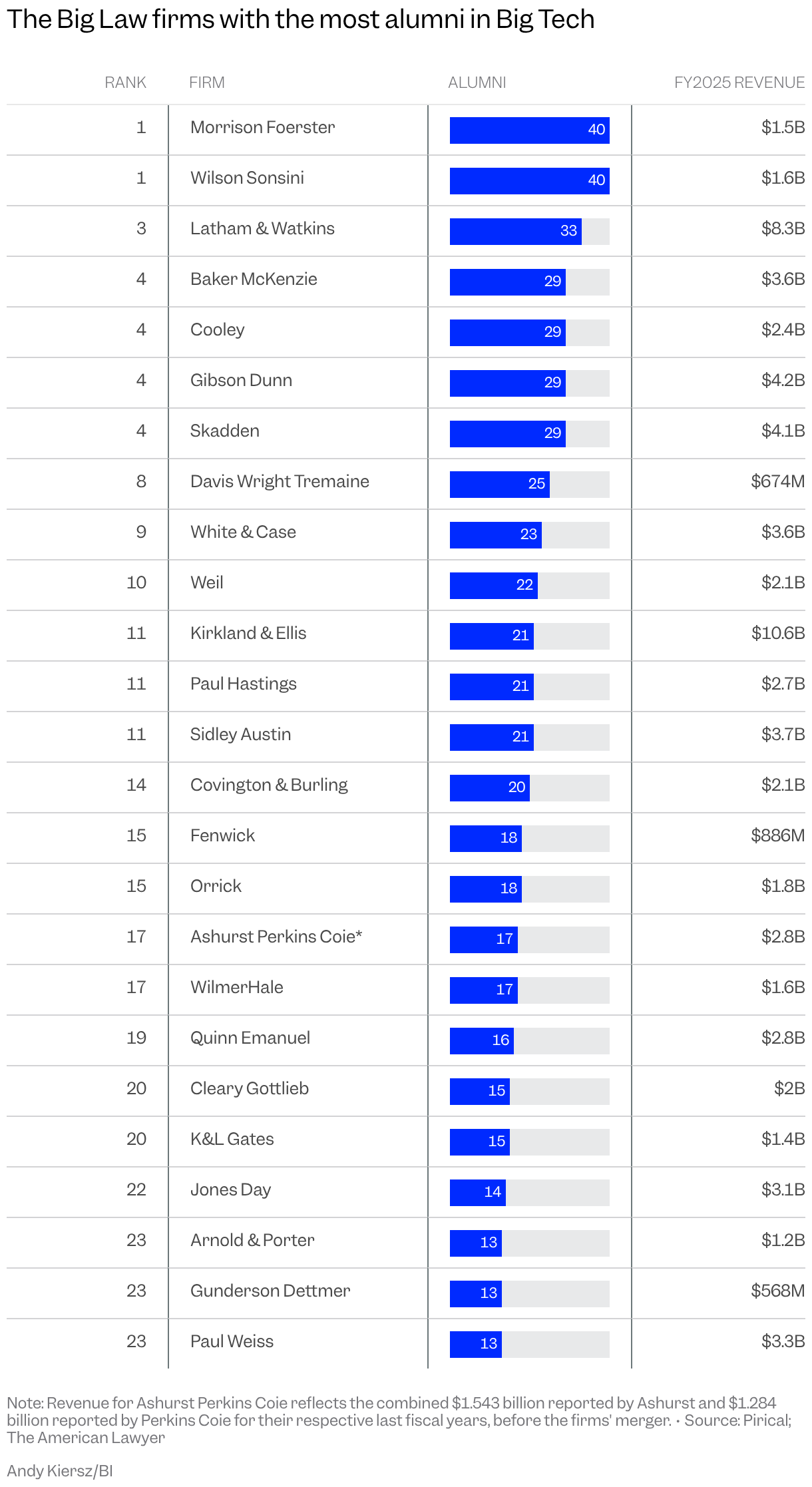
Pirical, a legal people-analytics company, tracked lawyers who previously worked at the 200 largest law firms by revenue in the United States and now hold legal roles at seven tech companies: Google, Meta, Microsoft, Nvidia, OpenAI, Anthropic, and SpaceX. Pirical filtered out summer associates and interns.

Morrison Foerster and Wilson Sonsini tied for the top spot, each with 40 alumni working in legal roles across the seven companies. Both firms regularly represent tech startups and the investors backing them.

Latham & Watkins followed with 33 former lawyers. Kirkland & Ellis, the industry's revenue leader, ranked 11th with 21 former lawyers working at those companies, tied with Paul Hastings and Sidley Austin.

Table

Pirical's analysis may have missed lawyers whose job titles fell outside its search criteria, said Craig Savitzky, its insights and content editor. He said newer companies, particularly Anthropic, are also likely undercounted because their legal teams are growing faster than public profiles are updated.

Big Law-Big Tech pipeline

For attorneys hoping to land a coveted job at a tech giant, a stint at a white-shoe law firm can be a stepping stone. They can trade billable-hour quotas for a seat closer to the business, attractive pay, and just one client to keep happy instead of dozens.

That combination makes these roles "some of the most highly desirable and sought-after positions" for law firm associates, said Casey Sullivan, a recruiter with CMW Legal Search.

There's another draw, Sullivan said. The companies at the forefront of artificial intelligence are wrestling with some of the thorniest legal questions of the day, from intellectual property to regulation.

"That's where the most interesting work is for lawyers," he said.

Not all law firms are equally effective launch pads. Pirical's Savitzky noted that the firms near the top of the list have deep ties to the tech industry, if not the deepest pockets.

Cooley brought in $2.4 billion in revenue last fiscal year, placing it 29th on The American Lawyer's ranking of top law firms by revenue. But it tied fourth on Pirical's list, with 29 alumni working at the seven tech companies, including nine at Nvidia, a longtime client.

Davis Wright Tremaine, which has represented Microsoft in antitrust and employment lawsuits, has 13 alumni working in the software giant's legal department. Fenwick, which advised Wiz and Fitbit on their sales to Google, has 13 lawyers at the search giant.

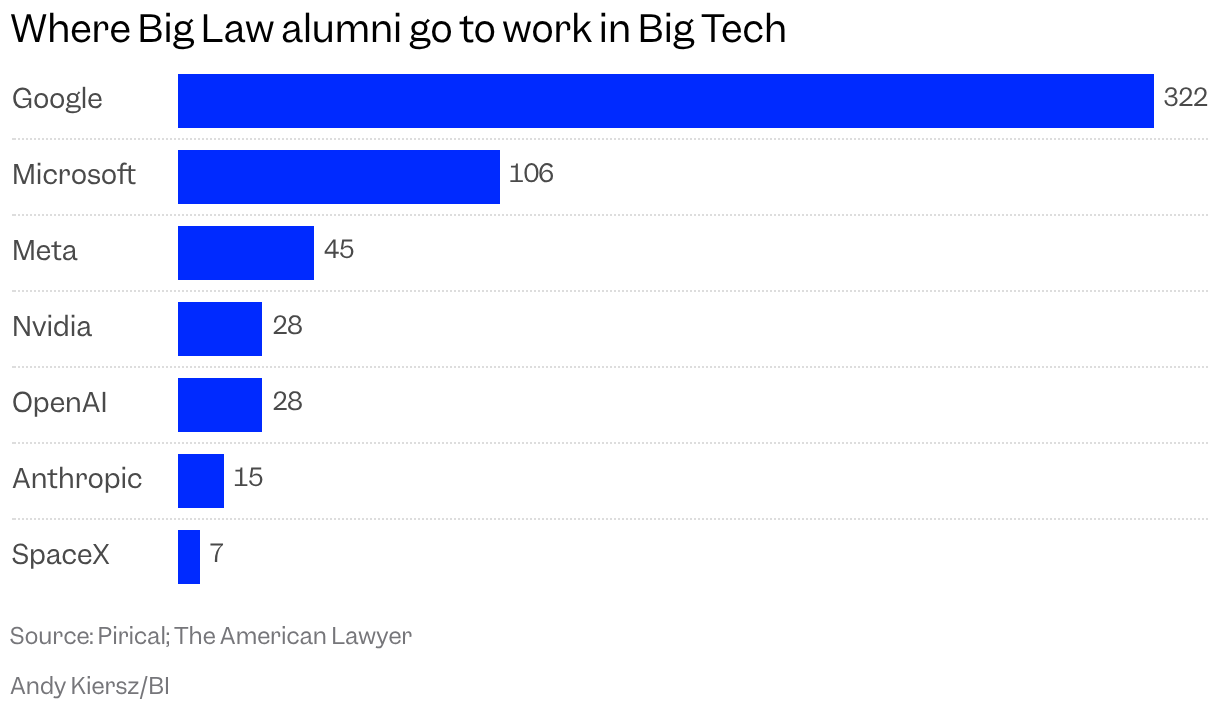
Business Insider also sliced the data another way, looking at which of the seven tech giants employ the most alumni from the top 25 firms on Pirical's list.

Bar Chart

Big Law is effectively a feeder school for Google's legal team. The company employs 322 alumni of the top 25 law firms on Pirical's list, more than any other tech company studied.

That doesn't necessarily mean Google is the most desirable location for lawyers leaving Big Law. Savitzky said the numbers likely reflect the sheer size of Google's legal department and the decades it has had to recruit from top firms.

Read the original article on Business Insider
  •  
❌