❌

Reading view

Trump's Tariffs Are Politically Toxic

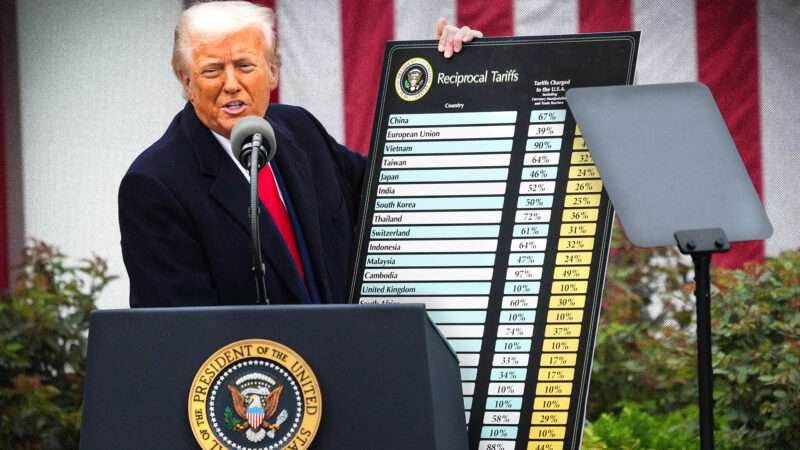
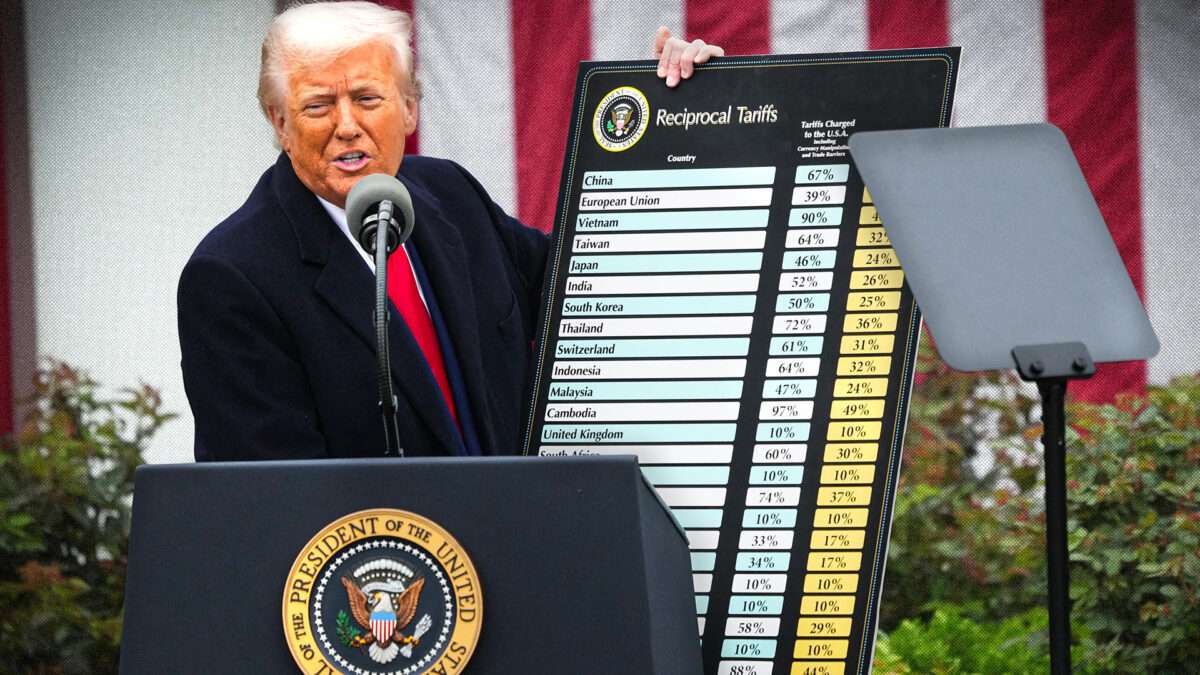
Trump-Tariff-oct-26 | Chris Kleponis - CNP/Newscom

When the White House rolled back tariffs on coffee, fruit, beef, and farm equipment, it was effectively an admission that the tariffs were raising prices—and that Americans, not foreigners, had been paying for them.

Now, in the closing stages of the midterm campaign, the White House is once again rolling back some of those import taxes—and once again making an awkward implicit admission.

President Donald Trump's tariffs have become politically toxic.

The administration announced late last week that it would lift the 50 percent tariffs on some Canadian imports, apparently in an attempt to help Sen. Susan Collins (R–Maine) survive a tough reelection campaign in which the tariffs have played a significant role.

If this is indeed an attempt to sway voters in Maine, it is not a very convincing one. The Trump administration is removing tariffs on some agricultural and mechanical goods, as well as packaging and plywood, The Wall Street Journal reports. But Trump is also imposing new 50 percent tariffs on "other Canadian goods, including carpet, certain valves, and waste products."

Collins issued a statement thanking the White House for the changes. This is what members of the U.S. Senate have been reduced to—begging the president to cast his capricious, tariff-happy eyes toward products that will hurt people in other states more than in your own. (In fairness to Collons, she has voted repeatedly to roll back Trump's tariffs, but not enough of her fellow Republicans went along with it.)

Still, it's worth asking: What exactly is the pitch to voters here? Here's a tariff cut, now vote for Republicans so the president can continue to arbitrarily tax imports whenever the mood strikes?

It's easy to see why Trump's tariffs have become so unpopular. They are a huge and broad tax increase—the Tax Foundation estimates that 54 percent of imports are subject to Trump's tariffs, which are costing the average household about $1,000 annually—that was imposed without congressional authorization or popular support. They create more losers than winners, as downstream businesses and consumers pay the price for the protectionism offered to American manufacturers. Even the supposed "winners" of the tariff policy tend also to be "losers," since so much manufacturing depends on importing raw materials and intermediate goods.

Perhaps more surprising is how unwilling Republicans are to defend the president's signature economic policy. Or to even talk about it.

The Wall Street Journal's Greg Ip crunched the numbers and found that House GOP candidates have not run a single ad talking about the tariffs during this election cycle.

Just such a fun chart here from @greg_ip. If only we could tease out some meaning. Ah, well, nevertheless. 🤣 pic.twitter.com/1X4AWcWQMV

— Scott Lincicome (@scottlincicome) October 23, 2026

That silence speaks volumes. Trump says "tariff" is "the most beautiful word in the dictionary." But it is now "one of the most hated words in politics," writes Ip.

The only Republicans to mention trade or tariffs in a campaign ad, as far as I've seen, is former Rep. Mike Rogers, who is now running for the Senate seat in Michigan (and thus was not included in Ip's analysis). And he's calling for an end to the "tariff war."

There is a lesson here that hopefully will linger beyond the next week: If you support a policy that deliberately and unlawfully raises taxes and prices, voters will not reward you for it.

It's a lesson that the Republican Party learned long ago, but apparently forgot.

Against economists' advice, a Republican-led government in 1930 implemented a huge tariff hike intended to protect American farms and factories at the start of the Great Depression. Instead, those tariffs worsened economic conditions and triggered foreign retaliation.

When voters went to the polls in 1930, the first midterm after the Smoot-Hawley tariffs were passed, they registered their displeasure. The GOP lost 52 seats in the House that year. Two years later, an even larger landslide would sweep Democrats into power in Congress and the White House, ushering in the New Deal era that reshaped the federal government forever. The two lawmakers who lent their names to the legislation were among those who lost their seats, fittingly.

The most notable difference this time around is that Congress didn't actually pass a tariff bill. The trade barriers were instead imposed directly by the executive. Voters don't seem to care. Republicans were too cowardly to stand up to Trump's unilateral power grab, and now they seem too ashamed to try to defend that policy (and their largely complicit response) on the campaign trail.

As they say, those who don't learn from history are doomed to repeat it. And "doomed" may be a fitting way to describe the Republican majority in Congress right now, thanks in no small part to Trump's tariffs.

The post Trump's Tariffs Are Politically Toxic appeared first on Reason Magazine.

  •  

In Maine, an ‘Oyster Thug’s’ Struggle to Get Over Graham Platner

A Platner superfan’s reluctance to support the Democrat now running against Senator Susan Collins reflects the party’s challenges navigating left-wing passions.

© Ryan David Brown for The New York Times

  •  

Democrats See a Rare but Fleeting Chance to Shake Up the Senate Map

Democrats are targeting G.O.P. strongholds that could set them up for new majorities. But if they don’t win those races now, it could be a long time before they have another chance.

© Clayton Steward for The New York Times

Protesters outside of an event for Senator Roger Marshall in Topeka, Kan. Soaring fuel costs and economic struggles have made some Republican senators like Mr. Marshall vulnerable on their home turf.
  •  

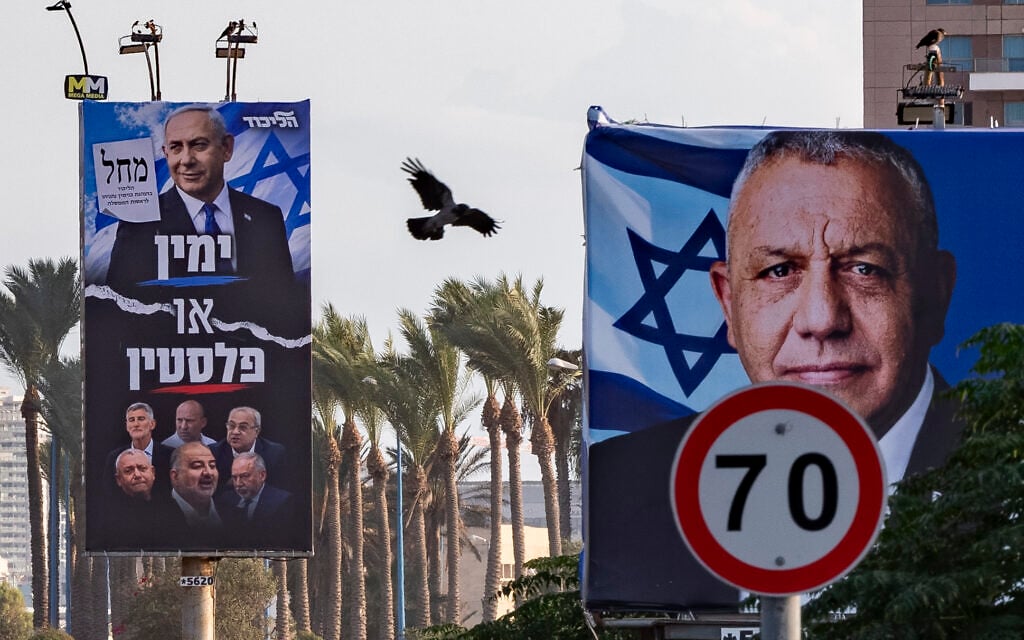
Opposition rages at ‘corruption’ as PM filmed convincing small Haredi party to drop out of race

New footage shows Likud minister and Haredi leader accused of sex crimes, with Netanyahu on the line, reach agreement on Achi party's withdrawal in exchange for deputy minister role
  •  

Vučić Has Lost Serbia’s Election. His System May Be Harder to Remove

Serbia has achieved something that appeared improbable only months ago. Aleksandar Vučić, who dominated the country’s political institutions for more than a decade, has acknowledged electoral defeat. A movement born from student demonstrations against corruption is now preparing to take power. Yet the most consequential struggle may only be beginning.

The parliamentary election of 25 October represents more than the rejection of an increasingly centralised political leadership. It raises a fundamental question about the Serbian state: whether the institutions shaped by Vučić’s Serbian Progressive Party (SNS) can function independently of the political organisation that controlled them.

According to preliminary figures released by Serbia’s Republic Electoral Commission, the Student List secured 52.54 per cent of the vote against 39.29 per cent for Vučić’s United Serbia coalition, with 8,077 of 8,392 polling stations counted. Projections give the students approximately 140 seats in the 250-member National Assembly, enough to govern without coalition partners.

Vučić had resigned from the presidency in September, hoping to return to power as prime minister. Instead, the election deprived him of the parliamentary majority necessary to complete that manoeuvre. His concession has substantially reduced the immediate prospect of a disputed transfer of power, although the election results still require formal certification.

But losing an election and losing control of a political system are not necessarily the same thing.

The political inheritance of the 1990s

Vučić’s political career provides important context for understanding the significance of his defeat.

He entered politics through the ultranationalist Serbian Radical Party, led by Vojislav Šešelj, and served as information minister in Slobodan Milošević’s government from 1998. During that period, Serbian authorities employed restrictive media legislation against independent newspapers and broadcasters, imposing substantial financial penalties and limiting critical reporting.

After Milošević’s removal in 2000, Vučić remained politically active. His subsequent association with the Serbian Progressive Party, formed in 2008 following a split within the Radical Party, allowed him to reposition himself as a politician promising economic modernisation and European integration.

This transformation proved remarkably successful.

The SNS came to power in 2012, and Vučić subsequently served as prime minister and president. Serbia attracted foreign investment, undertook major infrastructure projects and maintained its formal ambition of joining the European Union. At the same time, political authority became increasingly concentrated around Vučić and his associates.

The distinction between Serbia under Milošević and Serbia under Vučić should not be overlooked. The former governed during the violent disintegration of Yugoslavia and pursued policies that brought international isolation. The latter operated through electoral institutions, international economic partnerships and a declared European orientation.

Nevertheless, Vučić’s political career illustrates a continuity in personnel and political methods that Serbia’s post-2000 democratic transition never entirely resolved.

The OSCE’s assessment of Serbia’s 2023 parliamentary elections documented advantages enjoyed by the governing party, political pressure on public employees, media bias and the misuse of state resources. These findings demonstrated how electoral competition could continue while the conditions under which parties competed became increasingly unequal.

The Student List has now broken that pattern at the ballot box. Whether it can prevent its reconstruction remains uncertain.

Why the students succeeded

The immediate origins of the political upheaval lie in the November 2024 collapse of a railway station canopy in Novi Sad, which killed 16 people.

The disaster became a symbol of wider concerns about public procurement, construction oversight and political accountability. Demonstrations demanding responsibility subsequently developed into a nationwide movement challenging the government’s legitimacy.

As EU Today previously examined, the protests exposed a deeper conflict between Serbian society and institutions widely perceived by demonstrators as serving political interests rather than the public.

Unlike established opposition parties, the student movement did not depend on a familiar political leader or traditional party machinery. It mobilised university communities, academics, professionals and citizens who had previously remained outside organised political activity.

Its central demand was institutional accountability rather than a comprehensive ideological programme.

That distinction was crucial. By concentrating on corruption, democratic standards and the functioning of the state, the movement attracted voters with differing views on nationalism, foreign policy and European integration.

However, the same diversity that helped it win the election could complicate governing. Its candidates must now agree on economic priorities, ministerial appointments, foreign relations and the extent of institutional reform.

A protest movement can unite around opposition to a political leader. A government must reach agreement on decisions that inevitably divide its supporters.

Russia’s influence will not disappear with Vučić

One of the most important consequences of the election concerns Serbia’s relationship with Moscow.

Throughout his presidency, Vučić cultivated the image of a leader capable of maintaining productive relations with Brussels, Moscow and Beijing simultaneously.

Serbia continued its EU accession negotiations and benefited substantially from European investment and trade. Yet Belgrade consistently refused to join the principal European sanctions against Russia following its full-scale invasion of Ukraine.

The contradiction was particularly striking because Serbia’s economic relationship with the EU vastly outweighs its trade with Russia.

The European Commission’s assessment found that the EU accounted for 58.3 per cent of Serbia’s total trade in 2024. European markets, investment and regulatory structures have therefore become fundamental to the Serbian economy.

Vučić nevertheless preserved close political links with Moscow, benefiting domestically from nationalist sentiment and Russia’s diplomatic support for Serbia’s position on Kosovo.

He also attempted to demonstrate that relations with Russia did not preclude cooperation with Ukraine.

In June 2025, Vučić travelled to Odesa for the Ukraine–Southeast Europe Summit, where he met President Volodymyr Zelenskyy and reaffirmed Serbia’s support for Ukrainian sovereignty and territorial integrity.

Serbia provided humanitarian assistance to Ukraine but declined to sign the summit’s joint declaration. Its continuing refusal to impose sanctions on Moscow remained the most substantial distinction between Serbian policy and the EU position.

Yet a Student List government would not necessarily reverse that policy.

In September, the movement explicitly declared its opposition to imposing sanctions on Russia, referring to Serbia’s historical experience with international restrictive measures.

Vučić nevertheless predicted during his concession speech that the incoming government would introduce sanctions against Moscow by March or April. He also attributed his defeat to interference by European governments and what he called the American “deep state”, supposedly opposed to President Donald Trump.

His prediction about sanctions was therefore inconsistent with the movement’s publicly stated position.

This exposes an important misconception about Serbia’s political transformation. Opposition to Vučić does not automatically translate into support for every element of EU foreign policy. Serbian public attitudes towards Russia, Kosovo and national sovereignty extend beyond the electorate traditionally associated with the SNS.

The new government may pursue closer integration with European institutions while retaining positions that Brussels considers incompatible with membership.

The economic structures behind political influence

The challenge extends beyond diplomatic relationships.

Russia’s presence in Serbia includes strategic energy interests, notably its controlling shareholding in Naftna Industrija Srbije (NIS), which operates the country’s principal oil refinery.

American sanctions against the Russian-owned company have complicated its operations, while negotiations over the proposed acquisition of the Russian stake by Hungary’s MOL Group illustrate how energy security, foreign ownership and international sanctions have become interconnected.

For an incoming administration, reducing such dependencies will require commercial negotiations, regulatory oversight and alternative energy supplies. Political declarations cannot achieve these objectives on their own.

Equally important will be the examination of public contracts and relationships between political officeholders and businesses that benefited from government decisions.

The European Commission’s 2025 Serbia report identified persistent corruption concerns, insufficient transparency in major infrastructure procurement and weaknesses in institutional accountability.

Any investigation into alleged wrongdoing under Vučić must be independent, evidence-based and subject to judicial scrutiny. Allegations of corruption do not themselves establish criminal responsibility.

A government elected to restore the rule of law would undermine its own mandate if it replaced politically selective justice with prosecutions directed by a new political majority.

The central objective must be to ensure that prosecutors, courts and oversight bodies can investigate former as well as current officials without political interference.

Brussels faces a test of its own

For the European Union, the election provides an opportunity to reconsider its approach towards Belgrade.

For years, European institutions confronted a government that professed commitment to EU membership while resisting reforms considered essential to the accession process.

In July 2026, the European Parliament adopted a resolution stressing that Serbia’s negotiations should advance only when measurable improvements are achieved in the rule of law, judicial independence, media freedom and the fight against corruption. Parliament also called for alignment with EU sanctions against Russia.

The Student List’s victory may improve the prospects for domestic institutional reform, but the disagreement over sanctions remains unresolved. Brussels cannot assume that a new Serbian government will satisfy every accession requirement simply because it defeated Vučić.

Nor should it overlook the political significance of the result.

The movement’s strongest mandate concerns the restoration of public accountability. Supporting independent institutions, transparent procurement and genuinely competitive elections would address both Serbian public demands and longstanding EU concerns.

There is also the unresolved question of Kosovo. A change of government in Belgrade does not remove the political and constitutional difficulties surrounding relations with Pristina. The new leadership will inherit negotiations that have repeatedly stalled under previous administrations.

The EU will therefore need to distinguish between areas where rapid progress is possible and disputes that require more sustained diplomacy.

The difference between victory and democratic transition

Serbia has removed one of the central figures of its post-Yugoslav political order from government. It has not yet demonstrated that the system surrounding him can be dismantled through constitutional means.

The immediate tasks are substantial: forming an effective cabinet, protecting the independence of prosecutors, scrutinising public expenditure, reforming media regulation and ensuring that state institutions no longer operate as extensions of the governing party.

A separate presidential election must also follow Vučić’s September resignation, adding another important stage to the transition.

The greatest danger is not simply that the former governing party could eventually return to office. Electoral competition must allow that possibility in any democracy.

The more consequential danger is that the political methods associated with Vučić’s administration could survive under different leadership.

Serbia’s experience after Milošević demonstrated that removing a dominant political figure does not necessarily eliminate the structures, interests and habits of government accumulated during his rule.

The student movement has now been given an opportunity to confront that unfinished transition.

Its success will ultimately be measured not by the political fate of Aleksandar Vučić, but by whether Serbia develops institutions capable of investigating misconduct, restricting the arbitrary use of power and operating independently of whichever party wins the next election.

That would represent a more fundamental transformation than the defeat of any single political leader.

  •  

Serbia’s Student Opposition Wins Decisive Parliamentary Victory

Supporters celebrate the Serbian student movement’s parliamentary election victory over Aleksandar Vučić in Belgrade.

A student movement that emerged after a deadly railway disaster has turned nearly two years of protests into an electoral victory.


Serbia’s student-led opposition has secured a decisive parliamentary victory over Aleksandar Vučić’s ruling party, according to preliminary results, ending 14 years of political dominance by the Serbian Progressive Party (SNS) and opening a new chapter in the country’s politics.

RELATED: Serbia’s Vucic Concedes Victory to Opposition Students Party

Vučić acknowledged the defeat on Sunday, saying initial projections indicated that the Student List would win between 135 and 140 seats, compared with about 105 for his party. The result follows nearly two years of student-led demonstrations against corruption and what protesters describe as growing authoritarianism.

The Centre for Free Elections and Democracy (CeSID), a non-governmental organization, projected that the Student List would win 139 seats after 56% of ballots had been counted, against 104 for the SNS. Unofficial estimates from polling institute Ipsos put the student movement at 140 seats and Vučić’s party at 103, down 26 seats from the 2023 parliamentary election, when it secured an absolute majority.

The setback was compounded by the failure of the Socialist Party, a longtime ally of Vučić, to clear the 3% threshold for parliamentary representation. The party previously held 18 seats. Preliminary estimates also gave three seats to Serbia’s Hungarian minority party and two to the Albanian minority list.

Turnout approached 70%, the highest since the breakup of Yugoslavia in 1992 and close to the record set in the 2000 parliamentary election.

The student movement grew out of protests that began in 2024, after 16 people died when a canopy collapsed at a railway station in Novi Sad. The disaster prompted mass demonstrations across Serbia, with protesters demanding accountability over the collapse and the construction work carried out by a Chinese company following a tendering process criticized for its lack of transparency.

Hundreds of thousands of people took to the streets, turning the demonstrations into a broader challenge to corruption and the concentration of political power. The student movement emerged as a nationwide opposition force and sustained pressure on Vučić’s government for nearly two years.

Vučić, who had led the country for 14 years, resigned as head of state in September to run for prime minister.

Celebrations and tensions in Belgrade

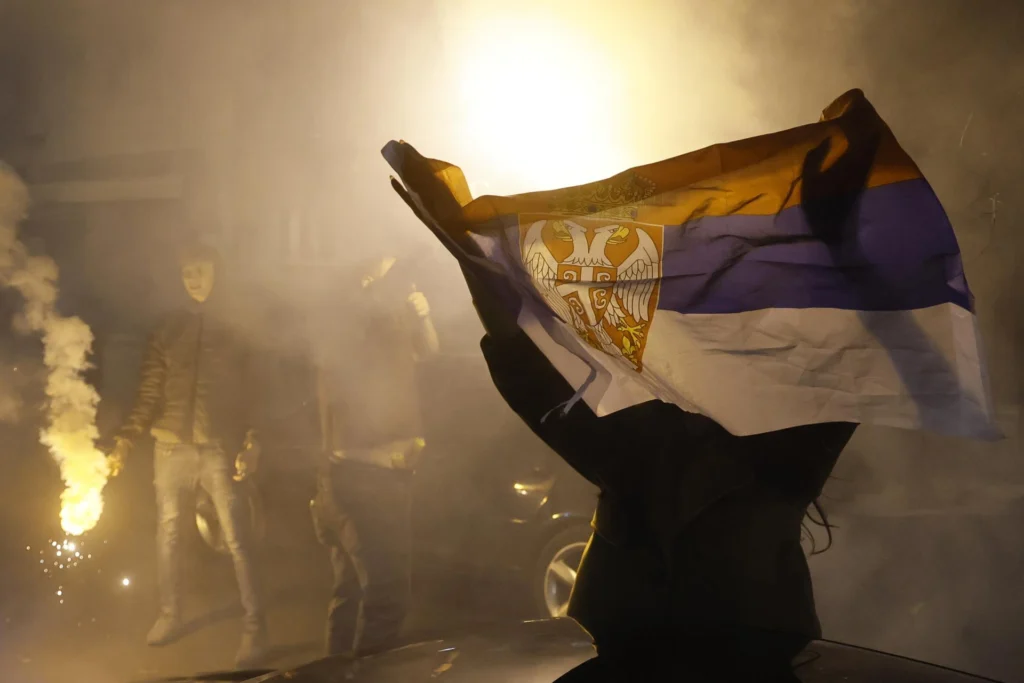
The preliminary results sparked celebrations across Belgrade, where thousands gathered to dance, chant slogans and set off flares and fireworks. Crowds shouted “Victory” and “Vučić is leaving” as people embraced and wept with joy.

Slavija Square, a focal point of the mass protests against the government, filled with supporters of the student movement. At Pioneers Park, between parliament and the presidential palace, hundreds of people tore down the fence surrounding the grounds and entered the public space.

The park had been closed to the public for months and periodically occupied by groups of masked Vučić supporters, who were accused of being used as a force to confront government opponents.

The celebrations underscored the scale of the political shift after more than a decade of SNS rule. Vučić had weathered previous opposition challenges, but the student movement turned sustained street protests into an electoral campaign that defeated his party.

A decentralized political movement

The Student List has presented itself as an alternative to Vučić’s centralized model of leadership. It operates through a horizontal structure and has avoided putting forward a single public face, arguing that political decisions should be made from the bottom up rather than imposed from above.

Its slate of 250 candidates includes university professors, actors and farmers, many of them little known to the wider public.

Radomir Sajcic, a University of Belgrade professor representing the movement, celebrated the result at its headquarters. “Dear Serbia, tonight the voice of the people can be heard,” he declared. “Tonight we celebrate victory; tomorrow we will build the future.”

Sajcic also described the outcome as “a victory of courage over fear, a victory of hope over indifference, a victory of faith that Serbia can and must be different.”

The movement’s platform calls for restoring the separation of powers and the autonomy of the prosecutor general’s office, as well as increasing investment in health care and education. It also pledges to tackle corruption and individual privileges to boost public revenue, while promoting technological modernization across the economy, including agriculture.

Serbia’s score in Transparency International’s corruption index has deteriorated during Vučić’s tenure. The European Union has also raised concerns about the country’s declining adherence to the rule of law.

European support and foreign policy questions

European institutions have welcomed the student movement’s victory, describing it as an opportunity to advance democratic reforms, strengthen the rule of law and combat corruption.

European Commissioner for Enlargement Marta Kos and European Commission President Ursula von der Leyen congratulated the students and offered support for reforms and greater press freedom. Council of Europe Secretary-General Alain Berset highlighted Vučić’s acceptance of the results and his commitment to a peaceful democratic transition.

Today, the people of Serbia turned out in record numbers to shape their country’s future.

Congratulations to the Student List on its victory in the parliamentary elections.

We stand ready to support reforms on the rule of law, media freedom, the fight against corruption and…

— Ursula von der Leyen (@vonderleyen) October 25, 2026

Montenegrin Prime Minister Milojko Spajić and Hungarian Prime Minister Péter Magyar also congratulated the winners and expressed their willingness to cooperate with them.

The election could also affect Serbia’s relations with the European Union and Russia. Under Vučić, the country has pursued EU membership while maintaining close ties with the Kremlin. Serbia has been an official candidate for EU accession since 2012.

Before the vote, EU foreign policy spokesperson Christian Wigand said the bloc would monitor the election closely and stressed the need for a free, fair and transparent process.

The Student List has offered fewer details about its international priorities than about its domestic reform agenda. Available indications suggest it may maintain Serbia’s EU candidacy while continuing to oppose sanctions against Russia, although the movement has yet to clearly outline its foreign policy plans.

The student movement’s victory marks a major political turning point for Serbia after 14 years of Vučić’s dominance. Its ability to convert demands for accountability and institutional reform into a parliamentary majority has reshaped the country’s political landscape, but the incoming government’s approach to domestic reform and foreign relations remains uncertain.

  •  

Mexico Detains Ex-Prosecutor on Treason Charges Over CIA Raid

Former Chihuahua prosecutor César Jáuregui Moreno faces treason charges over a CIA-linked operation in Mexico.

A former Chihuahua prosecutor faces federal charges over a drug-lab operation involving US intelligence agents, escalating a dispute over Mexico’s national sovereignty.


A Mexican federal judge has ordered the pretrial detention of former Chihuahua attorney general César Jáuregui Moreno on charges of treason, ruling that evidence supports allegations that he compromised national sovereignty by allowing US intelligence agents to take part in a drug-lab operation without federal authorization.

RELATED: Flávio Bolsonaro Rejects Lula’s Victory, Seeks Annulment

Judge Ricardo Alfonso Santos Dorantes issued the order early Sunday after finding sufficient grounds to bring Jáuregui Moreno to trial. The former prosecutor will remain in a maximum-security prison in the State of Mexico while the case proceeds.

The charges stem from a mid-April operation to dismantle a drug laboratory in the Sierra del Pinal, in the northern border state of Chihuahua. According to Mexico’s Attorney General’s Office (FGR), agents from the US Central Intelligence Agency (CIA) participated without the required notification to the Foreign Affairs Ministry or the necessary legal authorizations.

Prosecutors argue that Jáuregui Moreno’s failure to act enabled armed foreign personnel to operate on Mexican territory in activities reserved exclusively for the federal government, putting national security at risk.

Luego de aportar más de 150 datos de prueba, la #FGR obtuvo auto de vinculación a proceso en contra de César “N”, ex fiscal general del estado de Chihuahua, por su posible participación en el delito de traición a la patria. pic.twitter.com/sbhM0vY6cG

— FGR México (@FGRMexico) October 25, 2026

Text Reads: After providing more than 150 pieces of evidence, the #FGR obtained an order of linkage to trial against César “N”, former Attorney General of the state of Chihuahua, for his possible involvement in the crime of treason against the homeland.

The FGR presented more than 150 pieces of evidence at the hearing. Prosecutors also cited public statements in which Jáuregui Moreno said the operation had been planned for months by Chihuahua’s State Investigation Agency and its Special Strategic Operations Prosecutor’s Office. They argued that the account pointed to information being withheld from federal authorities and shared with foreign personnel.

The defense presented documents and witness testimony to challenge the federal allegations. However, Judge Santos Dorantes upheld the charges and set a two-month deadline for investigators to complete the supplementary investigation.

Jáuregui Moreno was initially arrested in Chihuahua city on Saturday under a state-level warrant accusing him of illegally exercising public office and collusion. A local judge ordered him to stand trial on the public-office charge but did not impose pretrial detention, leaving open the possibility of his release.

On October 18, agents from the federal Criminal Investigation Agency arrested him under a separate warrant as he was leaving detention. He was transferred to Mexico City and taken to El Altiplano, a maximum-security prison in the State of Mexico. The hearing on the federal treason charge began on Saturday afternoon and was held behind closed doors.

The case has fueled tensions between state and federal authorities and sparked a wider political dispute over the Chihuahua operation. The controversy has also drawn attention to a private meeting on September 19 in Ciudad Juárez between Chihuahua Governor Maru Campos and President Claudia Sheinbaum.

Campos later disclosed details of the encounter, which involved heated exchanges over the case. She said she went public to counter rumors that she had reached a political pact or a behind-the-scenes agreement with the federal government.

Jorge Romero Herrera, national leader of the opposition National Action Party (PAN), defended Campos’s decision to disclose details of the meeting.

“She is an adult woman; she makes her own decisions,” Romero Herrera said. He also reaffirmed his party’s support for Campos and other PAN officials, including governors and mayors.

  •  

Flávio Bolsonaro Rejects Lula’s Victory, Seeks Annulment

Flávio Bolsonaro challenges Lula’s reelection in Brazil amid allegations of election-day public transport disruptions.

Brazil’s far-right candidate challenges the election result after voting hours were extended over public transport disruptions.


Brazilian far-right presidential candidate Flávio Bolsonaro has rejected President Luiz Inácio Lula da Silva’s reelection and vowed to seek the annulment of the vote, citing a Supreme Federal Court decision to extend voting hours amid allegations of disruptions to public transport.

RELATED: Massive Celebrations Erupt Across Brazil After Lula’s Run-off Victory

The Superior Electoral Court (TSE) confirmed Lula’s reelection on Sunday. Bolsonaro, however, declared the result unacceptable and announced plans to challenge it in court.

“It is impossible to recognize the election results,” Bolsonaro said. “We will turn to our legal team and request that these elections be annulled.”

Bolsonaro based his challenge on a ruling by Supreme Federal Court Justice Cristiano Zanin, who extended voting by two hours after the Workers’ Party (PT) reported alleged irregularities affecting voter transportation in several cities.

The ruling came shortly before polls were due to close at 5 p.m. Zanin ordered polling stations nationwide to remain open until 7 p.m. Brasília time, citing the seriousness of the allegations and the urgency of the measure.

The PT accused mayors opposed to Lula of failing to comply with electoral court orders requiring municipalities to provide free public transport at full capacity on election day, as they would on a regular working day. The party also called for those responsible for the alleged violations to be caught in the act.

In Salvador, electoral authorities ordered the arrest of Pablo Souza, the city’s mobility secretary, over suspicions that he had withdrawn buses to disadvantage Lula. The northeastern city is governed by União Brasil, a center-right party allied with Bolsonaro. In the first round of the presidential election, Lula received 65% of the vote in Salvador, compared with 27% for Bolsonaro.

Brazilian trade union federations also denounced transport disruptions in several cities on election night and called for immediate action by the authorities.

In a statement, the unions condemned what they described as the deliberate obstruction of eligible voters’ right to participate in the election. They alleged that some cities had reduced their bus fleets despite a Supreme Federal Court order requiring public transport to operate at full capacity on election day.

The disruptions left thousands of people waiting at bus stops, uncertain whether they would reach polling stations in time. In some cases, the unions said, voters were unable to cast their ballots.

Bolsonaro’s campaign also sought an extension of voting hours, according to local media reports. His team requested additional time in cities across São Paulo, Paraná and Santa Catarina states, citing difficulties caused by heavy rainfall.

The dispute recalls the aftermath of the October 2022 presidential election, when Lula defeated Flávio Bolsonaro’s father, Jair Bolsonaro. The former president repeatedly challenged the result and conspired to overturn it.

On Jan. 8, 2023, thousands of his radicalized supporters stormed the Congress, presidential palace and Supreme Federal Court buildings in Brasília. Jair Bolsonaro was subsequently tried and is now serving a 27-year prison sentence for conspiring against Brazil’s democratic order and attempting a coup.

  •  

In Islamophobic Rant, Trump Seeks to Stir Republican Base in Michigan

The president contended that Dr. Abdul El-Sayed, a Muslim, would “invite hordes of jihadis to our shores” as he sought to bolster the G.O.P. candidate in a tight Senate race.

© Haiyun Jiang/The New York Times

President Trump’s comments, coming in a key midterm battleground nine days before the elections, underscored the dark themes and personal vilification he and his allies have embraced as part of their closing pitch.
  •  
❌