
❌

Reading view

Connecticut's New Restrictions on Flock Cameras Highlight the Dearth of Meaningful Privacy Protections
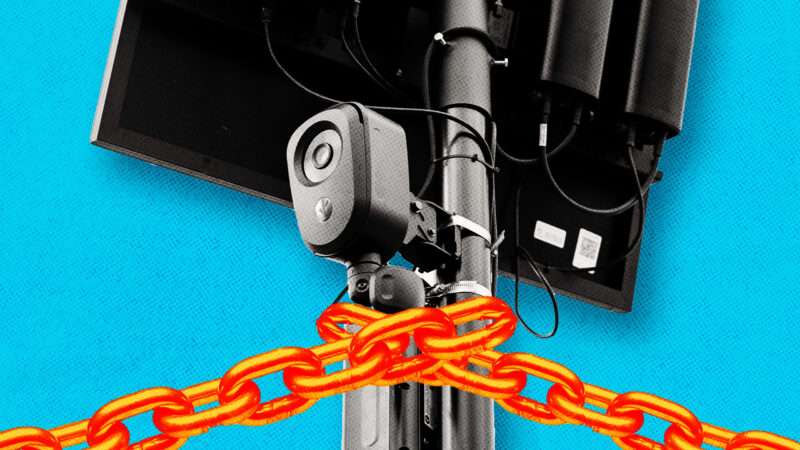
a license plate camera in chains | M. Scott Brauer/Zuma Press/Newscom/Cemil Adakale/Dreamstime/Fatima Ruiz

A Connecticut law that took effect at the beginning of October imposes new restrictions on police use of automated license plate readers (ALPRs), which enable what a federal judge recently described as "a type of indiscriminate mass surveillance." The law reflects the bipartisan backlash against AI-assisted cameras that record images of passing cars billions of times a week, building databases that police can use to track drivers, identify other vehicles in their vicinity, predict itineraries, and conduct searches based on a wide range of vehicle characteristics.

Connecticut previously imposed no statutory limits on ALPRs, a fact that underlines how readily police can access license plate data, which they can search without any sort of judicial review and often without meaningful internal supervision. But the law's provisions, while promising in some ways, fall short of the reforms recommended by critics who warn that unconstrained use of ALPRs threatens the privacy of innocent motorists across the country.

As of today, DeFlock's mapping project has identified nearly 145,000 ALPR cameras in the United States, most of which were installed by Flock Safety, the leading vendor. That network includes more than 1,500 cameras deployed by Connecticut law enforcement agencies, three-quarters of which use the technology.

The concerns underlying the new law, which Gov. Ned Lamont signed last May, echo objections raised in other states. Last February, for example, CT Insider reported that out-of-state agencies had searched ALPR data from Connecticut thousands of times for immigration enforcement purposes. When police in Johnson City, Texas, searched Connecticut data for a missing woman, the log noted that she "had an abortion," which reinforced concerns that ALPR information might be used to enforce abortion bans.

As elsewhere, ALPR critics in Connecticut also have complained about a lack of transparency. In April 2025, for instance, South Windsor began using Flock cameras without any public notice. The resulting consternation prompted the city council to cancel the program early this month. CT Mirror reports that South Windsor is "at least the sixth Connecticut community to end or suspend the use of ALPRs this year, following Windsor, Killingworth, Ledyard, Milford and Newtown."

Compared to those moves, the new state restrictions are pretty weak tea. But they include some potentially meaningful changes, and they highlight how lax oversight of ALPRs has been.

The new law restricts the sharing of ALPR data, which henceforth will be limited to Connecticut, Massachusetts, New York, and Rhode Island unless an agency in another state obtains a judicial warrant. The law says the data may not be used for immigration enforcement, to target conduct protected by the First Amendment, or for investigations related to "reproductive" or "gender-affirming" health care services. It also bars the placement of ALPRs near facilities that provide such services or organizations that primarily serve immigrants.

The original bill specified that ALPR data could be retained for no more than seven days unless it is tied to an ongoing criminal investigation, subject to a warrant, or used for toll enforcement. The final version of the bill extended that limit to 21 days. Flock's original default was 30 days. But last August, in response to widespread criticism of ALPR surveillance, the company began recommending a seven-day limit. Connecticut's Police Officer Standards and Training Council, which last month sent Lamont a report that included suggested reforms, thinks the state should adopt the seven-day standard.

Under the new law, police may search ALPR data to "assist in the recovery of a stolen motor vehicle," "assist in locating a missing or endangered individual," or "assist in the apprehension of an individual with an outstanding warrant." They also may query the database for information "relevant and material to a specific active investigation of a criminal offense in which there is reasonable suspicion that the offense has been or is being committed." When they do that, their agency must record "the reason for the access and any associated case number for the complaint or incident that is being investigated and is the basis for the access."

It is remarkable that Connecticut lacked such basic safeguards until now, and it is not clear how effective the new rules will be. Since July 1, 2025, Virginia has required that cops state a "specific purpose" for ALPR searches, including "the offense type." Yet last April, WHRO reported that Norfolk police often give "incomplete and imprecise reasons" for ALPR queries, including "suspect," "suspicious," and "investigation" or "inv."

Connecticut's "reasonable suspicion" requirement is more lenient than the standard that the Institute for Justice favors. The organization's model statute would generally require a warrant based on probable cause for ALPR queries. The proposed law makes exceptions for "exigent circumstances," stolen vehicles, and toll, parking, or traffic enforcement.

Connecticut's law also addresses the sort of blatant abuses that have fueled opposition to license plate cameras, including cases in which cops have been caught using ALPR data to stalk personal nemeses, ex-girlfriends, possibly unfaithful spouses, and objects of romantic interest. The law says an officer "who is found to have knowingly accessed, used or disseminated automated license plate reader data with malicious intent for purposes outside of the provisions of this section shall be subject to disciplinary action including, but not limited to, suspension, cancellation or revocation of certification" for police work.

The law establishes two additional remedies that could deter ALPR abuses. It authorizes the attorney general to sue ALPR contractors for damages and injunctive relief when they violate the new restrictions. It also allows "any aggrieved individual" to sue "a public agency" that flouts the rules.

"The law, for a first bite at the apple, is not bad," Ken Barone, manager of the University of Connecticut's Racial Profiling Prohibition Project, told CT Insider. Given that "there was a benchmark of nothing," he said, the attempt to constrain and track ALPR use is "a big step forward."

The post Connecticut's New Restrictions on Flock Cameras Highlight the Dearth of Meaningful Privacy Protections appeared first on Reason Magazine.

  •  

Amazon Faces Fresh EU Scrutiny Over Worker Surveillance and Algorithmic Management

Members of the European Parliament are visiting Amazon logistics centres in Germany and Poland this week to investigate working conditions and the use of digital monitoring systems, reopening a dispute between the technology company, European legislators and trade unions over employee rights.

The fact-finding mission, scheduled for 26th and 27th October, will examine how Amazon organises work, measures employee productivity and uses automated systems in warehouses. MEPs will meet management, employees, works councils and trade union representatives, with particular attention to whether technological changes are affecting workers’ health and their ability to exercise employment rights.

The investigation comes as the European Commission prepares its Quality Jobs Act, which is expected to address algorithmic management, occupational safety and working conditions across the European economy. Amazon’s extensive logistics network makes the company a prominent example of the questions legislators must resolve.

MEPs enter warehouses after prolonged dispute

The delegation is led by Li Andersson, chairwoman of Parliament’s Employment and Social Affairs Committee, and includes Belgian MEPs Liesbet Sommen and Estelle Ceulemans, alongside representatives from several other political groups.

According to the European trade union federation UNI Europa, MEPs will inspect facilities in Dortmund and Mönchengladbach on Monday before travelling to Poland on Tuesday.

The German visits will cover older warehouse operations and newer facilities incorporating robotics, allowing parliamentarians to compare different approaches to handling orders and managing employees. The Polish programme includes a major returns facility in the Katowice area.

The visit follows several years of strained relations between Amazon and the European Parliament.

In February 2024, Parliament withdrew permanent access badges from Amazon representatives following disagreements over the company’s participation in hearings and requests for visits to its warehouses.

Amazon disputed suggestions that it was avoiding scrutiny, maintaining that it had offered alternative arrangements for parliamentary visits during periods when its logistics operations were particularly busy.

Company executives eventually appeared before the Employment and Social Affairs Committee in January 2026, where they defended Amazon’s employment policies and workplace practices.

The controversy over digital surveillance

At the centre of the dispute is the increasingly widespread use of electronic systems to monitor productivity.

Warehouse employees commonly use handheld scanners, while automated systems can help allocate tasks, coordinate movements and identify delays in processing orders.

These technologies allow employers to manage substantial logistics operations with considerable precision. They also make it possible to collect detailed information about individual workers’ activities throughout their shifts.

Trade unions argue that such monitoring can create unreasonable performance pressure, particularly where targets are adjusted automatically or workers cannot challenge assessments generated by software.

The concerns are not confined to Amazon.

A European Commission survey examined by EU Today earlier this month found that 42 per cent of surveyed smaller and medium-sized businesses already used artificial intelligence or algorithmic management systems.

However, 49 per cent of respondents expressed distrust of automated systems making decisions about employees, illustrating the distinction between using technology to support management and delegating consequential decisions to algorithms.

Previous regulatory action

Amazon has already faced formal European regulatory scrutiny over workplace monitoring.

France’s data protection authority imposed a €32 million fine on Amazon France Logistique in December 2023, announcing the decision in January 2024. The regulator concluded that certain employee monitoring practices were excessively intrusive and breached data-protection requirements.

The investigation examined the collection and retention of detailed information from warehouse scanners, including productivity indicators and periods of inactivity.

Amazon rejected the regulator’s conclusions and subsequently appealed the decision. The penalty therefore needs to be distinguished from any final judicial determination of the dispute.

The case nevertheless demonstrates that workplace monitoring falls within existing European privacy legislation, independently of proposals for new employment rules.

EU Today has also reported on the application of European data-protection law to automated employment decisions, including the question of whether meaningful human review is available when software affects a person’s ability to work.

Amazon disputes allegations

Amazon maintains that its warehouse technology is intended to improve operational efficiency, safety and the reliability of deliveries.

In its January parliamentary testimony, the company defended its investment in employee training and insisted that workers have the right to join trade unions.

It also pointed to engagement with works councils and employee representative bodies across its European operations.

Trade unions contest the adequacy of those arrangements, particularly in Germany, where the ver.di union has repeatedly sought a collective agreement covering Amazon employees.

These competing positions will form part of the parliamentary delegation’s assessment.

Implications for EU employment legislation

The Commission’s Quality Jobs initiative addresses several questions raised by the Amazon dispute, including algorithmic management, psychosocial risks and the effectiveness of collective bargaining.

Legislators must determine how far employers should be required to disclose the operation of automated monitoring systems, how employees can contest decisions and what safeguards should apply when performance targets are generated by software.

Rules must also accommodate legitimate requirements for stock management, security and workplace safety.

The parliamentary visit will not itself establish whether Amazon has breached employment legislation. It is a fact-finding exercise intended to inform future policy discussions.

Its importance lies in giving legislators direct access to warehouse operations and employee accounts before deciding how European labour law should respond to increasingly automated workplaces.

  •  
❌