❌

Reading view

Chromebook scheme

THE government’s plan to distribute 500,000 Chromebooks to students over two years could help narrow Pakistan’s digital divide. The devices, which will come with MiFi internet connectivity, are meant for students handpicked under the scheme. In a country where access to computers and reliable internet still depends heavily on family income and location, that matters.

A student who cannot afford a laptop should not be locked out of online learning, digital skills or job opportunities. But the value of the scheme will depend on how it is carried out. The state should publish clear eligibility criteria, ensure that poorer students are not crowded out by those who already have devices, and explain how the refurbished Chromebooks will be procured, tested and distributed.

The total cost should also be disclosed, along with safeguards against political influence in selecting recipients and suppliers. There should also be a plan for repairs, replacement and technical support. A device that stops working after a few months, or cannot connect reliably outside major cities, will do little to close the gap it was meant to address.

More importantly, access to hardware is only one part of Pakistan’s education problem. A Chromebook cannot compensate for weak teaching, poor literacy, overcrowded classrooms or schools without dependable electricity and internet access. Nor will handing out devices automatically improve learning. Teachers need training to use digital tools well, students need access to useful content, and schools need systems that can blend technology with ordinary classroom instruction.

The government should therefore set measurable goals for the scheme: whether students use the devices regularly for learning, whether their digital skills improve, and whether this leads to better educational outcomes. Independent evaluation would help determine if the programme deserves expansion. There is also a case for giving students in remote and low-income areas greater weight, since they stand to benefit most from access they currently lack.

Pakistan has launched laptop schemes before; what matters now is whether this one produces more than a distribution ceremony. Technology can widen opportunity, but only when it is tied to good teaching, reliable connectivity and clear educational purpose.

Published in Dawn, October 27th, 2026

  •  

Financial strain, desperate measures

The apparent rise in murder-suicide cases among young, middle-class families in Karachi cannot be attributed solely to social transition or inadequate mental healthcare. Amid sluggish growth, persistent inflation and unemployment, the government cannot escape scrutiny over its mounting tax burden on middle-class households and the economic distress that may push vulnerable towards desperate extremes.

Experts urge the government to abandon ad hoc economic policies and inequitable taxation that force ordinary Pakistanis to shoulder the cost of inefficient utilities and FBR’s failure to adequately tax powerful agriculture, trading and real estate interests and curb corruption in tax machinery.

“Unless the state becomes fairer and stops squeezing an already exhausted blue and white-collar workforce, isolated tragedies could give way to wider public unrest, potentially ignited by a seemingly minor trigger,” warns an analyst requesting anonymity.

The inability of average families to deal with the consistently rising cost of living and unfairly high taxes and stressors, such as rent, utility bills, fuel hikes, rising education and healthcare cost, chips away at a family’s emotional baseline until a minor shock feels like catastrophic triggering sometimes dangerous actions.

Are poor economic conditions, flawed govt policies pushing middle class to murder-suicides?

Traditional family and neighbourhood support networks are fraying, institutional alternatives remain weak, mental healthcare is largely inaccessible, and bank credit to tide over financial distress is often out of reach. These tragedies in Ahsanabad in September and Gulshan-e-Hadeed this month, where fathers allegedly killed their dependents before taking their own lives, have heightened anxiety across cosmopolitan Karachi and beyond. They raise troubling questions about mounting economic pressures, fears of downward social mobility and growing despair among young family heads struggling to sustain families.

Media reports indicated that both families involved in reported incidents were middle-class. One was headed by a doctor, the other man’s profession was unreported, though he lived in rented accommodation and was reportedly building his own house. Together, the two tragedies claimed 10 lives, including five unsuspecting children.

Some officials and analysts have dismissed attempts to link such tragedies to economic conditions and government policies as overstretched. Yet, global evidence establishes economic distress as a significant suicide risk factor. Debt, business failures and insolvency feature prominently in India, Bangladesh and Sri Lanka, while unemployment and corporate restructuring contributed to rising suicides in Japan, South Korea and Hong Kong, following the 1997-98 crisis. Studies in Iran and Egypt highlight similar risks. Western economies, including the US, Australia and parts of Europe, also recorded increases during economic downturns, notably the 2008 global financial crisis, when job losses, foreclosures and declining living standards intensified psychological distress.

The middle class in Pakistan, earning Rs100,000 to Rs250,000 a month, faces a disproportionate tax burden, stagnant wages and shrinking job opportunities, the pressures that are repeatedly highlighted but inadequately addressed. Queries to federal and Sindh government officials went unanswered by the deadline, while State Bank of Pakistan’s response on middle-class access to credit was awaited. Political leaders of major parties, economists and corporate leaders were approached for views on measures to prevent such tragedies from reoccurring.

Senior Sindh government sources privately expressed concern that such tragedies damage Karachi’s reputation. They cautioned against portraying isolated incidents as evidence of broader economic or government failures without considering the complexities of a megacity of over 20 million people. They suggested that mental health challenges, rather than economic pressures alone, may be involved in individual cases, currently under investigation. They also criticised a section of the media for allegedly sensationalising human suffering for commercial gain.

According to official records shared by Sindh Additional IG Police Azad Khan, Karachi reported one murder-suicide case each in 2022, 2024 and 2025. In 2026, however, two such tragedies have already occurred, barely a month apart.

Abdul Moiz Jafery, a founding member of the Awaam Pakistan Party, blames the mounting financial strain on middle-class families on chronic mismanagement and the government’s failure to broaden the tax base and distribute burden equitably. He argues that the problem dates back to Pakistan’s inception and has worsened as successive governments expanded opportunities for rent-seeking while financing entrenched privileges through regressive taxation. The result, he says, “is a system that disproportionately squeezes the poor and middle classes while leaving much of the wealthy elite undertaxed or entirely undocumented”.

Younus Dagha, former federal secretary and chairman of the Policy Research and Advisory Council, Karachi Chamber of Commerce and Industry, advocates a multipronged strategy addressing both immediate mental health needs and underlying socioeconomic distress.

In the short to medium term, he urges the Sindh government to collaborate with mental health professionals and community organisations to provide accessible treatment for depression, establish suicide prevention helplines and launch intensive awareness campaigns. Community engagement, sensitive to local cultural values, was essential for effective intervention.

Long term solutions, he argues, require identifying the roots of despair and helplessness, particularly the widening gap between aspirations and opportunities. “The government must prioritise education, empowerment and meaningful public participation, enabling people to voice grievances and regain control over their lives rather than feel trapped by circumstances beyond their control”.

Muhammad Aslam Soomro, special secretary Sindh, speaking in his personal capacity, advocates a transparent, community-based social protection system offering immediate, dignified and confidential assistance to distressed families, including middle-class households facing temporary crises. He proposes government grants to credible NGOs for identifying and supporting beneficiaries, backed by independent audits to ensure accountability without compromising privacy. Unlike direct government interventions, potentially vulnerable to political influence, community-led mechanisms could better identify genuine cases and facilitate beneficiaries’ eventual exit from assistance.

Soomro also urges effective utilisation of substantial Zakat funds alongside government grants and community contributions. He stresses that public cooperation in identifying deserving households and discouraging fraudulent claims is essential to prevent misuse and ensure the system’s credibility and sustainability.

Published in Dawn, The Business and Finance Weekly, October 26th, 2026

  •  

Minister blames closure of border for LPG price hike

ISLAMABAD: The National Assembly was apprised on Monday that closure of Pakistan-Iran border was one of the main reasons of sky rocketing price of Liquefied Petroleum Gas (LPG) in the country.

“Closure of Pak-Iran border is one of the main reasons of high prices of LPG and now we are trying to get the fuel from sea route,” said Federal Minister for Petroleum Ali Pervez Malik while responding to a calling attention notice in the house.

The notice, which was jointly moved by Ms Aliya Kamran, Shahida Begum and Naeema Kishwar Khan, invited the attention of minister to a matter of urgent public importance regarding unprecedented increase in the prices of LPG causing grave concern among the public.

A mover of the bill Aliya Kamran said in remote and northern areas of the country the LPG was selling at Rs 700 to Rs 800 per kg against its official price, set by Oil and Gas Regulatory Authority (Ogra) of Rs 280 per kg.

LPG is largely consumed fuel in remote and far flung areas of the country where pipe gas is not available. The consumption of LPG and its price increase in winter.

Naeema Kishwar questioned that why the government has suspended trade with Iran through border.

On this the minister said 50 to 60pc LPG was imported from Iran and rest of the required fuel we get from Qatar. He said due to United States-Iran war LPG supply from Qatar has been suspended.

He said the government was reviewing the whole system and that it has a policy to acquir the gas from other sources abroad.

The minister also agreed the official price of LPG, prescribed by Ogra was Rs 280 per kg. However, it has been observed that even during surplus supply of LPG, the gas is nowhere sold at the government rate.

Published in Dawn, October 27th, 2026

  •  

Trump invokes 9/11 in urging voters to oppose El-Sayed

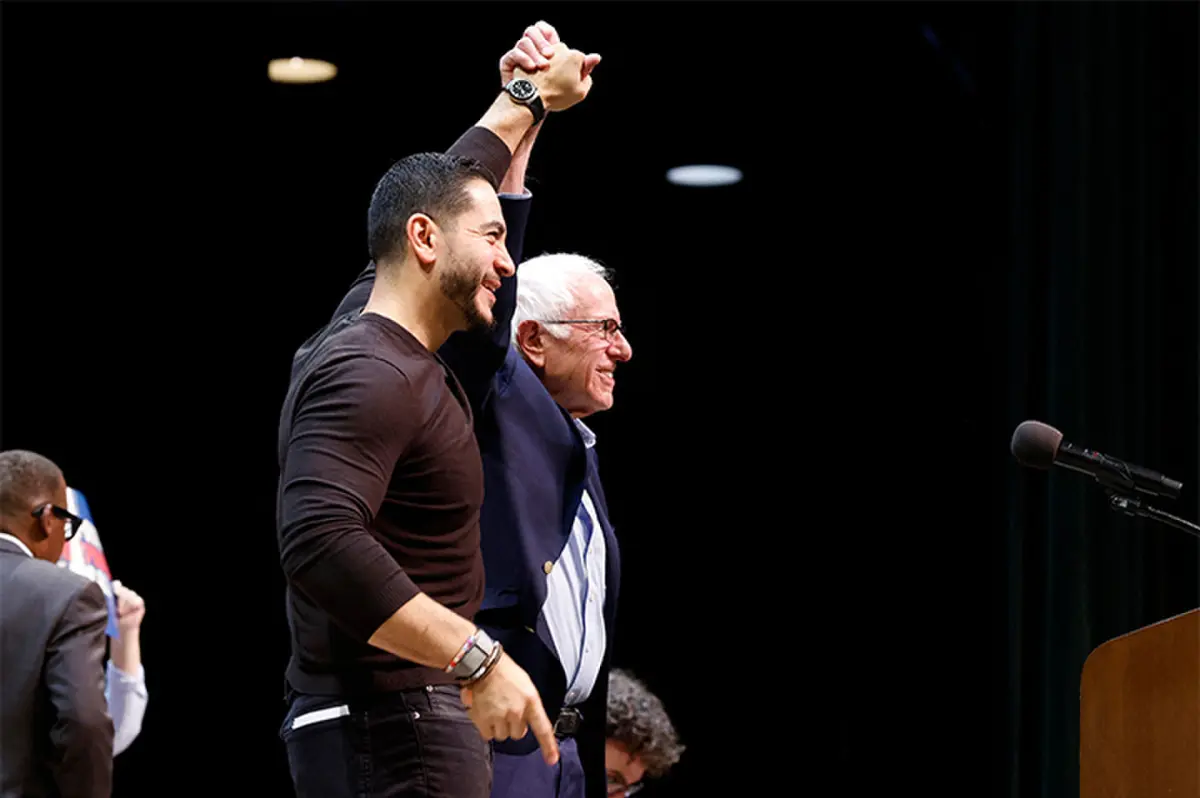
  Senator Bernie Sanders joins hands with Democrat senatorial candidate Abdul El-Sayed at a campaign rally  in Grand Rapids, Michigan.—AFP
Senator Bernie Sanders joins hands with Democrat senatorial candidate Abdul El-Sayed at a campaign rally in Grand Rapids, Michigan.—AFP

PORT HURON: President Donald Trump at a Sunday campaign rally ratcheted up his push to link US Senate candidate Abdul El-Sayed to Muslim extremists, comparing him to the 9/11 attackers while saying Democrats would let violent anti-American terrorists into the United States.

“I’m here to keep a jihadist, Muslim Brotherhood member from becoming a United States senator,” the president told a receptive audience in Port Huron, which is in a Michigan area where 66pc of the vote went to Trump in the 2024 presidential election.

If El-Sayed wins, he would be the first Muslim elected to the US Senate. Trump has sought to paint him as an anti-American Muslim radical, and on Sunday he took the rhetoric to a new level, likening El-Sayed to the attackers who took over United Flight 93 during the Sept 11, 2001, attacks.

Michigan has one of the nation’s most competitive US Senate contests going into the Nov 3 midterm elections, with former US Representative Mike Rogers, a Republican, and El-Sayed vying for an open seat that will help to decide control of the chamber.

The president on Sunday compared voting against El-Sayed to the actions of Michigan native Todd Bea­mer and others who fought back aga­i­­nst the Flight 93 hijackers. “Twenty-five years later, Michigan needs to stand up and fight, just like Todd did, to stop a jihadist from walking into the Capitol,” said Trump.

If El-Sayed wins, “he would be the only senator that will have to go through a metal detector before he’s allowed to go in the Senate,” Trump said.

El-Sayed has dismissed the accusations against him, and at a Sunday night event, he suggested that Trump’s frequent emphasis of El-Sayed’s name contains a measure of hypocrisy. “I get that the president of the United States takes personal offence to my first name,” El-Sayed told an audience in Grand Rapids, Michigan. “He doesn’t mind as much when it’s a shared name from the Saudis who are funding his son-in-law’s private equity, doesn’t seem to mind as much when it’s the Qataris who are giving him a $400 million private jet.” Affinity Partners, Trump son-in-law Jared Kushner’s investment fund, has reportedly received billions from a Saudi Government entity. Qatar gifted Trump a Boeing 747 jet.

The mostly White crowd at Sunday’s rally cheered Trump’s comments on El-Sayed. Some attendees yelled traitor and others yelled deport, although El-Sayed was born in Michigan. Terrance Camburn, a 52-year-old disabled Army veteran from Sandusky, Michigan, said he supported Trump’s criticism because of El-Sayed’s political beliefs.

“I’ve been down to Dearborn and I’ve seen many of the things he agrees with,” Camburn said when asked about Trump’s 9/11 comments. Dearborn, Michigan, has the highest per-capita concentration of Muslims of any US city.

As he left the venue after the rally, Rogers did not respond to questions about Trump’s invocation of 9/11. But earlier on Sunday, he said on NBC’s “Meet the Press” that he did not agree with the notion that El-Sayed is a violent terrorist. “I’ve never called him a terrorist,” Rogers told NBC.

Rogers has alleged without evidence that El Sayed has ties to the Muslim Broth­erhood, one of the Arab world’s oldest and most influential Islamist groups. El-Sayed has denied affiliation with the Muslim Brotherhood, saying it is “shameful” for Rogers to question his allegiance to the United States.

Rogers told “Meet the Press” that El-Sayed had not sufficiently responded to questions about the allegations. “He’s a Democrat Socialist of America-aligned candidate who has these pretty radical support groups that don’t like America,” he said.

Trump’s speech in eastern Michigan on Sunday came a day after former President Barack Obama campaigned for Democrats in the state, underscoring its importance in next week’s elections. At a Saturday rally in Detroit, Obama framed the attacks by El-Sayed’s opponents as an attempt to make him look “less American than they are.”

The former president compared them to his own experience as the target of false claims that he was born in Kenya. “This stuff didn’t work on me,” Obama said. “Not in Michigan. It’s not going to work on Abdul.” Dem­­ocrats need to gain just a handful of seats each in the US Senate and House of Repr­esentatives to overturn Repu­blicans’ narrow 53-47 and 218-214 majorities.

Published in Dawn, October 27th, 2026

  •  

In a pickle in Jamnagar

THE massive Reliance refinery in Jamnagar abutting the Arabian Sea from its perch in Gujarat was inaugurated in December 1999. There may be absolutely no connection between the refinery’s birthday and India’s nuclear tests of May 1998. But it’s difficult also to ignore the high stakes involved in its presence facing Pakistan, which too became a nuclear power that year.

History shows a pattern of power play associated with such critical and strategic assets. It was on the eve of World War I that Churchill decided that the Royal Navy should switch to oil and away from Welsh coal to make the fleet faster and more efficient. But with no oil of its own, Britain turned to the Abadan refinery, which would eventually become the world’s largest such facility, except that it was needlessly close to the border with Iraq. The refinery was at the heart of the 1953 coup against Mohammad Mossadegh when the elected prime minister nationalised the oil industry. It was the first scalp for Saddam Hussein in the long war he launched against Iran in 1980.

The Jamnagar refinery is said to be the world’s largest facility to process the most difficult of crude oils, including hugely discounted volumes imported from cash-strapped Venezuela. Given its proximity to Pakistan, the facility has figured in comments by analysts and voluble generals alike as a potential target, a veritable sitting duck.

The Ambani family on its part has played an active role in seeking to improve ties with Pakistan. They reportedly played a role in pleading through a former US president close to the family in pressing Gen Pervez Musharraf to allow Nawaz Sharif to be able to leave Pakistan to live in exile. The refinery has also featured as a potential bridge between the implacable rivals, at one point offering to transport refined products to Pakistan through the Punjab border.

Given the fact that India has only suspended the war it launched against Pakistan under the sobriquet of Operation Sindoor and not brought it to a closure, the tense ties are expected to continue to keep a range of targets in the crosshairs of both sides. In the prevailing circumstances of a global economic meltdown mocking the poor and the rich alike, it’s probably just a question of a nudge that the proverbial ice is broken between the two, and last week may have offered a sliver of such a hope.

The day US Secretary of State Marco Rubio came to visit the Reliance oil refinery in Jamnagar, President Mohamed Muizzu of the Maldives was landing in Islamabad where he would give an unusual call to revive the frozen South Asian Association for Regional Cooperation (Saarc). Muizzu’s call had a strange ring to it given that he was elected to lead his archipelago nation in 2023 on the openly anti-India slogan of “India out”.

The US wants to dry up Moscow’s wartime oil revenues by pushing India toward alternative heavy crude markets.

Seen as close to Beijing and pointedly hostile to New Delhi at the time, Muizzu preferred a mellow approach in Pakistan when Prime Minister Shehbaz Sharif broached the two issues he routinely raises: Kashmir and Indus water sharing with India.

Leading the first Maldivian state visit to Islamabad in 11 years, Muizzu kept his sights on sweeping maritime security and defence pacts. For both Pakistan and the Maldives, a stronger bilateral relationship is seen as serving as a necessary strategic counterweight to balance India’s regional dominance.

Rubio’s visit to Jamnagar was not only aimed at sending more stolen oil from Venezuela for refining with a view to easing the enormous pressure put by the reckless Israel-US war on Iran on global fuel markets. Rubio’s primary objective apparently was to convince Reliance to buy more Venezuelan crude while aggressively cutting its intake of Russian oil.

Following Western sanctions on Russia, India became Russia’s top oil buyer. The US wants to dry up Moscow’s wartime oil revenues by pushing India toward alternative heavy crude markets. Gleaning from Rubio’s description, the US sees Jamnagar as the only facility globally with the sheer muscle to offset Russian volumes.

Before the visit ended, however, unflattering news came trickling in from Arunachal Pradesh, an Indian-ruled province China claims as South Tibet. The paramilitary patrol keeping vigil for India had had recent face-offs with Chinese counterparts at several parts of the border where they had held their ground valiantly. Or so claimed the paramilitary chief Shatrujeet Kapur. His comments were said to have been taken down and the government denied anything at all was really amiss.

Only a couple of days or so before the reported transgressions around Arunachal Pradesh and their denial by New Delhi, the two countries had gone through a notably high-decibel exchange over the naming of geographical features in Ladakh. The Global Times, considered close to China’s ruling Communist Party, wrote a long editorial reminding India of the need to avoid disturbing the agreement on peace and tranquillity along their border.

A bird’s-eye view of the South Asia chessboard, therefore, reveals a fraught cross-section of forces at play. Pakistan appears agreeable in its ties with the three big powers — the US, China and Russia. Whereas India has struggled to keep the US in good humour, which makes it even more of an ordeal to avoid annoying Russia, a traditional ally in countless ways. With China, the relations require a greater quotient of tender care but with scant quantities in sight.

Add to the mix the Indian youth mobilisation that’s rocked the over 12-year-old government of Prime Minister Narendra Modi. Has Rubio created more trouble for Modi, including by not even meeting him during the visit, or has he by visiting Jamnagar set the grounds for a diplomatic entente with neighbours? Which would leave Modi elbowroom to address the domestic crisis with any degree of composure or hope to endure the pickle he is in.

The writer is Dawn’s correspondent in Delhi.

jawednaqvi@gmail.com

Published in Dawn, October 27th, 2026

  •  

Whither terrorism

THE future of Khyber Pakhtun­khwa remains unclear, whether it’s as a single entity or as a democratic one. PTI, we are told, has been made PNG — once again. And the south of KP is reportedly being carved out rapidly to be a new province or to simply reverse the amendment that made the former Fata part of KP. No one is really sure what the coming days hold.

Amid this confusion, a newly appointed member of the Area Representative and Development Council (ARDC) for the special emergency-hit districts of the south has created another storm in a teacup. In a video statement he spoke of reaching out to the Afghan Taliban to bring peace to Pakistan. Considering that this preference for dialogue over conflict with the fitna-across-the-border ostensibly has been the reason the PTI government was sent home, a similar message of love from the new advisory council just wasn’t cricket. But before we could get our breath back at this audacity, the new spokesman of the region, Mehmood Jan Babar, added to the mess by not denying the idea altogether.

Eventually Samar Bilour, who represents the Peshawar-led advisory council, had to enter the fray to diss the notion of talks. As an aside, we now have a Peshawar council and a Southern council.

Be that as it may, the point is these statements have simply added to the confusion surrounding the province. And terrorism, despite the frequency of the attacks and the statements of the government, has taken a backseat.

The focus is more on what the grand plan for KP is. Is it simply to close the doors on PTI? Is it to conduct an experiment on the efficacy of newer, smaller provinces? Or is it simply to reverse the Fata merger? Or perhaps it was to give the governor the chance to clear encroachments, a favourite problem for most non-elected officials these days. As the Urdu saying goes, there are as many rumours as there are mouths.

We appear to be using the same old playbook put together in the post-Musharraf period.

But none of these rumours seem to be highlighting the basic issue — how to address the decades-old problem of militancy in these regions. Other than vague promises of fighting the problem, there is little that has been shared with the people to explain what the new government is doing or planning to do.

And this is where the problem lies.

Militancy is going from bad to worse. The intensity of the attacks is worrying and impacts the entire country, especially one looking for more foreign investment. But while the state is clear on its decision to fight its way to victory, it doesn’t seem to have a clear strategy or path for this — or so it appears to those on the outside.

Any strategy to succeed must take into account the current environment.

However, we appear to be using the same old playbook put together in the post-Musharraf period when the TTP was controlling large swathes of land in what is now former Fata. In order to flush the Taliban out, military operations were conducted after the ordinary residents were persuaded to leave their homes and villages before the clearing out was done. And once the area/s were cleared, the displaced people were allowed to return to their homes and businesses.

However, nearly two decades later, the TTP is no longer controlling areas; it seems to appear only to conduct attacks or block roads, or carry out other activities and then melt away. And yet, it seems, our strategy remains the same — of wanting to clear out areas, be it at the level of villages and so on.

But if the TTP is not controlling these areas and the plan is to clear out the residents before launching operations, surely the TTP will also vacate the areas along with the residents and simply return later. How is this effective? And this is all the more difficult now because 20 years earlier, the TTP escaped to an Afghanistan run by a hostile government, which is no longer the case. But these questions are really not being discussed.

The intelligence-based operations (IBOs) are also offered as an alternative. Though once again, there is little clarity on how effective these are; they only become public when they lead to deaths of troops, which is tragic. But once again, there is little information available on why there is even one fatality during an IBO. And if they are effective, then why has the problem simply grown?

The second problem with this strategy is the public sentiment, which is against military operations because of the displacement and suffering that comes in the wake of this. But more than that, the displacements were not accompanied by the compensation the people had been promised — for the damage to their property and business. This has been a major reason for their reluctance to support operations this time around. And yet, this also does not seem to have led to any kind of brainstorming about what to do differently.

More worrying still is the distrust or alienation of the people in general from the state as well as the TTP. In many anecdotal accounts, it is suggested the local residents of the affected areas see the activities of the TTP and the state as alienating. These gaps with the state, ideally, should be bridged before operations are launched. It is rather obvious that kinetic operations cannot succeed without the people’s support. And yet the state seems to be doing little to earn this support or trust.

And along with all this comes the larger issue of why the kinetic operations, whenever they have succeeded, are not followed by a successful handover to strong functioning civilian institutions which can then govern effectively. In other words, the build-and-transfer part has eluded us for decades.

Indeed, the reduction of the debate over terrorism to a simple one of using force or not is a very one-dimensional one. The problem requires a lot more depth and nuance than is realised.

The writer is a journalist.

Published in Dawn, October 27th, 2026

  •  

Privatisation framework

THE proposed merger of the Privatisation Commission and the Public-Private Partnership Authority (P3A) into a single institution is a sensible move. It will end the duality of functions and provide a more coherent framework for mobilising private capital to manage public assets and develop physical infrastructure for which the state has limited resources to spare.

Although the two bodies operate under separate laws, their mandates intersect in bringing private capital and expertise into areas dominated by the state. A unified entity could offer a common platform for evaluating these options.

Privatisation involves transferring ownership or control of state assets, while public-private partnerships (PPPs) allow governments to enlist private capital for projects they cannot finance. Both approaches require sound financial assessments and clear risk allocations.

With Pakistan facing persistent fiscal constraints, the state cannot afford to finance loss-making enterprises indefinitely. Private investment can help ease these pressures, but it is not an end in itself. Poorly structured transactions can leave the state with inadequate returns or costly contractual obligations.

The proposed legislation envisages four public funds to support privatisation and PPP transactions. These instruments could help prepare viable projects and attract investment. However, they must not become vehicles for subsidising commercially unsound ventures. Government guarantees and liabilities should be disclosed and assessed before deals are approved.

The proposed legal protections for serving and former officials acting in good faith also require careful rethinking. Officials should be protected against frivolous litigation when making decisions in the public interest. Such protection must not, however, become immunity from accountability.

Making PPP agreements accessible as public documents is also positive. Public scrutiny is particularly important when private investors enter long-term arrangements that may impose financial obligations on taxpayers and successive governments.

The new arrangement offers an opportunity to improve the management of state assets and infrastructure investment. Its success will depend on securing fair value for public property, attracting credible investors and ensuring that partnerships deliver tangible benefits.

The bill proposes a majority-independent board with private-sector representation to strengthen commercial decision-making. Its effectiveness will require transparent appointments, relevant expertise, political independence, clear performance benchmarks, strong accountability, and enforceable conflict-of-interest rules to ensure effective governance.

The state must now ensure that commercial discipline, transparency and accountability guide its implementation.

Published in Dawn, October 27th, 2026

  •  

Makkah pact allies move from defence to diplomacy

• Pakistan’s army chief, Saudi defence minister, Turkish spymaster meet top Iranian officials
• Pezeshkian backs understanding ‘to strengthen unity among Muslim nations’
• Saudis say visit aimed at supporting Qatari, Pakistani mediation efforts
• Halting Houthi attacks, reopening Hormuz among main concerns

ISLAMABAD: Iran on Monday expressed support for efforts to promote security and development as President Masoud Pezeshkian met senior officials from Pakistan, Saudi Arabia and Turkiye, the three signatories to the Makkah defence pact, with both sides agreeing to continue dialogue on regional peace and security.

“The Islamic Republic of Iran supports any understanding aimed at strengthening the unity and cohesion of Islamic nations,” President Pezeshkian was quoted as saying in an official statement.

He added that regional countries could set an example of justice and development by pooling their resources and capabilities.

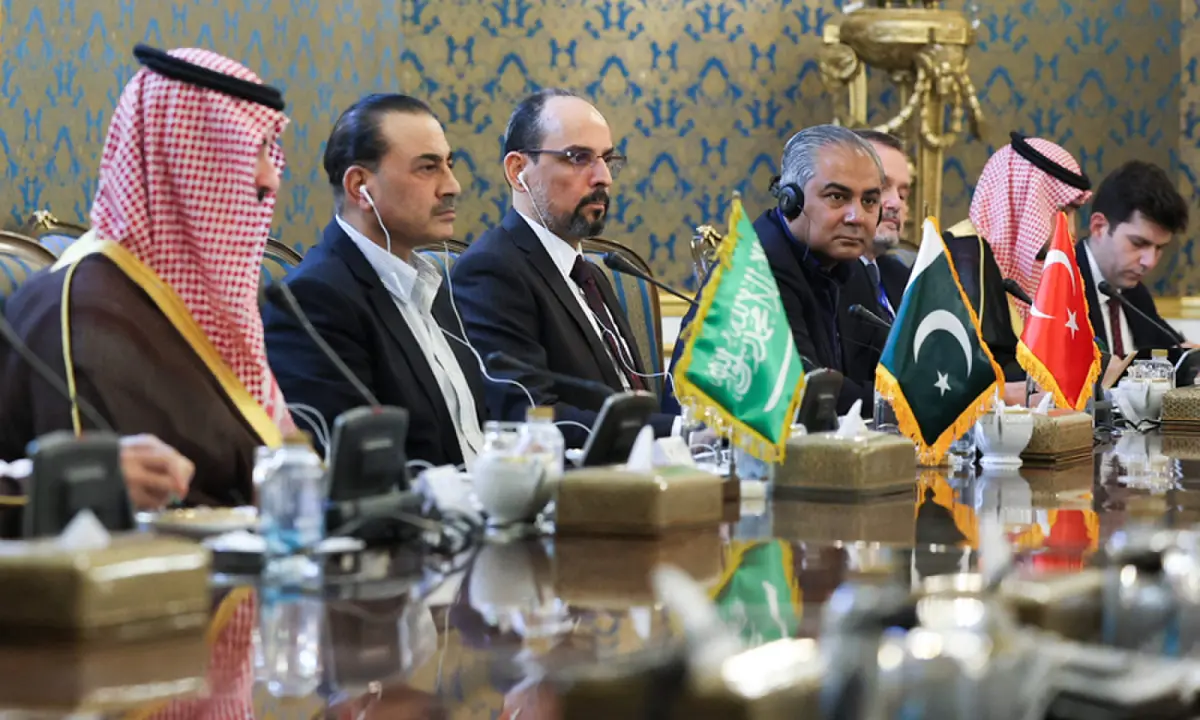
The meeting brought together Saudi Defence Minister Prince Khalid bin Salman, Pakistan’s Chief of Army Staff and Chief of Defence Forces Field Marshal Asim Munir, and Turkish intelligence chief Ibrahim Kalin. Iran was represented by senior officials, including Foreign Minister Abbas Araghchi and Supreme National Security Council Secretary Mohsen Rezaei.

The visiting officials met with Mr Rezaei separately ahead of their meeting with President Pezeshkian.

During the preliminary meeting, it was decided that they would “continue their dialogue to bolster cooperation among the four regional nations, including in the areas of regional peace and security.”

The talks followed Field Marshal Munir’s visit to Tehran last week, where he had proposed the meeting, according to Iranian Foreign Ministry spokesman Esmaeil Baghaei.

The first meeting of the Makkah Joint Defence Agreement countries with Tehran reflected the realisation that regional tensions need to be addressed through diplomacy, even as the participating countries strengthen their own defence cooperation.

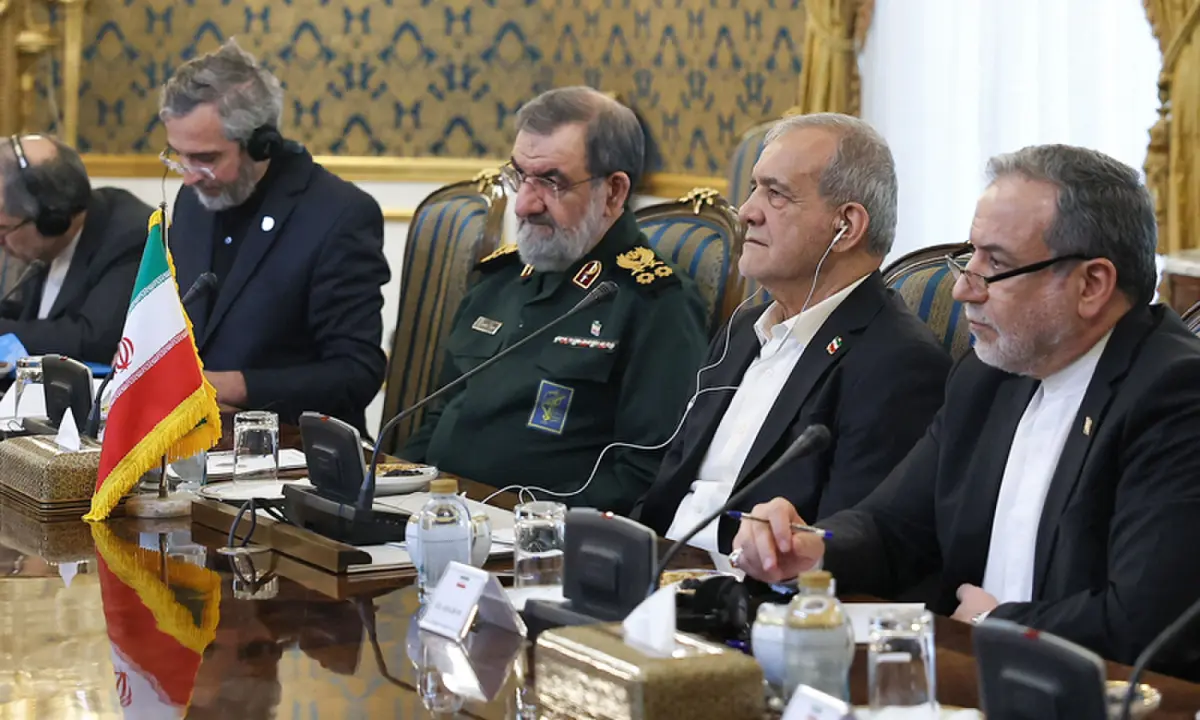
 (RIGHT) Iranian National Security Council head Mohsen Rezaei, President Masoud Pezeshkian and Foreign Minister Abbas Araghchi during talks between Makkah pact members and Iran in Tehran.—AFP
(RIGHT) Iranian National Security Council head Mohsen Rezaei, President Masoud Pezeshkian and Foreign Minister Abbas Araghchi during talks between Makkah pact members and Iran in Tehran.—AFP

Saudi Arabia’s Foreign Ministry described the visit as part of continuing efforts by the agreement’s members to reduce tensions, promote dialogue and support diplomatic solutions. The visit, it said, was aimed to support the mediation efforts of Qatar and Pakistan.

Abdul Aziz Hamad Al-Uwaisheq, assistant secretary-general for political affairs and negotiations at the Gulf Cooperation Council, similarly identified de-escalation, dialogue and support for Pakistan and Qatar led mediation as key objectives of the initiative.

A Qatari delegation had immediately preceded the visit by Makkah pact officials to Tehran, suggesting coordination between the diplomatic initiatives.

The discussions took place against a backdrop of heightened concern over the escalating conflict between Yemen’s Ansar Allah rebels against Saudi Arabia, the security of the Strait of Hormuz and the prospect of renewed US and Israeli military action against Iran.

Moreover, the meeting coincided with Egyptian parliament authorising its president to provide defensive military support to Saudi Arabia in its conflict with Yemen’s Ansar Allah movement. Cairo has, meanwhile, maintained contacts with Iran, the United States and other regional partners in an effort to prevent the conflict from widening.

In a way the meeting was also an extension of the R4 initiative, with Cairo conducting its diplomacy with Tehran in parallel and the other three going over to Tehran to see Iranian leaders.

Iran has long argued that regional security should be managed by countries in the region rather than outside powers. Monday’s meeting offered Saudi Arabia, Pakistan and Turkiye an opportunity to convey their concerns directly to Iranian leaders, while exploring whether regional cooperation could help contain the risks of a wider conflict.

Media reports said the discussions included the possibility of a regional non-aggression framework, along with the resumption of US-Iran negotiations, halting Ansar Allah attacks, the reopening of Strait of Hormuz and the US naval blockade of Iranian ports. Other issues reportedly raised included the consequences of US and Israeli military actions and developments in Palestine and Lebanon.

There was no immediate indication that the participants had reached an agreement on these issues after their meeting that lasted about two hours.

Mr Rezaei, however, speaking to the media later, said, “a new and positive atmosphere has emerged within the region as reflected in the dialogues held with senior officials from Turkiye, Pakistan, and Saudi Arabia.”

For Pakistan, the initiative offers a means of maintaining its defence partnership with Saudi Arabia while keeping channels open with neighbouring Iran. Islamabad has also sought to facilitate communication between Washington and Tehran, an effort that would become more difficult if regional hostilities resumed.

Saudi Arabia, meanwhile, faces the task of strengthening protection for its territory and critical infrastructure from Houthi attacks and fallout of US/Israel-Iran conflict. Its participation in the talks suggests that closer defence cooperation with Pakistan and Turkiye is not precluding engagement with Tehran.

Published in Dawn, October 27th, 2026

  •  

Rate hike divides business community

KARACHI: Foreign investors welcomed the State Bank of Pakistan’s (SBP) 50bps rate hike to 12 per cent on Monday, but the business community called it counterproductive for stabilisation, industrial growth and export competitiveness.

M. Abdul Aleem, Secretary General of the Overseas Investors Chamber of Commerce and Industry, acknowledged the SBP’s move, saying it was needed to contain inflationary pressure and safeguard macroeconomic stability amid global energy price risks.

However, with large-scale manufacturing growth recovering to 1.9pc in July-August FY26 and private-sector credit expanding 14.1pc year-on-year, it is equally important to sustain the emerging momentum in investment and economic activity, he said.

As inflationary pressures are significantly influenced by external energy prices and domestic supply constraints, he emphasised that monetary tightening must be complemented by targeted supply-side reforms, fiscal discipline, competitive energy tariffs, broader tax-base coverage and predictable taxation and regulatory policies.

Foreign investors back SBP’s move to curb inflation, while industry says it will hurt exports and growth

In contrast, FPCCI President Atif Ikram Sheikh said raising the policy rate to an uncompetitive 12pc would further inflate borrowing costs for manufacturers already grappling with unprecedented high overheads, soaring utility tariffs and liquidity constraints.

Instead of curbing inflation — driven largely by supply-side bottlenecks, energy costs and fiscal anomalies rather than excess demand — tight monetary policy has crippled domestic manufacturing, he said, urging the government and the State Bank to recalibrate the framework and bring the policy rate to single digits to make credit affordable for trade, SMEs and large-scale manufacturing.

High interest rates also place an unmanageable debt-servicing burden on the exchequer and private borrowers, creating a cycle of fiscal distress and stagnant output, he said, asking the SBP to align rates with regional benchmarks.

KCCI President Talat Mahmood warned that the hike would further raise the cost of doing business, discourage private-sector investment and undermine growth. He said Pakistan needs to strengthen its productive capacity, attract investment, generate employment and accelerate export-led growth but the policy rate hike will send the wrong signal to businesses planning to invest and expand.

SITE Association of Industry President Abdul Hadi said the move would further aggravate industry problems at a time when factories are operating far below capacity and barely surviving.

The business community has long demanded a single-digit policy rate, but industry’s real problems have again been ignored, he said, adding that high rates will not only make fresh funding harder but also increase the burden on existing loans.

He said the rate hike would burden manufacturers, forcing formal businesses to shut down or scale back, as costlier borrowing would hit new investment, expansion and production.

Korangi Association of Trade & Industry President Sheikh Umer Rehan said the hike could hurt industry, business growth, and recovery, adding that inflation could also be curbed by cutting energy costs, fixing taxation, improving the business climate, and implementing effective industrial policies.

Pakistan Textile Exporters Association Chairman Rehan Naseem Bharara said the rate hike would raise working-capital costs, constrain investment and weaken global competitiveness at a time when industry is already grappling with expensive energy and financing.

Published in Dawn, October 27th, 2026

  •  

Regional trade deficit widens sharply

ISLAMABAD: Pakistan’s trade deficit with nine neighbouring countries widened by 26.62 per cent to $4.97 billion during the first quarter of 2026-27 compared to $3.93bn in the corresponding period last year.

The widening gap reflects a contraction in Pakistan’s exports to regional markets, largely due to reduced shipments to Afghanistan and Bangladesh.

Trade with Afghanistan, including exports, has remained suspended since Oct 10, 2025, further weighing on overall export performance.

Imports from China rose sharply during the July-September quarter, contributing significantly to the widening imbalance. Consequently, the bilateral deficit with China widened by $858.808 million, accounting for approximately 82.18pc of the increase in the combined deficit with the nine countries.

Gap with nine neighbours rises 26.6pc to $4.97bn in July-September

Exports to China rose marginally, while exports to Nepal also grew in percentage terms, though the increase remained negligible in dollar value.

In contrast, shipments to Afghanistan, Bangladesh and Sri Lanka declined, according to the latest data compiled by the State Bank of Pakistan.

Exports to nine countries—Afghanistan, China, Bangladesh, Sri Lanka, India, Iran, Nepal, Bhutan and the Maldives—fell 6.72pc to $944.24mn in July to September of FY27, down from $1.01 billion in the same period last year.

By contrast, imports surged 19.79pc to $5.92bn in 3MFY27 from $4.94bn in the same months of the previous fiscal year.

Further analysis showed that imports from China grew 19.76pc to $5.82bn in 3MFY27, up from $4.85bn over the same period last year. Pakistan’s exports to China grew 17.95pc to $663.57m in 3MFY27 from $562.56m in the same months of the preceding fiscal year.

Imports from India increased by 68.90pc to $61.74m in 3MFY27 from $36.55m over the last year. Meanwhile, no exports to India were recorded in the first quarter of FY27.

Exports to Afghanistan fell 88.34pc to $18.86m in 3MFY27, down from $161.76m last year. Imports stood at $0.25m in 3MFY27, compared with $4.52m in FY26, a decline of 94.40pc.

Pakistan’s exports to Bangladesh declined by 2.96pc to $174.77m in 3MFY27 from $180.12m over the last year. Imports dipped 36.11pc to $13.88m in 3MFY27 from $21.73m over the last year.

Published in Dawn, October 27th, 2026

  •  
❌