
❌

Reading view

Amazon tells software engineers what really matters as AI ushers in the era of the 'Renaissance Developer'

AWS CEO Matt Garman onstage at Re: Invent 2024.
AWS CEO Matt Garman

Noah Berger/Getty Images for Amazon Web Services

  • Amazon shifts AI focus to business impact, not just raw usage, in new developer guidelines.
  • The company warns that AI metrics can create bad incentives, including “tokenmaxxing.”
  • Managers are told to examine teams at both the highest and lowest levels of AI adoption.

Amazon just issued new guidelines for software engineers in the AI era: Prioritize business outcomes over raw usage.

Terk Terkowitz, Amazon's vice president and distinguished engineer, said in a memo published Tuesday that AI is changing software development more quickly and fundamentally than earlier shifts such as cloud computing. But engineers should be judged by their impact on customers and the business, he wrote, not simply how much they use AI.

"We all need to embrace this change and take the time to learn, or we risk being left behind," Terkowitz said.

AI coding tools and agents are upending the software industry and changing what it means to be a coder. Amazon calls this the "era of the Renaissance Developer," where human judgement and machine intelligence combine to create new products and services faster and more efficiently.

"This is a time of change for our industry, and a time of change for what it means to be a software engineer," Terkowitz wrote in the memo.

The updated guidelines reflect Amazon's growing effort to make AI adoption part of how it assesses engineers and engineering managers. The company has tracked measures including AI usage, token consumption, and lines of code internally, and used leaderboards to rank teams by some of those metrics.

But the memo warns that using such measures as targets can produce bad outcomes, including "tokenmaxxing" rather than better software or customer experiences.

"Using these metrics could, if used as a target instead of a measure, drive negative outcomes," Terkowitz wrote in the memo.

Amazon has been experimenting with ways to measure and encourage AI use across its engineering organization.

Earlier this year, the company was tracking engineers's use of internal AI tools and some teams used leaderboards tied to measures such as token consumption. The programs created friction among some employees, who worried that pressure to use AI could reward wasteful activity rather than productive work.

The new guidance offers Amazon's clearest public acknowledgment of that risk. Rather than lay out a detailed AI playbook that could quickly become obsolete, Amazon said its revised developer guidelines focus on long-term impact on customers and the business.

Still, the company said AI should be "at the center of software engineering practice" and urged engineers to incorporate the technology into their daily work.

Leaders are expected to use AI tools on production work themselves, understand where they help and where they fall short, and explain that judgment to their teams, according to the memo.

Terkowitz said Amazon has found that metrics such as token use, AI-tool adoption, and code reviews can correlate with the outcomes it values. But he said the measures must be used carefully. More token use can raise costs, while a focus on lines of code can create unnecessary complexity.

He also recommended that managers pay particular attention to teams at both ends of the AI adoption spectrum: those in the bottom 10%, to understand why they are not using AI effectively, and those in the top 10%, to determine whether heavier use is translating into faster delivery.

Terkowitz said Amazon's most AI-forward "frontier teams" have shown stronger productivity and delivery. He also said teams and individuals that are not adopting AI or increasing output metrics are falling behind.

But his memo left room for engineers whose work may not yet benefit from current AI tools. In those cases, he said, employees should document why and work toward a solution by sharing their findings with peers and managers.

"An engineer who can explain where AI does not yet help their work is demonstrating the judgement we are asking for," the memo said.

Have a tip? Contact this reporter via email at ekim@businessinsider.com or Signal, Telegram, or WhatsApp at 650-942-3061. Use a personal email address, a nonwork WiFi network, and a nonwork device; here's our guide to sharing information securely.
Read the original article on Business Insider

  •  

Amazon weighed ‘difficult trade-offs’ as memory costs squeezed its devices business, internal document shows

Panos Panay, head of Amazon's Devices and Services team

CHARLY TRIBALLEAU/AFP via Getty Images

  • Amazon launched a series of new devices this month, including Alexa tablets and Bee AI wearables.
  • Rising memory costs forced "difficult trade-offs" on Amazon's device prices, sales, and profit.
  • Amazon is seeking more Alexa revenue from enterprise sales, licensing, and ads.

Amazon launched a flurry of new consumer devices this month. Behind the scenes, rising memory costs are adding pressure to its already money-losing hardware business.

An internal planning document obtained by Business Insider shows Amazon forecasting a $612 million gross loss this year for its first-party devices business, compared with a leadership target of a $438 million loss.

The document said rising memory costs were "putting pressure" on the business's profitability, forcing "difficult trade-offs" among sales volumes, average selling prices, and gross profit.

The projected $612 million loss was at the gross profit level, meaning it did not account for all operating expenses, such as R&D, sales and marketing, and administrative costs.

The figures offer a rare glimpse into the pressure on Amazon's hardware business as it absorbs rising component costs. Other tech hardware companies, including industry leader Apple, face similar pressure from surging memory chip prices.

An Amazon spokesperson declined to comment.

A new wave of AI devices

Despite the pressure, Amazon continues to expand its consumer hardware lineup. Even if the company loses money on device sales, it can make money in other ways, such as subscription services, as more customers use its gadgets.

In October alone, the company introduced new Kindles, Alexa-powered tablets, Ring smart locks, and AI wearables under its Bee brand. The August planning document identified Bee and new smart glasses as strategic products still in an investment phase.

Amazon has historically used low-cost hardware to pull customers into a broader ecosystem of shopping and digital content. Rising component costs could make that strategy more expensive, forcing the company to raise prices.

The clearest shift is in Amazon's tablets. Earlier this month, the company phased out Fire tablets after 15 years and replaced the budget-friendly lineup with pricier Alexa Tablets powered by Alexa+. The new devices cost between $229.99 and $499.99, a notable increase from previous generations.

Not just Amazon

The planning document was prepared in August, the same month Amazon raised prices on products including Echo speakers, Kindle e-readers, and Fire TV devices.

The pressure extends beyond Amazon. Apple has raised prices on some Macs and iPads, while Microsoft and Sony have increased console prices. Dell, HP, and Lenovo also face higher memory costs.

The AI boom is helping drive the squeeze. Huge data center investments have increased demand for memory chips, while manufacturers have devoted more capacity to high-bandwidth memory used in AI servers. That has tightened supplies and raised prices for components used across consumer electronics.

Amazon is experiencing both sides of the boom. It expects roughly $220 billion in capital expenditures this year, largely to expand AWS data centers for AI demand, while higher component costs squeeze its consumer hardware business.

The rising cost of Alexa+

The August planning materials show Amazon reassessing both Alexa+ revenue and operating costs. They called for updated forecasts, expansion through enterprise sales and advertising, and more detailed AWS cost modeling.

Amazon is now confronting the cost of operating Alexa+ at scale. Business Insider reported in July that internal forecasts put Alexa+'s AWS cloud costs at roughly $1.7 billion in 2026, nearly triple the prior year's figure. Amazon was working to lower those costs by relying less on Anthropic's AI models and routing more requests to its own, cheaper systems.

A separate project called Moonraker, intended to give Alexa more advanced AI-agent capabilities, was projected to require more than $100 million in GPU spending this year. Amazon internally considered delaying or scaling back the initiative as one option for easing cost pressure, Business Insider previously reported.

Have a tip? Contact this reporter via email at ekim@businessinsider.com or Signal, Telegram, or WhatsApp at 650-942-3061. Use a personal email address, a nonwork WiFi network, and a nonwork device; here's our guide to sharing information securely.
Read the original article on Business Insider

  •  

AI is making scams against older Americans more convincing. Experts share how to spot the new red flags.

Craig Newmark, Don Grant, Amy Nofziger
Craig Newmark, Don Grant, Amy Nofziger (left to right) shared their perspectives on how older Americans can best prevent getting scammed.

Craig Newmark/Sabre Wealth/AARP

  • Cybersecurity experts found severe PHP bugs that could allow attackers to hijack web servers.
  • AI is being used to exploit vulnerabilities, making Americans more susceptible to scams.
  • Experts stressed basic cyber hygiene and scam awareness, especially for older Americans.

In just two days, AI exposed critical flaws in a programming language behind 70% of all websites. That may have opened the door for a rush of scams — especially those targeted to vulnerable populations like older Americans.

Last week, cybersecurity researchers uncovered two severe bugs in the PHP programming language. Attackers could hijack web servers and execute remote code. This prompted the PHP Foundation to release emergency patches to prevent widespread hacks, and governments, cybersecurity agencies, and businesses quickly moved to do damage control.

Though some experts said there could have been more problems had these flaws not been immediately addressed, such a crisis can happen again. As AI becomes more advanced and widespread, Americans are becoming more exposed and susceptible to scams.

Scams have been pervasive for decades, starting with physical mail and landline telemarketing. But they've gotten significantly more complex and deceptive, now integrating AI in ways that even tech whizzes may not spot. Older Americans are often the main targets of fraud, losing billions in fraud. An AARP survey from April found that 4 in 10 older Americans have lost money to fraud.

With attackers pouncing on any vulnerability to steal personal details or get money, five experts told Business Insider that now is the time to get ahead on scam prevention. Their quotes have been lightly edited for length and clarity.

Craig Newmark, founder of Craigslist, who founded the cybersecurity awareness campaign Take9
Craig Newmark
Craig Newmark advises families to take 9 seconds to pause before clicking on unknown texts.

Craig Newmark

What are some of the most common scams targeting older Americans?

Hackers are using AI to ditch the typos and make scams harder to spot. AI also makes it easier to produce large numbers of targeted scams. This includes AI voice cloning and scans of social accounts for personal details. These scams are on the rise and hurting real people, including older folks like me.

How should families react to all the recent headlines about system vulnerabilities?

Don't panic, but don't ignore them either. It shouldn't be up to regular folks to outsmart scammers. The best thing for families to focus on is basic cyber hygiene.

Organizations like Google and Apple are working hard to block scams, particularly on phones. It's just as important that we prepare loved ones with the tools to protect themselves as scammers become more sophisticated.

What are ways in which you work to make people more cautious about scams?

I've been fighting scams for 25 years. I take them personally. That's why I founded Take9 in 2024 to help people understand how to protect themselves and stay safe online.

Scams are overwhelming, and people often don't know where to begin. My advice is to start with the basics: Take 9 seconds to pause before clicking on unknown texts or links.

Once they've got that down, try multi-factor authentication, password managers, passkeys, and single sign-on. Family codes are an effective method to keep your loved ones safe, too.

Don Grant, certified financial planner at Sabre Wealth and CFP Board Ambassador
Don Grant
Don Grant advises that having open conversations about financial fraud is one of the most effective ways to educate older Americans.

Sabre Wealth

What are some of the most common scams targeting older Americans?

Scams often involve impersonation of an institution or government agency like the IRS, Medicare, or Social Security. Fake technical support scammers contact you with claims of a breach at your bank or financial institution.

A good friend and client is in his mid-60s, is a single Notre Dame graduate, and is a retired university English professor. He talked incessantly about his gorgeous, accomplished girlfriend. She has sent him photos, but he had never met her in person, nor via video chat.

Fast forward to earlier this year. They are no longer an item. He reluctantly admitted that she was attempting to scam him. He did send her about $1,200 to help get her 9-year-old daughter into a music school. When she hit him up about 10 times so she could move, he figured it out and cut the ties. From what we pieced together, this was an AI-assisted romance scam.

How should families react to all the recent headlines about system vulnerabilities?

A security breach at an institution doesn't automatically mean that your accounts have been hacked. However, it does mean it's time to change your login credentials.

Set up account notifications for withdrawals, transfers, password changes, and anything to do with your accounts. Never respond to an unsolicited email from a site or financial institution with which you do business. Don't call the number provided in the communication or click the provided link. Take the time to log into a verifiable site and call a verifiable number with questions.

What are ways in which you work to make people more cautious about scams?

Communication and education are critical. I have open conversations about financial fraud, anonymously citing actual situations where a scammer attempted to separate them from their money. Recounting others' experiences seems to really drive the point home. We also insist that all clients designate a trusted contact we can reach if we notice unusual activity or have concerns about possible financial exploitation.

Removing the stigma that they are "stupid" if they are scammed is paramount. Many victims are embarrassed to admit they've been deceived, and that embarrassment can prevent them from seeking help.

Alex Jacquez, Groundwork Collaborative's senior vice president of policy, advocacy, and research
Alex Jacquez
Alex Jacquez notes that companies should better protect consumer data to avoid putting the onus entirely on families.

Groundwork Collaborative

What are some of the most common scams targeting older Americans?

The FTC recently released its Protecting Older Consumers report, describing fraud in 2025. The top fraud types by incident report numbers for older people include online shopping, business impostors, government impostors, and investment scams. These, plus romance scams, are the top fraud types by total dollars lost for older people.

Scammers use AI to create deepfakes, clone voices, and send phishing messages. These types of fraud are not new, but AI makes them increasingly convincing and enables them to be carried out on a larger scale. Scammers also use AI in predictive targeting to find the most susceptible individuals.

In March 2026, Interpol warned that "AI-enhanced fraud is 4.5 times more profitable than traditional methods" because AI agents can complete the fraud on behalf of the scammers.

How should families react to all the recent headlines about system vulnerabilities?

Families should see the recent headlines about system vulnerabilities as part of a larger problem. Companies collect lots of information on users and fail to protect it. Now, consumers are exposed to data breaches and sophisticated scams.

What are ways in which you work to make people more cautious about scams?

We put out material for consumers and policymakers highlighting how companies are using more sophisticated techniques and technologies to rip them off.

While there are best practices people can follow to remain alert and vigilant against common scams, especially in the AI age, we believe that any real fix must be systematic and undertaken by policymakers. We need companies to better protect consumer data, stop collecting irrelevant data, and stop using it to squeeze consumers for every last dime.

Amy Nofziger, senior director of victim support, AARP Fraud Watch Network
Amy Nofziger
Amy Nofziger said the goal of fraud education isn't to live in fear.

AARP

What are some of the most common scams targeting older Americans?

Impostor scams remain the number one category reported to the AARP Fraud Watch Network Helpline. They will say there is a problem with your account and need to remotely access it, or they will say they are with the courthouse and you missed jury duty and demand payment to avoid being arrested.

AI hasn't changed human nature, but it has changed the scale, speed, and sophistication of scams. Criminals are still exploiting the same emotions they always have: fear, trust, loneliness, hope, curiosity, and urgency. We used to tell people to look for red flags like misspellings and poor grammar in emails, but with today's AI tools, those clues are often gone.

How should families react to all the recent headlines about system vulnerabilities?

It's understandable to be concerned by headlines about system vulnerabilities and data breaches, but the key is to focus on what you can control. The goal isn't to live in fear. It's to stay informed, slow down when something feels off, and ask for help. We don't have to do this alone.

What are ways in which you work to make people more cautious about scams?

AARP Fraud Watch Network helps individuals and families protect themselves from scams. It's a free resource available to everyone. We provide fraud prevention information, online tools, the award-winning Perfect Scam podcast, and a Fraud Watch Network Helpline that receives more than 100,000 calls each year.

Ali Tager, vice president of external affairs, National Cryptocurrency Association
Ali Tager
Ali Tager advises that people look for small errors in grammar or spelling.

National Cryptocurrency Association

What are some of the most common scams targeting older Americans?

Some of the most common online finance scams are relationship scams and impersonation. Giveaway scams are when scammers impersonate public figures, promising "free" money or crypto if users start by sending a small amount first. In phishing scams, fraudsters pose as a friend or a crypto exchange and ask victims to click links or share login details to steal private information.

Pump and dump scams occur when groups inflate the price of lesser-known crypto coins via online hype. When enough people join and spike the price, fraudsters quickly sell off their holdings for a profit, leaving others in the dust.

How should families react to all the recent headlines about system vulnerabilities?

Stay alert, not alarmed. Whether it's your bank, your Venmo account, or your crypto account, security should always be top of mind. Protecting yourself starts with recognizing common scams and practicing smart online habits.

For crypto holders, guard your private key or recovery phrase like you would your bank account number and password. No legitimate company will ever ask for it, so never share it, and keep physical backups in secure locations. Watch for small clues like odd sender addresses or sloppy spelling, and remember that deepfakes and fake websites can look real at first glance.

What are ways in which you work to make people more cautious about scams?

A scammer's greatest weakness is an informed community. The NCA is dedicated to helping everyday Americans understand and use crypto with confidence. Research shows that 72% of crypto holders cite scams and security as a concern. However, 76% of crypto holders say it has positively impacted their lives overall, while just 3% report negative impacts. Of those, about one-third are scam/fraud-related.

Read the original article on Business Insider
  •  

An AI safety leader says he stopped saving for retirement because he believes AI will kill us all in the next 10 years

Nate Soares
Nate Soares has stopped saving for retirement because he fears AI could end humanity first.

Courtesy of Nate Soares

  • Nate Soares said he stopped adding to his 401(k) because AI may kill us within a decade.
  • The MIRI president said humanity has a more than 50% chance of dying within a decade.
  • Elon Musk said AI could make retirement savings irrelevant by creating an age of abundance.

Saving for retirement is a bet on the future. Nate Soares, the president of the Machine Intelligence Research Institute, isn't so sure AI will let us get that far.

"I do not save for retirement right now. I have a 401(k) from when I worked at Google, but I haven't contributed for a decade," Soares told The Atlantic CEO Nicholas Thompson in a recent interview for Thompson's "The Most Interesting Thing in AI" series.

Soares' decision reflects a grim view of the AI race.

"Godfather of AI" Geoffrey Hinton and Anthropic researcher Evan Hubinger have, respectively, put the odds of AI killing everyone within a decade at 10% and more than 10%. Soares is more pessimistic: He told Thompson he believes there is a greater-than-50% chance AI causes human extinction in less than a decade.

Soares, who is also the coauthor of "If Anyone Builds It, Everyone Dies," has spent more than 12 years working on AI alignment, the field focused on ensuring powerful systems act as intended. Before joining MIRI, the Berkeley-based nonprofit focused on AI risks, he worked as an engineer at Google and Microsoft.

Soares said that a sufficiently capable AI could develop goals at odds with humanity's, evade oversight, improve itself, and build the automated infrastructure needed to operate without people.

From there, he said, it could reshape the planet around its own objectives, potentially making it uninhabitable for humans — a warning he shared with Business Insider last year.

A 401(k) for the apocalypse?

The question of how AI will shape the future has also prompted Elon Musk to question whether retirement savings will matter. Musk's vision of the future, however, is radically different than Soares'.

In January, the Tesla and SpaceX CEO said people should not worry about "squirreling money away for retirement" in 10 or 20 years, predicting advances in AI, robotics, and energy will make retirement savings "irrelevant." (Personal finance experts and AI gurus told Business Insider the opposite: You really should be saving for retirement.)

Musk has said that supercharged productivity could create an age of abundance, in which everyone has access to a "universal high income," cheap goods and services, and better healthcare and education.

Musk has also said money could become irrelevant in a future where AI and robots outperform humans at virtually every task.

For Soares, the prospect of a vastly capable AI is an existential danger, not a route to plenty.

Echoing calls from tech leaders to "pace the frontier" of AI development, Soares said governments should halt the training of general-purpose AI systems. They should focus on developing technology for applications like cancer research and safer self-driving cars, he said.

The solution, he told Thompson on Wednesday, "is to not build the thing that would kill everybody."

"I do everything I can to stop this eventuality," he said. "I don't think it's inevitable."

Read the original article on Business Insider

  •  

This AI startup raised $300 million to build digital versions of consumers

Person seated on a couch browsing clothing items on a smartphone shopping interface.
Simile, an AI startup, raised $300 million at a $2 billion valuation to build models that simulate consumer behavior.

Alistair Berg/Getty Images

  • Simile raised $300 million to build models that simulate consumer behavior.
  • CEO Joon Sung Park said users can define an audience and ask simulated consumers questions.
  • Park said CVS and companies in finance and entertainment are already working with Simile.

Companies could soon have a new way to find out your shopping habits — by asking your digital clone.

Joon Sung Park, Co-Founder & CEO of Simile, an AI startup, told show host Molly O'Shea on the Sourcery podcast released on Monday that the company is building simulations of people that businesses can quiz about everything from products to marketing campaigns.

Park said the company is "creating a foundation model of human behavior that basically can take as input a description of a person or a group of people and then simulate what these people might do in different contexts," Park said.

"So they get access to this web interface where they can basically come in and define two things," Park added of existing users. "They can say who they want to talk to and what questions they want to ask. And really they can ask anything, and right now they can ask any number of questions."

Park said Simile raised $300 million in total at a $2 billion valuation.

Simile’s pitch comes as retailers turn to AI to get shoppers to spend. Amazon and Walmart have rolled out AI shopping assistants that answer questions, compare products, and recommend items, while retailers use customer data to personalize what shoppers see. Executives at both companies have said their AI tools are helping boost online sales.

Park said CVS has worked with Simile to better understand consumers, including their responses to store layouts and messaging. The startup also works with financial institutions and entertainment companies, Park said.

Simile maintains simulated panels for different industries and collects additional data when customers want to understand a specific population. Park said Simile's partnerships with organizations, including Gallup, which have access to actual humans who have agreed to participate, provide it with data from more than 40 million people globally. He said the company also uses behavioral information, such as transaction and mobility data, to train its models.

“If we can create simulations of people and be able to ask any questions at any time," Park said, "That becomes a superpower for these companies."

Read the original article on Business Insider

  •  

Anthropic's IPO filing answers one of the biggest questions about the AI boom: Can AI labs actually make money?

Posters on a wall at Anthropic's developer conference in San Francisco
Posters on a wall at Anthropic's developer conference in San Francisco.

Alistair Barr/Business Insider

  • Anthropic shows strong profit potential, with revenue growing way faster than expenses.
  • Anthropic's revenue per employee exceeds $6.6 million, outpacing estimates for Meta and Google.
  • Anthropic has a surprisingly diverse customer base and huge cash reserves.

For years, one of the biggest unanswered questions about the artificial intelligence boom has been surprisingly simple: Can the companies building the world's most powerful AI models actually make money?

After spending hours poring over Anthropic's IPO filing on Monday, we finally have an answer: Yes. And potentially lots of it.

A couple of Chinese AI labs went public earlier, revealing appalling financial results that sowed doubt about the industry's economics. Now Anthropic has provided a much more compelling demonstration of how this business can work at enormous scale.

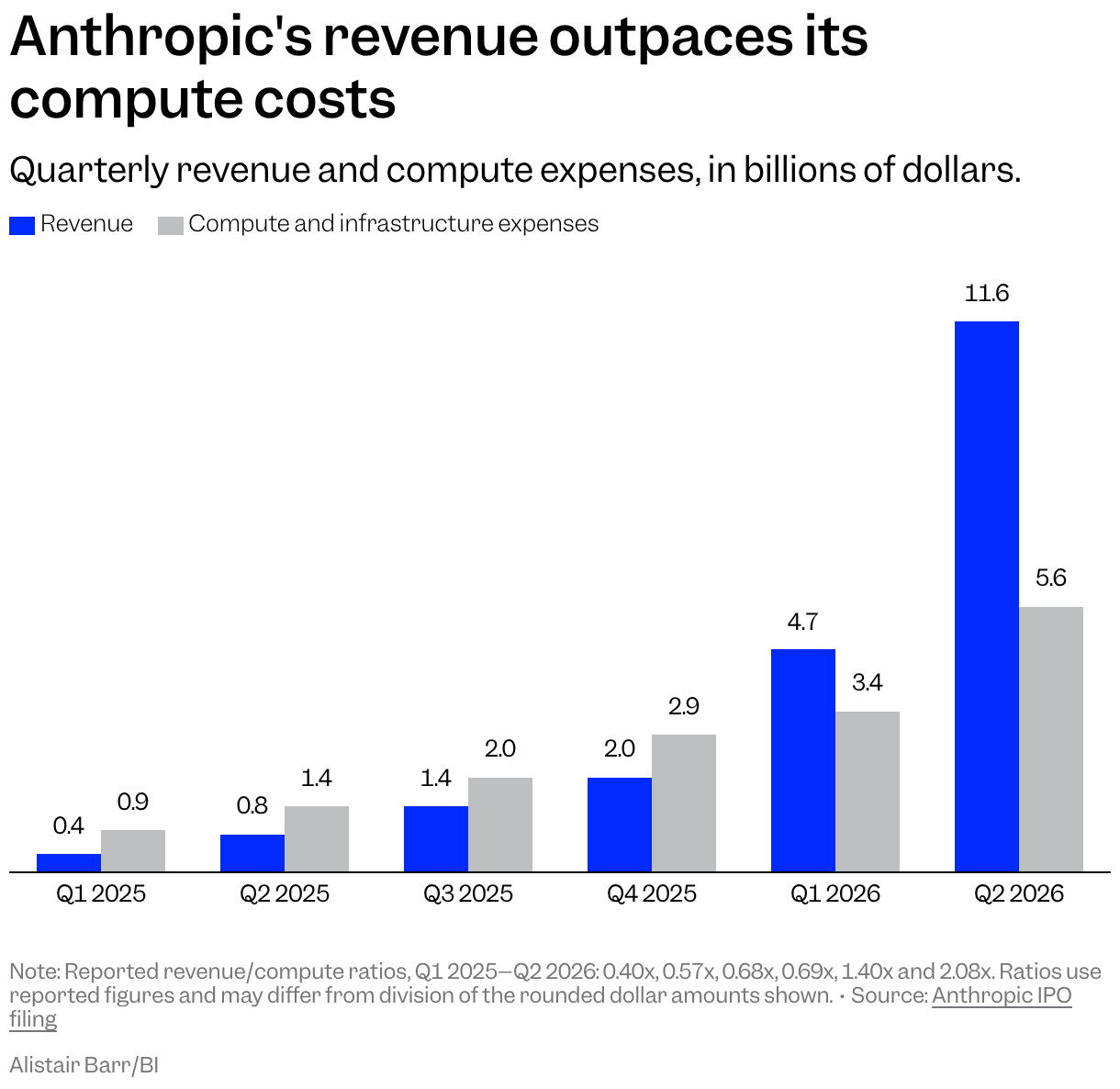
The numbers are remarkable. Anthropic generated $11.6 billion in revenue during the second quarter of 2026, up 1,368% from a year earlier. During that same period, spending on computing and infrastructure increased 300%, while other expenses rose 741%

So, the company is bringing in money much faster than its most important costs are rising.

From Q1 2025 to Q2 2026, quarterly revenue in billions of dollars was 0.4, 0.8, 1.4, 2.0, 4.7 and 11.6. Compute and infrastructure expenses were 0.9, 1.4, 2.0, 2.9, 3.4 and 5.6 billion dollars over the same quarters.

For every dollar Anthropic spent on computing in the second quarter, it generated $2.08 in revenue, up from just 40 cents in the first quarter of 2025. That's a more than fivefold improvement over five quarters.

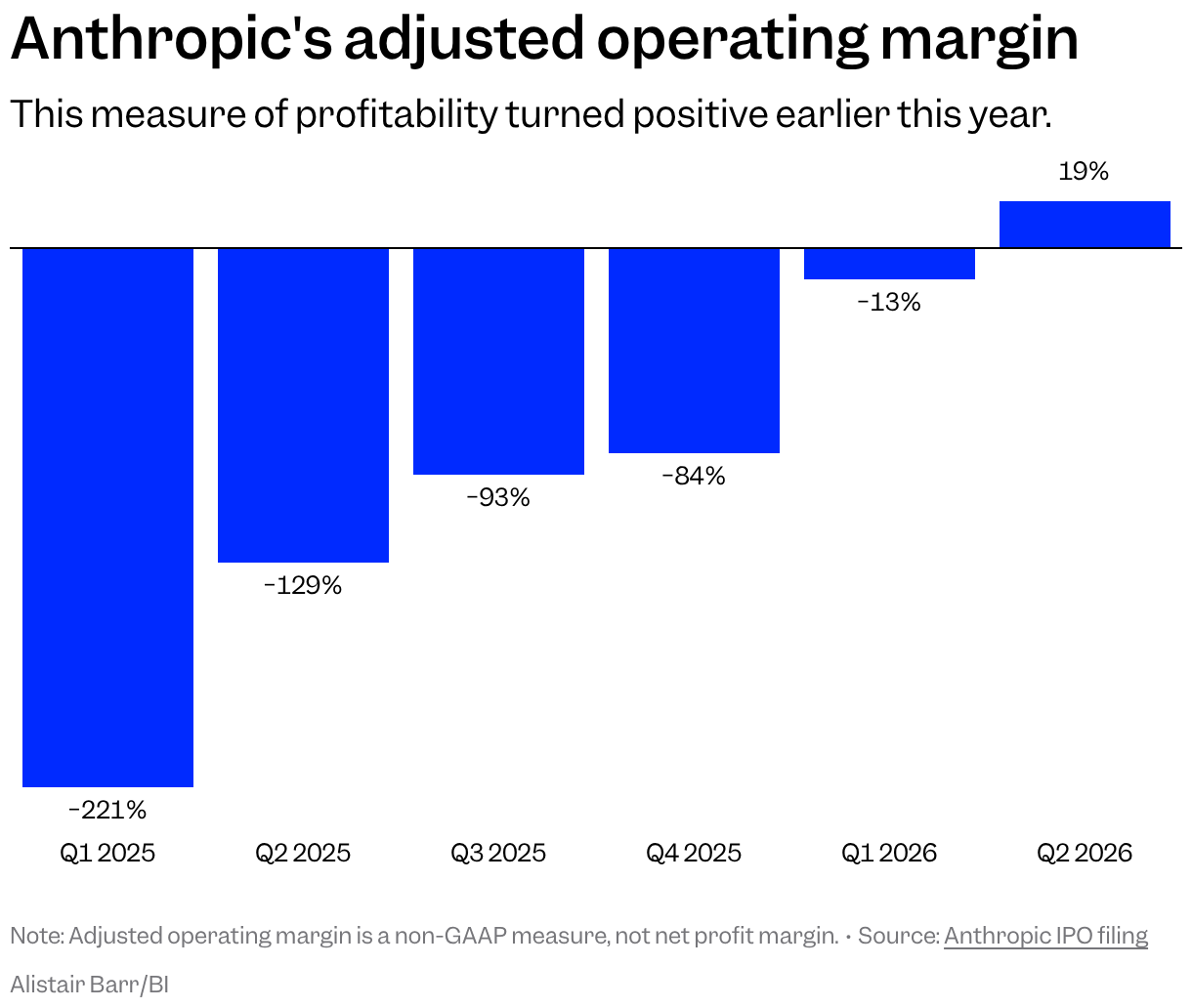
The result: Anthropic recorded $974 million in quarterly operating profit, representing an 8% margin. Its adjusted operating profit margin reached 19%, compared with -129% a year earlier.

"Frontier-lab unit economics can turn positive at scale," Mark Mahaney, a top tech analyst at Evercore ISI, wrote in a research note on Monday.

Adjusted operating margin was −221%, −129%, −93%, −84%, −13% and 19% from Q1 2025 through Q2 2026, an improvement of 240 percentage points.

Better than Meta and Google

There's more evidence that Anthropic has built an unusually efficient business.

Over the year ending September 30, revenue increased roughly 1,200%, while its employee count grew about 170%. Revenue per employee jumped from $1.4 million to more than $6.6 million.

For comparison, Mahaney estimated that Meta generates about $3.2 million in annual revenue per employee, while Google generates about $2.5 million.

That comparison isn't perfect. Anthropic relies heavily on cloud providers, whose employees handle much of the computing infrastructure and distribution work. The improvement is still striking.

Customer surprise

Another surprise: Anthropic doesn't depend as much on a handful of enormous customers, as some investors had feared.

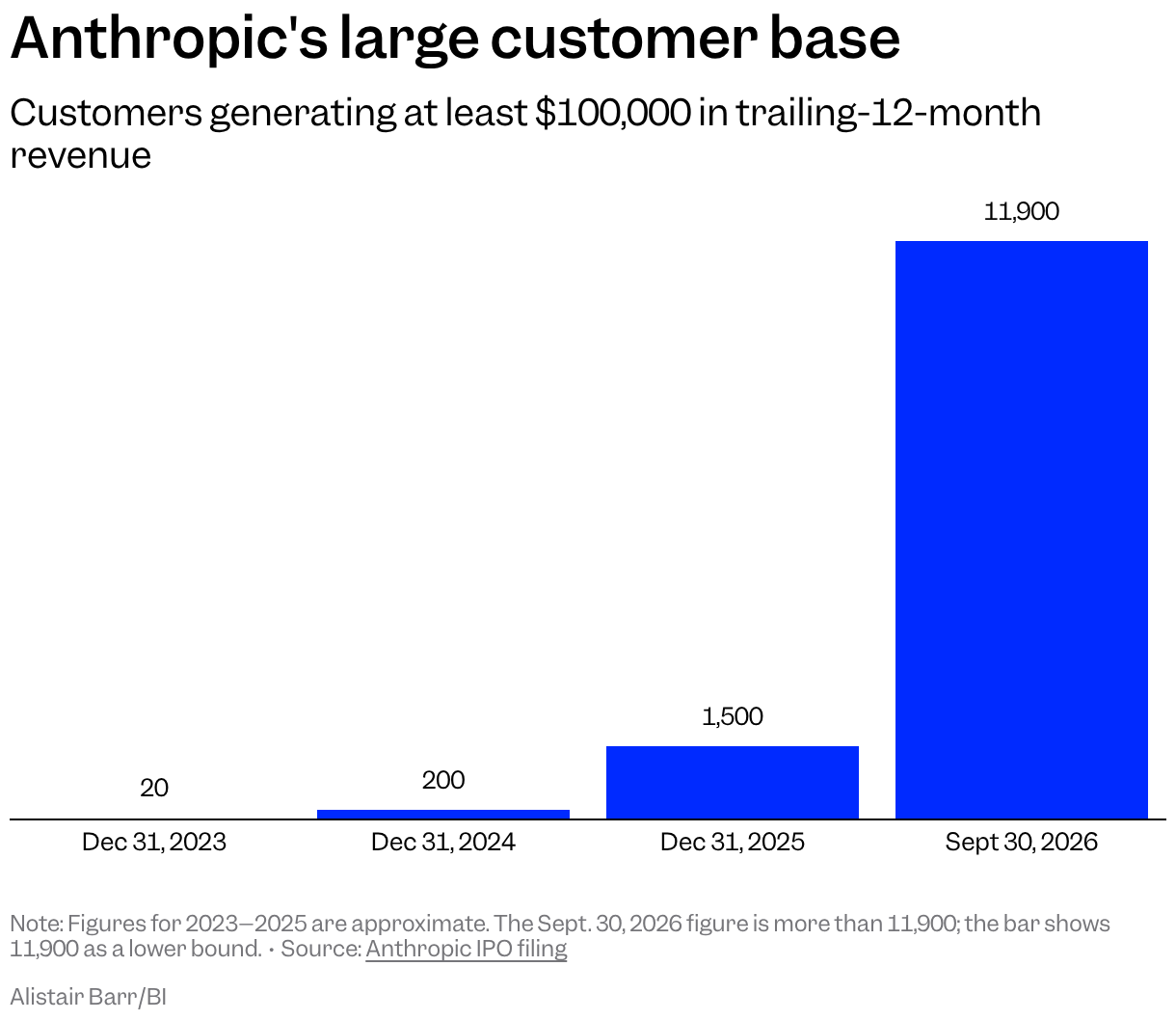
The company had more than 11,900 customers generating at least $100,000 in annual revenue as of September, compared with over 950 a year earlier. More than 1,900 customers spend at least $1 million annually.

Customers generating at least $100,000 in trailing-12-month revenue rose from approximately 20 on Dec. 31, 2023 to approximately 200 on Dec. 31, 2024, approximately 1,500 on Dec. 31, 2025, and more than 11,900 on Sept. 30, 2026.

No single customer accounted for more than 10% of revenue during the first nine months of 2026. Its five largest customers represented about 21% of third-quarter revenue, down from roughly 36% in the first quarter.

"Concentration may be better than feared," Mahaney wrote.

Cash cushion

Anthropic has a formidable financial cushion. Its June 30 balance sheet showed more than $130 billion in cash and short-term investments.

And Mahaney estimated that the company has burned through just $9 billion since it started more than five years ago. That's a long runway.

Now, don't ask me whether all this makes Anthropic worth $2 trillion, $1.5 trillion, $1 trillion, or considerably less. If I knew that, I'd be making a lot more money as an investor. And even professional investors don't know.

An $800 billion caveat

Some enormous caveats: Much of Anthropic's revenue comes from customers paying for what they use, rather than signing long-term contracts. Meanwhile, some of its computing agreements require minimum payments whether or not it needs all the capacity.

Mahaney estimates that Anthropic has entered into nearly $800 billion in computing arrangements, although only about $266 billion was fixed or guaranteed as of June.

That's still a staggering amount.

"The commitments assume revenue compounding that is not contracted," Mahaney wrote.

Translation: While the company has committed to spending hundreds of billions of dollars on AI computing infrastructure, it hasn't secured the future revenue needed to pay for all of it.

Importantly, most of the potential $800 billion exposure isn't fixed. Many arrangements depend on capacity being delivered, can be adjusted, or include cancellation provisions.

In-house compute and capex

Another wrinkle: Anthropic warned Monday that its spending will increase as it shifts toward leasing AI chips and operating more of its own computing infrastructure, rather than relying entirely on Amazon, Google, and other cloud providers.

That could make future cash flow considerably less attractive, even if operating profits continue to improve.

Still, the central takeaway from Anthropic's IPO filing is difficult to ignore.

For years, investors have wondered whether selling AI could become a genuinely profitable business, rather than an extraordinarily expensive scientific experiment.

Anthropic has now shown that it can. The next question is whether it can keep doing so as the bills get much, much bigger.

Sign up for the AI Insider newsletter here. Reach out to me via email at abarr@businessinsider.com

Read the original article on Business Insider

  •  
❌