
 Login

Hasan Piker Sues Scott Jennings
From the complaint in Piker v. Jennings; of course, this is just Piker's side of the story—I expect we'll get Jennings' in a forthcoming motion to dismiss:
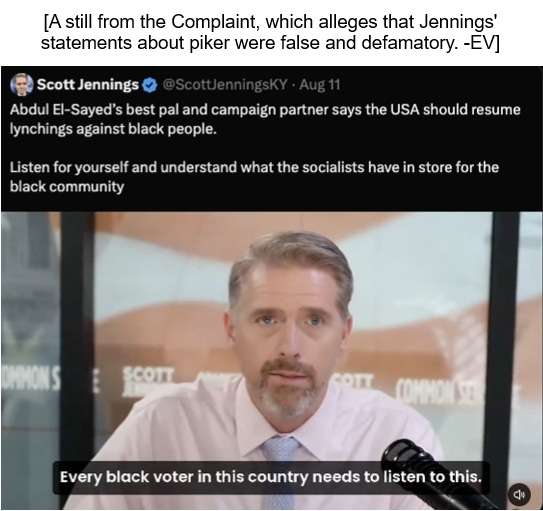
On August 11, 2026, Scott Jennings falsely told a nationwide podcast audience that Hasan Piker was "out there calling for Black voters to be lynched." He falsely told his listeners that Mr. Piker had a "plan of returning our country to lynchings." And then he falsely told his social media followers that Mr. Piker "says the USA should resume lynchings against black people."
All of Mr. Jennings' accusations are false. Mr. Piker has never advocated the lynching of Black Americans, or anyone else. He has never called for a return to lynchings. And he has never proposed anything remotely resembling the supposed plan that Mr. Jennings falsely attributed to him.
Mr. Jennings did not merely mischaracterize something Mr. Piker said. He took a false, fabricated, and manipulated video of Mr. Piker, added a made-up quotation that Mr. Piker never uttered, and then made accusations that went beyond even what the manipulated footage purported to show. Mr. Jennings presented those accusations as fact, telling his viewers to "[l]isten for yourself" about Mr. Piker, knowing that he was playing a falsified video of Mr. Piker for those viewers, and completely disregarding the truth of Mr. Piker's actual words.
The underlying footage came from a broadcast nearly two years earlier on Twitch, an online streaming service owned by Amazon. On October 29, 2024, Mr. Piker was reacting to a debate between two Black political commentators, one liberal and one conservative. When the conservative commentator blamed "woke DAs" for policies supposedly harming Black Americans, Mr. Piker mocked him by sarcastically portraying that comment as nostalgia for an era before the civil rights movement. Laughing, Mr. Piker said:
He said, "We need more Klansmen, okay? Can we go back to a better time when lynchings were happening? This is what I like as a Black man. Also, there's no real racism in America." My man said, "woke DAs," dude. What are you saying?
Mr. Piker was plainly ridiculing the commentator's position. He was not endorsing it. The debate video remained visible behind him. Mr. Piker introduced the remarks with "He said," laughed as he delivered them, and concluded by questioning the commentator's argument. His viewers understood the sarcasm. Some laughed along. Others expressly described his comments as hyperbole. Still others predicted that someone would eventually remove the context and circulate the resulting footage as though Mr. Piker had been speaking sincerely.
That is precisely what happened. In August 2026, a 42-second video began circulating on social media that combined fragments of three separate Twitch broadcasts. The portions taken from Mr. Piker's October 2024 stream had been cropped, shortened, and rearranged. The underlying debate was removed from view. So was the contemporaneous audience commentary.
The words "He said," which identified the object of Mr. Piker's ridicule, were omitted. Mr. Piker's laughter and subsequent explanation were also removed. The resulting video portrayed sarcastic criticism of another as though it were an expression of Mr. Piker's own beliefs.
On August 11, 2026, Mr. Jennings broadcast that false video on The Scott Jennings Show, misrepresenting the manipulated video as authentic. But Mr. Jennings did not stop at repeating someone else's misleading edit. He added his own caption to the video, presented as a direct quotation from Mr. Piker:
PIKER: "LET'S GO BACK TO A BETTER TIME WHEN LYNCHINGS WERE HAPPENING" …
Mr. Piker never said those words. The original broadcast does not contain that statement. Neither does the manipulated video that Mr. Jennings chose to air. Mr. Jennings converted a sarcastic question, expressly attributed to and directed toward someone else, into a patently false first-person statement of Mr. Piker's own supposed beliefs, and then relayed that false statement to his viewers.
Mr. Jennings then went even further. After warning Black listeners to pay particular attention, Mr. Jennings accused Mr. Piker of "calling for Black voters to be lynched" and referred to "the Piker plan of returning our country to lynchings." Later that day, Mr. Jennings published the same false accusation on social media, telling his followers that Mr. Piker believed the United States "should resume lynchings against black people."
These were not expressions of disagreement with Mr. Piker's politics. Nor were they rhetorical characterizations of an admittedly controversial commentator. They were factual assertions about what Mr. Piker had said and advocated in his work. Each statement was demonstrably false.
The distinction matters. Mr. Jennings was free to criticize Mr. Piker, to condemn his political positions, or to argue that his commentary was offensive. Mr. Jennings was also free to play Mr. Piker's actual words, and provide his own commentary on what Mr. Piker actually said. Mr. Jennings was not free to do what he did: knowingly attribute to Mr. Piker statements that Mr. Piker never made, and then present those invented statements as evidence that Mr. Piker supports the racially motivated murder of Black Americans….
The post Hasan Piker Sues Scott Jennings appeared first on Reason Magazine.
