❌

Reading view

Hasan Piker Sues Scott Jennings

From the complaint in Piker v. Jennings; of course, this is just Piker's side of the story—I expect we'll get Jennings' in a forthcoming motion to dismiss:

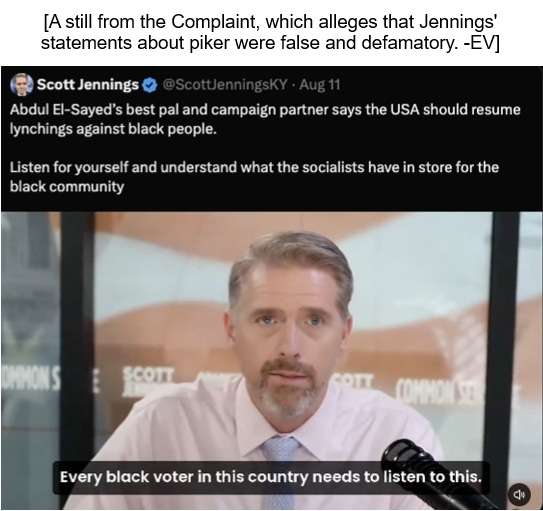
On August 11, 2026, Scott Jennings falsely told a nationwide podcast audience that Hasan Piker was "out there calling for Black voters to be lynched." He falsely told his listeners that Mr. Piker had a "plan of returning our country to lynchings." And then he falsely told his social media followers that Mr. Piker "says the USA should resume lynchings against black people."

All of Mr. Jennings' accusations are false. Mr. Piker has never advocated the lynching of Black Americans, or anyone else. He has never called for a return to lynchings. And he has never proposed anything remotely resembling the supposed plan that Mr. Jennings falsely attributed to him.

Mr. Jennings did not merely mischaracterize something Mr. Piker said. He took a false, fabricated, and manipulated video of Mr. Piker, added a made-up quotation that Mr. Piker never uttered, and then made accusations that went beyond even what the manipulated footage purported to show. Mr. Jennings presented those accusations as fact, telling his viewers to "[l]isten for yourself" about Mr. Piker, knowing that he was playing a falsified video of Mr. Piker for those viewers, and completely disregarding the truth of Mr. Piker's actual words.

The underlying footage came from a broadcast nearly two years earlier on Twitch, an online streaming service owned by Amazon. On October 29, 2024, Mr. Piker was reacting to a debate between two Black political commentators, one liberal and one conservative. When the conservative commentator blamed "woke DAs" for policies supposedly harming Black Americans, Mr. Piker mocked him by sarcastically portraying that comment as nostalgia for an era before the civil rights movement. Laughing, Mr. Piker said:

He said, "We need more Klansmen, okay? Can we go back to a better time when lynchings were happening? This is what I like as a Black man. Also, there's no real racism in America." My man said, "woke DAs," dude. What are you saying?

Mr. Piker was plainly ridiculing the commentator's position. He was not endorsing it. The debate video remained visible behind him. Mr. Piker introduced the remarks with "He said," laughed as he delivered them, and concluded by questioning the commentator's argument. His viewers understood the sarcasm. Some laughed along. Others expressly described his comments as hyperbole. Still others predicted that someone would eventually remove the context and circulate the resulting footage as though Mr. Piker had been speaking sincerely.

That is precisely what happened. In August 2026, a 42-second video began circulating on social media that combined fragments of three separate Twitch broadcasts. The portions taken from Mr. Piker's October 2024 stream had been cropped, shortened, and rearranged. The underlying debate was removed from view. So was the contemporaneous audience commentary.

The words "He said," which identified the object of Mr. Piker's ridicule, were omitted. Mr. Piker's laughter and subsequent explanation were also removed. The resulting video portrayed sarcastic criticism of another as though it were an expression of Mr. Piker's own beliefs.

On August 11, 2026, Mr. Jennings broadcast that false video on The Scott Jennings Show, misrepresenting the manipulated video as authentic. But Mr. Jennings did not stop at repeating someone else's misleading edit. He added his own caption to the video, presented as a direct quotation from Mr. Piker:

PIKER: "LET'S GO BACK TO A BETTER TIME WHEN LYNCHINGS WERE HAPPENING" …

Mr. Piker never said those words. The original broadcast does not contain that statement. Neither does the manipulated video that Mr. Jennings chose to air. Mr. Jennings converted a sarcastic question, expressly attributed to and directed toward someone else, into a patently false first-person statement of Mr. Piker's own supposed beliefs, and then relayed that false statement to his viewers.

Mr. Jennings then went even further. After warning Black listeners to pay particular attention, Mr. Jennings accused Mr. Piker of "calling for Black voters to be lynched" and referred to "the Piker plan of returning our country to lynchings." Later that day, Mr. Jennings published the same false accusation on social media, telling his followers that Mr. Piker believed the United States "should resume lynchings against black people."

These were not expressions of disagreement with Mr. Piker's politics. Nor were they rhetorical characterizations of an admittedly controversial commentator. They were factual assertions about what Mr. Piker had said and advocated in his work. Each statement was demonstrably false.

The distinction matters. Mr. Jennings was free to criticize Mr. Piker, to condemn his political positions, or to argue that his commentary was offensive. Mr. Jennings was also free to play Mr. Piker's actual words, and provide his own commentary on what Mr. Piker actually said. Mr. Jennings was not free to do what he did: knowingly attribute to Mr. Piker statements that Mr. Piker never made, and then present those invented statements as evidence that Mr. Piker supports the racially motivated murder of Black Americans….

The post Hasan Piker Sues Scott Jennings appeared first on Reason Magazine.

  •  

Alibaba and the Forty Lobbyists, and the First Amendment

From a long opinion yesterday by Judge Eumi Lee (N.D. Cal.) in Alibaba Group Holding Ltd. v. U.S. Dep't of Defense:

On February 13, 2026, the United States Department of Defense ("Department") publicly designated Alibaba Group Holding Limited as a "Chinese military company" ("CMC"). On June 30, 2026, 10 U.S.C. § 4663 went into effect, barring the Department from contracting with any company who retained the same lobbyist as a CMC. Alibaba asserts that Section 4663 has caused lobbyists to withdraw from representing Alibaba for fear of losing other clients.

The court issued a preliminary injunction, concluding § 4663 likely violates the Free Speech Clause and the Petition Clause:

Alibaba is an e-commerce and cloud-computing company that provides products, technology, infrastructure, and services to consumers and businesses for civilian and commercial use. Alibaba provides U.S. companies and businesses with a platform to sell their products to consumers in China. Additionally, it provides commercial cloud services to companies, including U.S. companies, operating in China and other countries. Alibaba has developed open-source AI models, including Qwen, with a focus on "commercial applications that make it more efficient and secure for businesses to sell goods to consumers in China." Alibaba is publicly listed on both the New York Stock Exchange and Hong Kong Stock Exchange.

"Prior to being designated [a CMC], Alibaba had retained over two dozen lobbyists and multiple lobbying firms to represent its interests before Congress and the Executive Branch" [including] … "… the Executive Office of the President, the Federal Communication Commission [("FCC")], the Federal Trade Commission, the Consumer Products Safety Commission, the Department of the Treasury, and [other entities]" …. "They presented Alibaba's views on legislation, rules, regulations, executive orders, and other government policies of commercial interest to the company. Specifically, they advocated regarding export expansion, small business export promotion, technology policy, access to U.S. capital markets, e-commerce-related issues, consumer-protection laws, and intellectual property." …

The Court finds that First Amendment scrutiny applies because Section 4663 regulates speech. By restricting Alibaba's ability to retain lobbyists, Section 4663 functionally restricts its political speech. "Discussion of public issues" is "pure speech" that is at "the core of the protection afforded by the First Amendment[.]" The First Amendment also protects "[t]he right to petition," that is, "the right of the people to inform their representatives in government of their desires with respect to the passage or enforcement of laws[.]"Lobbying government officials is therefore an activity fully protected by the First Amendment. FTC v. Super. Ct. Trial Laws. Ass'n (1990) ("It is, of course, clear that the association's efforts to … lobby District officials to enact favorable legislation … were activities that were fully protected by the First Amendment.")….

Here, Section 4663 appears to be directed at defense contractors, but its consequences are on Alibaba's speech. "[A] government official cannot do indirectly what she is barred from doing directly" by "coerc[ing] a private party to punish or suppress disfavored speech on her behalf." NRA v. Vullo (2024)…. Section 4663's impact falls on the relationship between Alibaba and the third parties crucial to its speech rights. Thus, the Court finds that Section 4663 burdens Alibaba's speech….

Defendants observe that Alibaba is not completely banned from appearing before the federal government—it could hire more in-house lobbyists or find a firm that is willing to forgo defense contractor clients…. [But] Alibaba is unlikely to find a lobbyist willing to forgo any clients who might want to contract with the Department. {The statute applies to defense contractors who contract with "entities"—in other words, lobbying firms—who also contract with CMCs. Defense contractors would not risk their ability to enter into a contract with the federal government when there are plenty of capable lobbying firms available. The lobbying firm then must choose. One or more of its lobbyists can choose to represent Alibaba, but then the entire lobbying firm must forgo representing defense contractors. The only rational choice for a lobbying firm is to stop representing Alibaba.}

[Alibaba also] represents that it cannot hire the number of experienced in-house lobbyists needed to address the federal government for all its interests…. The reduction to Alibaba's speech is sufficient to demonstrate a colorable First Amendment claim….

The court then concluded that the law was subject to strict scrutiny:

"Content-based regulations are subject to the most exacting scrutiny because 'the government has no power to restrict expression because of its message, its ideas, its subject matter, or its content.'" In examining a statute, courts must also examine "restrictions distinguishing among different speakers, allowing speech by some but not others." "Speech restrictions based on the identity of the speaker are all too often simply a means to control content." Thus, identity-based regulations may "demand strict scrutiny when they reflect the Government's preference for the substance of what the favored speakers have to say (or aversion to what the disfavored speakers have to say)." …

{Section 4663 is not a content-based restriction…. Section 4663 operates based solely on whether a CMC is involved. What the CMC (or non-CMC) plans to say does not affect whether Section 4663 applies.} [But] Section 4663 is a speaker-based restriction on speech—it is only applicable if a CMC seeks to retain a lobbyist. As a speaker-based restriction on political speech, Section 4663 is subject to strict scrutiny.

Defendants assert that Section 4663 should be considered under intermediate scrutiny, because Alibaba's "differential treatment" is justified by its "special characteristic[ ]," namely the potential involvement of a foreign adversary. Defendants again rely on TikTok, where the Supreme Court applied intermediate scrutiny despite finding that the divestiture statute was a speaker-based restriction, because the differential treatment was due to a content-neutral reason, namely TikTok's susceptibility to foreign control.

While Section 4663 also involves a foreign adversary, TikTok is distinguishable because political speech was not at issue. Id. ("emphasiz[ing] the inherent narrowness" of its holding and observing that "[a] law targeting any other speaker would by necessity entail a distinct inquiry and separate considerations"). Here, Defendants provide no authority to suggest that differential treatment with respect to political speech may be considered under intermediate scrutiny. Citizens United v. FEC (2010) states the opposite: "Laws that burden political speech are 'subject to strict scrutiny,'" and "the First Amendment generally prohibits the suppression of political speech based on the speaker's identity." The Court thus applies strict scrutiny in determining whether Section 4663 violates the First Amendment.

{The Court recognizes that this is a close question. But for the context of political speech—specifically the ability and right to petition the government—Defendants' argument that intermediate scrutiny should apply would likely prevail, because Section 4663 is otherwise a content-neutral statute. As in TikTok, Section 4663 singles out a particular group of speakers, but not because of the content of their speech. Instead, the treatment is based on a particular characteristic of the speaker, i.e., their status as a CMC.} …

And the court held that the law failed strict scrutiny, because it was not narrowly tailored to the government interests in "(1) … prevent[ing] CMCs 'from accessing sensitive military information through their relationships with lobbyists,' and (2) … ensur[ing] that CMCs 'cannot subtly influence any of [the Department's] decisions related to national security by influencing a lobbyist'":

[T]he government cannot impose a restriction on speech based solely on "mere conjecture." Rather, it must "point to record evidence or legislative findings demonstrating the need to address a special problem."

Here, Defendants fail to meet their burden. Defendants provide only one exhibit in support of their opposition: the joint explanatory statement submitted as part of the legislative record for the Act. The statement provides an overview of Section 4663 and then "direct[s] the Comptroller General of the United States to submit a report to the congressional defense committees, not later than one year after the enactment of this Act, on the national security risks posed by consulting firms who simultaneously contract with the Department of Defense and the Chinese government or its proxies or affiliates."

Of note, the Comptroller General is directed to study consulting firms, not lobbyists. The statement does not express any findings by the Comptroller General or Congress about the risks posed by lobbyists retained by CMCs. At the preliminary injunction hearing, Defendants were unable to confirm whether a report by the Comptroller General had been submitted to Congress by December 23, 2025, one year after the Act's enactment; nor did Defendants provide a copy of the report. Other than the statement, Defendants do not provide any evidence of the national security risks or other compelling government interests….

[Moreover, d]efendants do not offer any evidence demonstrating that alternative [and less speech-restrictive] means were contemplated, much less rejected for being insufficient…. Meanwhile, Alibaba submits evidence that less alternative restrictions may exist. With respect to CMCs, Nebraska has required lobbyists representing entities on the 1260H List to file an acknowledgment that they are representing a foreign adversary. The Supreme Court "has upheld registration and disclosure requirements on lobbyists" as a "less restrictive alternative to more comprehensive regulations of speech." Defendants present no reason why a disclosure requirement, like Nebraska's, would be inadequate for the federal government.

Instead, Defendants summarily conclude that Alibaba's proposed disclosure requirement would not suffice because "there would still be access and the potential for influence." This speculation is insufficient to support a restriction on the First Amendment….

Carter G. Phillips, Christopher A. Eiswerth, Jennifer J. Clark, and Sheila Anil Gogate Armbrust (Sidley Austin LLP) represent Alibaba.

The post Alibaba and the Forty Lobbyists, and the First Amendment appeared first on Reason Magazine.

  •  

Government Officials Admit His Halloween Decorations Are Legal. Why Won't They Leave Him Alone?

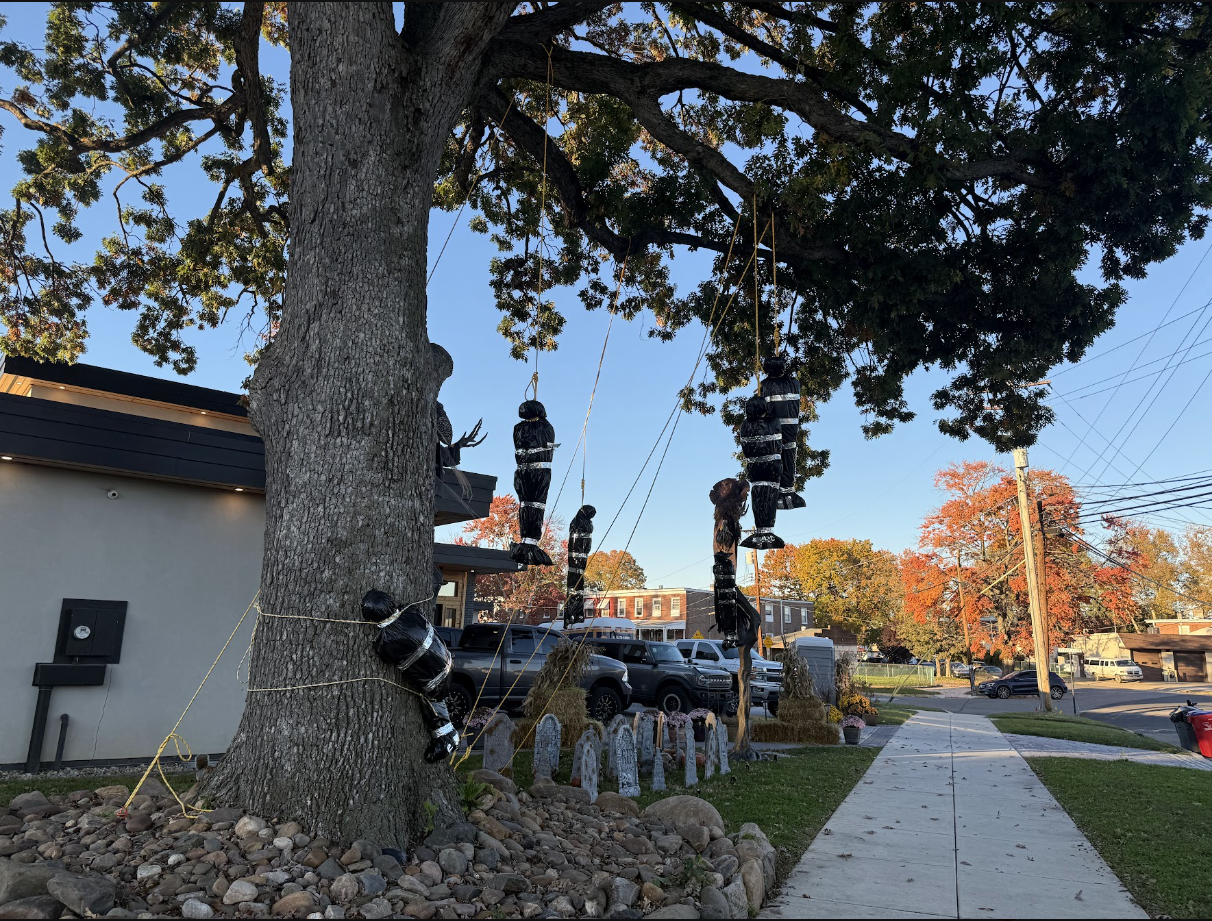
Halloween decorations hang from a tree | Photo: Matthew Harwood

A Pennsylvania man put up Halloween decorations around his property. He had no idea they would unleash the horrors of government jawboning. 

Mark, whose real name is being withheld, is a homeowner in Bristol Borough, a suburb near Philadelphia. He decorated his home with a small graveyard, two monster scarecrows, and five mannequins hanging from a large tree on his property. One additional mannequin was lashed to the tree. The faux bodies were wrapped in black plastic secured with duct tape. 

Now local officials are haunting Mark.

At an October 12 borough council meeting, a neighbor complained about Mark's decorations, concerned the display looked too close to lynching. Karla Scott said the decorations are "very offensive, not just to the black people in the community, but the community as a whole." Scott told FOX 29 that her "mind went back to what my ancestors went through being hung from trees with nooses around their neck." (In the televised story, the reporter gives a trigger warning and then blurs the very decorations viewers are supposed to judge as either offensive or old-fashioned spooky fun.)

Photo: Matthew Harwood

After Scott voiced her concerns, Council President Ralph DiGuiseppe said Mark had broken no ordinance and that Mark told the borough he would not take the decorations down. "They're just Halloween decorations," Mark told the Bucks County Courier Times. "I think it's been blown out of proportion." 

Despite acknowledging that Mark had violated no ordinance, DiGuiseppe noted a zoning inspector nevertheless visited his house immediately after the decorations went up. 

"Our borough inspector did stop there and talk to him. But we were unsuccessful….[Mark] feels they're Halloween decorations, and he won't take them down," DiGuiseppe told Scott at the meeting. DiGuiseppe then turned to another official who said, "We'll continue our efforts."

The decorations have divided the community, with some residents saying they're simply Halloween decorations and others saying they're racially insensitive. After receiving a complaint from a resident, the local NAACP chapter said in a statement on Facebook, "Something can be legally permissible and still be profoundly harmful." The statement also called for "continued engagement by borough leadership and voluntary reconsideration of the display. This is not about restricting Halloween celebrations or freedom of expression. It is about historical awareness, empathy, and respect for our neighbors."

But Mark's insistence that he would not take them down hasn't been respected by the borough. He was also contacted by Bristol Borough Manager James Dillon and other members of the council, according to Fox News Digital, which also did not publish any pictures of the display. Mark again said he would not take the decorations down. When the mayor of Bristol Borough, Frank Peranteau, reached out to him, Mark invited the mayor to have dinner with his family to discuss the matter. In an email to Reason, Peranteau said he wasn't there to try and change Mark's mind and "found him to be a genuinely caring person with no signs of prejudice." 

Nevertheless, things get spooky when government officials won't take no for an answer when contacting a law-abiding resident to "voluntarily" take down his constitutionally protected expression on his own property. This behavior by borough leadership and staff looks very much like jawboning, which is when government officials try to chill private citizens from exercising their constitutional rights through pressure or indirect threats. 

While Scott and other community members may prefer there be a rule to prevent such decorations, an ordinance banning "offensive" lawn displays would be dead on arrival, constitutionally speaking. It would be viewpoint discrimination and a direct violation of the First Amendment.

Mark says he may have considered removing the display if Scott would have approached him and explained how she felt, according to Peranteau. "He told me that he was upset at the way things were handled in the beginning and he may have considered removing the display then had it been different," the mayor said, "but it was a matter of principle at that point."

Talking with your neighbor may resolve more than summoning government ghouls.

The post Government Officials Admit His Halloween Decorations Are Legal. Why Won't They Leave Him Alone? appeared first on Reason Magazine.

  •  

Two Brief Discovery-Related Orders in Trump v. BBC

From Magistrate Judge Enjolique A. Lett (S.D. Fla.):

[1.] Defendant served its Notice of Subpoena Duces Tecum to non-party Mar-a-Lago Club, LLC ("MAL") seeking two discrete categories of documentation: (1) documents sufficient to identify the total number of applications for MAL membership from January 6, 2020, through January 6, 2026, and (2) documents sufficient to identify the total cost of membership and initiation fees for a new MAL applicant from January 6, 2020, through January 6, 2026. Defendant contends it needs this information for discovery purposes to generally contest Plaintiff's allegation of damages of "not less than $10,000,000,000."

The scope of discovery is broad, allowing each party to "obtain discovery regarding any nonprivileged matter that is relevant to any party's claim or defense and proportional to the needs of the case…." Notably here, non-party MAL has neither moved to quash the subpoena nor raised any burdensome objections. In fact, the only issue before the Court is Plaintiff's contention that the subpoena seeks discovery outside the permissible scope of the amended pleadings.

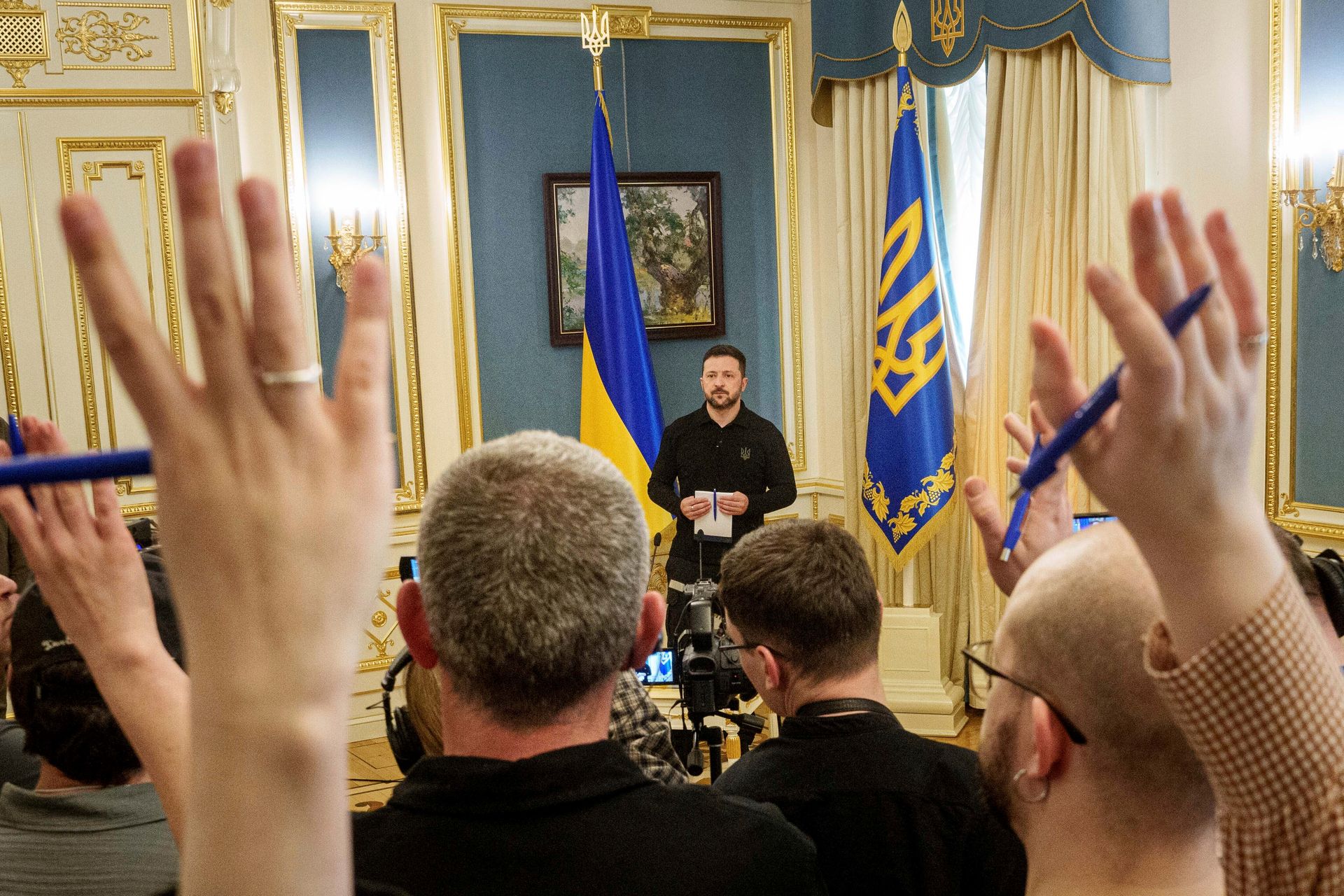
The Court disagrees. The Amended Complaint alleges Defendant's defamatory actions "injured President Trump in his profession, occupation, and trade," "damaged President Trump in his occupation," and "damaged his professional reputation." As Chief Executive of the United States, it is publicly known that President Trump often carries out his presidential duties in MAL. See, e.g. President Donald Trump meets with Ukrainian President Volodymyr Zelensky at Mar-a-Lago.

Moreover, the scope of discovery is broader than the scope of admissibility. See Fed. R. Civ. P. 26(b)(1) ("[i]nformation within this scope of discovery need not be admissible in evidence to be discoverable"). Plaintiff's argument that President Trump is not synonymous with and does not affect the financial success or failure of MAL may be well taken as it relates to the admissibility of the sought-after evidence, but at this stage in the proceedings, given MAL's relationship with the profession and professional persona of President Trump, Defendant's subpoena is a permissible basis of inquiry.

[2.] There can be no dispute that all parties, even some non-parties, must participate in the discovery process. This is especially true of a plaintiff who initiates the lawsuit and seeks affirmative relief.

Unsurprisingly therefore, Plaintiff does not dispute that he must sit for a deposition; the only point of contention is the timing of said deposition. Despite scheduling the deposition for October 16, 2026, President Trump unilaterally cancelled the deposition and did not offer alternative dates within the discovery period notwithstanding the quickly approaching December 18, 2026, discovery deadline. In light of this, the time for the deposition to occur is now….

President Trump shall sit for his deposition on or before December 11, 2026. Failure to do so may result in sanctions, including dismissal of the lawsuit. It is the Court's understanding that another extension of the discovery deadline may be sought. In the event Judge Kuntz grants such a request, the parties may agree to a mutually convenient date to conduct President Trump's deposition within the extended discovery period.

Charles David Tobin, Maxwell S. Mishkin, Maya Devi Gandhi, Richard W. Miller, Sasha (Alexandra) Dudding, and Yanni Chen (Ballard Spahr LLP) represent the BBC.

The post Two Brief Discovery-Related Orders in <i>Trump v. BBC</i> appeared first on Reason Magazine.

  •  

W. Va. Law Restricting Disclosing Home Addresses and Phone Numbers of Judges and Police Struck Down, but …

From today's opinion in Jackson v. Thomson Reuters Am. Corp., by Fourth Circuit Judge Paul Niemeyer, joined by Judges Steven Agee and Pamela Harris; the law covers :

West Virginia's Daniel's Law …, which is designed "to enhance the safety and security" of judicial and law enforcement officials, prohibits the disclosure by any person or entity of the home addresses or unpublished telephone numbers of … {"any active, formerly active, or retired judicial officer, prosecutor, … public defender, … or law-enforcement officer"} if a reasonable person would believe that such a disclosure would create a risk of harassment or harm. The law authorizes protected persons to bring a civil action for damages….

As distinct from the Daniel's Laws in other States, … West Virginia's version does not require that the Covered Person, upon discovering an improper disclosure, notify the person or entity that disseminated the information and request that the person or entity delete the information before liability arises. In addition, for liability to arise under West Virginia's version, the person or entity need not know that they have disclosed a Covered Person's information. The only limiting principle of § 5A-8-24(e) liability is that the information must have been disclosed "under circumstances in which a reasonable person would believe that providing such information would expose another to harassment or risk of harm to life or property." …

For generations now, home addresses and telephone numbers have been disseminated to the public, initially through Whitepages and Yellow Pages and now through "people search" services on the Internet. The public has thus long had the facility to look up the name of a person and obtain that person's address and telephone number. Sharing that information has been the gateway to communication and the exchange of ideas or messages that have long been protected by the First Amendment. In the digital age, such information may now be shared with greater efficiency, but the tradition continues with the understanding that it is protected speech.

In a similar vein, it has long been custom and practice to record for public examination the names and addresses of persons buying, selling, and financing real property. And it has been the tradition to share publicly information about taxes, appraisals, liens, and voting.

To be sure, while the dissemination of such information is protected speech necessary to the exchange of ideas, it can also contribute to abuse and the pursuit of harmful and, indeed, malicious ends, as exemplified by the murder of Daniel Anderl. To address such abuse, governments have enacted laws like Daniel's Law in an effort to restrict the dissemination of home addresses and unpublished telephone numbers of specified public officials who serve in roles important to society. And the parties here agree that those governments have a compelling interest in enhancing the safety and security of such officials. The task, therefore, is to draw an appropriate line between protecting the dissemination of such information while, at the same time, excepting from dissemination the same information when it creates a potential for harm of specified public officials.

Because of the high value that our Constitution and longstanding practices place on the free dissemination of information and the exercise of free speech, we draw the line with the greatest caution, requiring that governments regulate speech about the home addresses and telephone numbers of designated public officials in a manner that is the least restrictive of speech.

In this case, West Virginia was fully justified in attempting to regulate such speech in light of the compelling government interest in enhancing the safety and security of certain public officials, but its efforts reached more broadly then necessary to accomplish the task; it did not employ the least restrictive means of doing so. For that reason and only that reason, we agree with the district court that West Virginia could have regulated more narrowly to accomplish its purpose and thereby be less restrictive of what is otherwise protected speech. Thus, we agree that the provision of West Virginia's Daniel's Law at issue here … violates the First and Fourteenth Amendments.

The court concluded that the law is a speech restriction, not just a restriction on "data":

[Jackson argues] that speech must be communicative such that it "convey a particularized message" with "the likelihood … that the message would be understood by those who" received it. Since Daniel's Law regulates disclosures of "pure facts" that lack a particularized message, he argues, the law is not subject to any First Amendment analysis….

[But] the Supreme Court has clearly held that the scope of "speech" regulated by the First Amendment is broader and includes data, reasoning that facts are "the beginning point for much of the speech that is most essential to advance human knowledge and to conduct human affairs." Sorrell v. IMS Health Inc (2011). Indeed, the Court has noted more specifically that statutes like West Virginia's Daniel's Law, which address only the disclosure of information, involve the regulation of speech protected by the First Amendment, observing, "If the acts of 'disclosing' and 'publishing' information do not constitute speech, it is hard to imagine what does fall within that category …." Bartnicki v. Vopper (2001).

The court then concluded that the law was content-based:

West Virginia's Daniel's Law …, on its face, distinguish[es] between different disclosures based on communicative content alone. It restricts disclosure of certain kinds of information (home addresses and unlisted telephone numbers), and it does so for certain individuals (judicial and law enforcement officers and their families)….

This means, for example, that a disclosure that a grocery store clerk lives at 100 Main Street is permitted, while a disclosure that a police officer lives at 100 Main Street is prohibited. The only difference between the two disclosures is the communicative content, or what the disclosures mean. In the hypothetical, the latter disclosure is prohibited because it identifies 100 Main Street as being the home address of the police officer, while the earlier disclosure is permitted because it identifies 100 Main Street as belonging to the grocery store clerk.

The court held that the law wasn't limited to "commercial speech" (which generally refers to commercial advertising), a category of speech that is entitled to lower protection:

While a speaker's economic motivation for speech may be a relevant factor in determining whether speech is commercial, economic motivation alone is insufficient to justify a categorization of that speech as commercial. Furthermore, because, even under Jackson's argument, only some of the regulated speech would be commercial, that fact does not render the law subject to the intermediate scrutiny of commercial speech. When a statute "applies with equal force to both commercial and noncommercial messages" with "no exception for noncommercial speech," the fact that some of the regulated speech is commercial does not justify an application of intermediate scrutiny….

And the court held that the law, as a content-based speech restriction, had to pass strict scrutiny, which is to say that (among other things) it had to be the "least restrictive means" of serving a "compelling government interest"; and the court held that the law failed such scrutiny:

[T]he parties agree, as do we, that the law's purpose of enhancing the safety of judicial and law enforcement officials is a compelling government interest …. [But] West Virginia's Daniel's Law does not employ the least restrictive means of serving the law's purpose.

Section 5A-8-24(e) imposes liability on a data broker immediately upon its disclosure of addresses and telephone numbers, regardless of whether the data broker had knowledge that the information related to Covered Persons. Whenever an entity such as a data broker collects names and addresses of all persons in a particular town using public land records and then publishes that information in some form of a directory, it undoubtedly violates the law because that directory includes, albeit unknowingly, information about, for instance, a police officer or public defender…. When a restriction on speech creates liability without a knowledge requirement, speakers are understandably incentivized to engage in self-censorship to avoid inadvertently incurring liability. See Counterman v. Colorado (2023) (noting that "prohibitions on speech have the potential to chill, or deter, speech outside their boundaries")….

Jackson argues, however, that the law is much more limited because it imposes liability only if "a reasonable person would believe that providing such information would expose another to harassment or risk of harm to life or property."

That provision, however, is hardly limiting, … because every disclosure of a person's name and address on the Internet exposes that person to harassment or a risk of harm…. [Indeed, in his complaints, Jackson] alleged that the mere disclosure of home addresses and unpublished telephone numbers "exposed [him] and his peers to harassment and/or risk of harm to life or property." And to support that unremarkable proposition, he quoted the FTC's report on "Data Brokers," which highlights the "potential risks to consumers from data brokers' collection and use of consumer data," including the fact that "people search products can be used to facilitate harassment, or even stalking, and may expose domestic violence victims, law enforcement officers, prosecutors, public officials, or other individuals to retaliation or other harm." Indeed, Jackson added that the FTC's report explains why the defendants' disclosures are "so dangerous." Thus, the argued "limitation" in § 5A-8-24(e) is actually not limiting but universal, as it is inevitable that every disclosure of personal information on the Internet poses an additional risk of harassment or harm to the person whose information is disclosed.

Additionally, States other than West Virginia that have enacted Daniel's Laws have uniformly required that, before liability attaches to a disclosure of home addresses and unpublished telephone numbers, Covered Persons give notice of their request that the data broker (or any other disclosing party) remove the information. Only on the failure to comply does liability attach. But West Virginia's Daniel's Law alone does not require notification as a precondition of liability. Thus, this aspect of the law fails to provide the least restrictive means of furthering the law's compelling interest.

While we hasten to note that requiring notice prior to imposing liability is one method for narrowing the law, it is not the only way. But it is the way that Congress and virtually every other State has chosen to narrow their laws and render them less speech-restrictive.

At bottom, we agree with the district court's conclusion:

[D]ue to its lack of a notice requirement, [§ 5A-8-24(e)] of West Virginia's Daniel's Law is far more restrictive then its comparators [in other States] and is definitively not the least restrictive means of achieving its compelling interest. Section [5A-8-24(e)] of West Virginia's Daniel's Law therefore fails strict scrutiny even as other more narrowly tailored federal and state statutes aiming at the same compelling interest pass constitutional muster….

The paragraph endorsing the district court's conclusion strongly suggests that the panel endorsed laws limited to situations where a covered person first demands that covered material be removed. But it's not clear whether the panel would endorse broad versions of such laws, which apply even when the address or phone number is relevant to a matter of public concern (see Kratovil v. City of New Brunswick (N.J. 2025), which upheld such a broad law), or whether it would insist that there be an exception for such public-concern situations (as there is in the federal version of Daniel's Law).

Samir I. Deger-Sen (Latham & Watkins LLP) argued on behalf of the defendants.

The post W. Va. Law Restricting Disclosing Home Addresses and Phone Numbers of Judges and Police Struck Down, but … appeared first on Reason Magazine.

  •  
❌