❌

Reading view

ATC reserves verdict in security breach case against Imaan, Hadi

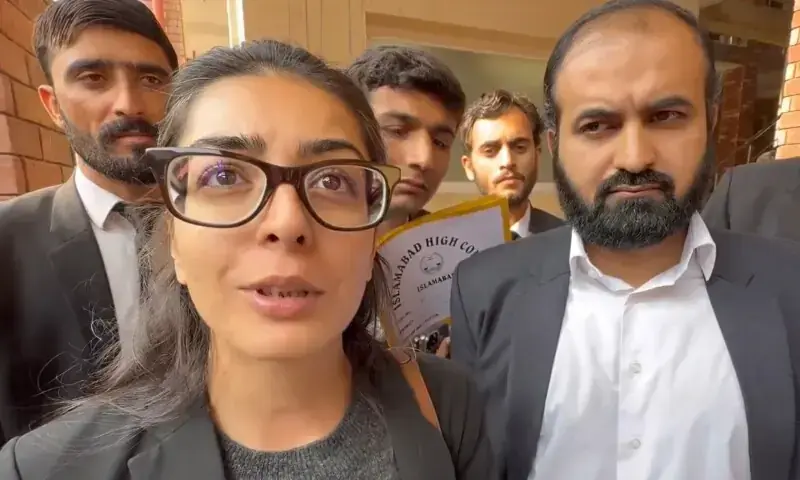
ISLAMABAD: The trial of human rights lawyer Imaan Zainab Mazari-Hazir and her husband, Hadi Ali Chattha, in the security breach case concluded at Adiala Jail on Tuesday, with the anti-terrorism court (ATC) reserving its verdict.

Imaan and Hadi are facing a jail trial in a 2024 case pertaining to the alleged disruption of an international cricket team’s security route and incitement to public unrest. The couple, accused of removing barriers from the route, was indicted on October 7.

On Tuesday, both accused recorded their statements under Section 342 (power to examine the accused) of the Code of Criminal Procedure, while final arguments by the state counsel also concluded during the proceedings.

Following the completion of the trial and final arguments, the court reserved its verdict and said that it would be pronounced on October 29.

A day prior, the couple approached the Supreme Court to challenge the Islamabad High Court’s (IHC) Oct 19 order refusing to stay the trial in the case.

The IHC had heard their appeals last week against an Oct 10 ATC order dismissing petitions challenging the framing of charges and the inclusion of terrorism-related provisions. The high court issued notices and said it would decide how to proceed after receiving responses from the parties.

The couple has been in jail since their arrest on Jan 23 in a case registered against them for protesting outside the IHC and allegedly manhandling the high court Bar Association president. The arrest prompted criticism by rights bodies, politicians and journalists, who stressed the couple’s right to a fair trial.

Just a day later, a sessions court sentenced them to 17 years on multiple charges under the Prevention of Electronic Crimes Act in the controversial social media posts case. The convictions were widely condemned by lawyers and United Nations (UN) experts.

On Sept 17, following months of litigation before the courts, the Supreme Court suspended their sentences in the case. The SC ordered their release pending the IHC’s final verdict on their appeals against the trial court’s decision.

However, the reprieve was short-lived as hours later, Islamabad police arrested the couple again in connection with the security breach case. The case was registered at the federal capital’s Kohsar police station on March 22 last year on the complaint of City Magistrate Ghulam Murtaza Chandio.

  •  

Justice Mohsin Akhtar Kayani posted to Pindi bench after reshuffle at Lahore High Court

ISLAMABAD: Justice Mohsin Akhtar Kayani has returned to the twin cities following a reshuffle at the Lahore High Court (LHC), according to the court’s duty roster for November and December 2026. He will preside over a single bench at the Rawalpindi registry.

Justice Kayani hails from Islamabad, while Islamabad and Rawalpindi are traditionally referred to as the twin cities. He was transferred to the LHC in April this year and assigned to its principal seat in Lahore. Despite being a senior judge of the LHC, he was not assigned to any division bench.

According to the new duty roster, three division benches at the LHC’s Rawalpindi registry will comprise Justice Sadaqat Ali Khan and Justice Syed Farhad Ali Shah, who will handle criminal matters; Justice Mirza Viqas Rauf and Justice Muhammad Raza Qureshi, who will handle civil matters; and a special division bench comprising Justice Mirza Viqas Rauf and Justice Syed Farhad Ali Shah.

The six single benches at the Rawalpindi registry will be headed by Justices Sadaqat Ali Khan, Mirza Viqas Rauf, Mohsin Akhtar Kayani, Muha­mmad Raza Qureshi, Malik Javid Iqbal Wains and Syed Farhad Ali Shah. The roster will remain in effect from Nov 2 to Dec 24, 2026.

Justice Kayani previously served as the senior puisne judge of the Islamabad High Court (IHC) and was expecting to be elevated to chief justice. However, the transfer of Justice Sardar Muhammad Sarfraz Dogar from the LHC, along with two other judges from the Sindh and Balochistan high courts, prompted him to challenge the inter-high court transfers.

The Supreme Court’s constitutional bench upheld the transfers to the IHC, including that of Justice Dogar, who is now its chief justice. The decision, however, triggered a broader legal battle. Justice Kayani and other senior IHC judges approached the SC to challenge the administrative powers exercised by Chief Justice Dogar. They alleged that the office had been turned into a “monocracy” and that judges could be excluded from the roster at will.

Following his own transfer to the LHC, Justice Kayani lost his seniority and was placed 12th on the high court’s seniority list.

The new duty roster assigns him only to a single bench at the Rawalpindi registry, despite his previous position as the IHC’s senior puisne judge and his pending challenge to the inter-high court transfers.

Published in Dawn, October 27th, 2026

  •  
❌