Login

UN General Assembly Approves Cuba’s Resolution Against U.S. Blockade
The nonbinding resolution passed with 130 votes in favor, 17 against and 25 abstentions.
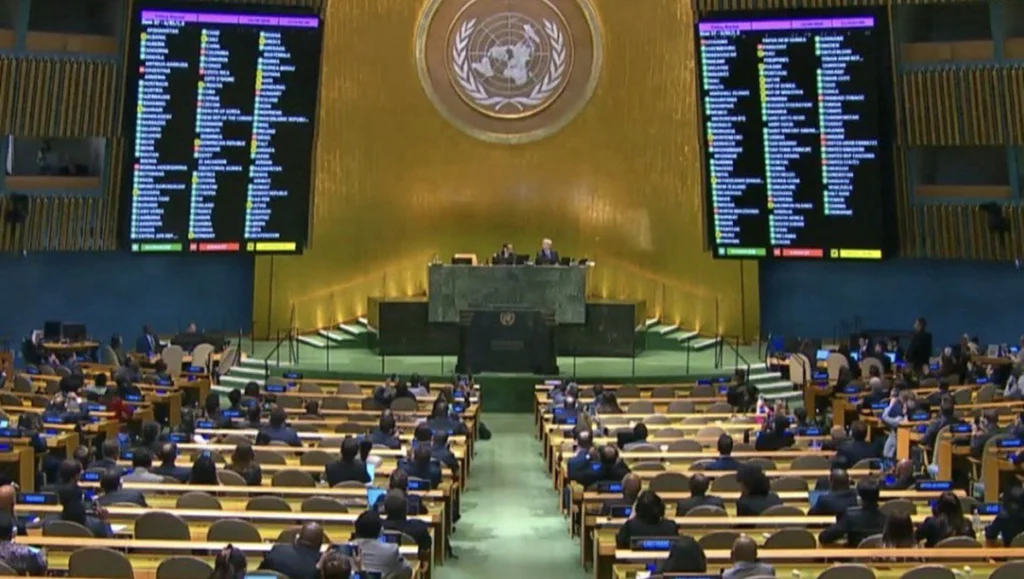
On Wednesday, the United Nations General Assembly (UNGA) approved a resolution presented by Cuba against the U.S. blockade, with 130 votes in favor, 17 against and 25 abstentions.
RELATED:
Cuba Hails International Support for Ending U.S. Blockade at UN
Colombia, Paraguay, Argentina, Ecuador, and Costa Rica were the Latin American countries that joined the United States in voting against the nonbinding resolution titled “Necessity of Ending the Economic, Commercial and Financial Blockade Imposed by the United States of America Against Cuba.”
“The world has once again spoken out overwhelmingly against the blockade, despite the most blatant pressure and blackmail by the U.S. to change the course of this vote,” Cuban President Miguel Diaz-Canel said on social media.
“This victory for Cuba today in the UNGA is a victory for the heroic Cuban people, who refuse to surrender in the face of economic strangulation, threats and abuses by the U.S. government.”
“It is the triumph of truth over those who resort to lies and blackmail to subject an entire nation to collective punishment. Cuba is not a threat; the blockade is!” the revolutionary leader stressed.
BREAKING 🇨🇺🇺🇳 The UN General Assembly has overwhelmingly condemned the genocidal US blockade of Cuba for the 34th time. pic.twitter.com/WbPSMmHL7x
— Progressive International (@ProgIntl) October 28, 2026
The U.S. Blockade Causes $23 Million In Damages Per Day
Before the vote, Cuban Foreign Affairs Minister Bruno Rodriguez forcefully rebutted the United States, which denies that a blockade against the island exists. He said the economic war against Cuba causes more than US$22.9 million in economic damage in a single day.
Rodriguez displayed a real-time counter tracking the economic impact of the U.S. blockade. The counter began operating on Tuesday, coinciding with the start of the debate in the General Assembly on the annual resolution against the sanctions.
“The blockade kills and silently punishes our population as never before,” Rodriguez said and warned that the administration of U.S. President Donald Trump “has unleashed a wave of pressure, intimidation and blackmail” against countries to prevent them from supporting the resolution, a text that has been approved almost unanimously year after year since 1992.
“The U.S. blockade is an act of war, collective punishment, and genocide… Its effects are felt at Cuban families’ dinner tables, in the beds of the sick, during childbirth or in operating rooms, in a child’s food or classroom, in the lack of electricity, drinking water and medicines, and in the high prices of goods essential to life,” Rodriguez pointed out.
Among other things, he denounced that Cuba faces shortages of 70% of the medicines on its basic list and that about 100,000 people, including 12,000 children, are awaiting surgery. All of this is “a consequence of the blockade.”
“What Cuba is asking for is to be left in peace, to allow the Cuban people to live in peace, resolve our own problems peacefully and find solutions to the great difficulties facing the world today, free from political, military, cognitive or economic aggression,” Rodriguez concluded.
“Cuba is not a threat. The blockade is.” 🇨🇺🇺🇳
— teleSUR English (@telesurenglish) October 28, 2026
In his speech, Cuban Foreign Minister Bruno Rodriguez denounced the cynicism and hypocrisy of labeling the island an “unusual and extraordinary threat” to the national security of the world's greatest nuclear power.
The diplomat… pic.twitter.com/duJubAbbqJ
teleSUR/ JF
Source: EFE