❌

Reading view

Trump Hands Alliant Energy $5.1 Billion in Loans Ahead of Key Midterm Races in Iowa and Wisconsin
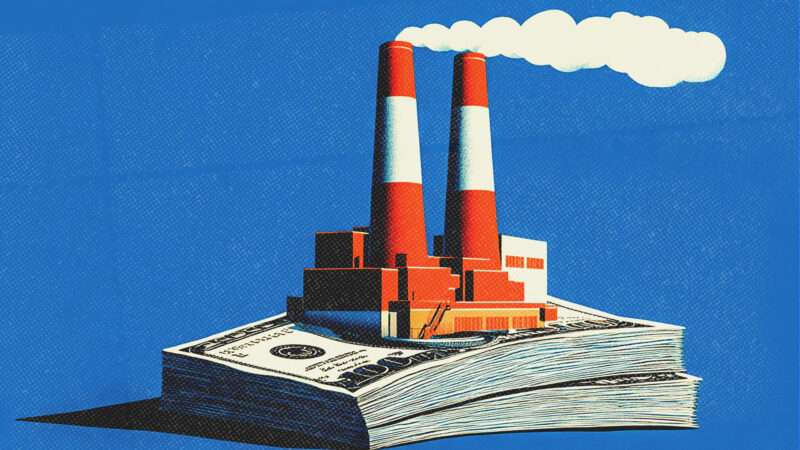
An illustration of a power plant sitting on top of a stack of cash against a blue background | Illustration: Midjourney

On Wednesday, the Office of Energy Dominance Financing at the U.S. Department of Energy announced it had closed a $5.1 billion loan package to Alliant Energy—a utility company with over 1.5 million customers across Iowa and Wisconsin—to "lower electricity costs, expand firm power generation, and strengthen grid reliability" in the Midwestern states. 

The loan package is part of the Energy Department's response to President Donald Trump's April 2025 executive order directing the agency and its secretary, Chris Wright, to ensure the nation uses "all available power generation resources" to expand and secure America's electric grid amid growing demand. 

In a press release, Alliant said the 30-year loan package will finance 1.6 gigawatts of new natural gas generation, 240 megawatts of increased capacity at its existing natural gas facilities, and a gigawatt of energy storage. The loan package will also allow Alliant to add 2 billion cubic feet of liquefied natural gas storage. All told, these upgrades and additions will generate enough electricity to power 2 million homes annually, according to the Energy Department.

Alliant estimates the deal will result in "up to $1.2 billion in cumulative customer savings," as well as the creation of "more than 1,600 local jobs" through construction projects financed by the loans. Of course, some of the savings likely stem from Alliant receiving more favorable loan terms from the Energy Department than it would from an open-market lender. 

A report filed with the Securities and Exchange Commission outlining the deal's terms shows that the interest rate to be charged on each loan aligns with the government's borrowing costs. However, the markup on each loan will remain a fixed percentage, regardless of whether lending to Alliant becomes riskier or more expensive. Under the deal's terms, Alliant has until May 15, 2056, to repay the loan, but it is only responsible for paying interest until the first principal payment is due in 2052. 

The Energy Department said the deal is the Trump administration's 10th financial close and its "sixth and seventh utility financing completed through the Energy Dominance Financing Program." As of September 30, the department had issued $132 billion in loans and guarantees through the program, including $47.5 billion announced in conditional commitments, and disbursed $53.2 billion. 

While the Trump administration is taking credit for the deal, the loan is essentially a repackaging of a $3 billion conditional commitment offered by the Biden administration in 2025 as part of its last-ditch effort to spend as much taxpayer money on green projects as possible before Trump took office. Under the terms of the Joe Biden-era deal, Alliant would have used the loan to "finance multiple clean energy and battery energy storage system projects." Instead, the company will now receive an additional $2.1 billion in funding, without the climate goals the Biden administration stipulated.

Gregory Beard, director of the Office of Energy Dominance Financing, said the agency is "putting capital to work." The deal is perhaps better described as the Energy Department usurping a role that should be reserved for private-sector, institutional lenders. "This type of government involvement is only another example of the current Energy Department distorting the power generation market," says Tom Opdyke, director of energy and environmental policy at the R Street Institute.

The agency's meddling seems even more unnecessary given that Alliant's revenue is expected to grow 6.8 percent annually over the next three years, with its profit margins increasing from 18.4 percent to 22.2 percent, according to the stock research and portfolio-tracking platform Simply Wall St.

The timing of the announcement also raises some red flags. While an Alliant spokesperson tells Reason they spent "months reviewing the details and finalizing contracts" before the loan package "was finalized this week," the money is conveniently being directed to energy projects in two fairly competitive states in this year's midterm elections. The Cook Political Report has the Iowa Senate race as a toss-up and several incumbent House Republican seats in Iowa and Wisconsin leaning Democrat.

The loan package could be a ploy to boost Trump's and Republicans' favorability with the electorate in Iowa and Wisconsin by appearing to address a cost-of-living issue high on voters' list of concerns. "Even if that's the case, those things aren't going to happen by Election Day, and voters' opinions aren't likely to shift on the promise of future jobs and savings," says Opdyke. "So it might be too little, too late."

Trump is scheduled to speak this weekend in an Iowa-Wisconsin border town.

Whatever the reasoning, the loan package is effectively a subsidy for Alliant to expand its operations and grow its customer base at a lower cost. It's cronyism that enriches Alliant and disadvantages its competitors, at American taxpayers' expense.

The post Trump Hands Alliant Energy $5.1 Billion in Loans Ahead of Key Midterm Races in Iowa and Wisconsin appeared first on Reason Magazine.
  •  

The Midterms Offer a Choice Between Two Brands of Socialism

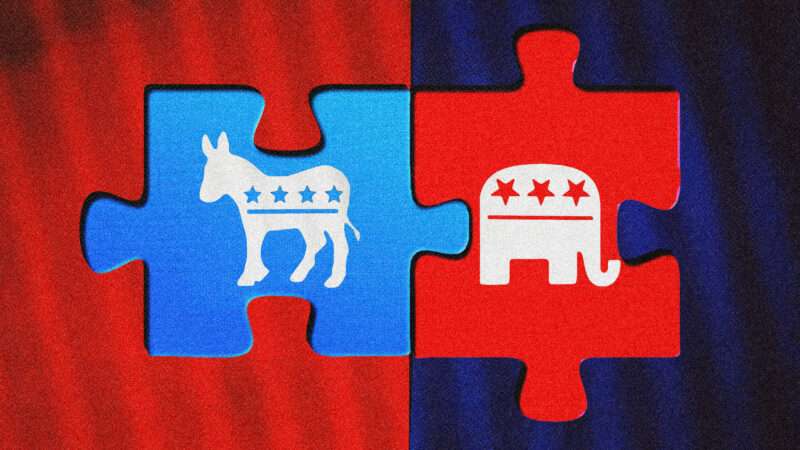
Two puzzle pieces fit together, one with a Democratic donkey and the other with a Republican elephant. | Illustration: Peter Kovac/Mishkacz/Dreamstime

In the country with arguably the most successful market economy on Earth, it's not unreasonable to ask for just one major political party to favor a system of relatively unfettered voluntary exchange. And yet, the midterm elections offer Americans a "choice" between a party openly embracing socialism by name, and one that increasingly embraces state-directed economic activity in the cause of nationalism. Not every candidate running as a Democrat or Republican is on board with their parties' statist transformations, and there are certainly other issues separating the two dominant political tribes. But if you want reliable advocacy of economic freedom, you won't find it in the two major parties.


Open Socialism vs. Nationalist Economic Control

The shift in the Democratic Party's policy preferences from a heavily regulated market economy to outright government control has been well-documented, but it's worth noting Eric Bradner August report at CNN about "a growing list of victories by democratic socialists who are a prominent part of the Democratic Party's left-wing insurgency."

Before his election as mayor of New York City, Zohran Mamdani called for "seizing the means of production," as has congressional candidate Darializa Avila Chevalier. The Democratic Socialists of America (DSA), which backs many of the new breed of officeholders and candidates and organized their insurgency, boasts of its solidarity with the totalitarian regimes in Cuba and Venezuela. Just a year ago, it sent "a delegation of 40 DSA elected leaders and rank-and-file members" to Havana to learn "about the achievements and challenges of Cuban socialism."

At 65 percent support for socialism in Gallup polling, more Democrats favor a state-controlled economy than back capitalism (35 percent)—though the odd tie in favorability with free enterprise (also 65 percent, but declining) suggests the schools aren't doing a great job of explaining ideas.

Republicans nominally hold very different economic preferences, with only 14 percent favoring socialism, while 86 percent support free enterprise and 75 percent have positive views of capitalism. But when asked by CNBC's All-America Economic Survey whether government should have control of private businesses, "66% of Democrats found it not appropriate for the U.S. to take equity stakes in American companies, while only 34% of Republicans agreed."

That's likely because under the Republican Trump administration, the federal government has been grabbing a piece of the action from tech and resource firms—40 companies, at the current count—and party stalwarts are happy to go along so long as the S word isn't used to describe the arrangement. Instead, it's cloaked as top-down encouragement of domestic jobs and manufacturing.


Two Parties With a Similar Taste for Government Economic Intervention

"American political leaders on the left and right are rebelling against the market-first consensus that dominated Washington for four decades," concluded Axios's Courtenay Brown and Neil Irwin in July. "It's evident in everything from the Trump administration taking government stakes in dozens of private companies to socialist candidates winning Democratic primaries promising a more active government role in the economy."

A glimpse of a socialist future can be found not only in the rising tide of explicitly socialist Democrats, but in GOP heir apparent and Vice President J.D. Vance's repeated denunciation of free-market economic thinking and its emphasis on private choice.

"Do we serve pure, unfettered commercial freedom?" he asked in First Things in 2019. "Or do we serve something higher? And are we willing to use political power to actually accomplish those things?"

In a June interview with The Daily Wire's Michael Knowles, Vance returned to the topic to criticize the market-oriented ideas of economist Milton Friedman and called for a state-directed and Christian-infused "American developmentalist" approach to escape what he called "a hyper globalized economy."

"The policies supported by both major political parties suggest a growing embrace of state ownership of the economy," warns economist Daniel J. Smith for the American Institute for Economic Research. "The range of policies widely accepted as legitimate options, referred to as the 'Overton Window,' has shifted toward greater government direction of the economy, with some conservative politicians and voters now treating partial state ownership as an acceptable function of government."

Smith pointed out that the economist F.A. Hayek had observed this phenomenon among authoritarians of the right and left in the 1930s. It was why he dedicated his book, The Road to Serfdom, "to the socialists of all parties."


Rejecting Free Markets Means Losing Liberty and Prosperity

Why this is important is illustrated by Smith's recent research into the correlation, or lack thereof, between socialism and political liberty: "The record, from 1789 forward, is not ambiguous. High degrees of political freedom and heavy state ownership of the economy have not been sustained together."

Smith's observation is supported by the prominent socialist writer Robert Heilbroner's admission in his 1986 book, The Nature and Logic of Capitalism, that "political freedom in modern times…has only appeared in capitalist states." He added, "democratic liberties have not yet appeared, except fleetingly, in any nation that has declared itself to be fundamentally anticapitalist."

Also important, as the Fraser Institute's recently published Economic Freedom of the World: 2026 report points out, "economic freedom tends to be associated with better outcomes." Specifically, the report indicates strong correlations between free-market economies and higher GDP per capita, higher level of income for the bottom 10 percent of earners, lower poverty, higher life expectancy, and lower infant mortality. As with the sources cited above, the report found that "personal freedoms such as freedom of speech, association, and religion are highly correlated with economic freedoms."

So, the benefits of having a major political party that believes in and supports free markets with minimal government intrusion are found not just in expanded political choice, but also in policies that promote freedom, prosperity, and human well-being. Unfortunately, both the Democratic Party and Republican Party are retreating from economic liberty and embracing state control over how we produce, work, own, buy, and sell. Democrats' explicit embrace of socialism, and Republicans' dismissal of free markets in favor of state management and ownership, promise a future of less freedom and reduced wealth.

Maybe Americans would vote against socialism—both the open kind and the implicit nationalist variety—if given the choice. But it's increasingly difficult to find a free-market option on the ballot.

The post The Midterms Offer a Choice Between Two Brands of Socialism appeared first on Reason Magazine.

  •  
❌