President Trump on Wednesday shared a quote crediting him with Israeli Prime Minister Benjamin Netanyahu’s lead in the Israeli elections, though his coalition is far from the majority needed to form a new government. “When President Trump endorsed Bibi Netanyahu, the whole tide turned, and now, rather than a decisive defeat for a Great Prime […]
Hours before the final results from Israel’s elections were in, several things were clear. Benjamin Netanyahu’s far-right coalition had lost its mandate, and the opposition had a firm majority.
But most of Israel’s Jewish opposition ruled out governing with Palestinian-led parties, in the course of a racist election campaign in which Netanyahu painted Palestinian citizens as an enemy inside the state.
With nearly all votes counted, Netanyahu’s coalition government has lost its majority, but main opponents also fail to gain outright majority; marked gains by Palestinian parties
With almost all votes counted, Benjamin Netanyahu’s coalition government has lost its majority, but his main opponents, an alliance of Jewish Israeli parties unofficially led by Gadi Eisenkot, have also failed to gain an outright majority.
Israeli media report that Netanyahu’s bloc is ahead, with projections he could take 53 seats under the current vote share, but this could change further. The projections put Gadi Eisenkot’s opposition bloc on 48 seats and the Palestinian parties on 19 seats. Sixty-one seats are needed to form a majority to govern in the Knesset.
The remainder of votes to be counted come from absentee ballots, according to Israeli media. We can expect absentee ballots to be counted on Wednesday night, with final results by Thursday.
The Palestinian Israeli parties have received a historically strong vote. The Joint List, a new ticket of several Arab-majority parties, triumphed with at least 12 seats, while Ra’am, the other Islamic party, won seven.
The key question is whether the Eisenkot-led “Change” bloc (consisting of the rightwinger Naftali Bennett’s Together party, the centre-left Yair Golan’s Democrats and the rightwing Yisrael Beiteinu party) will partner with Palestinian Israeli parties or if they will resort to a new election, or even working with Netanyahu.
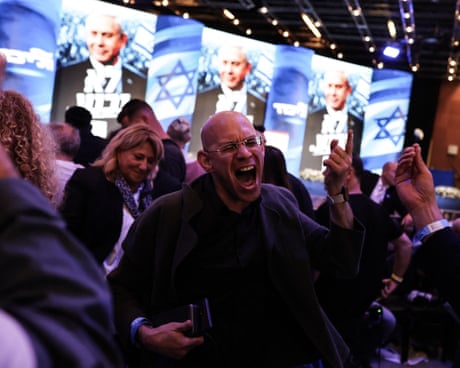
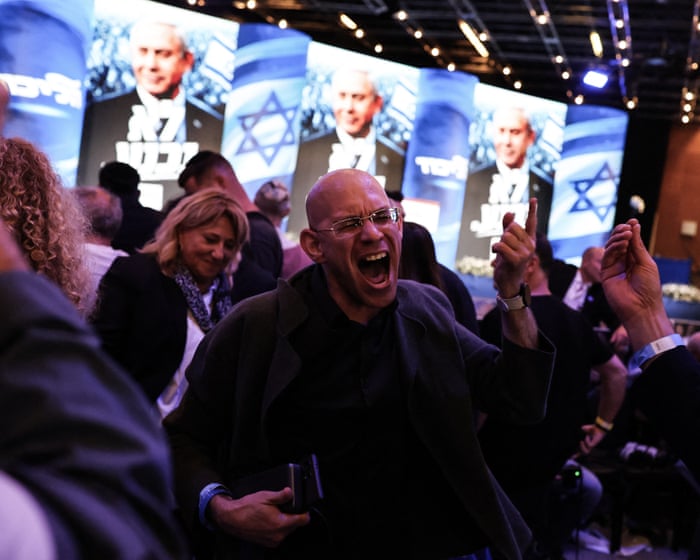
Netanyahu took the stage at a post-election rally in Jerusalem just after 3am, telling his supporters that official results will show that “Likud is the largest party in Israel”. He told his supporters that the country must “establish a strong, rightwing national government” – adding that a government that relied on the support of Palestinian parties must not be formed.
Eisenkot told cheering supporters in Tel Aviv that the “Israeli public has voted against Netanyahu’s service as Israel’s prime minister … a worthy leader would have accepted the people’s non-confidence and announced today his retirement from politics”. In his speech, he also warned Netanyahu not to “use Israel’s security” for political ends, playing on fears that the prime minister could use this period of uncertainty to launch a new attack on Iran.
The Palestinian Israeli vote, which represents about 20% of the population, had long been seen as a decisive factor for who will be able to form government, and the high turnout of this election was driven by the community experiencing increased racism and discrimination under Netanyahu’s government.
This is the most voted-for election in Israel’s political history, with many Israelis flying back into the country to cast their vote, and nearly 80% of IDF soldiers voting.
Donald Trump said his endorsement had helped Netanyahu perform better than polling estimates.
Palestinian President Mahmoud Abbas will visit Cyprus on Thursday and Friday for talks with President Nikos Christodoulides, the government spokesman said.
Abbas will be received at the Presidential Palace for a private meeting, followed by a working lunch with delegations from both sides.
It is the third contact between the two leaders since Christodoulides took office, with the last being held in May 2025 in Palestine.
The agenda covers the Middle East and Cyprus’ humanitarian role, in particular the ‘Amalthea’ sea corridor for aid shipments to Gaza.
The leaders will also discuss bilateral relations, EU-Palestine relations, developments in the West Bank and East Jerusalem, and the Cyprus problem.
The government said the visit reflects the “historical ties between Nicosia and Ramallah”.
Relations date to the 1960s and 1970s, when Archbishop Makarios took Cyprus into the Non-Aligned Movement, and the island recognised the State of Palestine immediately after its 1988 declaration.
A Cypriot representative office opened in Ramallah in 2009, and after the 2012 UN General Assembly vote, it was upgraded to a full embassy, among the first in the EU.
Demetris Christofias, president from 2008 to 2013, made the relationship a visible part of his foreign policy.
On his first official visit to Israel and the Palestinian territories, Christofias met Abbas in Ramallah, and the two signed five bilateral agreements.
His term also covered the opening of the Ramallah office and the 2012 upgrade to an embassy.
Abbas’ last visit was in June 2022, when then President Nicos Anastasiades said close ties with Israel would not come at the expense of Palestinians’ “legitimate rights”. Christodoulides visited Ramallah in August 2023.
President Nikos Christodoulides visited Ramallah in 2023 and laid a wreath at Yasser Arafat’s tomb, and in March 2024 the first aid ship for Gaza left a Cypriot port.
Israel once declared Androulla Vassiliou, wife of former president George Vassiliou, persona non grata after a delegation she led tried to meet Arafat, who was confined to his compound in Ramallah.
Abbas has led the Palestinian Authority since 2005, with its Fatah-dominated administration governing parts of the West Bank, while Hamas has run Gaza.
Palestinian National Initiative Secretary-General Mustafa Barghouti told Al Mayadeen after “Israel’s” election that “Netanyahu has fallen” and that “the era of Smotrich and Ben-Gvir is over.”
He hailed the Arab electorate for its stand “against fascism,” and said divisions within the right-wing camp had weakened Netanyahu’s bloc, leaving the remaining parties to determine the next political steps.
Warnings on the road ahead
Barghouti warned that if former military chief Gadi Eisenkot fails to ally with Arab parties, “Israel” could face another election or a zionist unity government. He said that regardless of who leads the next Israeli government, Palestinian statehood remains off the table, and that the most dangerous scenario would be Netanyahu’s government continuing as a caretaker administration.
On Gaza, he said US President Donald Trump’s Board of Peace has failed to bring peace to the besieged territory, and that the election result would have repercussions there. He expressed distrust of Trump and said that if the US president loses his congressional majority, it would be a “positive development” for Palestinians.
What the exit polls show
Exit polls after Tuesday’s vote showed Netanyahu’s right-wing and religious bloc at about 50 seats, down from the 64 it won in 2022. Eisenkot’s opposition bloc was at 51 to 53 seats, and both fall short of the 61 needed for a majority.
Likud was projected as the largest single party, with 24 to 25 seats against 21 to 23 for Eisenkot’s Yashar party, though a pro-Netanyahu channel, Channel 14, gave the prime minister’s camp 60 seats.
Arab parties, the Joint List and Ra’am, were projected to win a record 16 to 18 seats, nearly double their 10 in the outgoing Knesset, on turnout that reached a three-decade high.
Eisenkot said the exit polls reflect “a complete lack of confidence” in Netanyahu, but he has ruled out a government that depends on Arab parties, and other opposition leaders have said the same.
Finance Minister Bezalel Smotrich said his party “won’t let” Arab voters celebrate, and National Security Minister Itamar Ben-Gvir warned Netanyahu against a unity government with Eisenkot.
Gaza and the Board of Peace
The Gaza ceasefire took effect on October 10 last year, but more than 100 aid and rights groups said earlier this month that it is a ceasefire “in name only.”
Gaza’s Health Ministry has said at least 1,471 people were killed between the ceasefire and early October. In August, Netanyahu rejected the Board of Peace’s 15-point roadmap, which Hamas had accepted, effectively bringing the initiative to a standstill.
When the final results are in, Israeli President Isaac Herzog will consult representatives of all the parties in the Knesset and then task whoever he thinks is best placed with forming a government.

 Login