
❌

Reading view

This chart shows how much Google's head count surged in the AI boom

Google CEO Sundar Pichai
Sundar Pichai, chief executive of Alphabet Inc., during an interview on "The Circuit with Emily Chang" on May 1, 2024.

David Paul Morris/Bloomberg via Getty Images

  • While some companies are slashing head count, Google's is surging.
  • The company had nearly 205,000 employees at the end of September.
  • While Google has conducted layoffs, it has also ramped up hiring and acquired Wiz.

While AI may be driving some companies to slash their head count, Google's is soaring.

When Google reported its Q3 earnings on Wednesday, it said it had 204,757 employees for the quarter ending September 2026. That means Google added roughly 10,000 people to the payroll since the end of March.

The uptick in head count runs counter to another trend across the tech industry, where some of Google's peers are slashing their workforces. Meta has been on a cost-cutting odyssey for several years, while Microsoft recently offered voluntary buyouts to 60,000 employees.

Some of Google's head count growth can be attributed to mergers and acquisitions. On March 11, Google said it had completed its acquisition of cybersecurity firm Wiz, which had roughly 2,000 employees.
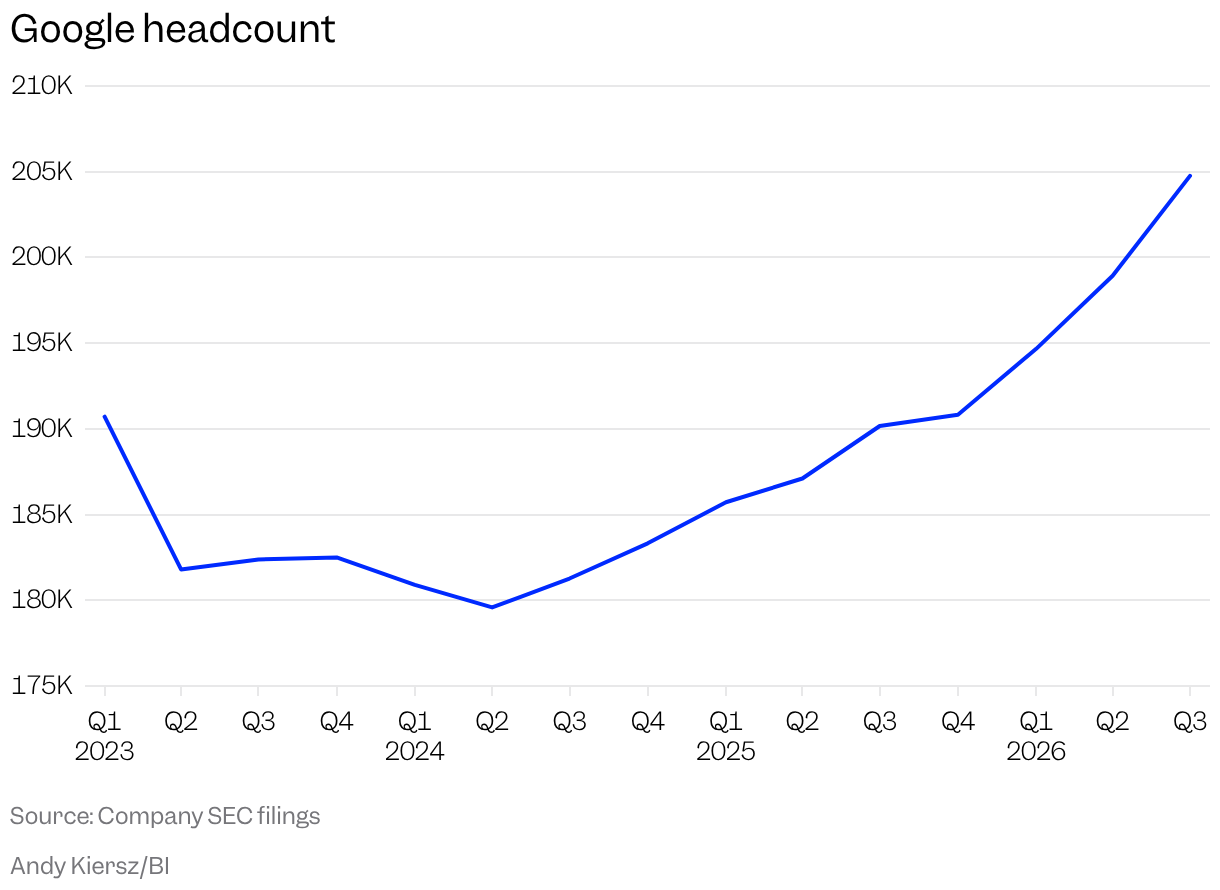
Line chart

In January 2023, Google announced it would slash roughly 12,000 roles — around 6% of the workforce at the time — and has since made several smaller rounds of layoffs, Business Insider has reported.

While the head count has grown somewhat steadily since Q2 2024, it has accelerated since the end of 2025. Google also reported Wednesday that its quarterly revenue grew 25% from this period last year.

Have something to share? Contact this reporter via email at hlangley@businessinsider.com or Signal at hughlangley.01. Use a personal email address and a non-work device; here's our guide to sharing information securely.

Read the original article on Business Insider

  •  

Ações da Alphabet, dona do Google, caem 10% após dados fracos no 3º tri

A Alphabet, controladora do Google, divulgou resultados decepcionantes em seu principal negócio, a publicidade em buscas, e uma aceleração maciça no consumo de caixa, à medida que injetava recursos no desenvolvimento de IA.

Em um sinal de que os clientes corporativos estão adotando a tecnologia, as receitas do Google Cloud mais que dobraram, mas os investidores, inquietos com o altíssimo custo e com a desaceleração do crescimento do mecanismo de busca dominante no mercado, fizeram com que as ações caíssem 10% após o fechamento do mercado.

“Em um mercado preocupado com a possibilidade de a IA canibalizar o negócio principal, os investidores precisam ver a busca acelerando, não desacelerando”, disse Dave Wagner, gestor de portfólio da Aptus Capital Advisors.

“A nuvem está impulsionando os resultados, mas, até que a busca mostre que a IA é um valor agregado, as ações provavelmente continuarão sendo negociadas em baixa.”

A empresa de Mountain View, na Califórnia, registrou um fluxo de caixa livre negativo de US$ 9,1 bilhões, contra as expectativas dos analistas de que ficaria próximo do ponto de equilíbrio, segundo dados da LSEG.

Esforços agressivos para aumentar a capacidade da nuvem e financiar o desenvolvimento de IA levaram a Alphabet a queimar US$ 5,9 bilhões no último trimestre, a primeira vez que o resultado ficou negativo em 22 anos como empresa de capital aberto.

A receita total ficou aquém das expectativas de Wall Street: o crescimento da receita do Google Cloud superou as expectativas, mas não foi suficiente para compensar uma queda de US$ 1,4 bilhão na publicidade.

O segundo trimestre consecutivo de fluxo de caixa negativo da Alphabet representou uma reviravolta brusca para uma empresa que há muito tempo era uma das maiores geradoras de caixa do setor de tecnologia.

Além disso, a Alphabet ainda planeja aumentar significativamente seus gastos de capital para 2027, em comparação com as previsões de gastos deste ano, que variam entre US$ 195 bilhões e US$ 205 bilhões, disse a diretora financeira Anat Ashkenazi aos analistas em uma teleconferência.

Embora os executivos não tenham especificado um valor para os gastos de 2027, os investidores estavam apreensivos com a possibilidade de um grande salto.

O lucro líquido disponível para os acionistas ordinários da Alphabet caiu 25%, para US$ 26,17 bilhões, e o lucro ajustado por ação, de US$ 2,67, ficou abaixo das estimativas de Wall Street, que eram de US$ 3,02.

Os resultados refletem os enormes custos da expansão da IA, com os investidores preocupados tanto com um possível gasto excessivo quanto com o risco de ficar para trás dos concorrentes por não investir o suficiente.

A receita total do terceiro trimestre, de US$ 127,6 bilhões, ficou aquém da estimativa dos analistas de US$ 128,2 bilhões, segundo dados da LSEG. A receita com anúncios ficou em US$ 82 bilhões, ficando abaixo das expectativas de US$ 83,4 bilhões.

Google anuncia inclusão do Pix no Google Pay

  •  

Google faces a $500 billion stock wipeout — one of the biggest-ever market cap drops

Google CEO Sundar Pichai speaks during a conference.
Google CEO Sundar Pichai.

Karl Mondon / AFP via Getty Images

  • Alphabet shed around $500 billion in market value on Thursday after its stock tanked 13%.
  • If the losses persist, it will be the second-largest one-day drop in market cap for any company.
  • Shares of Google's parent company fell after its earnings disappointed investors.

Alphabet is on track to suffer its biggest-ever one-day market-cap wipeout, and the second-largest value drop in stock-market history.

Shares of Google's parent company slumped by as much as 13.5% in early trading on Thursday, slashing Alphabet's market capitalization by over $500 billion, from around $3.9 trillion to $3.4 trillion.

If the losses persist until the close, it would be the second-largest one-day loss of market capitalization ever. Only AI chipmaker Nvidia has lost more value in a single day, when it shed close to $600 billion on January 27, 2025, on fears that China's DeepSeek would steal its lunch.

Alphabet's shares slumped after its earnings report on Wednesday showed about $9.1 billion in negative free cash flow as it spent heavily on AI infrastructure, and profits that fell short of Wall Street's forecasts.

Google's AI search revenue also lagged expectations, despite CEO Sundar Pichai saying on the earnings call that AI helped search queries grow at the fastest year-over-year pace in five years.

Search revenue of $63 billion came in below analysts' estimates and was virtually flat compared to the previous quarter.

That came as a shock because search revenue had beaten Wall Street's estimates in each of its four previous quarterly earnings reports.

"It's worth noting that the strong growth in AI Mode queries had an impact because of the lower monetization we were seeing in AI Mode," Philipp Schindler, Google's chief business officer, said on the call.

He also announced that Google is introducing ads in AI Mode to more users, including in international markets for the first time.

The rise of generative AI has shaken up Google's core business as chatbots like ChatGPT and Claude give people an alternative way to search. While Google has its own chatbot, Gemini, and has integrated it into its search engine with AI Mode, revenue is lagging behind its popularity.

"Just like our shift to mobile over a decade ago, we are focused on building the best Search user experience, followed by monetization," Pichai said.

As well as one of the market's biggest-ever single-day value losses, if Alphabet stock closes more than 9.77% lower on Thursday, it would be the company's worst post-earnings percentage drop since going public in 2004.

"In the AI trade you need a clean story to pique investor interest. But it only matters if numbers track in the right direction," Mark Shmulik, a senior analyst at Bernstein, wrote in a note.

"Is Google an AI winner? Probably, but not today."

Read the original article on Business Insider

  •  
❌