❌

Reading view

Lithuania plans universal conscription

RT | October 29, 2026

Lithuania will introduce universal male conscription despite public resistance to compulsory military service, the country’s government has announced.

The Baltic state reinstated selective conscription in 2015, seven years after abolishing it. Under the new plan, the draft would be extended to all eligible men, while women would continue to serve voluntarily.

Annual recruitment will increase from just over 5,000 to around 7,500 men, President Gitanas Nauseda announced on Thursday following a State Defense Council meeting.

Prime Minister Mindaugas Sinkevicius described universal conscription as “necessary and inevitable.”

The decision follows similar recruitment pushes elsewhere in Europe. Poland is considering restoring compulsory service, which was abolished in 2009, and introducing a system covering both men and women. A recent poll, however, found that 53% of Poles aged 18–24 opposed reinstatement of the draft.

Germany has already introduced mandatory military registration for 18-year-old men. Enlistment remains voluntary, but parliament can activate compulsory service if recruitment falls short or the security situation deteriorates.

Berlin’s recruitment drive has met resistance, with some 45,000 people joining student protests across roughly 100 German cities and towns in September, with some carrying banners reading “We won’t fight in your wars” and “Russia is not our enemy.”

Applications for conscientious objector status reached over 12,000 between January and August, compared with 3,879 throughout 2025, according to figures reported by German media.

European officials have nevertheless continued discussing preparations for a possible war with Russia by the end of the decade. Estonian Defense Minister Martin Herem “joked” last month that if Estonia mobilized and Russia did not attack, it would be “economically more correct to attack ourselves” rather than keep troops waiting.

Moscow has repeatedly stated that it has neither reason nor intention to attack NATO countries, describing such allegations as “horror stories” intended to prepare European populations for further militarization.

Russian officials have warned that Europe’s military buildup could itself lead to confrontation and that expanding NATO infrastructure near Russia’s borders would prompt additional security measures. Moscow has stressed that it is prepared to defend itself if attacked.


  •  

Germany holds two 19-year-olds over Bulgaria’s Starlink arson, and Sofia says they also attacked the network Ukraine fights with elsewhere in the EU

germany holds two 19-year-olds over starlink arson bulgaria sofia says struck another eu country too · post higher regional court düsseldorf olg-duesseldorf ukraine news ukrainian reports

The Higher Regional Court in Düsseldorf has ordered two 19-year-old Germans held pending extradition to Bulgaria, which accuses them of setting fire to Starlink antennas at a satellite ground station near Sofia, the court and Düsseldorf prosecutors said on 29 October. The men, from Duisburg and Moers, were arrested on 23 October, German prosecutors told Reuters.

As Russia presses its war on Ukraine, Starlink keeps Ukraine’s drone units and front-line troops connected, and its ground sites in Europe have become targets. Within a month, fires and attempted fires hit Starlink sites in Poland, Bulgaria, and Lithuania, and Warsaw and Vilnius have linked them to Russia. The Bulgarian case now has its first arrests, and Sofia says the same pair struck another EU country, which would make it more than a one-off.

Sofia says the pair struck another EU country on 18 October

Bulgarian Interior Minister Ivan Demerdzhiev said he expected both suspects to be handed over to Bulgaria, and that the same two carried out a similar attack in another EU member state on 18 October, the state news agency BTA reported on 28 October. He did not name the country outright, but went on to cite Lithuania’s prime minister on an attempted arson there.

Overnight on 18 October, intruders tried to set fire to a Lithuanian company that stores Starlink equipment used by Ukraine, but tipped-off guards foiled the attempt. Lithuania’s prime minister called it part of Russia’s hybrid war.

Bulgarian Prime Minister Rumen Radev said the suspects had been detained in Germany several days earlier, and that disclosing their names sooner would have let them flee. The opposition wants to know whether a foreign security service warned Bulgaria at least a week before the attack, and how two 19-year-olds could enter the country and leave unnoticed. Parliament has failed three times to gather a quorum for a sitting to hear Radev and the security chiefs.

The suspects refuse a quick handover

The two did not agree to a simplified extradition, and the court will rule later on whether handing them over is admissible, according to the court’s statement carried by the dts news agency. Any extradition is to be approved only on the condition that, after a final sentence, they are offered a transfer back to Germany to serve it. Their lawyers plan to contest the Bulgarian warrant, dpa reported.

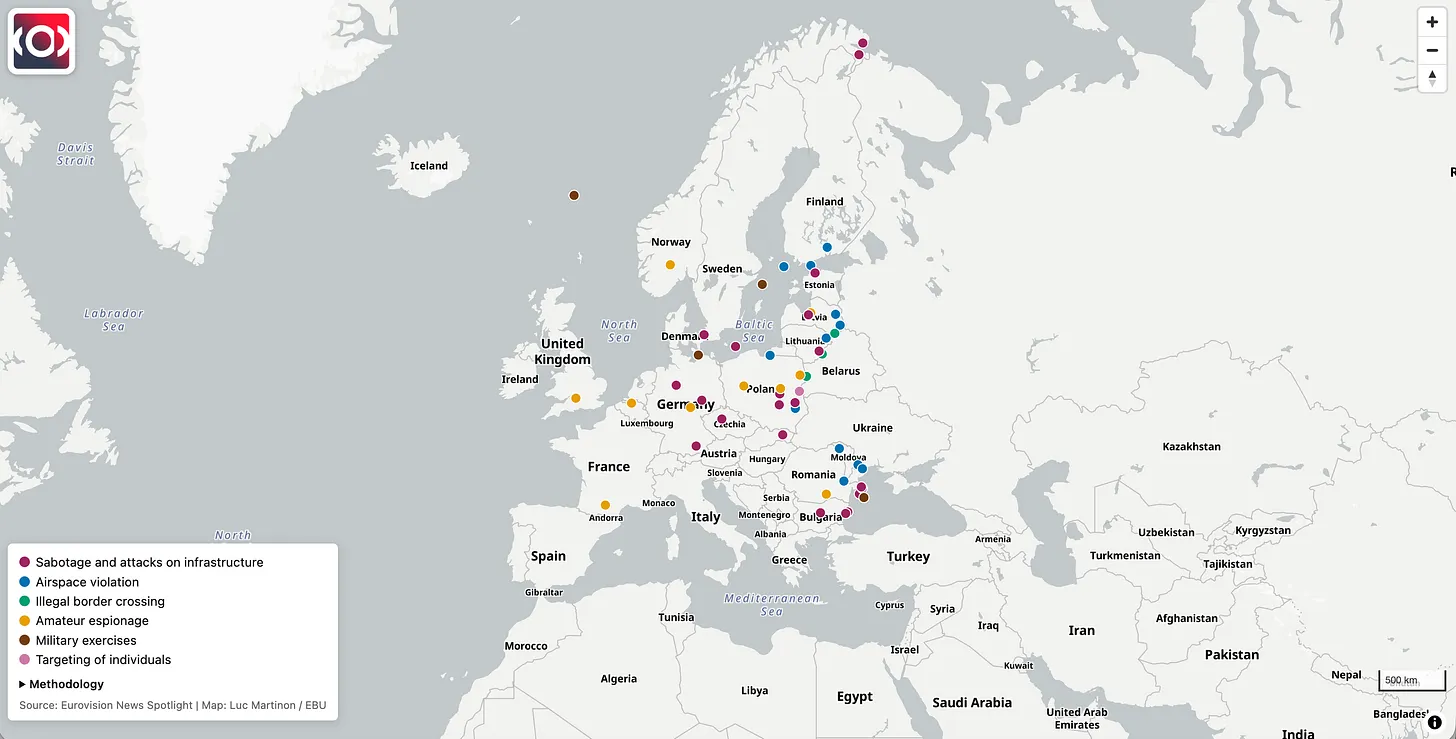
Physical hybrid incidents linked to Russia in 17 European countries, 1 April to 15 October 2026; many points stand for clusters of incidents. Map: Luc Martinon/ EBU, Eurovision News Spotlight
Explore further

17 public broadcasters mapped Russia’s hybrid war on Europe. Germany: four dots

Bulgarian prosecutors say the pair crossed from Serbia as tourists on 9 October, set fire to eight antennas at the Plana teleport south of Sofia, and drove back to Serbia the same night. They were charged in absentia, a Sofia court confirmed European arrest warrants for them, and they face three to 12 years in prison if convicted.

Sofia City prosecutors announced the arrests on 27 October and said German authorities are gathering evidence for the case under a European investigation order. The pre-trial investigation continues, they said.

  •  
❌