Login

California Is Voting on the Wrong Wealth Tax
If you’re worked up about what billionaires pay, wait till you hear about the millionaires.

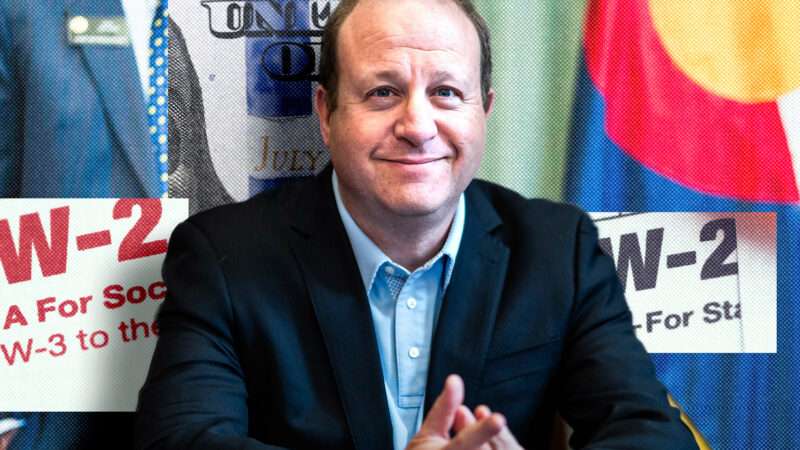
Next week's election is a pivotal one for Colorado, as voters will decide a pair of ballot questions that could secure the state's low-tax, small-government reputation—or shatter it.
Confusingly, there is a slim possibility that they decide to do both. More on that in a moment.
The two competing ballot measures could hardly be more different. The first, Proposition 136, would cap individual and corporate income taxes at 4.4 percent—the state's current flat rate.
The other, Amendment 87, would rewrite the state's constitution to allow for a progressive income tax. It would also set new rates, ranging from 7.4 percent on income over $500,000 to 8.4 percent on income over $1 million. And it would offer a modest tax cut to the lower end of the income spectrum: Individuals earning less than $100,000 would pay 4.2 percent, while those earning less than $25,000 would pay 3.7 percent.
Even with those offsets, Amendment 87 would be a massive tax increase. Both advocates and opponents agree that it would generate about $2–3 billion in additional annual revenue for the state government.
For now, the higher tax rates created by Amendment 87 would only apply to incomes over $500,000. Unsurprisingly, supporters of the measure are framing this as an opportunity to make the wealthy "pay their fair share."
There are two reasons why that argument is a bit deceiving.
As Jared Walczak, a senior fellow at the Tax Foundation, points out, "the new rates would be statutory, while the authorization for a graduated-rate tax would be enshrined in the constitution, permitting the legislature to adjust rates later." Lawmakers would not have to get permission from the voters to make those changes, so Coloradans would be trading away their flat income tax for a new model where income taxes could be hiked by the legislature at any time.
Second, the new rates are not indexed to inflation. As a result, "a household making $450,000 a year in today's dollars would be moved into a higher tax bracket within eight years if their earnings increased by 3% annually," reports The Colorado Sun, which crunched the numbers. Such "bracket creep" would also push more workers over the $100,000 threshold, nullifying the small tax cut for workers making less than that.
Politically, the progressive income tax proposal is dividing Democrats. The Colorado Democratic Party has endorsed Amendment 87 (along with many of its usual allies, like the AFL-CIO and the state's largest teachers union).
But Democratic Gov. Jared Polis has called the proposal "a huge blank check to politicians" that will "cripple our economy and reduce jobs."
In comments to a Denver TV station, Polis also highlighted how higher taxes in Colorado would make the state less competitive with its neighbors. "Utah has a very similar tax rate to what we have. If ours is double, we can't compete for businesses," Polis told Denver7. "It's game over. We will not be able to attract new employers to Colorado if the voters adopt this."
It's not just Utah. If the amendment passes, Colorado would have a significantly higher top income tax rate than any of its neighbors. (The current highest in that group is New Mexico, with its top rate of 5.9 percent.)
Under Colorado law, constitutional amendments typically need 55 percent approval to pass. However, Amendment 87 requires only a simple majority* because it technically repeals provisions in the constitution, rather than adding new ones. Similarly, Proposition 136—the one that would cap the income tax rate at 4.4 percent—requires just a simple majority.
It is possible, though unlikely, that both could pass. That would create a conflict, since the state's income tax can't be capped at 4.4 percent and also hiked to more than 7 percent on incomes over $500,000.
If that happens, the ballot question with the larger share of support would win, per state law. "In short, that means Amendment 87 would need to both win majority support from voters and surpass Proposition 136 in total votes to go into effect," explains the Denver Post, which has encouraged residents to vote against both ballot measures.
Accordingly, Proposition 136 must win majority support from the voters and surpass Amendment 87 (which needs 55 percent to pass, don't forget) to be implemented.
It is all a bit confusing, but the outcomes are worth watching. Colorado has long been a bit of an outlier among "blue" states for its relatively low taxes and booming population. It's now up to the voters to decide if that remains true.
*CORRECTION: This article incorrectly described how Amendment 87 could be passed into law.
The post Jared Polis Warns Colorado's Progressive Tax Ballot Measure Could 'Cripple' the Economy appeared first on Reason Magazine.
Denmark and Belgium may have held this title in 2024, but France once again has taken the lead as the European country with the highest tax/GDP ratio.
Under the pressure of immense debt and weak economic growth, France’s burden jumped to 46 percent last year from 43.5 percent. The European average is 40.7 percent, according to Fdesouche, citing Le Figaro.
The tax-to-GDP ratio measures the total amount of tax revenue a country collects relative to the size of its economy. It is calculated by dividing total tax revenues (including income taxes, corporate taxes, VAT, and compulsory social security contributions) by the country’s gross domestic product, or GDP.
It was France’s low growth of just 0.8 percent that really hurt it last year, versus just over 1 percent in 2024. Denmark saw its 2025 GDP grow by 2.9 percent versus 3.5 percent in 2024, with its tax/GDP ratio decreasing slightly to 45.1 percent from 45.2 percent.
As the costs mount from the latest round of riots, and everybody eyeing a possible debt ratings downgrade, the prospects do not look bright, even if those in government seem far from worries.
National Rally presidential candidate Marine Le Pen blasted French Finance Minister Roland Lescure for claiming he is little concerned about the taxes imposed on fuel.
“The Minister of the Economy explains that the taxes on fuels ‘do not keep him from sleeping.’ Know this, Mr. Lescure, that they keep millions of workers, entrepreneurs, retirees, and families from sleeping and even from living. Your disdain is unbearable,” she posted on X.
Le ministre de l’économie explique que les taxes sur les carburants ne « l’empêchent pas de dormir ». Sachez, M. Lescure, qu’elles empêchent des millions de travailleurs, d’entrepreneurs, de retraités et de familles de dormir et même de vivre. Votre dédain est insupportable. https://t.co/MscRVc3bGV
— Marine Le Pen (@MLP_officiel) October 28, 2026
The post France takes back title of highest tax-to-GDP ratio as economic growth flounders appeared first on Remix News.

No matter what happens in Tuesday's elections, support for wealth taxes keeps growing. Its justification is based on the idea that the very rich owe all of us something, and taxing their fortunes is collecting on that debt. We're told their success fuels inequality and that it's selfish of them to keep so much, especially if they don't proclaim that they want to do more for society.
Former International Monetary Fund chief economist Olivier Blanchard of France recently gave this narrative a clear voice. Writing on X, he wondered why California's wealthiest are spending so heavily to defeat Proposition 40, the supposed one-time 5 percent tax on the net worth of billionaires. Blanchard added that billionaires "typically have not indicated that they are building their wealth to eventually make the world a better place."
The entire notion misunderstands how fortunes are made. In a market economy, people don't build great wealth first and redeem it later through good works. They build it by making the world better first.
When I buy an $800 smartphone, it's because I value the phone more than whatever else I would have bought with the money. The seller values my $800 more than they do the phone. We both walk away richer by our own measure. Neither owes the other anything more.
Repeat this exchange a few hundred million times, and vast fortunes take shape for the people who create amazing technology so abundantly and affordably that we take it for granted. More importantly, though, people hand over every cent of it voluntarily.
As my colleague Arnold Kling aptly explained over the weekend, "Profits are earned within a positive-sum game for society. Profits induce firms to serve consumers and to innovate." The drive for wealth taxes relies on "the opposite point of view. It regards profits as something that businesses take from the rest of us, as if we can take innovation and efficiency for granted. [It] acts as if we are in a zero-sum environment in which one person's gain is necessarily another person's loss."
And, yes, the gains are divided more fairly than people think. Nobel laureate and Yale University economist William Nordhaus estimated that innovators in the U.S. business sector personally captured, on average, a mere 2.2 percent of the social surplus they created between 1948 and 2001. The other 97.8 percent went to everyone else in the form of lower prices, higher wages, better products and goods, and services that didn't previously exist.
In short, the world has already been compensated, many times over.
Those urging billionaires to acquiesce also err by blithely assuming that the state that grabs the money will use it well enough to "make the world a better place." The burden of proof is on them. California's government already spends roughly $350 billion a year. What will the extra few billion accomplish that the rest hasn't?
"Giving money and power to government is like giving whiskey and car keys to teenage boys," as journalist and satirist P.J. O'Rourke used to say. Maybe California's billionaires aren't eager to fund a Merced-to-Bakersfield rail line that the state prices around $35 billion and its inspector general puts closer to $48 billion. Perhaps they're hesitant to backfill pension funds like the California Public Employees' Retirement System, whose staff concedes is unlikely to hit an assumed 6.8 percent return without leaning on private equity.
Prop 40's revenue is earmarked for health care, but money is fungible. In the end, California has one budget. Every earmarked dollar frees another for something else. Some billionaires might simply have concluded that their philanthropy does more good elsewhere, or that their dollars are more beneficial when invested in private enterprises.
The tax also doubles down on California's worst habit: spend, spend, spend, and then tax, tax, tax. The money is never enough to cover all the spending. A one-time levy spent over five years doesn't fix that. It funds new commitments with temporary money. Some will want to make the tax permanent, which its intellectual architects clearly prefer and may have made possible. And yet that still won't be enough.
That's the commitment problem that Blanchard admits California can't solve. Billionaires are wise to distrust the "one-time" promise.
What worries me most is the moral framework. When a society convinces itself that the people making life better and less costly are the problem, we eventually stop getting those people.
Contrary to Blanchard's naive belief, billionaires aren't lacking in public spirit. Even if we ignore their often massive charitable giving, we can't forget that the market already collected their contribution and handed a large share of it to the rest of us. We should stop demanding they apologize for the other two cents.
COPYRIGHT 2026 CREATORS.COM
The post Billionaires Have Already Paid Us Back. So Why Does California Want More? appeared first on Reason Magazine.