
❌

Reading view

Amazon CEO sees AI spending 'meaningfully' higher in 2027

Amazon CEO Andy Jassy

Michael Nagle/Bloomberg via Getty Images

  • Amazon reported third-quarter earnings on Thursday.
  • Amazon stuck with its $220 billion capex forecast for 2026.
  • CEO Andy Jassy expects the company to spend "meaningfully more" next year.

Amazon is already spending a record amount on AI data centers. Next year will be even bigger.

The world's biggest cloud-computing company reported third-quarter results on Thursday and reiterated its plan for $220 billion in capital expenditure for 2026.

Then, CEO Andy Jassy shared his outlook for next year, saying Amazon expects "to spend meaningfully more in 2027."

Amazon’s spending has become the central question hanging over the company. It's building massive data centers and buying expensive chips and other gear to meet surging demand for AI.

That's pushed its free cash flow into negative territory, with third-quarter results showing a hole of $42.4 billion for the trailing twelve months.

Amazon spent $75.9 billion in cash capital expenditures during the third quarter alone, CFO Brian Olsavsky said, primarily on AWS and AI infrastructure.

The results did little to ease investors' concern about the spending. Amazon's third-quarter revenue and earnings came in below Wall Street expectations, and its shares fell roughly 6% in after-hours trading.

"The cloud unit's improving operating margin was one welcome signal, but it may not be sufficient to alleviate concerns about the sharp spike in capex spending and corresponding freefall of its free cash flow," Sky Canaves, a principal analyst at eMarketer, said in a statement.

Amazon has argued that AI infrastructure takes years to build before it can begin generating revenue, and that AI chip servers typically break even in less than three years once deployed. But the scale of the outlay has raised the stakes for Amazon's cloud business to sustain rapid growth as competitors make similarly enormous bets.

On Thursday, Jassy reiterated his confidence in the company's AI business model and outlook, saying there's a "clear line of sight to attractive financial returns."

The time it takes Amazon to turn newly delivered servers into revenue-generating capacity has also come under scrutiny.

Last week, Business Insider exclusively reported that Amazon has begun receiving billions of dollars in Nvidia server racks before all of the gear can be deployed at their final data-center sites, as power shortages and construction delays hold back new capacity.

"We can fund this plan"

Jassy argued Thursday that Amazon has visibility into the demand supporting its huge AI investments. Customers that need the largest AI deployments reserve capacity well ahead of time, he said, in blocks ranging from hundreds of megawatts to, in some cases, as much as a gigawatt.

"We have very good visibility into 2027 and 2028 and some of '29 too with respect to what customers want in those really big chunks of capacity," Jassy said.

AWS revenue rose 39.3% year over year to $46 billion in the third quarter, its fastest growth in nearly five years. Jassy said he expects AWS revenue to grow more than 40% in both 2027 and 2028, a projection that requires the company to keep rapidly adding capacity.

Jassy described the spending as a once-in-a-lifetime opportunity rather than an optional expansion. It would be more convenient, he said, if Amazon could spread the investment over 25 years. But the speed of the AI market does not allow that.

"We can fund this plan," he said. "It will forever change our revenue. It will forever change our free cash flow."

Have a tip? Contact this reporter via email at ekim@businessinsider.com or Signal, Telegram, or WhatsApp at 650-942-3061. Use a personal email address, a nonwork WiFi network, and a nonwork device; here's our guide to sharing information securely.
Read the original article on Business Insider

  •  

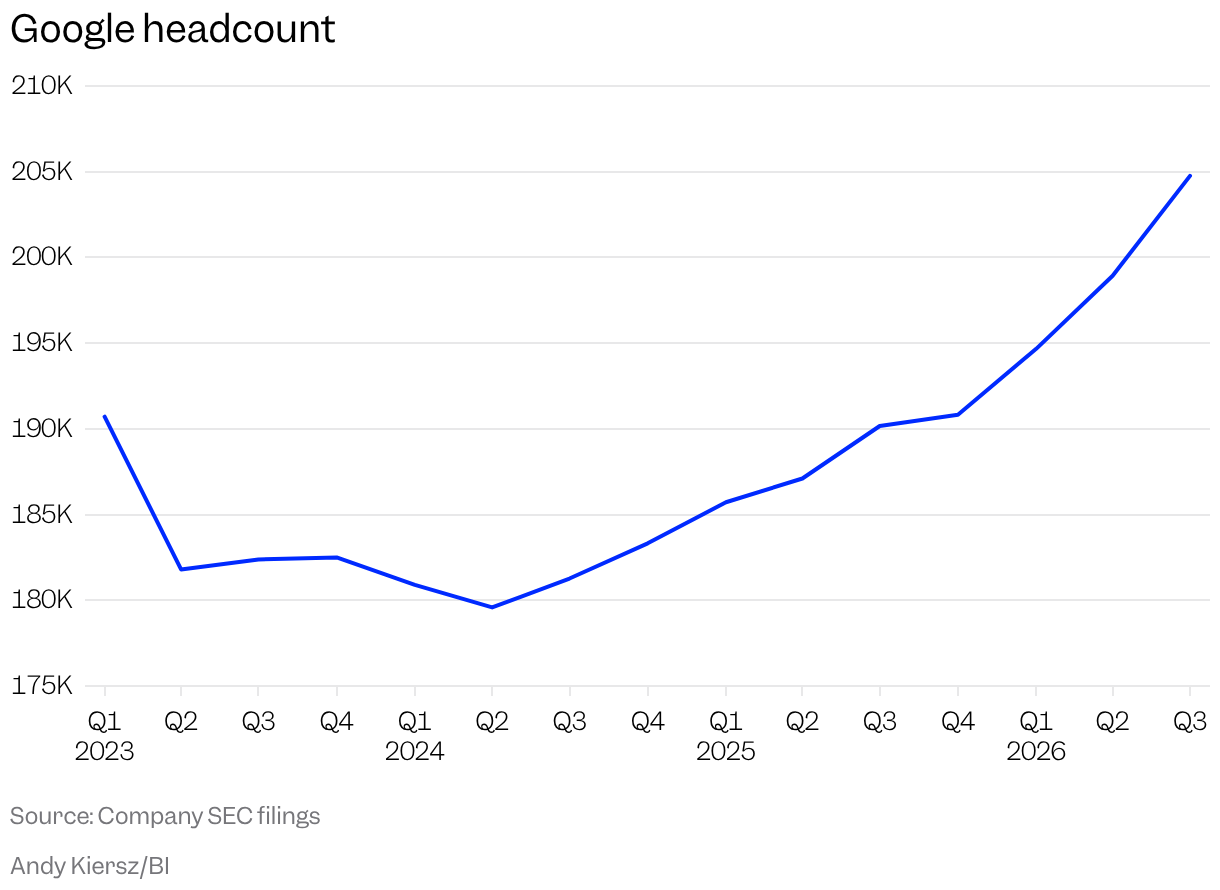
This chart shows how much Google's head count surged in the AI boom

Google CEO Sundar Pichai
Sundar Pichai, chief executive of Alphabet Inc., during an interview on "The Circuit with Emily Chang" on May 1, 2024.

David Paul Morris/Bloomberg via Getty Images

  • While some companies are slashing head count, Google's is surging.
  • The company had nearly 205,000 employees at the end of September.
  • While Google has conducted layoffs, it has also ramped up hiring and acquired Wiz.

While AI may be driving some companies to slash their head count, Google's is soaring.

When Google reported its Q3 earnings on Wednesday, it said it had 204,757 employees for the quarter ending September 2026. That means Google added roughly 10,000 people to the payroll since the end of March.

The uptick in head count runs counter to another trend across the tech industry, where some of Google's peers are slashing their workforces. Meta has been on a cost-cutting odyssey for several years, while Microsoft recently offered voluntary buyouts to 60,000 employees.

Some of Google's head count growth can be attributed to mergers and acquisitions. On March 11, Google said it had completed its acquisition of cybersecurity firm Wiz, which had roughly 2,000 employees.

Line chart

In January 2023, Google announced it would slash roughly 12,000 roles — around 6% of the workforce at the time — and has since made several smaller rounds of layoffs, Business Insider has reported.

While the head count has grown somewhat steadily since Q2 2024, it has accelerated since the end of 2025. Google also reported Wednesday that its quarterly revenue grew 25% from this period last year.

Have something to share? Contact this reporter via email at hlangley@businessinsider.com or Signal at hughlangley.01. Use a personal email address and a non-work device; here's our guide to sharing information securely.

Read the original article on Business Insider

  •  

Google has a plan to keep ads alive even when AI agents do the shopping

An image showing Google AI mode
AI overviews have led to more searches than ever, but Google is not making money at the same rate.

Matteo Della Torre/NurPhoto via Getty Images

  • Google said that AI agents can automate shopping, but users will still want choices.
  • Investors have long argued that AI chatbots and agents will threaten Google's search business.
  • Google's Q3 revenue fell short of analyst expectations, and shares fell 10% after hours.


Google has a pitch for advertisers worried AI agents will make Search obsolete: Let the bots do the shopping legwork, but leave people to compare brands, prices, perks — and sponsored offers.

"When users shop, and that's important, there's a part of the journey they don't like, the grunt work, which is frankly fantastic to automate with AI," Philipp Schindler, Google's chief business officer, said on Alphabet's earnings call on Tuesday. "But we also want to enhance, not just automate away the discovery experience that people frankly love in so many cases."

He said users do not always want the cheapest option; they also weigh brand loyalty and customer service. Google believes that this decision-making process gives it space to build ads into agentic shopping.

He shared an example of how that might work: "Here's the insurance product we found, and here's another strong option, one of which is a higher premium, maybe a lower deductible, and they are currently offering a very special discount."

Schindler added that there is almost never a single perfect solution for any shopping decision, which makes Google "confident" that there is room for advertising even in agentic search.

The comments offer a clearer explanation of Google's business model for agentic search, which has presented a challenge for its core ads business. On Tuesday, the company said that Google's AI mode has led to more searches than ever, but it's not making money at the same rate. It's a major concern among investors, who have long argued that AI chatbots and agents will threaten Google's search business.

Google has been signaling for months that it wants to solve that problem without simply cramming old-style ads into a chatbot. Last quarter, Google said it was testing ideas like showing offers during travel planning and clearly marked sponsored links inside AI-generated lists.

Alphabet reported third-quarter revenue of $127.58 billion, narrowly below the $127.97 billion analysts expected. Earnings per share came in at $2.12, versus roughly $3.01 expected, largely because of an $8.2 billion unrealized loss on its SpaceX investment. Shares fell about 10% after hours.

Read the original article on Business Insider

  •  
❌