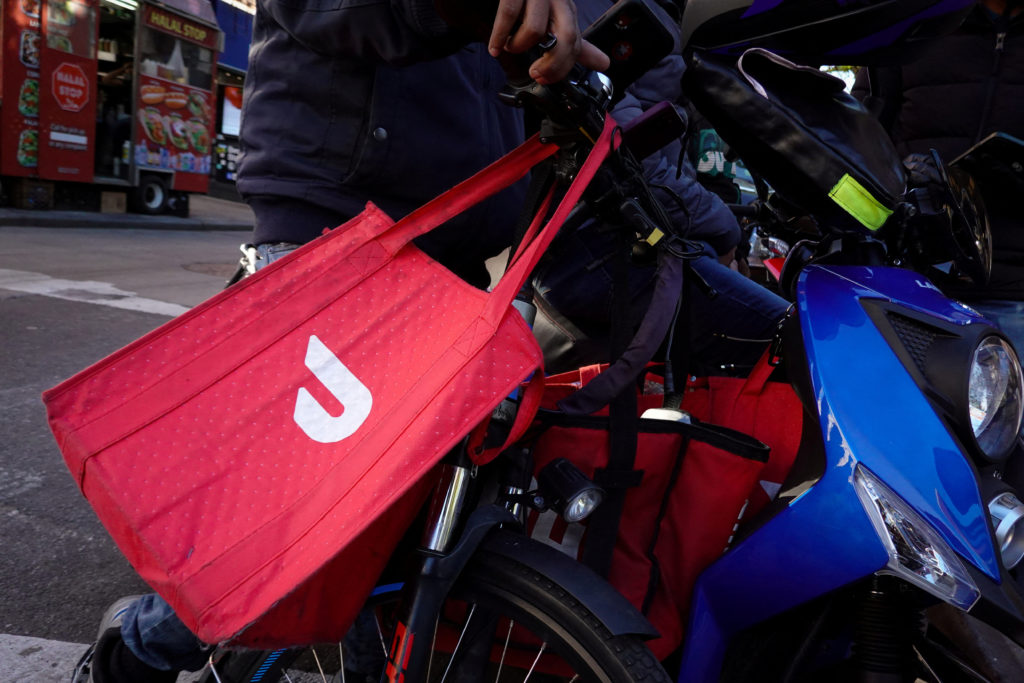
The companies say the tie-up would combine DoorDash's global reach and expertise in logistics with Instacart's purpose-built technology and long relationships with grocers.
DoorDash plans to keep Instacart's brand after the $17 billion acquisition wins federal approval.
Michael Nagle/Bloomberg via Getty Images
DoorDash says its planned acquisition of Instacart will create new opportunities for delivery workers.
The $17 billion deal would preserve both apps, DoorDash said.
DoorDash also plans to start listing restaurants on the Instacart app.
Gig workers could see changes to how they make deliveries if DoorDash's $17 billion deal for Instacart goes through.
The companies announced the acquisition on Thursday after several years of considering a deal. It would give DoorDash, long one of the dominant names in restaurant delivery, a much stronger position in grocery delivery.
The acquisition would also bring together millions of gig workers who make deliveries for both companies.
Here's what we know so far about how the deal would affect delivery workers:
DoorDash plans to keep the Instacart app
If the deal wins federal approval, DoorDash doesn't plan to fold Instacart's brand into its own.
That means that the apps will continue to function on a stand-alone basis, DoorDash executives said on a call on Thursday to discuss the deal.
"I think Instacart has built a great brand, and it is a very unique brand where their audience is very loyal to that brand," DoorDash CEO Tony Xu said on the call.
Gig workers will be able to take both restaurant and grocery orders
DoorDash plans to cross-list merchants on the two different apps, CFO Ravi Inukonda said.
Restaurants represent one obvious opportunity, he said. "We are going to be able to list our restaurant platform on Instacart, which is going to drive top-line growth," Inukonda said.
Access to more kinds of orders means that gig workers will have "more choice over when and how they earn, whether that's grocery orders on a quiet day, restaurant orders at peak times, or both," the company said in its deal announcement.
DoorDash says the deal could mean 'greater earning opportunities'
Many of Instacart's grocery partners are lookingto compete with bigger companies, Xu said on the call. Amazon and Walmart are both expanding their delivery networks, especially for same-day delivery and fresh food, and many smaller chains will turn to the combined company to offer delivery.
That could mean "faster delivery times, more affordable prices for everyone, greater earning opportunities for shoppers," Xu said, referring to gig workers who shop and deliver orders.
Whether those opportunities result in more pay for workers remains to be seen.
Instacart workers make about $13 an hour, while those working for DoorDash average about $11 an hour, according to gig worker pay data from analytics company Gridwise published in March. Both rates were lower than rival delivery services, such as Amazon Flex and Uber Eats.
Do you have a story idea about DoorDash and/or Instacart? Contact this reporter at abitter@businessinsider.com or via encrypted messaging app Signal at 808-854-4501. Use a personal email address, a nonwork WiFi network, and a nonwork device; here's our guide to sharing information securely.
The New York City mayor denounced the proposed acquisition in a post on X on Thursday, hours after the company announced it.
"Corporate consolidation means higher prices, harsher exploitation, and greater economic inequality for New Yorkers," he wrote.
"We've stood up to these giants before," he added. "That doesn't stop now."
DoorDash CEO Tony Xu said on Thursday that the deal would lead to lower prices and faster delivery times for customers, as well as "more earnings" for the gig workers who make deliveries on the apps.
Mamdani also referenced the City's settlement with DoorDash last month, in which the delivery service agreed to pay $131.5 million to end an investigation into how it paid delivery workers in the city.
The settlement includes returning some of the money to workers. Mamdani and the City's Department of Consumer and Worker Protection have taken aim at delivery companies multiple times over the past year, including by enforcing a law requiring the companies to offer customers the option to tip at checkout.
Samuel A.A. Levine, the Department's commissioner, said that the deal "continues a troubling trend of mega-corporations consolidating while working to divide workers and consumers."
"Whether or not this merger proceeds, we will fully enforce delivery workers' rights," Levine added.
Do you have a story idea about Uber, DoorDash, or Instacart? Contact this reporter at abitter@businessinsider.com or via encrypted messaging app Signal at 808-854-4501. Use a personal email address, a nonwork WiFi network, and a nonwork device; here's our guide to sharing information securely.
The $17 billion deal is expected to close at the end of 2027 or in the first half of 2028.
It will give DoorDash a leg up over Uber and Amazon in the world of grocery delivery.
Two of the biggest names in food delivery are coming together.
DoorDash plans to acquire Instacart in a deal worth about $17 billion, the companies said Thursday. The deal is expected to close at the end of 2027 or in the first half of 2028.
The acquisition would combine DoorDash's historical dominance in restaurant delivery with Instacart's roster of grocery partnerships, creating one company to deliver much of customers' weekly dining needs.
"Together, we can accelerate innovation across the grocery industry and make online grocery more seamless and affordable for the millions of households we serve," said Chris Rogers, the CEO of Instacart.
This isn't the first time that DoorDash and Instacart have considered a deal, Apoorva Mehta, Instacart's founder, said in a statement Thursday.
"Tony and I have explored bringing Instacart and DoorDash together on and off over the years," he said.
"We kept coming back to it because the industrial logic has always been clear," Mehta added, referring to the opportunity to sell customers more of the 21 meals they eat each week.
DoorDash has been growing its grocery business since the pandemic, which pushed many shoppers out of stores and toward delivery services as they stayed home more. Since then, the company has partnered with dozens of grocers, creating a selection that rivals Amazon's with less infrastructure, CEO Tony Xu said earlier this year.
Instacart, meanwhile, has focused on grocery delivery since its inception in 2012. The startup delivered orders from Whole Foods before Amazon bought the chain in 2017. It now works with thousands of retailers in North America and sells retail technology, from digital price tags to smart shopping carts.
In a joint announcement, the companies said the deal would mean Instacart customers could shop at more than 50,000 additional stores, and that DashPass and Instacart+ members would pay one membership fee instead of two.
The deal, which will be at least 75% cash, values Instacart at $65.00 per share, representing a 26% premium over its closing price on October 22.
Taking on Amazon and Uber
The combined company will be a more formidable presence in the competitive grocery delivery industry.
Amazon has spent years trying to increase sales in its grocery business, including a rollout of same-day perishable food deliveries to more parts of the US over the past year. And Walmart is also building its own delivery infrastructure, including its own network of gig-worker couriers and expanding into restaurant delivery.
Combining DoorDash and Instacart would give other grocers a better shot at taking on companies like Amazon and Walmart, DoorDash said.
"A lot of what we talk about with grocers is: How can we together help them compete against the largest companies in the world?" DoorDash CEO Tony Xu said on a call Thursday.
Uber has also grown its restaurant and grocery delivery business through Uber Eats. The company has recently moved deeper into premium ride-hailing options, such as black car services, as well as travel through a hotel-booking partnership with Expedia.
Both DoorDash and Instacart have relied on gig workers to pick orders and make deliveries. As independent contractors, most don't receive many of the same benefits as full-time workers, such as health insurance or contributions to retirement accounts.
Do you have a story idea about DoorDash and/or Instacart? Contact this reporter at abitter@businessinsider.com or via encrypted messaging app Signal at 808-854-4501. Use a personal email address, a nonwork WiFi network, and a nonwork device; here's our guide to sharing information securely.

 Login