❌

Reading view

An armored capsule instead of an open platform: Ukraine develops an evacuation module for the Murakha UGV

The Murakha UGV with the CASEEVAK module.Photo: Robotic Complexes company

Ukrainian company Robotic Complexes is developing CASEEVAK, an armored module that lets the Murakha unmanned ground vehicle carry wounded soldiers off the battlefield, the company told Militarnyi on 28 October. The casualty rides in a closed capsule with ventilation, heating, lighting, and a first-aid kit, and side and rear doors let medics load and reach the soldier from any side.

Drones that can fly long distances pose a threat to both wounded soldiers and the crews evacuating them, making transportation the main challenge, said Ukrainian military medic Daryna Boiko, The Independent reported. Developers are looking for new ways to counter this threat. The current Murakha model is being equipped with passive anti-drone protection elements, the developers say.

An armored capsule that keeps the wounded connected

After a wounded soldier is loaded onto an evacuation platform, it is important not only to transport them to a safe location but also to protect them and monitor their condition during transit.

The module is built around a closed armored capsule made of 3.5 mm-thick Armox 500T steel with an inner lining of HDPE 1000, the media outlet reports. Side and rear doors allow the wounded to be loaded from different directions and accessed during evacuation.

A military personnel member inside the CASEEVAK module of the Murakha UGV. Photo: Robotic Complexes company

To enable the operator to monitor the person inside and maintain contact with them, the capsule is equipped with a camera with day and night channels and two-way audio communication. The system can be controlled via ELRS, LTE, Starlink, or fiber-optic communications. Militarnyi reports that even if the capsule is detached from the main platform, it retains two independent communication channels.

The developers are also working to integrate vital-signs monitoring systems intended to provide medical personnel with information about the wounded person’s condition during transport.

An electric platform and protection against FPV drones

The evacuation module requires a platform capable of carrying it as it moves through dangerous areas. The Murakha is equipped with two electric motors, delivering a combined torque of 1,600 N·m, and a 35 kWh battery. The system’s stated range is up to 80 km, according to the media outlet.

Another area of development is protection against drones. Measures intended to protect the system include net launchers and electronic warfare (EW) equipment. However, work on a protective cage against FPV drones is still ongoing, according to the report.

The company has already conducted ballistic tests of the armor steel at a distance of 50 meters, using ammunition of various calibers, Militarnyi reports.

The Murakha-Mini logistics platform


The same company previously developed the Murakha-Mini logistics platform. Ukrainian military personnel began using it on the front line to deliver equipment, provisions and other supplies, Militarnyi reported on 24 October 2025.

Ukraine’s Murakha-Mini unmanned ground vehicle. 2025. Photo: Robotic Complexes company

The UGV can carry up to 250 kg and travel up to 40 km on a single charge, the media outlet reported. During one combat mission, it transported 150 kg of cargo and towed a six-metre platform carrying another drone and provisions, covering 16 km in one direction, Militarnyi reported.

  •  

Classrooms in Sumy Oblast are moving underground due to Russian shelling: 13 such schools are already operating, nine are under construction, and another 14 are at the design stage

Children study in a radiation-protective shelter in Sumy, December 2025. Photo: Suspilne Sumy

Since the start of Russia’s full-scale invasion, Russian forces have damaged 165 schools in Sumy Oblast and destroyed 21 beyond repair, according to the head of the regional administration. The administration’s answer is to move classrooms underground. Design documentation for 14 new underground schools has already been prepared, Oleh Hryhorov, head of the Sumy Oblast Military Administration, said in an interview with Ukrinform published on 28 October 2026. In addition, 13 such schools are already operating in Sumy region, while nine more are under construction, the media outlet reported.

Sumy region is one of the areas regularly shelled by the Russian military, making it dangerous to hold classes in above-ground school buildings. Of the region’s 280 schools, 225 have shelters, mostly basic ones, while more than 70 have radiation-protective shelters, Hryhorov noted.

“The process is ongoing and is being scaled up as much as possible,” he said, adding that the region is bringing in partners.

Underground classrooms provide a safer learning environment in Sumy Oblast

The construction of new underground schools is primarily focused on the larger cities of Sumy Oblast, where most schoolchildren are concentrated, Hryhorov explained.

The learning process at such a school differs from the usual format. This was explained by Oleksandr Vaniushenko, the principal of one of the first underground schools in Sumy, Suspilne reported on 23 December 2025.

“We have the first shift—entirely younger children, and fifth- and sixth-graders also go out to the open locations. The second shift brings in just as many more children. The total number studying per day is 360–370,” Vaniushenko noted.

The shelter has backup power supplies, allowing children to continue their lessons during air raid alerts and power outages, according to the project, media reported.

Children study in a radiation-protective shelter in Sumy, December 2025. Photo: Suspilne Sumy

Currently, 22 schools operate entirely in person, while 193 use a hybrid learning format, the head of the regional administration said. A total of 75,000 children are currently attending school in Sumy Oblast, he noted.

A Russian bomb hit a Sumy school during lessons in September

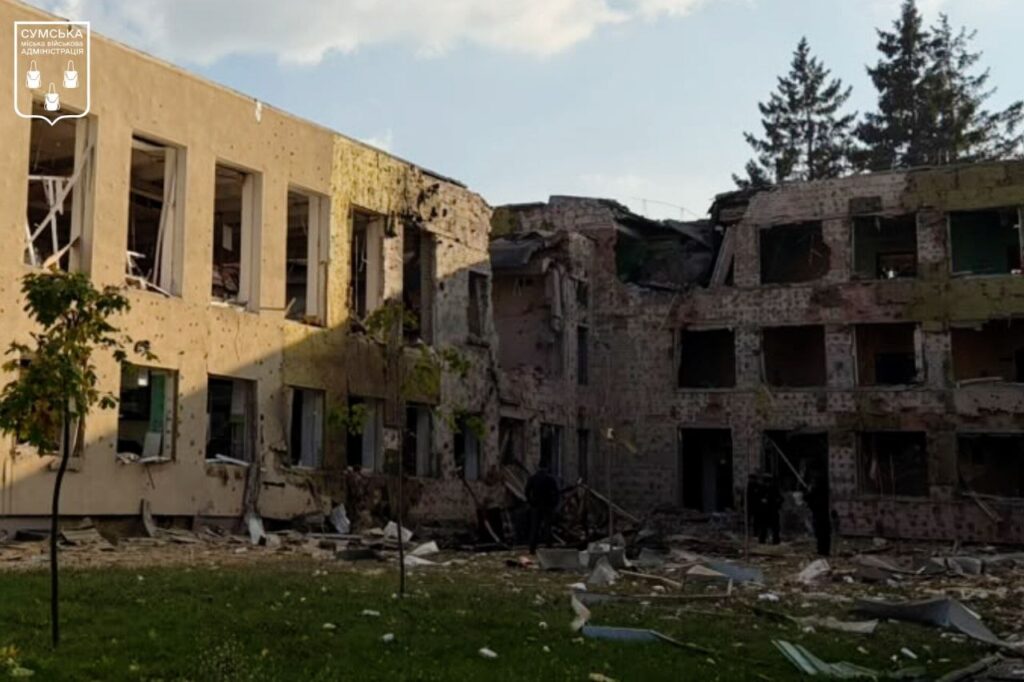
On 29 September, Russia struck a school in Sumy with a 250-kilogram aerial bomb while children in grades 1 to 4 were there, Serhii Kryvosheienko, head of the Sumy City Military Administration, reported. He said the Russians aimed the bomb at the school on purpose. About 40 students were in the school’s shelter when the bomb hit, a school employee told Suspilne.

A school in Sumy where Russian forces carried out a strike while elementary school children were studying, 29 September 2026. Photo: Sumy City Military Administration

"With no pity or compassion whatsoever, they strike at children? There is nothing human in the enemy! He is not fighting on the battlefield—he is destroying a nation," Kryvosheienko said.

  •  

Six lanes and metro line under fire: Kyiv prepares about $22 million for backup river crossings after Russian strike on Southern Bridge

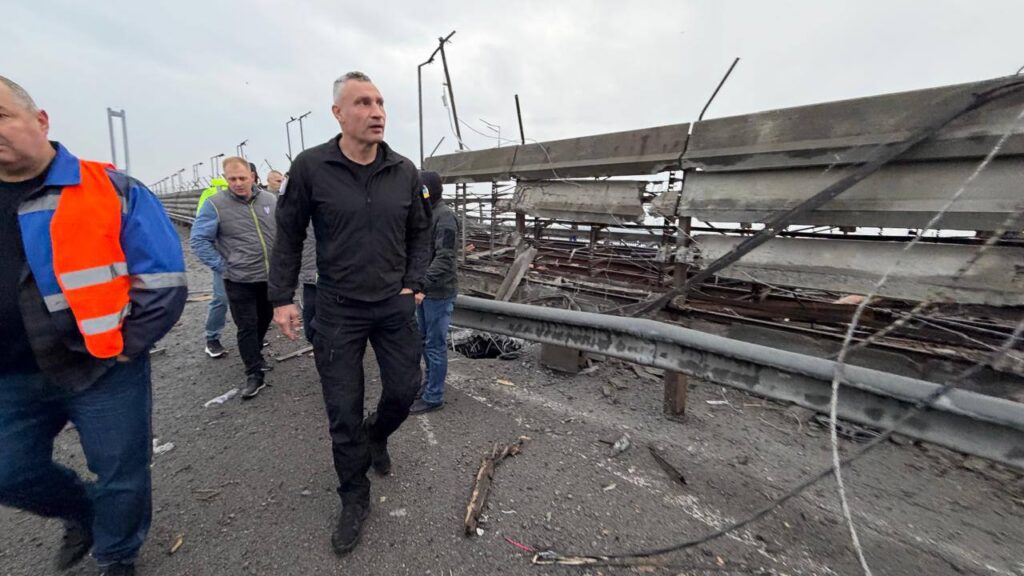
Kyiv Mayor Vitali Klitschko inspects damage on the Southern Bridge after a Russian ballistic missile strike, 27 October 2026

The Ukrainian government has instructed Kyiv to establish alternative routes after Russian attacks stopped traffic on one of the capital’s main bridges. The city authorities will bear the cost of the new crossings, with Kyiv Mayor Vitali Klitschko saying the city needs an additional $22 million.

This year, Russia has launched tactics to spread panic among civilians and trigger more people to leave the country. In the latest attack, several Russia's ballistic missiles struck the Southern Bridge, used for vehicle and metro traffic, breaking a huge hole and paralyzing all the pathes. The bridge was closed. Now, there is a fear that more bridges can be targeted this way, dividing Kyiv in two parts.

The situation is urgent, as Ukrainian Transport Minister Mykola Kalashnyk says about 600,000 vehicles cross the Dnipro in Kyiv every day.

What is Kyiv’s response to the winter terror? 

According to Klitschko, Kyiv convened the capital’s Defense Council on 28 October to find an answer to this difficult question.

The agenda included implementing a project to build combined water crossings over the Dnipro River and access roads to them.

“The military command will determine the locations, with approval to be granted, among others, by the Kyiv City Military Administration,” Klitschko said.

Under the government’s recommendations, the Kyiv city authorities must find $22 million for the project.

Klitschko had previously faced heavy criticism after it emerged that the city lacked sufficient shelters and last winter exposed serious shortcomings in preparing infrastructure for Russian attacks. These included a lack of alternative energy supply routes, poorly distributed energy, burst heating pipes that flooded apartments, and the inability of people with disabilities to reach shelters without elevators.

The mayor himself said the problems stemmed from the central government withholding funding, which had stalled numerous energy resilience projects and delayed their implementation.

The latest announcement also indicates that Kyiv has once again taken on the financial burden itself.

Meanwhile, Ukraine has been working with Japan on backup crossings. Tokyo has already delivered 720 meters of prefabricated bridge structures to Ukraine. The two sides are currently exploring how this equipment could be used to establish alternative crossings.

Step two: strengthening existing infrastructure

Another option is to reinforce existing bridges. City specialists are developing additional technical solutions to protect bridges across the Dnipro River, Klitschko said in his statement on 27 October, adding that proposals from the military had also been heard.

The issue of installing mobile shelters was also raised on the same day, the mayor of Kyiv said in a separate statement on his Telegram channel on 27 October. Despite intensifying Russian attacks and about, as Radio Svoboda reported in its article on 30 September, $11 million set aside in 2025, Kyiv still has only a handful of mobile shelters: LB reported in December 2025 that district tenders failed. Donors paid for the first one at a bus stop, the Kyiv City State Administration said on 15 October.

Klitschko raised the issue of shelters again after a court on 12 October ruled that local authorities must urgently install mobile shelters in public areas, including near public transport stops, parks, and squares, according to Kyiv’s Prosecutor’s Office.

Russia hits the Southern Bridge again

On 2 October, Ukrainian President Volodymyr Zelenskyy said in an interview with the Financial Times that Russian ruler Vladimir Putin had ordered the lifting of previous restrictions on airstrikes. Among new targets, according to him, were bridges, data centers, internet, mobile networks, hospitals, kindergartens, schools, and universities.

The night of 26–27 October showed what that looks like. Russia launched ballistic missile attacks in a few waves, and the second of them hit the Southern Bridge and the metro infrastructure on it, Klitschko said. The structure carries six lanes of road traffic and two metro tracks.

Rescuers work beside a fence pocked by shrapnel in Kyiv after the Russian attacks of 26–27 October 2026
Rescuers work beside a fence pocked by shrapnel in Kyiv after the Russian attacks of 26–27 October 2026. Photo: DSNS Kyiv

Zelenskyy put the night’s total at 16 ballistic missiles and blamed delays in deliveries of Patriot and NASAMS interceptors: “Every such delay is a new Russian hit on one target or another.”

  •  
❌