Login

High-speed diesel price crosses Rs400 with Re0.85 increase; no change in petrol rate
Official ex-depot prices (PKR/litre) — OGRA & Ministry of Energy notifications



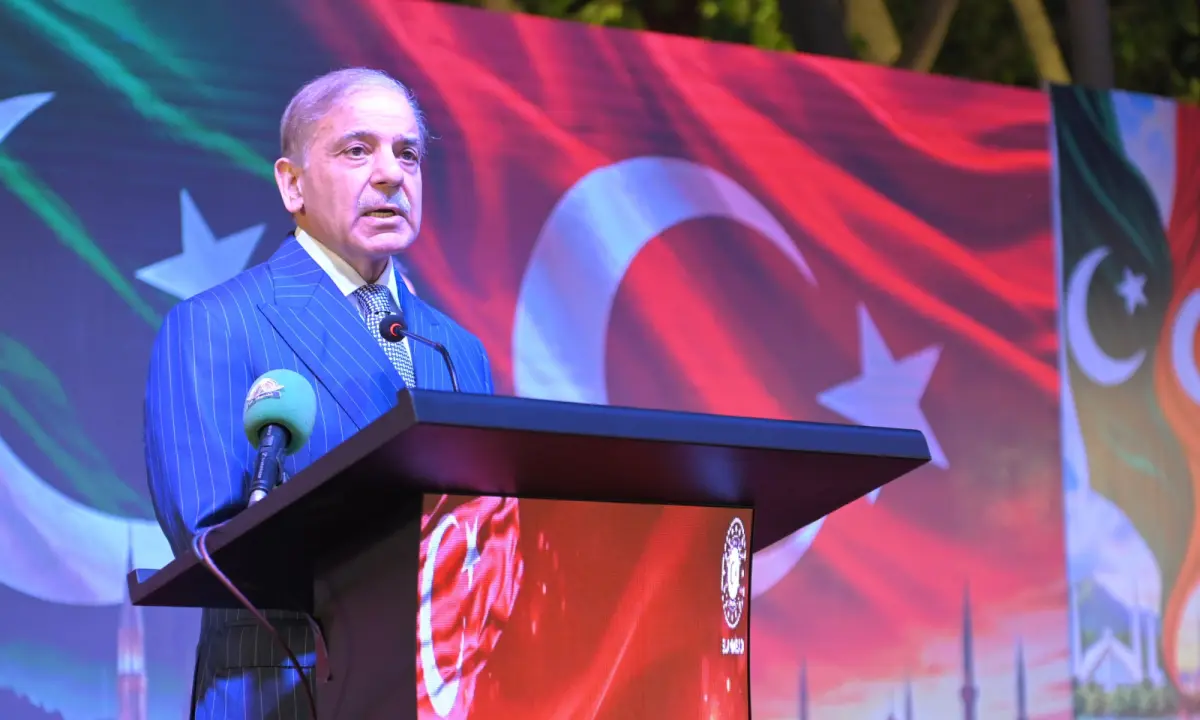
Prime Minister Shehbaz Sharif on Thursday affirmed that Pakistan and Turkiye would continue to push for dialogue and diplomacy while strengthening their defences under the Makkah Defence Agreement.
He made the remarks while addressing an event in Islamabad marking the 103rd national day of Turkiye, with which Pakistan enjoys strong bilateral ties and maintains multi-sectoral cooperation.
The premier said the pact, signed on Aug 7 between Pakistan, Turkiye and Saudi Arabia, marked an “important milestone” in cooperation between Islamabad and Ankara.
“It strengthens our collective deterrence and reinforces our shared commitment to regional peace and stability,” PM Shehbaz noted.
“While we strengthen our defences, we shall continue to champion dialogue, diplomacy, respect for international law and the peaceful settlement of disputes.”
The prime minister hailed Turkiye’s diplomatic support during Marka-i-Haq last May, when India initiated unilateral aggression against Pakistan, triggering a four-day conflict between the nuclear-armed neighbours.
“Turkiye stood firmly by our side with unwavering commitment and dedication. This sincere act of solidarity was a profound source of comfort and strength for the people of Pakistan, a gesture that will forever remain etched in our hearts and our memories,” he emphasised.
Additionally, the premier observed that Islamabad and Ankara’s relationship had evolved into a “multifaceted strategic partnership”, spanning political dialogue, defence, trade, culture and people-to-people ties, among other areas.
He stressed that the economic partnership between Pakistan and Turkiye needs to match the heights of the political and strategic bond between both nations.
“In July this year, at the Pakistan-Turkiye business conference in Istanbul, I announced the establishment of the President Tayyip Erdogan Special Economic Zone in Karachi,” PM Shehbaz said.
“Now I invite Turkish businessmen to look at Pakistan with its young population, strategic location and growing economic opportunities. Let us translate the goodwill between our two peoples into joint ventures, shared prosperity and meaningful jobs for our young people.”
During his speech, the prime minister highlighted the longstanding, historic ties that the two countries shared, recalling that during the Khilafat Movement — a campaign to protect the Ottoman Empire after World War I — people donated whatever they could from the subcontinent, including money and jewellery, to support their “Turkish brethren”.
“A century ago, our forefathers sent their love across the seas. Generations later, that love returned to our doorsteps during our darkest times,” he added, referring to humanitarian aid from Turkiye during the 2005 earthquake and the devastating floods of 2010.
PM Shehbaz also highlighted that under Turkish President Recep Tayyip Erdogan’s instructions, Turkiye established a modern hospital, a school and modern villages for the people of Muzaffargarh after the floods.
“The 100 years between the Khilafat Movement and that moment seemed to close into a single circle,” the premier said, noting that when a massive earthquake rocked Turkiye in February 2023, “the people of Pakistan grieved as if the rubble lay upon our own homes”.
“We stood with our Turkish brothers and sisters, in their hour of sorrow, just as they had stood with us.”
Earlier this week, Pakistan, Turkiye, Saudi Arabia and Iran participated in a quadrilateral meeting where Iranian President Masoud Pezeshkian called for “regional unity” and hoped that the presence of other Islamic powers would “further consolidate regional unity and cohesion”.
Earlier this month, both nations signed an agreement to enhance cooperation in combating terrorism, narcotics trafficking and organised crime and agreed to establish a joint working group to strengthen collaboration between their interior ministries.
The decisions were taken during a meeting between Interior Minister Mohsin Naqvi and his Turkish counterpart Mustafa Çiftçi in Istanbul.
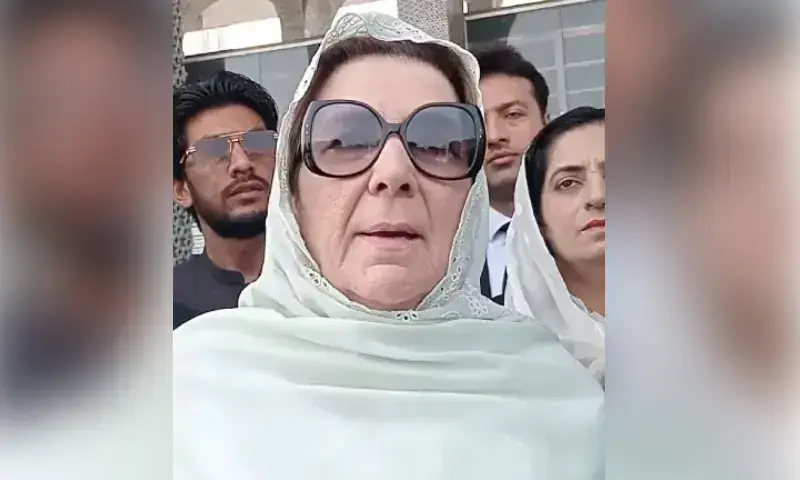
Adviser to the prime minister on political affairs, Rana Sanaullah, on Thursday informed the Senate that Noreen Niazi, the sister of jailed PTI founder Imran Khan, was fine after being provided medical treatment in Lahore.
Imran’s three sisters — Noreen, Aleema Khan, and Uzma Khan — have been in detention since Sept 21 under the Punjab Maintenance of Public Order Ordinance, 1960 (MPO) on the Lahore deputy commissioner’s (DC) orders.
On Wednesday, Noreen’s lawyer said that she was moved from Lahore’s Kot Lakhpat jail to the Punjab Institute of Cardiology (PIC) due to high blood pressure. Her lawyer claimed that no family member had been informed about her deteriorating health condition.
Speaking on the floor of the Senate on Thursday, Sanaullah responded to the query by PTI parliamentary leader Barrister Ali Zafar, who sought information regarding Noreen’s health and her being taken to the hospital.
The PML-N senator said Noreen was “immediately provided with medical facilities”.
“As per the information available, she is fine and all her medical tests are normal,” he said.
On concerns about Noreen’s family allegedly not being allowed to meet her, the prime minister’s adviser said details would also be sought on the matter. He assured the PTI that if this was true, it would be addressed depending on the circumstances at the hospital.
During his address, PTI Senator Mashal Yousafzai continued to interrupt Sanaullah, questioning the need for Noreen’s detention.
The PML-N senator replied: “She is in jail because she wanted to spread turmoil in the country. She wanted to attack Islamabad by launching a long march and inciting the people.”
Addressing Zafar, Sanaullah said that as the PTI founder was in jail under judicial custody, any relief regarding his health and meeting should be sought from the courts.
Imran’s sisters are currently serving the second term of a 30-day detention under the MPO, which was extended on Oct 7. The detention came amid reports of a crackdown on the PTI ahead of its countrywide protest and march to Islamabad, which the party had called to demand Imran’s release from jail and mobilise people for the supremacy of the Constitution.
In his remarks on the Senate floor, Zafar contended that Noreen had been detained despite not having committed any crime.
While Noreen’s lawyer had said she had faced high blood pressure, Zafar said she suffered a heart attack and claimed that her family was not being allowed to meet her.
Quoting Shakespeare’s phrase “milk of human kindness”, Senator Zafar said if even a little human kindness remained, the government must immediately stop grave human rights violations.
“If there is even a minimum of human kindness left in you, release her. At least allow her family to meet her and ensure proper medical care,” he said while speaking on a point of order.
He also condemned the detention of Imran’s nephews, asking why family members should suffer for their relationship with a political leader.
He alleged Imran had been kept in solitary confinement for a year and was being subjected to torture, claiming that the PTI founder’s wife Bushra Bibi was also facing inhumane treatment.
He demanded an immediate end to their mistreatment, which the government denies, saying both are being provided with the facilities they are entitled to.
Zafar claimed that the government believes the Constitution can be broken and suspended, as witnessed in the imposition of governor’s rule and emergency in Khyber Pakhtunkhwa, which has rendered the elected provincial government non-functional.
“There is one thing that cannot be broken, suspended or compromised: the fundamental human rights of the people of Pakistan,” he asserted.
Senator Zafar stressed that even if governor’s rule was claimed to be justified, it could never be a licence to violate fundamental rights, detain the chief minister, speaker and elected representatives, or keep their whereabouts undisclosed.
He warned that violating the sanctity of home and family honour, which hold deepest importance in Pashtun society, would provoke strong resentment among people of KP.
He also referred to reports of attacks on homes of MNAs and alleged violence against their wives and sisters, calling for impartial investigation.
“These are not merely political issues. These are matters of human rights, human dignity, family honour and rule of law. Human rights stand above politics,” he said.
Concluding, he said: “The Constitution may be violated by those who wield power, democratic mandates may be undermined, and institutions may fail in their duty. But we must never allow our humanity to fail.”
Meanwhile, in a statement, the PTI condemned the transfer of 70-year-old Noreen to the PIC without informing her family, expressing grave concern over her health and the treatment of “political prisoners”.
PTI Central Information Secretary Sheikh Waqas Akram criticised the authorities for not informing Noreen’s family after she felt unwell while in custody at the Kot Lakhpat jail.
He described the handling of her medical emergency as “callous and inhumane”, arguing that denying family members timely information about the condition of an elderly heart patient raised serious questions about prisoners’ rights, legal safeguards and basic human dignity.
“Noreen Niazi’s transfer to the PIC without prior notification to her family is alarming,” Akram said, demanding an immediate explanation from the Punjab government and the relevant authorities.
He demanded that Noreen receive the best possible medical treatment under the supervision of senior cardiologists without any delay, that her necessary diagnostic tests be conducted, and that her family be allowed access in accordance with applicable law.
“The authorities must provide her family with complete, credible and timely information about her condition,” the PTI leader further stressed.
Warning the government against disregarding fundamental rights in the alleged pursuit of political objectives, he said the PTI would not compromise on the protection of human life, health or constitutional freedoms under any circumstances.
Additional input by Ikram Junaidi
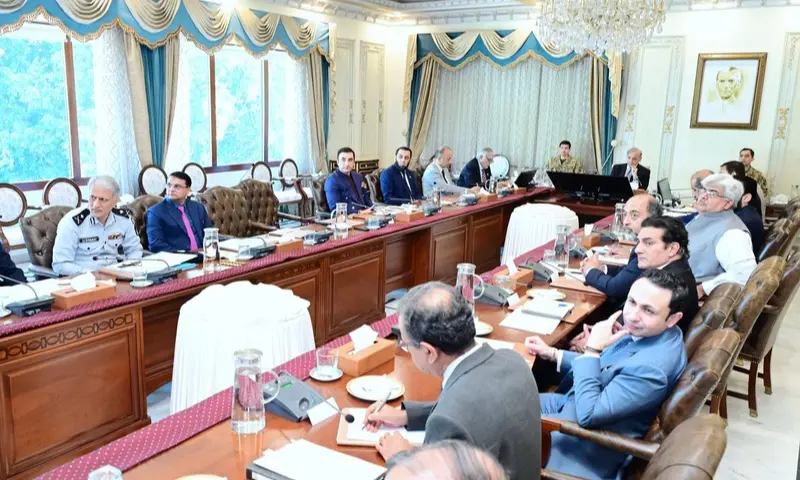
Prime Minister Shehbaz Sharif on Thursday approved the expansion of Allama Iqbal International Airport and Jinnah International Airport as outlined in their respective masterplans while seeking to turn Karachi into an “air cargo hub”.
According to a statement by the Prime Minister’s Office (PMO), the directives came during a meeting held in Islamabad under the premier’s chairmanship. It was attended by Deputy Prime Minister and Foreign Minister Ishaq Dar, federal ministers Khawaja Asif, Musadik Malik, Ahad Khan Cheema, Attaullah Tarar and other senior officials.
The statement said the meeting was briefed on a survey recently completed by an international firm assessing the quality of travel facilities at major airports.
During the meeting, the premier directed that no compromise be made on quality in the expansion projects, that they be aligned with international requirements and that third-party validation be ensured for reforms aimed at improving the expansion projects.
The meeting was informed that work on the installation of automated border management systems (e-gates) at major airports was underway. Furthermore, “work is also ongoing on the air cargo village to make Karachi an air cargo hub,” the statement said.
Per the statement, it was discussed that facilitating passengers at Pakistani airports should be made the “top priority”. PM Shehbaz directed that facilities be improved in line with international standards. To that effect, he directed to obtain the services of internationally renowned institutions.
He also emphasised the provision of regular training in high-quality service delivery to officers and staff facilitating passengers at airports, along with an improvement in the coordination among various entities present at airports.
“The services of the best caterers [should] be obtained for passengers at airports, and there will be no compromise on the quality of food and beverages,” the statement said.
The meeting was further briefed on the upgradation of various airports across the country and ongoing development work by the Civil Aviation Authority (CAA).
Furthermore, the meeting was informed that the expansion of the runway at Jinnah International Airport had been completed. According to the PMO, the Federal Investigation Agency (FIA) had also increased the number of staff and counters, keeping in view passenger convenience.
A meet-and-greet service had been launched at Islamabad airport, the statement added. Similarly, the FIA had established pre-departure desks at major airports in the country for timely guidance to passengers.
“The meeting was informed that the existing aviation institution in Hyderabad is being further improved to establish an international standard aviation university, with work to commence by February 2028,” PMO’s statement said.
Earlier this month, PM Shehbaz had also ordered the installation of “smart scanners” at all international airports to facilitate travellers.
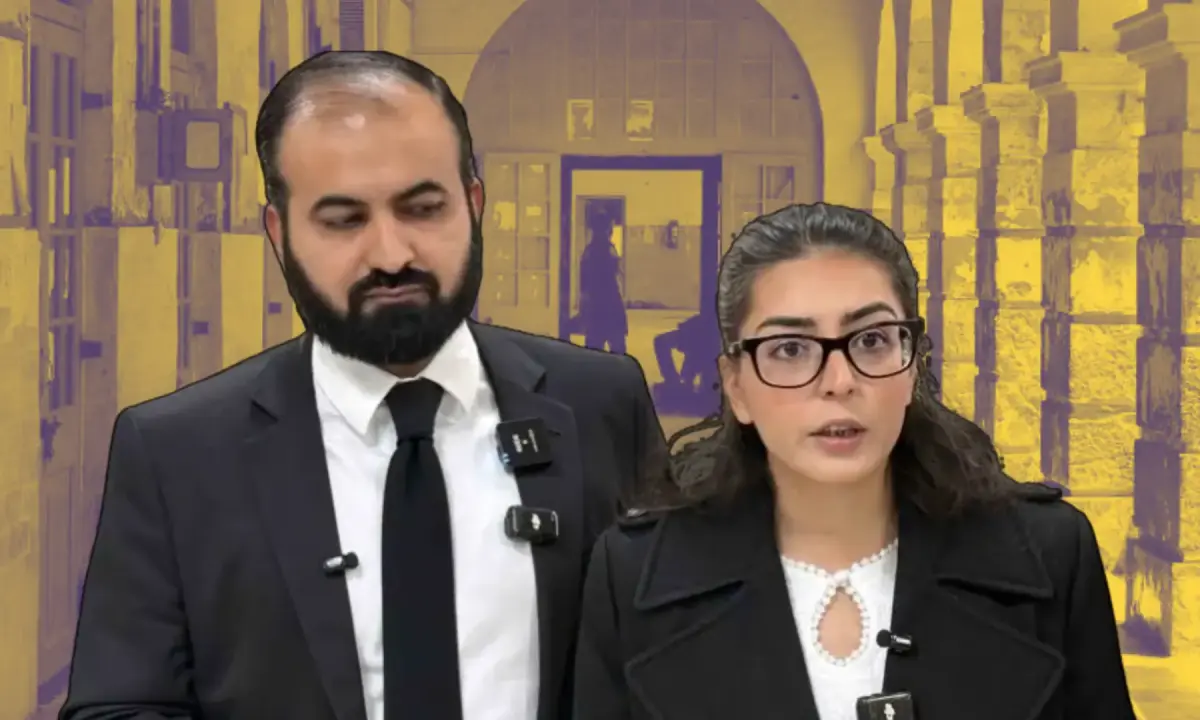
Human rights lawyer Imaan Zainab Mazari-Hazir and her husband, Hadi Ali Chattha, were convicted for the second time in less than a year on Thursday. This time, the couple was sentenced to 10 years in a security breach case following a jail trial.
The 2024 case pertained to the alleged disruption of an international cricket team’s security route and incitement to public unrest. The couple, accused of removing barriers from the route, was indicted on Oct 7.
After an anti-terrorism court pronounced them guilty, journalists and lawyers raised questions and expressed reservations.
Legal adviser for the International Commission of Jurists Reema Omer termed the convictions “cruel, vindictive and textbook examples of using law and the judicial process as weapons of persecution”.
“Imaan and Hadi are prisoners of conscience,” she posted on X.
Lawyer Rida Hosain said the convictions were “a stain on our judicial system”.
“Those entrusted with upholding the rule of law are weaponising it to persecute courageous human rights lawyers.
“This only further exposes a system that is functioning as an instrument of repression,” she said.
Op-ed editor at The News, Zebunnisa Burki, reacted to the development with “beyond ridiculous”.
Journalist Zarrar Khuhro also pointed out that the couple was sentenced to 10 years for “removing a barrier”.
“A decade in jail is what rapists usually get,” he said.
Journalist Asma Shirazi reacted to the news by calling it “reprehensible and regrettable”.
Journalist Maryam Nawaz Khan criticised the judgement saying: “A sham/ secret trial delivers a sham sentence. Imaan Mazari and Hadi Ali Chattha, two human rights lawyers, sentenced to 10 years in prison over road barriers they maintain they never removed. First, their tweets; now, this. Criminalising dissent and persecuting lawyers is an assault on fundamental rights and constitutional freedoms. This sentence is outrageous and unlawful.”
Academic Nida Kirmani said the couple was “paying the price for standing up to a cruel and vindictive state run by petty men with fragile egos”.
“Absolutely absurd verdict,” she said.
Journalist Saqib Bashir said the couple was sentenced without a “transparent” trial.
“This is a mockery of the judiciary and the justice system; it is a judicial murder of dissenting voices,” former Jamaat-i-Islami senator Mushtaq Ahmed said.
“Imaan and Hadi are strong voices against enforced disappearances and extrajudicial killings and that is their only crime,” he said.
“Those who speak up for justice face jail. Those who justify the state’s dictatorial actions ascend to higher positions,” journalist Veengas said.
The National Commission for Human Rights also expressed serious concern, saying the right to a fair trial, due process and effective judicial remedies must be fully protected.
“The severity of the sentences raises concerns about proportionality and the protection of fundamental rights,” the commission said.
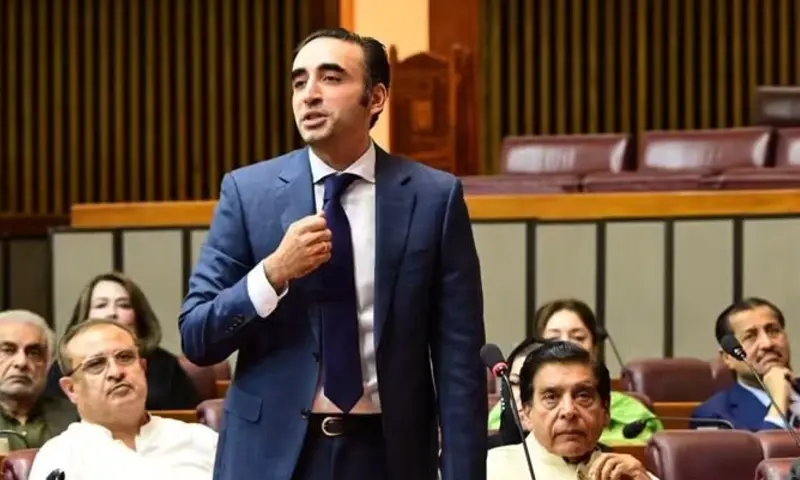
PPP Chairman Bilawal Bhutto-Zardari on Thursday urged National Assembly Opposition Leader Mehmood Khan Achakzai to use the “authority and power” delegated to him by jailed PTI founder Imran Khan to direct opposition members to participate in House committees and discuss pressing national issues.
He made the remarks while addressing the National Assembly during a session chaired by Deputy Speaker Syed Ghulam Mustafa.
Addressing the House, Bilawal called for strengthening Parliament by taking decisions on matters of national interest collectively on a single platform.
“If Parliament is powerful, we are all powerful; this is the power bestowed on us by the people of Pakistan,” he said.
Urging the speaker and the government to fulfil their responsibilities, the PPP chairman also called on the opposition to play its role in the House.
“Those who want this House to remain dysfunctional and do not want the people of Pakistan to benefit from it have succeeded,” he said, pointing towards the opposition benches. “Congratulations to you,” he added sarcastically.
“You have played a part in helping these people achieve their objective,” he said, criticising the opposition.
Bilawal also criticised the opposition’s decision to boycott committee proceedings, saying it had contributed to the “weakening” of Parliament.
“It is your responsibility to represent your party, the people and your constituencies in these committees. However, you are not raising their concerns on the relevant platforms,” he said.
Turning to Achakzai, Bilawal urged the opposition leader to use the “authority and power” delegated to him and the Senate opposition leader by Imran Khan to direct opposition members to participate in committee proceedings and discuss pressing national issues.
Bilawal said that since Parliament had decided, on a motion moved by the PPP, to constitute a committee on electoral reforms, the opposition leader should nominate a representative to the committee and submit the name to the speaker’s office.
He recalled that the opposition had described electoral rigging as its “fundamental issue”.
Urging the opposition leader to participate in the committee’s proceedings, Bilawal said the move was necessary if the opposition wanted the issue of alleged rigging to be addressed before the next general election, local government polls or by-elections.
The PPP chairman also described participation in the committee as a fundamental step towards restoring Parliament’s respect and authority.
“I request the opposition to at least exercise the power it has,” he said, questioning the purpose of an electoral reforms committee if the opposition did not participate in its proceedings.
“If we make efforts to bring all stakeholders together in a committee or arrange a briefing on terrorism, economic and security issues, and other concerns without the opposition’s participation, it will be pointless,” he said.
Against the backdrop of the evolving geopolitical situation, Bilawal called for the foreign, interior and defence ministers to brief the House on the challenges facing Pakistan.
“Tell this House about the potential threats facing Pakistan and the region, particularly as three key maritime routes are closed,” he said.
He also called for a briefing on developments related to the war in Iran and its implications for Pakistan. In addition, he sought a briefing from the government on the recent defence pacts signed by Pakistan.
“Every member of this House has the right to be informed about the challenges facing Pakistan, whether terrorism or other domestic issues, the steps being taken to address them and their potential consequences in the days ahead,” he said.
Addressing a rally in Karachi earlier this month, Bilawal had also extended an olive branch to the opposition parties, saying their positive engagement with the federal government could result in the reversal of governor’s rule in Khyber Pakhtunkhwa.
The PPP chairman had invited the opposition to join the Parliamentary electoral reforms process and “engage with the federal government”.
The Centre imposed governor’s rule and emergency in KP on Oct 11, citing the provincial government’s “deliberate disengagement” from the fight against terrorism. The move had drawn criticism from the opposition.
Separately, a PPP delegation met Achakzai and invited the PTI to join the parliamentary committee on electoral reforms, according to a statement the party issued on X.
The PPP delegation comprised of Raja Pervez Ashraf and Syed Naveed Qamar. Senate Opposition Leader Raja Nasir Abbas was also present.
The delegation invited Achakzai to participate in the parliamentary committee to promote consultation and discussion among parliamentary representatives on electoral reforms, the statement said.
Later, in a press conference, Ashraf said the PPP delegation had a meeting with Achakzai on Bilawal’s instructions to invite him to join the committee.
“The PPP wants the PTI to participate in parliamentary standing committees as well as the electoral reforms committee,” he added.
Achakzai had sought time to consult before responding to the invitation, he said.
The PPP has consistently sought to improve the electoral process, Ashraf said, adding that PTI also wanted electoral reforms.
“The PTI will respond to the PPP after consultations,” he said.
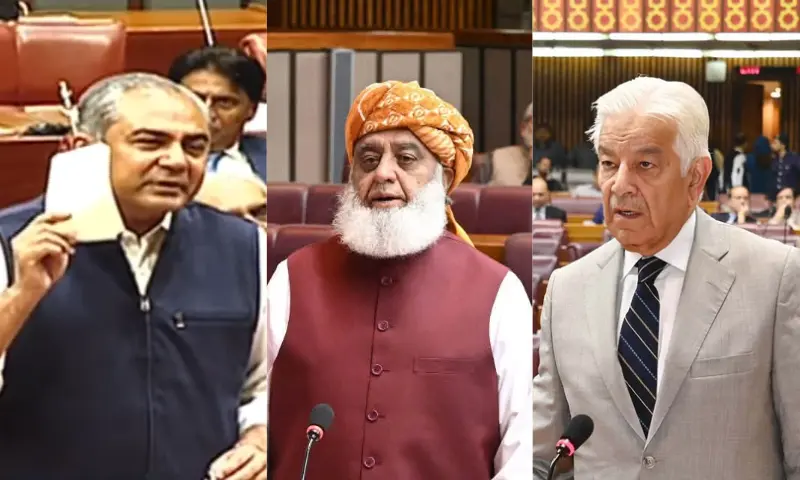
Federal ministers on Thursday responded to Jamiat Ulema-i-Islam-Fazl (JUI-F) chief Maulana Fazlur Rehman’s remarks regarding a recent huddle in Tehran comprising the Makkah defence pact countries and Iran.
Defence Minister Khawaja Asif and Interior Minister Mohsin Naqvi said the meeting was not related to defence. Hence, Asif said his presence was not required, while Naqvi explained the reasons for his participation.
The remarks came after the JUI-F chief questioned Asif’s absence and Naqvi’s presence at the meeting.
The meeting brought together top officials from Iran and member countries of the Makkah Defence Alliance — including Pakistan’s Chief of Defence Forces and Chief of the Army Staff Field Marshal Asim Munir, Saudi Defence Minister Prince Khalid bin Salman, and Turkish intelligence chief Ibrahim Kalin.
On Iran’s side, President Masoud Pezeshkian, Supreme National Security Council Secretary Mohsen Rezaei and Foreign Minister Abbas Araghchi were present. The huddle agreed to “continue their dialogue to bolster cooperation among the four regional nations, including in the areas of regional peace and security”.
On Wednesday, Fazl referred to the development during his address in the National Assembly (NA) and commented: “A defence pact is taking shape in Iran, a meeting is under way (there), and the defence minister is sitting here.”
Amid laughter and desk thumping in the Lower House, he referred to Naqvi’s presence at the Tehran huddle and questioned: “The interior minister is required there as well?”
Then, taking a jibe at Asif, he repeated the defence minister’s phrase that he had used against the PTI.
“There is your respect and stature — koi sharam hoti hai, koi haya hoti hai (have some shame, show some modesty),” he said, breaking into laughter.
Responding to him in the NA on Thursday, Asif said no defence pact was taking shape in Tehran, nor was the discussion focused on Pakistan’s defence or any related matter.
He said CDF Munir had “assumed a role for Pakistan” following last year’s military conflict with India. That role, he said, was of “peace and dialogue so that peace is established in our region”.
Since then, he noted, Pakistan has signed two defence pacts — the Makkah defence pact and the Badr Memorandum of Understanding.
“I was involved in those pacts as I am the defence minister,” he explained, adding that the meeting in Tehran was “not the defence ministry’s mandate”.
The CDF had gone there “as a messenger of peace and paved the ground” for the huddle, he said, ostensibly referring to Tehran last week.
During that visit, the CDF had proposed the Tehran meeting, according to Iranian Foreign Ministry spokesman Esmaeil Baqaei.
Asif said this was the situation and he was “not needed in Tehran”.
He added that the CDF had played a role in averting a confrontation. “The situation could have deteriorated as far as the Yemen issue is concerned […] There has been some talk and peace may emerge in the coming days or week as far as Saudi Arabia versus Yemen [sic] is concerned.”
Asif advised Fazl to be the bigger person and said his criticism was “misplaced”.
The defence minister further said Pakistan’s and the CDF’s role at the international level should be acknowledged, keeping political differences aside. He said one should at least show some dignity.
Meanwhile, in the Senate, Naqvi also responded to Fazl’s remarks on his participation in the Tehran meeting. The proceedings were marred by loud exchanges between the interior minister and JUI-F Senator Kamran Murtaza.
Naqvi clarified that he and CDF Munir undertook the visit to “handle the ongoing crisis in Iran”.
On Fazl’s query of why Asif had not gone there, he said, “He (Fazl) did not know that this [trip] was not related to defence.”
Defending his inclusion, the minister said: “I do not go out of my own volition. I have been especially tasked by the prime minister sahib; he has entrusted me with some matters regarding the current crisis of the [Iran] war, because of which I go.”
The independent senator noted that the JUI-F had been commenting on him for many days.
“I personally had heartfelt respect for Maulana Fazlur Rehman, but yesterday when he said I spit on the state, that respect ended,” Naqvi said.
Naqvi said he wanted to ask Fazl and his party’s senators present there just one question and then noted that JUI-F leaders had made very “disgusting statements about institutions” three to four months ago.
This prompted Senator Murtaza to object, saying he could not speak on a personal agenda in the House. Presiding Officer Shahadat Awan also immediately said he was expunging the word “disgusting” from Naqvi’s remarks.
As Murtaza continued shouting, Naqvi said, “You should listen here … You will have to listen.”
The presiding officer noted that Naqvi was a member of the Senate and urged the JUI-F leader to take his seat.
Resuming his remarks, Naqvi said, “Giving people the perception that this was a defence pact; this was not a defence agreement at all.
He added: “For them, the state is like a mother until the day they can squeeze it dry. The state is very good as long as they can extract wealth from the state, and when you do not get a share in the state and the government, then you spit on the state. This is not appropriate anywhere.”
Murtaza again interrupted, objecting to Naqvi’s language, at which the latter replied that the other side had also used similar language a day ago.
As the JUI-F senator continued speaking amid the presiding officer’s calls to halt cross-talk, Naqvi said, “If they criticise, they should garner and keep the courage to take the answer as well. This is no way [to behave] that you go and say whatever you want.”
The interior minister then went on to criticise the JUI-F, alleging that it “used Islam for business and for politics”.
Amid the ruckus, PML-N’s Abid Sher Ali also stood up and responded loudly, prompting State Minister of Interior Tallal Chaudhry and the presiding officer to urge him to take his seat.
Naqvi then addressed PTI’s Ali Zafar and said, “These very people (JUI-F) used to come to us before governor’s rule [was imposed] and say, ‘Impose governor’s rule, rid us of them!’ […] Those who come and sit with you and engage in opposition wanted governor’s rule imposed from their hearts. I will prove this to you.”
Addressing JUI-F, the interior minister said, “Now, you will not get jobs in the state. Now you will not get money from the state, nor will you get tickets from the state.”
He asserted that it was the JUI-F that was “continuously crossing the line” and that they would get a response if they kept doing so.
In his remarks in the NA, Asif alleged that Fazl’s past “is full of contradictions”.
“You taunt me with ‘have some shame, show some modesty’, but you should also have some shame and show some modesty. How many perks have you enjoyed over the past 40 years? You have been violating the very principles that you have been highlighting,” the PML-N leader said.
He recalled that Fazl had also offered to mediate with Kabul. “Were you the foreign minister?” he questioned, alleging that the move was aimed at “value addition to his politics and leverage that to extract maximum advantage from the government”.
Asif said Fazl had been in the government with every political party, making an incomplete remark: “When you don’t get a share in the power —”
“When you delete the past from your memory and attack your rivals — at least I don’t have that courage. When I speak, my past is fresh in my mind; that if I say this, whether I would be taunted that we supported General Ziaul Haq’s government,” he went on to say.
The defence minister recalled that Fazl was part of the Musharraf government, had also been an opposition leader in the House and also served as the Kashmir Committee chairperson. He said a person serving as the head of such a committee that raises issues at an international forum should have “impeccable credentials”.
When some lawmakers opposed him in favour of Fazl, he remarked, “The Maulana now needs women’s support. He is unable to find a man.”
He also accused Fazl of “targeting our diplomatic efforts”, saying that the government’s achievement at the global stage had not received the commendation they deserved.
Asif said his advice to the JUI-F would be a line often seen on buses and trucks: “Mehnat kar, hasad na kar (work hard and don’t envy).”
He ended his address, alleging that had Fazl been given some share in the governance in Khyber Pakhtunkhwa following the imposition of emergency and governor’s rule in the province, the JUI-F chief’s address the previous day would not have been delivered.
“This sideshow that they (JUI-F) are running, I feel that it is unfortunate that our sisters have been forced to defend the men [of JUI-F] while the men are nowhere to be seen,” Asif remarked.
Describing Fazl’s address as “blackmail”, Asif warned against coming into power based on “compromises”.
“Sitting in the opposition would be a more respectable approach, rather than sitting with people who will blackmail you,” he said.
“We as senior parliamentarians should convey to the nation that we will not do group-based politics but politics rooted in the constitution and [..] for the security of the country,” Asif urged, adding that lawmakers should chart a way forward together, rather than “grabbing each other by the collar”.
In remarks after the Senate ruckus, JUI-F’s Murtaza accused the government of staging a “requested programme”.
“I think nizam sahib (Mr System) sent messages and made calls to many people today, and told them to sling mud at Maulana sahib like this,” he said on Geo News’ programme ‘Aaj Shahzeb Khanzada Kay Sath’, apparently referring to Naqvi.
Murtaza questioned why Asif “suddenly remembered” to respond to Fazl the next day, rather than using his right of reply “even though he was present” in the NA yesterday.
He went on to object to the interior minister making “personal accusations”, even though he could have simply explained that the prime minister had tasked him with peace efforts.
The JUI-F senator insisted that Fazl’s remarks were not particularly about Pakistan but “if a state starts making its children fight each other”, asking if the ministers were considering that the state was doing so.
Asked what Fazl implied, Murtaza maintained that the JUI-F’s stance was “about every such state” that engaged in such acts.
The senator also claimed that Chaudhry had approached him with an “offer for a certain thing” when he was in the Senate hall.
“Did I reject you or not? 26th Amendment,” Murtaza said, with Chaudhry acknowledging that a “lot of things were being discussed at the time of 26th Amendment” but “not everything should be disclosed”.
Meanwhile, appearing on the same show, the state minister for interior regretted that Fazl, despite being a senior politician and a religious leader, “made martyrs a point of his and discuss it to advance his politics”.
Chaudhry said he had noted immense anger and frustration visible in the JUI-F chief’s demeanour in recent days.
Asked if the government wanted a “clash” with the JUI-F chief, the PML-N leader said, “I think Maulana sahib is deliberately clashing and bringing up such issues, after which no option is left for us other than to respond to it. Today, I have never seen Kamran Murtaza sahib in such a state of anger in my entire life.”
He highlighted that Fazl had questioned “what has this state given us”. “Do you think the state has given you nothing?” he asked.
In his remarks, Senate Opposition Leader Allama Raja Nasir Abbas claimed KP had been “snatched from the people” and reiterated the opposition’s allegations of rigging in the 2024 general elections.
“If even one person’s vote is snatched, it is a crime. It is the responsibility of those conducting elections to protect the vote. Earlier also you laid a crooked brick, and Pakistan broke. On Feb 8, elections were stolen. While stealing elections, where have you reached — you have even stolen Khyber Pakhtunkhwa,” he claimed.
The opposition leader said no society could progress without law, or function if law existed but without its implementation.
The House also took up a motion moved by Minister of State for Law Barrister Aqeel Malik for the constitution of a parliamentary electoral reforms committee.
PTI’s Zafar said he could write down entire electoral reforms on paper in an hour. “The issue is implementation. Make such a committee and procedure that the electoral process is actually implemented. Whatever they want to do, only that is approved,” he said.
Barrister Aqeel said the issue could be resolved by sitting together and asked members to bring their proposals.

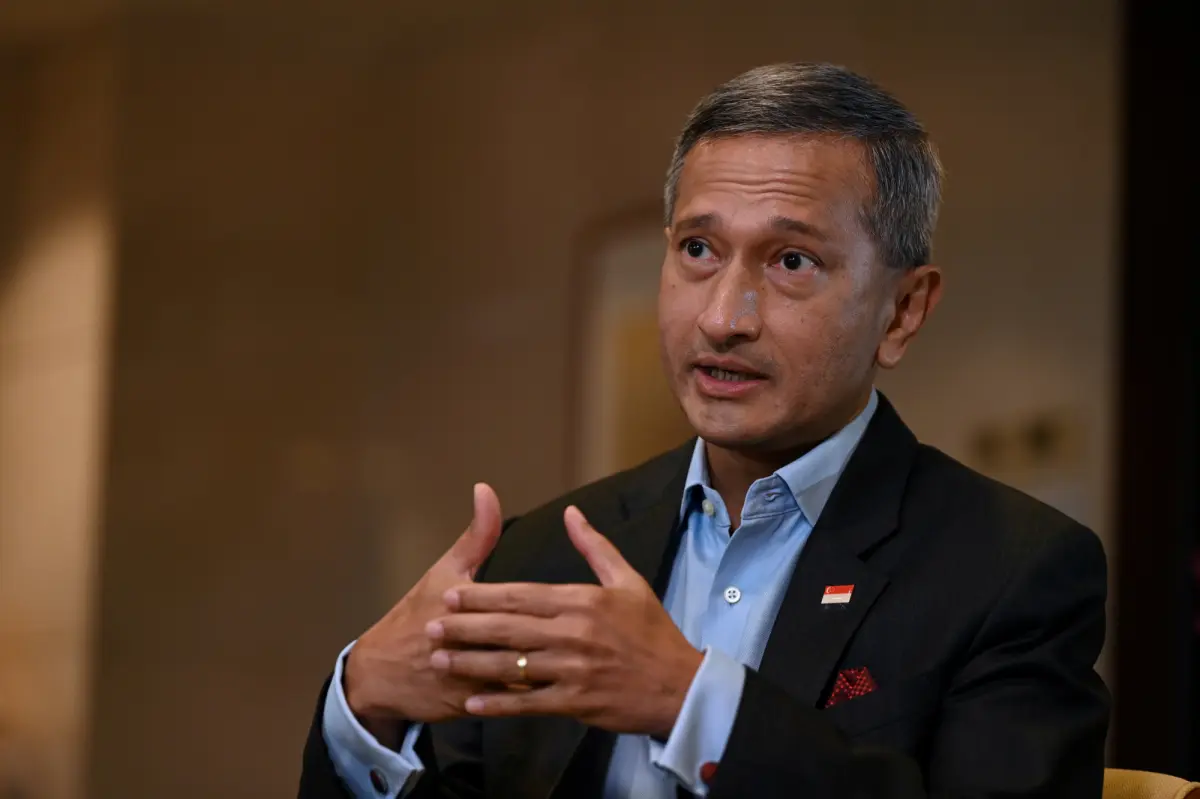
Singapore’s Minister for Foreign Affairs Dr Vivian Balakrishnan will undertake an official visit to Islamabad on Friday (Oct 30) at the invitation of Deputy Prime Minister and Foreign Minister Ishaq Dar, the Foreign Office (FO) said on Thursday.
“The visit assumes significance as it coincides with the 60th anniversary of the establishment of diplomatic relations between Pakistan and Singapore and comes ahead of Singapore’s assumption of the Asean chairmanship in 2027,” the FO said in a statement.
During the visit, Dar and Dr Balakrishnan will hold bilateral talks covering the entire spectrum of Pakistan-Singapore relations and exchange views on regional and global developments of mutual interest, it added.
A memorandum of understanding (MoU) on cooperation in disaster management between Pakistan’s National Disaster Management Authority (NDMA) and Singapore’s Civil Defence Force (SCDF) will also be exchanged.
Balakrishnan will also call on Pakistan’s leadership, the FO said.
Pakistan and Singapore maintain cordial bilateral relations based on mutual respect and longstanding friendship. The visit underscores the shared commitment of the two countries to deepening and diversifying their bilateral partnership, it added.
DPM Dar last spoke to Balakrishnan in May, requesting Singapore’s support in facilitating the “welfare and repatriation” of 11 Pakistanis and 20 Iranians aboard vessels seized by the United States.