❌

Reading view

US stocks slide as Google parent's revenue miss revives AI spending jitters

US stock prices retreated on Thursday, with investors reassessing big tech’s massive AI spending spree as they digested high-profile earnings, crucial inflation data and the US Federal Reserve’s policy decision.

All three major US stock indexes were in negative territory, with the Nasdaq dragged sharply lower by tech and tech-related megacaps in the wake of Alphabet’s disappointing quarterly results released late Wednesday.

In contrast, the smallcap Russell 2000 advanced 0.8 per cent.

Semiconductor stocks were poised to snap their four-day winning streak, dropping 2.0pc as investors sought to distinguish between companies that can fund their lofty AI ambitions from those that burn through cash and borrow funds to realise their ambitions.

Alphabet was in the latter camp following its quarterly report released late on Wednesday. The Google parent’s revenue miss was compounded by its accelerated AI-related cash burn. Its shares slid 13.2pc.

“A risk-off day like this, with small caps outperforming, is a good sign that thus far the market’s interpretation of cracks in the AI story doesn’t mean cracks in every corner of the market,” said Ross Mayfield, investment strategy analyst at Baird in Louisville, Kentucky.

“There’s plenty of other places to go with your money outside of the AI trade that have pretty decent prospects.”

On Wednesday, Federal Reserve policymakers chose to hold US rates steady, acknowledging that while price pressures remain “elevated”, the central bank will decide on its next move as it “accumulates more information”.

A raft of economic data released on Thursday answered that call, with a first take on third-quarter GDP that showed the US economy grew at a faster-than-expected pace in the third quarter, while price growth continued to gain heat with a war-related oil supply crunch feeding into broader, systemic inflation.

The Dow Jones Industrial Average fell 315.36 points, or 0.59pc, to 52,163.07, the S&P 500 lost 48.73 points, or 0.63pc, to 7,695.25 and the Nasdaq Composite lost 441.15 points, or 1.66pc, to 26,108.35.

Among the 11 major sectors in the S&P 500, communication services and tech were down the most, while healthcare led the gainers.

Third-quarter earnings season has crossed the halfway point, with 253 of the companies in the S&P 500 having reported. Of those, 81pc have beaten analyst expectations, according to the most recent LSEG data.

Analysts now expect aggregate third-quarter S&P 500 earnings growth of 31.0pc, year-on-year, per LSEG.

Caterpillar topped quarterly profit estimates but left its growth targets unchanged. The heavy equipment maker’s shares tumbled 9.5pc.

Eli Lilly jumped 6.3pc after the drugmaker lifted its revenue outlook on the strength of weight-loss drug sales.

Ford gained 2.9pc following the automaker’s third-quarter revenue beat.

Merck beat earnings expectations on the strength of its cancer drug Keytruda and its HPV vaccine Gardasil. The drugmaker’s shares advanced 4.4pc.

Software stocks were broadly weak. Fortinet and ServiceNow dropped more than 20pc each after their quarterly results.

Marvell Technology slumped 12.8pc after media reports said the company was in advanced talks to buy data-centre optics maker Lumentum Holdings. Lumentum shares rose 2.0pc.

Amazon’s shares were off 3.9pc ahead of its earnings report, expected after the closing bell.

Advancing issues outnumbered decliners by a 1.59-to-1 ratio on the NYSE. There were 113 new highs and 155 new lows on the NYSE.

On the Nasdaq, 2,416 stocks rose and 2,221 fell as advancing issues outnumbered decliners by a 1.09-to-1 ratio.

The S&P 500 posted 19 new 52-week highs and six new lows, while the Nasdaq Composite recorded 81 new highs and 131 new lows.


  •  

Afghanistan's Rashid Khan becomes first men's player to claim 200 T20I wickets

Former Afghanistan captain Rashid Khan became the first bowler to claim 200 wickets in men’s Twenty20 Internationals on Thursday, reaching the milestone during Afghanistan’s second T20 against Zimbabwe in Sharjah.

The leg-spinner brought up the landmark when he trapped Tadiwanashe Marumani lbw for two in the ninth over.

Rashid achieved the feat in his 120th T20 international, with the 28-year-old boasting an average of 13.96 and an economy rate of 6.13 in the format.

His record includes two five-wicket hauls, with best figures of 5-3.

The Afghan sits comfortably atop the list of leading wicket-takers in men’s T20 internationals with 200 wickets, 29 clear of England’s Adil Rashid in second place.

Rashid Khan became the first Afghanistan bowler to reach 200 ODI wickets during a match against Bangladesh in Abu Dhabi in October last year.

  •  

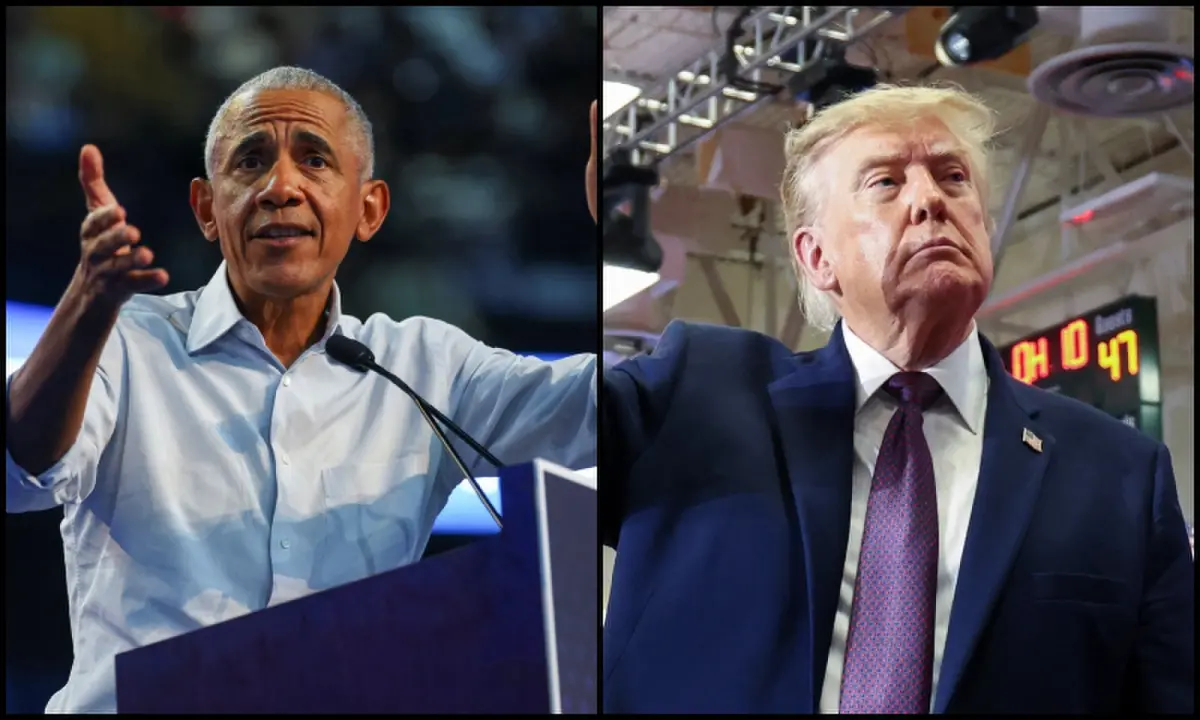
Obama mocks Trump’s government-wide response to Cheesecake Factory remark ahead of US midterms

Former US president Barack Obama on Wednesday mocked President Donald Trump for mobilising a government-wide response to his earlier remark that Trump had “got the White House looking like Saddam Hussein opened a Cheesecake Factory”.

“The White House even called the Secretary of Treasury,” Obama remarked, as he continued his campaign ahead of the congressional races in the US.

Obama quipped, “This is the man who is in charge of the economy. The person who’s supposed to be figuring out how to make your life more affordable… They told him he should hold a press conference in front of the Cheesecake Factory.”

Trump defended his White House decor and said Obama left the property deteriorated.

“The White House, I think, is the number one symbol of our country, and we can’t have a White House with broken windows, with broken stone that hasn’t been painted in 30 years,” Trump said in Ohio.

Neither man is on the ballot, but Republican President Trump and Democratic former president Obama took prominent roles on the campaign trail on Wednesday, with less than a week to go before congressional races that could shift the balance of power in Washington.

While Trump has been on a weeks-long campaign blitz that has underlined Republican concerns about losing control of Congress for the final two years of his presidency, Obama had kept a relatively low public profile until the past week, during which he has delivered blistering speeches criticising Trump.

Thirty-five of the 100 Senate seats and all 435 seats in the House of Representatives are being contested next Tuesday. Nonpartisan analysts generally favor Democrats’ chances of capturing a majority in the House, with the contest for the Senate seen as very close.

On Wednesday, Obama appeared in Morrow, Georgia, near Atlanta, where he urged voters to support Democratic Senator Jon Ossoff, who faces a challenge from Representative Mike Collins, a Republican.

While delivering the standard Democratic critique of Trump for imposing tariffs and going to war in Iran, Obama also said America’s values were on the ballot, as he recalled the vision of slain civil rights leader Martin Luther King Jr., who is buried in Atlanta.

“There is a moral component to the choices we face right now,” Obama said.

“We are not going to fix the system that’s broken, we’re not going to unrig our economy, so long as we’ve got a culture where anything goes, where people in the highest offices of the land think it’s OK to lie and cheat and bully, if we continue to have a culture where money is deemed the only measure of our worth,” Obama said.

Trump’s public approval rating has fallen to a near record low, with Americans increasingly sour on the high cost of living and the Iran war, but he remains an animating force in the party and has campaigned hard to increase Republican turnout.

Americans have been voting for weeks, with 40 million ballots already cast, according to the University of Florida’s Election Lab. A total of 45.9 million Americans voted early in the last midterm elections in 2022.

Addressing a rally inside a modest college gymnasium in the Ohio town of Chillicothe, the president appeared with Senator Jon Husted of Ohio as he faces a challenge from Democratic former senator Sherrod Brown.

Trump attacked Brown for supporting immigration policies the president said had overwhelmed Springfield, Ohio, with Haitian migrants. “The town went to hell,” he said.

Trump spread false claims during the 2024 presidential campaign that Haitian immigrants in Springfield were eating cats and dogs, allegations local officials repeatedly said were untrue.

Trump faces protesters

Enthusiastic crowds have cheered Trump at rallies throughout the campaign, but hundreds of protesters lined Trump’s motorcade route in rural Chillicothe, raising banners that read, “Republican against Trump,” “Grab them by the ballot” and “GOP: Guardians of pedophiles.”

During the rally, protesters interrupted Trump several times, including at least one who shouted about deceased convicted sex offender Jeffrey Epstein.

“I threw Jeffrey Epstein the hell out of Mar-a-Lago,” Trump said in response.

Trump and Epstein socialised in the 1990s and early 2000s, but Trump has said they later had a falling out and that he barred Epstein from Mar-a-Lago, Trump’s private club in Palm Beach, Florida.

Justice Department releases from the Epstein files have included references to Trump, as well as many other prominent figures. The department has cautioned that some materials contain allegations that were unverified or uncorroborated.

Protesters have interrupted Trump at virtually all his recent rallies. He typically accuses them of being paid protesters as they are carted off by security.

Alaska, Michigan races

Democrats will need to pick up seats in traditionally Republican-leaning states such as Ohio, Iowa or Alaska to overcome the current 53-47 Republican majority in the Senate.

The New York Times reported that aides to Mary Peltola, the Senate Democratic nominee in Alaska, worked with the campaign’s lawyers and senior staff at Senate Democrats campaign arm to recruit two candidates who are on the ballot and could siphon votes from incumbent Republican US Senator Dan Sullivan.

Representatives for Peltola did not immediately respond to requests for comment.

“Mary Peltola should resign from the race. I think she should be criminally prosecuted for what she did,” Trump told reporters before departing for Ohio.

In Michigan, where Republican Mike Rogers and Democrat Abdul El-Sayed are locked in a tight race for the Senate seat being vacated by Democratic Senator Gary Peters, both campaigns are relying on high-profile allies to energise supporters and boost turnout.

Rogers spent the day campaigning with Senator Ted Cruz of Texas on a four-stop bus tour culminating in Imlay City, a small community northeast of Detroit. El-Sayed, meanwhile, was scheduled to join Peters and fellow Michigan Senator Elissa Slotkin for an evening canvassing rally in Downriver, southwest of Detroit.

  •  

Commodity prices to surge 23pc, warns World Bank

WASHINGTON: Global commodity prices are set to surge 23 per cent in 2026, the World Bank said on Wednesday, citing rising energy prices and disruptions to cargo shipping during the Middle East war, grain shipment problems in the Black Sea and high demand for safe-haven assets such as gold.

Oil, natural gas, food and metals prices all rose sharply this year as global shocks mounted, the World Bank said in its latest Commodity Markets Outlook. It said the situation could worsen if the conflict in the Middle East ratcheted up and damage to Russian oil infrastructure continued.

Commodity prices were expected to ease by 7pc next year, it said, but continued shocks — including forecasts for the worst El Nino weather effect since 1950 — could keep food commodity prices elevated, raising the spectre of higher inflation and tighter monetary policy.

The global economy was more vulnerable to future supply shocks at the moment. Global oil stocks have been depleted during the war in the Middle East, and global oil supply is expected to drop 5.2% in 2026, the biggest drop in four decades outside the 2020 global recession, the bank said.

Energy up 32pc, metals 25pc, gold 40pc in 2026; food prices face El Nino threat

“Commodity markets are being hit by several major shocks at once,” said Ayhan Kose, the World Bank’s deputy chief economist. “Higher energy costs and trade disruptions are driving up prices across a broad range of commodities, threatening to worsen inflation, food insecurity, and economic growth.” The bank released its twice-yearly report on Wednesday, two days before foreign ministers from the world’s 20 largest economies are due to gather in Atlanta, Georgia for a meeting that will focus on the wars in the Middle East and Ukraine.

Kose said the World Bank was focused on protecting the world’s poorest people and supporting low-income countries alrea­­dy grappling with heavy debt burdens.

The bank had already provided $8.7 billion in low-cost loans and other aid to 25 countries affected negatively by the war in the Middle East, the report said. This included 10 countries that retooled existing programs to cover crisis-related expenses, and 19 that had tapped new resources, with some using both.

The report, released twice a year, said global energy prices surged 32pc in 2026, reaching their highest level since Russia’s 2022 invasion of Ukraine.

With oil output down, Brent oil prices were expected to remain elevated in the near term, averaging $92 per barrel for the year. Prices would be even higher if oil demand were not forecast to drop 2.5pc this year, the third-largest drop behind the 2020 Covid shock and the 1980 oil crisis.

It said food commodity prices were set to rise just over 10pc in 2026 due to grain shipment disruptions caused by hostilities between Russia and Ukraine in the Black Sea, and another 7pc plus in 2027, for a cumulative increase of nearly 18pc.

An adverse scenario that coupled a record El Nino, more Black Sea grain shipment disruptions, escalation in the Middle East conflict and ongoing damage to Russian oil infrastructure could drive food prices 12pc higher than expected, it said. That could trigger a food crisis like the one seen in the early 2010s, when more than 40 million additional people were pushed into extreme poverty, the bank noted.

Fertiliser prices were expected to rise 14pc in 2026 due to a surge in urea prices, then return to 2025 levels in 2027.

Metals prices were projected to rise 25pc and hit a new high in 2026, with aluminium, copper and tin all setting new records as a result of supply disruptions and strong demand from investments in renewable energy, electric vehicles and data centres, the bank said.

Precious metals prices were projected to surge by 40pc in 2026, amid elevated demand for safe-haven assets triggered by geopolitical and policy uncertainty, with some moderation seen in 2027.

Published in Dawn, October 29th, 2026

  •  
❌