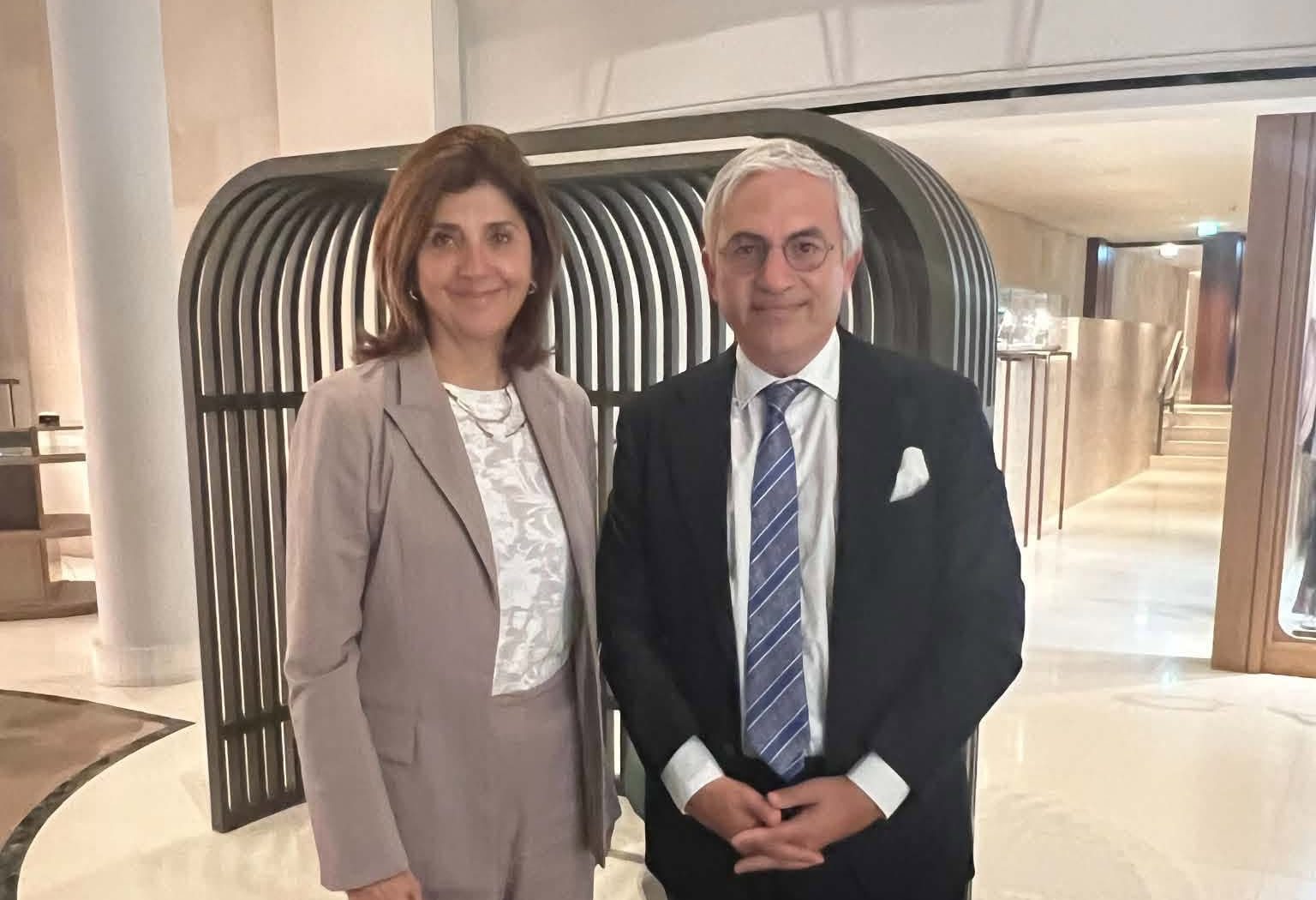
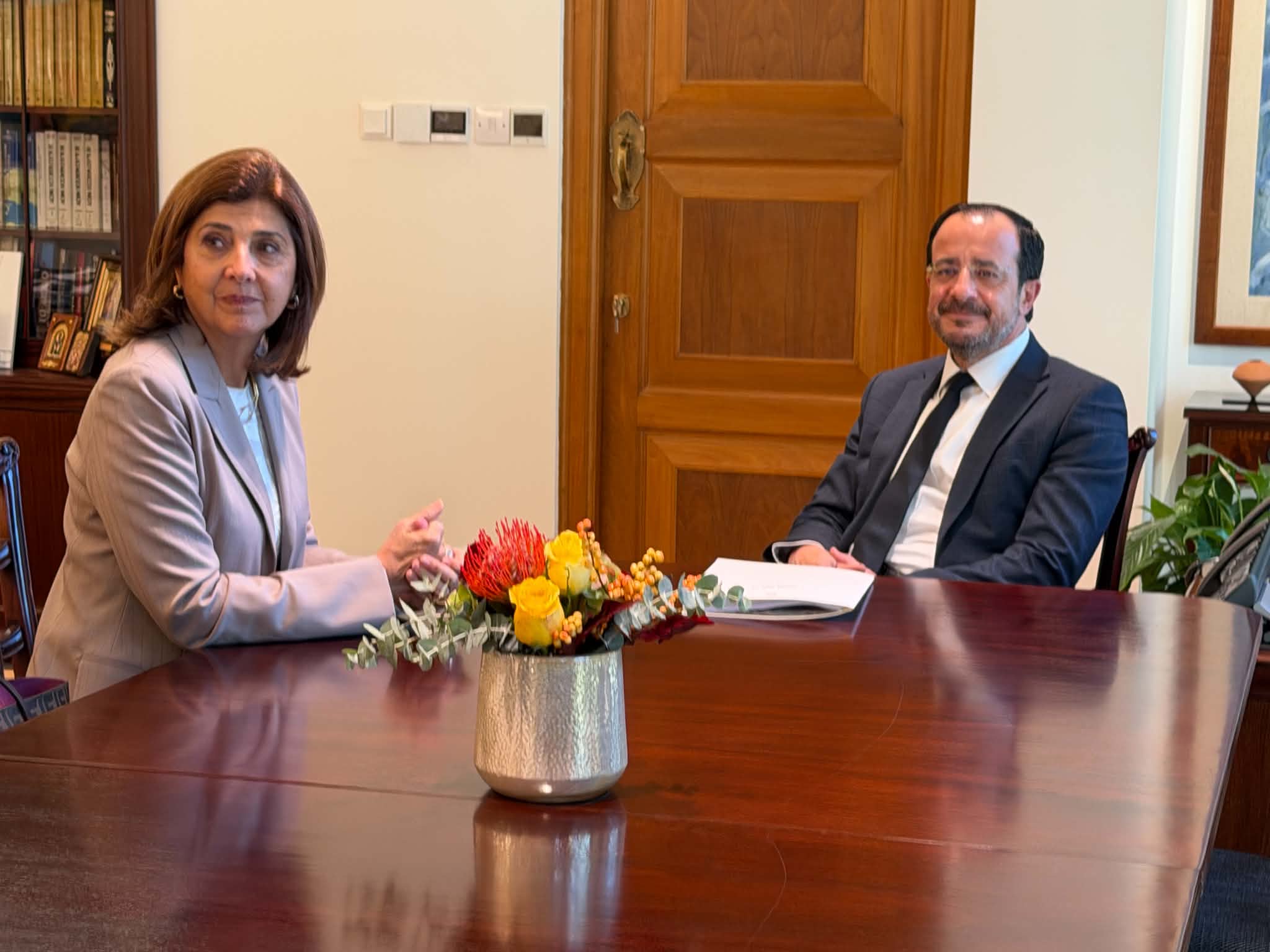
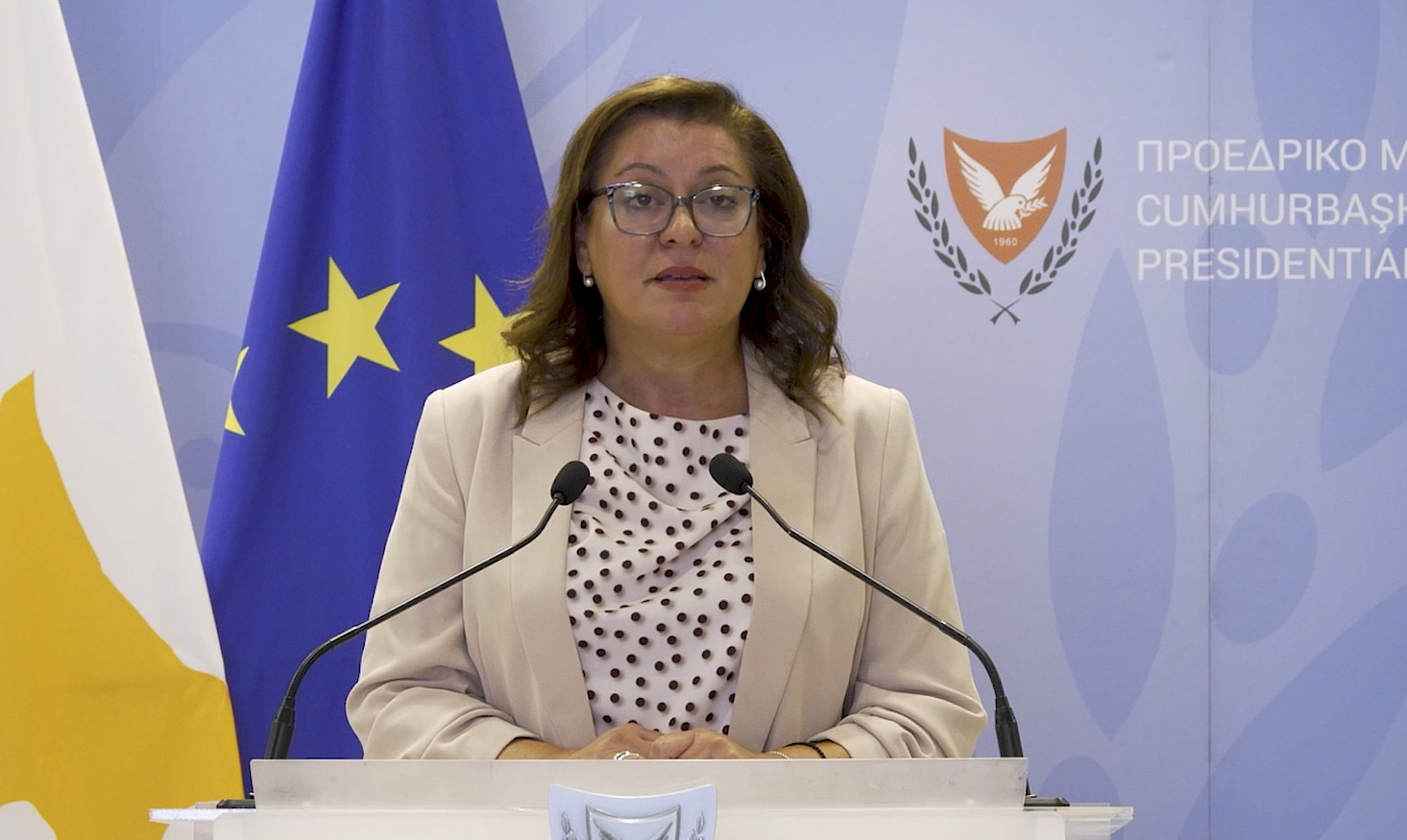
Maronite Cypriot non-voting representative in parliament Petros Nacouzi on Friday met United Nations Cyprus problem envoy Maria Angela Holguin, and after the meeting said that for his community “the resolution of the Cyprus problem is directly linked to the return to our villages”, the majority of which they fled after 1974.
Additionally, he said his community links a solution to the Cyprus problem to “the protection of our cultural and religious heritage and the ability of younger generations to maintain a living connection with their roots”.
“The voice of the Maronites must be heard, and our needs and rights must be substantively taken into account in any effort regarding the future of Cyprus,” he said.
He added that “at the same time, it remains essential to promote practical measures which improve daily life in the four Maronite villages and support our residents and displaced persons”.
“We are continuing with consistency, realism, and persistence, working towards a peaceful Cyprus which offers security and prospects for all,” he said.
Maronites have received fervent support from Bagimsizlik Yolu
In recent times, the most fervent backing for the Maronite Cypriots’ cause has come from Turkish Cypriot anarcho-communist political party Bagimsizlik Yolu [Independence Path], which in August said that “the longstanding, unresolved issue of the return of the Maronites to their villages could serve as a constructive confidence-building measure”.
“As is known, the return of Maronites to their villages reached its final stages during the tenure of the four-party government led by Tufan Erhurman as its prime minister,” between 2018 and 2019, it said.
However, it added, the matter was “subsequently shelved under the pretext of pursuing a ‘comprehensive solution’”.
It said that now, “the ‘Maronite initiative’, which entails the demilitarisation of three villages and the return of their inhabitants, could be brought about through unilateral steps taken by the Turkish Cypriot side”.
“Consultations with the military regarding such an initiative had previously taken place, and the necessary funds had even been allocated in the budget, yet the process was suspended for no reason,” it said.
‘The Maronites are not a party to the Cyprus conflict’
It then added that “the Maronites are not a party to the Cyprus conflict”, but instead “a minority community which has been among those most severely affected by the tensions and clashes between the two main communities”.
“If Tufan Erhurman, who claims to attach importance to confidence-building measures, wishes to present this issue as a positive example for all peoples living in Cyprus, he should approach it not by asking ‘what can I gain?’, but by asking, ‘what can I do to build confidence?’,” it said.
Additionally, it said, “the restoration of three Maronite villages … would serve as a powerful demonstration, directed at the Greek Cypriot authorities who have treated the Turkish Cypriots as a mere minority, that the Turkish Cypriot community is, in fact, a democratic society which has embraced multiculturalism”.
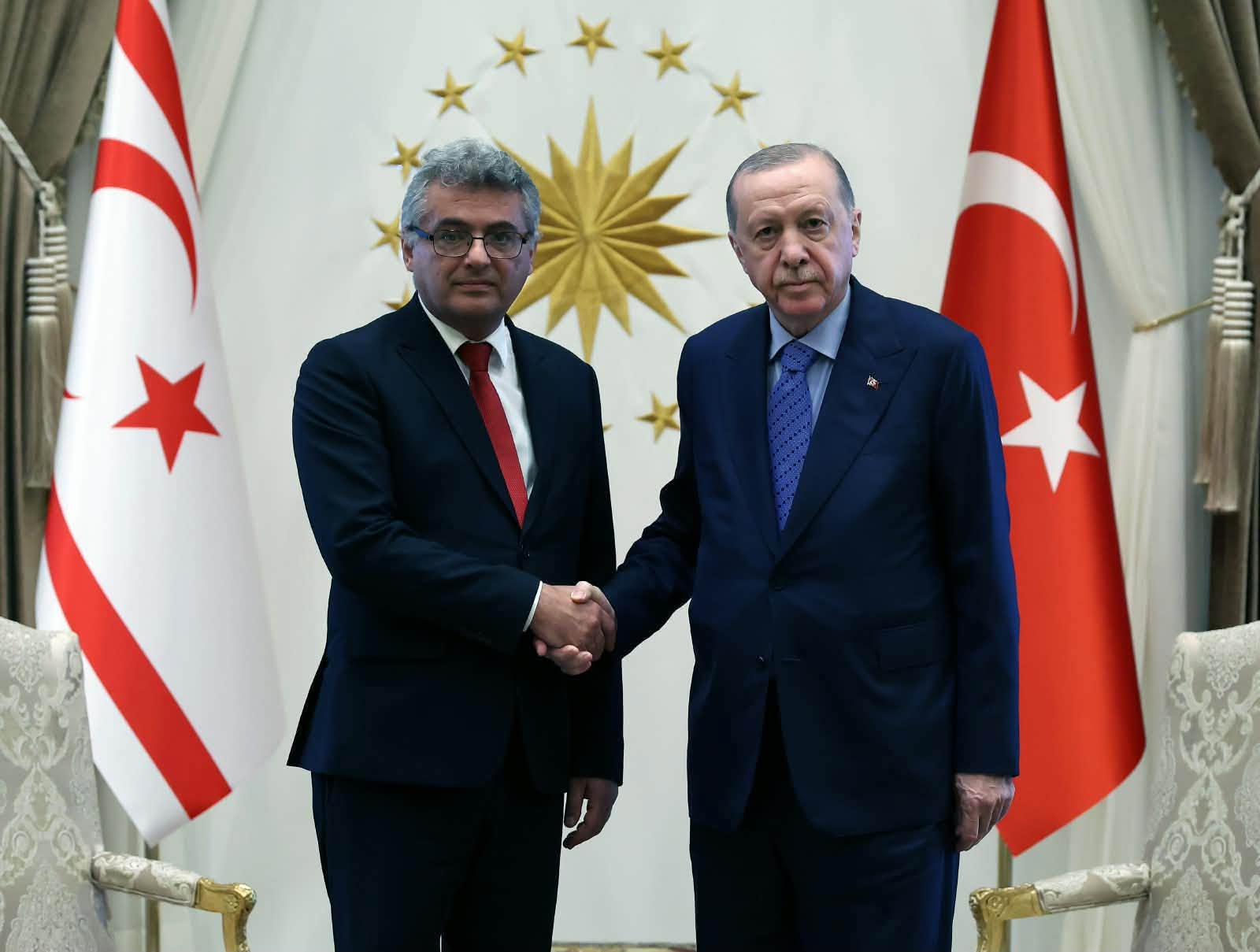
Turkish President Recep Tayyip Erdogan on Friday welcomed Turkish Cypriot leader Tufan Erhurman to Bestepe, Turkey’s presidential palace, and stressed the importance of Turkish Cypriots rights in any solution to the Cyprus problem.
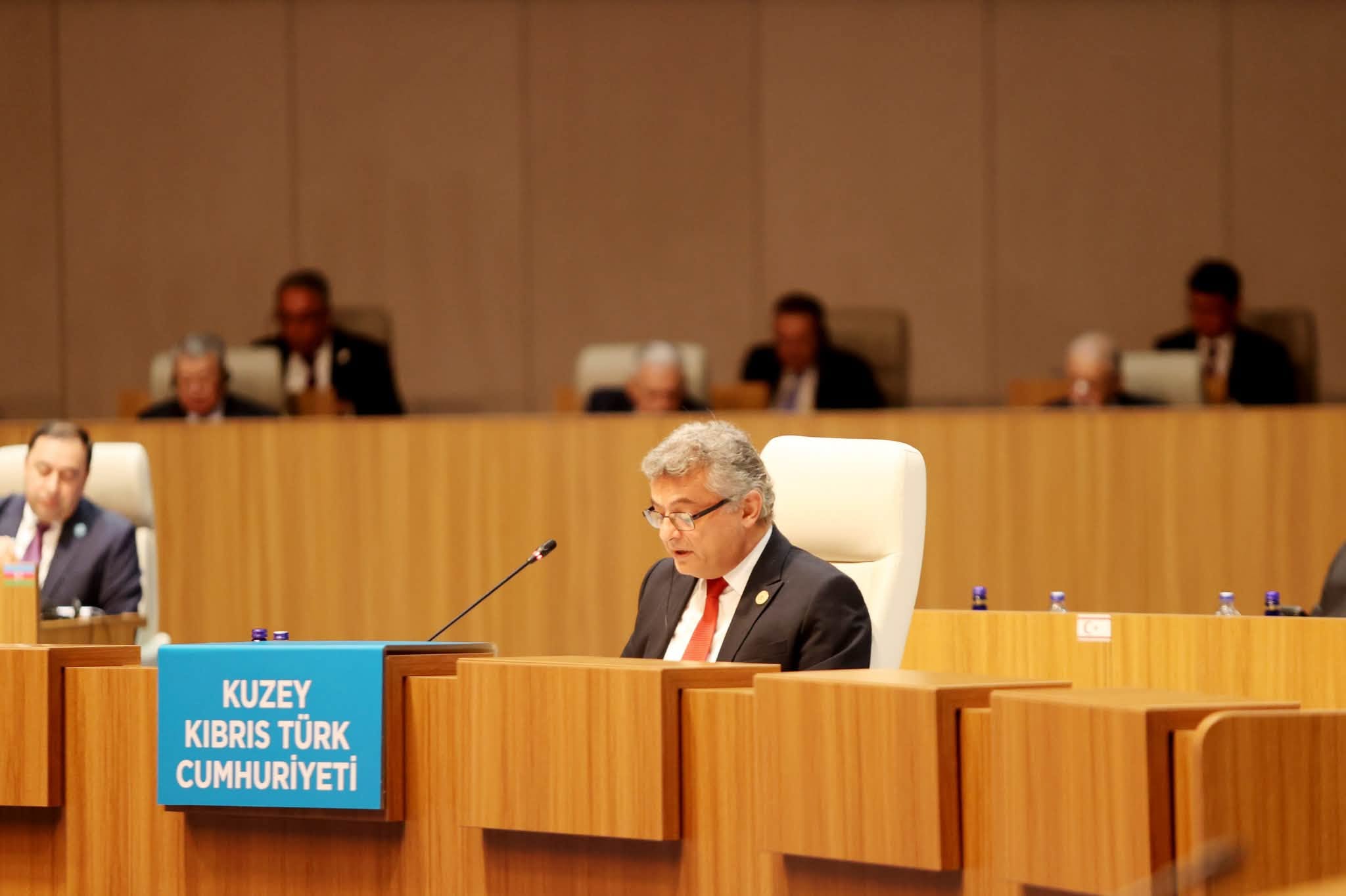
According to Turkey’s presidential communications directorate, “bilateral relations between Turkey and the TRNC, as well as regional issues, were discussed during the meeting”, while Erdogan said he was “pleased” that the Turkish Cypriots were represented at the Organisation of Turkic States summit which took place in Ankara on Friday.
“President Erdogan stated that no process which does not protect the rights and interests of the Turkish Cypriots can be the key to a lasting solution in Cyprus, and that Turkey will always continue to stand by the TRNC,” Turkey’s presidential communications directorate said.
Erhurman made no statement following the meeting.
Friday’s meeting is Erdogan’s first public intervention on the Cyprus problem since last month’s United Nations general assembly, when he said, “I call upon the international community to recognise and establish political, diplomatic, and economic relations with the Turkish Republic of Northern Cyprus”.
He had at the time added that “the inhumane isolation to which [the Turkish Cypriots] have been subjected must finally come to an end”.
Christodoulides accused Erdogan of ‘hypocrisy of the highest form’
This speech prompted a response from Cypriot President Nikos Christodoulides, who used his address to accuse Erdogan of “hypocrisy of the highest form”.
“References to international law, to the respect for the sovereignty and territorial integrity of all states, to illegal occupation, to the drama of refugees. Yet, in relation to Cyprus, Turkey is doing exactly the opposite. Hypocrisy of the highest form,” he said.
He said that Erdogan had, during his own speech, “quoted extensively from the UN charter”, but stressed that “politicians are judged not by their words, but their deeds.”
“Mr Erdogan, if you want to quote from the charter, you must first apply it. The UN security council has established the framework for the settlement of the Cyprus problem. That framework, of a bizonal, bicommunal federation with political equality, remains the only basis on which a comprehensive settlement must be reached,” he said.
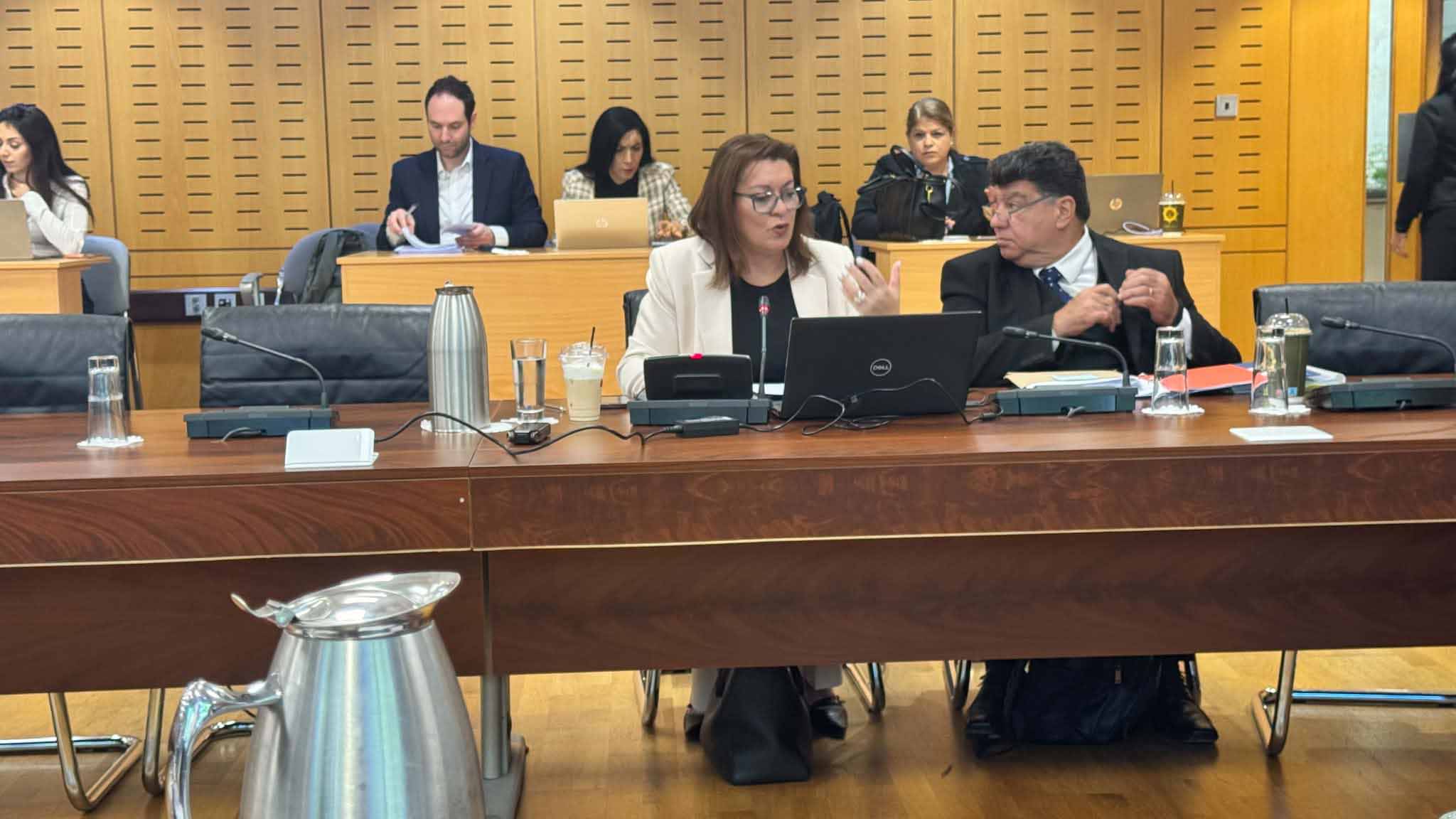
Education Minister Athena Michaelidou on Friday asked the House finance committee to approve a five-per-cent increase to her ministry’s budget, which, if approved, will amount to just shy of €1.7 billion next year.
“Through a coherent reform plan, we are seeking to free the education system from the logic of fragmented actions and are working towards a holistic framework, adopting a new culture of adequacy and efficiency,” she told the committee.
She added that her ministry’s budget “serves this strategy precisely”, and is “a tool for implementing our reform policy, with clear priorities, targeted investments, scientific documentation, and continuous evaluation”.
In this budget, she said, a total of €53 million has been allocated to school infrastructure, an increase of €10 million on this year’s budget, with her ministry “planning upgrades to school facilities and the implementation of 23 large-scale projects”.
Additionally, she said the ministry is planning to implement a free breakfast programme for children, and that social workers will be deployed to schools with “high rates of delinquency” so as to “support pupils and families”.
House education committee chairman and Diko MP Chrysanthos Savvides then lamented that “almost 90 per cent of the budget is allocated for teacher salaries”.
He also criticised that “no government has put in place a plan for the creation of school classrooms or school buildings”, and said that because of this, schools are “overcrowded” and “overpopulated”.
On this matter, he said that the rollout of portakabins to be used as classrooms is “a huge problem in the European Cyprus of 2026”.
President Nikos Christodoulides on Friday pledged further investment in higher education, research and innovation as he attended the foundation stone laying ceremony for the Cyprus University of Technology’s (Tepak) new school of marine sciences in Larnaca.
Speaking at the ceremony, Christodoulides welcomed the completion of the financial, institutional and legislative procedures necessary for the project to proceed.
“The planning has progressed and today we are here for the groundbreaking of the project,” he said.
The president described the new school as an “important development for both Larnaca and higher education in Cyprus,” stressing that “it formed part of the government’s broader strategy to strengthen research and innovation and forge closer links between universities, society and the economy.”
He praised Tepak for its pioneering role in this regard.
Christodoulides recalled that the government had decided to proceed with the project in March 2025, noting that Larnaca’s history and identity were closely linked to the sea.
“And I believe it has special symbolism in the fact that it acquires such a university school that will focus precisely on marine sciences, technology and sustainable development,” he said.
The president also highlighted the growing need for specialised personnel to help protect Cyprus’ marine environment and address challenges such as climate change.
“The presence in Larnaca of the Cyprus institute for the sea and maritime affairs, as well as the possibility of cooperation with other research and production bodies, create the conditions for the development of a substantial ecosystem of knowledge and research around the sea,” he said.
Christodoulides also raised the possibility of developing student accommodation near the new school, noting that space was available in the area for the construction of student residences.
Such facilities, he said, could help meet the accommodation needs arising from the arrival of students, academics and researchers.
He added that the project could provide a boost to the local economy, encourage cooperation with businesses and other organisations, and enrich Larnaca’s social and cultural life.
“For our part, we will continue to invest in higher education, research and innovation,” Christodoulides said.
He stressed that Cyprus’ greatest advantage was its people and that the state’s most important investment was to provide them with the knowledge, skills and opportunities needed to succeed.
Middle East conflict threatens Cyprus growth outlook, economics research centre warns
Cyprus’ economy is expected to grow by 3.2 per cent in 2026, up from a previous forecast of 2.7 per cent, as stronger-than-expected economic activity and improving business confidence offset mounting inflationary pressures linked to the conflict in the Middle East, according to a report published by the University of Cyprus’ Economics Research Centre (CypERC) in October.
The latest projections point to economic growth moderating from 4.8 per cent in 2025 to 3.2 per cent in 2026 and 3.1 per cent in 2027, with rising prices and tighter monetary conditions expected to weigh on activity over the coming quarters.
The revised 2026 forecast is 0.5 percentage points higher than CypERC’s July estimate, while the projection for 2027 remains unchanged.
The upward revision reflects stronger-than-expected growth during the second quarter of 2026, alongside favourable developments in the third quarter, including improved economic confidence, low unemployment and continued growth in new housing loans.
However, the research centre warned that the outlook remained vulnerable to geopolitical developments, with the Middle East conflict intensifying inflationary pressures and increasing the risk that economic growth could fall short of expectations.
Inflation is expected to accelerate sharply, rising from 0.1 per cent in 2025 to 3.1 per cent in 2026, before easing to 2.3 per cent in 2027.
The forecasts for 2026 and 2027 are respectively 0.1 and 0.2 percentage points higher than those published in July, reflecting rising international oil prices, strong domestic economic activity and persistently low unemployment.
Economic activity remains robust
Cyprus’ economy continued to expand faster than the European Union average during the second quarter of 2026, despite mounting inflationary pressures associated with the conflict in the Middle East.
Real gross domestic product (GDP) grew by 3.3 per cent year-on-year in the second quarter, accelerating from 3 per cent in the first three months of the year.
Real gross value added increased across all economic sectors, with growth accelerating in most industries compared with the previous quarter.
Information and communication activities remained among the fastest-growing sectors, although their expansion slowed for the fourth consecutive quarter. Growth in real estate activities and professional services also moderated slightly, extending the slowdown recorded during the first quarter.
Consumption growth strengthened further during the second quarter, driven primarily by increased government spending. Private consumption continued to expand above its long-term average, maintaining the pace recorded during the first quarter.
Investment also improved, with gross fixed capital formation continuing to grow on the back of increased spending on machinery and equipment and sustained investment in construction.
Both exports and imports recorded strong annual growth. However, net exports made a negative contribution to overall GDP growth because imports increased faster than exports.
Monthly indicators suggest that economic activity remained robust during the third quarter, although some data pointed to emerging challenges.
Retail trade volumes, card purchases and property sale contracts recorded between July and September indicated continued expansion. However, figures for motor vehicle registrations, new company registrations and tourist arrivals provided mixed signals about the strength of economic momentum.
The number of registered unemployed people continued to increase year-on-year throughout the third quarter, although the construction sector was a notable exception.
Nevertheless, the unemployment rate remained very low in August and well below the EU average, according to Eurostat.
The Economic Sentiment Indicator rose above its long-term average during the third quarter, reflecting stronger consumer and business confidence, particularly in services, retail trade and construction.
Companies’ employment expectations also strengthened, moving above their historical average. Economic uncertainty declined overall, although uncertainty among businesses in services and retail trade increased in September.
Consumers’ and companies’ expectations for future prices remained above their historical averages despite some easing during the quarter. Price expectations among consumers and manufacturing firms rose markedly in September.
Inflation and borrowing costs threaten growth
Consumer price inflation increased to 3.4 per cent in the third quarter of 2026, up from 2.8 per cent in the second quarter.
The acceleration was driven by higher prices for housing, water, electricity, fuels and transport, primarily reflecting rapid increases in international oil prices.
Food inflation also continued to add to domestic price pressures, exceeding the overall inflation rate for the third consecutive quarter.
CypERC warned that Cyprus’ heavy reliance on imported fossil fuels made its inflation outlook particularly sensitive to international oil prices, which are vulnerable to geopolitical developments.
The conflict in the Middle East continued to push up global energy prices during the third quarter, with the effects expected to feed through to the prices of goods and services over the forecast period.
Higher food prices are also expected to sustain inflationary pressures, with international food price indices increasing more rapidly during the third quarter than in the first half of 2026.
The report said rising prices had already put pressure on real incomes and were expected to restrain economic activity, particularly as labour market conditions normalised.
Inflation also increased in the euro area and the United Kingdom during the third quarter, potentially weighing on demand from Cyprus’ main trading partners, particularly for services.
Higher interest rates are expected to exert additional pressure on growth, with the effects becoming more pronounced during 2027.
Euro area key interest rates increased further in September in response to rising inflation linked to the Middle East conflict, while market interest rates had begun edging upwards in March and stood considerably higher in September 2026 than a year earlier.
Domestic interest rates on most loan and deposit categories were also higher in August than in the corresponding month of 2025.
CypERC expects tighter financing conditions to restrain both domestic demand and demand from euro area trading partners, with the effects gradually materialising in 2027 and becoming particularly evident after the first quarter.
The annual contraction in new corporate lending during January to August 2026 is also expected to weigh on growth prospects.
Nevertheless, the research centre said these pressures were being outweighed by the continued dynamism of the domestic economy, supported by recent national accounts data and leading indicators.
Continued growth in new housing loans and the banking sector’s strong liquidity and capital position were also supporting the outlook.
During the first eight months of 2026, the outstanding stock of loans recorded double-digit growth, while deposits expanded strongly, driven by rising domestic deposits.
However, the volume of new loans declined year-on-year over the same period because of contracting business lending, despite strong growth in housing loans.
The ratio of non-performing loans to total loans also declined further in June.
An exception to the broader increase in domestic borrowing costs was the interest rate on new corporate loans exceeding €1 million, which fell significantly in August to its lowest level in more than three and a half years.
Public finances provide support
Cyprus’ public finances remained strong during the first eight months of 2026, with the government recording a substantial budget surplus that exceeded the corresponding figure for 2025.
Government revenue increased robustly year-on-year, outpacing expenditure growth, while the public debt-to-GDP ratio continued to decline.
CypERC said the strong fiscal position was expected to support economic growth by preserving investor confidence amid rising government borrowing costs and helping cushion the effects of cost-of-living pressures.
International and domestic stock market indices also recorded further annual gains during the third quarter, while volatility remained relatively subdued.
The continued positive performance of equity markets was seen as a sign of economic resilience despite geopolitical tensions and elevated inflation. However, the report cautioned that these favourable effects could prove fragile if financing conditions tightened further and cost-of-living pressures intensified.
Growth forecasts remain vulnerable
The research centre said downside risks to economic growth continued to outweigh upside risks, with geopolitical tensions and potentially tighter financing conditions posing the main threats.
A prolonged conflict or further escalation in the Middle East could increase uncertainty, weaken external demand for services and discourage investment.
Further disruption to supply chains could also keep international commodity prices elevated, creating more persistent inflationary pressures and weighing more heavily on economic growth than currently anticipated.
Other risks include weaker-than-expected growth among Cyprus’ trading partners, financial market turmoil that could undermine investor confidence, climate-related events and fiscal challenges arising from higher government borrowing costs.
Conversely, stronger-than-expected growth could result from resilient demand, a longer tourist season, gradually easing inflationary pressures, government measures to mitigate the cost of living and investments not yet reflected in the available economic data.
CypERC’s forecasts remain broadly consistent with those of other institutions, although their projections differ slightly.
For 2026, the Central Bank of Cyprus and the International Monetary Fund expect GDP growth of 2.9 per cent, while the Finance Ministry forecasts 3.1 per cent.
For 2027, the Central Bank projects growth of 3.1 per cent and the IMF 3.2 per cent, while the Finance Ministry expects growth to moderate to 2.9 per cent.
Inflation risks remain tilted upwards
CypERC warned that upside risks to inflation continued to dominate, primarily because of the Middle East conflict and the possibility of further increases in international energy and commodity prices.
A prolonged period of high commodity prices could trigger second-round inflation effects, reinforcing price pressures, particularly while economic activity remains strong and unemployment low.
Other risks include robust wage growth if demand remains resilient, climate-related events that push up food prices and prolonged broad-based fiscal support measures aimed at mitigating the cost of living.
The research centre said such fiscal measures could contribute to higher-than-expected inflation, particularly given prevailing labour market conditions.
Downside risks to inflation include tighter euro area monetary policy and its cooling effect on demand, particularly if higher borrowing costs substantially reduce private and public spending.
Recently introduced fiscal support measures, including cuts to fuel excise duties and reductions in value added tax, could also lower inflation compared with current projections.
The gradual transition towards green technologies in Cyprus was identified as another factor that could help reduce inflationary pressures over the forecast period.
CypERC based its projections on quarterly national accounts data up to the second quarter of 2026, leading indicators covering the third quarter and monthly data available between July and September. The forecasts incorporated revised national accounts figures published on October 20, 2026.
Turkish Cypriot leader Tufan Erhurman on Friday told the leaders of member states of the Organisation of Turkic States there are “no obstacles” to them establishing close relations with the Turkish Cypriots, as he addressed the organisation’s summit in Ankara.
He said that the Turkish Cypriot people have “for many years” been subject to “an unjust isolation which has limited their direct contacts with the international community, their economic and social development, and their integration with the world”.
“However, a nation’s ability to engage with the international community in the fields of culture, art, sports, science, education, and economics is a fundamental issue of human rights which must be considered beyond political agreements,” he said.
To this end, he pointed out that “the Turkish Cypriot people, through their will for a solution demonstrated in 2004 and their constructive stance in subsequent negotiation processes, have repeatedly shown their desire for integration with the world and for a just and lasting solution on the island”.
“Despite this, attempts are being made to prevent our young people from participating in international sports competitions, to prevent cultural events from being held in our country, and to prevent our people from having direct contact with the world,” he said.
He added that “such initiatives negatively impact efforts to build mutual trust and create a favourable environment for a solution on the island”.
Developments ‘aligned with EU goals’
On this front, he made reference to a letter he had received from United Nations Secretary-General Antonio Guterres in response to concerns he had raised regarding efforts undertaken by the Greek Cypriot side to bring about the cancellation of a children’s football camp organised by FC Barcelona and a music festival in Kyrenia.
He said that Guterres had described those initiatives as “discouraging”, and that the secretary-general had “emphasised that initiatives hindering the establishment of trust and which lead to the cancellation of international events run contrary to joint efforts”.
Additionally, he referred to a second letter on the same matter he received from the European Commission, which, he said, “reaffirmed the European Union’s 2004 goal of ending the isolation of the Turkish Cypriot people”.
He added that the letter had also “said that initiatives which contribute to the socioeconomic development of the Turkish Cypriots, especially young people, and enable them to establish close relations with the European Union are consistent with the EU’s goals”.
“The common message of these two letters is clear. There is a strong political and legal basis for developing contact, dialogue, and cooperation with the Turkish Cypriot people in all areas, and this basis is confirmed and supported by the UN and the EU. Steps taken in this context will contribute to the creation of an environment of mutual trust and to efforts for a solution,” he said.
As such, he added, “I want it to be known that there are no obstacles to establishing close relation with the Turkish Cypriots in the fields of science, academia, culture, technology, and diplomacy”.
“We can develop joint research programmes between our universities, bring our youth together in academic and cultural exchange projects, and forge stronger ties in the field of sports,” he said.
‘The reintegration of the Turkish Cypriot people’
He added that “by developing shared cultural spaces such as exhibitions, concerts, opera, and performing arts, we can enhance the cultural dialogue among our artists”, and that “by bringing together our entrepreneurs, businesspeople, and researchers, we can create new opportunities in the fields of trade, investment, the digital transformation, and innovation”.
On this front, he said that “the Turkish Republic of Northern Cyprus, with its higher education resources, young workforce, tourism potential, and strategic location in the eastern Mediterranean, has the capacity to make significant contributions to these collaborations far exceeding its population and land areas”.
“In this context, we are ready to act with the goal of being an economic, scientific, and cultural bridge between the Turkic world and the eastern Mediterranean,” he said.
He then added that “the fundamental goal of all these efforts is to strengthen peace, stability, and cooperation on the island of Cyprus and in the region”.
“Our approach is clear. The reintegration of the Turkish Cypriot people into the world and the search for a solution in Cyprus are not mutually exclusive, by rather processes which reinforce one another,” he said.
To this end, he said that he will “continue to work for a fair and lasting solution on the island in close consultation with the Republic of Turkey”.
“We want the eastern Mediterranean to become a region where mutual respect, inclusive cooperation, and common prosperity, not tensions and exclusionary policies, prevail,” he said.
The day’s summit was, however, somewhat overshadowed by the absence of Azerbaijani President Ilham Aliyev, who elected not to travel to Ankara amid deteriorating relations between his government and Turkey, once his country’s closest ally.
On the surface of the matter is a rift which emerged following Azerbaijan’s decision to ban the wearing of headscarves at public schools in the country – a move which infuriated Turkish President Recep Tayyip Erdogan to the extent that he criticised Baku during his speech to the UN general assembly last month.
The Audit Office plans to introduce artificial intelligence to accelerate its work, identify potential irregularities and free up auditors to conduct more on-site inspections, auditor-general Andreas Papaconstantinou said on Friday.
Presenting the office’s 2027 budget to the House finance committee, Papaconstantinou said a major co-funded project, known as AuditAI, was being planned to allow AI to carry out preliminary assessments and identify potential warning signs, or “red flags”, requiring further investigation.
He said the technology would help speed up audits and the preparation of reports, allowing staff to devote more time to inspections and other substantive work.
The Audit Office has so far submitted 31 reports and five memoranda in 2026, with another 23 reports in progress. Papaconstantinou said the target was to publish between 45 and 50 reports by the end of the year, potentially releasing two reports a week.
The office’s proposed budget for 2027 stands at €12.06 million, an increase of approximately €810,000, or 7.2 per cent, compared with €11.26 million in 2026.
Personnel costs account for 82 per cent of the budget, while 7.5 per cent is allocated to consultancy services and five per cent to software purchases.
Funding has also been allocated for staff training in Cyprus and abroad to improve the early identification of risks, strengthen accountability and ensure more efficient management of public resources.
Papaconstantinou said the office’s budget focused on improving internal operations, strengthening cooperation, making better use of staff expertise and completing audits more quickly and to a higher standard.
Addressing staffing arrangements and salary scales, he said consideration had been given to practices elsewhere in the public sector, particularly the qualifications required of auditors.
He explained that auditors were required to obtain professional qualifications, including chartered accountant certification, and that the time needed to secure these qualifications had been considered when determining salary progression.
“We considered that there should be no unfair treatment, so we equalised the time component,” he said, adding that a similar approach was followed by the Transmission System Operator.
“Let us not exaggerate. They are auditors, and that is the reasoning,” he added.
On consultancy services, Papaconstantinou said the Audit Office preferred to retain expertise internally but that certain highly specialised areas required external assistance.
He cited the information systems of the national health scheme, Gesy, and the Ippodamos planning system as examples of areas requiring specialist technical knowledge.
Papaconstantinou also emphasised the importance of increasing on-site inspections, saying that the more inspections carried out, the better.
He explained that direct inspections allowed auditors to gain firsthand knowledge of the services they were examining, improving both the effectiveness of audits and staff performance.
On audits of municipalities and district local government organisations established under the local government reform, Papaconstantinou acknowledged concerns about the new administrative structures.
He said considerable time had been devoted to examining issues involving Paphos municipality and its suspended mayor.
The auditor-general also addressed the responsibilities of the assistant auditor-general, explaining that he participated in the management team and that efforts were being made to utilise his position effectively.
“I will not say anything more. He certainly needs to work, but let us leave it at that,” Papaconstantinou said.
He rejected suggestions by Alma MP and former auditor-general Odysseas Michaelides that the assistant auditor-general could assume the duties of a director, stressing that the two positions served different functions.
He said he did not accept the claims being made about the assistant auditor-general, explaining that the proposed director’s position was intended to fulfil separate management responsibilities.
“The position we are requesting is for a director’s work, and the assistant auditor-general has a different role,” he said.
In addition regarding a comment on the secondment of former civil defence commander Maria Papa to the Audit Office, Papaconstantinou said her role had been discussed with her and that, if she could not be effectively utilised, the possibility of returning her to her previous service would be considered. “If she cannot be utilised, we will look into having her return,” he said.
The director of the antiquities department Dr George Georgiou has warned that continued cuts to its budget will have consequences for the protection of Cyprus’ cultural heritage.
“The continued compression of spending on antiquities will not be without a price,” Georgiou told the House finance committee, accusing the government of using “creative accounting” to present the department’s reduced funding.
The deputy ministry’s proposed budget for next year stands at €64.3 million, down from its present allowance of €65.7 million, however, Deputy Minister Clea Hadjistefanou Papaellina said the previous year’s allocation included €2.2 million for cultural events during Cyprus’ EU council presidency.
Excluding that amount, the next year’s budget represents an increase of €820,000, she said.
The antiquities department has been allocated €23.6 million, including €19.9 million in recurrent expenditure and €3.8 million for development projects.
Akel MP Christos Christofides questioned the government’s commitment to culture, saying the Deputy Ministry’s share of the state budget had fallen from 0.62 per cent to 0.45 per cent.
He also criticised reductions in funding for cultural grant programmes, including support for theatre productions and contemporary cultural creation.
Christofides said Cyprus ranked near the bottom in Europe in terms of the proportion of public spending devoted to culture.
The ‘contemporary culture department’ is set to receive €21.1 million, of which €15.6 million is earmarked for development expenditure.
Its director, Ioanna Hadjicosti, said €300,000 had been cut from sponsorship programmes, with reductions spread across the various schemes.
Papaellina defended the ministry’s use of its available resources, saying they were being fully utilised to modernise cultural infrastructure and protect the island’s heritage.
She also said the ministry was reviewing sponsorship criteria in response to feedback from cultural organisations.
The committee also heard that completion of the new archaeological museum has been delayed to February 3, 2027, representing a 209-day extension to the original timetable.
Director general George Papageorgiou said a further 18 months will be required to transfer antiquities into the building,
She also confirmed that the ministry’s annual contribution to Limassol’s Rialto Theatre was €120,000, with state funding due to end by 2029 under the agreement with the municipality.
Air conditioners are expected to be operational in a significantly larger number of schools by April and May next year, Education Minister Athena Michaelidou said on Friday.
Speaking after presenting the education ministry’s annual budget to the House finance committee, Michaelidou said instructions had been issued to accelerate inspections during the winter months so that more units could be used for when temperatures rise.
“Already in several districts, the project has progressed significantly. All high schools have reached 100 per cent coverage, while a very high percentage of middle schools and a significant number of primary schools have also been equipped,” she said.
Michaelidou said the ministry expected a substantial increase in the number of operational units next year and would soon publish figures covering schools across Cyprus.
She acknowledged that the project had encountered technical and practical difficulties, but said work was continuing to address them.
The comments come amid concerns over the pace and safety of installations, for the audit office recently identified incomplete works and potentially unsafe electrical connections during inspections at five schools.
The president of the Nicosia school board, Nikos Megalemos, subsequently described safety concerns as exaggerated, while confirming that temporary connections used during the Pancyprian examinations would be disconnected.
The project, launched in 2023, has faced delays, with completion initially expected by the end of this year but now projected to extend into 2028.
Figures released by the education ministry show progress varies by district, with Famagusta leading at 65 per cent of primary schools fully equipped, while Paphos and Nicosia trail at 16 per cent and 24 per cent respectively.
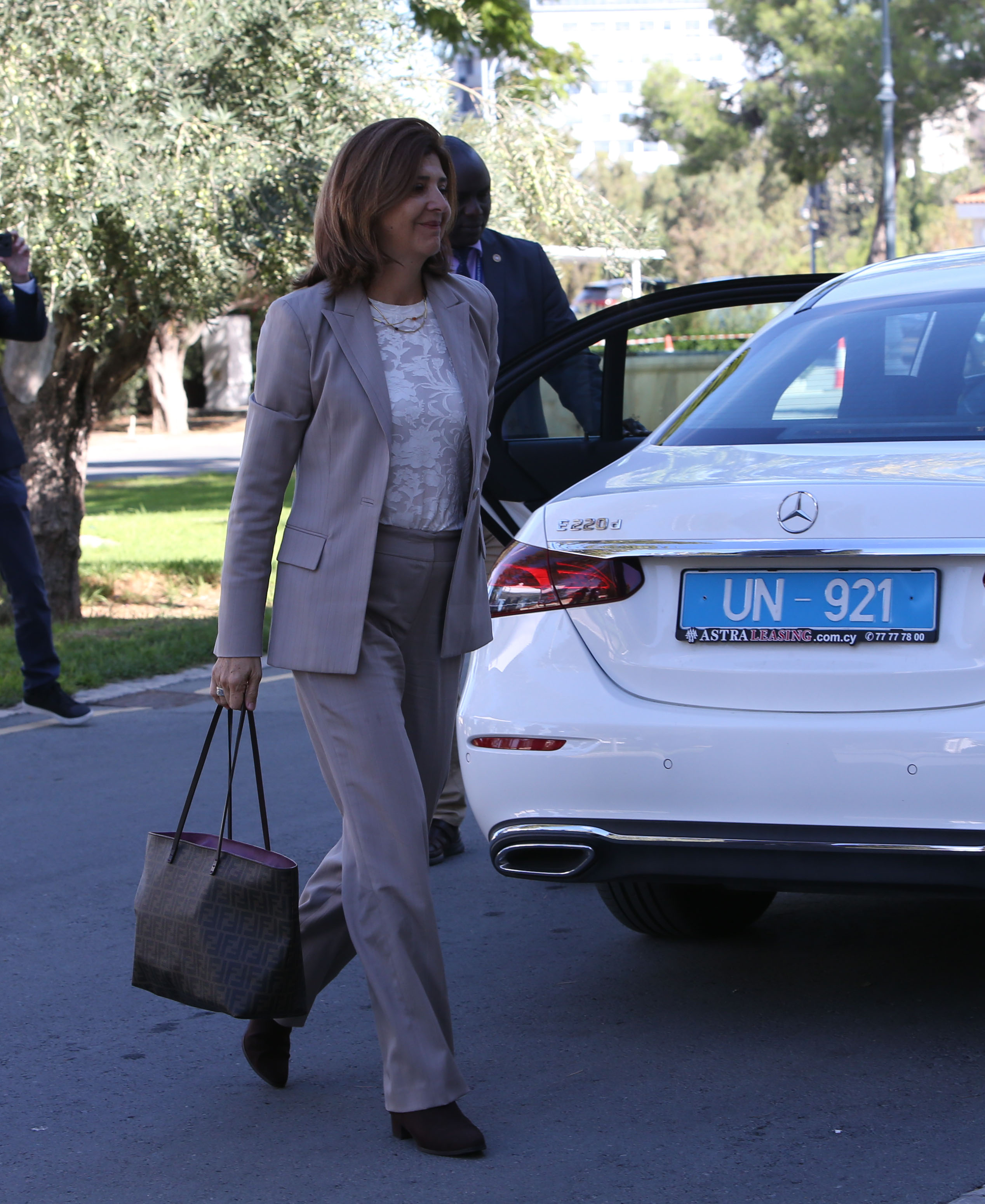
United Nations Cyprus problem envoy Maria Angela Holguin said that she remains optimistic over the prospect of an enlarged meeting on the Cyprus problem being held before the end of the year, after she met President Nikos Christodoulides at the presidential palace.
“Yes, I am optimistic … If there are some advances in the [confidence-building measures], in methodology, and in some substance, and if we can get this, we are going to have the 5+1,” she said, with the term “5+1” used to describe an enlarged meeting involving the island’s two sides, its three guarantor powers, Greece, Turkey, and the United Kingdom, and the UN.
Regarding Friday’s meeting and her planned meeting with Turkish Cypriot leader Tufan Erhurman, she said that “we are pushing and continue pushing”, and that “this is what the secretary-general asked of me, is until the last minute of his mandate, he wants to see if we can move forward on the Cyprus issue”.
Incumbent UN Secretary-General Antonio Guterres will leave office at the end of the year, with it still not yet clear who will replace him. It was Guterres who had first that enlarged meeting will only be achieved “after adequate progress” is achieved on confidence-building measures, the meeting’s methodology and the substance of the talks.
Holguin on Friday made no reference to efforts to choose Guterres’ successor, focusing instead on the content of her meeting with Christodoulides, which she described as “good”, before saying that she had wished to “listen from Christodoulides about his meetings with Tufan”, which have been taking place on a weekly basis since the summer.
Of those weekly meetings of Cyprus’ two leaders, she said that “I think it has been very good that they have these kinds of meetings together and I would still hope to see if we can [achieve] something”.
“We are going to have a trilateral meeting on November 9 and … I am here, I am an optimist, and I hope we can get something next week,” she said.
Leaders took vow of silence on Cyprus problem after Tuesday
The two leaders most recently met on Tuesday, and said after that meeting that both he and Erhurman had “agreed not to make further statements regarding specific issues” related to the Cyprus problem until Holguin’s arrival at the earliest.
Both men had also met the bicommunal technical committees on cultural heritage and on youth, as well as the civil society steering committee, following their one-on-one meeting.
Of those meetings, Christodoulides said that they were “constructive” and that “various views and suggestions were put forward” by committee members.
He added that those suggestions will be discussed by himself and Erhurman going forward.
(Photo: Christos Theodorides)
Christodoulides insists Varosha proposal is ‘mutually beneficial’
Prior to Tuesday’s meeting, Christodoulides had stressed that his proposal to open and repopulate the fenced-off area of Varosha under the United Nations’ administration and open the port of Famagusta under the European Union’s control is “mutually beneficial”.
“I believe this is a mutually beneficial proposal. It creates a positive situation for both sides and serves as a practical test of whether we are truly committed to moving forward, specifically by taking bold confidence-building measures which also send a strong message to society as a whole,” he said.
Erhurman had said last week that he had rejected the proposal, lamenting that it fell short of an entry into force of the European Union’s direct trade regulation.
“Is this the entry into force of the direct trade regulation? No, it is not the entry into force of the regulation, but since [the port] would be under EU control, direct trade would begin,” he said.
As such, he said, the proposal was unbalanced.
The direct trade regulation is a pending EU regulation which would allow Turkish Cypriot goods, as certified by the Turkish Cypriot chamber of commerce, to be exported directly into Europe via the Green Line, and given preferential treatment inside the European single market as European goods.
It was proposed in July 2004, three months after the rejection of the Annan plan to reunify Cyprus by the Greek Cypriot side in a referendum, and shortly after the Republic of Cyprus’ accession to the EU.
Menelaou had cited progress on crossing points
Previously, Greek Cypriot chief negotiator Menelaos Menelaou had said that a dispute over the routing of the planned transit road between Athienou and the Nicosia suburb of Aglandjia “has been overcome”.
He said that the outstanding dispute now remains over the question of whether a planned crossing point to connect Louroujina, the southernmost Turkish Cypriot village, with nearby Lymbia, will open at the same time.
The Turkish Cypriot side’s position is that the road between Athienou and Aglandjia constitutes two crossing points, one in Athienou and one in Aglandjia, and that they are part of a package of four alongside plans for a crossing point in the eastern Nicosia suburb of Mia Milia, and one in Louroujina.
However, the Greek Cypriot side treats the road between Athienou and Aglandjia as one crossing point, counterweighted by the Mia Milia crossing point, and is therefore of the view that the Louroujina crossing point should only be opened if a second transit road, through the Turkish Cypriot Kokkina exclave in the Tillyria region, also be opened.
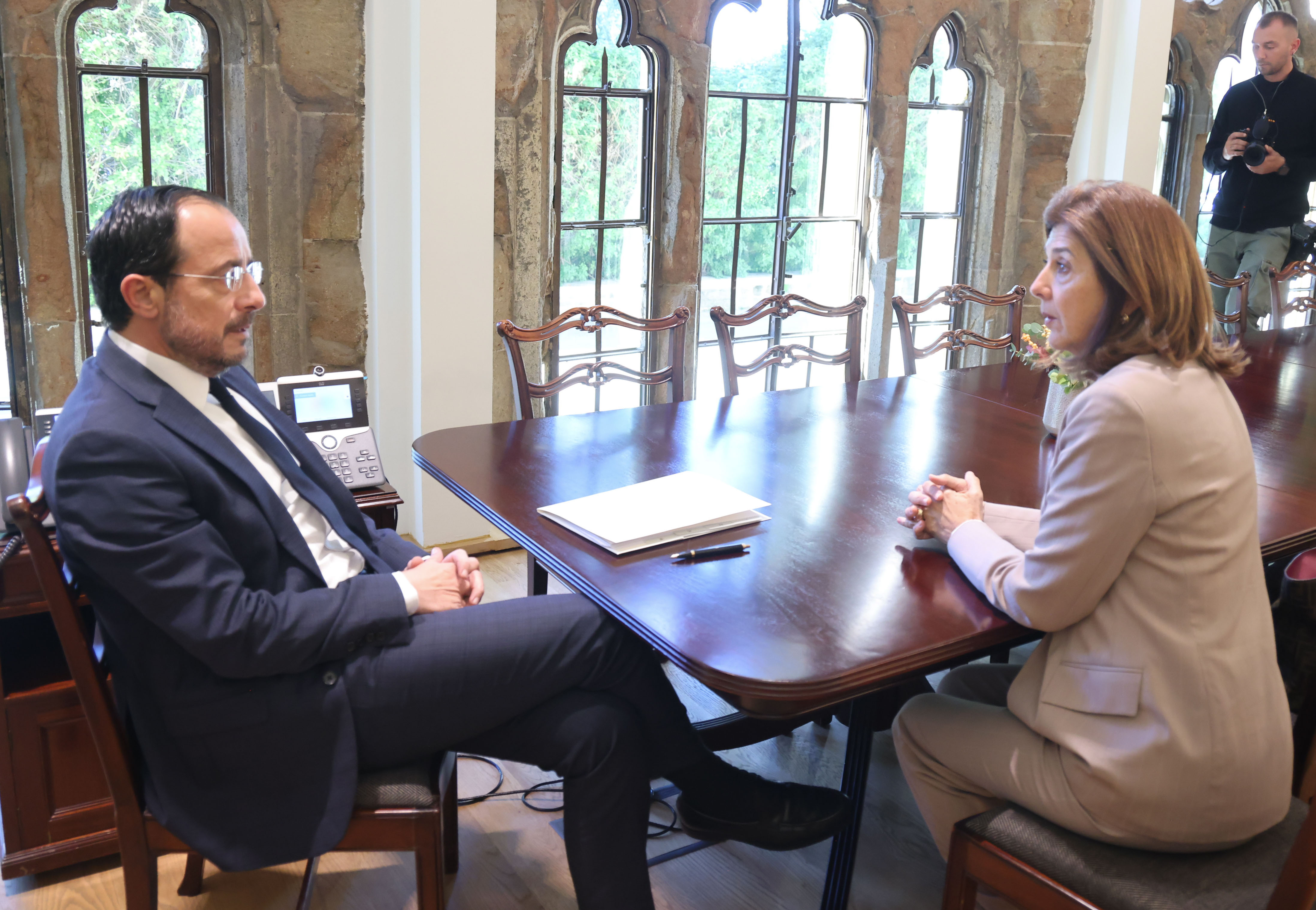
President Nikos Christodoulides, at a tête-à-tête meeting with the United Nations Cyprus problem envoy Maria Angela Holguin
Cyprus is increasingly being chosen by Israelis as a destination for live music, with tourism firms reporting on Friday that the lack of international artists performing in Israel is driving demand for festivals and club nights on the island.
Speaking to Israeli news outlet Mako, Prof Alon Gelbman, head of the master’s programme in tourism at Kinneret Academic, said the security situation and the absence of many international artists from Israeli stages were pushing young people towards “alternative destinations”.
He said Cyprus had a clear advantage for Israeli tourists due to its “proximity and short flight time”.
Vice president of marketing and sales at Israeli travel agency The Flying Carpet, Oren Cohen-Maguri, said Limassol had become “a sought-after entertainment destination among young people”, with its nightlife and clubs frequently playing host to international and Israeli DJs.
Cohen-Maguri said the scarcity of international performances in Israel meant concerts in Cyprus this summer could draw strong interest, “if they do take place”.
Official figures show the shift, for Cystat confirmed 135,628 Israelis arrivals last month, up from 105,597 a year earlier, a rise of more than 28 per cent.
Israel accounted for 23.3 per cent of all arrivals, making it the second largest market behind the United Kingdom on 30.5 per cent.
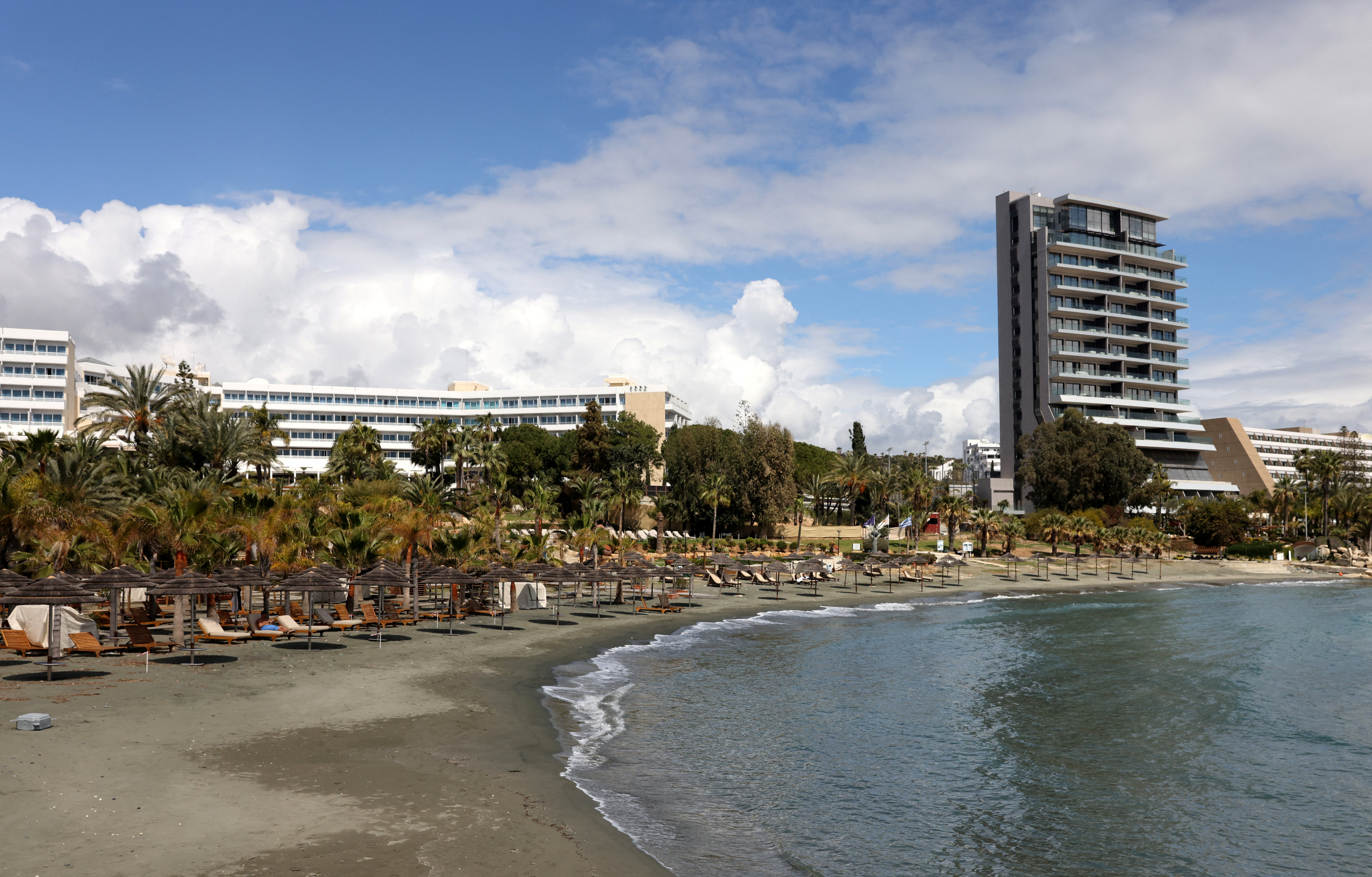
Limassol has become a particular draw, with Israeli travel and entertainment listings featuring the City of Dreams Mediterranean resort, beach clubs and music festivals.
Other venues featuring on Israeli nightlife listings include The Warehouse, Shaka, Columbia Sun, SODAP Beach and Guaba.
The trend has extended beyond Limassol, with Israeli rock band Kadachat having performed at Paradise Place in Pomos on October 17, according to Tel Aviv Times, which described Israeli flags inside the venue and a Hebrew welcome sign.
The growing demand comes as international performances in Israel have become increasingly scarce, with The Israel Festival having taken place this summer without an international act, while the Music Showcase Festival expected half as many overseas gests as last year.
Security restrictions have also affected domestic concerts, with stadium performances by Omer Adam and Eyal Golan postponed following Home Front Command restrictions on large gatherings in June.
Al Jazeera reported this week that Israeli visits reached nearly 600,000 last year, more than double the 2022 figure, while Israeli investment was estimated at €5.1 billion.
The Israeli embassy estimates that between 15,000 and 20,000 Israelis consider Cyprus home, compared with around 1,000 recorded in the 2021 census.
Discovering Kyparissos this month was really down to social media brainwashing. Obviously, my algorithm favours restaurants, but Kyparissos kept coming up, and I didn’t know the name at all.
After a little research, I realised it was a restaurant I had driven past so many times on my way into Kathikas, but for whatever reason I had never turned into the car park. Upon arrival, the algorithm hype melted into genuine delight. This restaurant revealed a level of cooking that made me grateful I had followed the digital breadcrumbs all the way to its door.
The restaurant is huge, with green taverna chairs matching the tablecloths. The interior on the night we visited was spotlessly clean, and it was definitely too cold and wet to sit in one of the outdoor areas dotted around the restaurant. At the back, as you park your car, you’re greeted by row upon row of vines leading to the restaurant and spectacular views. The menu is extensive, offering all of the Cypriot favourites. A particularly nice touch was the first page, with photos of the four generations involved in the restaurant since it started in 1960, and an explanation of how it all began with their grandfather announcing he would open a taverna after a family barbecue. Wow – how it has grown over the intervening years.
As part of the menu, there was a daily special of spinach pie, so we bypassed the selection of hot and cold small dishes and started with that to share. Complimentary toasted bread splashed with olive oil and herbs was served with gorgeous olives and a very tasty tahini on the side. The spinach pie’s arrival at the table was a lesson in excellent food presentation, and it applied to everything on the menu.
I have never seen a pie look so enticing. They split it into four parts on a chopping board and scattered cherry tomato halves and cheese crumbs over it. Beneath the whisper-thin sheets of filo pastry was a wonderful filling of spinach, soft herbs, and cheese, creating a decadent, savoury, velvety centre. The four of us quickly demolished it.
Choosing our main courses wasn’t easy and took much deliberation.
The first main was Spicy Lamb Meatballs, served over a Greek pitta with the freshest finely cut salad, tzatziki, and fries in a little basket. The meatballs were a winner and captured Kyparissos’ ethos: high-quality, fresh ingredients expertly cooked in the kitchen. The meatballs had real aromatic depth, were bold and indulgent, and were seared to a smoky crust. With the other ingredients on the plate, it offered perfection in textures and flavours.
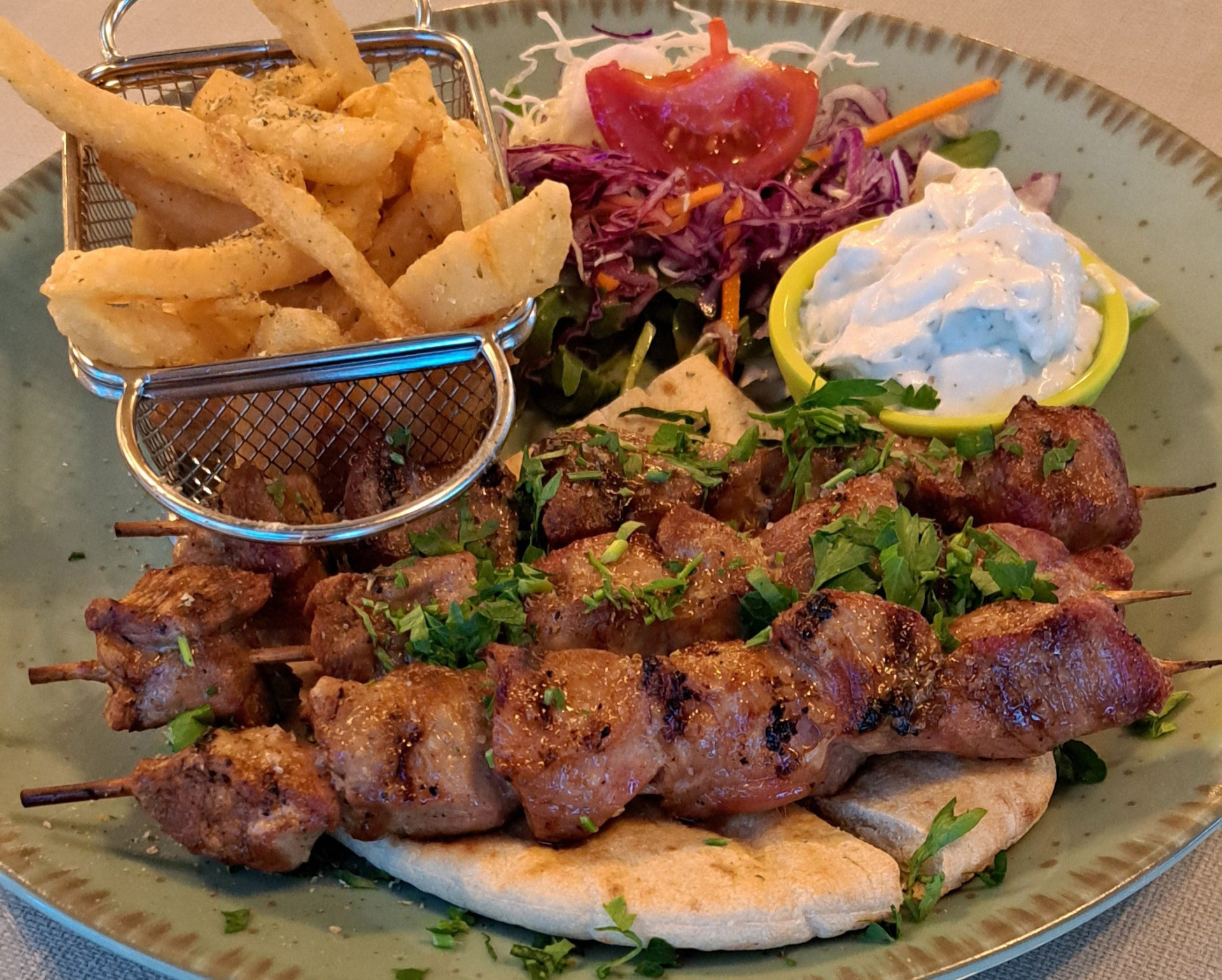
Two of us decided to try the Souvlaki in both pork and chicken versions, as others had praised it online. The best Souvlaki is all about the purity of fire and the patience to produce it. You want your meat to be kissed by the charcoal, not smothered by it. The Souvlaki at Kyparissos was juicy, tender and a generous portion. Both dishes came with salad, traditional pitta, and homemade fries with tzatziki on the side. Both were the finest examples of this traditional dish.
Our final main course was the Marinated Chicken, which was three pieces of chicken breast. It was crispy where it needed to be and succulent inside. Chicken is always highly attractive when the flavours sink deep into the meat and is richly seasoned. The Kyparissos version had a slow infusion of lemon, garlic, and fragrant herbs, resulting in tender, aromatic chicken with a whisper of smokiness. Everybody at the table was delighted with their choice and individual dish.
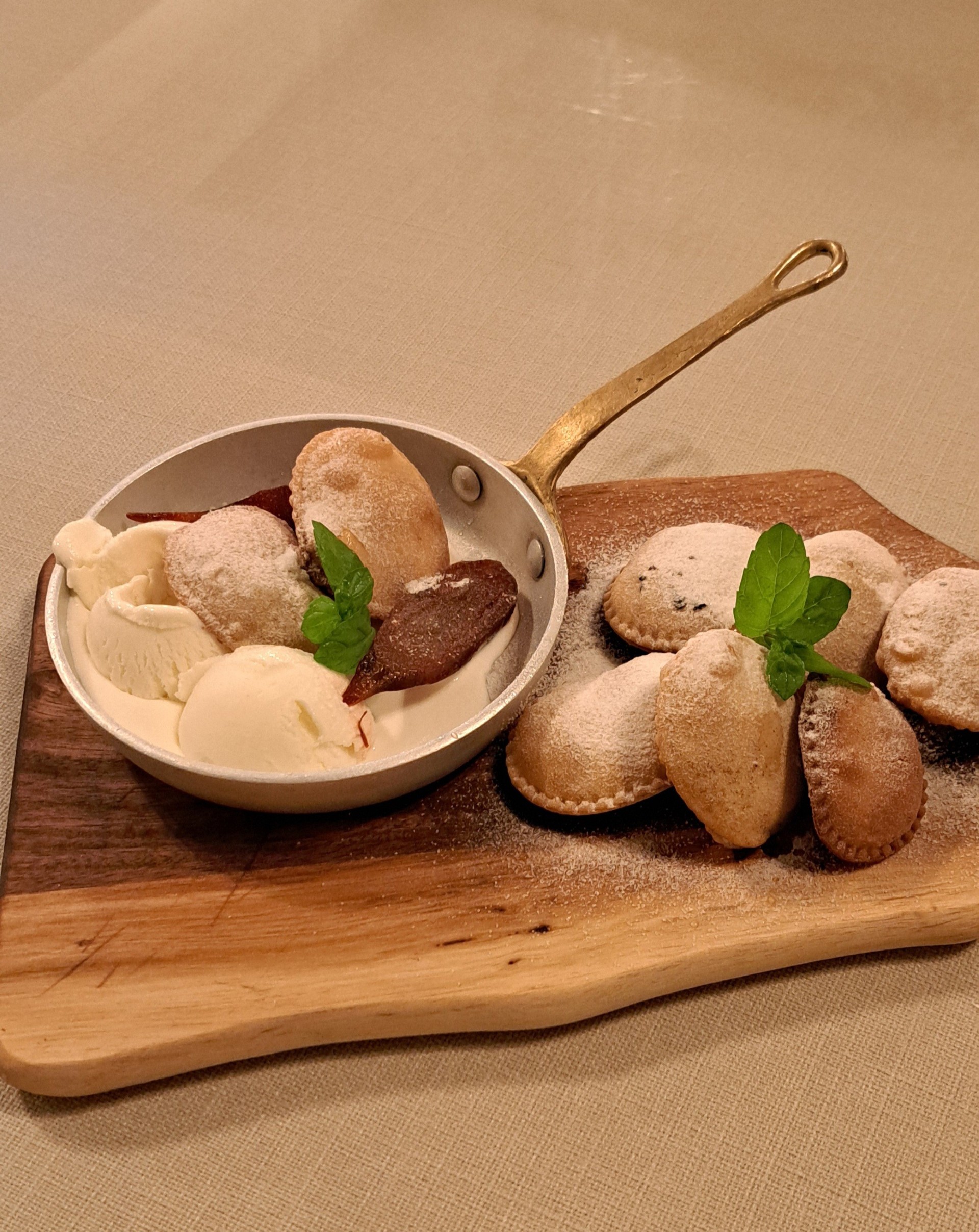
Rather embarrassingly, before we could order our pre-selected homemade desserts to share, a plate with four pieces of delectable orange cake was placed in front of us on the house. As we ordered two more desserts to write about, you could see the waiter’s face betraying his thoughts of greedy people! Still, we were glad to share an Anari Surprise and the Kyparissos Chocolate Cake – a word of warning that desserts here are definitely designed to be shared. The Anari dessert was very different to versions we have enjoyed in the past: like little mince pies with a filling of Anari cheese lifted by the strong flavour of Cinnamon. The chocolate cake was light and fluffy, with a velvety, decadent chocolate topping, served with ice cream and cream.
Combined with excellent service throughout the meal and a bottle of the house red from the family vineyard, the whole experience at Kyparissos was superb. A family-run taverna like this deserves every bit of praise. It is the kind of place where the cooking is heartfelt, the flavours are excellent, and every plate feels like it’s been carried from someone’s home kitchen.
I look forward to returning, either to try their full meze, which you just know would be pretty special, or their set menu Sunday lunch, which includes a variety of dishes for €25. Kyparissos is certainly a little piece of gastronomic heaven in the hills.
VITAL STATISTICS
SPECIALTY Cypriot
PRICES Cold Starters from €4.00, Hot Starters from €9.50, Salads from €10.00, Main Dishes from €15.50, Sunday Set Menu €25.00.
WHERE Leoforos Aki Kleanthous. Kathikas, Paphos. Main road up from Peyia.
WHEN Open every day except Wednesday. 1 – 11 pm. Reservations recommended.
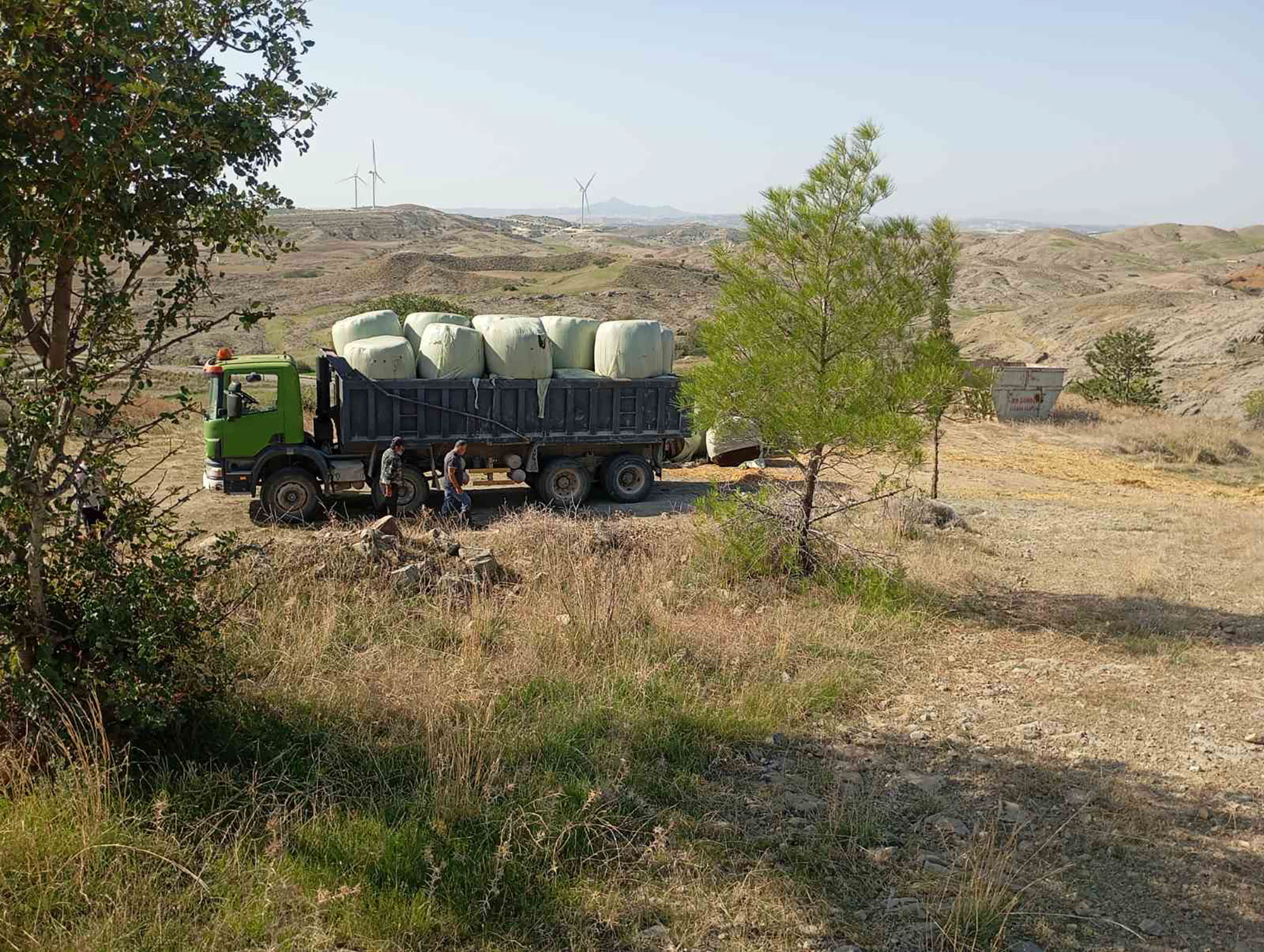
Hay bales contaminated with the food and mouth virus (FMD) that were intended to be buried in Troulli will be moved to another safe location so as not to affect livestock units in the adjacent areas, Agriculture Minister Christos Senekis said on Friday.
Senekis said the decision was made following consultation with Aradippou mayor Christodoulos Partou.
According to the minister, the goal was to address the issue safely without creating problems for the reactivation of livestock units following the FMD crisis, assuring that the transfer of the bales would take place immediately.
Cyprus showcased 28 local food and drink businesses at the international SIAL Paris exhibition in France from October 17 to 21, 2026, using two national pavilions covering a combined area of approximately 356 square metres to promote domestic products and explore new export opportunities.
The event, held at the Paris Nord Villepinte exhibition centre, is considered one of the leading international trade fairs for the food and beverage industry and is organised every two years by Comexposium.
According to an announcement by the Ministry of Energy, Commerce and Industry, this year’s exhibition brought together 8,000 exhibitors from 130 countries and approximately 295,000 professional visitors, offering opportunities to explore emerging industry trends, discover innovations and develop commercial partnerships.
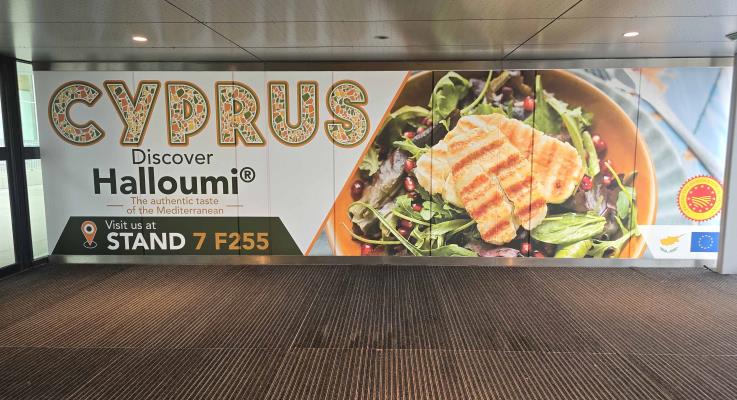
A major focus of Cyprus’ presence was halloumi, with 13 companies taking part in the dairy products pavilion in Hall 7.
The cheese received dedicated promotion through special signage featuring the Halloumi® name and Protected Designation of Origin (PDO) mark, while an entire side of the Hall 7 entrance was devoted to the Cypriot product.
Visitors were also able to use an interactive touchscreen entitled “Discover halloumi”, which provided information about the cheese and Cyprus’ dairies, highlighting its connection with domestic production.
The second national pavilion, located in Hall 2, hosted the remaining 15 participating businesses, which presented a wide variety of products from the island’s food industry.
These included olive oil, olives, honey, bulgur wheat, fruit juices, nuts, dried fruit, herbal beverages and coffee, alongside frozen foods and vegan products.
An interactive display at the pavilion provided information about the participating companies and their products, while also featuring a quiz designed to give visitors a more engaging and direct introduction to Cyprus’ food production.
“The country’s participation this year highlighted the potential and diversity of the domestic food industry, promoting both products with a strong identity and recognition, such as halloumi, and a wide range of other Cypriot products,” the ministry said.
“It also confirmed the importance of an organised presence at leading international exhibitions as a means of strengthening international outreach, promoting Cypriot production and exploring new business opportunities in international markets,” it added.
The Ministry of Energy, Commerce and Industry said it would continue supporting the promotion of Cypriot products abroad, helping strengthen the international presence of domestic businesses and create opportunities for further export growth.
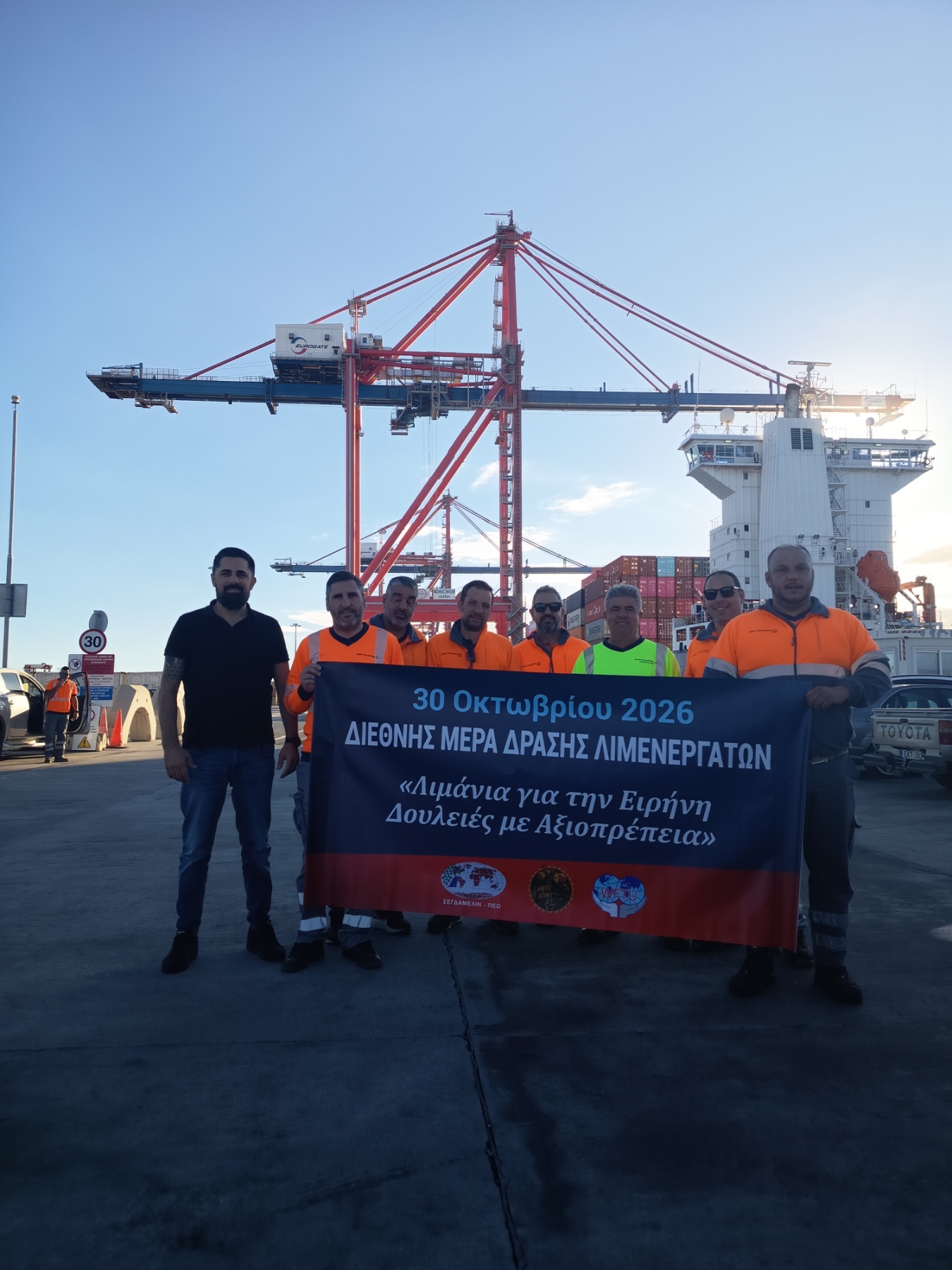
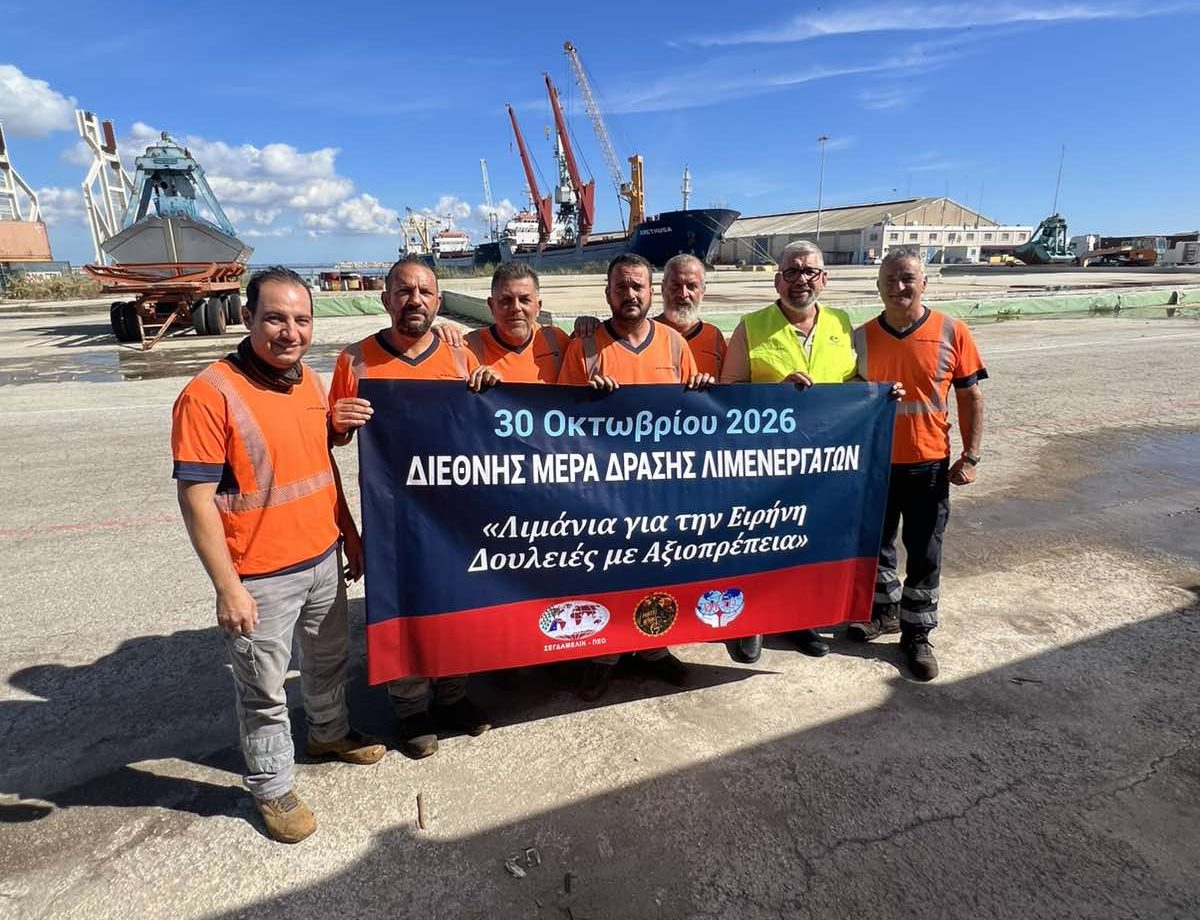
Dockworkers staged protests at the ports of Limassol and Larnaca on Friday as unions at more than 100 ports across four continents took part in an International Day of Action against Israel’s war in Gaza.
The port workers’ union (Segdamelin-Peo) organised the events to mark the second International Day of Action for Dockworkers, held under the slogan “Ports for Peace”.
The union said ports were “critical hubs” for the economy and trade, but that their infrastructure was being used to transport military equipment.
Workers should not “pay the price for wars and rivalries”, it said, adding that Cypriots knew “what war, occupation, partition and militarisation mean”.
It also called for decent wages, stable jobs, collective agreements and better health and safety protection.
Heavy spending on a war economy, it said, led to “austerity and cuts to healthcare, education, pensions and wages”.
The international action is backed by the Palestinian-led Boycott, Divestment and Sanctions (BDS) movement, which said more than 25 unions from 22 countries were taking part, along with seafarers and metalworkers.
Dockworkers in France, Italy, India, Greece and Turkey have called 24-hour strikes, while others are holding rallies in port cities; seventeen Palestinian trade unions and confederations have likewise endorsed the day.
The unions are demanding an end to “militarisation” and to what they describe as “Israel’s genocide against Palestinians”.
Markos Bekris, president of the Greek dockworkers’ union (Enedep), said unions representing tens of thousands of workers were taking a stand “from Piraeus to Genoa and from Marseille to Istanbul”.
Sara Elettra, who coordinates maritime and energy embargo campaigns for BDS, said more than 90 per cent of Israel’s imports arrived by sea, making dockworkers a choke point for its economy.
She said governments were legally obliged to impose a full military embargo on Israel after the International Court of Justice’s 2024 rulings.
“Where states fail to act, workers will,” she said.
Jamal Juma, of the Palestinian trade union coalition, said dockworkers who had blocked ships and arms shipments bound for Israel had shown “the collective power of organised labour”.
Cyprus’ unemployment rate remained at 4 per cent in September 2026, unchanged from August and below the 4.2 per cent recorded a year earlier, while youth unemployment stayed at 11.3 per cent, according to figures published by Eurostat on Friday.
The number of unemployed people in Cyprus stood at approximately 21,000 in September, down from around 22,000 in September 2025, as the labour market continued to perform better than the European Union average.
The figures also showed that youth unemployment in Cyprus declined over the past year, with the number of unemployed people aged under 25 falling from approximately 4,000 in September 2025 to 3,000 in June 2026, where it remained through September.
Across the EU, however, unemployment increased over the year, with the overall rate reaching 6.2 per cent in September, compared with 6 per cent in the same month of 2025.
The euro area unemployment rate stood at 6.5 per cent, unchanged from August but higher than the 6.3 per cent recorded a year earlier.
Eurostat, the statistical office of the European Union, estimated that 13.773 million people were unemployed across the EU in September, including 11.555 million in the euro area.
Compared with August, the number of unemployed people increased by 105,000 across the EU and by 122,000 in the euro area.
On an annual basis, unemployment rose by 471,000 across the EU and by 420,000 in the euro area.
Cyprus unemployment remains below EU average
Cyprus’ unemployment rate declined from 4.2 per cent in September 2025 to 3.8 per cent in June 2026, before edging up to 3.9 per cent in July and reaching 4 per cent in August, where it remained in September.
The number of unemployed people followed a similar pattern, falling from approximately 22,000 in September 2025 to 21,000 in June and July 2026.
The figure increased to around 22,000 in August before returning to approximately 21,000 in September.
The latest figures place Cyprus’ unemployment rate 2.2 percentage points below the EU average and 2.5 percentage points below the euro area rate.
While the EU and euro area have experienced an increase in unemployment over the past year, Cyprus’ rate has declined, indicating comparatively favourable labour market conditions.
Youth unemployment remains lower in Cyprus
The unemployment rate among people aged under 25 in Cyprus stood at 11.3 per cent in September 2026, unchanged from July and August and below the 12.9 per cent recorded in September 2025.
The rate had fallen to 11.8 per cent by June 2026 before declining further to 11.3 per cent in July.
The number of unemployed young people also decreased over the year, from approximately 4,000 in September 2025 to 3,000 in June 2026, remaining at that level through September.
The figures compare favourably with the wider European picture, where youth unemployment continued to rise.
Across the EU, the youth unemployment rate reached 15.5 per cent in September, up from 15.4 per cent in August.
In the euro area, the rate increased to 15.4 per cent from 15.1 per cent in the previous month.
Eurostat estimated that 3.022 million people aged under 25 were unemployed across the EU in September, including 2.469 million in the euro area.
Compared with August, youth unemployment increased by 44,000 across the EU and by 69,000 in the euro area.
Compared with September 2025, the number of unemployed young people rose by 45,000 in the EU and by 80,000 in the euro area.
Unemployment among women and men
The unemployment rate for men in Cyprus stood at 3.7 per cent in September 2026, unchanged from July and August, after declining from 4 per cent in September 2025 to 3.6 per cent in June 2026.
Among women, the rate reached 4.3 per cent in September, down from 4.4 per cent a year earlier.
Female unemployment had fallen to 4.1 per cent in June 2026 before increasing to 4.2 per cent in July and 4.4 per cent in August, then edging down in September.
The figures show that the unemployment rate for women remained higher than that for men in Cyprus, although the difference narrowed slightly in September.
Across the EU, the unemployment rate for women stood at 6.4 per cent in September, while the rate for men was 6 per cent, with both unchanged from the previous month.
In the euro area, female unemployment remained at 6.7 per cent, while the male rate increased to 6.4 per cent from 6.3 per cent in August.
European unemployment rises over the year
The wider European figures showed a gradual increase in unemployment compared with September 2025, despite rates remaining stable between August and September 2026.
In the euro area, the unemployment rate rose from 6.3 per cent in September 2025 to 6.4 per cent in June 2026, before reaching 6.5 per cent in July and remaining at that level through September.
The number of unemployed people in the euro area increased from 11.135 million in September 2025 to 11.555 million in September 2026.
Across the EU, the unemployment rate increased from 6 per cent in September 2025 to 6.2 per cent in June 2026, remaining at 6.2 per cent through September.
The total number of unemployed people across the bloc rose from 13.302 million to 13.773 million over the same period.
The latest figures therefore highlight a contrast between Cyprus, where overall unemployment and youth joblessness remained below their levels a year earlier, and the wider EU, where both the number of unemployed people and the overall rate increased.
Parliamentary staff have expressed strong dissatisfaction over the behaviour of certain MPs, both inside parliament and through public statements and social media posts, warning that disparaging remarks are undermining their professional dignity and working relationships.
In a letter dated October 27 to House president Annita Demetriou, members of the Pasydy parliamentary employees’ branch called for a working environment based on mutual respect and institutional decorum.
The employees said they carried out their duties daily with professionalism, responsibility and discretion, providing administrative, scientific and organisational support to MPs, their parliamentary associates and the House’s various bodies.
They stressed that their primary responsibility was to ensure the smooth functioning of parliament and protect the credibility and dignity of the institution.
However, they warned that behaviour and public comments which belittle employees, undermine their work or collectively assign blame without considering their institutional role and demanding working conditions “harm both their professional and personal dignity”.
“At the same time, they create a climate of disappointment and insecurity and undermine the fundamental relationship of cooperation between MPs and parliamentary staff in the future,” the letter said.
The employees acknowledged MPs’ right to criticise, raise concerns and seek explanations about parliamentary operations, but stressed that criticism should distinguish between institutional or administrative disagreements and personal attacks on staff.
“The public expression of disagreements must not become a means of targeting, assigning sole responsibility or belittling parliamentary staff,” they said.
The union branch called for measures to prevent similar behaviour and remarks in the future.
“The smooth functioning of parliament and the effective support of parliamentary work require relationships of cooperation, trust and mutual respect between MPs and staff,” the letter concluded.
A bill introducing a new teacher appointment system is expected to be submitted to parliament by late November or early December, Education Minister Athena Michaelidou said on Friday.
Speaking to the Cyprus News Agency (CNA) after presenting her ministry’s 2027 budget to the House finance committee, Michaelidou said the government intended to move ahead with the proposed changes despite objections from teachers’ unions.
Asked about the unions’ declaration that negotiations had reached a deadlock, their letter to President Nikos Christodoulides and the possibility of escalating industrial action, she described the unilateral declaration of deadlock as “somewhat problematic”.
“Nothing changes on this issue. We have already demonstrated our willingness to help, support and accommodate demands concerning an issue that was settled in 2015, 11 years ago,” she said.
She criticised the lengthy transition period introduced under the 2015 legislation, which provided for the abolition of the existing appointment list.
“The legislation in 2015 stipulated that the appointment list would be abolished, and a transitional period of almost 12 years was, criminally, allowed. During this period, many distortions emerged, which we have acknowledged,” she said.
Michaelidou said the government had agreed with unions that teachers who had worked during the transitional period should not be disadvantaged, but stressed that those who passed the appointment examinations must also be treated fairly.
“We agreed with the trade unions that people who worked during these years should not be treated unfairly, and that is what we are doing through our proposal. On the other hand, those who pass the examinations and will continue to sit them cannot be treated unfairly either,” she said.
She added that the ministry had listened to concerns and submitted an updated proposal, but one issue remained unresolved.
“The issue and demand for permanent appointments without examination is in conflict with the law. Therefore, we cannot dismiss or undermine the entire effort simply because not all the demands raised by the trade unions have been met,” she said.
The minister said the next steps would involve immediate public consultation, followed by approval from the cabinet and submission to parliament, where further discussions could take place.
Asked when the bill would reach parliament, she said it was expected by late November or early December.
“We want it passed as soon as possible, before March 2027, so that it can be implemented from the new school year,” Michaelidou said.
Household electricity prices in Cyprus fell to €0.26 per kilowatt-hour in the first half of 2026, according to Eurostat data, easing from their energy-crisis peak but remaining significantly above pre-crisis levels as electricity costs continue to weigh on consumers.
The latest figures show that prices, including all taxes and levies, have declined steadily since reaching €0.37 per kilowatt-hour in the first half of 2023, although households are still paying considerably more than they did before the energy crisis.
When adjusted for differences in purchasing power, Cyprus recorded 29.9 purchasing power standard (PPS) units per 100 kilowatt-hours in the first half of 2026, providing an indication of the relative burden of electricity costs on households.
Across the European Union, average household electricity prices fell by 2.2 per cent in the first half of 2026, declining to €0.28 per kilowatt-hour from €0.29 in the second half of 2025.
Despite the decrease, prices remained well above levels recorded before the 2022 energy crisis, indicating that households continued to face higher electricity costs than before the energy market turmoil.
Taxes and levies also declined slightly as a proportion of household electricity bills, falling by 0.5 percentage points, from 28.9 per cent in the second half of 2025 to 28.4 per cent in the first half of 2026.
Cyprus electricity prices peaked in 2023
Eurostat data show that household electricity prices in Cyprus followed a relatively stable pattern between 2015 and 2020, before surging during the energy crisis and subsequently easing.
During the initial period, prices fluctuated between €0.15 per kilowatt-hour in the first half of 2016 and €0.22 in the second half of 2019, before falling to €0.16 in the second half of 2020.
The subsequent energy crisis brought a sharp increase in household electricity costs, with prices reaching €0.37 per kilowatt-hour in the first half of 2023, more than double the level recorded in late 2020.
Prices then began to ease, declining to €0.32 per kilowatt-hour in the first half of 2024 before continuing their gradual downward trajectory.
By the first half of 2026, the price had fallen to €0.26 per kilowatt-hour, representing a substantial reduction from the 2023 peak but remaining well above the levels recorded before 2021.
The trend highlights the persistence of the energy crisis’ impact on household electricity bills, even as prices have retreated from their highest levels.
Ireland records highest electricity prices
Ireland recorded the highest household electricity prices in the EU during the first half of 2026, at €0.39 per kilowatt-hour, followed by Germany and Belgium, where prices stood at €0.36 per kilowatt-hour in both countries.
Six member states recorded household electricity prices exceeding €0.30 per kilowatt-hour, while five countries reported prices below €0.20.
The lowest nominal prices were recorded in Hungary, at €0.11 per kilowatt-hour, followed by Malta and Bulgaria, where households paid €0.13 per kilowatt-hour.
However, comparisons based solely on euros do not fully reflect the financial burden electricity bills place on households, as purchasing power and general price levels differ between countries.
When electricity prices were adjusted using the purchasing power standard (PPS), Romania recorded the highest costs, at 46.9 units per 100 kilowatt-hours, followed by Poland at 41.1 and the Czech Republic at 34.3.
Cyprus recorded 29.9 PPS units per 100 kilowatt-hours, while the lowest purchasing-power-adjusted prices were observed in Malta, at 13.8, Hungary at 14.7 and Luxembourg at 15.5.
The PPS measure allows comparisons between countries by accounting for differences in purchasing power, offering a clearer indication of the relative cost of electricity for consumers.
Electricity prices move sharply in several countries
Although the EU average declined in the first half of 2026 compared with the second half of 2025, national trends varied considerably when prices were compared with the same period a year earlier.
Using comparisons in national currencies, Eurostat found that household electricity prices increased sharply in Romania, rising by 51.6 per cent compared with the first half of 2025.
Ireland recorded the second-largest increase, at 19.8 per cent, followed by Finland, where prices rose by 18.4 per cent.
In contrast, Denmark registered the largest decrease, with household electricity prices falling by 31.7 per cent, while Luxembourg recorded a decline of 24.1 per cent.
The figures illustrate the uneven evolution of electricity costs across Europe, despite the overall reduction in average EU prices during the first six months of 2026.
For Cyprus, the combination of the historical price trend and the latest purchasing-power-adjusted figures shows that, although household electricity costs have fallen considerably from their 2023 peak, prices remain elevated compared with the period before the energy crisis.
Nurses’ trade unions have insisted that collective labour agreements protecting the rights and benefits of both existing and future nursing staff, including those recruited from abroad, are non-negotiable.
In a joint statement following Thursday’s House health committee discussion on proposed legislative amendments concerning the employment of nurses from third countries, SEK, PEO, Pasydy and Pasyno reiterated their position that staffing needs could be met by Cypriot nurses.
The unions said regulating employment conditions through collective agreements would help attract staff and prevent further departures from the profession.
They also stressed that language proficiency was primarily a matter of patient safety and quality of care, arguing that requirements must reflect the responsibilities of nursing staff and ensure effective communication with patients and other healthcare professionals.
The unions expressed strong dissatisfaction with the health ministry for failing to convene a meeting with trade unions, nursing representatives and employers’ organisations, despite having been given 15 days to facilitate dialogue on a comprehensive solution.
They said discussions before the House health committee had demonstrated that the conditions for a consensus did not exist and that the proposed legislative amendment should not proceed to the House plenum in its current form.
The unions also dismissed claims made by employers’ federation OEV and the private hospitals’ association (Pasin) as unsubstantiated, arguing that they did not contribute to addressing the nursing sector’s problems.
They warned that they would act as “a barrier to any attempt to downgrade the nursing profession or introduce any regulation that could endanger the quality and safety of care provided in Cyprus’ hospitals”.
The unions concluded that addressing healthcare staffing shortages required serious planning, reliable evidence and meaningful dialogue, alongside policies protecting healthcare standards and strengthening the nursing profession.

 Login