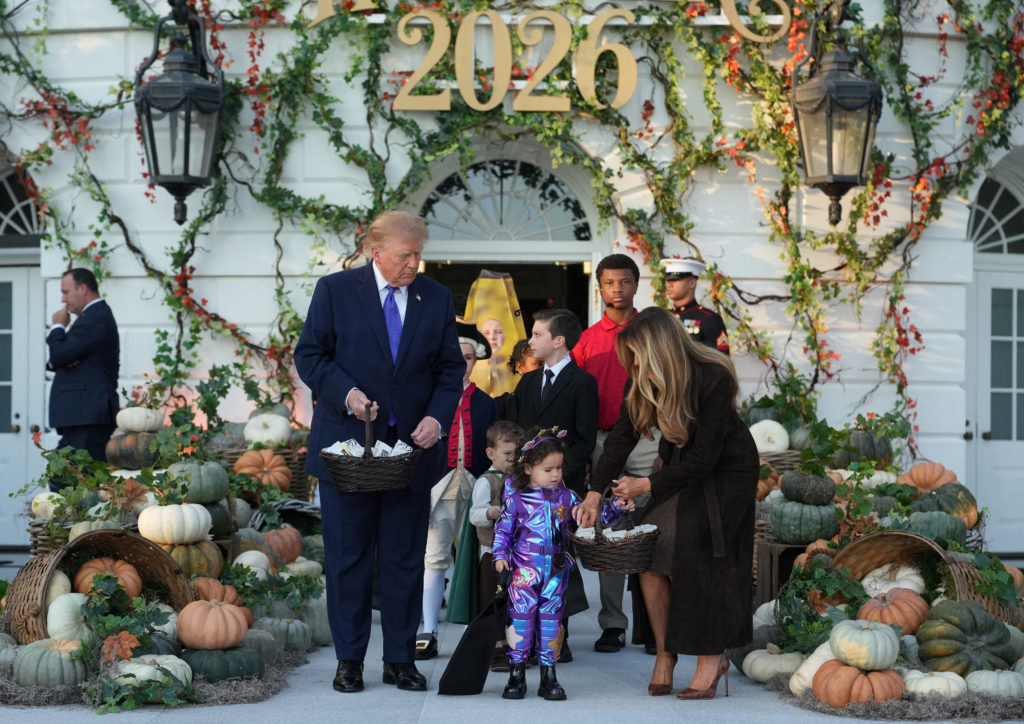
President Donald Trump and First Lady Melania Trump hosted trick-or-treaters for the annual Halloween bash on Thursday at the White House, with photos and videos showing the colorful festivities.
MS NOW’s Joe Scarborough condemned Donald Trump for flying into a “crazed rage” after the president called a Reuters reporter “disgusting” and “a sick guy” for asking about the cancellation of his campaign visits to Kansas and Iowa. The MS NOW host said the president’s behavior should trouble both the White House and the American public.
On Thursday, just days before the midterm elections, the Republican National Committee announced that Trump’s planned weekend rallies in Kansas and Iowa, two states that have become increasingly competitive, were off.
“With Republicans in a strong position in Kansas and Iowa, previously planned in-person rallies in those states will no longer take place as scheduled,” the RNC said in a statement. Instead, the party said Trump would hold phone rallies in nearly 20 states to reach more voters.
However, on Friday, the president reversed course. A White House official told MS NOW that Trump is “expected” to stop in Iowa and Kansas on Sunday and said the rallies were canceled and then rescheduled to accommodate his telerallies.
Before the rallies were put back on the schedule, Reuters reporter Jacob Bogage asked Trump if the cancellations were because he was “sick of traveling.” In response, Trump berated Bogage and said he was “sick” to ask that question.
“You know what the reason is? I don’t feel I have to go to Kansas,” Trump said on the tarmac at Joint Base Andrews. “You’ve been following me for two weeks. I feel perfect. You are disgusting. Put yourself in shape. You look like hell.”
On Friday’s “Morning Joe,” Scarborough said Trump’s stated reason for canceling the rallies didn’t match what he had heard from his sources.
“What he’s saying about canceling and why he canceled is a lie,” the MS NOW host said. “Yesterday afternoon, I got a call from Republican operatives who said, and I am quoting them: ‘This race has been gone for a week.’ That’s what Republicans are saying.”
Scarborough then turned to Trump’s exchange with Bogage, saying the president’s angry response to a basic question should concern his aides and the public. He said that Trump’s behavior should be “troubling for people inside the White House and for Americans.”
“People are asking him very simple, basic questions, and he’s just flying off in an absolute rage,” Scarborough said. “This has been happening now for a month or two, where a basic question any other president would answer, this one flies off in this crazed rage.”
“You just kind of worry if he’s OK,” he added. “I’m worried about him.”
You can watch Scarborough’s full comments in the clip at the top of the page.
At a Saturday night campaign rally in Georgia, Trump spent quite a bit of time bragging that oil and gas companies were “making a fortune” as a result of higher prices, so consumers struggling to pay their bills should be glad they’re paying more at the pump.
As for members of his team who encouraged him not to make such comments, the president added, “I said, ‘I don’t give a damn. I’m going to say it. We’re making a freaking fortune.’”
MaddowBlog routinely shines a light on instances when Trump tries to deceive the public, but in this case, the Republican had a point: Big Oil really is making a freaking fortune, thanks in large part to price spikes tied to the war with Iran, which the president started eight months ago but doesn’t know how to end. The New York Times reported:
The war with Iran has been very lucrative for American oil companies, which have earned more than $130 billion in profit as people pay much higher prices for gasoline, diesel and other fuel.
That is a conservative estimate based on the performance of more than 50 large U.S. oil and gas companies, most of them producers or refiners, in the six months from April through September. It does not reflect profits earned in March, the first month of the war, or in October.
According to the Times’ analysis, over the same period of time last year, these same energy companies collectively earned $47 billion less.
By his own admission, Trump thinks this is great news, telling the public that “we” are making an enormous amount of money. The trouble is, “we” is doing a lot of work in that sentence.
It’s true that the U.S. is producing a lot of oil, and it’s also true that higher prices are generating massive oil industry profits. But because the number of Americans who benefit from oil industry profits is very small, few are likely to applaud the ongoing hit to their wallets.
That said, when the president uses the word “we,” there’s also reason to believe he’s being rather literal. Congressional Democrats on the Joint Economic Committee released data this week showing that Trump personally owns oil and gas stocks, which have added as much as $35.8 million to his personal wealth this year.
That same Joint Economic Committee report added, “In 2026, over 94% of his oil and gas stock purchases occurred after Trump started his war in Iran. In total, from March 2026 through August 2026, Trump purchased as much as $17.5 million of oil and gas stocks.”
Keep such details in mind the next time the president declares, “We’re making a freaking fortune.”
In any election cycle, it’s common for candidates, officials and party leaders to save their strongest message for what’s known as a “closing argument” — a phrase the political world borrows from trial lawyers. After months of speeches, debates, advertisements, interviews and countless interactions with voters, this is the final opportunity for political players to put their best foot forward and summarize why they deserve the public’s support.
Donald Trump has spent quite a bit of time on the campaign trail lately, and I’ve heard his closing message several times. And while I’m certain the president wants voters to know something as they cast their ballots, I’m not at all sure what that is.
Modern political history offers few examples of closing arguments that appear more out of touch, self-defeating, or downright bizarre than what Donald Trump has offered his fellow Republicans ahead of next week’s midterm elections.
The Democratic message, as articulated by Barack Obama among others, is relatively straightforward: Trump and Republicans took power and made things worse. A Democratic-led Congress can serve as a check on White House abuses, hold the corrupt accountable and push policies that would help get the country back on track.
Trump’s message is … harder to nail down.
After watching his final-week rallies and reading his social media messages, it’s clear that the president cares a great deal about Republican Sen. Jon Husted’s buttocks. And cognitive tests. And the oil industry’s profits. And golf courses in Washington, D.C. And his weird attempts to give artificial intelligence a new name.
It’s equally clear that Trump desperately wants Americans to hate Democratic Rep. Ilhan Omar and fear transgender Muslim immigrants who believe in communism, and who apparently want to take hamburgers away.
Does the Republican president have any policy priorities or a vision for the final two years of his term? Well, no, but he has a lot of thoughts about Bill Maher (the target of Trump’s single longest online post since launching his own social media platform), White House renovations and why it would be awesome if New Mexico changed its name.
“Many Republicans, and even some in Trump’s orbit, don’t quite get it,” The Atlantic’s Lemire added. “What has happened, they ask, to the instincts of the man who authored two of the most improbable victories in American political history?
“Trump’s superpower was his intuitive understanding of what motivated his supporters. Many Republicans privately tell me that he’s lost that feel. Trump now lives, they think, in a gilded bubble, palling around with billionaires, oblivious to — and, even worse, uncaring about — the problems facing so many voters,” he said.
There’s already ample speculation about whom the White House will blame if Democrats fare well next week. Whether Trump is prepared to acknowledge his own role in crisscrossing the nation, peddling weird absurdities that only he seems to care about, remains to be seen.
“With the DOJ bringing frivolous lawsuits against the states and election boards that are clearly an attempt to interfere with the election, can these attorneys be disbarred?” — Karen
Hi Karen,
Yes, they can be.
Lawyers have faced bar discipline stemming from their support of President Donald Trump’s failed effort to overturn the 2020 election he lost to Joe Biden. The final word on those disciplinary proceedings is still unfolding, including with John Eastman’s pending Supreme Court petition challenging his California disbarment. I mention that timing factor to underscore that these cases can take years to resolve.
With that in mind, there is an effort to sanction Justice Department lawyers who sued to intervene in Alaska’s U.S. Senate contest just ahead of Election Day. Their Oct. 22 complaint seeks to make a federal case out of the concern that GOP Sen. Dan S. Sullivan could lose a key race to Democratic challenger Mary Peltola, due to the presence on the ballot of Daniel J. Sullivan, whom the DOJ accused of running “with the intention of misleading supporters of Senator Sullivan into voting for him.”
The lawsuit, which attempts to block the state from certifying the results if the Republican incumbent loses, has been uniformly panned by election law experts. An amicus brief from University of California at Los Angeles law professor Richard Hasen collects quotes from scholars across the political spectrum who have called the Justice Department’s legal argument “one of the worst I have ever seen,” “completely meritless,” “scraping the bottom of the barrel,” a “desperation play” that has “zero basis in the law,” “one of the weakest lawsuits I’ve ever seen,” “uniquely embarrassing, likely filed only because Trump himself insisted on it” and “unconstitutional and unprecedented.”
Hasen, who directs the Safeguarding Democracy Project, said in his brief that the federal government’s “error-filled complaint seeks to derail Alaska’s normal and constitutionally protected processes for certifying election results, and it includes the preposterous argument that the preamble to a federal voter registration statute mentioning ‘integrity’ grants the federal government vast powers to interfere with state election certification processes (and who knows what else).”
A motion from a group led by the League of Women Voters argued that the judge presiding over the case, Obama appointee Sharon Gleason, should not only dismiss the “frivolous, election-eve lawsuit,” but also sanction the lawyers who brought it. The voting rights coalition said the court “would do American democracy and the rule of law a further service by considering Rule 11 sanctions against the attorneys who signed the Complaint in the name of the United States Department of Justice.” Rule 11 is the federal civil procedure rule that governs frivolous and dishonest court filings and sanctions for bringing them.
The DOJ’s complaint was signed by Stanley Woodward, a high-ranking government lawyer in Trump’s second term who has been pressing the president’s priorities in court and previously represented various Trump-aligned figures while in private practice, and Alaska-based prosecutor E. Bryan Wilson.
Woodward and Wilson filed an amended complaint on Thursday that cited this week’s reporting from The New York Times that said the Peltola campaign worked with people trying to recruit the other Sullivan to run. The new complaint does not quote the Times’ caveat that “Ballot-stacking tactics are common in politics and generally considered legal — and have been employed by both parties in Alaska.”
Whatever the political effect of the Times’ reporting, it doesn’t retroactively make the DOJ’s suit more legally meritorious, nor does it retroactively make the filing of that suit more ethical.
We don’t know yet how Gleason will rule (or what will happen on any appeal), or whether she will impose sanctions. Even if she does, that wouldn’t necessarily endanger the attorneys’ law licenses. Whether that happens is up to the state bars and courts where they are licensed.
Earlier this year, watchdog group Campaign for Accountability filed a bar complaint against Woodward in the District of Columbia, where he is licensed, asking the authorities there to investigate potential ethics violations over his involvement in the “anti-weaponization fund,” which the group said would compensate “the same January 6 defendants and Trump associates he previously represented as a private defense attorney.” Attorney General Todd Blanche said the DOJ wasn’t moving forward with the fund, but pardoned Jan. 6 defendants, including Woodward’s former clients, are still pressing compensation claims.
At a hearing Friday in the protracted litigation over the East Potomac golf course, with Woodward representing the government, the Washington, D.C., judge handling that contentious case reportedly began by reading the D.C. bar’s rule about candor to the court.
Keep in mind that disbarment is the most extreme form of attorney discipline. Other options range from reprimand to suspension. Again, whether any discipline comes from current events could take years to know.
With time running out in the election cycle, JD Vance participated in a primetime town hall on Fox News, which was largely unremarkable except for one unexpected exchange.
A local college student told the vice president that the right routinely tells young people to get married and have children but that conservatives have failed to acknowledge how financially difficult this is for many. She asked, “So my question is, how does the right, and yourself, expect us to start families young when the average price of a home in America now costs more than $415,000, which just feels out of reach for us?”
It’s worth emphasizing for context that the question came from a young woman who identified herself as the vice president of her university’s Turning Point USA chapter. That is, Vance wasn’t confronting a political opponent; the question came from someone inclined to agree with the Trump White House.
Almost immediately, the Ohio Republican demonstrated the kind of political instincts that have made him famous.
Q: How do you expect us to start families young when the average price of a home feels out of reach?JD VANCE: I want to point out that I've only gotten one question about Jon Husted's ass
“I want to point out that I think that I have been asked four or maybe five questions by my count,” the vice president began. “I have only been asked one question about [Republican Sen.] Jon Husted’s ass — and it was by [Fox News’] Jesse Watters.”
So, during a nationally televised event, a young conservative voter asked a sincere question about one of the most pressing issues facing her generation, and Vance’s first thought was to make a joke about a senator’s backside.
It’s impossible to say just how many young voters watching at home were amused by this clumsy attempt at humor, but it seems likely the number was small.
It only got worse when Vance actually tried to answer the question with some substance.
“I think we have to take stock of the fact that the reason why housing exploded in the United States of America is in part because we allowed 20 million illegal aliens into our country to buy homes that ought, by right, go to American citizens,” the vice president argued.
Except that’s absurd. Vance’s statistic is wildly inflated and totally at odds with actual data — the idea that 20 million undocumented immigrants have the resources to buy up American real estate is nonsensical. (Last fall, he similarly complained to Fox News about importing “more and more low-wage servants” from other countries. How “low-wage servants” can afford to purchase homes has never been clear.)
The vice president went on to say, “Another reason why housing got too expensive in this country is because we allowed homes to be bought up by Wall Street and foreign investors.”
Unlike the rest of his response, this actually made some sense, though it touched on a problem Vance neglected to mention: Congress approved a bipartisan housing bill earlier this year that was designed to address the very problem he referred to. President Donald Trump, however, refused to sign it as part of a tantrum over a voter suppression proposal that he wanted but couldn’t have. (The housing bill, thankfully, became law anyway.)
This exchange didn’t have to be so politically messy for the vice president, but his unerring political instincts won out in the end anyway.
The ad plays out of context clips of three women of color (Rep. Alexandria Ocasio-Cortez, D-N.Y.; Rep. Ilhan Omar D-Minn.; and “The View” co-host Sunny Hostin) speaking about race, cut together with a horror movie aesthetic. Then comes the ad’s real message: “Today’s liberals are full of hate. They hate America. They’re obsessed with skin color,” says an unnamed female narrator obscured by shadow. “I can’t even show my face, because my skin is white and they’ll spew hate at me,” she laments.
If “liberals are the new racists,” according to America Next, who are the old racists? Maybe it’s the people at the highest positions of power and influence in the Grand Old Party and the MAGA movement?
New York Times reporter Ken Bensinger posted to X that the ad was paid for by America Next, a PAC created by former Republican Louisiana Gov. Bobby Jindal. According to its website, America Next is “not focused on elections” but rather “winning the war of ideas.” Bensinger also cited Federal Elections Commission data showing America Next paid $250,000 to a firm called Breakthrough LLC for the specific purpose of “opposition” to the Democratic candidate for Senate in Michigan, Abdul El-Sayed. The Guardian reported that Breakthrough was founded by former Jindal aide Timmy Teepell, whose son Tommy went viral after asking El-Sayed if he’d denounce the Muslim Brotherhood at a campaign event earlier in October. (Neither of the Teepells, nor America Next responded to The Guardian’s request for comment.)
It’s particularly ironic for Jindal, the son of immigrants from India, to bankroll an ad accusing the left of being “racist” and “obsessed with skin color.” It has, after all, only been a month since MAGA’s recent heated debate over whether Indian Americans can ever be “real Americans,” which was sparked by a Republican candidate’s outrage at a photo of nonwhite University of Texas football fans.
On Wednesday, the Trump War Room X account (the Trump White House’s more overtly political account) quote-posted an official White House account post warning, “The chaos, looting, and destruction we’re watching [in France] is exactly the future radical Democrats are pushing for America.” To drive home its point, the War Room account posted a photo of Trump with the caption, “Which way Western Man?”
For the uninitiated, “Which Way, Western Man?” is the title of a book published in 1978 that has become a foundational text for the neo-Nazi movement. It praises Adolf Hitler, advocates for violence against Jews and Blacks; quotes liberally from the antisemitic forgery, “The Protocols of the Elders of Zion;” and likens birth control to “the knife by which [the] civilized White man is cutting his own throat.” (That line, in particular, is evocative of a post Charlie Kirk wrote the day before his assassination: “Islam is the sword the left is using to slit the throat of America.”)
It must be said that this is hardly the first time the Trump administration has embraced Nazi sloganeering in its political outreach. The Department of Homeland Security has already put many “Which way Western Man” posts on the internet. It even used the white supremacist marching song “By God We’ll Have Our Home Again” on its social media accounts back in January.
But if “liberals are the new racists,” according to America Next, who are the old racists? Maybe it’s the people at the highest positions of power and influence in the Grand Old Party and the MAGA movement?
For the uninitiated, “Which Way, Western Man?” is the title of a book published in 1978 that has become a foundational text for the neo-Nazi movement. It praises Adolf Hitler, advocates for violence against Jews and Blacks and quotes liberally from the antisemitic forgery, “The Protocols of the Elders of Zion.”
At a GOP get-out-the-vote rally in Michigan on Monday, Health and Human Services Secretary Robert F. Kennedy, Jr. — noted anti-vax maniac and serial fabulist — went on a fact-bereft and racist rant seemingly directed at El-Sayed, saying, “There are five hundred million Arabs in the world. And yet they don’t produce science … They don’t win the Nobel Prize. They don’t win the Fields Medal. They don’t win the Wolf Prize.”
Two days later the Libs of TikTok X account — which is so influential on the White House that Reuters noted its “symbiosis” with the administration has “has triggered harassment and threats” — posted a photo of four Black high school students with the caption: “St. Cloud Area Schools in MN announces students chosen for an award. What do you notice?” As vile as it is for Libs of TikTok to draw children into its culture war obsessions, the obvious implication is that the Black students are undeserving. There’s a word for that.
And, of course, Trump in recent weeks has filled his campaign rallies with rank racism. Whether it’s repeatedly calling Somalis “low IQ” or referring to El-Sayed as “Abduladadalalalala” or using an antisemitic slur to defend Kansas Sen. Roger Marshall — Trump is very comfortable in his own skin as an old-school bigot.
While trying to frame anyone but themselves as racist, Trump and his MAGA allies dig ever deeper into the swamps of prejudice, then laugh about it. On Thursday, the White House posted an image of a pumpkin with a sombrero carved into it, and a caption reading, “Spooky szn is here.”
It’s an obvious troll meant to signal that Mexicans are scary, with the added goofy internet meme lingo deployed to soften the delivery. But fear and hatred of the other is the message — and normalizing racism is the point.
FAYETTEVILLE, N.C. — A promise not to start foreign wars was a central plank of Donald Trump’s 2024 platform. In North Carolina, home to the nation’s most populous military base, Fort Bragg, people have taken that broken promise personally.
Elizabeth Boahn, 48, from Stedman, voted for Trump in 2016, 2020 and 2024. But in 2026, with her 18-year-old son, Colby, on the verge of joining the Navy after graduation, she’s regretting her support.
“It’s heartbreaking. I just, I pray that he doesn’t have to go over there,” said Boahn, referring to the Middle East.
When you shake a man’s hand, you look him in the eye. If they can’t, you don’t trust them … be a man of your word.”
—Elizabeth Boahn
“My granddaddy taught me this, and he was a Marine. When you shake a man’s hand, you look him in the eye. If they can’t, you don’t trust them … be a man of your word,” Boahn said. Asked if she considered Trump a man of his word, she said, “Nope.”
Asked how the war with Iran had affected her life, Boahn said, “it’s on the verge of taking my son away … 18 years old, hasn’t even really begun to live a life.”
She had choice words for the president. “He’s going over there and starting wars, that is destroying our economy. It’s causing my struggle of living,” she said.
Boahn’s frustration with the president’s broken promise stood in contrast to how some veterans who spoke to MS NOW reflected on Trump’s failure to stay out of foreign military conflicts.
Chad McKeown, who voted for Trump in 2024, served in the Army for 20 years and deployed to Afghanistan and Iraq. After returning home, he started Kraken Customs, an auto body shop that emphasizes hiring veterans.
Kraken Customs, an auto body shop that emphasizes hiring veterans.MS NOW
McKeown acknowledged the costs of the war with Iran. “This whole thing is an economic nightmare,” said the 45-year-old entrepreneur, who said his business is still doing well despite the headwinds.
But asked about his thoughts on the war itself, McKeown said it’s part of the military’s culture not to question orders from the commander in chief.
“When you put your life on the line for your country in the service — whether it’s Army, Air Force, Navy, Marine Corps, now Space Force — you learn how to humble yourself amongst those that are appointed above you,” he said.
The moment you get on the side of naysaying them or becoming a shadow governor, you are discrediting what we’re all supposed to be standing for.”
—Chad McKeown
“The moment you get on the side of naysaying them or becoming a shadow governor, you are discrediting what we’re all supposed to be standing for,” he said.
Mary Hampton, an Army veteran from Vander who voted for Trump three times, echoed that deference. “Do I want our troops home? Yes, I do, absolutely. But I’ve got to leave those decisions to other leaders that are in charge right now,” she said.
Reagan Juan, an Army veteran, has service in her blood. Her grandfather, Don Feeney, is one of the original members of Delta Force, the prestigious elite U.S. Army special operations unit. Juan, who was named after President Ronald Reagan, said she voted for Trump in 2024 solely because of his promise not to start any foreign wars.
“That’s such a big promise. We’re not just promising, you know, more funding for education, or we’re not promising tax cuts. This is people’s lives, our real lives,” said Juan, whose husband also served in the military.
“There needs to be way more checks and balances. There needs to be more oversight. There needs to be more transparency in what is actually going on,” Juan said. “There needs to be a clear end state. There needs to be a clear exit strategy. If we aren’t doing that, I don’t know what we’re doing out there,” she said.
Juan said she feels “shame” for voting for Trump and repeatedly described the war in Iran as “reckless.”
An Elon University poll from March 2026, shortly after the war began, found that 51% of North Carolina voters opposed military involvement in Iran. A more recent poll from Elon University in September found that number virtually unchanged, with 52% of registered voters disapproving of the war. That is lower than national polling averages on the issue: An October Pew poll found 65% of Americans disapproving of the president’s handling of the conflict.
My delivery expense has nearly doubled. My prices have been inflated, but my margins have remained the same, or less.”
—Jason Bruton
The longer this war has gone on, the less patient Jason Bruton has become. Bruton, an auto body shop franchisee, voted for Trump three times.
“The war in Iran is dragging on too long. I was supportive of it in the beginning when I thought it would be like a monthlong war,” he said. The Pentagon estimated that the war has cost more than $47 billion dollars, an investment Bruton doesn’t think will pay dividends.
“My delivery expense has nearly doubled. My prices have been inflated, but my margins have remained the same, or less, because I’m absorbing some of the cost of doing business and to help keep my customers,” Bruton said.
Federal prosecutors in California have issued grand jury subpoenas to state and local election officials Thursday, according to a person with knowledge of the effort and a spokesperson for the Los Angeles County registrar-recorder’s office, which administers elections in the county. The person was granted anonymity to discuss sensitive investigative steps.
MS NOW has obtained three subpoenas issued last week to employees of the Los Angeles County registrar’s office. Each subpoena demands the recipient testify on Nov. 4, the morning after Election Day, and produce documents, including any records or communications reflecting the county’s efforts to screen for noncitizen voters or prevent the counting of any noncitizens’ votes.
The move expands the Department of Justice’s controversial probe into suspected noncitizens who are registered to vote in California. Earlier this month, the Department of Justice sued California to demand officials there set aside mail ballots cast by any of the roughly 20,000 registered voters it identified as “likely noncitizens,” according to a database compiled by the Department of Homeland Security.
A district court denied the Justice Department’s request for a temporary restraining order that would have forced California to segregate any mail ballots cast by alleged noncitizens and refrain from counting or tabulating them unless and until California can verify their citizenship. The DOJ has already appealed that order, and Bill Essayli, the top federal prosecutor in Los Angeles, has said that he expects the case will ultimately be decided by the Supreme Court.
California Attorney General Rob Bonta described the DOJ’s grand jury subpoenas as an attack.
“The Trump Administration’s escalating attacks on our hardworking elections officials in California are unacceptable,” Bonta said in a statement shared on X. Referring to District Judge David Carter, he continued, “As Judge Carter said in his opinion yesterday,‘these threats must stop.’”
California and L.A. County officials have criticized the DOJ for claiming, without evidence, that thousands of noncitizens are registered to vote, especially after the county said it reviewed a sample of registered voters on DHS’ list and found information indicating that many were born in the U.S.
The subpoenas, which were first reported by Bloomberg, are signed by Assistant U.S. Attorney General Michael Wheat, a veteran federal prosecutor who first joined the Justice Department in the 1980s. Wheat has brought criminal charges in recent weeks against alleged noncitizens for election-related crimes.
Wheat has also been tied to the investigation of Rep. Ilhan Omar, who, according to a search warrant issued earlier this month, is being scrutinized for potential immigration fraud.
President Donald Trump and first lady Melania Trump handed out candy to hundreds of costumed kids outside the White House residence at Thursday's annual Halloween celebration.

 Login